CHAPTER 17 –
CHAPTER 17
CAPITAL STRUCTURE: LIMITS TO THE
USE OF DEBT
Answers to Concepts Review and Critical Thinking Questions
1. Direct costs are potential legal and administrative costs. These are the costs associated with the
litigation arising from a liquidation or bankruptcy. These costs include lawyers’ fees, courtroom
costs, and expert witness fees. Indirect costs include the following: 1) Impaired ability to conduct
business. Firms may suffer a loss of sales due to a decrease in consumer confidence and loss of
reliable supplies due to a lack of confidence by suppliers. 2) Incentive to take large risks. When
bondholders receive only $50 in the recession because there is no more money in the firm. That is,
the firm declares bankruptcy, leaving the bondholders “holding the bag.” Thus, an increase in risk
can benefit the stockholders. The key here is that the bondholders are hurt by risk, since the
stockholders have limited liability. If the firm declares bankruptcy, the stockholders are not
responsible for the bondholders’ shortfall. 3) Incentive to under-invest. If a company is near
bankruptcy, stockholders may well be hurt if they contribute equity to a new project, even if the
project has a positive NPV. The reason is that some (or all) of the cash flows will go to the
2. The statement is incorrect. If a firm has debt, it might be advantageous to stockholders for the firm to
undertake risky projects, even those with negative net present values. This incentive results from the
3. The firm should issue equity in order to finance the project. The tax loss carryforwards make the
firm’s effective tax rate zero. Therefore, the company will not benefit from the tax shield that debt
1
CHAPTER 17 –
4. Stockholders can undertake the following measures in order to minimize the costs of debt: 1) Use
protective covenants. Firms can enter into agreements with the bondholders that are designed to
decrease the cost of debt. There are two types of protective covenants. Negative covenants prohibit
the company from taking actions that would expose the bondholders to potential losses. An example
5. Modigliani and Miller’s theory with corporate taxes indicates that, since there is a positive tax
advantage of debt, the firm should maximize the amount of debt in its capital structure. In reality,
however, no firm adopts an all-debt financing strategy. MM’s theory ignores both the financial
6. There are two major sources of the agency costs of equity: 1) Shirking. Managers with small equity
holdings have a tendency to reduce their work effort, thereby hurting both the debt holders and
7. The more capital intensive industries, such as air transport, television broadcasting stations, and
hotels, tend to use greater financial leverage. Also, industries with less predictable future earnings,
such as computers or drugs, tend to use less financial leverage. Such industries also have a higher
8. One answer is that the right to file for bankruptcy is a valuable asset, and the financial manager acts
in shareholders’ best interest by managing this asset in ways that maximize its value. To the extent
9. As in the previous question, it could be argued that using bankruptcy laws as a sword may be the
10. One side is that Continental was going to go bankrupt because its costs made it uncompetitive. The
bankruptcy filing enabled Continental to restructure and keep flying. The other side is that
Continental abused the bankruptcy code. Rather than renegotiate labor agreements, Continental
abrogated them to the detriment of its employees. In this, and the last several questions, an important
2
CHAPTER 17 –
Solutions to Questions and Problems
NOTE: All end-of-chapter problems were solved using a spreadsheet. Many problems require multiple
steps. Due to space and readability constraints, when these intermediate steps are included in this
solutions manual, rounding may appear to have occurred. However, the final answer for each problem is
found without rounding during any step in the problem.
Basic
1. a. Using M&M Proposition I with taxes, the value of a levered firm is:
b. The CFO may be correct. The value calculated in part a does not include the costs of any non-
2. a. Debt issue:
The company needs a cash infusion of $1.2 million. If the company issues debt, the annual
interest payments will be:
The cash flow to the owner will be the EBIT minus the interest payments, or:
Equity issue:
If the company issues equity, the company value will increase by the amount of the issue. So,
the current owner’s equity interest in the company will decrease to:
40-hour week cash flow = .71($475,000)
40-hour week cash flow = $335,976
3
CHAPTER 17 –
b. Tom will work harder under the debt issue since his cash flows will be higher. Tom will gain
c. The direct cost of both issues is the payments made to new investors. The indirect costs to the
3. According to M&M Proposition I with taxes, the value of the levered firm is:
We can also calculate the market value of the firm by adding the market value of the debt and equity.
Using this procedure, the total market value of the firm is:
With no nonmarketed claims, such as bankruptcy costs, we would expect the two values to be the
same. The difference is the value of the nonmarketed claims, which are:
4. The president may be correct, but he may also be incorrect. It is true the interest tax shield is
valuable, and adding debt can possibly increase the value of the company. However, if the
Intermediate
5. a. The interest payments each year will be:
This is exactly equal to the EBIT, so no cash is available for shareholders. Under this scenario,
the value of equity will be zero since shareholders will never receive a payment. Since the
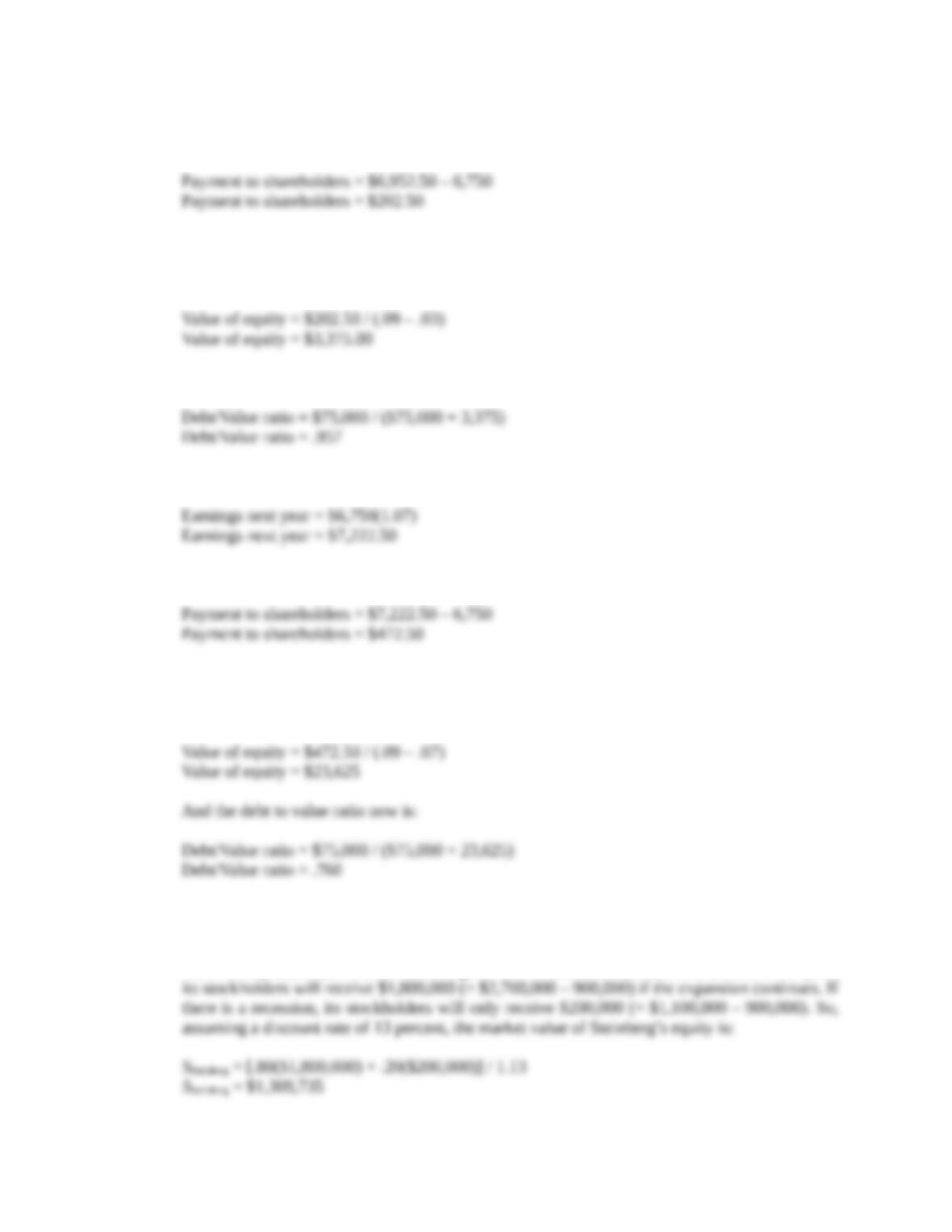
b. At a growth rate of 3 percent, the earnings next year will be:
4
CHAPTER 17 –
So, the cash available for shareholders is:
Since there is no risk, the required return for shareholders is the same as the required return on
the company’s debt. The payments to stockholders will increase at the growth rate of three
percent (a growing perpetuity), so the value of these payments today is:
And the debt to value ratio now is:
c. At a growth rate of 7 percent, the earnings next year will be:
So, the cash available for shareholders is:
Since there is no risk, the required return for shareholders is the same as the required return on
the company’s debt. The payments to stockholders will increase at the growth rate of seven
percent (a growing perpetuity), so the value of these payments today is:
6. a. The total value of a firm’s equity is the discounted expected cash flow to the firm’s
stockholders. If the expansion continues, each firm will generate earnings before interest and
taxes of $2,700,000. If there is a recession, each firm will generate earnings before interest and
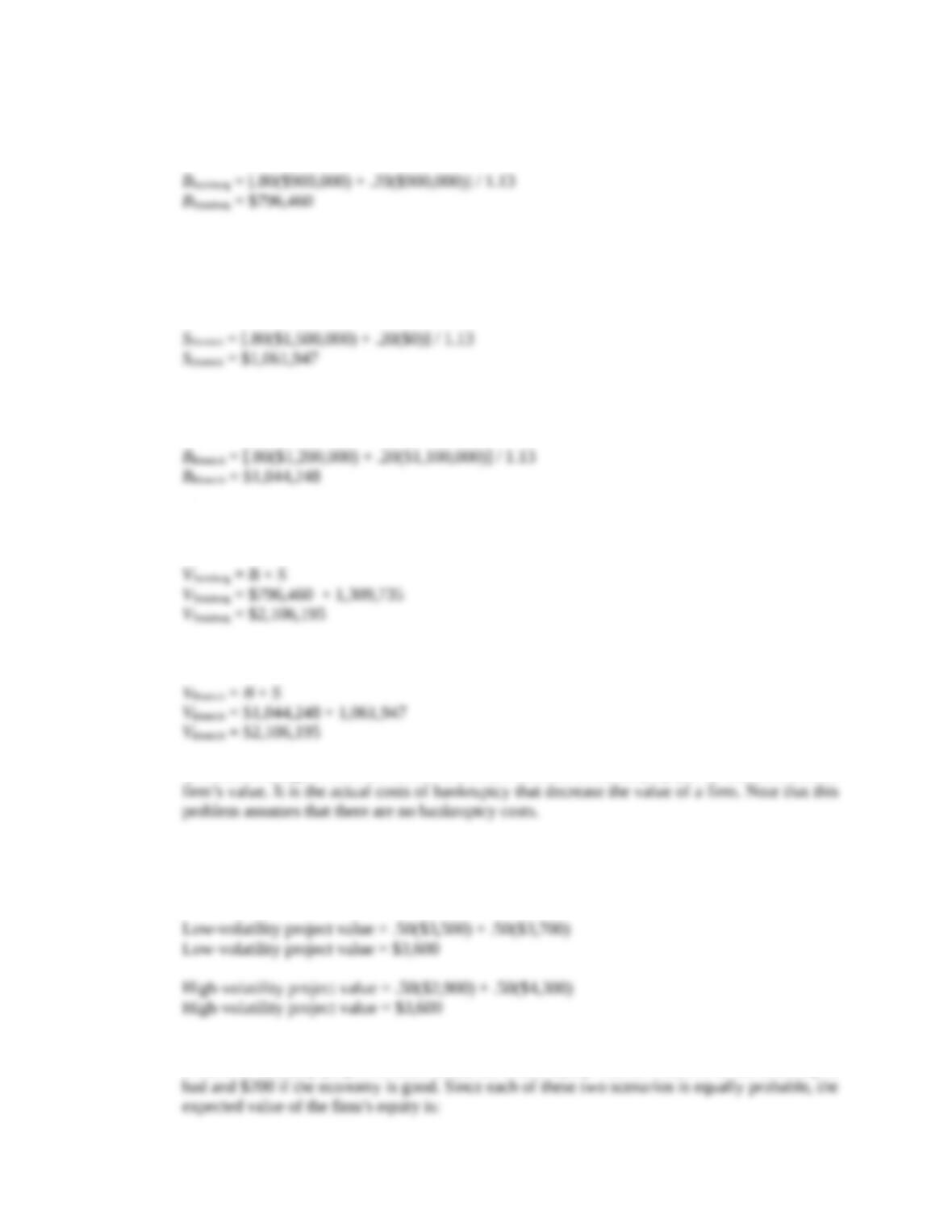
taxes of only $1,100,000. Since Steinberg owes its bondholders $900,000 at the end of the year,
5
CHAPTER 17 –
Steinberg’s bondholders will receive $900,000 whether there is a recession or a continuation of
the expansion. So, the market value of Steinberg’s debt is:
Since Dietrich owes its bondholders $1,200,000 at the end of the year, its stockholders will
receive $1,500,000 (= $2,700,000 – 1,200,000) if the expansion continues. If there is a
recession, its stockholders will receive nothing since the firm’s bondholders have a more senior
claim on all $1,100,000 of the firm’s earnings. So, the market value of Dietrich’s equity is:
Dietrich’s bondholders will receive $1,200,000 if the expansion continues and $1,100,000 if
there is a recession. So, the market value of Dietrich’s debt is:
b. The value of the company is the sum of the value of the firm’s debt and equity. So, the value of
Steinberg is:
And value of Dietrich is:
You should disagree with the CEO’s statement. The risk of bankruptcy per se does not affect a
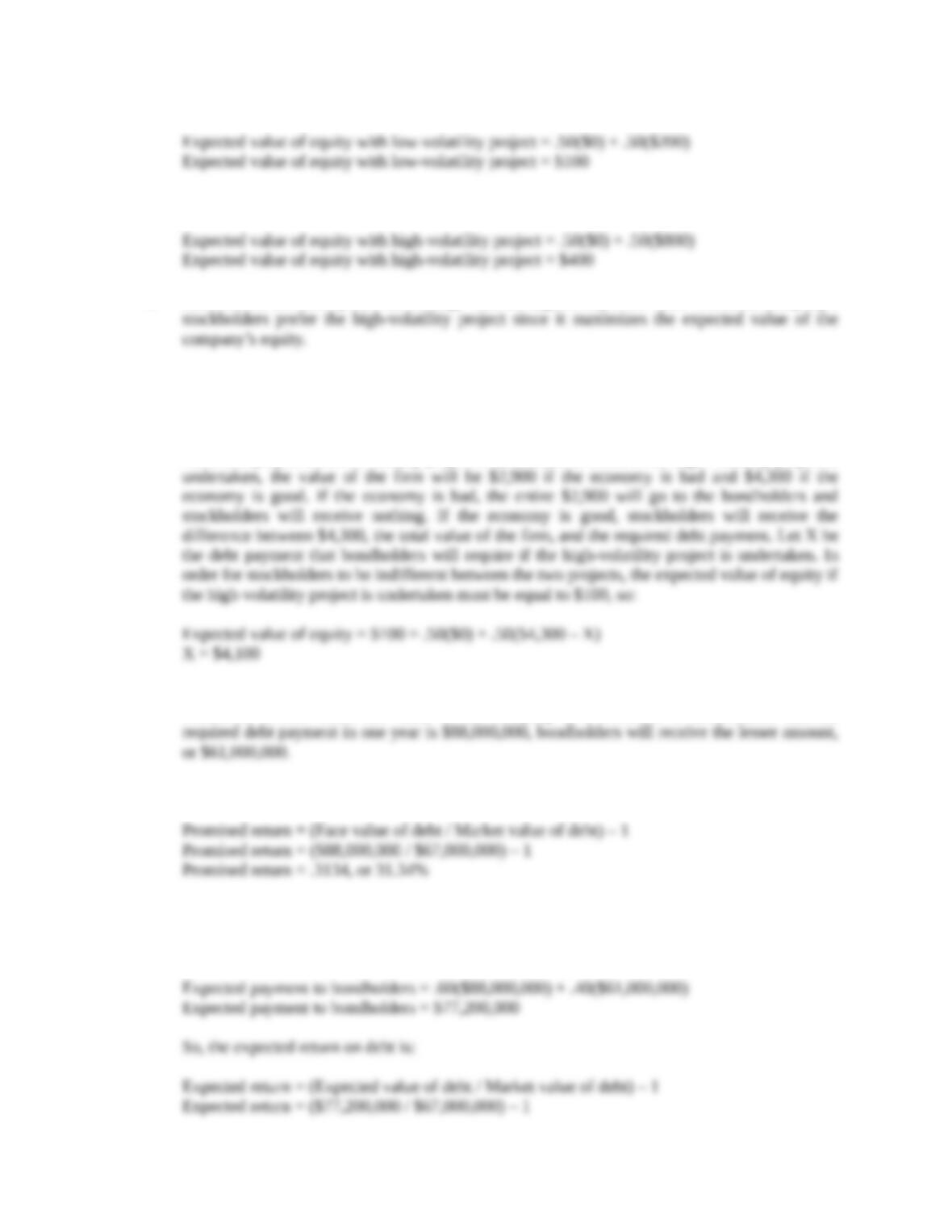
7. a. The expected value of each project is the sum of the probability of each state of the economy
times the value in that state of the economy. Since this is the only project for the company, the
company value will be the same as the project value, so:
b. The value of the equity is the residual value of the company after the bondholders are paid off.
If the low-volatility project is undertaken, the firm’s equity will be worth $0 if the economy is
6
CHAPTER 17 –
And the value of the company if the high-volatility project is undertaken will be:
c. Risk-neutral investors prefer the strategy with the highest expected value. Thus, the company’s
d. In order to make stockholders indifferent between the low-volatility project and the high-
volatility project, the bondholders will need to raise their required debt payment so that the
expected value of equity if the high-volatility project is undertaken is equal to the expected
value of equity if the low-volatility project is undertaken. As shown in part b, the expected
value of equity if the low-volatility project is undertaken is $100. If the high-volatility project is
8. a. The expected payoff to bondholders is the face value of debt or the value of the company,
whichever is less. Since the value of the company in a recession is $61,000,000 and the
b. The promised return on debt is:
c. In part a, we determined bondholders will receive $61,000,000 in a recession. In a boom, the
bondholders will receive the entire $88,000,000 promised payment since the market value of
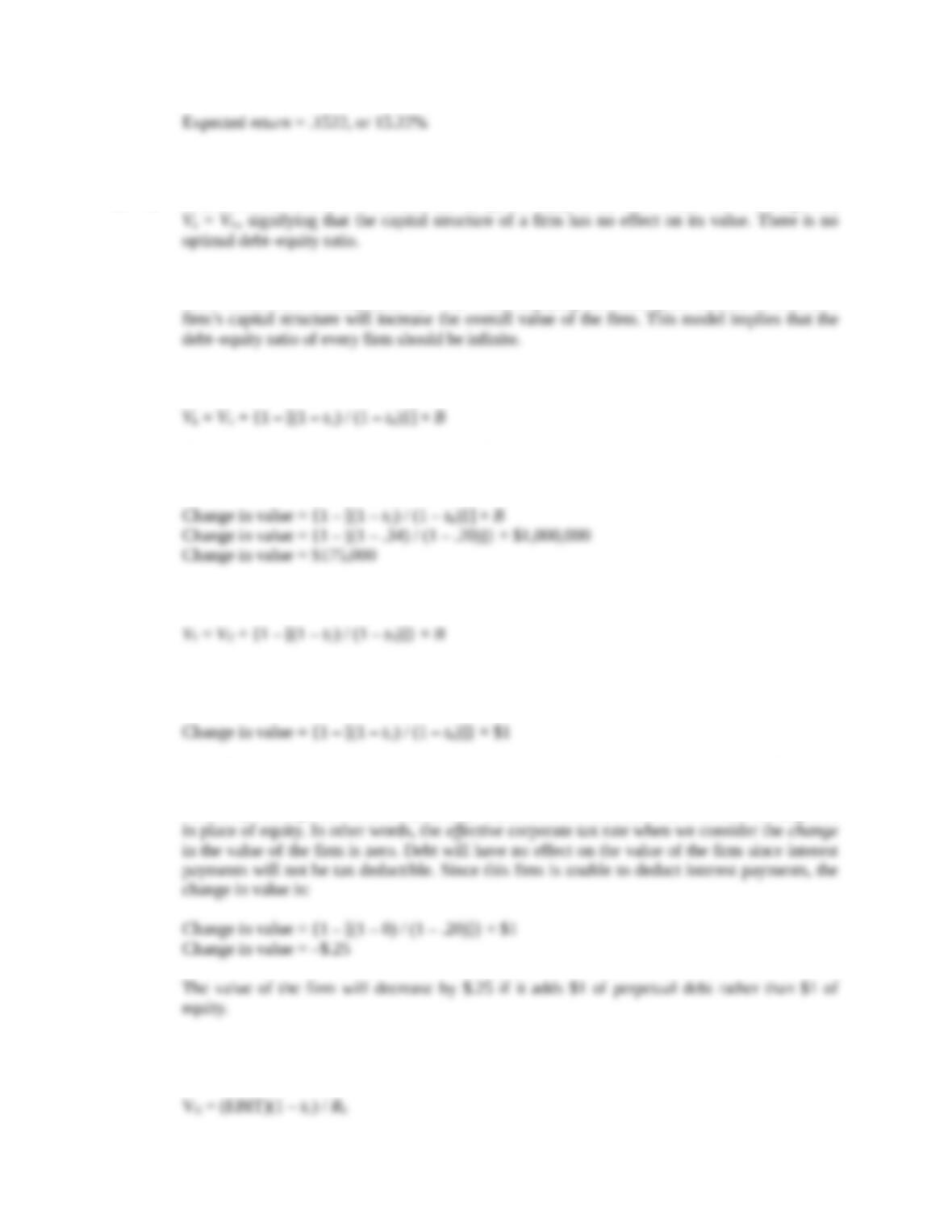
the company is greater than the payment. So, the expected value of debt is:
7
CHAPTER 17 –
Challenge
9. a. In their no tax model, MM assume that tC, tB, and C(B) are all zero. Under these assumptions,
b. In their model with corporate taxes, MM assume that tC > 0 and both tB and C(B) are equal to
zero. Under these assumptions, VL = VU + tCB, implying that raising the amount of debt in a
c. If the costs of financial distress are zero, the value of a levered firm equals:
Therefore, the change in the value of this all-equity firm that issues debt and uses the proceeds
to repurchase equity is:
d. If the costs of financial distress are zero, the value of a levered firm equals:
Therefore, the change in the value of an all-equity firm that issues $1 of perpetual debt instead
of $1 of perpetual equity is:
If the firm is not able to benefit from interest deductions, the firm’s taxable income will remain
the same regardless of the amount of debt in its capital structure, and no tax shield will be
created by issuing debt. Therefore, the firm will receive no tax benefit as a result of issuing debt
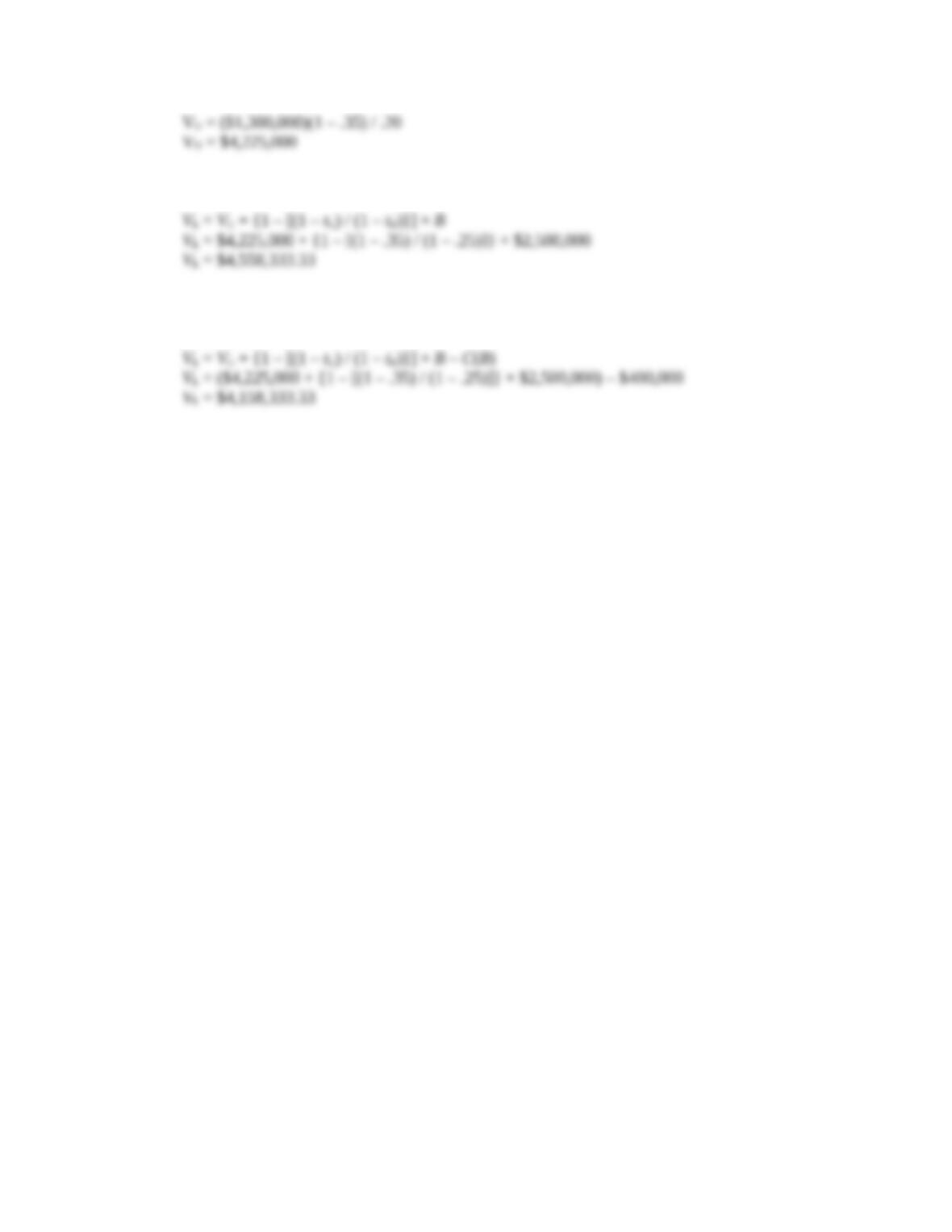
10. a. If the company decides to retire all of its debt, it will become an unlevered firm. The value of
an all-equity firm is the present value of the aftertax cash flow to equity holders, which will be:
8
CHAPTER 17 –
b. Since there are no bankruptcy costs, the value of the company as a levered firm is:
c. The bankruptcy costs would not affect the value of the unlevered firm since it could never be
forced into bankruptcy. So, the value of the levered firm with bankruptcy would be:
The company should choose the all-equity plan with this bankruptcy cost.
9