CHAPTER 15 B-
CHAPTER 15
LONG-TERM FINANCING: AN
INTRODUCTION
Answers to Concepts Review and Critical Thinking Questions
1. The indenture is a legal contract and can run into 100 pages or more. Bond features which would be
included are: the basic terms of the bond, the total amount of the bonds issued, description of the
2. The differences between preferred stock and debt are:
a. The dividends on preferred stock cannot be deducted as interest expense when determining
c. There is no legal obligation for firms to pay out preferred dividends as opposed to the obligated
payment of interest on bonds. Therefore, firms cannot be forced into default if a preferred stock
3. Some firms can benefit from issuing preferred stock. The reasons can be:
a. Public utilities can pass the tax disadvantage of issuing preferred stock on to their customers, so
b. Firms reporting losses to the IRS already don’t have positive income for any tax deductions, so
c. Firms that issue preferred stock can avoid the threat of bankruptcy that exists with debt
4. The return on non-convertible preferred stock is lower than the return on corporate bonds for two
reasons: 1) Corporate investors receive 70 percent tax deductibility on dividends if they hold the
stock. Therefore, they are willing to pay more for the stock; that lowers its return. 2) Issuing
Corporate investors are the primary holders of preferred stock since, unlike individual investors, they
5. The following table summarizes the main differences between debt and equity:
1
CHAPTER 15 B-
Debt Equity
Repayment is an obligation of the firm Yes No
Companies often issue hybrid securities because of the potential tax shield and the bankruptcy
6. There are two benefits. First, the company can take advantage of interest rate declines by calling in
an issue and replacing it with a lower coupon issue. Second, a company might wish to eliminate a
8. Preferred stock is similar to both debt and common equity. Preferred shareholders receive a stated
dividend only, and if the corporation is liquidated, preferred stockholders get a stated value.
9. A company has to issue more debt to replace the old debt that comes due if the company wants to
maintain its capital structure. There is also the possibility that the market value of a company
10. Internal financing comes from internally generated cash flows and does not require issuing
11. The three basic factors that affect the decision to issue external equity are: 1) The general economic
12. When a company has dual class stock, the difference in the share classes is the voting rights. Dual
share classes allow minority shareholders to retain control of the company even though they do not
13. The statement is true. In an efficient market, the callable bonds will be sold at a lower price than that
of the non-callable bonds, other things being equal. This is because the holder of callable bonds
effectively sold a call option to the bond issuer. Since the issuer holds the right to call the bonds, the
14. As interest rates fall, the call option on the callable bonds is more likely to be exercised by the bond
issuer. Since the non-callable bonds do not have such a drawback, the value of the bond will go up to
2
CHAPTER 15 B-
15. Sinking funds provide additional security to bonds. If a firm is experiencing financial difficulty, it is
likely to have trouble making its sinking fund payments. Thus, the sinking fund provides an early
warning system to the bondholders about the quality of the bonds. A drawback to sinking funds is
Solutions to Questions and Problems
NOTE: All end of chapter problems were solved using a spreadsheet. Many problems require multiple
steps. Due to space and readability constraints, when these intermediate steps are included in this
solutions manual, rounding may appear to have occurred. However, the final answer for each problem is
found without rounding during any step in the problem.
Basic
1. If the company uses straight voting, the board of directors is elected one at a time. You will need to
own one-half of the shares, plus one share, in order to guarantee enough votes to win the election.
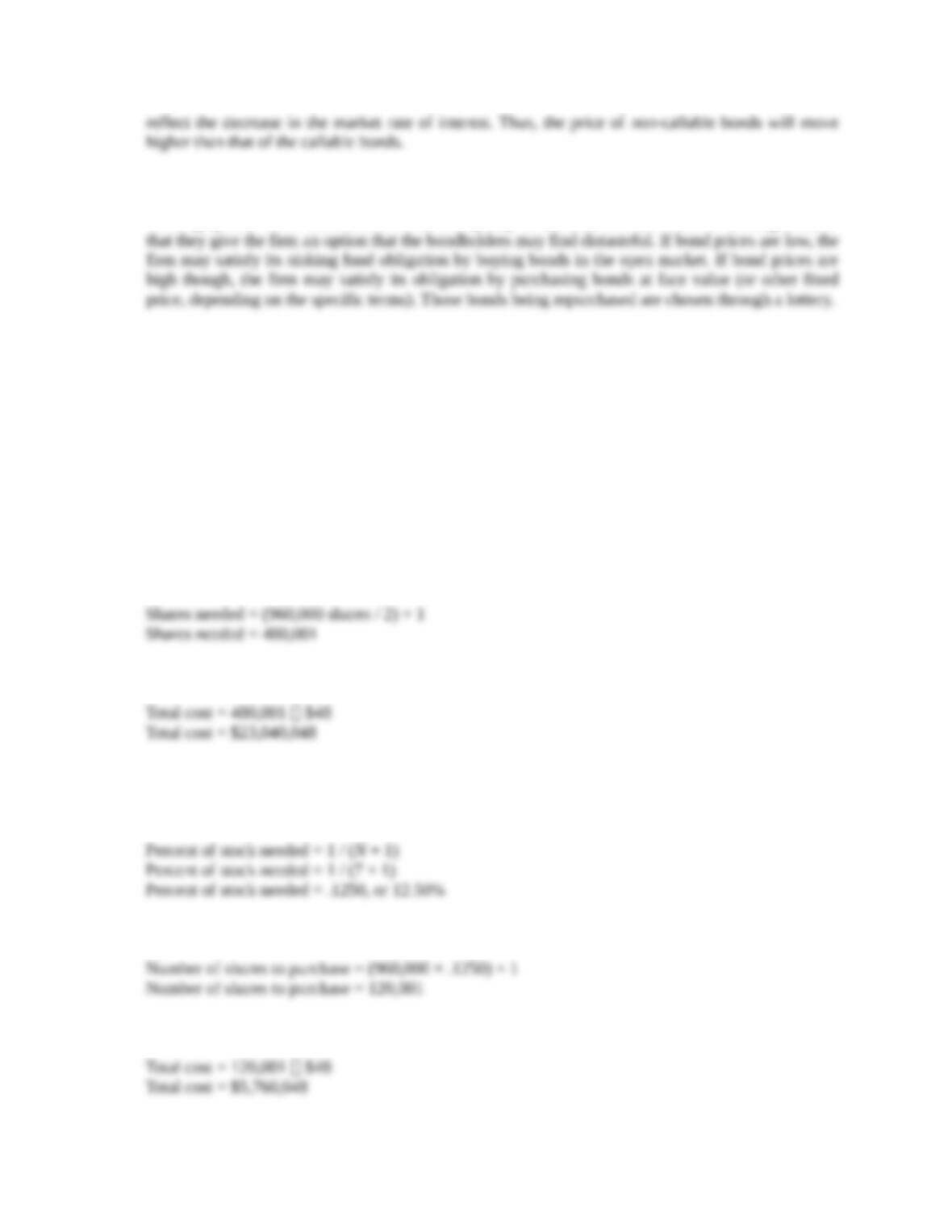
So, the number of shares needed to guarantee election under straight voting will be:
And the total cost to you will be the shares needed times the price per share, or:
If the company uses cumulative voting, the board of directors are all elected at once. You will need
1 / (N + 1) percent of the stock (plus one share) to guarantee election, where N is the number of seats
up for election. So, the percentage of the company’s stock you need is:
So, the number of shares you need to purchase is:
And the total cost to you will be the shares needed times the price per share, or:
3
CHAPTER 15 B-
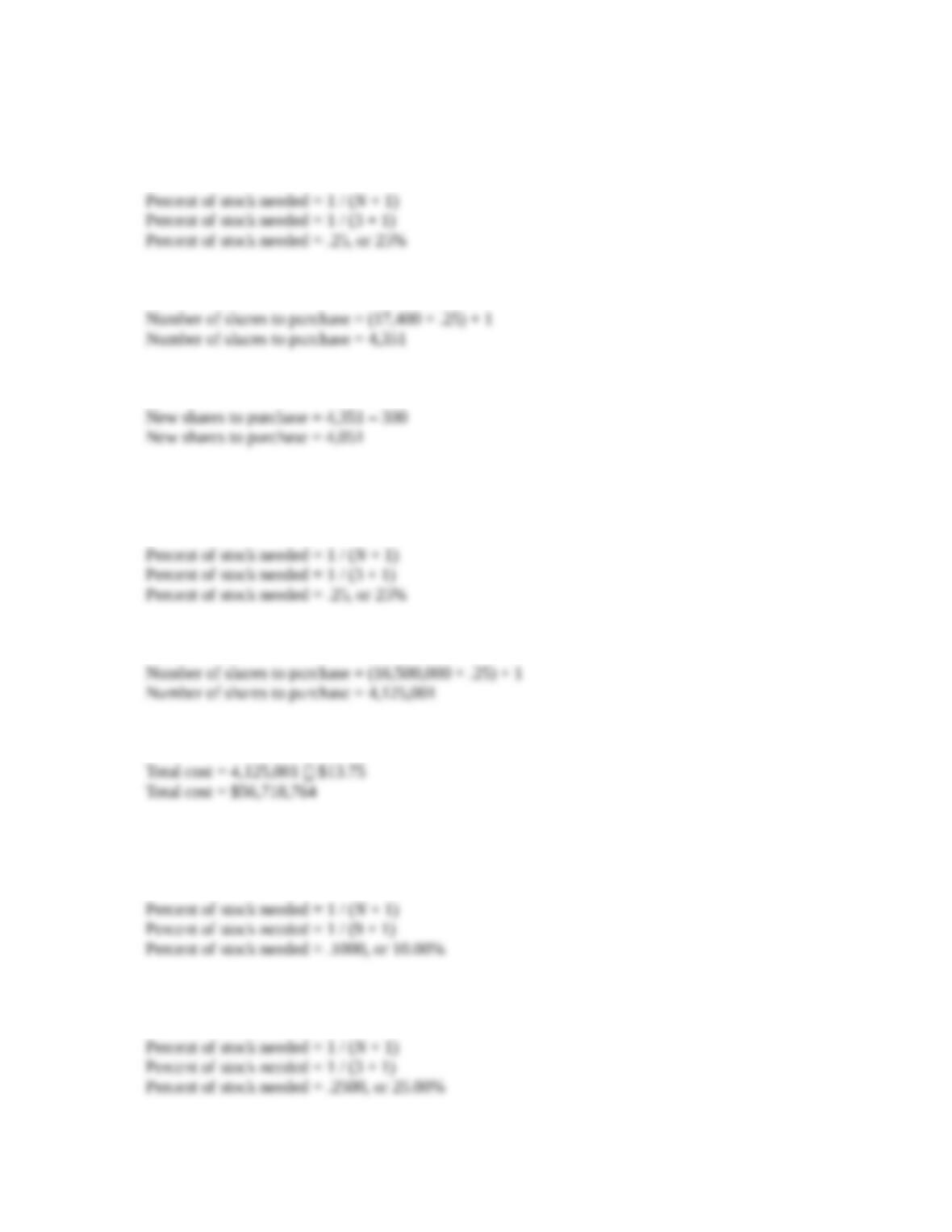
2. If the company uses cumulative voting, the directors are all elected at once. You will need 1/(N + 1)
percent of the stock (plus one share) to guarantee election, where N is the number of seats up for
election. So, the percentage of the company’s stock you need is:
So, the number of shares you need is:
So, the number of additional shares you need to purchase is:
3. If the company uses cumulative voting, the directors are all elected at once. You will need 1/(N + 1)
percent of the stock (plus one share) to guarantee election, where N is the number of seats up for
election. So, the percentage of the company’s stock you need is:
So, the number of shares you need to purchase is:
And the total cost will be the shares needed times the price per share, or:
4. Under cumulative voting, she will need 1 / (N + 1) percent of the stock (plus one share) to guarantee
election, where N is the number of seats up for election. So, the percentage of the company’s stock
she needs is:
Her nominee is guaranteed election. If the elections are staggered, the percentage of the company’s
stock needed is:
4
CHAPTER 15 B-
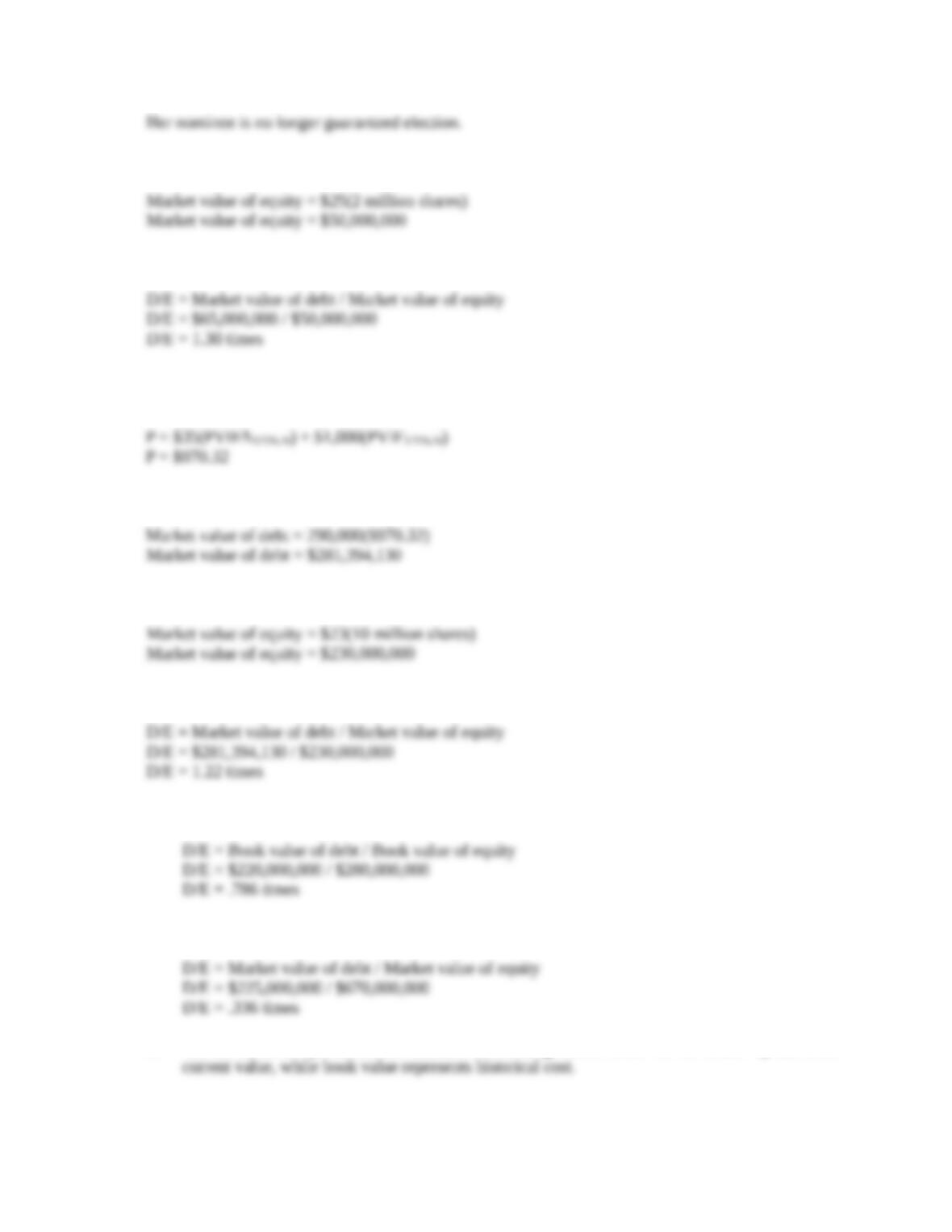
5. We first need to find the market value of equity, which is:
So, the debt–equity ratio is:
6. To find the price of the company’s bonds, we need to find the present value of the bond’s cash flows.
So, the price of the bond is:
So, the total market value of the company’s debt is:
And the market value of equity is:
So, the debt–equity ratio is:
7. a. The debt–equity ratio based on the book value of debt and equity is:
b. The debt–equity ratio based on the market value of debt and equity is:
c. Market values are preferred over book, or accounting, values since market values represent the
Intermediate
5
CHAPTER 15 B-
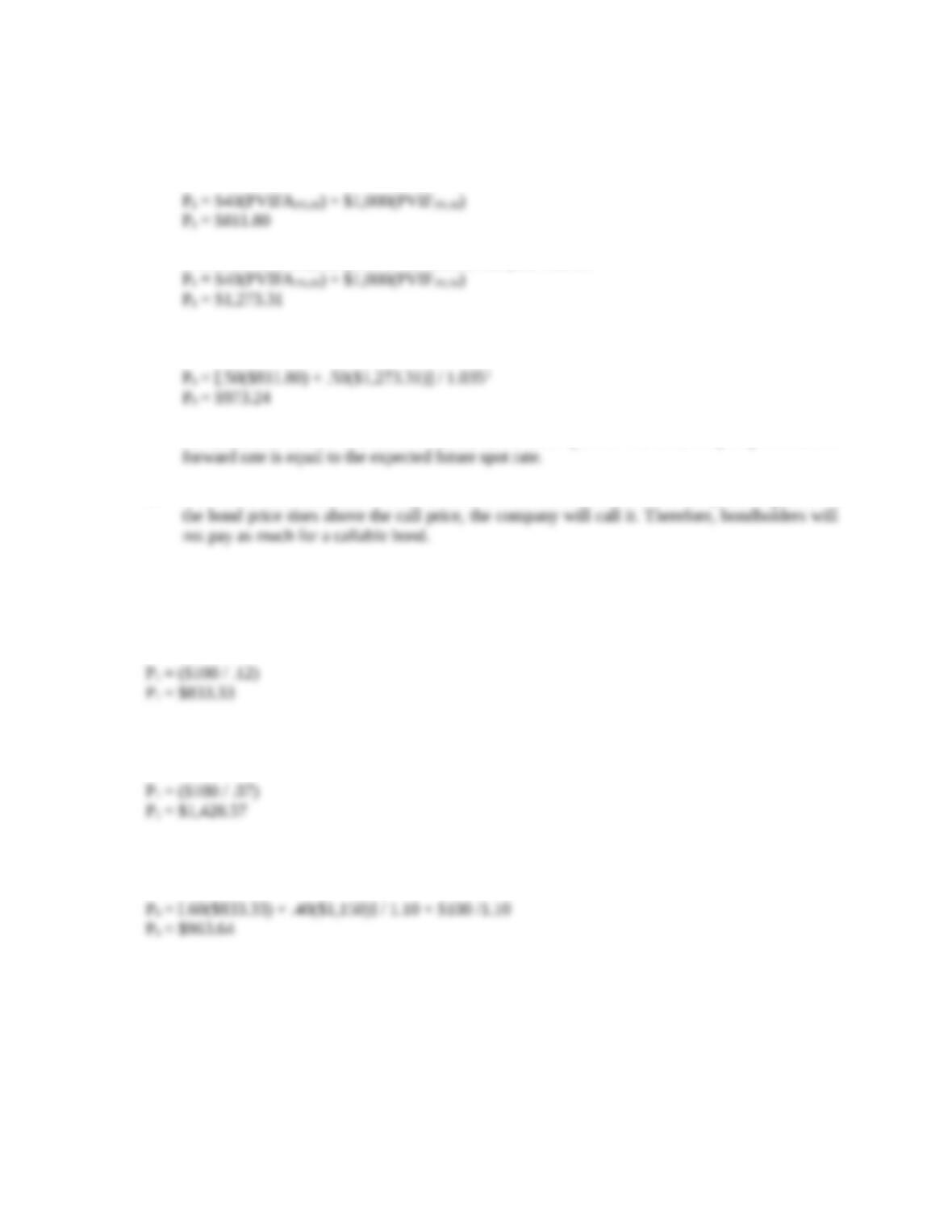
8. a. The price of the bond today is the present value of the expected price in one year. So, the price
of the bond in one year if interest rates increase will be:
If interest rates fall, the price if the bond in one year will be:
Now we can find the price of the bond today, which will be:
For students who have studied term structure, the assumption of risk-neutrality implies that the
b. If the bond is callable, then the bond value will be less than the amount computed in part a. If
9. The price of the bond today is the present value of the expected price in one year. The bond will be
called whenever the price of the bond is greater than the call price of $1,150. First, we need to find
the expected price in one year. If interest rates increase next year, the price of the bond will be the
present value of the perpetual interest payments, so:
This is lower than the call price, so the bond will not be called. If the interest rates fall next year, the
price of the bond will be:
This is greater than the call price, so the bond will be called. The present value of the expected value
of the bond price in one year, plus the coupon payment made in one year, is:
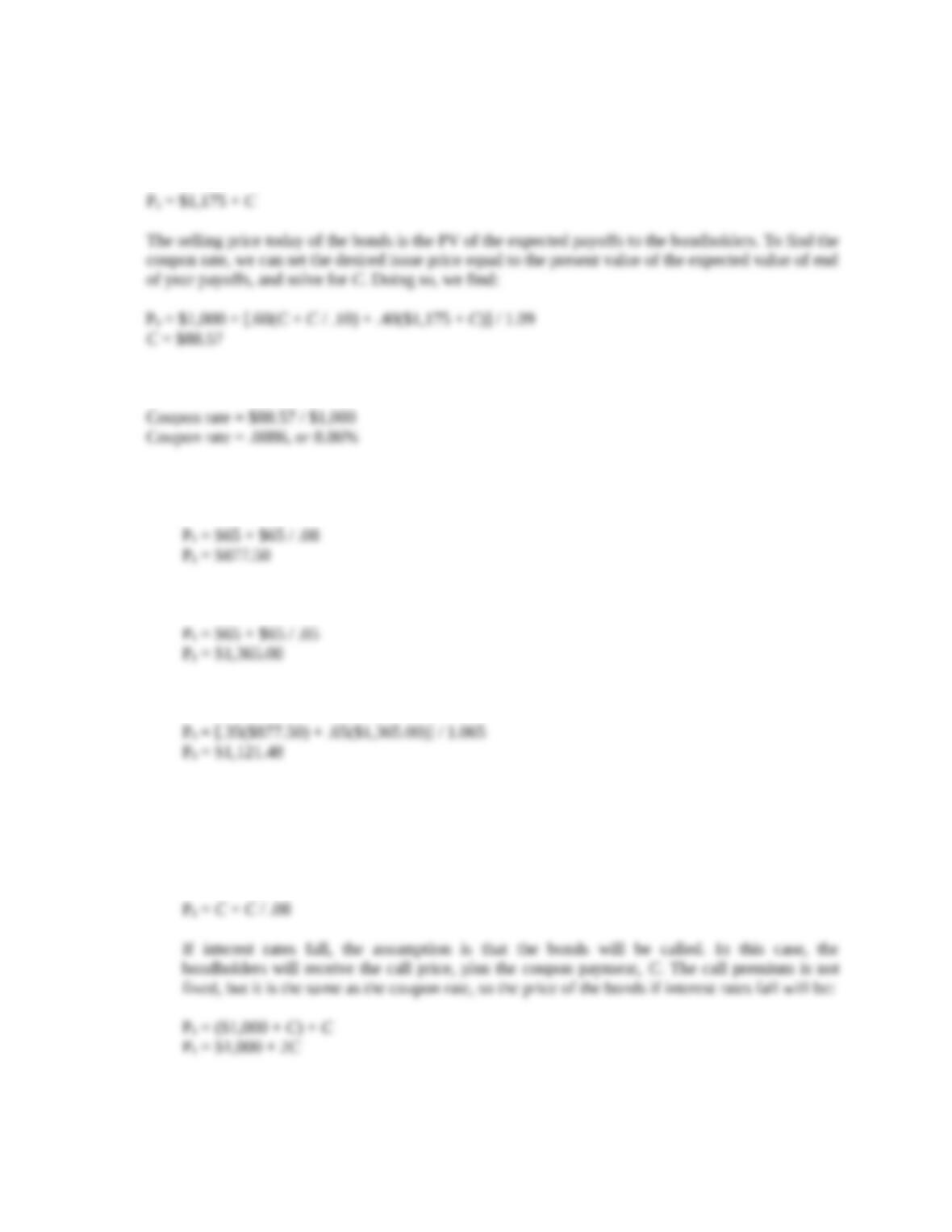
10. If interest rates rise, the price of the bonds will fall. If the price of the bonds is low, the company will
not call them. The firm would be foolish to pay the call price for something worth less than the call
price. In this case, the bondholders will receive the coupon payment, C, plus the present value of the
remaining payments. So, if interest rates rise, the price of the bonds in one year will be:
P1 = C + C / .10
6
CHAPTER 15 B-
If interest rates fall, the assumption is that the bonds will be called. In this case, the bondholders will
receive the call price, plus the coupon payment, C. So, the price of the bonds if interest rates fall will
be:
So the coupon rate necessary to sell the bonds at par value will be:
11. a. The price of the bond today is the present value of the expected price in one year. So, the price
of the bond in one year if interest rates increase will be:
If interest rates fall, the price of the bond in one year will be:
Now we can find the price of the bond today, which will be:
b. If interest rates rise, the price of the bonds will fall. If the price of the bonds is low, the
company will not call them. The firm would be foolish to pay the call price for something
worth less than the call price. In this case, the bondholders will receive the coupon payment, C,
plus the present value of the remaining payments. So, if interest rates rise, the price of the
bonds in one year will be:
7
CHAPTER 15 B-
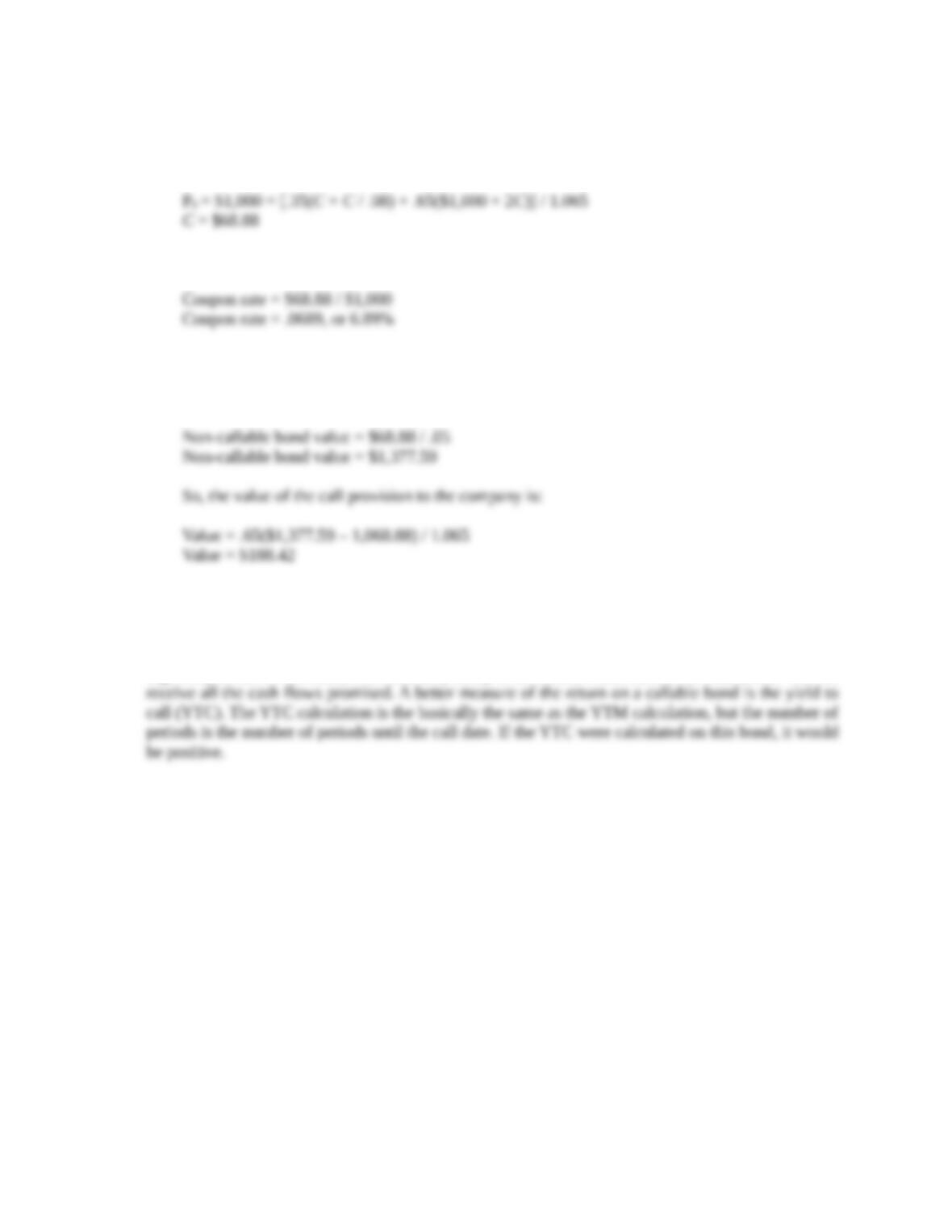
The selling price today of the bonds is the PV of the expected payoffs to the bondholders. To
find the coupon rate, we can set the desired issue price equal to the present value of the
expected value of end of year payoffs, and solve for C. Doing so, we find:
So the coupon rate necessary to sell the bonds at par value will be:
c. To the company, the value of the call provision will be given by the difference between the
value of an outstanding, non-callable bond and the call provision. So, the value of a non-
callable bond with the same coupon rate would be:
Challenge
12. In general, this is not likely to happen, although it can (and did). The reason that this bond has a
negative YTM is that it is a callable U.S. Treasury bond. Market participants know this. Given the
high coupon rate of the bond, it is extremely likely to be called, which means the bondholder will not
8