File: Chapter 09 – Foreign Currency Transactions and Hedging Foreign Exchange Risk
1. Pigskin Co., a U.S. corporation, sold inventory on credit to a British company on April 8, 2018.
Pigskin received payment of 35,000 British pounds on May 8, 2018. The exchange rate was £1 = $1.54
on April 8 and £1 = 1.43 on May 8. What amount of foreign exchange gain or loss should be recognized?
(round to the nearest dollar)
A) $10,500 loss
B) $10,500 gain
C) $ 1,750 loss
D) $ 3,850 loss
E) No gain or loss should be recognized.
2. For what amount should Sales be credited on December 1?
A) $ 5,500.
B) $16,949.
C) $18,182.
D) $17,241.
E) $16,667.
Copyright © 2017 McGraw-Hill Education. All rights reserved. No reproduction or distribution without the prior written consent of McGraw-Hill
Education.
Page 9-2
Feedback: December 1st Spot Rate $1.7241 × £10,000 = $17,241 Sales Revenue
[QUESTION]
REFER TO: 09-01
3. What amount of foreign exchange gain or loss should be recorded on December 31?
A) $300 gain.
B) $300 loss.
C) $ 0.
D) $941 loss.
E) $941 gain.
4. What amount of foreign exchange gain or loss should be recorded on January 30?
A) $1,516 gain.
B) $1,516 loss.
C) $575 loss.
D) $500 loss.
E) $500 gain.
Copyright © 2017 McGraw-Hill Education. All rights reserved. No reproduction or distribution without the prior written consent of McGraw-Hill
Education.
Page 9-3
REFER TO: 09-02
5. For what amount should Brisco’s Accounts Payable be credited on May 8?
A) $2,500,000.
B) $2,440,000.
C) $1,600,000.
D) $1,639,344.
E) $1,666,667.
6. How much Foreign Exchange Gain or Loss should Brisco record on May 31?
A) $2,520,000 gain.
B) $ 20,000 gain.
C) $ 20,000 loss.
D) $ 80,000 gain.
E) $ 80,000 loss.
7. How much US $ will it cost Brisco to finally pay the payable on June 7?
A) $1,666,667.
B) $2,440,000.
C) $2,520,000.
D) $2,500,000.
E) $2,400,000.
Copyright © 2017 McGraw-Hill Education. All rights reserved. No reproduction or distribution without the prior written consent of McGraw-Hill
Education.
Page 9-4
AACSB: Diversity
AICPA: BB Global
AICPA: FN Measurement
Feedback: $1.20 × FC 2,000,000 = FC 2,400,000 A/P
[QUESTION]
8. On June 1, CamCo received a signed agreement to sell inventory for ¥500,000. The sale would take
place in 90 days. CamCo immediately signed a 90-day forward contract to sell the yen as soon as they
are received. The spot rate on June 1 was ¥1 =$.004167, and the 90-day forward rate was ¥1 = $.00427.
At what amount would CamCo record the Forward Contract on June 1?
A) $2,083.
B) $ 0.
C) $2,110.
D) $2,532.
E) $2,135.
9. Belsen purchased inventory on December 1, 2017. Payment of 200,000 stickles was to be made in
sixty days. Also on December 1, Belsen signed a contract to purchase §200,000 in sixty days. The spot
rate was §1 = .35714, and the 60-day forward rate was §1 = $.38462. On December 31, the spot rate was
§1 = .34483 and the 30-day forward rate was §1 = .38168. Assume an annual interest rate of 12% and a
fair value hedge. The present value for one month at 12% is .9901.
In the journal entry to record the establishment of a forward exchange contract, at what amount should the
Forward Contract account be recorded on December 1?
A) $71,428.
B) $76,924.
C) $ 588.
D) $ 582.
E) $ 0, since there is no cost, there is no value for the contract at this date.
10. Meisner Co. ordered parts costing §100,000 for a foreign supplier on May 12 when the spot rate was
$.24 per stickle. A one-month forward contract was signed on that date to purchase §100,000 at a
forward rate of $.25 per stickle. On June 12, when the parts were received and payment was made, the
spot rate was $.28 per stickle. At what amount should inventory be reported?
A) $ 0.
B) $28,000.
C) $24,000.
D) $25,000.
E) $ 2,000.
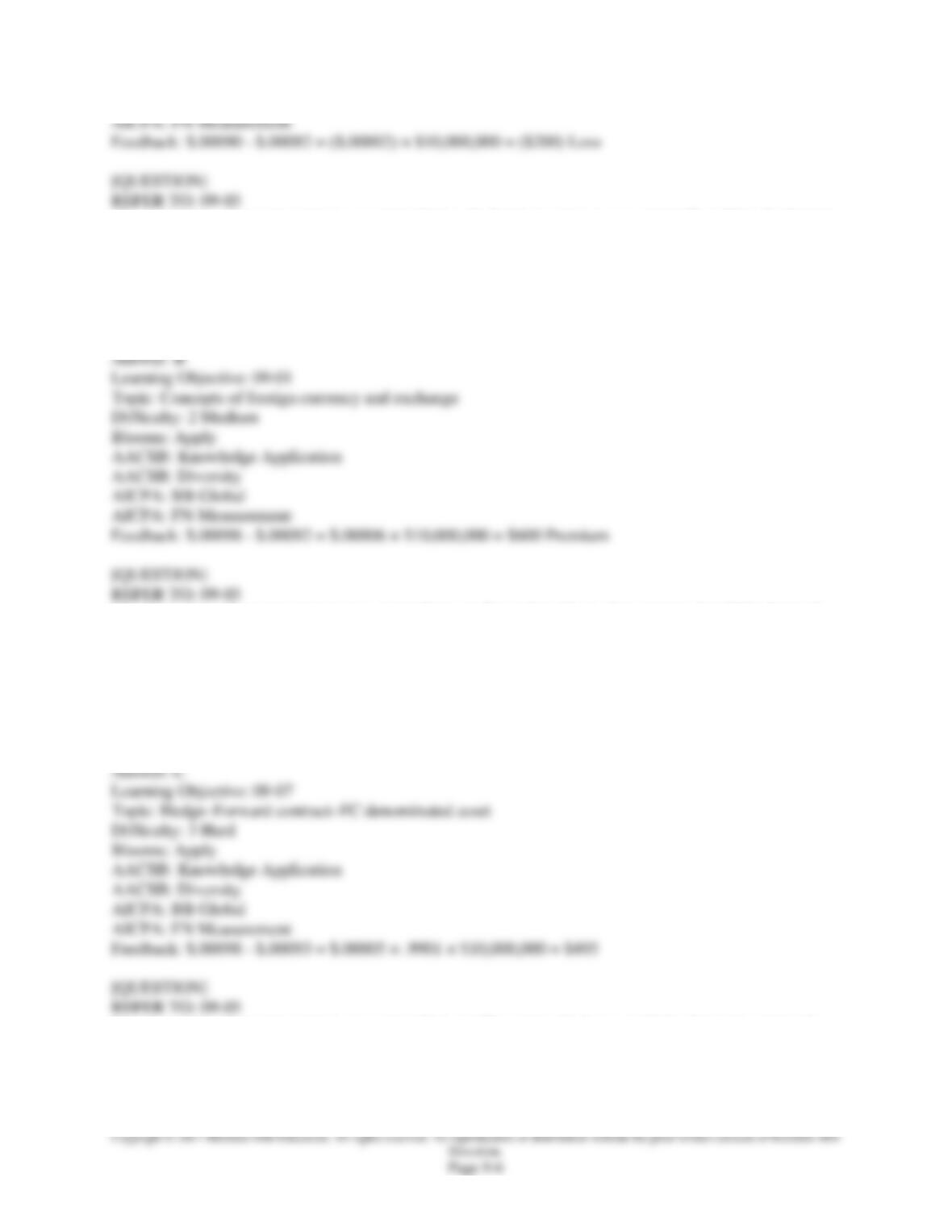
11. Assuming a forward contract was not entered into, what would be the net impact on Car Corp.’s 2018
income statement related to this transaction?
A) $ 500 (gain).
B) $ 500 (loss).
C) $ 200 (gain).
D) $ 200 (loss).
E) $ – 0 –
Copyright © 2017 McGraw-Hill Education. All rights reserved. No reproduction or distribution without the prior written consent of McGraw-Hill
Education.
Page 9-6
AICPA: FN Measurement
Feedback: $.00090 – $.00092 = ($.00002) × $10,000,000 = ($200) Loss
[QUESTION]
REFER TO: 09-03
12. Assuming a forward contract was entered into, the foreign currency was originally sold in the foreign
currency market on December 16, 2018 at a
A) Forward contract discount $ 600.
B) Forward contract premium $ 600.
C) Forward contract discount $ 980.
D) Forward discount premium $ 980.
E) There is no premium or discount because the fair value of the contract is zero.
13. Assuming a forward contract was entered into on December 16, at what amount should the forward
contract be recorded at December 31, 2018? Assume an annual interest rate of 12% and a fair value
hedge. The present value for one month at 12% is .9901.
A) $ 200.
B) $ 295.
C) $ 495.
D) $ 500.
E) $ 9,300.
14. Assuming a forward contract was entered into on December 16, how would the forward contract be
reflected on Car’s December 31, 2018 balance sheet?
A) Forward contract (asset).
B) Forward contract (liability).
C) Foreign currency (asset).
D) Foreign currency (liability).
E) Foreign exchange (liability)
15. Assuming a forward contract was entered into on December 16, what would be the net impact on Car
Corp.’s 2018 income statement related to this transaction? Assume an annual interest rate of 12% and a
fair value hedge. The present value for one half-month at 12% is .9950.
A) $ 700 (gain).
B) $ 700 (loss).
C) $ 995 (gain).
D) $ 300 (loss).
E) $ 298 (gain).
16. Assuming a forward contract was entered into on December 16, what would be the net impact on Car
Corp.’s 2019 income statement related to this transaction?
A) $ 500 (gain).
B) $ 500 (loss).
C) $ 300 (gain).
D) $ 300 (loss).
E) $0.
17. Mills Inc. had a receivable from a foreign customer that is due in the local currency of the customer
(stickles). On December 31, 2018, this receivable for §200,000 was correctly included in Mills’ balance
sheet at $132,000. When the receivable was collected on February 15, 2019, the U.S. dollar equivalent
was $144,000. In Mills’ 2019 consolidated income statement, how much should have been reported as a
foreign exchange gain?
A) $ 0.
B) $36,000.
C) $48,000.
D) $10,000.
E) $12,000.
18. A spot rate may be defined as
A) The price a foreign currency can be purchased or sold today.
B) The price today at which a foreign currency can be purchased or sold in the future.
C) The forecasted future value of a foreign currency.
D) The U.S. dollar value of a foreign currency.
E) The Euro value of a foreign currency.
19. The forward rate may be defined as
A) The price a foreign currency can be purchased or sold today.
B) The price today at which a foreign currency can be purchased or sold in the future.
C) The forecasted future value of a foreign currency.
D) The U.S. dollar value of a foreign currency.
E) The Euro value of a foreign currency.
20. Which statement is true regarding a foreign currency option?
A) A foreign currency option gives the holder the obligation to buy or sell foreign currency in the future.
B) A foreign currency option gives the holder the obligation to only sell foreign currency in the future.
C) A foreign currency option gives the holder the obligation to only buy foreign currency in the future.
D) A foreign currency option gives the holder the right but not the obligation to buy or sell foreign
currency in the future.
E) A foreign currency option gives the holder the obligation to buy or sell foreign currency in the future at
the spot rate on the future date.
21. A U.S. company sells merchandise to a foreign company denominated in U.S. dollars. Which of the
following statements is true?
A) If the foreign currency appreciates, a foreign exchange gain will result.
B) If the foreign currency depreciates, a foreign exchange gain will result.
C) No foreign exchange gain or loss will result.
D) If the foreign currency appreciates, a foreign exchange loss will result.
E) If the foreign currency depreciates, a foreign exchange loss will result.
Copyright © 2017 McGraw-Hill Education. All rights reserved. No reproduction or distribution without the prior written consent of McGraw-Hill
Education.
Page 9-10
[QUESTION]
22. A U.S. company sells merchandise to a foreign company denominated in the foreign currency. Which
of the following statements is true?
A) If the foreign currency appreciates, a foreign exchange gain will result.
B) If the foreign currency depreciates, a foreign exchange gain will result.
C) No foreign exchange gain or loss will result.
D) If the foreign currency appreciates, a foreign exchange loss will result.
E) Any gain or loss will be included in comprehensive income.
23. A U.S. company buys merchandise from a foreign company denominated in U.S. dollars. Which of
the following statements is true?
A) If the foreign currency appreciates, a foreign exchange gain will result.
B) If the foreign currency depreciates, a foreign exchange gain will result.
C) No foreign exchange gain or loss will result.
D) If the foreign currency appreciates, a foreign exchange loss will result.
E) Any gain or loss will be included in comprehensive income.
24. A U.S. company buys merchandise from a foreign company denominated in the foreign currency.
Which of the following statements is true?
A) If the foreign currency appreciates, a foreign exchange gain will result.
B) If the foreign currency depreciates, a foreign exchange loss will result.
C) No foreign exchange gain or loss will result.
D) If the foreign currency appreciates, a foreign exchange loss will result.
E) Any gain or loss will be included in comprehensive income.
Copyright © 2017 McGraw-Hill Education. All rights reserved. No reproduction or distribution without the prior written consent of McGraw-Hill
Education.
Page 9-11
AICPA: BB Global
AICPA: FN Measurement
[QUESTION]
25. U.S. GAAP provides guidance for hedges of all the following sources of foreign exchange risk except
A) Recognized foreign currency denominated assets and liabilities.
B) Unrecognized foreign currency firm commitments.
C) Forecasted foreign currency denominated transactions.
D) Net investment in foreign operations.
E) Deferred foreign currency gains and losses.
26. All of the following data may be needed to determine the fair value of a forward contract at any point
in time except
A) The forward rate when the forward contract was entered into.
B) The current forward rate for a contract that matures on the same date as the forward contract entered
into.
C) The future spot rate.
D) A discount rate.
E) The company’s incremental borrowing rate.
27. A forward contract may be used for which of the following?
1) A fair value hedge of an asset.
2) A cash flow hedge of an asset.
3) A fair value hedge of a liability.
4) A cash flow hedge of a liability.
A) 1 and 3
B) 2 and 4
C) 1 and 2
D) 1, 3, and 4
E) 1, 2, 3, and 4
Copyright © 2017 McGraw-Hill Education. All rights reserved. No reproduction or distribution without the prior written consent of McGraw-Hill
Education.
Page 9-12
Learning Objective: 09-04
Topic: Derivatives―Types and uses
Difficulty: 1 Easy
Blooms: Remember
AACSB: Reflective Thinking
AACSB: Diversity
AICPA: BB Global
AICPA: FN Measurement
[QUESTION]
28. A company has a discount on a forward contract for a foreign currency denominated asset. How is
the discount recognized over the life of the contract under fair value hedge accounting?
A) As a debit to discount expense.
B) As a debit to amortization expense.
C) As a debit to accumulated other comprehensive income.
D) As a debit impact on net income, as a result of the hedge.
E) As a decreases to sales.
29. Which of the following statements is true concerning hedge accounting?
A) Hedges of foreign currency firm commitments are used for future sales only.
B) Hedges of foreign currency firm commitments are used for future purchases only.
C) Hedges of foreign currency firm commitments are used for current sales or purchases.
D) Hedges of foreign currency firm commitments are used for future sales or purchases.
E) Hedges of foreign currency firm commitments are entered into for speculative purposes.
30. All of the following hedges are used for future purchase/sale transactions except
A) Forward contracts used as a fair value hedge of a firm commitment.
B) Options used as a fair value hedge of a firm commitment.
C) Option contract cash flow hedge of a forecasted transaction.
D) Forward contract cash flow hedges of a forecasted transaction.
E) Forward contracts used to hedge a foreign currency denominated liability.
Copyright © 2017 McGraw-Hill Education. All rights reserved. No reproduction or distribution without the prior written consent of McGraw-Hill
Education.
Page 9-13
Answer: E
Learning Objective: 09-04
Topic: Derivatives―Types and uses
Difficulty: 2 Medium
Blooms: Understand
AACSB: Reflective Thinking
AACSB: Diversity
AICPA: BB Global
AICPA: FN Measurement
REFERENCE: 09-04
On December 1, 2018, Keenan Company, a U.S. firm, sold merchandise to Velez Company of Canada for
150,000 Canadian dollars (CAD). Collection of the receivable is due on February 1, 2019. Keenan
purchased a foreign currency put option with a strike price of $.97 (U.S.) on December 1, 2018. This
foreign currency option is designated as a cash flow hedge. Relevant exchange rates follow:
Date
Spot Rate
Option Premium
December 1, 2018
$ .97
$ .05
December 31, 2018
$ .95
$ .04
February 1, 2019
$ .94
$ .03
[QUESTION]
REFER TO: 09-04
31. Compute the fair value of the foreign currency option at December 1, 2018.
A) $6,000.
B) $4,500.
C) $3,000.
D) $7,500.
E) $1,500.
32. Compute the fair value of the foreign currency option at December 31, 2018.
A) $6,000.
B) $4,500.
C) $3,000.
D) $7,500.
E) $1,500.
Copyright © 2017 McGraw-Hill Education. All rights reserved. No reproduction or distribution without the prior written consent of McGraw-Hill
Education.
Page 9-14
Topic: Hedge–Option–FC denominated asset
Difficulty: 2 Medium
Blooms: Apply
AACSB: Knowledge Application
AACSB: Diversity
AICPA: BB Global
AICPA: FN Measurement
Feedback: $.04 × C$150,000 = $6,000
[QUESTION]
REFER TO: 09-04
33. Compute the fair value of the foreign currency option at February 1, 2019.
A) $6,000.
B) $4,500.
C) $3,000.
D) $7,500.
E) $1,500.
34. Compute the U.S. dollars received on February 1, 2019.
A) $138,000.
B) $136,500.
C) $145,500.
D) $141,000
E) $142,500.
35. Which of the following approaches is used in the United States in accounting for foreign currency
transactions?
A) One-transaction perspective; defer foreign exchange gains and losses.
B) Two-transaction perspective; accrue foreign exchange gains and losses.
C) Three-transaction perspective; defer foreign exchange gains and losses.
D) One-transaction perspective; accrue foreign exchange gains and losses.
E) Two-transaction perspective; defer foreign exchange gains and losses.
36. When a U.S. company purchases parts from a foreign company, which of the following will result in
zero foreign exchange gain or loss?
A) The transaction is denominated in U.S. dollars.
B) The option strike price to sell foreign currency is less than the spot rate of the currency.
C) The option strike price to buy foreign currency is less than the spot rate of the currency.
D) The foreign currency appreciated in value relative to the U.S. dollar.
E) The foreign currency depreciated in value relative to the U.S. dollar.
37. Alpha, Inc., a U.S. company, had a receivable from a customer that was denominated in Mexican
pesos. On December 31, 2017, this receivable for 75,000 pesos was correctly included in Alpha’s balance
sheet at $8,000. The receivable was collected on March 2, 2018, when the U.S. equivalent was $6,900.
How much foreign exchange gain or loss will Alpha record on the income statement for the year ended
December 31, 2018?
A) $1,100 loss.
B) $1,100 gain.
C) $6,900 loss.
D) $6,900 gain.
E) $8,000 gain.
Copyright © 2017 McGraw-Hill Education. All rights reserved. No reproduction or distribution without the prior written consent of McGraw-Hill
Education.
Page 9-16
Feedback: $6,900 – $8,000 = ($1,100) Loss
REFERENCE: 09-05
On April 1, 2017, Shannon Company, a U.S. company, borrowed 100,000 euros from a foreign bank by
signing an interest-bearing note due April 1, 2018. The dollar value of the loan was as follows:
Date
Amount
April 1, 2017
$ 97,000
December 31, 2017
$ 103,000
April 1, 2018
$ 105,000
[QUESTION]
REFER TO: 09-05
38. How much foreign exchange gain or loss should be included in Shannon’s 2017 income statement?
A) $3,000 gain.
B) $3,000 loss.
C) $6,000 gain.
D) $6,000 loss.
E) $7,000 gain.
39. How much foreign exchange gain or loss should be included in Shannon’s 2018 income statement?
A) $1,000 gain.
B) $1,000 loss.
C) $2,000 gain.
D) $2,000 loss.
E) $8,000 loss.
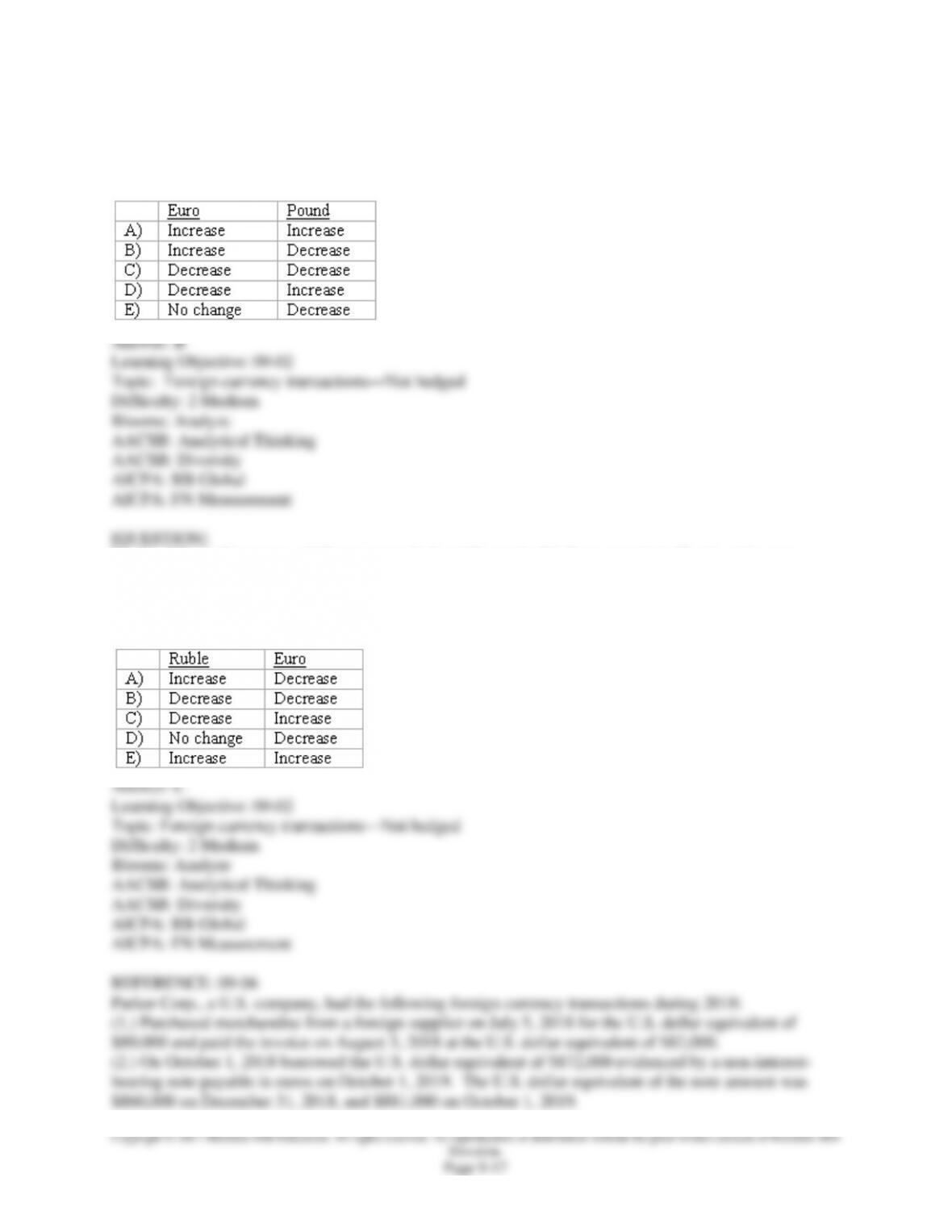
40. Angela, Inc., a U.S. company, had a euro receivable from exports to Spain and a British pound
payable resulting from imports from England. Angela recorded foreign exchange gain related to both its
euro receivable and pound payable. Did the foreign currencies increase or decrease in dollar value from
the date of the transaction to the settlement date?
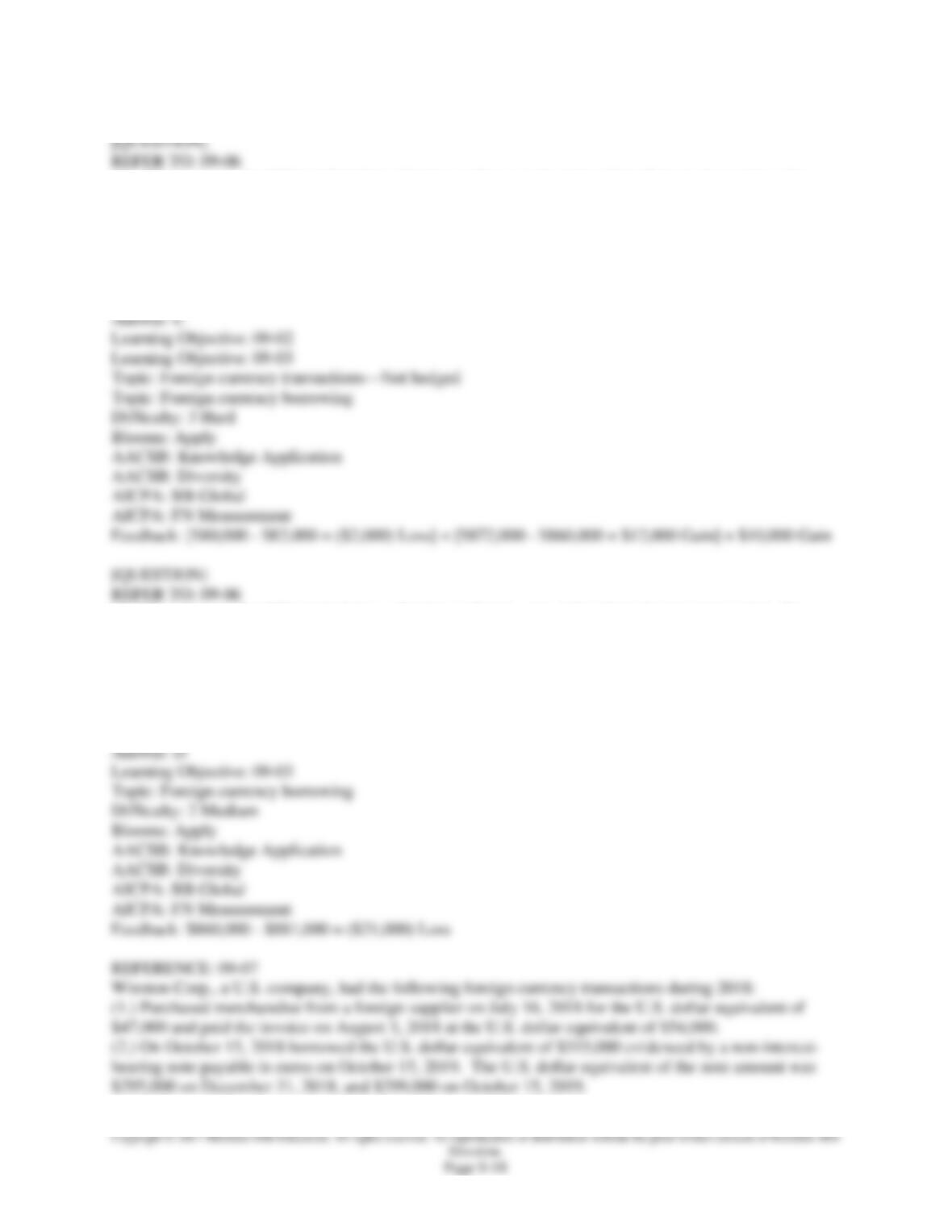
41. Frankfurter Company, a U.S. company, had a ruble receivable from exports to Russia and a euro
payable resulting from imports from Italy. Frankfurter recorded foreign exchange loss related to both its
ruble receivable and euro payable. Did the foreign currencies increase or decrease in dollar value from
the date of the transaction to the settlement date?
42. What amount should be included as a foreign exchange gain or loss from the two transactions for
2018?
A) $ 2,000 loss.
B) $ 2,000 gain.
C) $10,000 gain.
D) $14,000 loss.
E) $ 14,000 gain.
43. What amount should be included as a foreign exchange gain or loss from the two transactions for
2019?
A) $ 9,000 loss.
B) $ 9,000 gain.
C) $11,000 loss.
D) $21,000 loss.
E) $21,000 gain.
Copyright © 2017 McGraw-Hill Education. All rights reserved. No reproduction or distribution without the prior written consent of McGraw-Hill
Education.
Page 9-19
[QUESTION]
REFER TO: 09-07
44. What amount should be included as a foreign exchange gain or loss from the two transactions for
2018?
A) $ 9,000 loss.
B) $ 9,000 gain.
C) $11,000 loss.
D) $13,000 gain.
E) $ 14,000 gain.
45. What amount should be included as a foreign exchange gain or loss from the two transactions for
2019?
A) $1,000 loss.
B) $1,000 gain.
C) $2,000 loss.
D) $4,000 gain.
E) $4,000 loss.
46. Williams, Inc., a U.S. company, has a Japanese yen account receivable resulting from an export sale
on March 1 to a customer in Japan. The exporter signed a forward contract on March 1 to sell yen and
designated it as a cash flow hedge of a recognized receivable. The spot rate was $.0094, and the forward
rate was $.0095. Which of the following did the U.S. exporter report in net income?
A) Discount revenue.
B) Premium revenue.
C) Discount expense.
D) Premium expense.
E) Both discount revenue and premium expense.
47. Larson Company, a U.S. company, has an India rupee account receivable resulting from an export
sale on September 7 to a customer in India. Larson signed a forward contract on September 7 to sell
rupees and designated it as a cash flow hedge of a recognized receivable. The spot rate was $.023, and
the forward rate was $.021. Which of the following did the U.S. exporter report in net income?
A) Discount revenue.
B) Premium revenue.
C) Discount expense.
D) Premium expense.
E) Both discount revenue and premium expense.
48. Primo Inc., a U.S. company, ordered parts costing 100,000 rupee from a foreign supplier on July 7
when the spot rate was $.025 per rupee. A one-month forward contract was signed on that date to
purchase 100,000 rupee at a rate of $.027. The forward contract is properly designated as a fair value
hedge of the 100,000 rupee firm commitment. On August 7, when the parts are received, the spot rate is
$.028. At what amount should the payable be carried on Primo’s books?
A) $2,000.
B) $2,100.
C) $2,500.
D) $2,700.
E) $2,800.