deems it as having continued significance, then that segment should be disclosed currently to be
comparative to prior periods. 2) If an operating segment is to be disclosed in a current year and
was not separately disclosed in prior comparative years, then prior years must be restated to show
that segment comparatively with the current year.
92. Describe the test to determine whether a sufficient number of operating segments are
disclosed.
93. What approach is used, according to U.S. GAAP, for determining how a business is divided
into segments?
94. According to U.S. GAAP, what general information about an operating segment must be
disclosed?
Copyright © 2017 McGraw-Hill Education. All rights reserved. No reproduction or distribution without the prior written consent of
McGraw-Hill Education.
Page 8-38
Topic: Reportable segments―Disclosure requirements
Difficulty: 1 Easy
Blooms: Remember
AACSB: Reflective Thinking
AICPA: BB Critical Thinking
AICPA: FN Measurement
[QUESTION]
95. According to U.S. GAAP, how should general corporate costs be allocated to individual
segments to determine segment profit or loss?
96. List the five aggregation criteria that need to be considered by management in determining
whether business activities and environments are similar.
97. What is the purpose of the U.S. GAAP seventy-five percent requirement for industry segment
disclosure?
Copyright © 2017 McGraw-Hill Education. All rights reserved. No reproduction or distribution without the prior written consent of
McGraw-Hill Education.
Page 8-39
AACSB: Reflective Thinking
AACSB: Communication
AICPA: BB Critical Thinking
AICPA: FN Measurement
[QUESTION]
98. According to U.S. GAAP, what revenues and expenses included in segment profit or loss
need to be disclosed?
99. What related items need to be disclosed in regard to total segment assets?
100. Which items of information are required to be included in interim reports for each operating
segment?

Copyright © 2017 McGraw-Hill Education. All rights reserved. No reproduction or distribution without the prior written consent of
McGraw-Hill Education.
Page 8-40
AACSB: Communication
AICPA: BB Critical Thinking
AICPA: FN Measurement
[QUESTION]
101. Which two items of information must be reported for: (1) the domestic country; (2) all
foreign countries in which the enterprise derives revenues or holds assets; and (3) each foreign
country in which a material amount of revenues is earned?
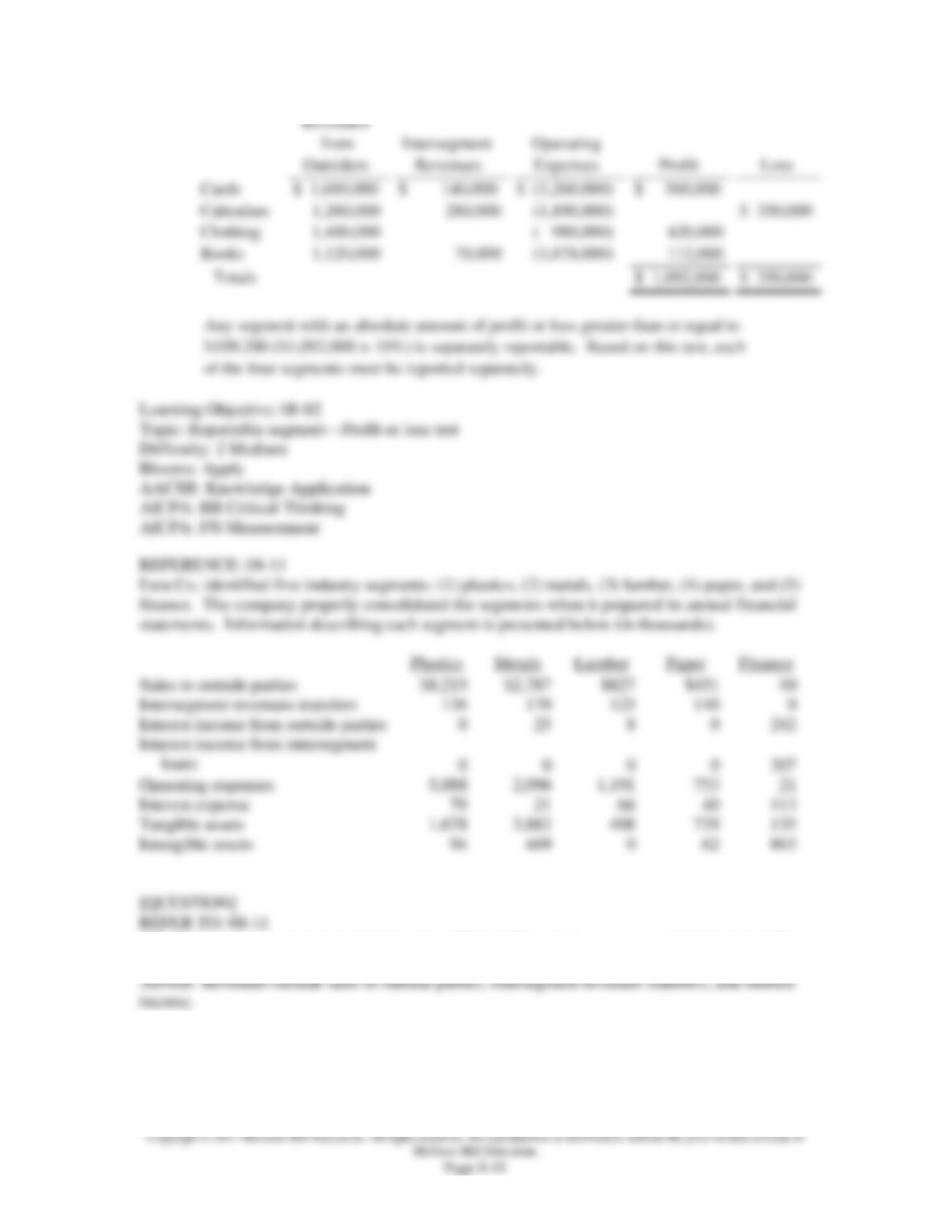
102. Burnside Corp. is organized into four operating segments. The following segment
information was generated by the internal reporting system in 2018:
Required:
1) What was the profit or loss of each of these segments?
2) Prepare the profit or loss test to determine which of these segments was separately reportable.
Revenues from
Intersegment
Operating
Outsiders
Revenues
Expenses
Cards
$ 1,680,000
$ 140,000
$ 1,260,000
Calendars
1,260,000
280,000
1,890,000
Clothing
1,400,000
—
980,000
Books
1,120,000
70,000
1,078,000
Copyright © 2017 McGraw-Hill Education. All rights reserved. No reproduction or distribution without the prior written consent of
McGraw-Hill Education.
Page 8-41
Learning Objective: 08-02
Topic: Reportable segment―Profit or loss test
Difficulty: 2 Medium
Blooms: Apply
AACSB: Knowledge Application
AICPA: BB Critical Thinking
AICPA: FN Measurement
REFERENCE: 08-11
Faru Co. identified five industry segments: (1) plastics, (2) metals, (3) lumber, (4) paper, and (5)
finance. The company properly consolidated the segments when it prepared its annual financial
statements. Information describing each segment is presented below (in thousands).
Plastics
Metals
Lumber
Paper
Finance
Sales to outside parties
$8,215
$2,787
$827
$451
$0
Intersegment revenues transfers
138
170
125
140
0
Interest income from outside parties
0
25
8
0
242
Interest income from intersegment
loans
0
0
0
0
207
Operating expenses
5,088
2,096
1,191
753
21
Interest expense
79
21
66
40
113
Tangible assets
1,678
3,882
408
729
135
Intangible assets
94
469
0
62
863
[QUESTION]
REFER TO: 08-11
103. Prepare the revenue test and determine which of these segments was separately reportable.
Revenues
from
Intersegment
Operating
Outsiders
Revenues
Expenses
Profit
Loss
Cards
$ 1,680,000
$ 140,000
$ (1,260,000)
$ 560,000
Calendars
1,260,000
280,000
(1,890,000)
$ 350,000
Clothing
1,400,000
( 980,000)
420,000
Books
1,120,000
70,000
(1,078,000)
112,000
Totals
$ 1,092,000
$ 350,000
Any segment with an absolute amount of profit or loss greater than or equal to
$109,200 ($1,092,000 × 10%) is separately reportable. Based on this test, each
of the four segments must be reported separately.
Reportable segment = at least $1,333.5 (in thousands) of revenues.
Learning Objective: 08-02
Topic: Reportable segment―Revenue test
Difficulty: 2 Medium
Blooms: Apply
AACSB: Knowledge Application
AICPA: BB Critical Thinking
AICPA: FN Measurement
[QUESTION]
REFER TO: 08-11
104. Prepare the profit or loss test and determine which of these segments was separately
reportable.
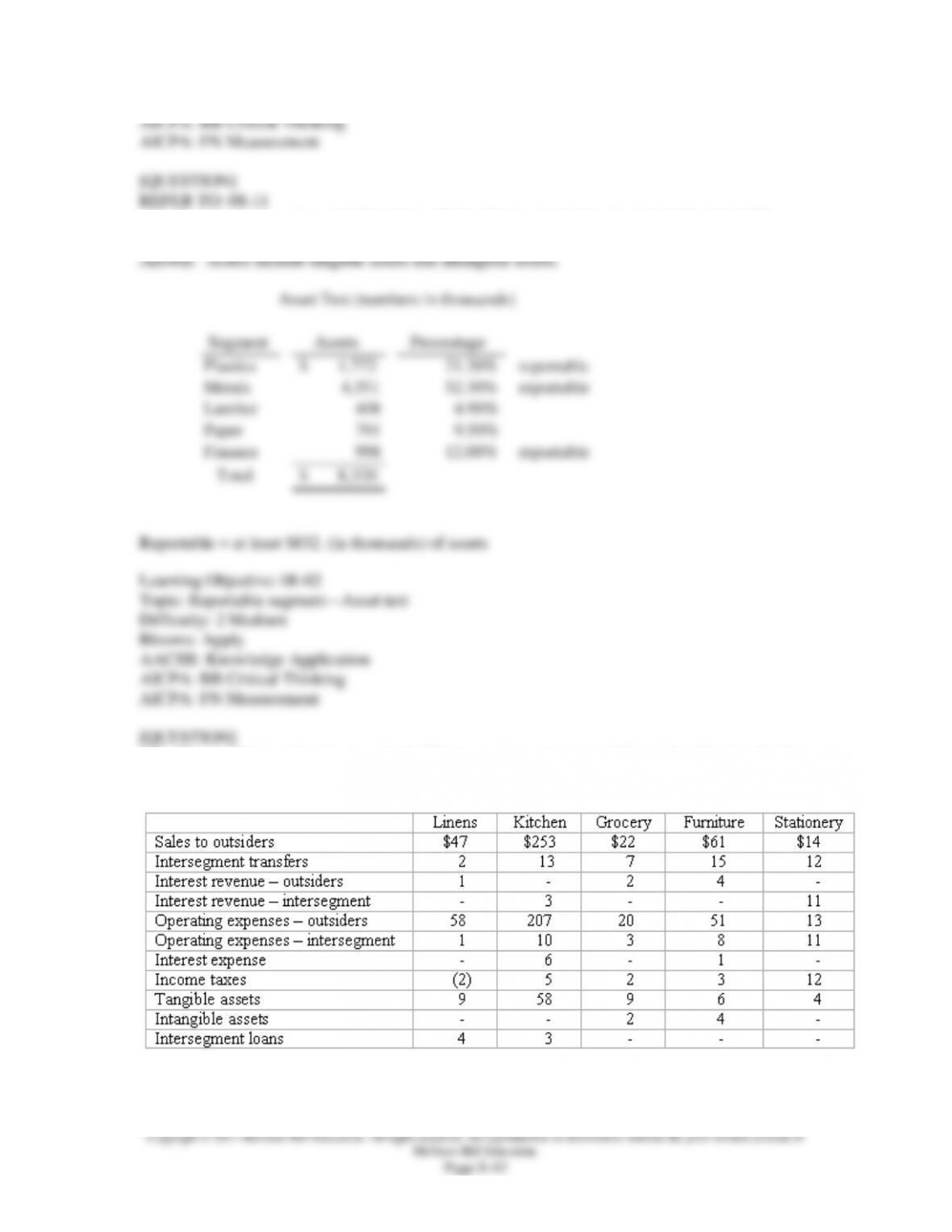
Revenue Test (numbers in thousands)
Segment
Revenues
Percentage
Plastics
$ 8,353
62.64%
reportable
Metals
2,982
22.36%
reportable
Lumber
960
7.20%
Paper
591
4.43%
Finance
449
3.37%
Total
$ 13,335
Profit or Loss Test (numbers in thousands)
Segment
Revenues
Expenses
Profit
Loss
Plastics
$ 8,353
$ 3,186
reportable
Metals
2,982
865
reportable
Lumber
960
$ 297
Paper
591
202
Finance
449
315
Total
$ 13,335
$ ( 9,468)
$ 4,366
$ 499
Copyright © 2017 McGraw-Hill Education. All rights reserved. No reproduction or distribution without the prior written consent of
McGraw-Hill Education.
Page 8-43
AICPA: BB Critical Thinking
AICPA: FN Measurement
[QUESTION]
REFER TO: 08-11
105. Prepare the asset test and determine which of these segments was separately reportable.
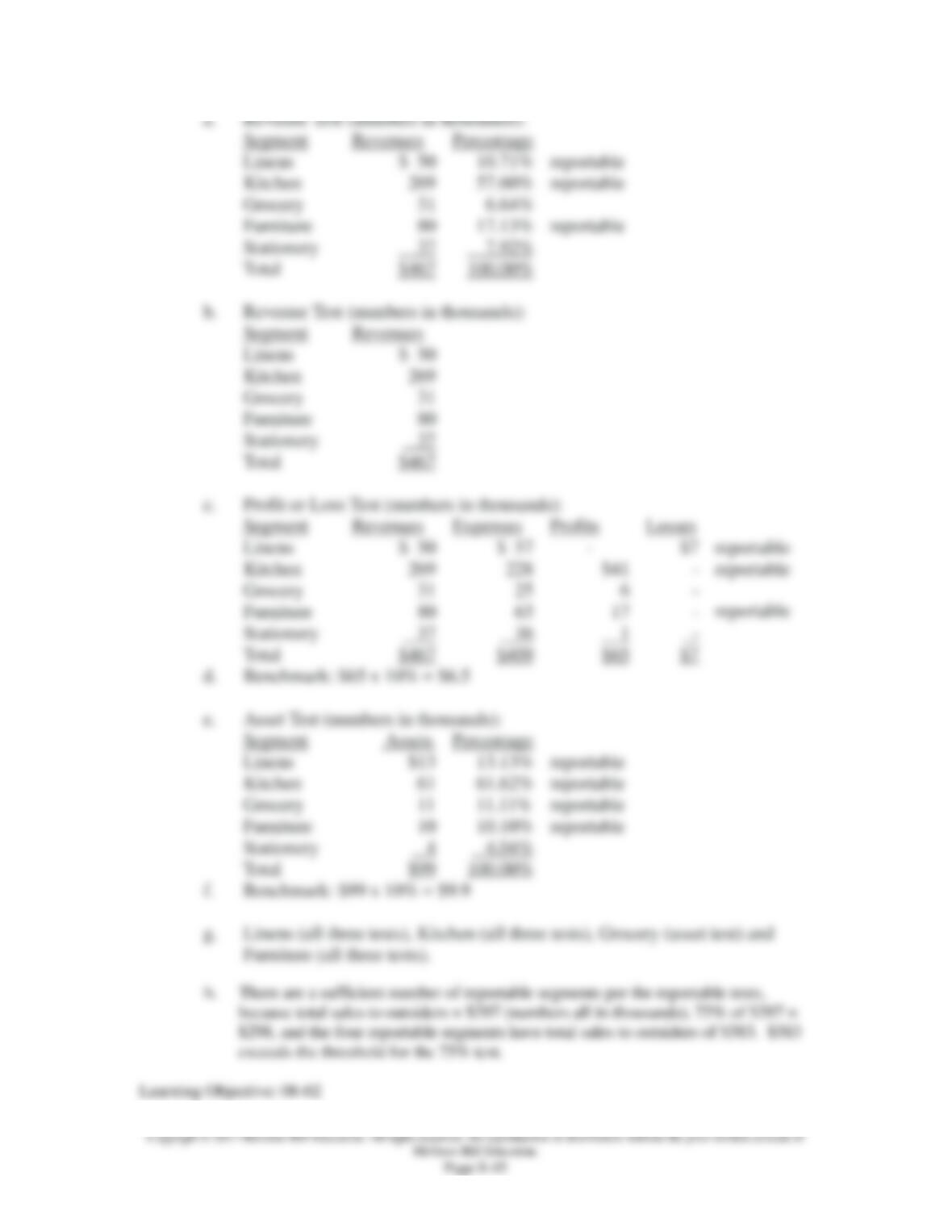
106. Blanton Corporation is comprised of five operating segments. Information about each of
these segments is as follows (in thousands):
Required:
A) Which operating segments are reportable under the revenue test?

B) What is the total amount of revenues in applying the revenue test?
C) Which operating segments are reportable under the profit or loss test?
D) In applying the profit or loss test, what is the minimum amount an operating segment must
have in order to meet the profit or loss test for a reportable segment?
E) Which operating segments are reportable under the asset test?
F) In applying the asset test, what is the minimum amount an operating segment must have in
order to meet the asset test for a reportable segment?
G) Which operating segments are reportable?
H) According to the test results for reportable segments, is there a sufficient number of reported
segments or should any additional segments also be disclosed? Explain the reason for your
conclusion.
Copyright © 2017 McGraw-Hill Education. All rights reserved. No reproduction or distribution without the prior written consent of
McGraw-Hill Education.
Page 8-45
a. Revenue Test (numbers in thousands):
Segment Revenues Percentage
Linens $ 50 10.71% reportable
Kitchen 269 57.60% reportable
Grocery 31 6.64%
Furniture 80 17.13% reportable
Stationery 37 7.92%
Total $467 100.00%
b. Revenue Test (numbers in thousands):
Segment Revenues
Linens $ 50
Kitchen 269
Grocery 31
Furniture 80
Stationery 37
Total $467
c. Profit or Loss Test (numbers in thousands):
Segment Revenues Expenses Profits Losses
Linens $ 50 $ 57 – $7 reportable
Kitchen 269 228 $41 – reportable
Grocery 31 25 6 –
Furniture 80 63 17 –
Stationery 37 36 1 –
reportable
Total $467 $409 $65 $7
d. Benchmark: $65 x 10% = $6.5
e. Asset Test (numbers in thousands):
Segment Assets Percentage
Linens $13 13.13% reportable
Kitchen 61 61.62% reportable
Grocery 11 11.11% reportable
Furniture 10 10.10% reportable
Stationery 4 4.04%
Total $99 100.00%
f. Benchmark: $99 x 10% = $9.9
g. Linens (all three tests), Kitchen (all three tests), Grocery (asset test) and
Furniture (all three tests).
h. There are a sufficient number of reportable segments per the reportable tests,
because total sales to outsiders = $397 (numbers all in thousands), 75% of $397 =
$298, and the four reportable segments have total sales to outsiders of $383. $383
exceeds the threshold for the 75% test.
Learning Objective: 08-02
Copyright © 2017 McGraw-Hill Education. All rights reserved. No reproduction or distribution without the prior written consent of
McGraw-Hill Education.
Page 8-46
Topic: Reportable segment―Any of the 10-percent tests
Topic: Reportable segments―Other guidelines
Difficulty: 3 Hard
Blooms: Apply
AACSB: Knowledge Application
AICPA: BB Critical Thinking
AICPA: FN Measurement
REFERENCE: 08-12
On February 23, 2018, Cleveland, Inc. paid property taxes of $300,000 for the calendar year
2018.
107. How much of this expense should be included in Cleveland’s net income for the quarter
ending March 31, 2018?
108. Prepare the journal entry for the payment of property taxes on February 23, 2018.
109. Assuming Gregor does not expect to replace the units of beginning inventory sold, what is
the amount of cost of goods sold for the quarter ended March 31, 2018?
110. Assuming Gregor expects to replace the units of beginning inventory sold before the year-
end at a cost of $41, what is the amount of cost of goods sold for the quarter ended March 31,
2018?
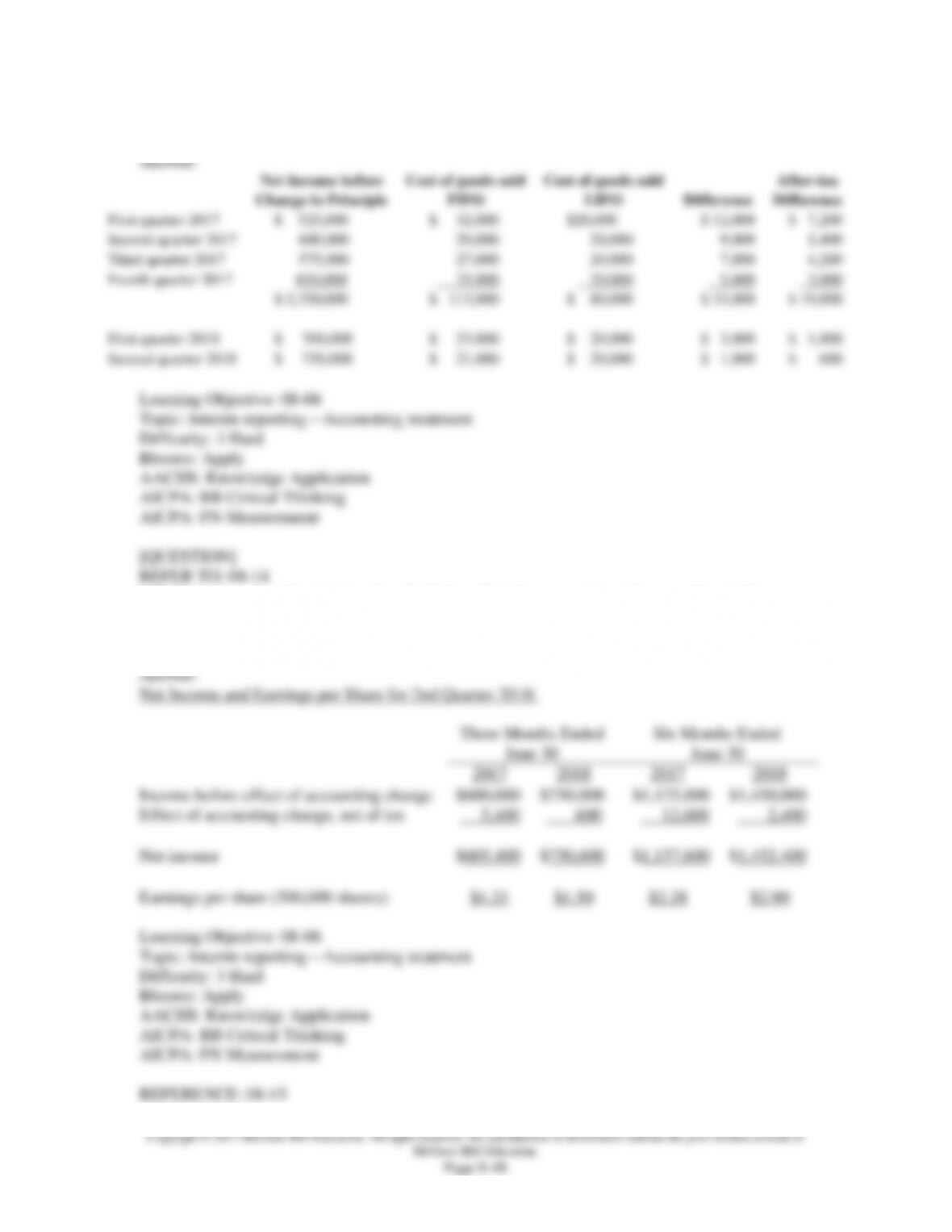
111. Compute the after-tax effect of Harrison’s change in inventory method.
112. Prepare a schedule showing the calculation of net income and earnings per share to be
reported by Harrison for the three-month period and the six-month period ended June 30, 2017
and 2018.
The following information for Urbanski Corporation relates to the three months ending June 30,
2018:
Units
Price per unit
Beginning inventory
11,000
$10
Purchases
75,000
$16
Sales
80,000
$25
Ending inventory
6,000
Urbanski uses the LIFO method to account for inventory, and expects at least 15,000 units to be
on hand in the ending inventory at year-end. Purchases made in the last six months are expected
to cost an average of $18 per unit.
[QUESTION]
REFER TO: 08-15
113. Compute cost of goods sold and gross profit for the quarter ending June 30, 2018.
114. Prepare the journal entries to reflect the sales and cost of goods sold, assuming Urbanski
expects to maintain 11,000 units in inventory at year-end.
Copyright © 2017 McGraw-Hill Education. All rights reserved. No reproduction or distribution without the prior written consent of
McGraw-Hill Education.
Page 8-50
Excess of replacement cost over historical cost for beginning inventory liquidated:
[($18 – $10) × 5,000 units]
Learning Objective: 08-06
Topic: Interim reporting―Accounting treatment
Difficulty: 2 Medium
Blooms: Analyze
AACSB: Analytical Thinking
AICPA: BB Critical Thinking
AICPA: FN Measurement
[QUESTION]
REFER TO: 08-15
115. Prepare the journal entries to reflect the sales and cost of goods sold, assuming Urbanski
does not expect to replace the liquidated inventory at year-end.
116. For each of the following situations, select the best answer concerning segment disclosures
of reportable segments.
A) Required to be disclosed by an operating segment, but not a geographical segment.
B) Required to be disclosed by a geographical segment, but not an operating segment.
C) Required to be disclosed by both an operating segment and a geographical segment.
D) Not required to be disclosed by either an operating segment or a geographical segment.
___ 1. Factors used to identify segments.
___ 2. Revenues from external customers.
___ 3. Types of products and services from which each segment derives its revenues.
___ 4. Names of major customers.
___ 5. Revenues from transactions with other segments.
___ 6. Interest revenue.
___ 7. Long-lived assets.
___ 8. Discontinued operations, when applicable.
___ 9. Income tax expense or benefit.
___10. Revenues for the domestic country.
___11. Cash flow information
Copyright © 2017 McGraw-Hill Education. All rights reserved. No reproduction or distribution without the prior written consent of
McGraw-Hill Education.
Page 8-51
Learning Objective: 08-03
Learning Objective: 08-04
Topic: Reportable segments―Other guidelines
Topic: Entitywide information―Geographic areas
Difficulty: 3 Hard
Blooms: Analyze
AACSB: Analytical Thinking
AICPA: BB Critical Thinking
AICPA: FN Measurement