C) Research and development expense.
D) Interest expense.
E) Interest income.
49. Which of the following must be disclosed by a geographic segment according U.S. GAAP?
A) Operating profit or loss.
B) Gross profit.
C) Total assets.
D) Revenues from external customers.
E) Revenues from internal customers.
50. Which of the following is not true for an operating segment according to U.S. GAAP?
A) Discrete financial information generated by the internal accounting system is available.
B) The segment recognizes revenues and incurs expenses.
C) The segment is regularly reviewed by a chief decision maker to assess performance decisions.
D) The segment is regularly reviewed by a chief decision maker to make resource allocations.
E) An organizational unit cannot be an operating segment if all of its operating transactions are
only with other segments of the organization.
51. Which of the following statements is true?
A) In determining reportable segments, two tests are applied and both must be met.
B) In determining reportable segments, three tests are applied and all three must be met.
C) In determining reportable segments, two tests are applied and only one must be met.
D) In determining reportable segments, three tests are applied and only one must be met.
E) In determining reportable segments, at least 80% of the revenues from external customers
must be reported.
52. According to U.S. GAAP, which of the following would be an acceptable grouping by a U.S.
company for presentation of information by geographic area?
A) France, Germany, All Other Countries.
B) United States, Europe, Canada.
C) United States, Africa, Europe, Asia.
D) United States, Canada, Mexico, Germany.
E) North America, Spain, All Other Countries.
53. Which of the following would be an acceptable grouping for a U.S. company to provide
information by geographic area?
A) United States, All Other Countries.
B) United States, Europe, Taiwan.
C) United States, Asia, Germany.
D) United States, Central America, Mexico, Germany.
E) South America, Spain, All Other Countries.
54. What information does U.S. GAAP require to be disclosed for a major customer?
A) The identity of the customer.
B) The operating segment reporting sales to the customer.
C) The geographic area of the customer.
D) The specific products or services purchased by the customer.
E) The length of time the customer has been a customer of the company.
55. How should revenues be recognized in interim periods?
A) In the same way as they are recognized on an annual basis.
B) On the cash basis.
C) On an annualized basis.
D) On a seasonal basis.
E) There are no revenues recognized in interim periods.
56. Which of the following is not correct regarding inventory procedures reported in an interim
financial statement?
A) LIFO liquidations a company expects to be replaced by year-end should be recorded in cost of
goods sold, quantified at expected replacement cost rather than original LIFO cost.
B) Lower-of-cost-or-net realizable value adjustments are not made for the interim period if they
are expected to reverse by the end of the year.
C) Variances in a standard costing system are reported at the end of the interim period unless they
are expected to be absorbed by year-end.
D) FIFO is remeasured using the LIFO method in an interim financial statement.
E) LIFO liquidations not expected to be replaced by the end of the year are reflected in cost of
goods sold at original LIFO cost.
Copyright © 2017 McGraw-Hill Education. All rights reserved. No reproduction or distribution without the prior written consent of
McGraw-Hill Education.
Page 8-24
units of beginning inventory sold at a cost of $45 per unit. Cement Company uses the LIFO
method to account for inventory.
[QUESTION]
REFER TO: 08-08
57. What is the correct journal entry to record cost of goods sold at the end of the first quarter?
A)
Inventory
8,000
Cost of Goods Sold
8,000
B)
Inventory
8,000
Excess of replacement cost over historical cost of LIFO liquidation
8,000
C)
Cost of goods sold
138,000
Inventory
130,000
Excess of replacement cost over historical cost of LIFO liquidation
8,000
D)
Cost of goods sold
130,000
Excess of replacement cost over historical cost of LIFO liquidation
8,000
Inventory
138,000
E)
No journal entry is required
58. The amount of gross profit for the first quarter is:
A) $ 83,000
B) $ 87,000
C) $ 90,000
D) $221,000
E) $250,000

59. Betsy Kirkland, Inc. incurred a flood loss during the first quarter of 2018 that is deemed both
unusual and not expected to recur again in the near future. The loss is considered immaterial to
the twelve-month period, but is material in amount relative to the first quarter. The proper
accounting treatment in the first quarter interim statement is to:
A) Ignore the loss.
B) Record the loss in the first quarter as an unusual loss, net of income taxes.
C) Record one-fourth of the loss in the first quarter as an unusual loss, net of income taxes.
D) Ignore the loss in the first quarter, and record it in the annual statement only.
E) Record the loss in the first quarter, but not as an unusual loss, and disclose the loss in a
separate note or in the income statement as a separate line item.
60. How should a change from one generally accepted accounting principle to another accepted
principle be handled in a third-quarter income statement?
A) Retrospectively restate the first-quarter income statement, net of income taxes, as though the
change occurred at the beginning of the year.
B) Postpone recording of the change to the annual income statement.
C) Record the change in the third-quarter income statement, net of income taxes.
D) Adjust financial statements for each prior period presented to reflect the effects of the new
principle in those reported periods.
E) These changes are prohibited by GAAP.
61. Which of the following is not a required disclosure in an interim financial report?
A) Sales or gross revenues.
B) Provision for income taxes.
C) Cash flow information.
D) Changes in accounting principles.
E) Seasonal revenues and expenses.

Copyright © 2017 McGraw-Hill Education. All rights reserved. No reproduction or distribution without the prior written consent of
McGraw-Hill Education.
Page 8-26
AICPA: BB Critical Thinking
AICPA: FN Measurement
[QUESTION]
62. Which of the following is not a required disclosure in an interim financial report?
A) Net income.
B) Earnings per share.
C) Gross profit.
D) Significant changes in estimates or provisions for income taxes.
E) Disposal of a component, net of income taxes.
63. Which of the following items of information are required to be included in interim reports for
each operating segment?
(I.) Revenues from external customers
(II.) Segment profit or loss
(III.) Reconciliation of segment profit or loss to the enterprise’s total income before taxes
(IV.) Intersegment revenues
A) I and III only.
B) I and II only.
C) I, II and III.
D) II and III only.
E) I, II, III, and IV.
64. If a company does not include a balance sheet and a statement of cash flows in an interim
report, then which of the following items must be separately disclosed for that interim period?
A) The balance of long-term liabilities.
B) Net working capital.
C) The change in stockholders’equity.
D) The balance of cash and cash equivalents.
E) The balance of retained earnings.

Copyright © 2017 McGraw-Hill Education. All rights reserved. No reproduction or distribution without the prior written consent of
McGraw-Hill Education.
Page 8-27
Difficulty: 2 Medium
Blooms: Understand
AACSB: Reflective Thinking
AICPA: BB Critical Thinking
AICPA: FN Measurement
[QUESTION]
65. What are the two approaches that can be followed in preparing interim reports?
A) Indiscrete and terminal.
B) Discrete and terminal.
C) Metric and integral.
D) Discrete and integral.
E) Discrete and metric.
66. Which of the following is reported for interim financial reports using the discrete approach?
A) Income tax expense.
B) Seasonal items.
C) Change in accounting principle.
D) Property tax expense.
E) Discontinued operations.
67. Which of the following is reported for interim financial reports using the integral approach?
A) Bonus expense.
B) Gross profit.
C) Cash basis accounting.
D) Current market value.
E) Segment level management compensation.

Copyright © 2017 McGraw-Hill Education. All rights reserved. No reproduction or distribution without the prior written consent of
McGraw-Hill Education.
Page 8-28
AICPA: BB Critical Thinking
AICPA: FN Measurement
[QUESTION]
68. How should seasonal revenues be reported in an interim report?
A) Disclose the seasonal nature of business operations, and include a pro forma report for the
next 12-month period.
B) Disclose the seasonal nature of business operations but do not include other reports
supplemental to the interim report.
C) Disclose the seasonal nature of business operations, and consider a report for the 12-month
period ended at the interim date to supplement the interim report.
D) The financial statements should be adjusted to reflect the assumption that no seasonal
revenues could be recognized.
E) Seasonal revenues have no particular reporting requirement.
69. According to authoritative accounting literature, which of the following are required to be
disclosed in interim reports?
A) Cash flows from investing activities.
B) Change in cash.
C) Total current liabilities.
D) Total assets.
E) Gross revenues.
70. All of the following are required to be reported in interim financial statements with respect to
material operating segments, except:
A) Segment assets.
B) Segment revenues from external customers.
C) Intersegment revenues.
D) Segment profit or loss.
E) Reconciliation of segment profit or loss to total income before taxes.

Copyright © 2017 McGraw-Hill Education. All rights reserved. No reproduction or distribution without the prior written consent of
McGraw-Hill Education.
Page 8-29
Difficulty: 2 Medium
Blooms: Remember
AACSB: Reflective Thinking
AICPA: BB Critical Thinking
AICPA: FN Measurement
[QUESTION]
71. What is the appropriate treatment in an interim financial report for inventory with a net
realizable value below cost?
A) The loss should always be recorded in the interim period in which net realizable value drops
below cost.
B) The loss should be recorded in the interim period in which net realizable value drops below
cost if the loss is considered temporary.
C) The loss should be recorded in the interim period in which net realizable value drops below
cost if the loss is considered permanent.
D) The loss should be ignored for interim reporting purposes.
E) There is no loss to report.
72. What is the appropriate treatment in an interim financial report for inventory that has cost
below net realizable value?
A) The loss should always be recorded in the interim period in which cost drops below net
realizable value.
B) The loss should be recorded in the interim period in which cost drops below net realizable
value if the loss is considered temporary.
C) The loss should be recorded in the interim period in which cost drops below net realizable
value if the loss is considered permanent.
D) The loss should be ignored for interim reporting purposes.
E) There is no loss to report.
73. What is the appropriate treatment in an interim financial report for a LIFO liquidation?
A) The LIFO liquidation is always ignored for interim reporting.
B) The LIFO liquidation should always be reflected in gross profit on an interim income
statement.

C) The LIFO liquidation should always result in replacement cost valuation of ending inventory
on the interim balance sheet and the interim income statement.
D) The LIFO liquidation should always result in replacement cost valuation of ending inventory
on the interim income statement but not the interim balance sheet.
E) The LIFO liquidation should only be reflected in gross profit on an interim income statement if
it is determined that it will not be replaced by year-end.
74. Which of the following statements is true regarding the reporting of revenues in an interim
report?
A) Revenues should be recognized on the income tax basis for interim reporting.
B) Revenues should be recognized in interim periods in the same way as they are on an annual
basis.
C) Projected losses on long-term contracts should be deferred to the annual report.
D) The percentage-of-completion method of reporting long-term construction projects is not an
acceptable method for interim reporting.
E) Revenues should be recognized on the cash basis of accounting for interim reporting.
75. What is the appropriate treatment in an interim financial report for variances arising from the
use of a standard costing system?
A) The variances are always ignored for interim reporting.
B) The variances should always be reflected in gross profit on an interim income statement.
C) The variances expected to be absorbed by year-end should not be reflected in the interim
statement.
D) The variances should always be reflected in the interim income statement but not the interim
balance sheet.
E) The variances should only be reflected in the interim balance sheet.
Copyright © 2017 McGraw-Hill Education. All rights reserved. No reproduction or distribution without the prior written consent of
McGraw-Hill Education.
Page 8-31
AICPA: FN Measurement
[QUESTION]
76. Which of the following costs require similar treatment to Property Tax Expense in an interim
financial report?
1) Annual major repairs.
2) Advertising expense.
3) Bonus expense, if estimable.
4) Quantity discounts based on annual sales.
A) 1 and 2
B) 1, 2, and 3
C) 1, 2, and 4
D) 2, 3, and 4
E) 1, 2, 3, and 4
77. How should discontinued operations be reported in an interim report?
A) Include in the gain or loss section of the interim report and include the tax with all other
income tax.
B) Include as discontinued operations, net of tax, if the component of the business is classified as
held-for-sale or is discontinued in the interim period.
C) Include net of the tax estimated specifically for the discontinued operations.
D) Include with other operations in the interim period but include the amount net of its specific
tax.
E) Include with other operations in interim periods until the annual financial statement is
prepared.
Copyright © 2017 McGraw-Hill Education. All rights reserved. No reproduction or distribution without the prior written consent of
McGraw-Hill Education.
Page 8-32
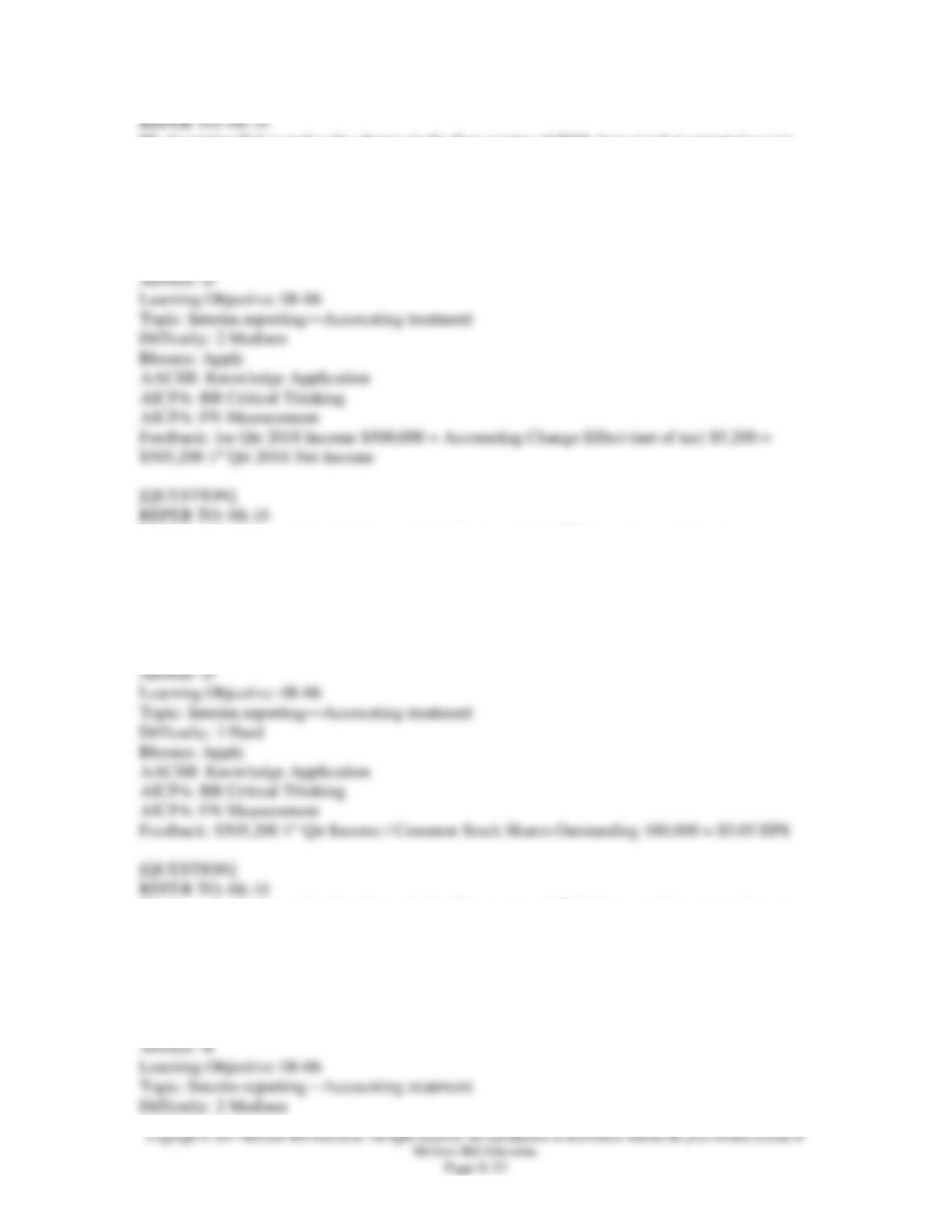
REFER TO: 08-09
78. How much income tax expense is recognized in the first quarter of 2018?
A) $ 0.
B) $ 26,250.
C) $ 96,000.
D) $105,000.
E) $112,000.
79. How much income tax expense is recognized in the second quarter of 2018?
A) $103,000.
B) $104,000.
C) $112,000.
D) $122,500.
E) $208,000.
Copyright © 2017 McGraw-Hill Education. All rights reserved. No reproduction or distribution without the prior written consent of
McGraw-Hill Education.
Page 8-33
REFER TO: 08-10
80. Assuming Baker makes the change in the first quarter of 2018, how much is reported as net
income for the first quarter of 2018?
A) $492,000.
B) $494,800.
C) $500,000.
D) $505,200.
E) $527,950.
81. Assuming Baker makes the change in the first quarter of 2018, compute net income per
common share.
A) $4.92.
B) $4.95.
C) $5.00.
D) $5.05.
E) $5.28.
82. Assuming Baker makes the change in the first quarter of 2017, how much is reported as net
income for the first quarter of 2017?
A) $300,000.
B) $322,750.
C) $335,000.
D) $265,000.
E) $277,250.
Copyright © 2017 McGraw-Hill Education. All rights reserved. No reproduction or distribution without the prior written consent of
McGraw-Hill Education.
Page 8-34
Blooms: Apply
AACSB: Knowledge Application
AICPA: BB Critical Thinking
AICPA: FN Measurement
Feedback: 1st Qtr 2017 Income $300,000 + Accounting Change Effect (net of tax) $22,750 =
$322,750 1st Qtr 2017 Net Income
[QUESTION]
REFER TO: 08-10
83. Assuming Baker makes the change in the first quarter of 2018 and that $400,000 net income
is earned during the second quarter, how much is reported as net income for the second quarter of
2018?
A) $400,000.
B) $405,200.
C) $427,950.
D) $894,850.
E) $905,200.
84. For companies that provide quarterly reports, how is the fourth quarter reported?
A) Every company that reports for the first three quarters must also publish a fourth-quarter
report.
B) A fourth-quarter report is not required.
C) Companies must publish a fourth-quarter report if there are significant changes from the third
quarter.
D) The SEC requires selected quarterly financial data to be reported separately as a fourth-quarter
report.
E) When fourth-quarter financial statements are provided, special accounting items of that quarter
must also be separately disclosed in the annual financial statements.
85. According to International Financial Reporting Standards (IFRS), all of the following are part
of minimum components of interim financial reporting except:
A) A condensed statement of cash flows.
B) A condensed statement of financial position.
C) A condensed statement of accumulated pension liabilities.
D) A condensed statement of net income and comprehensive income.
E) Accrual of income tax expense at the end of each interim period.
86. Which of the following is false with regard to accounting standards for segment reporting
according to International Financial Reporting Standards (IFRS) and U.S. GAAP?
A) IFRS and U.S. GAAP do not each require disclosure of segment liabilities.
B) IFRS and U.S. GAAP both require disclosure of intangible assets attributable to geographic
segments.
C) According to IFRS, operating segments can be based on products and services.
D) According to IFRS, operating segments can be based on geographic areas.
E) IFRS and U.S. GAAP both require disclosure of total assets.
87. What is the major objective of segment reporting?
88. What is meant by the term: disaggregated financial information?
89. Why are publicly traded companies in the U.S. required to publish quarterly financial
statements?
90. How does a company measure income tax expense to be reported in an interim period?
91. What two disclosure guidelines for operating segment information are designed to ensure the
consistency of data reported from year to year?