Chapter 07 – Consolidated Financial Statements – Ownership Patterns and Income Taxes
Multiple Choice:
1. When Buckette prepares consolidated financial statements, it should include
A) Shuvelle but not Tayle.
B) Tayle but not Shuvelle.
C) Either Shuvelle or Tayle.
D) Shuvelle and Tayle.
E) Neither Shuvelle nor Tayle.
2. What is this pattern of ownership called?
A) Pyramid ownership.
B) A connecting affiliation.
C) Mutual ownership.
D) An indirect affiliation.
E) An affiliated group.
3. What percentage of Tayle’s income is attributed to Buckette’s ownership interest?
A) 100%.
B) 75%.
C) 61%.
D) 40%.
E) 74%.
4. D Corp. had investments, direct and indirect, in several subsidiaries:
• E Co. is a domestic firm in which D Corp. owned a 90% interest
• F Co. is a domestic firm in which D Corp. owned 60% and E Co. owned 30%
• G Co. is a domestic firm wholly owned by E Co.
• H Co. is a foreign subsidiary in which D Corp. owned a 90% interest
• I Co. is a domestic firm in which D Corp. owned 50% and G Co. owned 25%
Which of these subsidiaries may be included in a consolidated income tax return?
A) E, F, G, H, and I.
B) E, G, H, and I.
C) E and F.
D) E, F, G, and H.
E) E, F, and G.
5. Evanston Co. owned 60% of Montgomery Corp. Montgomery owned 75% of Noir Inc., and Noir
owned 15% of Montgomery. This pattern of ownership would be called…
A) Mutual ownership.
B) Direct control.
C) Indirect control.
D) An affiliated group.
E) A connecting affiliation.
6. In a tax-free business combination,
A) The income tax basis for acquired assets and liabilities is adjusted to current fair value.
B) Any goodwill created by the combination may be amortized in calculating taxable income.
C) The subsidiary’s assets and liabilities are assigned an income tax basis of zero dollars, so that they will
have no future income tax consequences.
D) Any goodwill created by the combination must be deducted in total in calculating taxable income.
E) The subsidiary’s cost basis for assets are retained for income tax calculations.
7. The accrual-based net income of East Co. is calculated to be
A) $401,100.
B) $510,000.
C) $551,000.
D) $573,000.
E) $615,000.
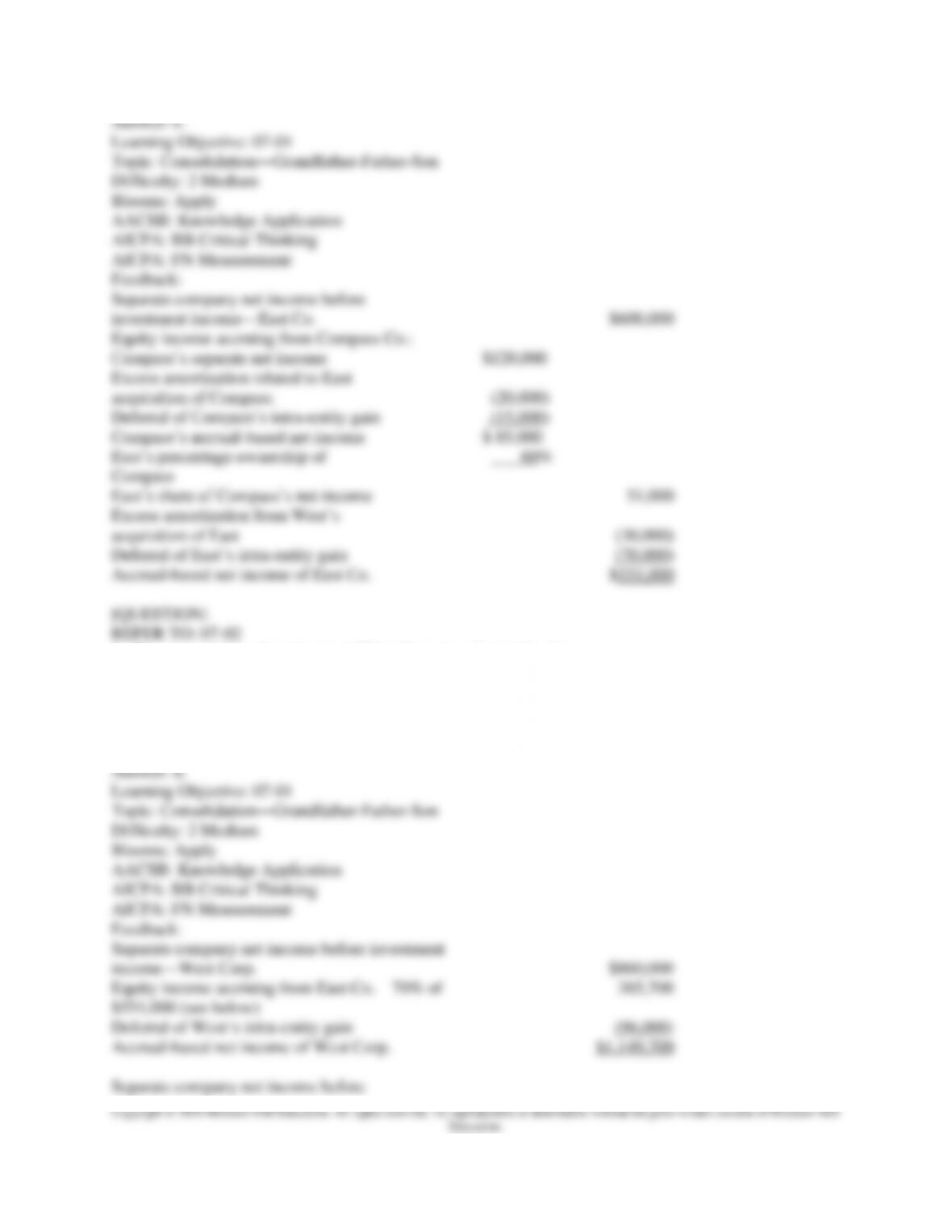
8. The accrual-based net income of West Corp. is calculated to be
A) $ 734,000.
B) $1,261,000.
C) $1,123,900.
D) $1,140,700.
E) $1,149,700.
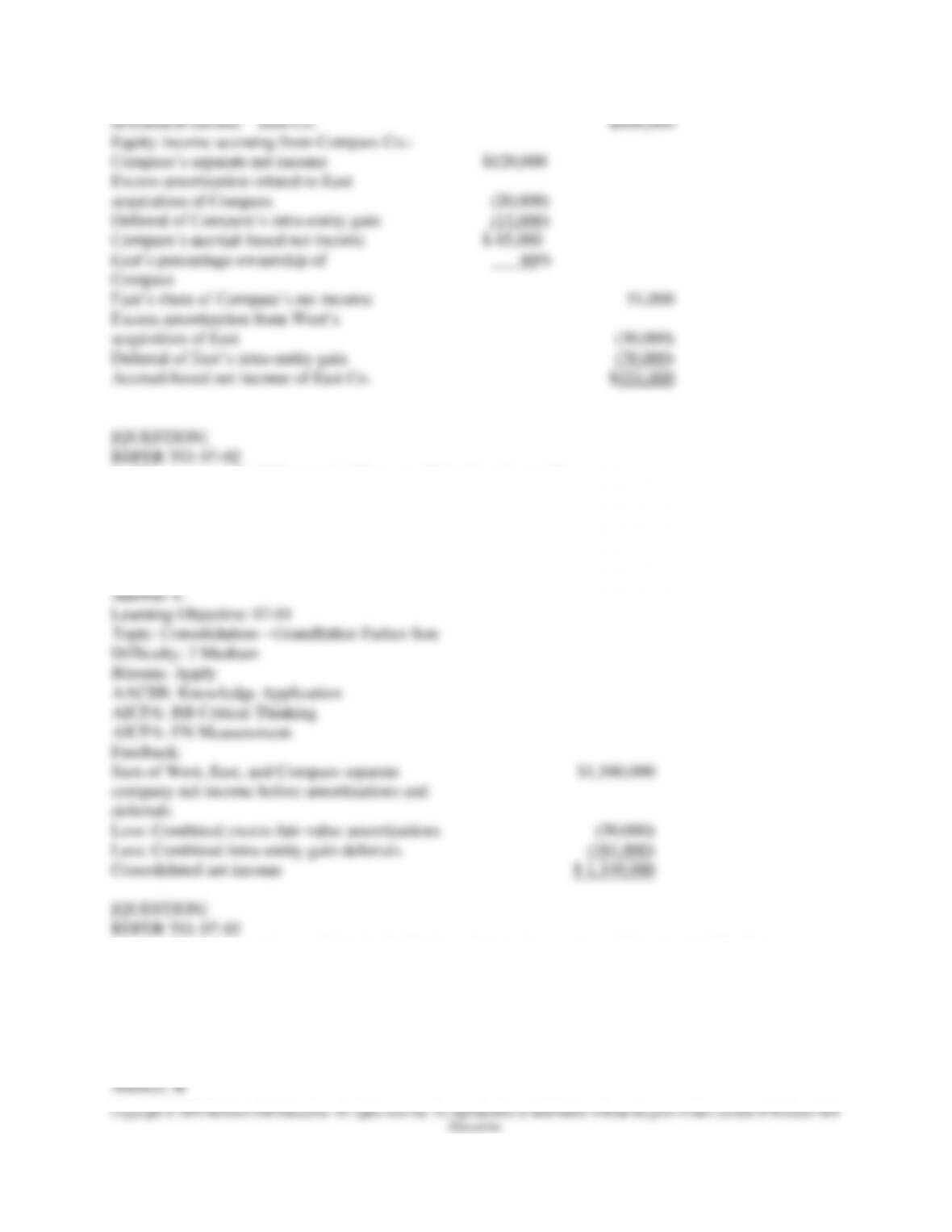
investment income—East Co.
$600,000
Equity income accruing from Compass Co.:
Compass’s separate net income
$120,000
Excess amortization related to East
acquisition of Compass
(20,000)
Deferral of Compass’s intra-entity gain
(15,000)
Compass’s accrual-based net income
$ 85,000
East’s percentage ownership of
Compass
60%
East’s share of Compass’s net income
51,000
Excess amortization from West’s
acquisition of East
(30,000)
Deferral of East’s intra-entity gain
(70,000)
Accrual-based net income of East Co.
$551,000
[QUESTION]
REFER TO: 07-02
9. What amount should be reported for consolidated net income?
A) $1,285,000.
B) $1,331,700.
C) $1,349,000.
D) $1,315,000.
E) $1,314,900.
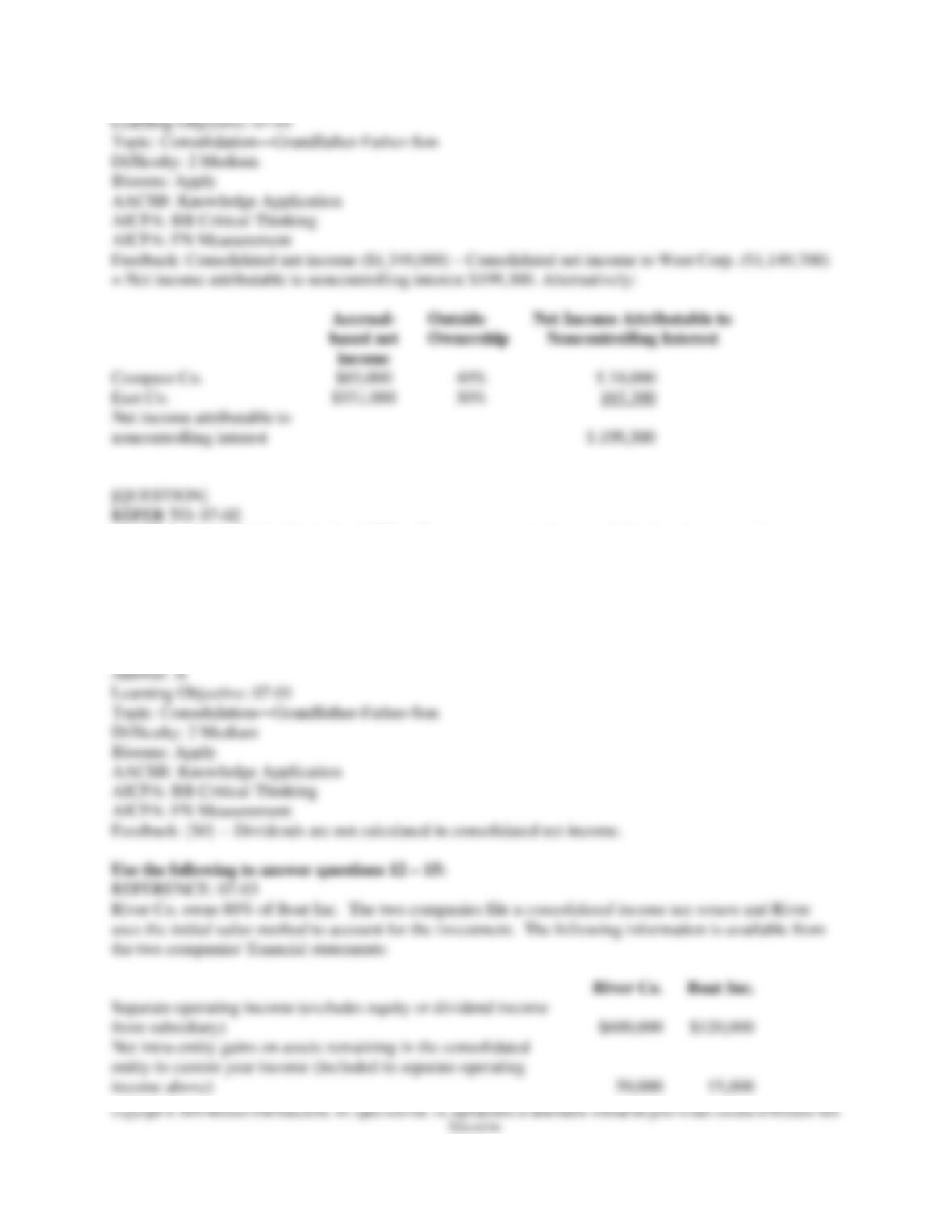
Less: Combined excess fair-value amortizations
Less: Combined intra-entity gain deferrals
Consolidated net income
10. For West Corp. and consolidated subsidiaries, what total amount would be reported for the net
income attributable to the noncontrolling interest?
A) $165,300.
B) $199,300.
C) $191,000.
D) $228,000.
E) $153,000.
11. What amount of dividends should West Corp. recognize in its consolidated net income with respect
to dividends received from Compass Co.?
A) $ -0-
B) $25,200.
C) $36,000.
D) $42,000.
E) $90,000.
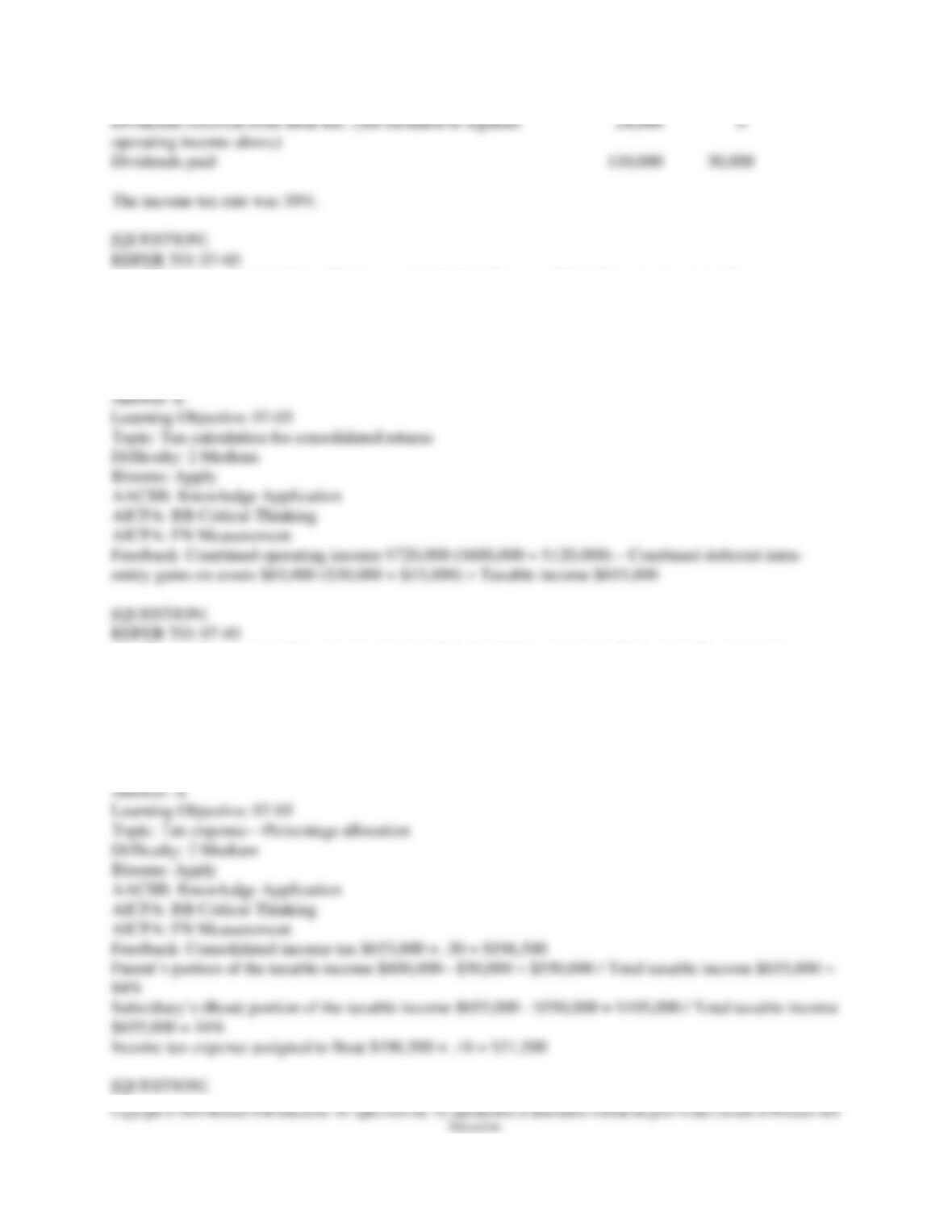
Dividends received from Boat Inc. (not included in separate
operating income above)
24,000
–0–
Dividends paid
110,000
30,000
The income tax rate was 30%.
[QUESTION]
REFER TO: 07-03
12. What is the amount of taxable income reported on the consolidated income tax return?
A) $720,000.
B) $625,000.
C) $621,000.
D) $665,000.
E) $655,000.
13. What is the amount of income tax expense that should be assigned to Boat using the percentage
allocation method?
A) $31,500
B) $32,750
C) $36,000
D) $32,660
E) $30,390
14. The amount of income tax expense that should be assigned to Boat using the separate return method
is approximately:
A) $36,000
B) $31,500
C) $33,390
D) $32,750
E) $32,660
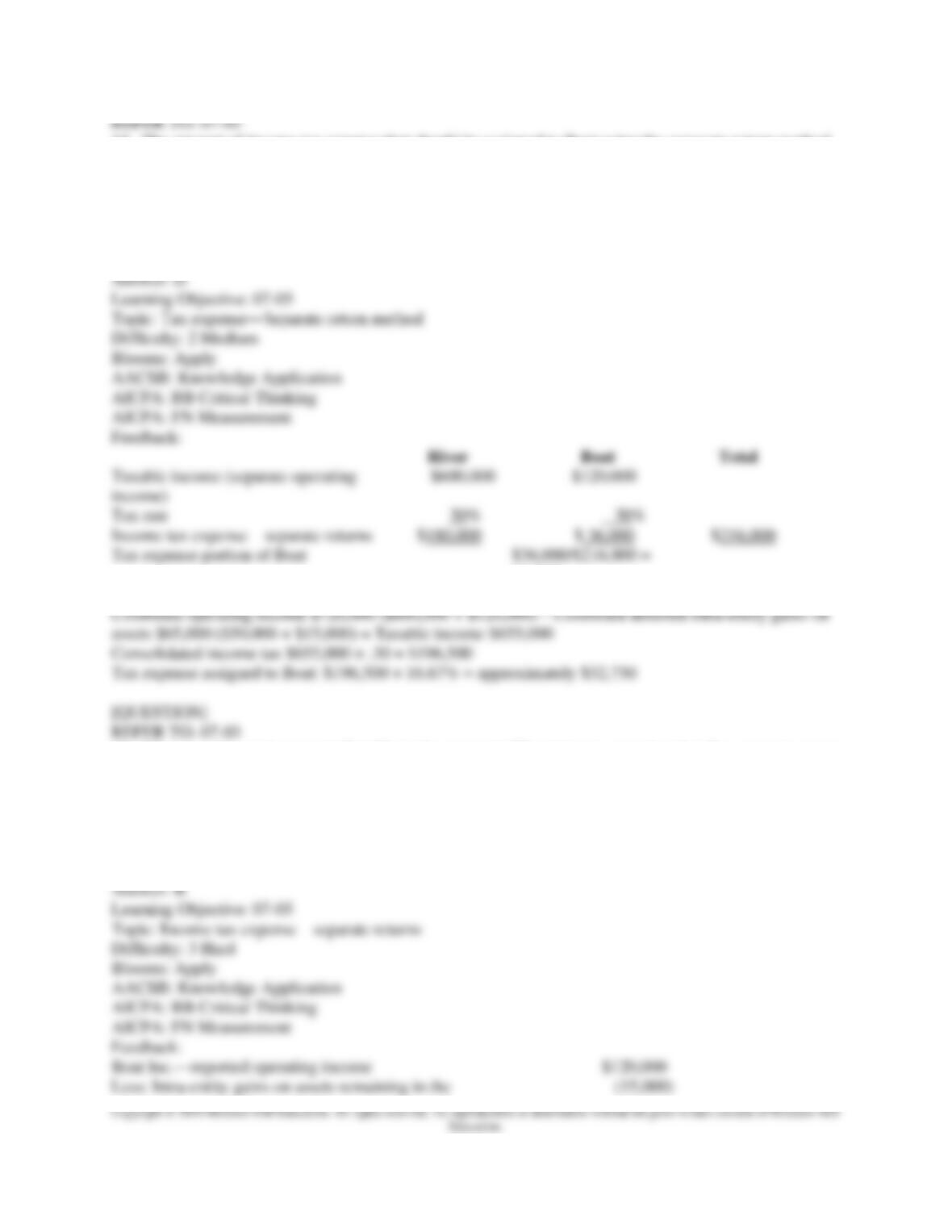
consolidated entity
Less: Assigned income tax expense (see below)
(32,750)
Boat Inc.—adjusted income
$72,250
Outside ownership
20%
Net income attributable to the noncontrolling interest
$ 14,450
Calculation of assigned income tax expense:
River
Boat
Total
Taxable income (separate operating
income)
$600,000
$120,000
Tax rate
30%
30%
Income tax expense—separate returns
$180,000
$ 36,000
$216,000
Tax expense portion of Boat
$36,000/$216,000 =
16.67%
Tax expense:
Combined operating income $720,000 ($600,000 + $120,000) – Combined deferred intra-entity gains on
assets $65,000 ($50,000 + $15,000) = Taxable income $655,000
16. On a consolidated income statement, what is the net income attributable to the noncontrolling
interest?
A) $ 9,800.
B) $13,692.
C) $10,836.
D) $12,460.
E) $11,214.
17. How would the 10% Investment in Prescott owned by Bell be presented in the consolidated balance
sheet?
A) The 10% investment would be eliminated and no amount would be shown in the consolidated balance
sheet.
B) The 10% investment would be reclassified in Bell’s balance sheet as Treasury Stock before the
consolidation process begins.
C) The 10% investment would be eliminated and the same dollar amount would appear as treasury stock
in the consolidated balance sheet.
D) The 10% investment would be included as part of Additional Paid-In Capital because it is less than
20% and therefore indicates no significant influence is present.
E) Prescott would treat the shares owned by Bell as if they had been repurchased on the open market, and
a treasury stock account would be set up on Prescott’s books recording the shares at their fair value on the
date of combination.
18. On January 1, 2018, a subsidiary bought 10% of the outstanding shares of its parent company.
Although the total book value and fair value of the parent’s net assets were $5.5 million, the consideration
transferred for these shares was $590,000. During 2018, the parent reported separate net income of
$714,000, before including investment income, while dividends declared were $196,000. How were these
shares reported at December 31, 2018?
A) The investment was recorded for $641,800 at the end of 2018 and then eliminated for consolidation
purposes.
B) Consolidated stockholders’ equity was reduced by $641,800.
C) The investment was recorded for $590,000 at the end of 2018 and then eliminated for consolidation
purposes.
D) Consolidated stockholders’ equity was reduced by $639,800.
E) Consolidated stockholders’ equity was reduced by $590,000.
19. Jastoon Co. acquired all of Wedner Co. for $588,000 cash in a tax-free transaction. On that date, the
subsidiary had net assets with a $560,000 fair value but a $420,000 book value and income tax basis. The
income tax rate was 30%. What amount of goodwill should have been recognized on the date of the
acquisition?
A) $ 70,000.
B) $ 28,000.
C) $ (14,000).
D) $ 19,600.
E) $ 65,000.
20. The accrual-based net income of Eckston Inc. is calculated to be
A) $234,000.
B) $211,000.
C) $221,000.
D) $224,000.
E) $246,000.
21. The accrual-based net income of Maroon Corp. is calculated to be
A) $481,600.
B) $472,700.
C) $488,900.
D) $502,300.
E) $358,800.
22. The accrual-based net income of Beagle Co. is calculated to be
A) $706,670.
B) $755,980.
C) $805,280.
D) $838,150.
E) $815,770.
Eckstons’s accrual-based net income
$224,000
Maroon’s percentage ownership of Eckston
90%
Maroon’s share of Eckston’s net income
201,600
Accrual-based net income of Maroon
$481,600
Use the following to answer questions 23 – 25:
REFERENCE: 07-06
Hardford Corp. held 80% of Inglestone Inc., which, in turn, owned 80% of Jade Co. Excess amortization
expense was not required by any of these acquisitions. Separate net income figures (without investment
income) as well as upstream intra-entity gross profits (before deferral) included in the income for the
current year follow:
[QUESTION]
REFER TO: 07-06
23. The accrual-based net income of Jade Co. is calculated to be
A) $193,000.
B) $189,000.
C) $196,000.
D) $201,000.
E) $144,000.
24. The net income attributable to the noncontrolling interest of Jade Co. is calculated to be
A) $36,900.
B) $33,600.
C) $42,400.
D) $32,300.
E) $39,200.
Hardford
Inglestone
Jade
C
orp.
Inc.
Co.
Separate net income
$ 560,000
$ 420,000
$ 280,000
Intra-entity gross profits
70,000
42,000
84,000
25. The net income attributable to the noncontrolling interest of Inglestone Inc. is calculated to be
A) $106,950.
B) $102,640.
C) $114,530.
D) $106,960.
E) $103,680.
26. When indirect control is present, which of the following statements is true?
A) At least one company within the consolidated entity holds a parent and a subsidiary relationship.
B) The parent company owns a percent of subsidiary and subsidiary owns a percent of the parent.
C) Consolidated financial statements are required for only one subsidiary.
D) Recognition of income for an indirectly owned subsidiary is ignored.
E) Only dividend income is recognized for an indirectly owned subsidiary.
27. Which of the following statements is false concerning a father-son-grandson configuration?
A) This type of ownership pattern does not significantly alter the worksheet process.
B) Most worksheet entries are simply made twice.
C) The doubling of entries may seem overwhelming.
D) The individual consolidation procedures remain unaffected.
E) Consolidated financial statements are required for only the father and son companies.
28. Which of the following statements is true regarding mutual ownership between a parent and its
subsidiary?
A) The shares of the parent held by a subsidiary should be treated as outstanding stock on the
consolidated balance sheet.
B) Only the subsidiary’s shares held by the parent should be eliminated in consolidation.
C) The treasury stock approach is required to reflect parent shares held by the subsidiary.
D) The treasury stock approach is required to eliminate subsidiary shares held by the parent company.
E) The parent company does not need to file consolidated financial statements if there is mutual
ownership.
29. Which of the following statements is true regarding a subsidiary’s investment in the parent company’s
stock?
A) The treasury stock approach focuses on the parent’s control over its subsidiary.
B) For consolidation, both the parent and subsidiary must defer gross profit on remaining inventory from
intra-entity transfers.
C) In consolidation, the parent’s retained earnings will not be reduced by the dividends it paid to the
subsidiary.
D) This corporate combination is known as mutual ownership.
E) All of these answer choices are true statements.
30. Which of the following statements is true regarding the subsidiary’s investment in its parent’s
common stock?
A) All of the parent company’s common stock is eliminated.
B) The consolidation worksheet entry to eliminate the subsidiary’s investment in parent’s common stock is
debited to treasury stock.
C) The consolidation worksheet entry to eliminate the subsidiary’s investment in parent’s common stock is
debited to retained earnings.
D) The consolidation worksheet entry to eliminate the subsidiary’s investment in parent’s common stock
is debited to additional paid-in capital.
E) The investment in parent company’s common stock is not eliminated in consolidation.
31. Which of the following statements is true regarding the filing of income taxes for an affiliated group?
A) Domestic subsidiaries greater than 50% ownership must file a consolidated tax return.
B) Domestic subsidiaries greater than 60% ownership must file a consolidated tax return.
C) Domestic subsidiaries greater than 80% ownership must file a consolidated tax return.
D) Domestic subsidiaries greater than 80% ownership may file a consolidated tax return.
E) Foreign subsidiaries must file a consolidated tax return.
32. The benefits of filing a consolidated tax return include all of the following except
A) Gross profits from intra-entity transfers are not taxed until such amounts are recognized for financial
statement reporting purposes.
B) Recognition of gross profits from intra-entity transfers is deferred for income tax recognition purposes.
C) The issuance of dividends between related entities are not taxable.
D) Losses incurred by an affiliated company can be used to reduce taxable income earned by other
members to that affiliated group.
E) Gross profits on intra-entity transfers are taxed before they are recognized for financial statement
reporting purposes in the year of the transfer, but any such losses are deferred.
33. Which of the following statements is true regarding goodwill?
A) For accounting purposes, goodwill may be amortized over a period not to exceed 40 years.
B) For accounting purposes, goodwill may be amortized over a period not to exceed 20 years.
C) For tax purposes, goodwill amortization cannot be deductible.
D) For tax purposes, goodwill amortization may be deductible over a 20-year period.
E) For tax purposes, goodwill amortization may be deductible over a 15-year period.
34. Compute Chase’s attributed ownership in Ross.
A) 40.0%.
B) 64.0%.
C) 24.0%.
D) 32.0%.
E) 12.8%.
35. Compute the net income attributable to the noncontrolling interest in Ross for 2018.
A) $92,000.
B) $77,400.
C) $75,000.
D) $64,500.
E) $69,000.
36. Compute Lawrence’s accrual-based net income for 2018.
A) $354,000.
B) $329,500.
C) $334,000.
D) $265,000.
E) $344,500.
37. Compute Chase’s accrual-based net income for 2018.
A) $746,000.
B) $719,000.
C) $779,600.
D) $774,200.
E) $758,100.
38. What would be included in a consolidation worksheet entry for 2018?
A) Debit treasury stock, $135,000.
B) Credit treasury stock, $135,000.
C) Debit treasury stock, $150,000.
D) Credit treasury stock, $150,000.
E) Debit common stock, $150,000.
39. Compute the amount allocated to trademarks recognized in the January 1, 2018 consolidated balance
sheet.
A) $ 80,000.
B) $100,000.
C) $ 76,000.
D) $ 16,000.
E) $ -0-
40. Compute Whitton’s accrual-based consolidated net income for 2018.
A) $199,000.
B) $190,000.
C) $185,000.
D) $184,000.
E) $176,000.
41. Compute the net income attributable to the noncontrolling interest for 2018.
A) $11,000.