B) Consolidation Entry P is recorded to eliminate the long-term receivable and debt representing
AHI’s initial investment in RMC as follows:
Loan receivable from RMC $3,000,000
Long-term debt $3,000,000
C) Consolidation Entry S is recorded to eliminate the interest payment on the loan from RMC to
AHI as follows:
Interest expense $180,000
Interest income $180,000
D) Consolidation Entry E is recorded to amortize the excess fair value allocation to the Asset over
its remaining useful life as follows:
Other operating expenses $32,000
Asset $32,000
E) Consolidation Entry P is recorded to eliminate the beginning stockholders’ equity of the VIE
and recognize the 100% equity ownership of the noncontrolling interest as follows:
Retained earnings – RMC 1/1/18 $ 6,000
Common stock – RMC $34,000
Retained Earnings-AHI $40,000
87. Parent Corporation loaned money to its subsidiary with a five-year note at the market interest
rate. How would the note be accounted for in the consolidation process?
88. What are the primary sources of information that are used for preparation of a consolidated
statement of cash flows?
Copyright © 2017 McGraw-Hill Education. All rights reserved. No reproduction or distribution without the prior written consent of
McGraw-Hill Education.
Page 6-42
Topic: Consolidated statement of cash flows
Difficulty: 1 Easy
Blooms: Remember
AACSB: Reflective Thinking
AICPA: BB Critical Thinking
AICPA: FN Measurement
[QUESTION]
89. Parent Corporation acquired some of its subsidiary’s bonds on the open bond market. The
remaining life of the bonds was eight years, and Parent expected to hold the bonds for the full
eight years. How would the acquisition of the bonds affect the consolidation process?
90. Parent Corporation acquired some of its subsidiary’s bonds on the open bond market, paying
a price $40,000 higher than the bonds’ carrying value. How should the difference between the
purchase price and the carrying value be accounted for?
91. How are intra-entity inventory transfers treated on the consolidation worksheet and how are
they reflected in a consolidated statement of cash flows?
Copyright © 2017 McGraw-Hill Education. All rights reserved. No reproduction or distribution without the prior written consent of
McGraw-Hill Education.
Page 6-43
AICPA: FN Measurement
[QUESTION]
92. Danbers Co. owned seventy-five percent of the common stock of Renz Corp. How does the
issuance of a five percent stock dividend by Renz affect Danbers and the consolidation process?
93. During 2018, Parent Corporation purchased at carrying value some of the outstanding bonds
of its subsidiary. How would this acquisition have been reflected in the consolidated statement of
cash flows?
94. On January 1, 2018, Parent Corporation acquired a controlling interest in the voting common
stock of Foxboro Co. At the same time, Parent purchased sixty percent of Foxboro’s outstanding
preferred stock. In preparing consolidated financial statements, how should the acquisition of the
preferred stock be accounted for?
95. When a company has preferred stock in its capital structure, what amount should be used to
calculate noncontrolling interest in the preferred stock of the subsidiary when the company is
acquired as a subsidiary of another company?
96. Parent Corporation acquired some of its subsidiary’s outstanding bonds. Why might Parent
purchase the bonds, rather than the subsidiary buying its own bonds?
97. Parent Corporation had just purchased some of its subsidiary’s outstanding bonds on the open
market. What items related to these bonds will have to be accounted for in the consolidation
process?
Copyright © 2017 McGraw-Hill Education. All rights reserved. No reproduction or distribution without the prior written consent of
McGraw-Hill Education.
Page 6-45
AICPA: BB Critical Thinking
AICPA: FN Measurement
[QUESTION]
98. Parent Corporation recently acquired some of its subsidiary’s outstanding bonds at an amount
which required the recognition of a loss. In what ways could the loss be allocated? Which
allocation would you recommend? Why?
99. How does the existence of a noncontrolling interest affect the preparation of a consolidated
statement of cash flows?
100. On January 1, 2018, Bast Co. had a net book value of $2,100,000 as follows:
Preferred stock, 2,000 shares $70 par value,
cumulative, nonparticipating, nonvoting
$ 140,000
Common stock, 22,400 shares $50 par value
1,120,000
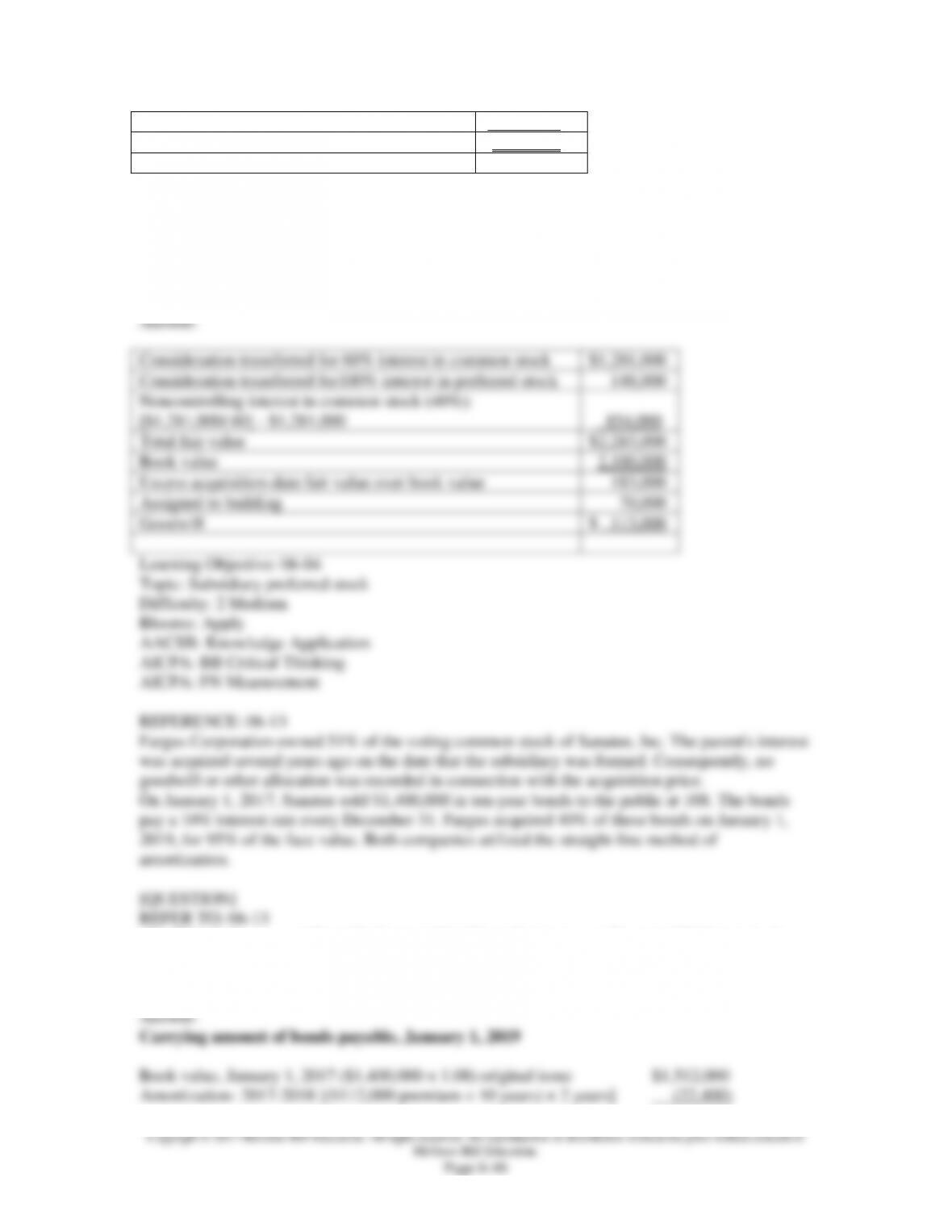
Retained earnings
840,000
Total shareholders’ equity
$2,100,000
Fisher Co. acquired all of the outstanding preferred shares for $148,000 and 60% of the common
stock for $1,281,000. Fisher believed that one of Bast’s buildings, with a twelve-year life, was
undervalued on the company’s financial records by $70,000.
Required:
What is the amount of goodwill to be recognized from this purchase?
Consideration transferred for 60% interest in common stock
$1,281,000
Consideration transferred for100% interest in preferred stock
148,000
Noncontrolling interest in common stock (40%):
[$1,281,000/.60] – $1,281,000
854,000
Total fair value
$2,283,000
Book value
2,100,000
Excess acquisition-date fair value over book value
183,000
Assigned to building
70,000
Goodwill
$ 113,000
101. What balances would need to be considered in order to prepare the consolidation entry in
connection with these intra-entity bonds at December 31, 2019, the end of the first year of the
intra-entity investment? Prepare schedules to show numerical answers for balances that would be
needed for the entry.
Amortization- 2017-2018 [($112,000 premium ÷ 10 years) × 2 years]
(22,400)
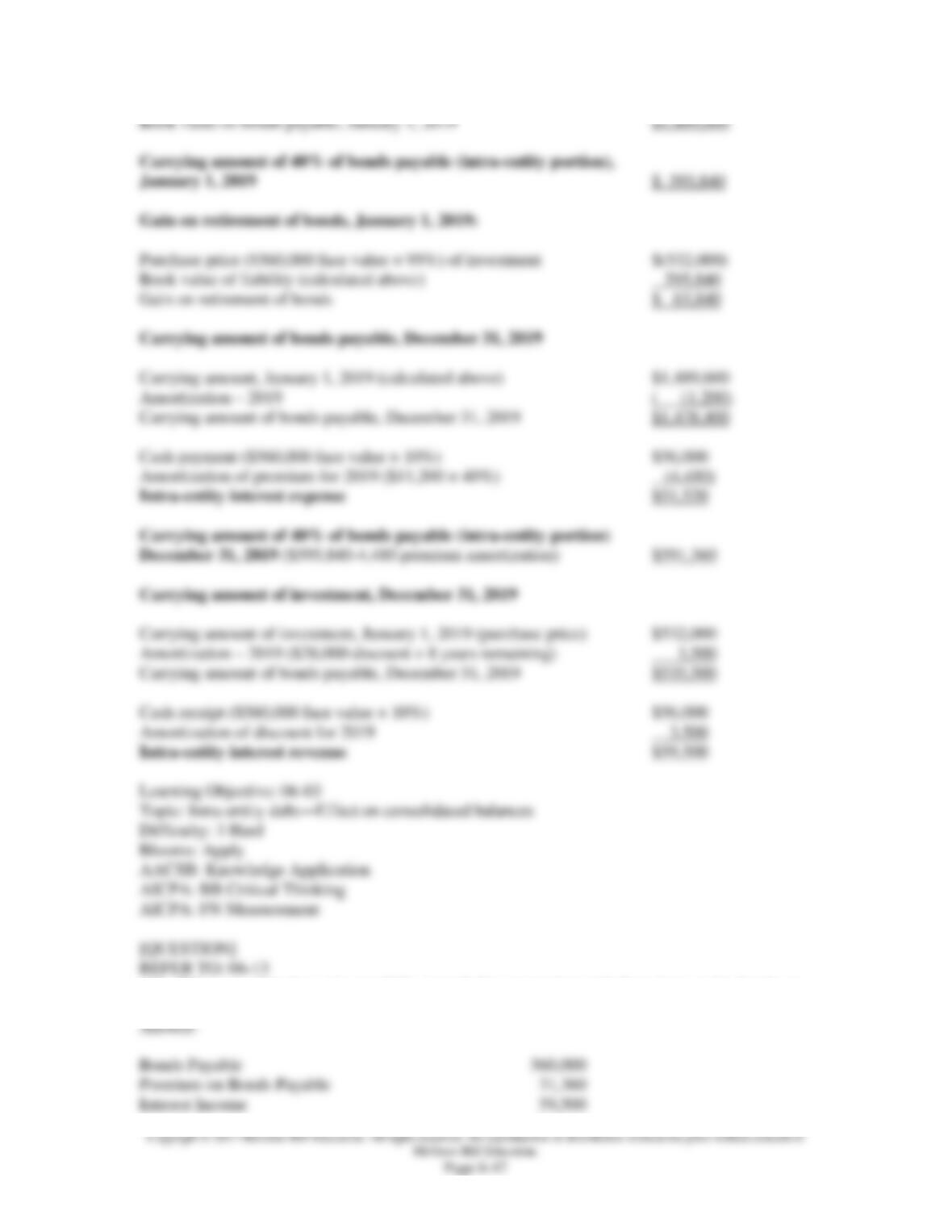
Book value of bonds payable, January 1, 2019
$1,489,600
Carrying amount of 40% of bonds payable (intra-entity portion),
January 1, 2019
$ 595,840
Gain on retirement of bonds, January 1, 2019:
Purchase price ($560,000 face value × 95%) of investment
$(532,000)
Book value of liability (calculated above)
595,840
Gain on retirement of bonds
$ 63,840
Carrying amount of bonds payable, December 31, 2019
Carrying amount, January 1, 2019 (calculated above)
$1,489,600
Amortization – 2019
( 11,200)
Carrying amount of bonds payable, December 31, 2019
$1,478,400
Cash payment ($560,000 face value × 10%)
$56,000
Amortization of premium for 2019 ($11,200 × 40%)
(4,480)
Intra-entity interest expense
$51,520
Carrying amount of 40% of bonds payable (intra-entity portion)
December 31, 2019 ($595,840-4,480 premium amortization)
$591,360
Carrying amount of investment, December 31, 2019
Carrying amount of investment, January 1, 2019 (purchase price)
$532,000
Amortization – 2019 ($28,000 discount ÷ 8 years remaining)
3,500
Carrying amount of bonds payable, December 31, 2019
$535,500
Cash receipt ($560,000 face value × 10%)
$56,000
Amortization of discount for 2019
3,500
Intra-entity interest revenue
$59,500
Learning Objective: 06-03
Topic: Intra-entity debt―Effect on consolidated balances
Difficulty: 3 Hard
Blooms: Apply
AACSB: Knowledge Application
AICPA: BB Critical Thinking
AICPA: FN Measurement
[QUESTION]
REFER TO: 06-13
102. What consolidation entry would be recorded in connection with these intra-entity bonds on
December 31, 2019?
Bonds Payable
Interest Income
Copyright © 2017 McGraw-Hill Education. All rights reserved. No reproduction or distribution without the prior written consent of
McGraw-Hill Education.
Page 6-48
Investment in Bonds
535,500
Interest Expense
51,520
Gain on retirement
63,840
Learning Objective: 06-03
Topic: Intra-entity debt―Gain or loss for consolidation
Difficulty: 2 Medium
Blooms: Apply
AACSB: Knowledge Application
AICPA: FN Measurement
[QUESTION]
REFER TO: 06-13
103. What consolidation entry would be recorded in connection with these intra-entity bonds on
December 31, 2020?
104. What consolidation entry would be recorded in connection with these intra-entity bonds on
December 31, 2021?
Bonds Payable
Premium on Bonds Payable
22,400
Interest Income
59,500
Investment in Bonds
542,500
Interest Expense
51,520
Retained Earnings, 1/1/21 (Fargus Corp.)
47,880
Bonds Payable
Premium on Bonds Payable
26,880
Interest Income
59,500
Investment in Bonds
539,000
Interest Expense
51,520
Retained Earnings, 1/1/20 (Fargus Corp.)
55,860
105. Skipen Corp. had the following stockholders’ equity accounts:
The preferred stock was participating and is therefore considered to be equity. Vestin Corp.
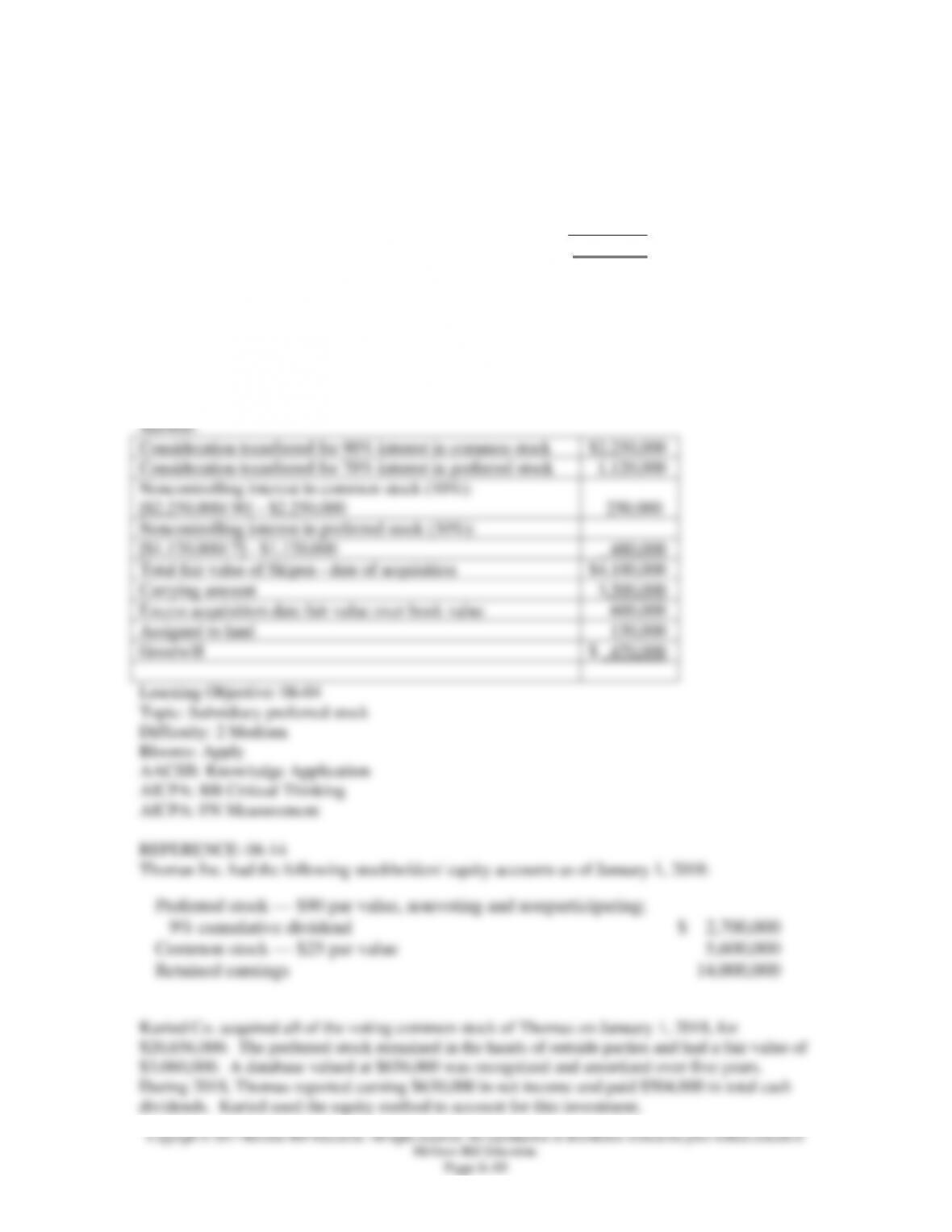
acquired 90% of this common stock for $2,250,000 and 70% of the preferred stock for
$1,120,000. All of the subsidiary’s assets and liabilities were determined to have fair values equal
to their carrying amounts except for land, which is undervalued by $130,000.
Required:
What amount was attributed to goodwill on the date of acquisition?
Preferred stock (8% cumulative dividend)
$ 700,000
Common stock
1,050,000
Additional paid
–
in capital
420,000
Retained earnings
Total
1,330,000
$ 3,500,000
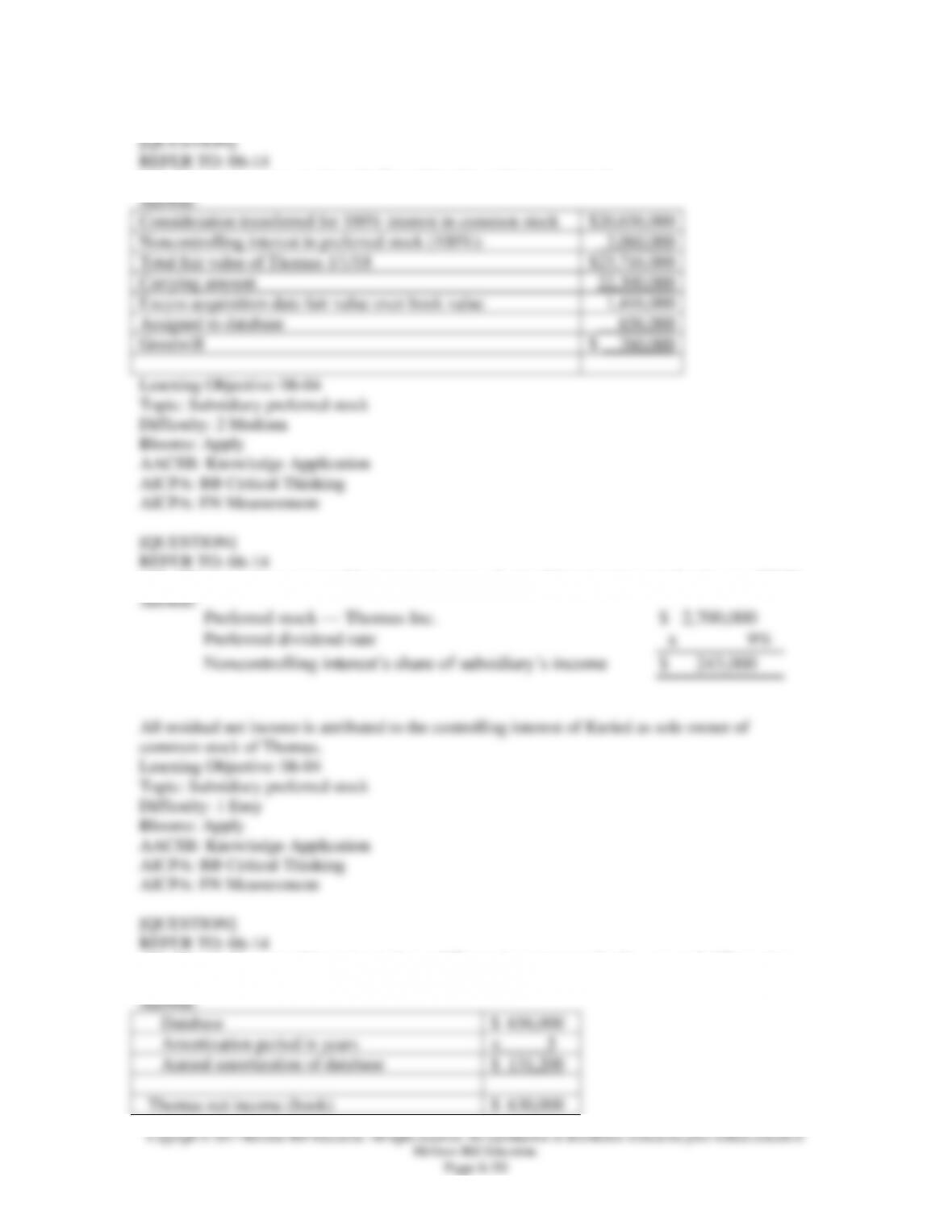
106. What is the amount of goodwill resulting from this acquisition?
107. What was the noncontrolling interest’s share of consolidated net income for the year 2018?
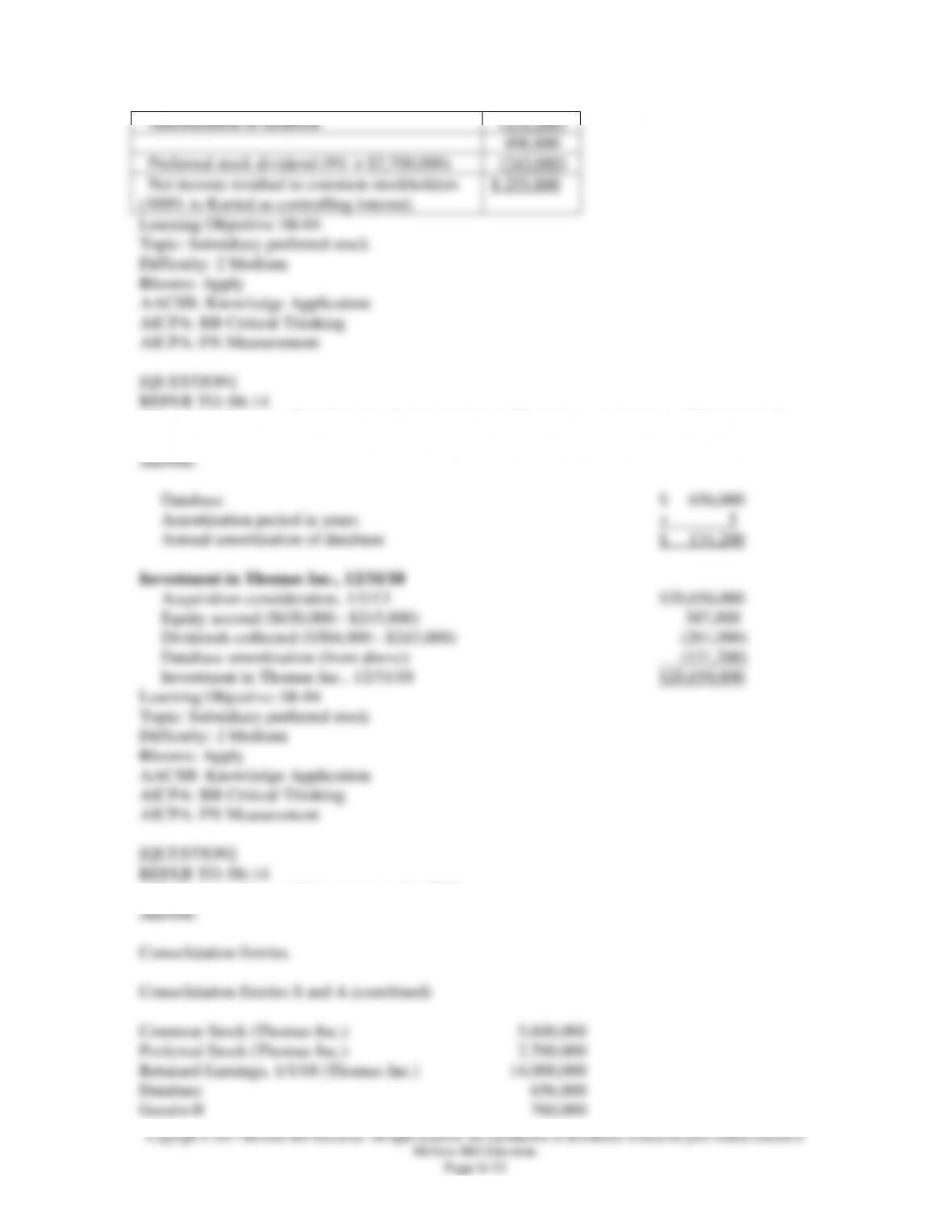
108. What is the controlling interest share of Thomas’ net income for the year ended December
31, 2018?
Amortization of database
(131,200)
498,800
Preferred stock dividend (9% × $2,700,000)
(243,000)
Net income residual to common stockholders
(100% to Kuried as controlling interest)
$ 255,800
Learning Objective: 06-04
Topic: Subsidiary preferred stock
Difficulty: 2 Medium
Blooms: Apply
AACSB: Knowledge Application
AICPA: BB Critical Thinking
AICPA: FN Measurement
[QUESTION]
REFER TO: 06-14
109. What was Kuried’s balance in the Investment in Thomas Inc. account as of December 31,
2018?
Database
$ 656,000
Amortization period in years
÷ 5
Annual amortization of database
$ 131,200
Acquisition consideration, 1/1/13
$20,656,000
Equity accrual ($630,000 – $243,000)
387,000
Dividends collected ($504,000 – $243,000)
(261,000)
Database amortization (from above)
(131,200)
Investment in Thomas Inc., 12/31/18
$20,650,800
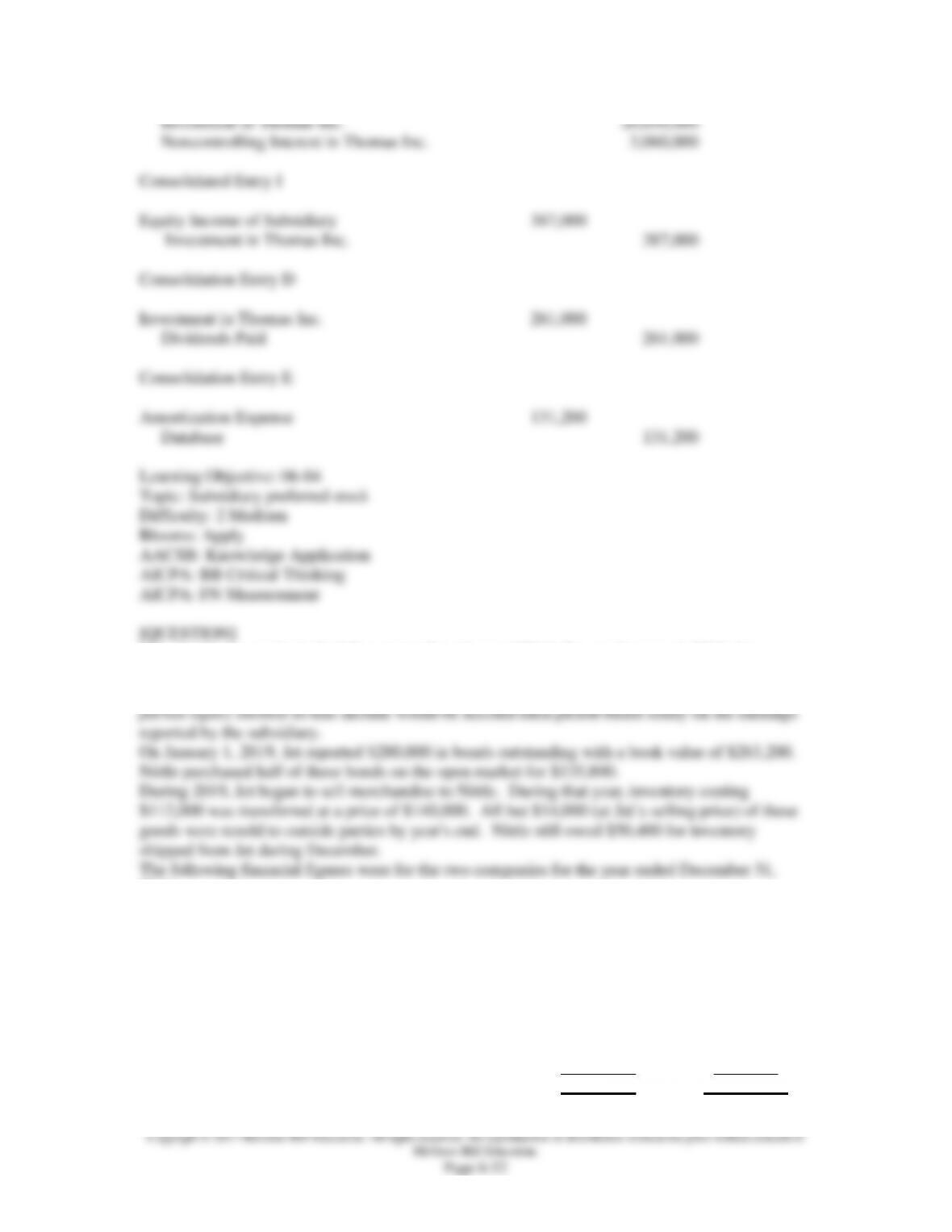
110. Prepare all consolidation entries for 2018.
Consolidation Entries
Consolidation Entries S and A (combined)
Common Stock (Thomas Inc.)
Preferred Stock (Thomas Inc.)
Database
Investment in Thomas Inc.
20,656,000
Noncontrolling Interest in Thomas Inc.
3,060,000
Consolidated Entry I
Equity Income of Subsidiary
387,000
Investment in Thomas Inc.
387,000
Consolidation Entry D
Investment in Thomas Inc.
261,000
Dividends Paid
261,000
Consolidation Entry E
Amortization Expense
131,200
Database
131,200
Learning Objective: 06-04
Topic: Subsidiary preferred stock
Difficulty: 2 Medium
Blooms: Apply
AACSB: Knowledge Application
AICPA: BB Critical Thinking
AICPA: FN Measurement
[QUESTION]
111. Jet Corp. acquired all of the outstanding shares of Nittle Inc. on January 1, 2016, for
$644,000 in cash. Of this consideration transferred, $42,000 was attributed to equipment with a
ten-year remaining useful life. Goodwill of $56,000 had also been identified. Jet applied the
2019.
Jet Corp.
Nittle Inc.
Revenues
$(894,600)
$(652,400)
Cost of goods sold
483,000
277,200
Expenses
187,600
225,400
Interest expense-bonds
33,600
0
Interest income-bond investment
0
(15,400)
Equity in income of Nittle Inc.
(165,200)
0
Net income
$(355,600)
$ (165,200)
Retained earnings, January 1, 2019
$(483,000)
$(505,400)
Net income (above)
(355,600)
(165,200)
Dividends paid
217,000
85,400
Retained earnings, December 31, 2019
$(621,600)
$(585,200)
Cash and receivables
$186,200
$109,200
Inventory
239,400
121,800
Investment in Nittle Inc.
851,200
0
Investment in Jet Corp. bonds
0
137,200
Land, buildings, and equipment (net)
348,600
757,400
Total assets
$ 1,625,400
$1,125,600
Accounts payable
$(315,000)
$(232,400)
Bonds payable
(280,000)
(140,000)
Discount on bonds payable
11,200
0
Common stock
(420,000)
(168,000)
Retained earnings, December 31, 2019 (above)
(621,600)
(585,200)
Total liabilities and stockholders’ equity
$(1,625,400)
$(1,125,600)
Required:
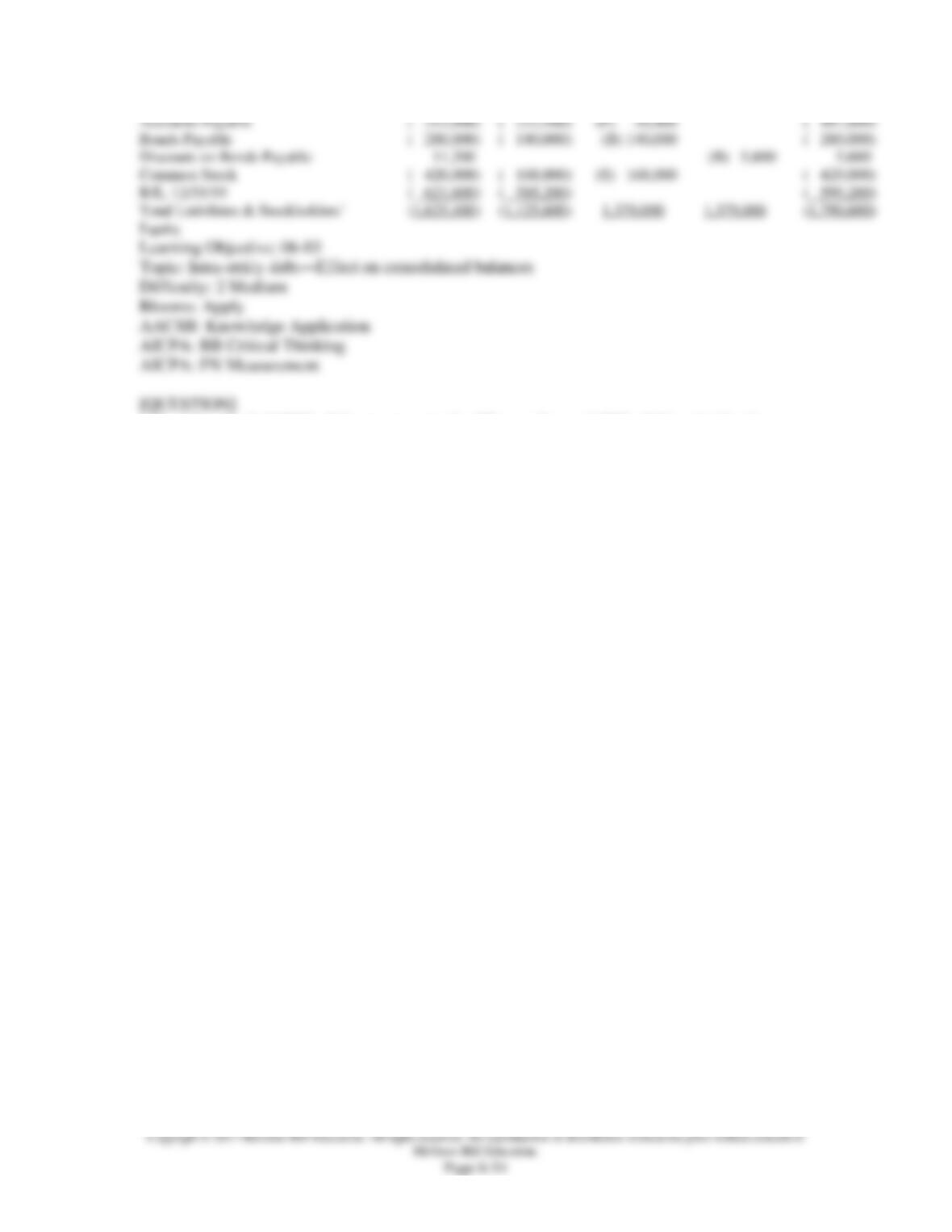
Prepare a consolidation worksheet for the year ended December 31, 2019.
Copyright © 2017 McGraw-Hill Education. All rights reserved. No reproduction or distribution without the prior written consent of
McGraw-Hill Education.
Page 6-54
Accounts Payable
( 315,000)
( 232,400)
(P) 50,400
( 497,000)
Bonds Payable
( 280,000)
( 140,000)
(B) 140,000
( 280,000)
Discount on Bonds Payable
11,200
(B) 5,600
5,600
Common Stock
( 420,000)
( 168,000)
(S) 168,000
( 420,000)
R/E, 12/31/19
( 621,600)
( 585,200)
( 599,200)
Total Liabilities & Stockholders’
Equity
(1,625,400)
(1,125,600)
1,379,000
1,379,000
(1,790,600)
Learning Objective: 06-03
Topic: Intra-entity debt―Effect on consolidated balances
Difficulty: 2 Medium
Blooms: Apply
AACSB: Knowledge Application
AICPA: BB Critical Thinking
AICPA: FN Measurement
[QUESTION]
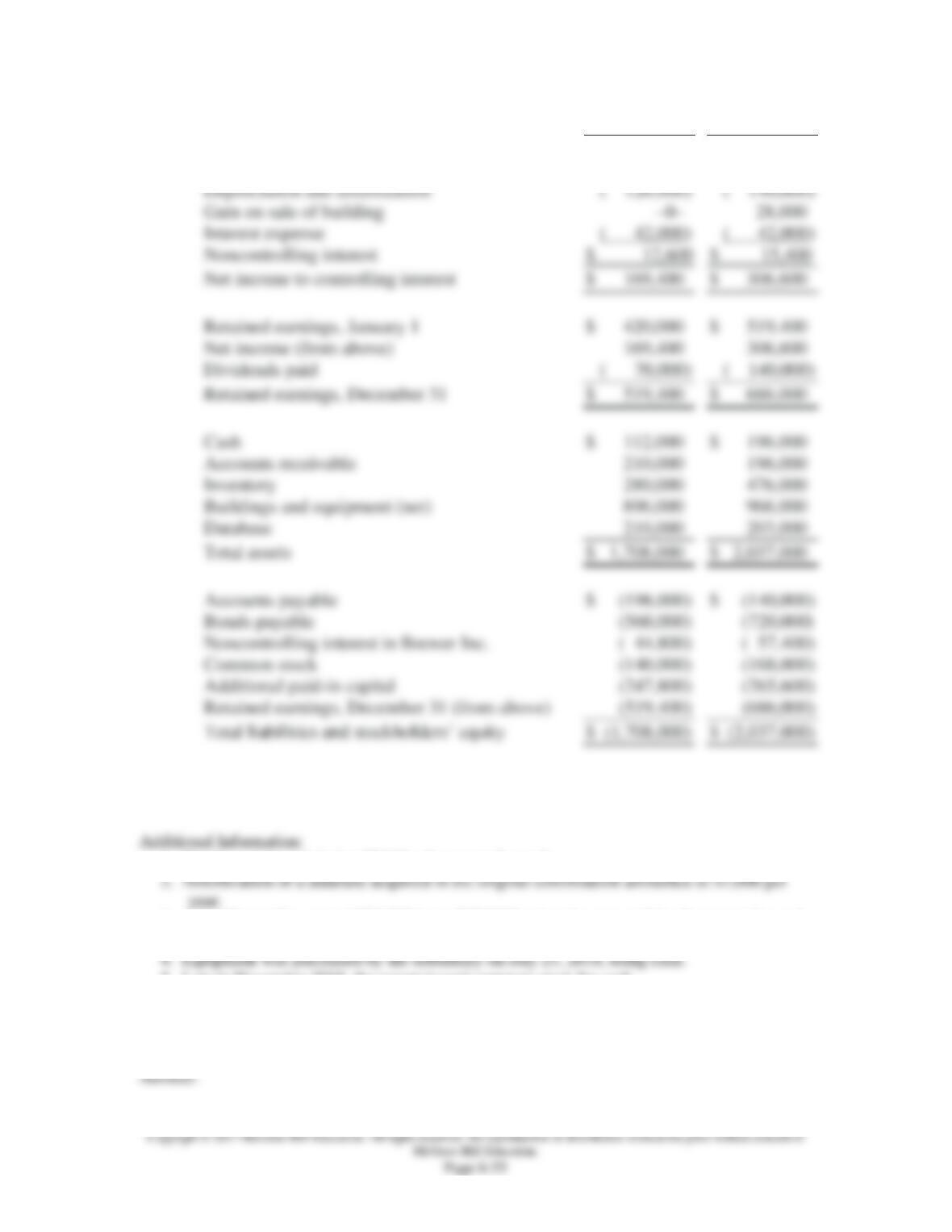
112. Allen Co. held 80% of the common stock of Brewer Inc. and 40% of this subsidiary’s
convertible bonds. The following consolidated financial statements were for 2017 and 2018.
Copyright © 2017 McGraw-Hill Education. All rights reserved. No reproduction or distribution without the prior written consent of
McGraw-Hill Education.
Page 6-55
Additional Information:
1. Bonds were issued during 2018 by the parent for cash.
3. A building with a cost of $84,000 but a $42,000 book value was sold by the parent for cash
on May 11, 2018.
5. Late in November 2018, the parent issued common stock for cash.
6. During 2018, the subsidiary paid dividends of $14,000.
Required:
Prepare a consolidated statement of cash flows for this business combination for the year ending
December 31, 2018. Either the direct method or the indirect method may be used.
2017
2018
Revenues
$ 1,064,000
$ 1,232,000
Cost of goods sold
( 714,000)
( 756,000)
Depreciation and amortization
( 126,000)
( 140,000)
Gain on sale of building
–
0
–
28,000
Interest expense
( 42,000)
( 42,000)
Noncontrolling interest
$ 12,600
$ 15,400
Net income
to controlling interest
$ 169,400
$ 306,600
Retained earnings, January 1
$ 420,000
$ 519,40
0
Net income (from above)
169,400
306,600
Dividends paid
( 70,000)
( 140,000)
Retained earnings, December 31
$ 519,400
$ 686,000
Cash
$ 112,000
$ 196,000
Accounts receivable
210,000
196,000
Inventory
280,000
476,000
Buildings and equipment (net)
896,000
966,000
Database
210,000
203,000
Total assets
$ 1,708,000
$ 2,037,000
Accounts payable
$
(196,000)
$ (140,000)
Bonds payable
(560,000)
(720,000
)
Noncontrolling interest in Brewer Inc.
( 44,800)
( 57,400)
Common stock
(140,000)
(168,000)
Additional paid
–
in capital
(247,800)
(265,600)
R
etained earnings, December 31 (from above)
(519,400)
(686,000)
Total liabilities and stockholders’ equity
$ (1,708,000)
$ (2,037,000)
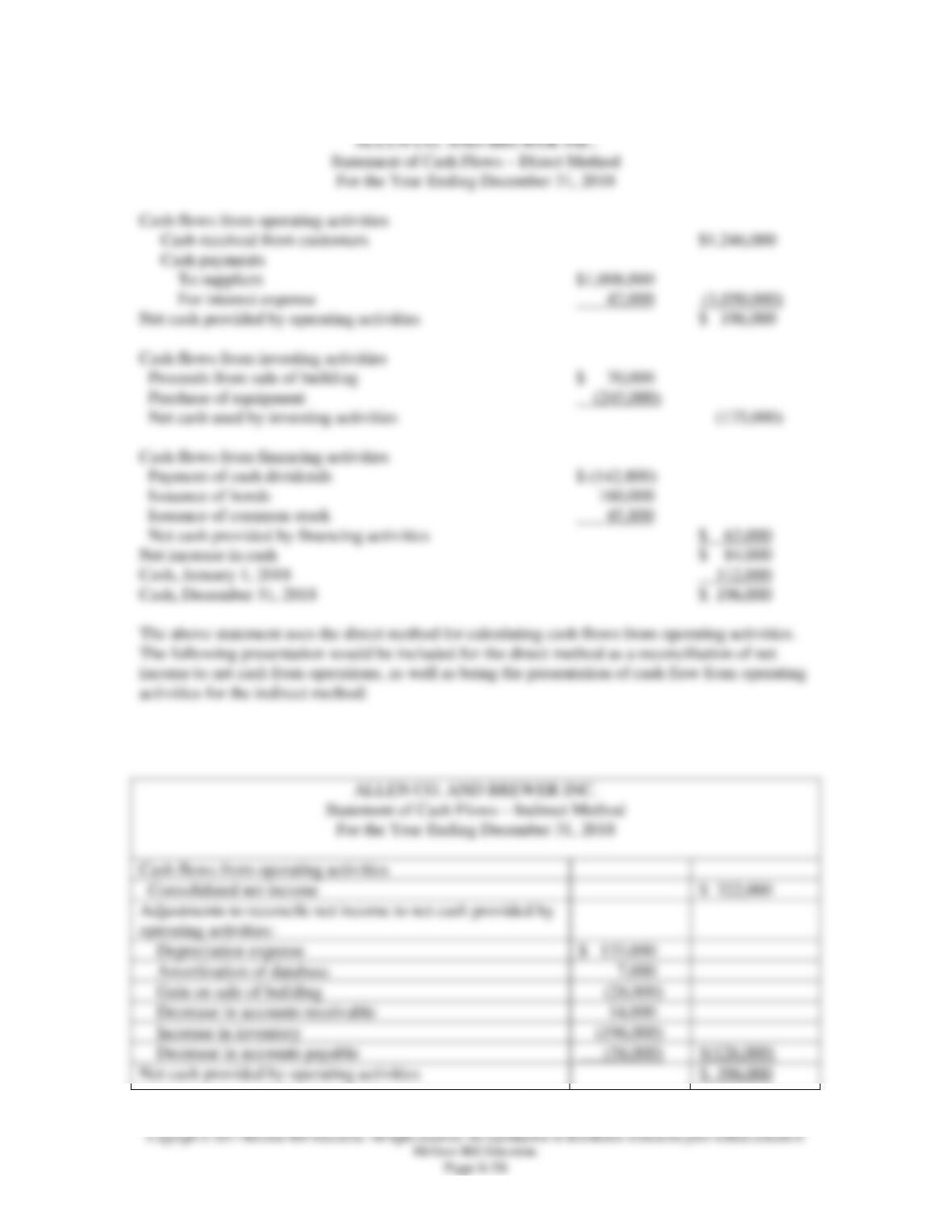
ALLEN CO. AND BREWER INC.
Statement of Cash Flows – Direct Method
For the Year Ending December 31, 2018
Cash flows from operating activities
Cash received from customers
$1,246,000
Cash payments
To suppliers
$1,008,000
For interest expense
42,000
(1,050,000)
Net cash provided by operating activities
$ 196,000
Cash flows from investing activities
Proceeds from sale of building
$ 70,000
Purchase of equipment
(245,000)
Net cash used by investing activities
(175,000)
Cash flows from financing activities
Payment of cash dividends
$ (142,800)
Issuance of bonds
160,000
Issuance of common stock
45,800
Net cash provided by financing activities
$ 63,000
Net increase in cash
$ 84,000
Cash, January 1, 2018
112,000
Cash, December 31, 2018
$ 196,000
The above statement uses the direct method for calculating cash flows from operating activities.
The following presentation would be included for the direct method as a reconciliation of net
income to net cash from operations, as well as being the presentation of cash flow from operating
activities for the indirect method:
ALLEN CO. AND BREWER INC.
Statement of Cash Flows – Indirect Method
For the Year Ending December 31, 2018
Cash flows from operating activities
Consolidated net income
$ 322,000
Adjustments to reconcile net income to net cash provided by
operating activities:
Depreciation expense
$ 133,000
Amortization of database
7,000
Gain on sale of building
(28,000)
Decrease in accounts receivable
14,000
Increase in inventory
(196,000)
Decrease in accounts payable
(56,000)
$(126,000)
Net cash provided by operating activities
$ 196,000
Copyright © 2017 McGraw-Hill Education. All rights reserved. No reproduction or distribution without the prior written consent of
McGraw-Hill Education.
Page 6-57
Learning Objective: 06-05
Topic: Consolidated statement of cash flows
Difficulty: 3 Hard
Blooms: Apply
AACSB: Knowledge Application
AICPA: BB Critical Thinking
AICPA: FN Measurement
REFERENCE: 06-15
Panton, Inc. acquired 18,000 shares of Glotfelty Corp. several years ago for $30 per share when
Glotfelty had a book value of $450,000. Before and after that time, Glotfelty’s stock traded at $30
per share. At the present time, Glotfelty reports the following stockholders’ equity:
Glotfelty issues 5,000 shares of previously unissued stock to the public for $40 per share. None
of this stock is purchased by Panton.
[QUESTION]
REFER TO: 06-15
113. Describe how this transaction would affect Panton’s books.
114. Prepare Panton’s journal entry to recognize the impact of this transaction.
Copyright © 2017 McGraw-Hill Education. All rights reserved. No reproduction or distribution without the prior written consent of
McGraw-Hill Education.
Page 6-58
Answer:
Investment in Glotfelty 63,000
Additional Paid in Capital 63,000
Learning Objective: 06-07
Topic: Subsidiary stock―New issue-Percentage change
Difficulty: 1 Easy
Blooms: Apply
AACSB: Knowledge Application
AICPA: BB Critical Thinking
AICPA: FN Measurement
REFERENCE: 06-16
Panton, Inc. acquired 18,000 shares of Glotfelty Corp. several years agofor $30 per share when
Glotfelty had a book value of $450,000. Before and after that time, Glotfelty’s stock traded at $30
per share. At the present time, Glotfelty reports the following stockholders’ equity:
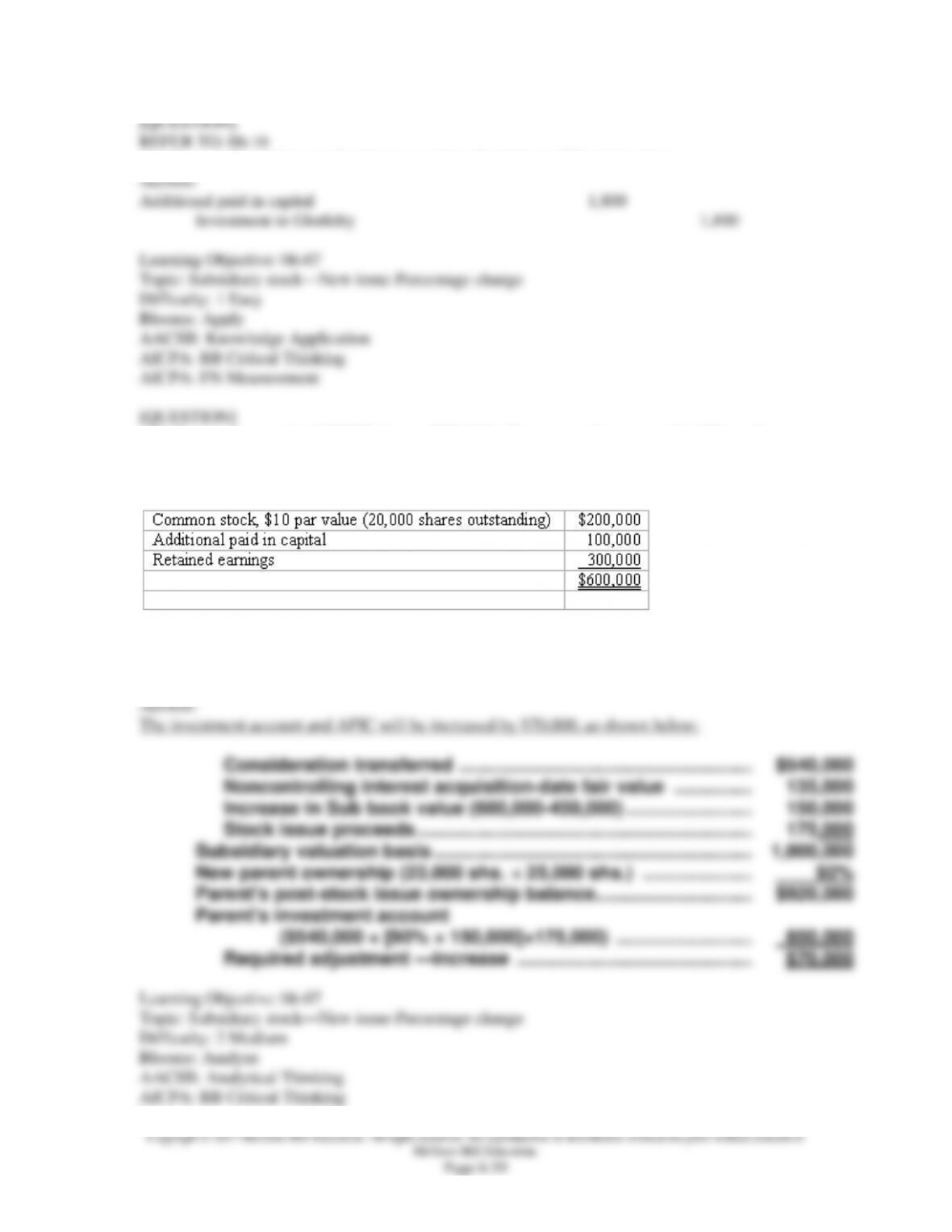
Glotfelty issues 5,000 shares of previously unissued stock to the public for $22 per share. None
of this stock is purchased by Panton.
[QUESTION]
REFER TO: 06-16
115. Describe how this transaction would affect Panton’s books.
Copyright © 2017 McGraw-Hill Education. All rights reserved. No reproduction or distribution without the prior written consent of
McGraw-Hill Education.
Page 6-59
[QUESTION]
REFER TO: 06-16
116. Prepare Panton’s journal entry to recognize the impact of this transaction.
117. Panton, Inc. acquired 18,000 shares of Glotfelty Corp. several years ago for $30 per share
when Glotfelty had a book value of $450,000. Before and after that time, Glotfelty’s stock traded
at $30 per share. At the present time, Glotfelty reports the following stockholders’ equity:
Glotfelty issues 5,000 shares of previously unissued stock to Panton for $35 per share.
Required: Describe how this transaction would affect Panton’s books.

Copyright © 2017 McGraw-Hill Education. All rights reserved. No reproduction or distribution without the prior written consent of
McGraw-Hill Education.
Page 6-60
AICPA: FN Measurement