Copyright © 2017 McGraw-Hill Education. All rights reserved. No reproduction or distribution without the prior written consent of
McGraw-Hill Education.
Page 6-21
Answer: A
Learning Objective: 06-05
Topic: Consolidated statement of cash flows
Difficulty: 1 Easy
Blooms: Analyze
AACSB: Analytical Thinking
AICPA: BB Critical Thinking
AICPA: FN Measurement
Feedback: The $8,000 Receivables Decrease is Added to Net Income and Classified as an
Operating Item
[QUESTION]
REFER TO: 06-05
46. Using the indirect method, where does the decrease in accounts payable appear in a
consolidated statement of cash flows?
A) $7,000 increase to net income as an operating activity.
B) $7,000 decrease to net income as an operating activity.
C) $5,600 increase to net income as an operating activity.
D) $5,600 decrease to net income as an operating activity.
E) $7,000 increase as a financing activity.
47. What is the adjusted book value of Jones after the sale of the shares?
A) $ 200,000.
B) $1,400,000.
C) $1,280,000.
D) $1,050,000.
E) $1,440,000.
Copyright © 2017 McGraw-Hill Education. All rights reserved. No reproduction or distribution without the prior written consent of
McGraw-Hill Education.
Page 6-22
Learning Objective: 06-07
Topic: Subsidiary stock―New issue-Percentage change
Difficulty: 1 Easy
Blooms: Apply
AACSB: Knowledge Application
AICPA: BB Critical Thinking
AICPA: FN Measurement
Feedback: Beginning carrying amount $1,200,000 + Add’l Shares Sold $200,000 ($10 ×
20,000) = $1,400,000 Current carrying amount
[QUESTION]
REFER TO: 06-06
48. What is the new percent ownership of Webb in Jones after the stock issuance?
A) 75%.
B) 90%.
C) 80%.
D) 64%.
E) 60%.
49. What adjustment is needed for Webb’s investment in Jones account?
A) $180,000 increase.
B) $180,000 decrease.
C) $ 45,000 decrease.
D) $ 45,000 increase.
E) No adjustment is necessary.
Copyright © 2017 McGraw-Hill Education. All rights reserved. No reproduction or distribution without the prior written consent of
McGraw-Hill Education.
Page 6-23
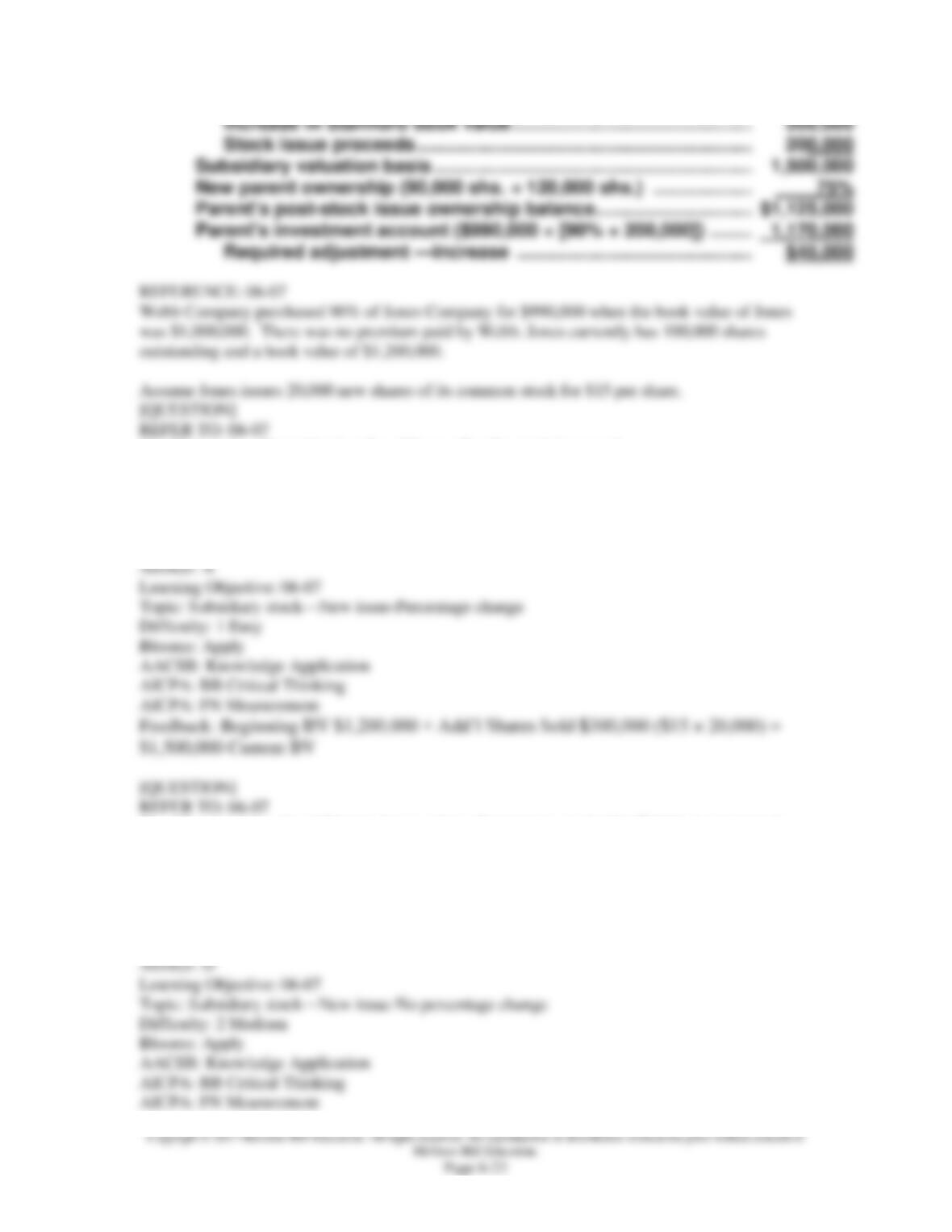
Increase in Stamford book value ………………………………………. 200,000
Stock issue proceeds ………………………………………………………. 200,000
Subsidiary valuation basis ……………………………………………………. 1,500,000
New parent ownership (90,000 shs. ÷ 120,000 shs.) ………………. 75%
Parent’s post-stock issue ownership balance ………………………… $1,125,000
Parent’s investment account ($990,000 + [90% × 200,000]) …….. 1,170,000
Required adjustment —increase ……………………………………… $45,000
REFERENCE: 06-07
Webb Company purchased 90% of Jones Company for $990,000 when the book value of Jones
was $1,000,000. There was no premium paid by Webb. Jones currently has 100,000 shares
outstanding and a book value of $1,200,000.
Assume Jones issues 20,000 new shares of its common stock for $15 per share.
[QUESTION]
REFER TO: 06-07
50. What is the adjusted book value of Jones after the stock issuance?
A) $1,500,000.
B) $1,200,000.
C) $1,350,000.
D) $1,080,000.
E) $1,335,000.
51. After acquiring the additional shares, what adjustment is needed for Webb’s investment in
Jones account?
A) $270,000 increase.
B) $270,000 decrease.
C) $ 30,000 increase.
D) $ 30,000 decrease.
E) No adjustment is necessary.
Copyright © 2017 McGraw-Hill Education. All rights reserved. No reproduction or distribution without the prior written consent of
McGraw-Hill Education.
Page 6-24
Feedback:
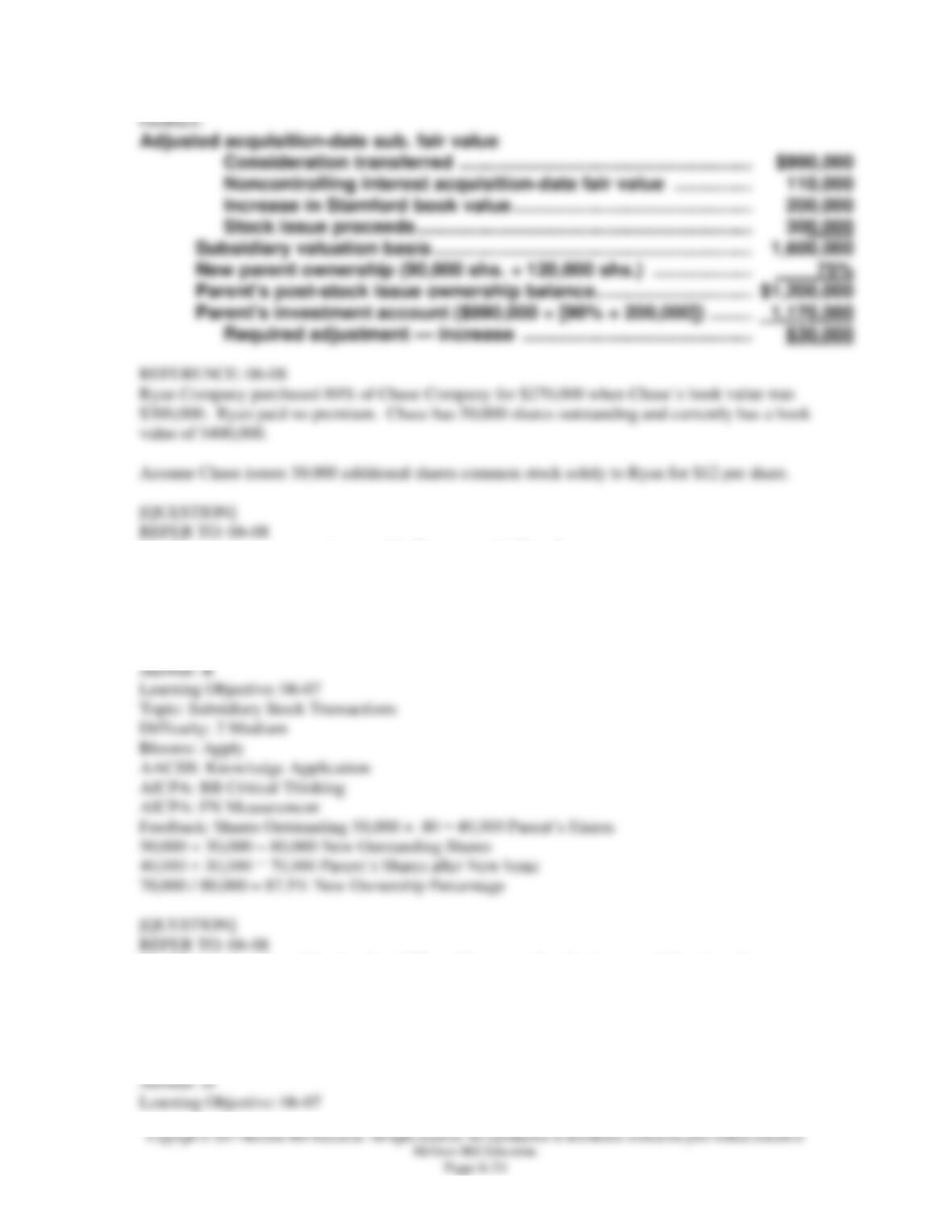
Adjusted acquisition-date sub. fair value
Consideration transferred ……………………………………………….. $990,000
Noncontrolling interest acquisition-date fair value …………… 110,000
Increase in Stamford book value ………………………………………. 200,000
Stock issue proceeds ………………………………………………………. 300,000
Subsidiary valuation basis ……………………………………………………. 1,600,000
New parent ownership (90,000 shs. ÷ 120,000 shs.) ………………. 75%
Parent’s post-stock issue ownership balance ………………………… $1,200,000
Parent’s investment account ($990,000 + [90% × 200,000]) …….. 1,170,000
Required adjustment — increase …………………………………….. $30,000
REFERENCE: 06-08
Ryan Company purchased 80% of Chase Company for $270,000 when Chase’s book value was
$300,000. Ryan paid no premium. Chase has 50,000 shares outstanding and currently has a book
value of $400,000.
Assume Chase issues 30,000 additional shares common stock solely to Ryan for $12 per share.
[QUESTION]
REFER TO: 06-08
52. What is the new percent ownership Ryan owns in Chase?
A) 80.0%.
B) 87.5%.
C) 90.0%.
D) 75.0%.
E) 82.5%.
53. What is the adjusted book value of Chase Company after the issuance of the shares?
A) $608,000.
B) $720,000.
C) $680,000.
D) $760,000.
E) $400,000.
Copyright © 2017 McGraw-Hill Education. All rights reserved. No reproduction or distribution without the prior written consent of
McGraw-Hill Education.
Page 6-25
Topic: Subsidiary Stock Transactions
Difficulty: 1 Easy
Blooms: Apply
AACSB: Knowledge Application
AICPA: BB Critical Thinking
AICPA: FN Measurement
Feedback: Beginning carrying amount $400,000 + Additional Shares Sold $360,000 ($12
× 30,000) = $760,000 Current carrying amount
[QUESTION]
REFER TO: 06-08
54. After acquiring the additional shares, what adjustment is needed for Ryan’s investment in
Chase account?
A) $70,000 increase.
B) $70,000 decrease.
C) $12,188 decrease.
D) $12,188 increase.
E) No adjustment is necessary.
55. What should the adjusted book value of Chase be after the treasury shares were purchased?
A) $400,000.
B) $480,000.
C) $320,000.
D) $336,000.
E) $464,000.
56. What is Ryan’s percent ownership in Chase after the acquisition of the treasury shares
(rounded)?
A) 80%.
B) 95%.
C) 64%.
D) 76%.
E) 69%.
57. When Ryan’s new percent ownership is rounded to a whole number, what adjustment is
needed for Ryan’s investment in Chase account?
A) $16,000 decrease.
B) $60,000 decrease.
C) $46,000 increase.
D) $46,000 decrease.
E) No adjustment is necessary.
Copyright © 2017 McGraw-Hill Education. All rights reserved. No reproduction or distribution without the prior written consent of
McGraw-Hill Education.
Page 6-27
AICPA: FN Measurement
Feedback: Investment balance = 270,000 + (80% x 100,000 increase in book value) =
350,000. Adjusted sub value = (400,000 – 80,000) = 320,000. 320,000 x new ownership
percentage 95% = 304,000. 350,000 – 304,000 = 46,000 decrease in investment account
[QUESTION]
58. A variable interest entity can take all of the following forms except a(n):
A) Trust.
B) Partnership.
C) Joint venture.
D) Corporation.
E) Estate.
59. All of the following are examples of variable interests except:
A) Guarantees of debt.
B) Stock options.
C) Lease residual value guarantees.
D) Participation rights.
E) Asset purchase options.
60. Which of the following is not a potential loss or return of a variable interest entity?
A) Entitles holder to residual profits.
B) Entitles holder to benefit from increases in asset fair value.
C) Entitles holder to receive shares of common stock.
D) If the variable interest entity cannot repay liabilities, honoring a debt guarantee will produce a
loss.
E) If leased asset declines below the residual value, honoring the guarantee will produce a loss.

Copyright © 2017 McGraw-Hill Education. All rights reserved. No reproduction or distribution without the prior written consent of
McGraw-Hill Education.
Page 6-28
AACSB: Reflective Thinking
AICPA: BB Critical Thinking
AICPA: FN Measurement
[QUESTION]
61. Which of the following characteristics is not indicative of an enterprise qualifying as a
primary beneficiary with a controlling financial interest in a variable interest entity?
A) The power to direct the most significant economic performance activities.
B) The power through voting or similar rights to direct activities, which significantly impact
economic performance.
C) The obligation to absorb potentially significant losses of the entity.
D) No ability to make decisions about the entity’s activities.
E) The right to receive potentially significant benefits of the entity.
62. Which of the following statements is false concerning variable interest entities (VIEs)?
A) Sometimes VIEs do not have independent management.
B) Most VIEs are established for valid business purposes.
C) VIEs may be formed as a source of low-cost financing.
D) VIEs have little need for voting stock.
E) A VIE cannot take the legal form of a partnership or corporation.
63. Which of the following statements is true concerning variable interest entities (VIEs)?
(1.) The role of the VIE equity investors can be fairly minor.
(2.) A VIE may be created specifically to benefit the business enterprise that established it with
low-cost financing.
(3.) VIE governing agreements often limit activities and decision-making.
(4.) VIEs usually have a well-defined and limited business activity.
A) 2 and 4.
B) 2, 3, and 4.
C) 1, 2, and 4.
D) 1, 2, and 3.
E) 1, 2, 3, and 4.

Copyright © 2017 McGraw-Hill Education. All rights reserved. No reproduction or distribution without the prior written consent of
McGraw-Hill Education.
Page 6-29
Answer: E
Learning Objective: 06-01
Topic: VIE―Characteristics
Difficulty: 1 Easy
Blooms: Remember
AACSB: Reflective Thinking
AICPA: BB Critical Thinking
AICPA: FN Measurement
[QUESTION]
64. Which of the following is not a factor that indicates a business enterprise that establishes a
variable interest entity (VIE) should consolidate such VIE with its own financial statements?
A) The business enterprise establishing a VIE has the obligation to absorb potentially significant
losses of the VIE.
B) The business enterprise establishing a VIE receives risks and rewards of the VIE in proportion
to equity ownership.
C) The business enterprise establishing a VIE has the right to receive potentially significant
benefits of the VIE.
D) The business enterprise establishing a VIE has power through voting rights to direct the
entity’s activities that significantly impact economic performance.
E) The business enterprise establishing a VIE is a primary beneficiary for the VIE.
65. A parent acquires all of a subsidiary’s common stock and 60 percent of its preferred stock.
The preferred stock has a cumulative dividend. No dividends are in arrears. How is the
noncontrolling interest in the subsidiary’s net income assigned?
A) The noncontrolling interest in consolidated net income is assigned as 40 percent of the value
of the preferred stock, based on an allocation between common stock and preferred stock.
B) There is no allocation to the noncontrolling interest because the parent owns 100% of the
common stock and net income belongs to the controlling interest.
C) The noncontrolling interest in consolidated net income is assigned as 40 percent of the
preferred stock dividends.
D) The noncontrolling interest in consolidated net income is assigned as 40 percent of the
subsidiary’s income before preferred stock dividends.
E) The noncontrolling interest in consolidated net income is assigned as 40 percent of the
subsidiary’s income after subtracting preferred stock dividends.
Copyright © 2017 McGraw-Hill Education. All rights reserved. No reproduction or distribution without the prior written consent of
McGraw-Hill Education.
Page 6-30
AICPA: FN Measurement
[QUESTION]
66. A parent acquires 70% of a subsidiary’s common stock and 60 percent of its preferred stock.
The preferred stock is noncumulative. The current year’s dividend was paid. How is the
noncontrolling interest in the subsidiary’s net income assigned?
A) The noncontrolling interest in consolidated net income is assigned as 40 percent of the value
of the preferred stock, based on an allocation between common stock and preferred stock and
their relative par values.
B) There is no allocation to the noncontrolling interest because there are no dividends in arrears.
C) The noncontrolling interest in consolidated net income is assigned as 40 percent of the
preferred stock dividends.
D) The noncontrolling interest in consolidated net income is assigned as 40 percent of the
preferred stock dividends plus 30% of the subsidiary’s income after subtracting all preferred
stock dividends.
E) The noncontrolling interest in consolidated net income is assigned as 30 percent of the
subsidiary’s income after subtracting 60% of preferred stock dividends.
67. Wolff Corporation owns 70 percent of the outstanding stock of Donald, Inc. During the
current year, Donald made $75,000 in sales to Wolff. How does this transfer affect the
consolidated statement of cash flows?
A) Included as a decrease in the investing section.
B) Included as an increase in the operating section.
C) Included as a decrease in the operating section.
D) Included as an increase in the investing section.
E) Not reported in the consolidated statement of cash flows.
68. MacDonald, Inc. owns 80 percent of the outstanding stock of Stahl Corporation. During the
current year, Stahl made $125,000 in sales to MacDonald. How does this transfer affect the
consolidated statement of cash flows?
A) Include 80 percent as a decrease in the investing section.
B) Include 100 percent as a decrease in the investing section.
C) Include 80 percent as a decrease in the operating section.
D) Include 100 percent as an increase in the operating section.
E) Not reported in the consolidated statement of cash flows.
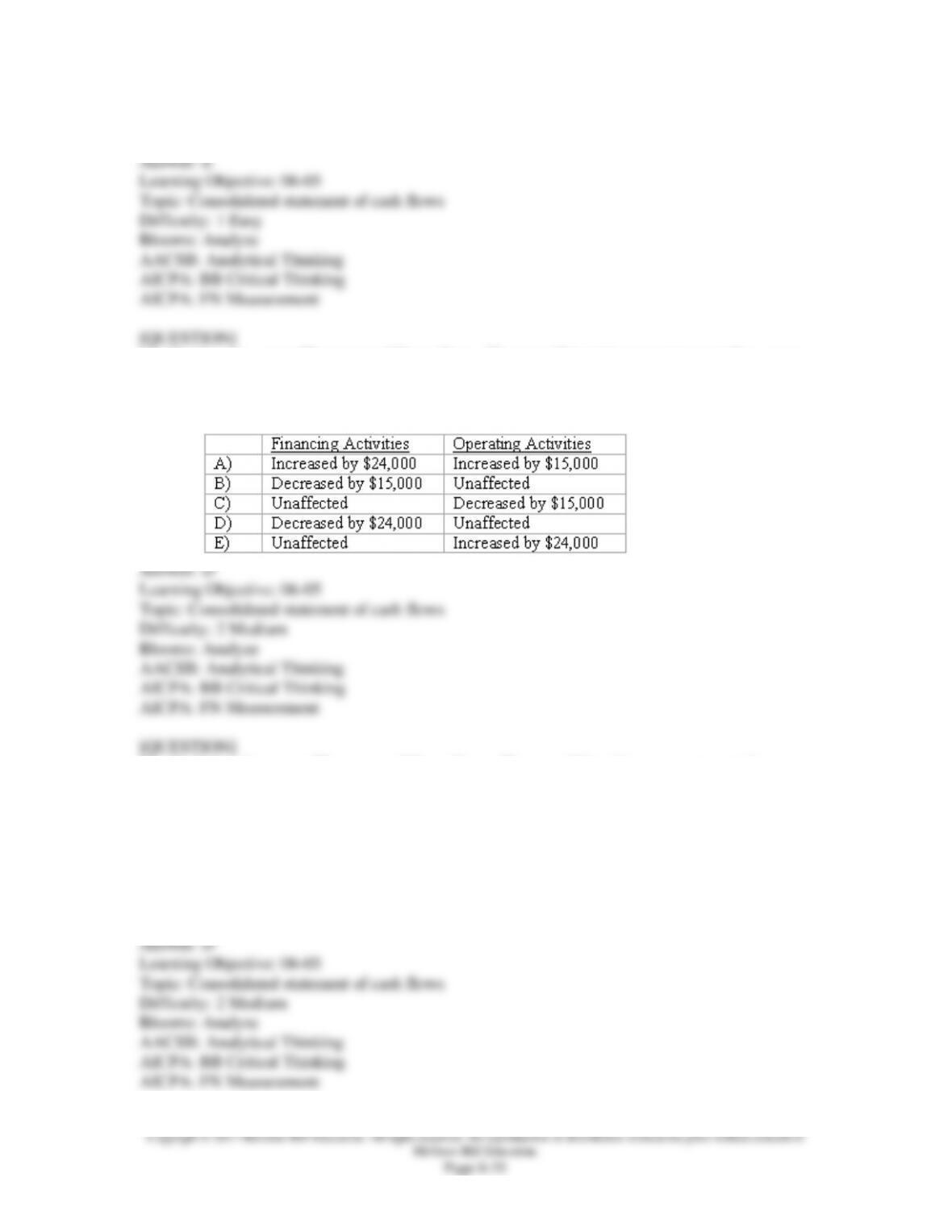
69. Pursley, Inc. owns 70 percent of Harry Corp. The consolidated income statement for a year
reports $50,000 Noncontrolling Interest in Harry Corp.’s Net Income. Harry paid dividends in
the amount of $80,000 for the year. What are the effects of these transactions in the consolidated
statement of cash flows for the year?
70. Goehring, Inc. owns 70 percent of Harry Corp. The consolidated income statement for a year
reports $40,000 Noncontrolling Interest in Harry Corp.’s Net Income. Harry paid dividends in
the amount of $100,000 for the year. What are the effects of these transactions in the
consolidated statement of cash flows for the year?
A) Increase in the financing section of $70,000, and decrease in the operating section of $30,000.
B) Increase in the operating section of $70,000, and decrease in the financing section of $30,000.
C) Increase in the operating section of $70,000.
D) Decrease in the financing section of $30,000.
E) No effects.
Copyright © 2017 McGraw-Hill Education. All rights reserved. No reproduction or distribution without the prior written consent of
McGraw-Hill Education.
Page 6-32
REFERENCE: 06-10
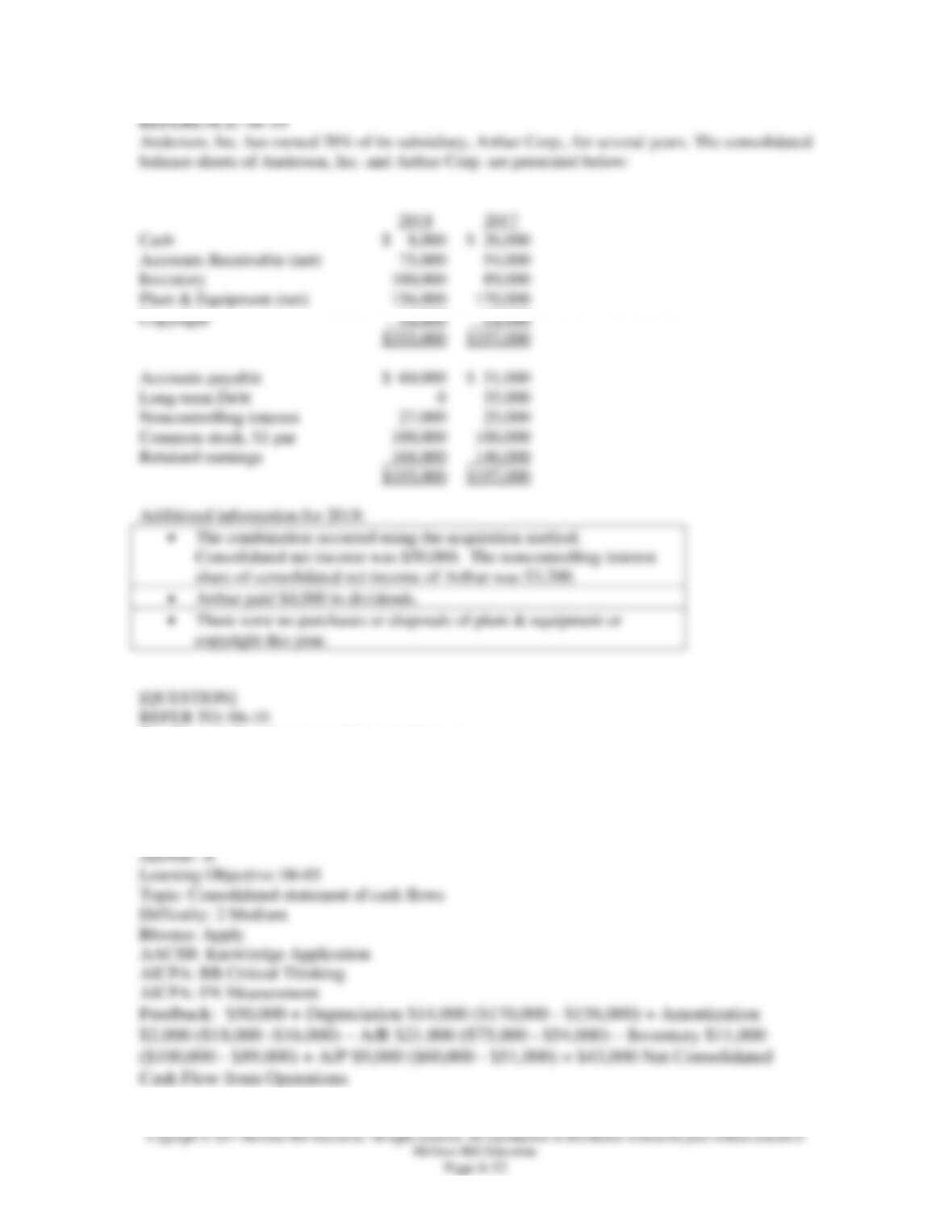
Anderson, Inc. has owned 70% of its subsidiary, Arthur Corp., for several years. The consolidated
balance sheets of Anderson, Inc. and Arthur Corp. are presented below:
2018
2017
Cash
$ 8,000
$ 26,000
Accounts Receivable (net)
75,000
54,000
Inventory
100,000
89,000
Plant & Equipment (net)
156,000
170,000
Copyright
16,000
18,000
$355,000
$357,000
Accounts payable
$ 60,000
$ 51,000
Long-term Debt
0
35,000
Noncontrolling interest
27,000
25,000
Common stock, $1 par
100,000
100,000
Retained earnings
168,000
146,000
$355,000
$357,000
Additional information for 2018:
• The combination occurred using the acquisition method.
Consolidated net income was $50,000. The noncontrolling interest
share of consolidated net income of Arthur was $3,200.
• Arthur paid $4,000 in dividends.
• There were no purchases or disposals of plant & equipment or
copyright this year.
[QUESTION]
REFER TO: 06-10
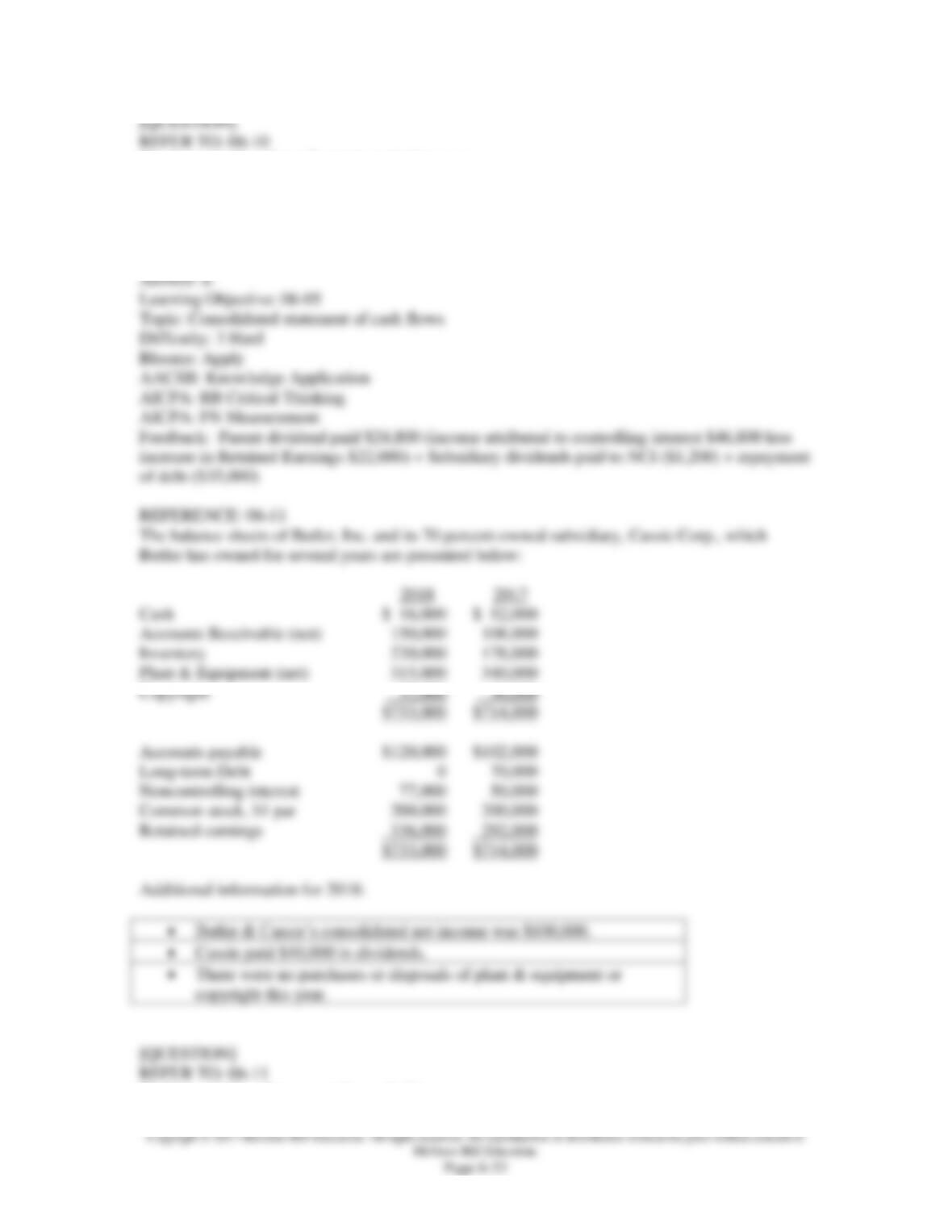
71. Net cash flow from operating activities was:
A) $43,000.
B) $44,800.
C) $46,200.
D) $50,000.
E) $25,000.
Copyright © 2017 McGraw-Hill Education. All rights reserved. No reproduction or distribution without the prior written consent of
McGraw-Hill Education.
Page 6-33
[QUESTION]
REFER TO: 06-10
72. Net cash flow from financing activities was:
A) $(28,000).
B) $(35,000).
C) $(13,000).
D) $(63,000).
E) $(61,000).
73. Net cash flow from operating activities was:
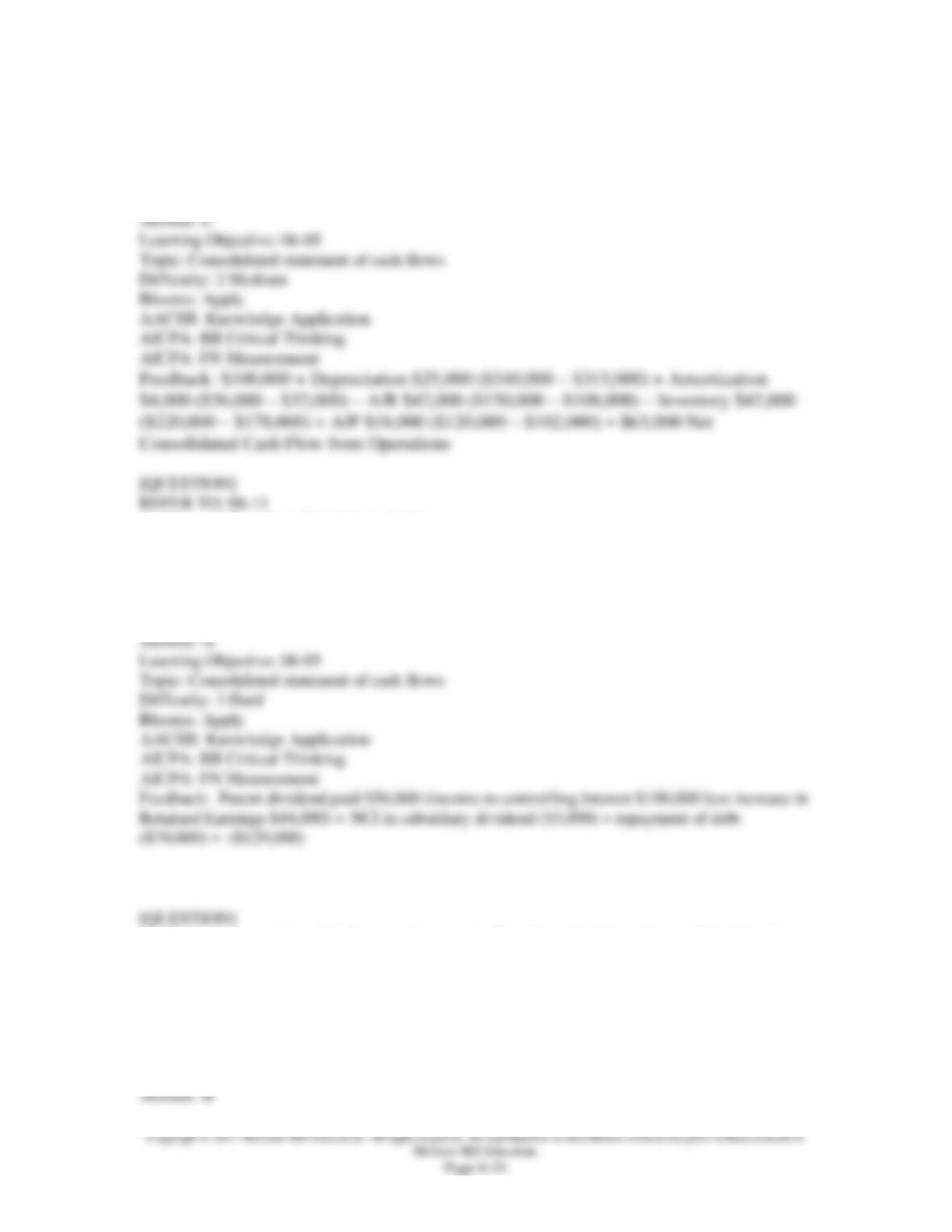
A) $92,000.
B) $27,000.
C) $63,000.
D) $29,000.
E) $34,000.
74. Net cash flow from financing activities was:
A) $(129,000).
B) $ (96,000).
C) $(300,000).
D) $ (80,000).
E) $(126,000).
75. How do outstanding subsidiary stock warrants affect the calculation of consolidated earnings
per share?
A) They will be included in both basic and diluted earnings per share if they are dilutive.
B) They will only be included in diluted earnings per share if they are dilutive.
C) They will only be included in basic earnings per share if they are dilutive.
D) Only the warrants owned by the parent company affect consolidated earnings per share.
E) Because the warrants are for subsidiary shares, there will be no effect on consolidated earnings
per share.
Copyright © 2017 McGraw-Hill Education. All rights reserved. No reproduction or distribution without the prior written consent of
McGraw-Hill Education.
Page 6-35
Learning Objective: 06-06
Topic: EPS―Consolidated diluted EPS
Difficulty: 2 Medium
Blooms: Remember
AACSB: Reflective Thinking
AICPA: BB Critical Thinking
AICPA: FN Measurement
[QUESTION]
76. A parent company owns a controlling interest in a subsidiary and on the last day of the year,
the subsidiary issues new shares entirely to outside parties at $33 per share. The parent still holds
control over the subsidiary. The adjusted subsidiary value at the date of the new stock issuance
was $27 per share. Which of the following statements is true?
A) Since the sale was made at the end of the year, the parent’s investment account is not affected.
B) Since the shares were sold for more than the adjusted subsidiary value per share, the parent’s
investment account must be increased.
C) Since the shares were sold for more than the adjusted subsidiary value per share, the parent’s
investment account must be decreased.
D) Since the shares were sold for more than the adjusted subsidiary value per share, but the
parent did not buy any of the shares, the parent’s investment account is not affected.
E) None of these answer choices are correct.
77. A parent company owns a controlling interest in a subsidiary whose stock has a valuation
basis of $27 per share. On the last day of the year, the subsidiary issues new shares entirely to
outside parties at $25 per share. The parent still holds control over the subsidiary. Which of the
following statements is true?
A) Since the sale was made at the end of the year, the parent’s investment account is not affected.
B) Since the shares were sold for less than the adjusted subsidiary value per share, the parent’s
investment account must be increased.
C) Since the shares were sold for less than the adjusted subsidiary value per share, the parent’s
investment account must be decreased.
D) Since the shares were sold for less than the adjusted subsidiary value per share, but the parent
did not buy any of the shares, the parent’s investment account is not affected.
E) None of these answer choices are correct.
78. A parent company owns a 70 percent interest in a subsidiary whose stock has a valuation
basis of $27 per share. On the last day of the year, the subsidiary issues new shares for $27 per
share, and the parent buys its 70 percent interest in the new shares. Which of the following
statements is true?
A) Since the sale was made at the end of the year, the parent’s investment account is not affected.
B) Since the shares were sold for the same per share amount as the the adjusted subsidiary value
per share, the parent’s investment account must be increased.
C) Since the shares were sold for the same per share amount as the the adjusted subsidiary value
per share, the parent’s investment account must be decreased.
D) Since the shares were sold for the same per share amount as the the adjusted subsidiary value
per share, and the parent bought 70 percent of the shares, the parent’s investment account is not
affected except for the total acquisition amount for the new shares.
E) None of these answer choices are correct.
79. Carlson, Inc. owns 80 percent of Madrid, Inc. Carlson reports net income for 2018 (without
consideration of its investment in Madrid, Inc.) of $1,500,000. For the same year, Madrid reports
net income of $705,000. Carlson had bonds payable outstanding on January 1, 2018 with a
carrying value of $1,200,000. Madrid acquired the bonds on the open market on January 3, 2018
for $1,090,000. For the year 2018, Carlson reported interest expense on the bonds in the amount
of $96,000, while Madrid reported interest income of $94,000 for the same bonds. Assuming
there are no excess amortizations or other intra-entity transactions, what is Carlson’s share of
consolidated net income?
A) $2,064,000.
B) $2,066,000.
C) $2,176,000.
D) $2,207,000.
E) $2,317,000.
Copyright © 2017 McGraw-Hill Education. All rights reserved. No reproduction or distribution without the prior written consent of
McGraw-Hill Education.
Page 6-37
REFERENCE: 06-12
On January 1, 2018, Harrison Corporation spent $2,600,000 to acquire control over Involved, Inc.
This price was based on paying $750,000 for 30 percent of Involved’s preferred stock, and
$1,850,000 for 80 percent of its outstanding common stock. As of the date of the acquisition,
Involved’s stockholders’ equity accounts were as follows:
[QUESTION]
REFER TO: 06-12
80. What is the total acquisition-date fair value of Involved?
A) $2,600,000
B) $4,812,500
C) $3,062,500
D) $2,312,500
E) $3,250,000
81. Assuming Involved’s accounts are correctly valued within the company’s financial
statements, what amount of goodwill should be recognized for the Investment in Involved?
A) $(100,000.)
B) $ 0.
C) $ 200,000.
D) $ 812,500.
E) $2,112,500.
Copyright © 2017 McGraw-Hill Education. All rights reserved. No reproduction or distribution without the prior written consent of
McGraw-Hill Education.
Page 6-38
Feedback: Common Stock Noncontrolling Interest at Acquisition = $1,850,000 / .80 = $2,312,500
× .20 = $462,500
Preferred Stock Noncontrolling Interest at Acquisition = $750,000 / .30 = $2,500,000 × .70 =
$1,750,000
(CS Parent $1,850,000) + (CS NCI $462,500) + (PS Parent $750,000) + (PS NCI $1,750,000) =
$4,812,500 FV of Sub at Acquisition
FV $4,812,500 – carrying amount $4,000,000 = $812,500 Goodwill
[QUESTION]
82. Johnson, Inc. owns control over Kaspar, Inc. Johnson reports sales of $400,000 during 2018
while Kaspar reports $250,000. Kaspar transferred inventory during 2018 to Johnson at a price of
$50,000. On December 31, 2018, 30% of the transferred goods are still held in Johnson’s
inventory. Consolidated accounts receivable on January 1, 2018 was $120,000, and on December
31, 2018 is $130,000. Johnson uses the direct approach in preparing the statement of cash flows.
How much is cash collected from customers in the consolidated statement of cash flows?
A) $590,000.
B) $610,000.
C) $625,000.
D) $635,000.
E) $650,000.
83. Which of the following variable interests entitles a holder to residual profits, losses, and
dividends?
A) Participation rights
B) Lease residual value guarantees
C) Common stock
D) Asset purchase options
E) Subordinated debt instruments
84. Which of the following statements regarding consolidation of a VIE with its primary
beneficiary is true?
A) The consolidation of a VIE with its primary beneficiary requires the business enterprise to
follow a separate process than the one required for consolidations based on voting interests.
B) All intra-entity transactions between the primary beneficiary and the VIE are included in the
consolidation.
C) Only intra-entity transactions between the primary beneficiary and the VIE resulting from
intra-entity transfers are eliminated in the consolidation.
D) VIEs with controlling interests must include one hundred percent of the primary beneficiary’s
net income in a consolidation.
E) The allocation of the VIE’s net income is based on an analysis of the underlying contractual
arrangements between the primary beneficiary and other holders of variable interests.
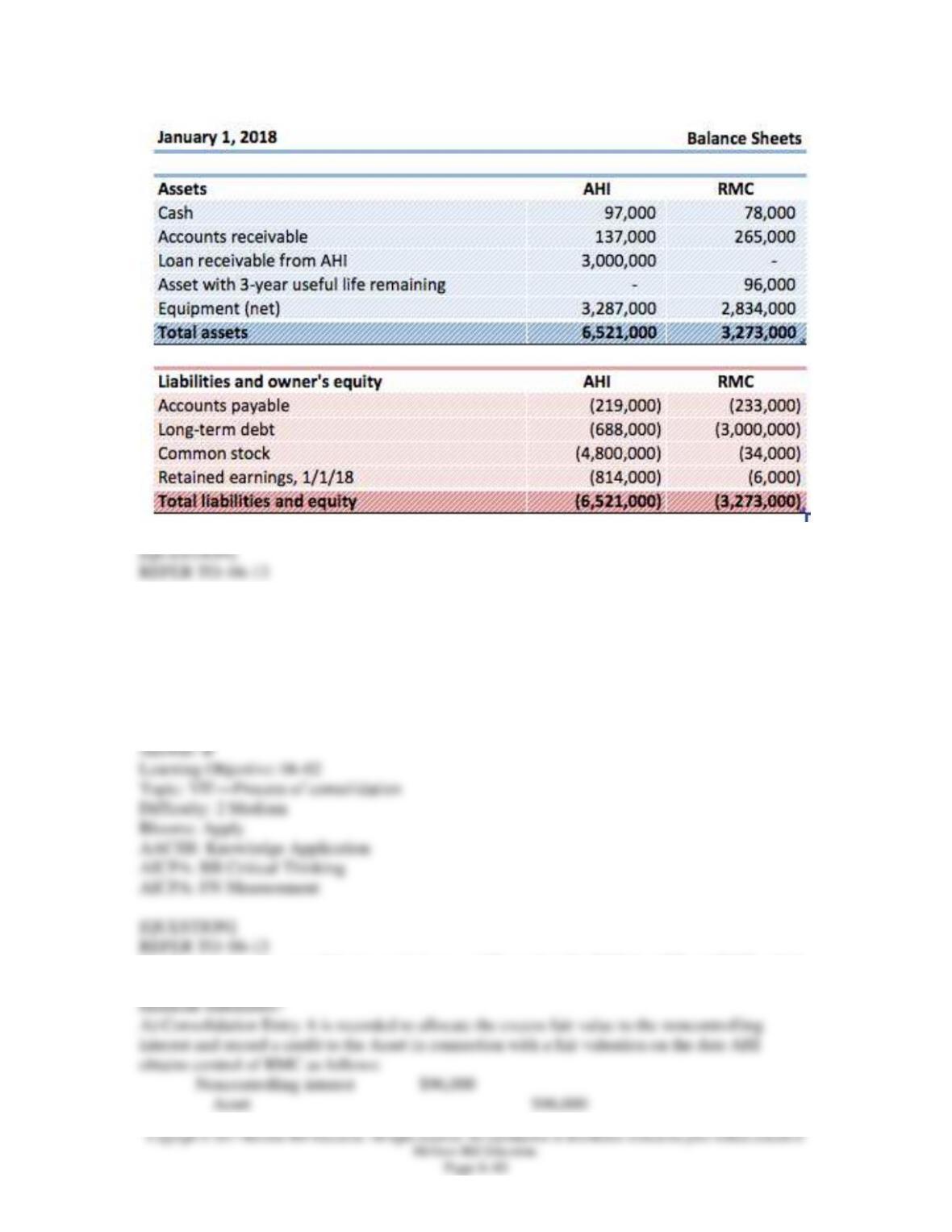
85. With respect to the acquisition-date consolidation worksheet, which of the following is
accurate?
A) The value of the noncontrolling interest is $40,000.
B) The total of all adjustments and eliminations equal $3,136,000.
C) The consolidated total long-term debt equals $3,688,000.
D) The total consolidated assets equal $9,794,000.
E) The total liabilities and equity on a consolidated basis equals $5,614,000.
86. In preparing the consolidation worksheet as of December 31, 2018 for AHI and RMC, which
of the following worksheet entry descriptions reflects what AHI should do to consolidate the