File: Chapter 06 – Variable Interest Entities, Intra-Entity Debt, Consolidated Cash Flows,
1. On January 1, 2018, Riley Corp. acquired some of the outstanding bonds of one of its
subsidiaries. The bonds had a carrying value of $421,620, and Riley paid $401,937 for them.
How should you account for the difference between the carrying value and the purchase price in
the consolidated financial statements for 2018?
A) The difference is added to the carrying value of the debt.
B) The difference is deducted from the carrying value of the debt.
C) The difference is treated as a loss from the extinguishment of the debt.
D) The difference is treated as a gain from the extinguishment of the debt.
E) The difference does not influence the consolidated financial statements.
2. Regency Corp. recently acquired $500,000 of the bonds of Safire Co., one of its subsidiaries,
paying more than the carrying value of the bonds. According to the most practical view of this
intra-entity transaction, to whom should the loss be attributed?
A) To Safire because the bonds were issued by Safire.
B) The loss should be allocated between Safire and Regency based on the purchase price and the
original face value of the debt.
C) The loss should be amortized over the life of the bonds and need not be attributed to either
party.
D) The loss should be deferred until it can be determined to whom the attribution can be made.
E) To Regency because Regency is the controlling party in the business combination.
3. Which one of the following characteristics of preferred stock would make the stock a dilutive
security for purposes of calculating earnings per share?
A) The preferred stock is callable.
B) The preferred stock is convertible.
C) The preferred stock is cumulative.
D) The preferred stock is noncumulative.
E) The preferred stock is participating.
4. Where do dividends paid to the noncontrolling interest of a subsidiary appear on a
consolidated statement of cash flows?
A) Cash flows from operating activities.
B) Cash flows from investing activities.
C) Cash flows from financing activities.
D) Supplemental schedule of noncash investing and financing activities.
E) They do not appear in the consolidated statement of cash flows.
5. Where do dividends paid by a subsidiary to the parent company appear in a consolidated
statement of cash flows?
A) Cash flows from operating activities.
B) Cash flows from investing activities.
C) Cash flows from financing activities.
D) Supplemental schedule of noncash investing and financing activities.
E) They do not appear in the consolidated statement of cash flows.
6. Where do intra-entity transfers of inventory appear in a consolidated statement of cash flows?
A) They do not appear in the consolidated statement of cash flows.
B) Supplemental schedule of noncash investing and financing activities.
C) Cash flows from operating activities.
D) Cash flows from investing activities.
E) Cash flows from financing activities.
7. How do intra-entity transfers of inventory affect the preparation of a consolidated statement of
cash flows?
A) They must be added in calculating cash flows from investing activities.
B) They must be deducted in calculating cash flows from investing activities.
C) They must be added in calculating cash flows from operating activities.
D) Because the consolidated balance sheet and income statement are used in preparing the
consolidated statement of cash flows, no special elimination is required.
E) They must be deducted in calculating cash flows from operating activities.
8. How would consolidated earnings per share be calculated if the subsidiary has no convertible
securities or warrants?
A) Parent’s earnings per share plus subsidiary’s earnings per share.
B) Parent’s net income divided by parent’s number of shares outstanding.
C) Consolidated net income divided by parent’s number of shares outstanding.
D) Average of parent’s earnings per share and subsidiary’s earnings per share.
E) Consolidated income divided by total number of shares outstanding for the parent and
subsidiary.
The balance in Riney’s Investment in Garvin Co. account was $552,000, and the noncontrolling
interest was $138,000. On January 1, 2018, Garvin Co. sold 10,000 shares of previously unissued
common stock for $15 per share. Riney did not acquire any of these shares.
[QUESTION]
REFER TO: 06-01
9. What is the balance in Riney’s “Investment in Garvin Co. Account” following the sale of the
10,000 shares of common stock?
A) $552,000.
B) $560,000.
C) $460,000.
D) $404,000.
E) $672,000.
10. What amount should be attributed to the Noncontrolling Interest in Garvin Co. following the
sale of the 10,000 shares of common stock?
A) $288,000.
B) $101,000.
C) $280,000.
D) $230,000.
E) $168,000.
Common stock ($5 par value)
$ 250,000
Additional paid
–
in capital
110,000
Retained earnings
330,000
Total stockholders’ equity
$ 690,000
Copyright © 2017 McGraw-Hill Education. All rights reserved. No reproduction or distribution without the prior written consent of
McGraw-Hill Education.
Page 6-5
Total Equity at Acquisition = $690,000 + Equity Added by Stock Offering (10,000 × $15)
$150,000 = Total Equity after Stock Offering $840,000 × 20,000/60,000 = $280,000
Noncontrolling Interest
[QUESTION]
11. Rojas Co. owned 7,000 shares (70%) of the outstanding 10%, $100 par, preferred stock and
60% of the outstanding common stock of Brett Co. Assuming there are no excess amortizations
or intra-entity transactions, and Brett reports net income of $780,000, what is the noncontrolling
interest in the subsidiary’s income?
A) $234,000.
B) $273,000.
C) $302,000.
D) $312,000.
E) $284,000.
12. What would Knight Co. report as consolidated basic earnings per share (rounded)?
A) $6.37
B) $6.40
C) $7.00
D) $5.68
E) $6.00
Copyright © 2017 McGraw-Hill Education. All rights reserved. No reproduction or distribution without the prior written consent of
McGraw-Hill Education.
Page 6-6
Blooms: Apply
AACSB: Knowledge Application
AICPA: BB Critical Thinking
AICPA: FN Measurement
Feedback: Sub net income (300,000) – preferred divs(4,000) = $296,000 x 80% = 236,800
included in consolidated EPS. Parent net income (400,000)+ portion of sub net income =
(400,000 + 236,800) / 100,000 shares = $6.37
[QUESTION]
REFER TO: 06-02
13. What would Knight Co. report as consolidated diluted earnings per share (rounded)?
A) $4.00.
B) $. 4.71
C) $8.71.
D) $5.89.
E) $6.37.
14. Campbell Inc. owned all of Gordon Corp. For 2018, Campbell reported net income (without
consideration of its investment in Gordon) of $280,000 while the subsidiary reported $112,000.
There are no excess amortizations associated with this consolidation. The subsidiary had bonds
payable outstanding on January 1, 2018, with a book value of $297,000. The parent acquired the
bonds on that date for $281,000. During 2018, Campbell reported interest income of $31,000
while Gordon reported interest expense of $29,000. What is consolidated net income for 2018?
A) $406,000.
B) $374,000.
C) $378,000.
D) $410,000.
E) $394,000.
Copyright © 2017 McGraw-Hill Education. All rights reserved. No reproduction or distribution without the prior written consent of
McGraw-Hill Education.
Page 6-7
Feedback: Income of the Parent $280,000 + Income of the Sub $112,000 – Difference in
Interest Income over Interest Expense on Intra-Entity Bonds ($31,000 – $29,000) $2,000
+ Gain on Bonds Purchase ($297,000 – $281,000) $16,000 = $406,000 Consolidated Net
Income
[QUESTION]
15. Vontkins Inc. owned all of Quasimota Co. The subsidiary had bonds payable outstanding on
January 1, 2017, with a book value of $265,000. The parent acquired the bonds on that date for
$288,000. Subsequently, Vontkins reported interest income of $25,000 in 2017 while Quasimota
reported interest expense of $29,000. Consolidated financial statements were prepared for 2018.
What adjustment would be required for the retained earnings balance as of January 1, 2018?
A) Reduction of $27,000.
B) Reduction of $4,000.
C) Reduction of $19,000.
D) Reduction of $30,000.
E) Reduction of $20,000.
16. Tray Co. reported current earnings of $560,000 while paying $56,000 in cash dividends.
Sparrish Co. earned $140,000 in net income and distributed $14,000 in dividends. Tray held a
70% interest in Sparrish for several years, an investment that it originally acquired by transferring
consideration equal to the book value of the underlying net assets. Tray used the initial value
method to account for these shares.
On January 1, 2018, Sparrish acquired in the open market $70,000 of Tray’s 8% bonds. The
bonds had originally been issued several years ago at a price that would yield a 10% effective
interest rate. On the date of the bond purchase, the book value of the bonds payable was $67,600.
Sparrish paid $65,200 based on a 12% effective interest rate over the remaining life of the bonds.
What is the noncontrolling interest’s share of the subsidiary’s net income?
A) $42,000.
B) $37,800.
C) $39,600.
D) $40,070.
E) $44,080.
Copyright © 2017 McGraw-Hill Education. All rights reserved. No reproduction or distribution without the prior written consent of
McGraw-Hill Education.
Page 6-8
AACSB: Knowledge Application
AICPA: BB Critical Thinking
AICPA: FN Measurement
Feedback: Sub’s income $140,000 × .30 = $42,000 NCI’s Portion of Income (gain or loss
is assigned to the parent only)
[QUESTION]
17. A company had common stock with a total par value of $18,000,000 and fair value of
$62,000,000; and 7% preferred stock with a total par value of $6,000,000 and a fair value of
$8,000,000. The book value of the company was $85,000,000. Assuming ninety percent (90%)
of the company’s total equity is acquired, what amount must be attributed to the noncontrolling
interest?
A) $8,500,000.
B) $7,000,000.
C) $6,200,000.
D) $2,400,000.
E) $6,929,400.
18. Cadion Co. owned a controlling interest in Knieval Inc. Cadion reported sales of $420,000
during 2018 while Knieval reported $280,000. Inventory costing $28,000 was transferred from
Knieval to Cadion (upstream) during the year for $56,000. Of this amount, twenty-five percent
was still in ending inventory at year’s end. Total receivables on the consolidated balance sheet
were $112,000 at the first of the year and $154,000 at year-end. No intra-entity debt existed at
the beginning or ending of the year. Using the direct approach, what is the consolidated amount
of cash collected by the business from its customers?
A) $602,000.
B) $644,000.
C) $686,000.
D) $714,000.
E) $592,000.
Copyright © 2017 McGraw-Hill Education. All rights reserved. No reproduction or distribution without the prior written consent of
McGraw-Hill Education.
Page 6-9
Feedback: Parent’s Sales $420,000 + Sub’s Sales $280,000 – Intra-Entity Sales $56,000 –
increase in A/R $42,000 ($154,000 – $112,000) = $602,000 Consolidated Cash Collected
[QUESTION]
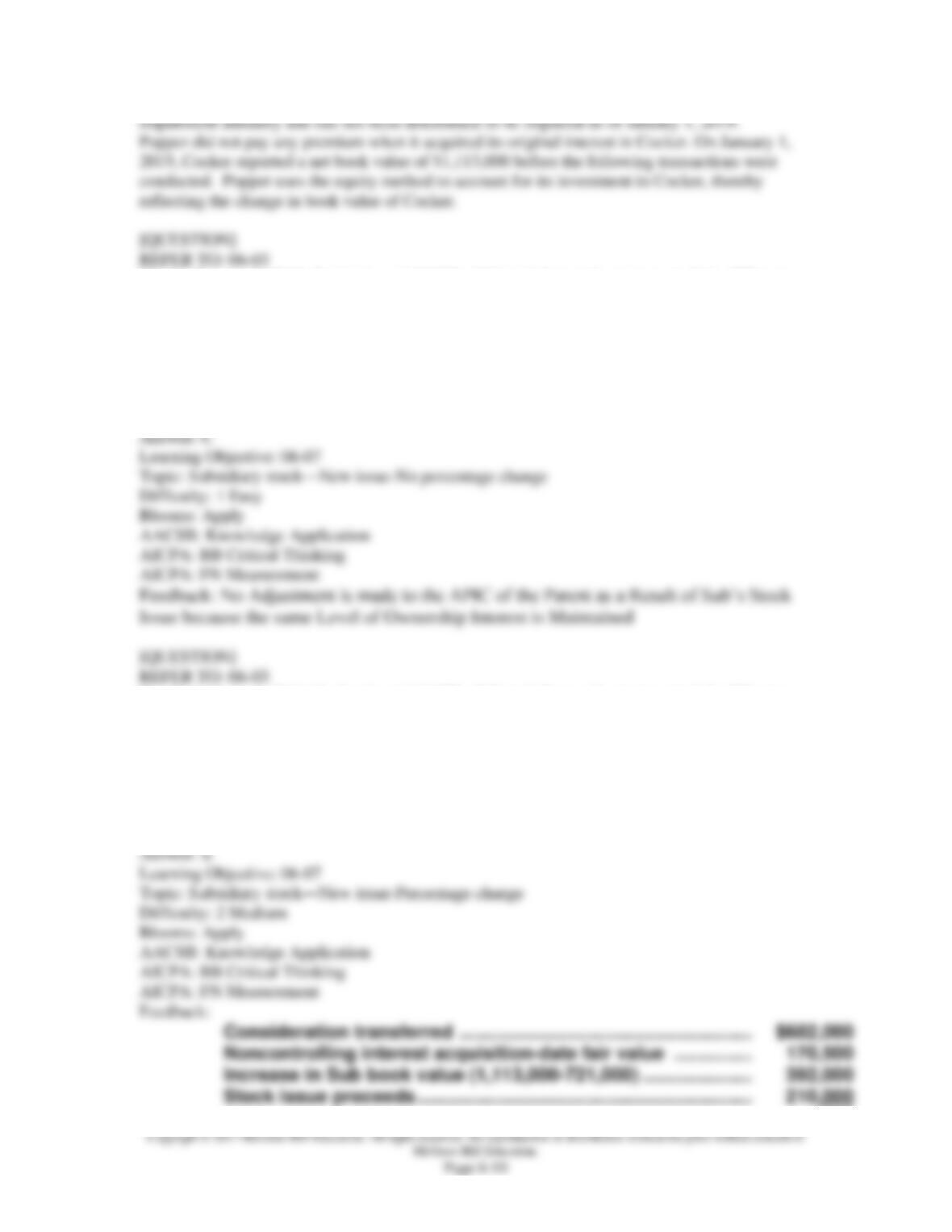
19. Parker owned all of Odom Inc. Although the Investment in Odom Inc. account had a balance
of $834,000, the subsidiary’s 12,000 shares had an underlying book value of only $56 per share.
On January 1, 2018, Odom issued 3,000 new shares to the public for $70 per share. How does
this transaction affect the Investment in Odom Inc. account?
A) It should be decreased by $210,000.
B) It should be increased by $210,000.
C) It should be increased by $168,000.
D) It should be decreased by $1,200.
E) It is not affected since the shares were sold to outside parties.
Copyright © 2017 McGraw-Hill Education. All rights reserved. No reproduction or distribution without the prior written consent of
McGraw-Hill Education.
Page 6-10
impairment annually and has not been determined to be impaired as of January 1, 2019.
Popper did not pay any premium when it acquired its original interest in Cocker. On January 1,
2019, Cocker reported a net book value of $1,113,000 before the following transactions were
conducted. Popper uses the equity method to account for its investment in Cocker, thereby
reflecting the change in book value of Cocker.
[QUESTION]
REFER TO: 06-03
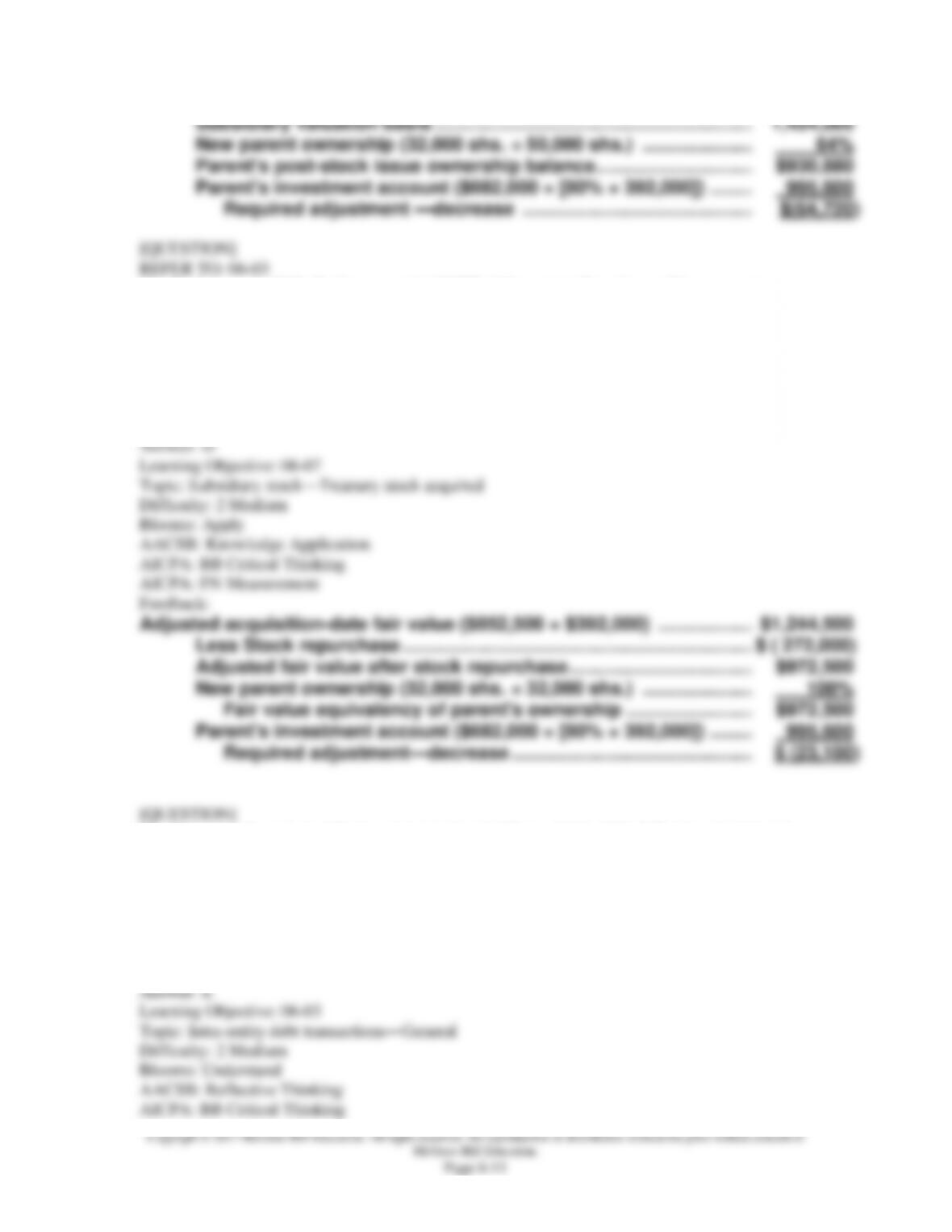
20. On January 1, 2019, Cocker issued 10,000 additional shares of common stock for $35 per
share. Popper acquired 8,000 of these shares. How would this transaction affect the additional
paid-in capital of the parent company?
A) Increase it by $28,700.
B) Increase it by $16,800.
C) $0.
D) Increase it by $280,000.
E) Increase it by $593,600.
21. On January 1, 2019, Cocker issued 10,000 additional shares of common stock for $21 per
share. Popper did not acquire any of this newly issued stock. How would this transaction affect
the additional paid-in capital of the parent company?
A) $0.
B) Decrease it by $23,240.
C) Decrease it by $68,250.
D) Decrease it by $45,060.
E) Decrease it by $64,720.
Copyright © 2017 McGraw-Hill Education. All rights reserved. No reproduction or distribution without the prior written consent of
McGraw-Hill Education.
Page 6-11
Subsidiary valuation basis ……………………………………………………. 1,454,000
New parent ownership (32,000 shs. ÷ 50,000 shs.) ………………… 64%
Parent’s post-stock issue ownership balance ………………………… $930,880
Parent’s investment account ($682,000 + [80% × 392,000]) …….. 995,600
Required adjustment —decrease …………………………………….. $(64,720)
[QUESTION]
REFER TO: 06-03
22. On January 1, 2019, Cocker reacquired 8,000 of the outstanding shares of its own common
stock for $34 per share. None of these shares belonged to Popper. How would this transaction
have affected the additional paid-in capital of the parent company?
A) $0.
B) Decrease it by $32,900.
C) Decrease it by $45,700.
D) Decrease it by $23,100.
E) Decrease it by $50,500.
23. If new bonds are issued from a parent to its subsidiary, which of the following statements is
false?
A) Any premium or discount on bonds payable is exactly offset by a premium or discount on
bond investment.
B) There will be $0 net gain or loss on the bond transaction.
C) Interest expense needs to be eliminated on the consolidated income statement.
D) Interest revenue needs to be eliminated on the consolidated income statement.
E) A net gain or loss on the bond transaction will be reported.
Copyright © 2017 McGraw-Hill Education. All rights reserved. No reproduction or distribution without the prior written consent of
McGraw-Hill Education.
Page 6-12
AICPA: FN Measurement
[QUESTION]
24. The accounting problems encountered in consolidated intra-entity debt transactions when the
debt is acquired by an affiliate from an outside party include all of the following except:
A) Both the investment and debt accounts have to be eliminated now and for each future
consolidated financial statement despite containing differing balances.
B) Subsequent interest revenue/expense must be removed although these balances fail to agree in
amount.
C) A gain or loss must be recognized by both parent and subsidiary companies.
D) Changes in the investment, debt, interest revenue, and interest expense accounts occur
constantly because of the amortization process.
E) The gain or loss on the retirement of the debt must be recognized by the business combination
in the year the debt is acquired, even though this balance does not appear on the financial records
of either company.
25. Which of the following statements is true concerning the acquisition of existing debt of a
consolidated affiliate in the year of the debt acquisition?
A) Recognition of any gain or loss is deferred until the debt is extinguished for purposes of
reporting such debt on consolidated financial statements.
B) Any gain or loss is recognized in the year of acquisition on a consolidated income statement.
C) Interest revenue generated from the debt of an affiliate is recognized on a consolidated income
statement.
D) Interest expense recognized from carrying debt instruments is recognized on a consolidated
income statement.
E) Consolidated retained earnings is adjusted to take into account the difference between the
purchase price and carrying value of the debt.
26. Which of the following statements is false regarding the assignment of a gain or loss when an
affiliate’s debt instrument is acquired on the open market?
A) Subsidiary net income is not affected by a gain on the debt transaction.
B) Subsidiary net income is not affected by a loss on the debt transaction.
C) Parent Company net income is not affected by a gain on the debt transaction.
D) Parent Company net income is not affected by a loss on the debt transaction.
E) Consolidated net income is not affected by a gain or loss on the debt transaction.
27. What would differ between a statement of cash flows for a consolidated company and an
unconsolidated company using the indirect method?
A) Parent’s dividends would be subtracted as a financing activity.
B) Gain on sale of land would be deducted from net income.
C) Noncontrolling interest in net income of subsidiary would be added to net income.
D) Proceeds from the sale of long-term investments would be added to investing activities.
E) Loss on sale of equipment would be added to net income.
28. Which of the following statements is true for a consolidated statement of cash flows?
A) Parent’s dividends and subsidiary’s dividends are deducted as a financing activity.
B) Only parent’s dividends are deducted as a financing activity.
C) Parent’s dividends and its share of subsidiary’s dividends are deducted as a financing activity.
D) All of parent’s dividends and noncontrolling interest of subsidiary’s dividends are deducted as
a financing activity.
E) Neither parent’s nor subsidiary’s dividends are deducted as a financing activity.
29. In reporting consolidated earnings per share when there is a wholly owned subsidiary, which
of the following statements is true?
A) Parent company earnings per share equals consolidated earnings per share when the equity
method is used.
B) Parent company earnings per share is equal to consolidated earnings per share when the initial
value method is used.
C) Parent company earnings per share is equal to consolidated earnings per share when the partial
equity method is used and acquisition-date fair value exceeds book value.
D) Parent company earnings per share is equal to consolidated earnings per share when the partial
equity method is used and acquisition-date fair value is less than book value.
E) Preferred dividends are not deducted from net income for consolidated earnings per share.
30. A subsidiary issues new shares of common stock at an amount below book value. Outsiders
buy all of these shares. Which of the following statements is true?
A) The parent’s additional paid-in capital will be increased.
B) The parent’s investment in subsidiary will be increased.
C) The parent’s retained earnings will be increased.
D) The parent’s additional paid-in capital will be decreased.
E) The parent’s retained earnings will be decreased.
31. A subsidiary issues new shares of common stock. If the parent acquires all of these shares at
an amount greater than book value, which of the following statements is true?
A) The investment in subsidiary will decrease.
B) Additional paid-in capital will decrease.
C) Retained earnings will increase.
D) The investment in subsidiary will increase.
E) No adjustment will be necessary.
32. If a subsidiary re-acquires its outstanding shares from outside ownership for more than the
noncontrolling interest valuation basis at the date of buying such treasury stock, which of the
following statements is true?
A) Additional paid-in capital on the parent company’s books will decrease.
B) Investment in subsidiary will increase.
C) Treasury stock on the parent’s books will increase.
D) Treasury stock on the parent’s books will decrease.
E) No adjustment is necessary.
33. If a subsidiary issues a stock dividend, which of the following statements is true?
A) Investment in subsidiary on the parent’s books will increase.
B) Investment in subsidiary on the parent’s books will decrease.
C) Additional paid-in capital on the parent’s books will increase.
D) Additional paid-in capital on the parent’s books will decrease.
E) No adjustment is necessary.
34. Stevens Company has had bonds payable of $10,000 outstanding for several years. On
January 1, 2018, when there was an unamortized discount of $2,000 and a remaining life of 5
years, its 80% owned subsidiary, Matthews Company, purchased the bonds in the open market
for $11,000. The bonds pay 6% interest annually on December 31. The companies use the
straight-line method to amortize interest revenue and expense. Compute the consolidated gain or
loss on a consolidated income statement for 2018.
A) $1,000 gain.
B) $1,000 loss.
C) $2,000 loss.
D) $3,000 loss.
E) $3,000 gain.
Copyright © 2017 McGraw-Hill Education. All rights reserved. No reproduction or distribution without the prior written consent of
McGraw-Hill Education.
Page 6-16
AICPA: FN Measurement
Feedback: Bonds Purchase Price $11,000 – Bonds carrying amount ($10,000 – $2,000) =
$3,000 Loss to Consolidation Income
[QUESTION]
35. Keenan Company has had bonds payable of $20,000 outstanding for several years. On
January 1, 2018, there was an unamortized premium of $2,000 with a remaining life of 10 years,
Keenan’s parent, Ross, Inc., purchased the bonds in the open market for $19,000. Keenan is a
90% owned subsidiary of Ross. The bonds pay 8% interest annually on December 31. The
companies use the straight-line method to amortize interest revenue and expense. Compute the
consolidated gain or loss on a consolidated income statement for 2018.
A) $3,000 gain.
B) $3,000 loss.
C) $1,000 gain.
D) $1,000 loss.
E) $2,000 gain.
36. With respect to Nichols’ investment in Smith, determine the amount to be recorded and
identify which account should be adjusted to reflect such amount.
A) $1,324,000 for Investment in Smith.
B) $1,200,000 for Investment in Smith.
C) $1,200,000 for Investment in Smith’s Common Stock and $124,000 for Investment in Smith’s
Preferred Stock.
D) $1,200,000 for Investment in Smith’s Common Stock and $120,000 for Investment in Smith’s
Preferred Stock.
E) $1,448,000 for Investment in Smith’s Common Stock.
37. Compute the goodwill recognized in consolidation.
A) $ 800,000.
B) $ 310,000.
C) $ 124,000.
D) $ 0.
E) $(196,000.)
38. Compute the noncontrolling interest in Smith at date of acquisition.
A) $486,000.
B) $480,000.
C) $300,000.
D) $150,000.
E) $120,000.
Copyright © 2017 McGraw-Hill Education. All rights reserved. No reproduction or distribution without the prior written consent of
McGraw-Hill Education.
Page 6-18
AICPA: BB Critical Thinking
AICPA: FN Measurement
Feedback: Common Stock Noncontrolling Interest at Acquisition = $1,200,000 / .80 = $1,500,000
× .20 = $300,000
Preferred Stock Noncontrolling Interest at Acquisition = $124,000 / .40 = $310,000 × .60 =
$186,000
$300,000 + $186,000 = $486,000 Noncontrolling Interest at Acquisition Date
[QUESTION]
REFER TO: 06-04
39. The consolidation entry at date of acquisition will include (referring to Smith):
A) Debit Common stock $500,000 and debit Preferred stock $120,000.
B) Debit Common stock $400,000 and debit Additional paid–in capital $160,000.
C) Debit Common stock $500,000 and debit Preferred stock $300,000.
D) Debit Common stock $500,000, debit Preferred stock $120,000, and debit Additional paid-in
capital $200,000.
E) Debit Common stock $400,000, debit Preferred stock $300,000, debit Additional paid-in
capital $200,000, and debit Retained earnings $500,000.
40. If Smith’s net income is $100,000 in the year following the acquisition,
A) The portion allocated to the common stock (residual amount) is $92,800.
B) $10,800 preferred stock dividend will be subtracted from net income attributed to common
stock in arriving at noncontrolling interest in consolidated income.
C) The noncontrolling interest in consolidated net income is $27,200.
D) The preferred stock dividend will be ignored in noncontrolling interest in consolidated net
income because Nichols owns the noncontrolling interest of preferred stock.
E) The noncontrolling interest in consolidated net income is $30,800.
41. How is the loss on sale of land reported on the consolidated statement of cash flows?
A) $20,000 added to net income as an operating activity.
B) $20,000 deducted from net income as an operating activity.
C) $15,000 deducted from net income as an operating activity.
D) $5,000 added to net income as an operating activity.
E) $5,000 deducted from net income as an operating activity.
42. Where does the noncontrolling interest in Stage’s net income appear on a consolidated
statement of cash flows?
A) $30,000 added to net income as an operating activity on the consolidated statement of cash
flows.
B) $30,000 deducted from net income as an operating activity on the consolidated statement of
cash flows.
C) $30,000 increase as an investing activity on the consolidated statement of cash flows.
D) $30,000 decrease as an investing activity on the consolidated statement of cash flows.
E) Noncontrolling interest in Stage’s net income does not appear on a consolidated statement of
cash flows.
Copyright © 2017 McGraw-Hill Education. All rights reserved. No reproduction or distribution without the prior written consent of
McGraw-Hill Education.
Page 6-20
Feedback: NCI’s Income is NOT Reported on Consolidated Cash Flows
[QUESTION]
REFER TO: 06-05
43. How will dividends be reported in consolidated statement of cash flows?
A) $15,000 decrease as a financing activity.
B) $25,000 decrease as a financing activity.
C) $10,000 decrease as a financing activity.
D) $23,000 decrease as a financing activity.
E) $17,000 decrease as a financing activity.
44. How is the amount of excess acquisition-date fair value over book value recognized in a
consolidated statement of cash flows assuming the indirect method is used?
A) It is ignored.
B) $6,000 subtracted from net income.
C) $4,800 subtracted from net income.
D) $6,000 added to net income.
E) $4,800 added to net income.
45. Using the indirect method, where does the decrease in accounts receivable appear in a
consolidated statement of cash flows?