C) $ 9,000 loss.
D) $21,000 gain.
E) $21,000 loss.
89. Assuming there are no excess amortizations or other intra-entity transactions, Compute the income
from Devin reported on Pepe’s books for 2017.
A) $174,600.
B) $184,800.
C) $172,000.
D) $171,000.
E) $180,000.
90. Assuming there are no excess amortizations or other intra-entity transactions, Compute the income
from Devin reported on Pepe’s books for 2018.
A) $190,200.
B) $196,000.
C) $194,400.
D) $187,000.
E) $195,000.
Copyright © 2017 McGraw-Hill Education. All rights reserved. No reproduction or distribution without the prior written consent of McGraw-Hill
Education.
Page 5-40
Feedback: Subsidiary’s 2018 Income ($325,000) – Second Year Recognition of Loss ($1,000) = $324,000
X .60 = $194,400 Subsidiary’s Net Income Reported by Parent
[QUESTION]
REFER TO: 05-13
91. Assuming there are no excess amortizations or other intra-entity transactions, Compute the net
income attributable to the noncontrolling interest of Devin for 2017.
A) $116,400.
B) $120,400.
C) $120,000.
D) $123,200.
E) $112,000.
92. Assuming there are no excess amortizations or other intra-entity transactions, compute the net income
attributable to the noncontrolling interest of Devin for 2018.
A) $126,800.
B) $130,000.
C) $122,000.
D) $130,800.
E) $129,600.
93. For each of the following situations (1 – 10), select the correct entry (A – E) that would be required on
a consolidation worksheet.
(A) Debit retained earnings.
(B) Credit retained earnings.
(C) Debit investment in subsidiary.
(D) Credit investment in subsidiary.
(E) None of these answer choices are correct.
___ 1. Upstream beginning intra-entity gross profit on inventory, using the initial value method of
accounting.
___ 2. Downstream beginning intra-entity gross profit on inventory, using the initial value method of
accounting.
___ 3. Upstream ending intra-entity gross profit on inventory, using the initial value method of
accounting.
___ 4. Downstream ending intra-entity gross profit on inventory, using the initial value method of
accounting.
___ 5. Upstream transfer of depreciable assets, in the period after transfer, where subsidiary recognizes a
gain, using the initial value method of accounting.
___ 6. Downstream transfer of depreciable assets, in the period after transfer, where parent recognizes a
gain, using the initial value method of accounting.
___ 7. Upstream transfer of land, in the period after transfer, where subsidiary recognizes a loss, using the
initial value method of accounting.
___ 8. Downstream transfer of land, in the period after transfer, where parent recognizes a loss, using the
initial value method of accounting.
___ 9. Eliminate income from subsidiary, recorded under the equity method of accounting.
___ 10. Eliminate recorded amortization of acquisition-date fair value over book value, recorded under
the equity method of accounting.
94. On April 7, 2018, Pate Corp. sold land to Shannahan Co., its subsidiary. From a consolidated
financial statement point of view, when will the gain on this transfer actually be recognized?
Copyright © 2017 McGraw-Hill Education. All rights reserved. No reproduction or distribution without the prior written consent of McGraw-Hill
Education.
Page 5-42
AICPA: BB Critical Thinking
AICPA: FN Measurement
[QUESTION]
95. Throughout 2018, Cleveland Co. sold inventory to Leeward Co., its subsidiary. From a consolidated
financial statement point of view, when will the gross profit on this transfer be recognized?
96. Varton Corp. acquired all of the voting common stock of Caleb Co. on January 1, 2018. Varton
owned some land with a book value of $84,000 that was sold to Caleb for its fair value of $120,000. How
should this transfer be accounted for by the consolidated entity?
97. During 2018, Edwards Co. sold inventory to its parent company, Forsyth Corp. Forsyth still owned
the entire amount of inventory purchased at the end of 2018. Why must the gross profit on the sale be
deferred when consolidated financial statements are prepared at the end of 2018?
Copyright © 2017 McGraw-Hill Education. All rights reserved. No reproduction or distribution without the prior written consent of McGraw-Hill
Education.
Page 5-43
Learning Objective: 05-01
Learning Objective: 05-03
Topic: Why eliminate intra-entity transfers
Topic: Intra-entity ending inventory―Year of transfer
Difficulty: 2 Medium
Blooms: Understand
AACSB: Reflective Thinking
AACSB: Communication
AICPA: BB Critical Thinking
AICPA: FN Measurement
[QUESTION]
98. How does a gain on an intra-entity transfer of equipment affect the calculation of a noncontrolling
interest?
99. How do upstream and downstream inventory transfers differ in their effect in a year-end
consolidation?
Copyright © 2017 McGraw-Hill Education. All rights reserved. No reproduction or distribution without the prior written consent of McGraw-Hill
Education.
Page 5-44
[QUESTION]
100. How is the gain on an intra–entity transfer of a depreciable asset recognized?
101. Dithers Inc. acquired all of the common stock of Bumstead Corp. on January 1, 2018. During 2018,
Bumstead sold land to Dithers at a gain. No consolidation entry for the sale of the land was made at the
end of 2018. What errors will this omission cause in the consolidated financial statements?
102. Why do intra-entity transfers between the component companies of a business combination occur so
frequently?
Copyright © 2017 McGraw-Hill Education. All rights reserved. No reproduction or distribution without the prior written consent of McGraw-Hill
Education.
Page 5-45
AICPA: FN Measurement
[QUESTION]
103. Fraker, Inc. owns 90 percent of Richards, Inc. and bought $200,000 of Richards’ inventory in 2018.
The transfer profit was equal to 30 percent of the sales price. When preparing consolidated financial
statements, what amount of these sales is eliminated?
104. What is an intra-entity gross profit on a transfer of inventory, and how is it treated on a consolidation
worksheet?
105. What is the impact on the noncontrolling interest of a subsidiary when there are downstream
transfers of inventory between the parent and subsidiary companies?
106. When is the gain on an intra–entity transfer of land recognized in consolidated net income?
107. What is the purpose of the adjustments to depreciation expense within the consolidation process
when there has been an intra-entity transfer of a depreciable asset?
108. Tara Company owns 80 percent of the common stock of Stodd Inc. In the current year, Tara reports
sales of $5,000,000 and cost of goods sold of $3,500,000. For the same period, Stodd has sales of
$500,000 and cost of goods sold of $400,000. During the year, Stodd sold merchandise to Tara for
$40,000 at a price based on the normal markup. At the end of the year, Tara still possesses 20 percent of
this inventory. Prepare the consolidation entry to defer intra-entity gross profit.
109. King Corp. owns 85% of James Co. King uses the equity method to account for its investments.
During 2018, King sells inventory to James for $500,000. The inventory originally cost King $420,000.
At 12/31/2018, 25% of the goods were still in James’ inventory.
Required:
Prepare the Consolidation Entry TI and Consolidation Entry G for the consolidation worksheet.
110. Flintstone Inc. acquired all of Rubble Co. on January 1, 2018. Flintstone decided to use the initial
value method to account for this investment. During 2018, Flintstone sold to Rubble for $600,000
inventory with a cost of $500,000. At the end of the year 30% of the goods were still in Rubble’s
inventory.
Required:
Prepare Consolidation Entry TI for the intra-entity transfer and Consolidation Entry G for the ending
inventory adjustment necessary for the consolidation worksheet at 12/31/20.
2018. The goods had cost Yoderly $105,000 and the selling price was $140,000. Nelson had not sold any
of the goods by the end of the year.
Required:
Prepare Consolidation Entry TI and Consolidation Entry G that are required for 2018.
Difficulty: 2 Medium
Blooms: Apply
AACSB: Knowledge Application
AICPA: BB Critical Thinking
AICPA: FN Measurement
[QUESTION]
112. Strayten Corp. is a wholly owned subsidiary of Quint Inc. Quint decided to use the initial value
method to account for this investment. During 2018, Strayten sold Quint goods, which had cost $48,000.
The selling price was $64,000. Quint still had one-eighth of the goods purchased from Strayten on hand at
the end of 2018.
Required:
Prepare Consolidation Entry *G, which would have to be recorded at the end of 2019.
113. Hambly Corp. owned 80% of the voting common stock of Stroban Co. During 2018, Stroban sold a
parcel of land to Hambly. The land had a book value of $82,000 and was sold to Hambly for $145,000.
Stroban’s reported net income for 2018 was $119,000. Required:
Assuming there are no other intra-entity transactions nor excess amortizations, What was the net income
attributable to the noncontrolling interest of Stroban?
AICPA: FN Measurement
[QUESTION]
114. McGraw Corp. owned all of the voting common stock of both Ritter Co. and Lawler Co. During
2018, Ritter sold inventory to Lawler. The goods had cost Ritter $65,000, and they were sold to Lawler
for $100,000. At the end of 2018, Lawler still held 30% of the inventory.
Required:
How should the sale between Lawler and Ritter be accounted for in a 2018 consolidation worksheet?
Show worksheet entries to support your answer.
Answer:
Lawler and Ritter are related parties since they are both part of a combined entity. The following
consolidation entries should be prepared:
Sales
100,000
Cost of Goods Sold
100,000
Cost of Goods Sold
10,500
Inventory
10,500
These entries: (i) eliminate the sale from the consolidated income statement; (ii) decrease cost of goods
sold; and (iii) reduce consolidated inventory to its cost to the combined entity.
Learning Objective: 05-02
Learning Objective: 05-03
Topic: Eliminate intra-entity sales and purchases
Topic: Intra-entity ending inventory―Year of transfer
Difficulty: 2 Medium
Blooms: Apply
AACSB: Knowledge Application
AICPA: BB Critical Thinking
AICPA: FN Measurement
REFERENCE: 05-14
Virginia Corp. owned all of the voting common stock of Stateside Co. Both companies use the perpetual
inventory method, and Virginia decided to use the partial equity method to account for this investment.
During 2017, Virginia made cash sales of $400,000 to Stateside. The gross profit rate was 30% of the
selling price. By the end of 2017, Stateside had sold 75% of the goods to outside parties for $420,000
cash.
[QUESTION]
REFER TO: 05-14
115. Prepare journal entries for Virginia and Stateside to record the sales/purchases during 2017.
On the books of Virginia:
Cash
Sales
Copyright © 2017 McGraw-Hill Education. All rights reserved. No reproduction or distribution without the prior written consent of McGraw-Hill
Education.
Page 5-51
Inventory
280,000
On the books of Stateside:
Inventory
400,000
Cash
400,000
Cash
420,000
Sales
420,000
Cost of Goods Sold
300,000
Inventory
300,000
Learning Objective: 05-02
Learning Objective: 05-03
Topic: Eliminate intra-entity sales and purchases
Topic: Intra-entity ending inventory―Year of transfer
Difficulty: 1 Easy
Blooms: Apply
AACSB: Knowledge Application
AICPA: BB Critical Thinking
AICPA: FN Measurement
[QUESTION]
REFER TO: 05-14
116. Prepare the consolidation entries that should be made at the end of 2017.
Consolidation Entry TI
Sales
400,000
Cost of Goods Sold
400,000
Consolidation Entry G
Cost of Goods Sold
30,000
Inventory
30,000
117. Prepare any 2018 consolidation worksheet entries that would be required regarding the 2017
inventory transfer.
118. Assume that Polar sold inventory to Icecap at a markup equal to 25% of cost. Intra-entity transfers
were $130,000 in 2017 and $165,000 in 2018. Of this inventory, $39,000 of the 2017 transfers were
retained and then sold by Icecap in 2018, while $55,000 of the 2018 transfers was held until 2019.
Required:
For the consolidated financial statements for 2018, determine the balances that would appear for the
following accounts: (i) Cost of Goods Sold; (ii) Inventory; and (iii) Net income attributable to the
noncontrolling interest.
$7,800 unrecognized gain)
( 7,800)
Reduction of ending inventory because of 2018 unrecognized gain
($55,000 transfer price/125% = $44,000 cost; $55,000 less $44,000 =
$11,000 unrecognized gain
11,000
Consolidated cost of goods sold
$520,200
Consolidated Inventory
Polar Inc.’s inventory
$484,000
Icecap’s inventory
154,000
Eliminate ending inventory unrecognized gain (from above)
( 11,000)
Consolidated inventory
$627,000
Net income attributable to the noncontrolling interest
Icecap’s reported net income ($504,000 – $276,000 – $147,000)
$81,000
Noncontrolling interest percentage
x 20%
Net income attributable to the noncontrolling interest
$16,200
Learning Objective: 05-02
Learning Objective: 05-03
Learning Objective: 05-04
Learning Objective: 05-05
Topic: Eliminate intra-entity sales and purchases
Topic: Intra-entity ending inventory―Year of transfer
Topic: Intra-entity inventory―Beginning and ending
Topic: Noncontrolling interest―Downstream gross profit
Difficulty: 2 Medium
Blooms: Apply
AACSB: Knowledge Application
AICPA: BB Critical Thinking
AICPA: FN Measurement
[QUESTION]
REFER TO: 05-15
119. Assume that Icecap sold inventory to Polar at a markup equal to 25% of cost. Intra-entity transfers
were $70,000 in 2017 and $112,000 in 2018. Of this inventory, $29,000 of the 2017 transfers were
retained and then sold by Polar in 2018, whereas $49,000 of the 2018 transfers was held until 2019.
Required:
For the consolidated financial statements for 2018, determine the balances that would appear for the
following accounts: (i) Cost of Goods Sold; (ii) Inventory; and (iii) Net income attributable to the
noncontrolling interest.
Consolidated Cost of Goods Sold
Poplar Inc.’s cost of goods sold
$406,000
Icecap Co.’s cost of goods sold
276,000
Elimination of 2018 intra–entity transfer of inventory
(112,000)
Reduction of beginning inventory because of 2017 unrecognized gain
= $5,800 unrecognized gain)
($49,000 / 125% = $39,200 cost; transfer price $49,000
less $39,200 cost = $9,800 unrecognized gain
9,800
Consolidated cost of goods sold
$574,000
Consolidated Inventory
Polar Inc.’s inventory
$484,000
Icecap’s inventory
154,000
Eliminate ending inventory unrecognized gain (from above)
( 9,800)
Consolidated inventory
$628,200
Net income attributable to the noncontrolling interest
Icecap’s reported net income
$81,000
2017 unrecognized gain realized in 2018 (from above)
5,800
2018 unrecognized gain to be realized in 2018 (from above)
( 9,800)
$77,000
Noncontrolling interest percentage
x 20%
Net income attributable to the noncontrolling interest
$15,400
Learning Objective: 05-02
Learning Objective: 05-03
Learning Objective: 05-04
Learning Objective: 05-05
Topic: Eliminate intra-entity sales and purchases
Topic: Intra-entity ending inventory―Year of transfer
Topic: Intra-entity inventory―Beginning and ending
Topic: Noncontrolling interest―Upstream gross profit
Difficulty: 2 Medium
Blooms: Apply
AACSB: Knowledge Application
AICPA: BB Critical Thinking
AICPA: FN Measurement
[QUESTION]
REFER TO: 05-15
120. Polar sold a building to Icecap on January 1, 2017 for $112,000, although the book value of this
asset was only $70,000 on that date. The building had a five-year remaining useful life and was to be
depreciated using the straight-line method with no salvage value.
Required:
For the consolidated financial statements for 2018, determine the balances that would appear for the
following accounts: (i) Buildings (net); (ii) Operating expenses; and (iii) Net income attributable to the
noncontrolling interest.
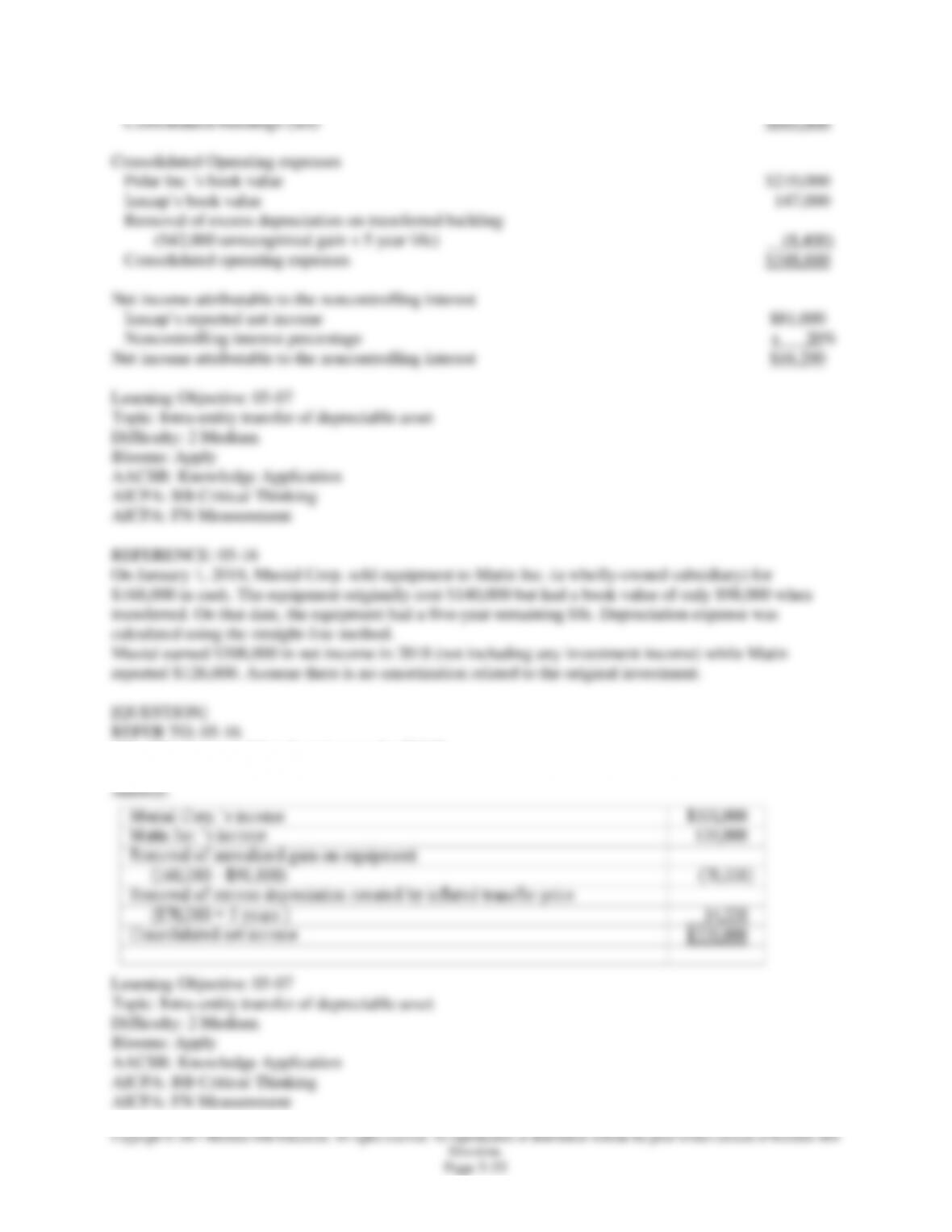
Consolidated Buildings (Net)
Poplar Inc.’s book value
Icecap Co.’s book value
Removal of gain created by transfer
(112,000 – $70,000)
Removal of excess depreciation created by transfer
Copyright © 2017 McGraw-Hill Education. All rights reserved. No reproduction or distribution without the prior written consent of McGraw-Hill
Education.
Page 5-55
Consolidated buildings (net)
$695,800
Consolidated Operating expenses
Polar Inc.’s book value
$210,000
Icecap’s book value
147,000
Removal of excess depreciation on transferred building
($42,000 unrecognized gain ÷ 5 year life)
(8,400)
Consolidated operating expenses
$348,600
Net income attributable to the noncontrolling interest
Icecap’s reported net income
$81,000
Noncontrolling interest percentage
x 20%
Net income attributable to the noncontrolling interest
$16,200
Learning Objective: 05-07
Topic: Intra-entity transfer of depreciable asset
Difficulty: 2 Medium
Blooms: Apply
AACSB: Knowledge Application
AICPA: BB Critical Thinking
AICPA: FN Measurement
REFERENCE: 05-16
On January 1, 2018, Musial Corp. sold equipment to Matin Inc. (a wholly-owned subsidiary) for
$168,000 in cash. The equipment originally cost $140,000 but had a book value of only $98,000 when
transferred. On that date, the equipment had a five-year remaining life. Depreciation expense was
calculated using the straight-line method.
Musial earned $308,000 in net income in 2018 (not including any investment income) while Matin
reported $126,000. Assume there is no amortization related to the original investment.
[QUESTION]
REFER TO: 05-16
121. What is consolidated net income for 2018?
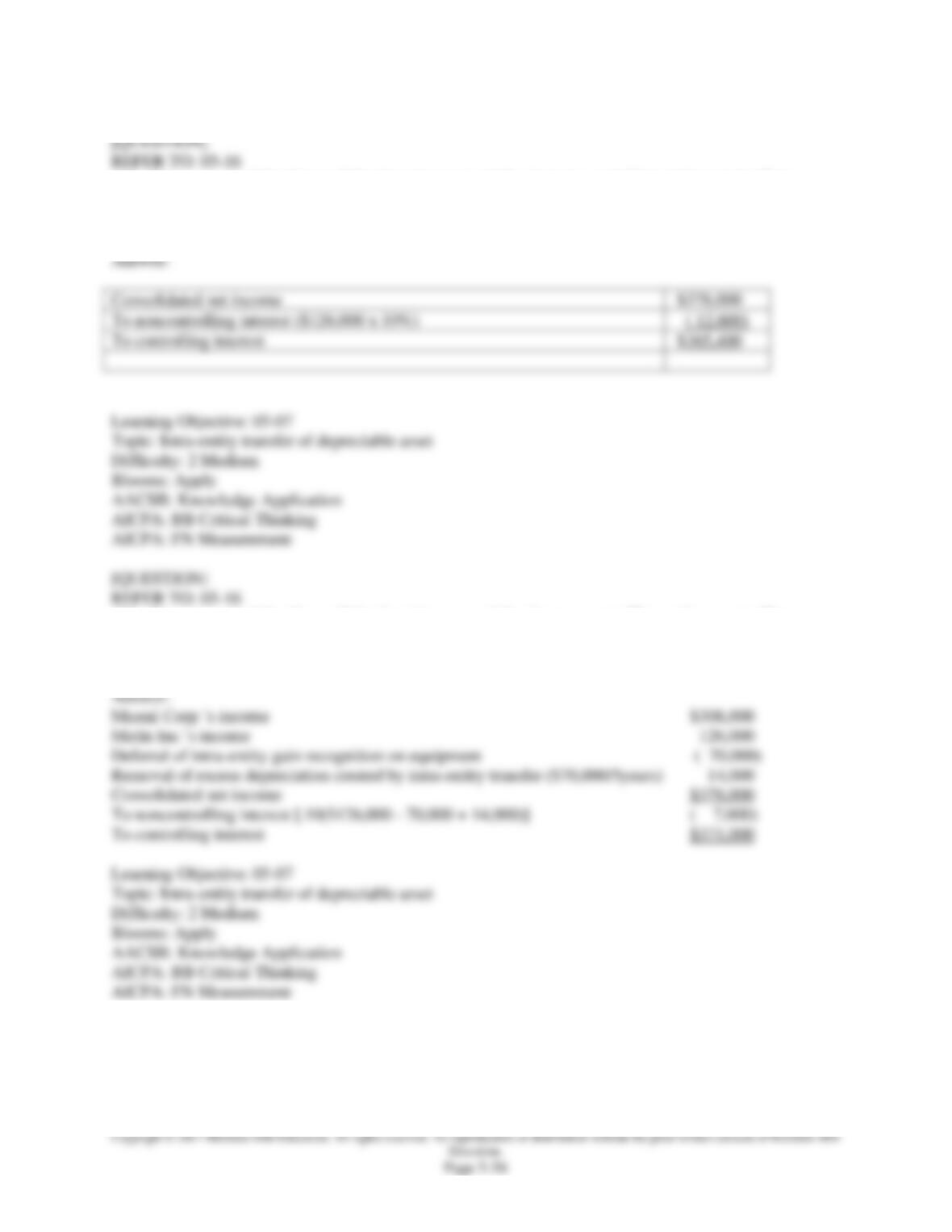
122. Prepare a schedule of consolidated net income and the share to controlling and noncontrolling
interests for 2018, assuming that Musial owned only 90% of Matin and the equipment transfer had been
downstream.
123. Prepare a schedule of consolidated net income and the share to controlling and noncontrolling
interests for 2018, assuming that Musial owned only 90% of Matin and the equipment transfer had been
upstream