equity method. It provides some of the advantages of the equity method but is easier to use.
Under the partial equity method, the balance in the investment account is increased by the accrual
94. What should an entity evaluate when making an initial impairment assessment of an
intangible asset (other than goodwill)?
95. What is the basic objective of all consolidations?
Copyright © 2017 McGraw-Hill Education. All rights reserved. No reproduction or distribution without the prior written consent of
McGraw-Hill Education.
Page 3-42
and stockholders’ equity accounts in a manner consistent with the concepts of the acquisition
method to reflect substance over form in financial reporting for consolidations. When a parent
has control (substance) over a subsidiary and separate incorporation is maintained (form), the
consolidated financial statements will reflect results as if the multiple entities were one entity.
Learning Objective: 03-01
Difficulty: 2 Medium
Topic: Consolidation―Overall effects
Blooms: Understand
AACSB: Reflective Thinking
AACSB: Communication
AICPA BB: Critical Thinking
AICPA FN: Measurement
[QUESTION]
96. Yules Co. acquired Noel Co. and applied the acquisition method. Yules decided to use the
partial equity method to account for the investment. The current balance in the investment
account is $416,000. Describe in words how this balance was derived.
97. Paperless Co. acquired Sheetless Co. and in effecting this business combination, there was a
cash-flow performance contingency to be paid in cash, and a market-price performance
contingency to be paid in additional shares of stock. In what accounts and in what section(s) of a
consolidated balance sheet are these contingent consideration items shown?
98. Avery Company acquires Billings Company in a combination accounted for as an acquisition
and adopts the equity method to account for Investment in Billings. At the end of four years, the
Investment in Billings account on Avery’s books is $198,984. What items constitute this
balance?
99. Dutch Co. has loaned $90,000 to its subsidiary, Hans Corp., which retains separate
incorporation. How would this loan be treated on a consolidated balance sheet?
100. A business combination results in $90,000 of goodwill. Several years later a worksheet is
being produced to consolidate the two companies. Describe in words at what amount goodwill
will be reported at this date.
101. Compare the differences in accounting treatment for goodwill between U.S. GAAP and
IFRS.
102. On January 1, 2017, Jumper Co. acquired all of the common stock of Cable Corp. for
$540,000. Annual amortization associated with the acquisition amounted to $1,800. During
2017, Cable recognized net income of $54,000 and paid dividends of $24,000. Cable’s net income
and dividends for 2018 were $86,000 and $24,000, respectively.
Required:
Assuming that Jumper decided to use the partial equity method, prepare a schedule to show the
balance in the investment account at the end of 2018.
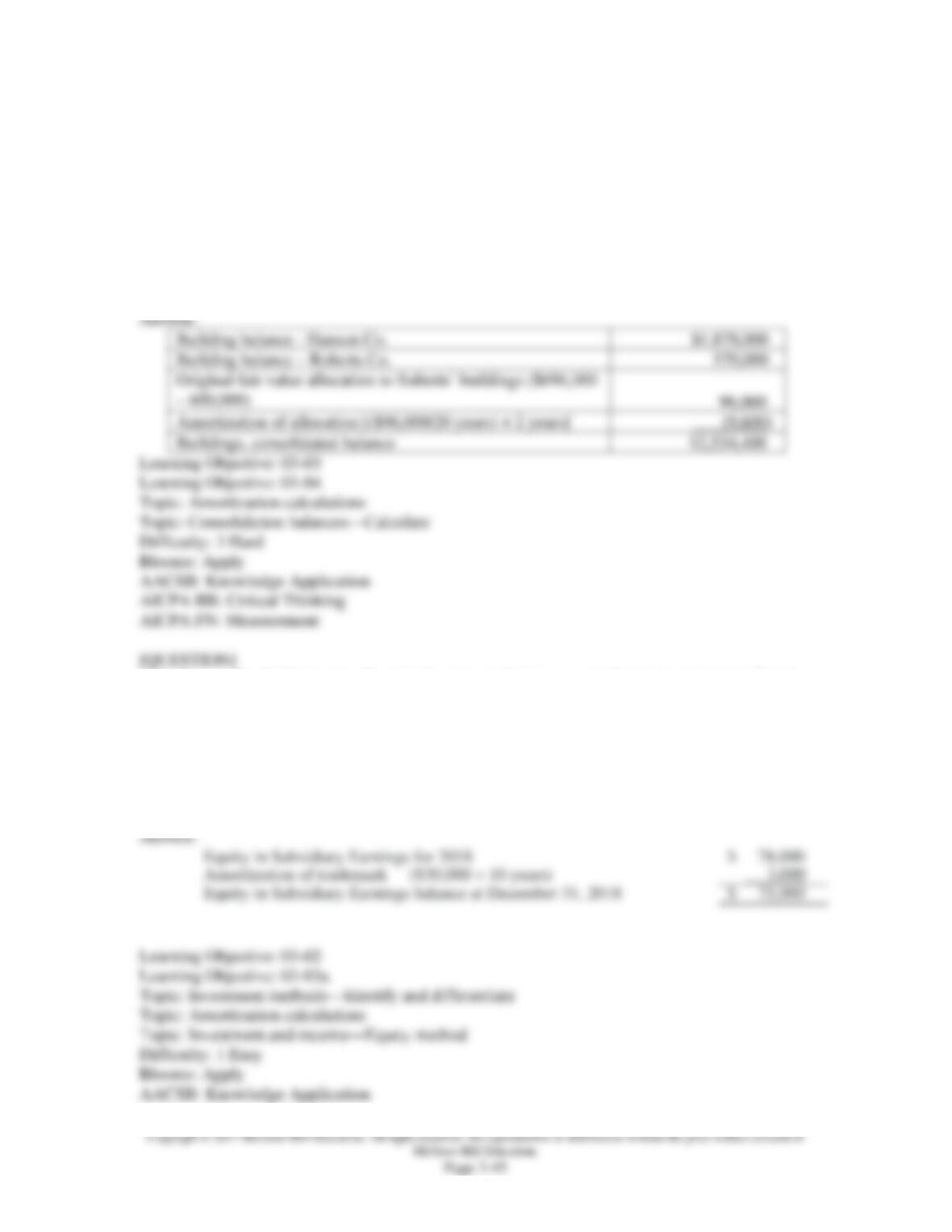
103. Hanson Co. acquired all of the common stock of Roberts Inc. on January 1, 2017,
transferring consideration in an amount slightly more than the fair value of Roberts’ net assets. At
that time, Roberts had buildings with a twenty-year useful life, a book value of $600,000, and a
fair value of $696,000. On December 31, 2018, Roberts had buildings with a book value of
$570,000 and a fair value of $648,000. On that date, Hanson had buildings with a book value of
$1,878,000 and a fair value of $2,160,000.
Required:
What amount should be shown for buildings on the consolidated balance sheet dated December
31, 2018?
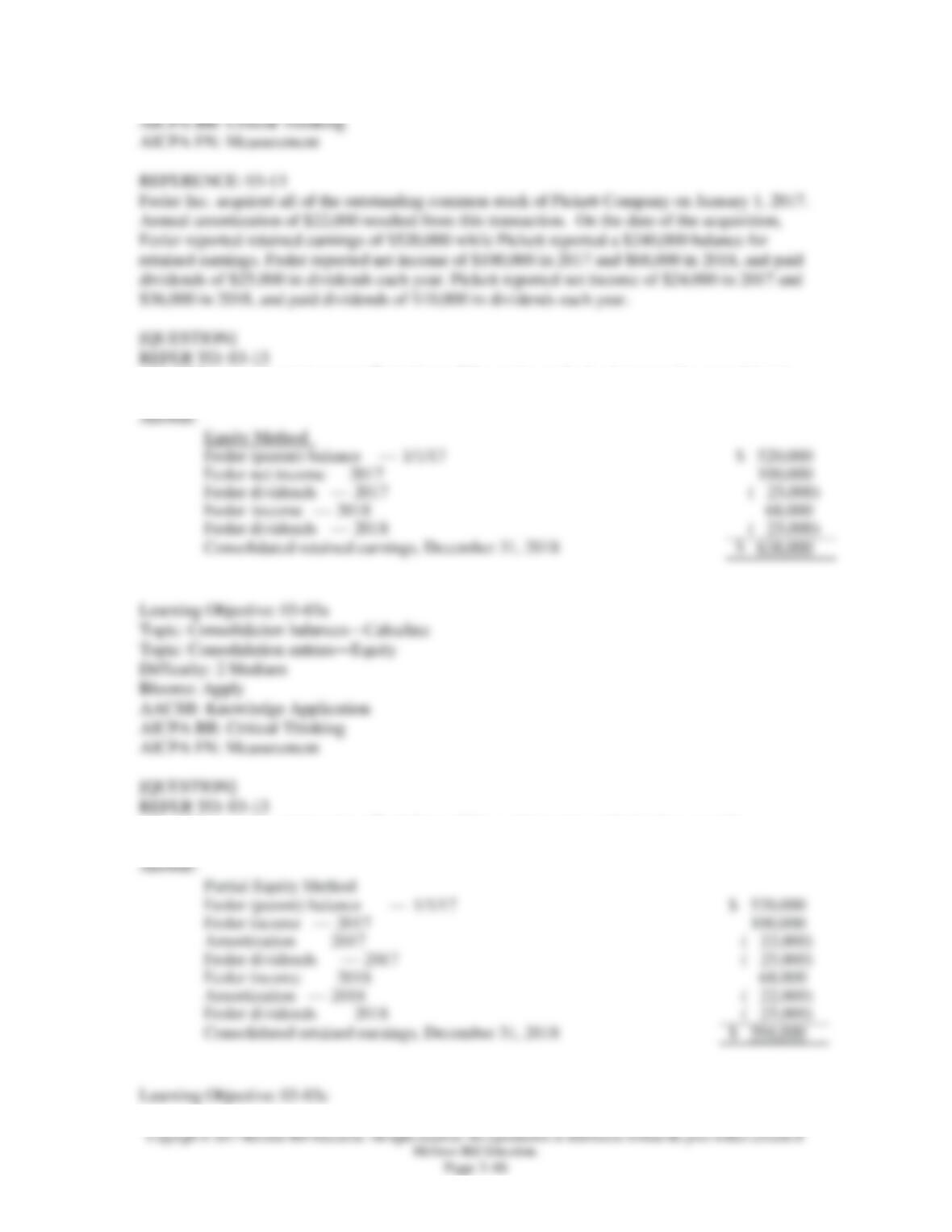
104. Carnes Co. decided to use the partial equity method to account for its investment in Domino
Corp. An unamortized trademark associated with the acquisition was $30,000, and Carnes
decided to amortize the trademark over ten years. For 2018, Carnes’ Equity in Subsidiary
Earnings was $78,000.
Required:
What balance would have been in the Equity in Subsidiary Earnings account if Carnes had used
the equity method?
AICPA BB: Critical Thinking
AICPA FN: Measurement
REFERENCE: 03-13
Fesler Inc. acquired all of the outstanding common stock of Pickett Company on January 1, 2017.
Annual amortization of $22,000 resulted from this transaction. On the date of the acquisition,
Fesler reported retained earnings of $520,000 while Pickett reported a $240,000 balance for
retained earnings. Fesler reported net income of $100,000 in 2017 and $68,000 in 2018, and paid
dividends of $25,000 in dividends each year. Pickett reported net income of $24,000 in 2017 and
$36,000 in 2018, and paid dividends of $10,000 in dividends each year.
[QUESTION]
REFER TO: 03-13
105. If the parent’s net income reflected use of the equity method, what were the consolidated
retained earnings on December 31, 2018?
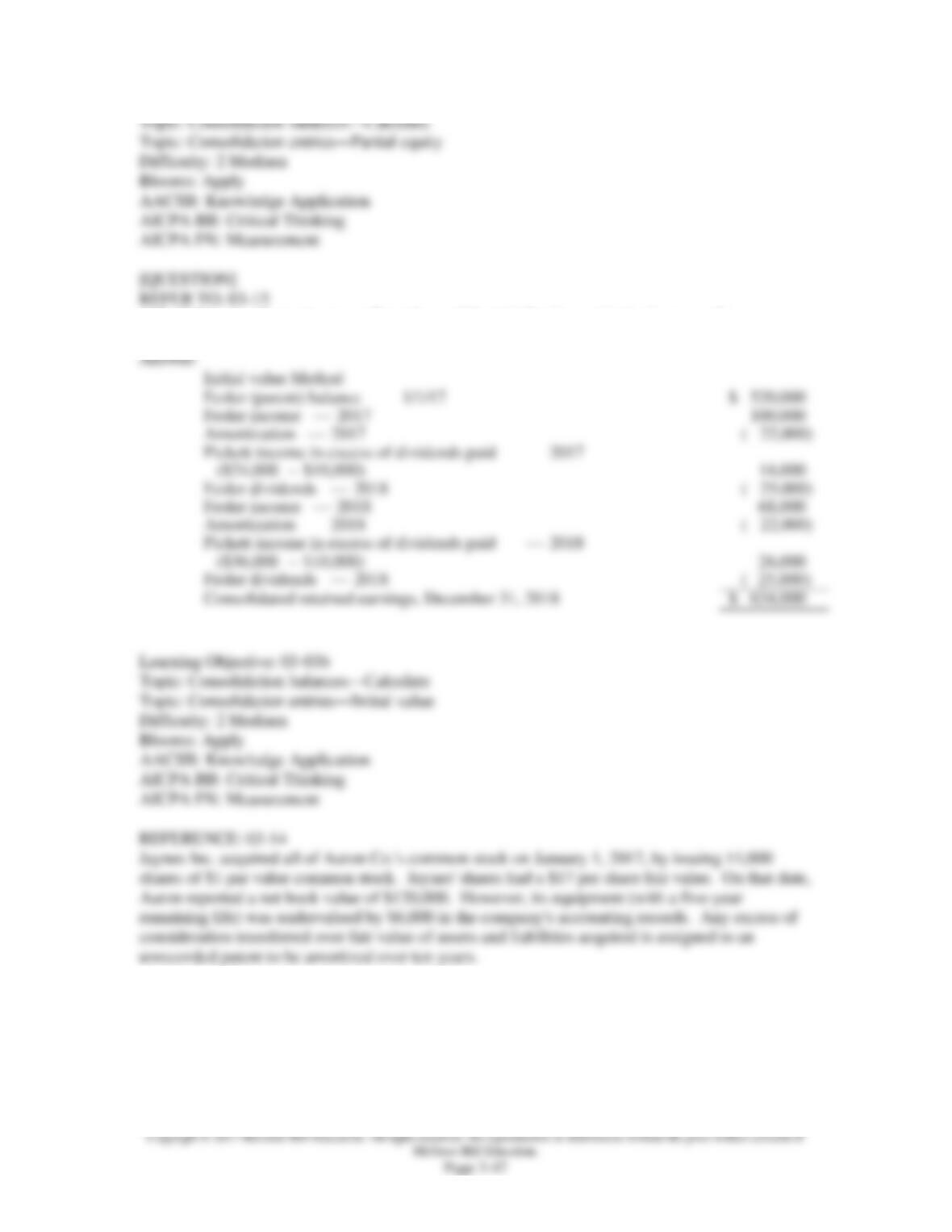
106. If the parent’s net income reflected use of the partial equity method, what were the
consolidated retained earnings on December 31, 2018?
Copyright © 2017 McGraw-Hill Education. All rights reserved. No reproduction or distribution without the prior written consent of
McGraw-Hill Education.
Page 3-47
Topic: Consolidation balances―Calculate
Topic: Consolidation entries―Partial equity
Difficulty: 2 Medium
Blooms: Apply
AACSB: Knowledge Application
AICPA BB: Critical Thinking
AICPA FN: Measurement
[QUESTION]
REFER TO: 03-13
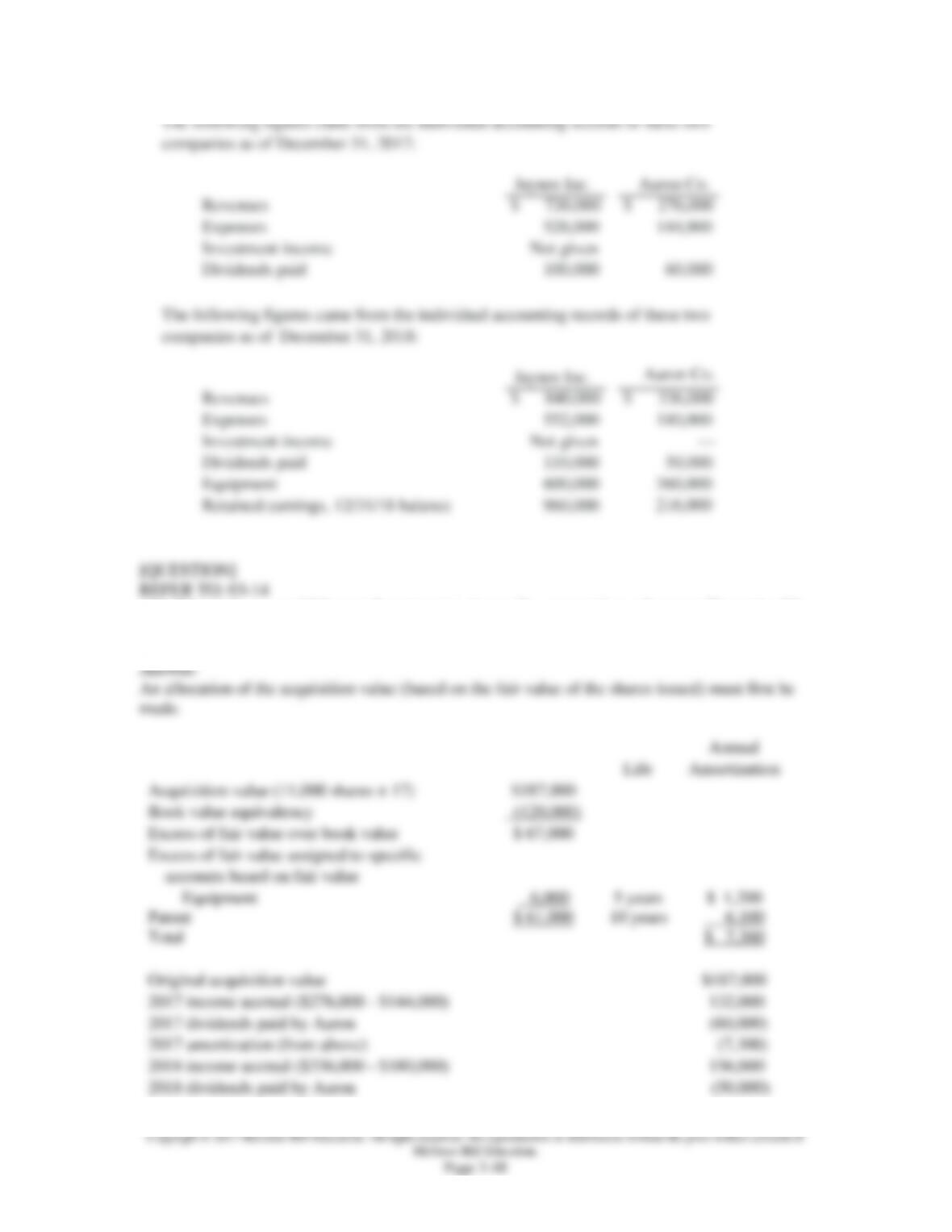
107. If the parent’s net income reflected use of the initial value method, what were the
consolidated retained earnings on December 31, 2018?
[QUESTION]
REFER TO: 03-14
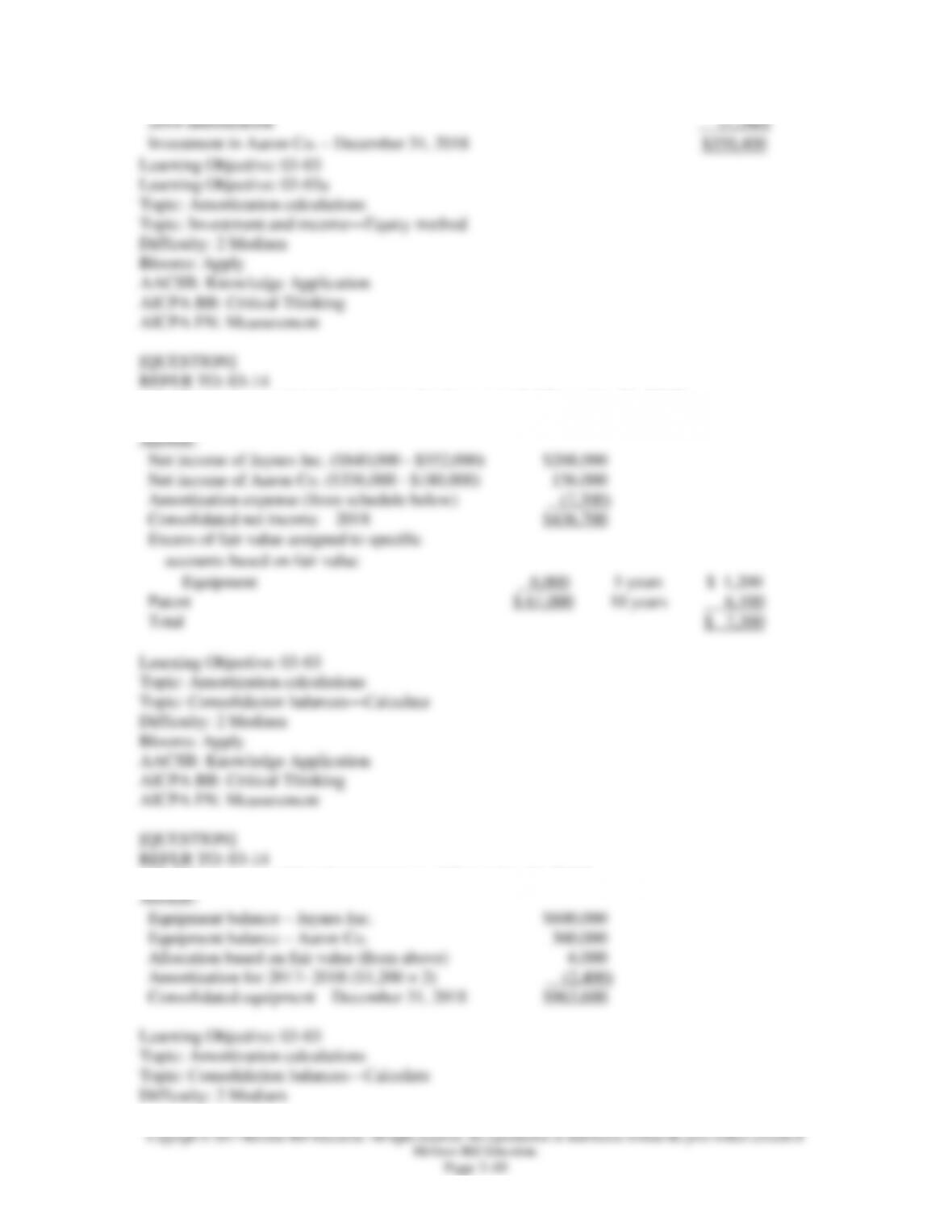
108. What balance would Jaynes’ Investment in Aaron Co. account have shown on December 31,
2018, when the equity method was applied for this acquisition?
The following figures came from the individual accounting records of these two
companies as of December 31, 2017:
Jaynes Inc.
Aaron Co.
Revenues
$ 720,000
$ 276,000
Expenses
528,000
144,000
Investment income
Not given
—
Dividends paid
100,000
60,000
The following figures came from the individual accounting records of these two
companies as of
December 31, 2018:
Jaynes Inc.
Aaron Co.
Revenues
$ 840,000
$ 336,000
Expenses
552,000
180,000
Investment income
Not given
—
Dividends paid
110,000
50,000
Equipment
600,000
360,000
Retained earnings, 12/31/18 balance
960,000
216,000
Copyright © 2017 McGraw-Hill Education. All rights reserved. No reproduction or distribution without the prior written consent of
McGraw-Hill Education.
Page 3-49
2018 amortization
(7,300)
Investment in Aaron Co. – December 31, 2018
$350,400
Learning Objective: 03-03
Learning Objective: 03-03a
Topic: Amortization calculations
Topic: Investment and income―Equity method
Difficulty: 2 Medium
Blooms: Apply
AACSB: Knowledge Application
AICPA BB: Critical Thinking
AICPA FN: Measurement
[QUESTION]
REFER TO: 03-14
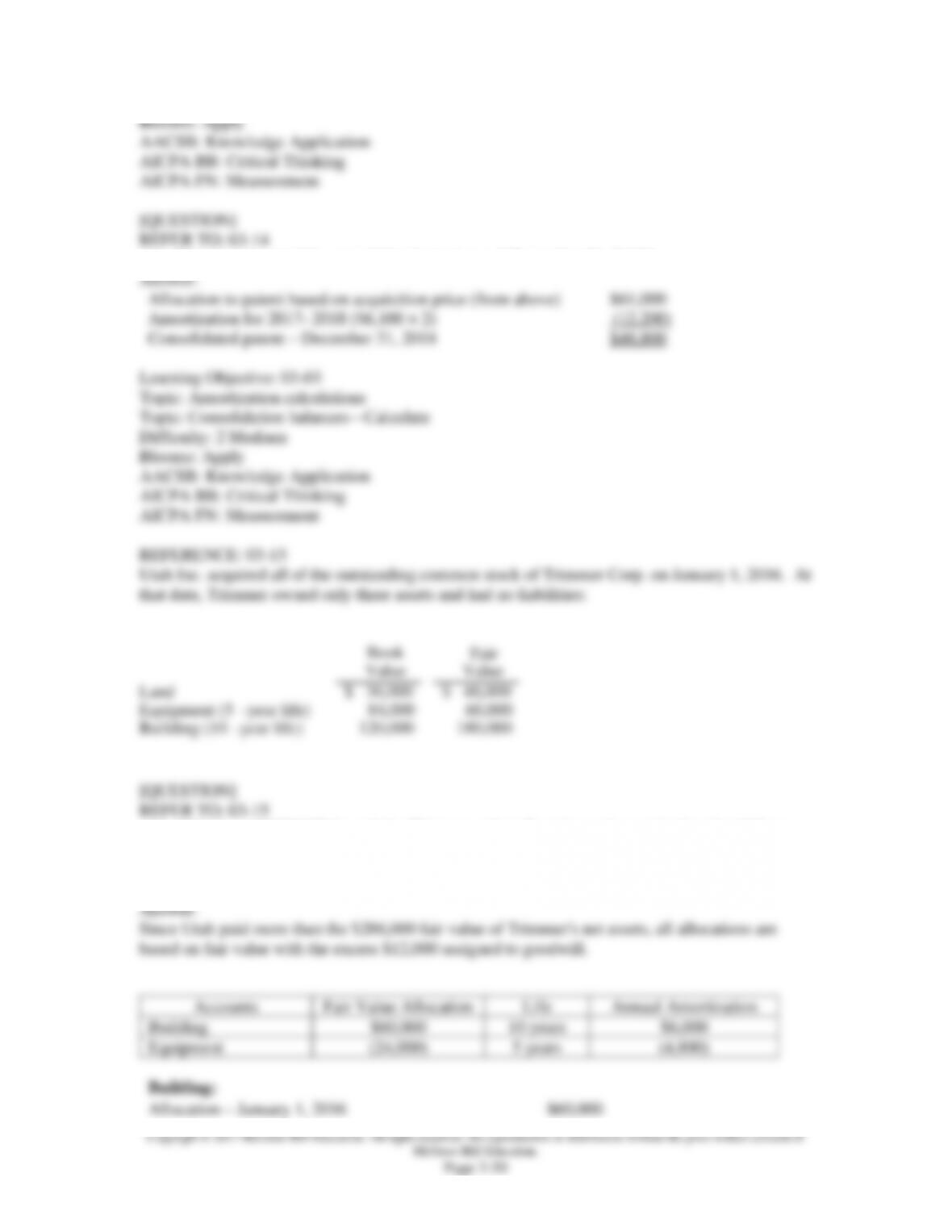
109. What was consolidated net income for the year ended December 31, 2018?
110. What was consolidated equipment as of December 31, 2018?
Excess of fair value assigned to specific
accounts based on fair value
Blooms: Apply
AACSB: Knowledge Application
AICPA BB: Critical Thinking
AICPA FN: Measurement
[QUESTION]
REFER TO: 03-14
111. What was the total for consolidated patents as of December 31, 2018?
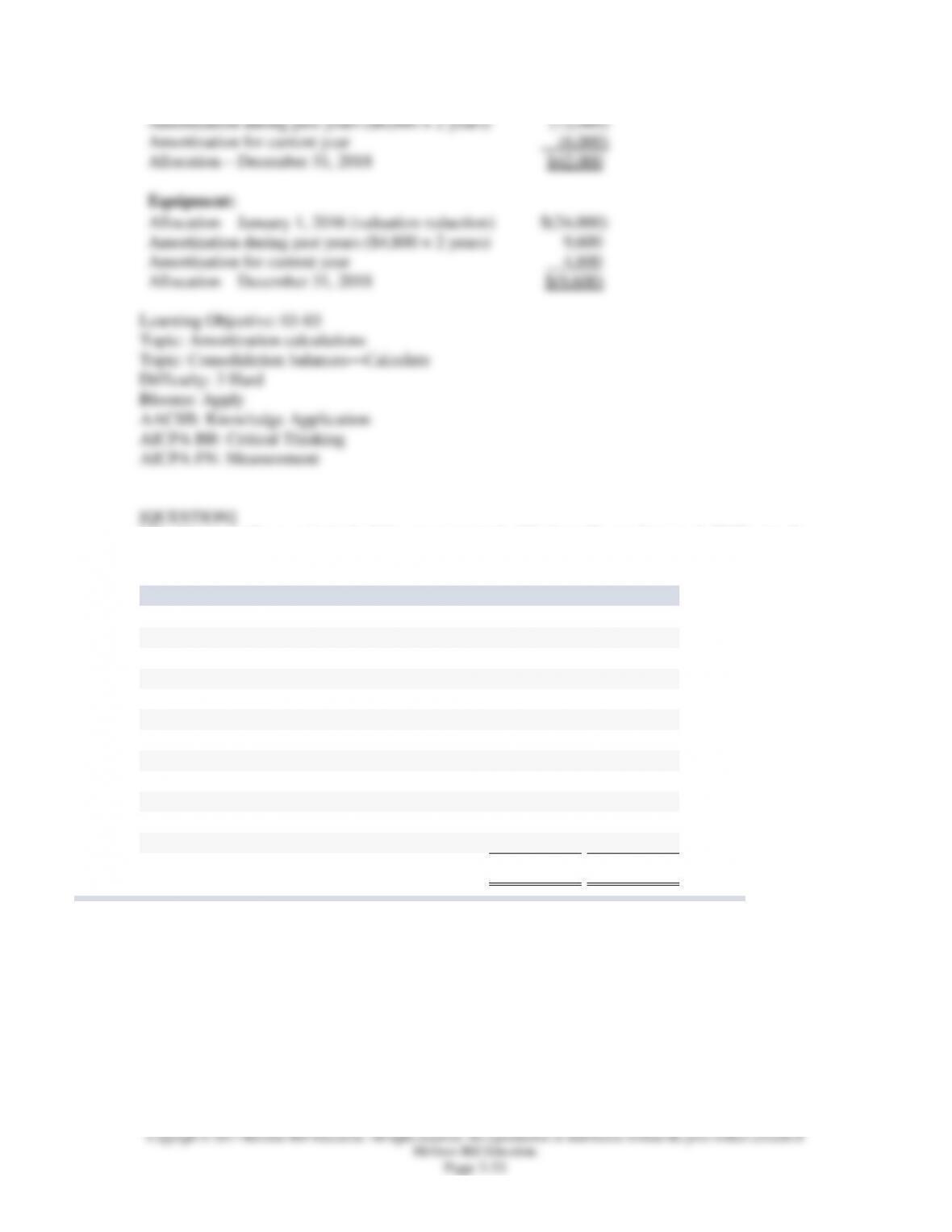
112. If Utah paid $300,000 in cash for Trimmer, what allocation and amortization should have
been assigned to the subsidiary’s Building account and its Equipment account in a December 31,
2018 consolidation?
Copyright © 2017 McGraw-Hill Education. All rights reserved. No reproduction or distribution without the prior written consent of
McGraw-Hill Education.
Page 3-51
Amortization during past years ($6,000 × 2 years)
(12,000)
Amortization for current year
(6,000)
Allocation – December 31, 2018
$42,000
Equipment:
Allocation – January 1, 2016 (valuation reduction)
$(24,000)
Amortization during past years ($4,800 × 2 years)
9,600
Amortization for current year
4,800
Allocation – December 31, 2018
$(9,600)
Learning Objective: 03-03
Topic: Amortization calculations
Topic: Consolidation balances―Calculate
Difficulty: 3 Hard
Blooms: Apply
AACSB: Knowledge Application
AICPA BB: Critical Thinking
AICPA FN: Measurement
[QUESTION]
113. Matthews Co. acquired all of the common stock of Jackson Co. on January 1, 2017. As of
that date, Jackson had the following trial balance:
Debit
Credit
Accounts payable
$
60,000
Accounts receivable
$
50,000
Additional paid-in capital
60,000
Buildings (net) (20-year life)
140,000
Cash and short-term investments
70,000
Common stock
300,000
Equipment (net) (8-year life)
240,000
Intangible assets (indefinite life)
110,000
Land
90,000
Long-term liabilities (mature 12/31/19)
180,000
Retained earnings, 1/1/17
120,000
Supplies
20,000
Totals
$
720,000
$
720,000
During 2017, Jackson reported net income of $96,000 while paying dividends of $12,000.
During 2018, Jackson reported net income of $132,000 while paying dividends of $36,000.
Assume that Matthews Co. acquired the common stock of Jackson Co. for $588,000 in cash. As
of January 1, 2017, Jackson’s land had a fair value of $102,000, its buildings were valued at
$188,000, and its equipment was appraised at $216,000. Any excess of consideration transferred
over fair value of assets and liabilities acquired is due to an unamortized patent to be amortized
over 10 years.
Matthews decided to use the equity method for this investment.
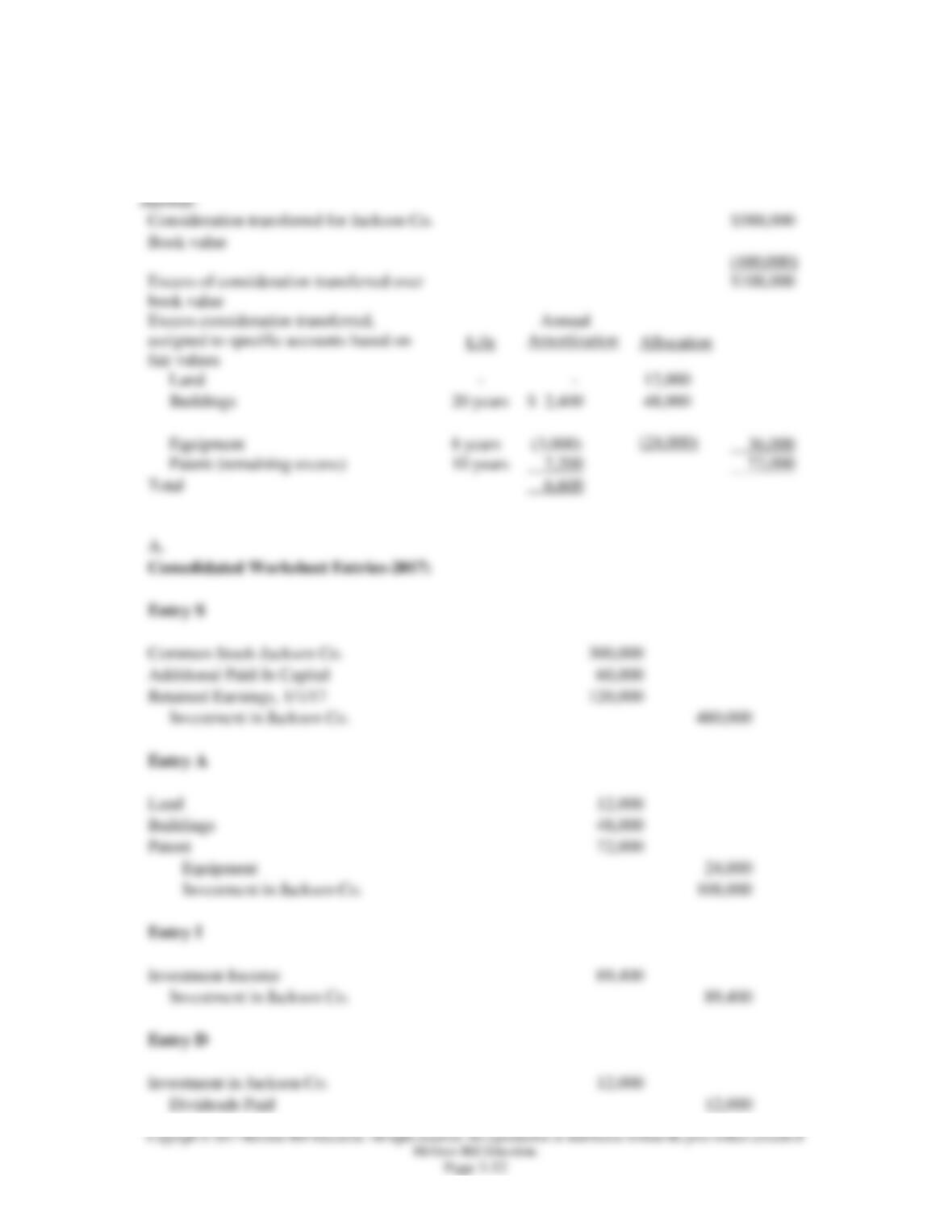
Required:
(A.) Prepare consolidation worksheet entries for December 31, 2017.
(B.) Prepare consolidation worksheet entries for December 31, 2018.
Entry E
Expense
6,600
Equipment
3,000
Buildings
2,400
Patent
7,200
B. Consolidated Worksheet Entries – 2018:
Entry S
Common Stock-Jackson Co.
300,000
Additional Paid-In Capital
60,000
Retained Earnings, 1/1/18
204,000
Investment in Jackson Co.
564,000
Entry A
Land
12,000
Buildings
45,600
Patent
64,800
Equipment
21,000
Investment in Jackson Co.
101,400
Entry I
Investment Income
125,400
Investment in Jackson Co.
125,400
Entry D
Investment in Jackson Co.
36,000
Dividends Paid
36,000
Entry E
Expense
6,600
Equipment
3,000
Buildings
2,400
Patent
7,200
Learning Objective: 03-03a
Topic: Consolidation entries―Equity
Difficulty: 3 Hard

Blooms: Apply
AACSB: Knowledge Application
AICPA BB: Critical Thinking
AICPA FN: Measurement
[QUESTION]
114. On January 1, 2016, Rand Corp. issued shares of its common stock to acquire all of the
outstanding common stock of Spaulding Inc. Spaulding’s book value was only $140,000 at the
time, but Rand issued 12,000 shares having a par value of $1 per share and a fair value of $20 per
share. Rand was willing to convey these shares because it felt that buildings (ten-year life) were
undervalued on Spaulding’s records by $60,000 while equipment (five-year life) was undervalued
by $25,000. Any consideration transferred over fair value of identified net assets acquired is
assigned to goodwill.
Following are the individual financial records for these two companies for the year ended
December 31, 2019.
Rand
Spaulding
Corp.
Inc.
Revenues
$ 372,000
$108,000
Expenses
(264,000)
(72,000)
Equity in subsidiary earnings
25,000
0
Net income
$ 133,000
$ 36,000
Retained earnings, January 1, 2019
$ 765,000
$102,000
Net income (above)
133,000
36,000
Dividends paid
(84,000)
(24,000)
Retained earnings, December 31, 2019
$ 814,000
$114,000
Current assets
$ 150,000
$ 22,000
Investment in Spaulding Inc.
242,000
0
Buildings (net)
525,000
85,000
Equipment (net)
389,250
129,000
Total assets
$1,306,250
$236,000
Liabilities
$ 82,250
$ 50,000
Common stock
360,000
72,000
Additional paid-in capital
50,000
0
Retained earnings, December 31, 2019 (above)
814,000
114,000
Total liabilities and stockholders’ equity
$1,306,250
$236,000
Required:
Prepare a consolidation worksheet for this business combination.
Copyright © 2017 McGraw-Hill Education. All rights reserved. No reproduction or distribution without the prior written consent of
McGraw-Hill Education.
Page 3-55
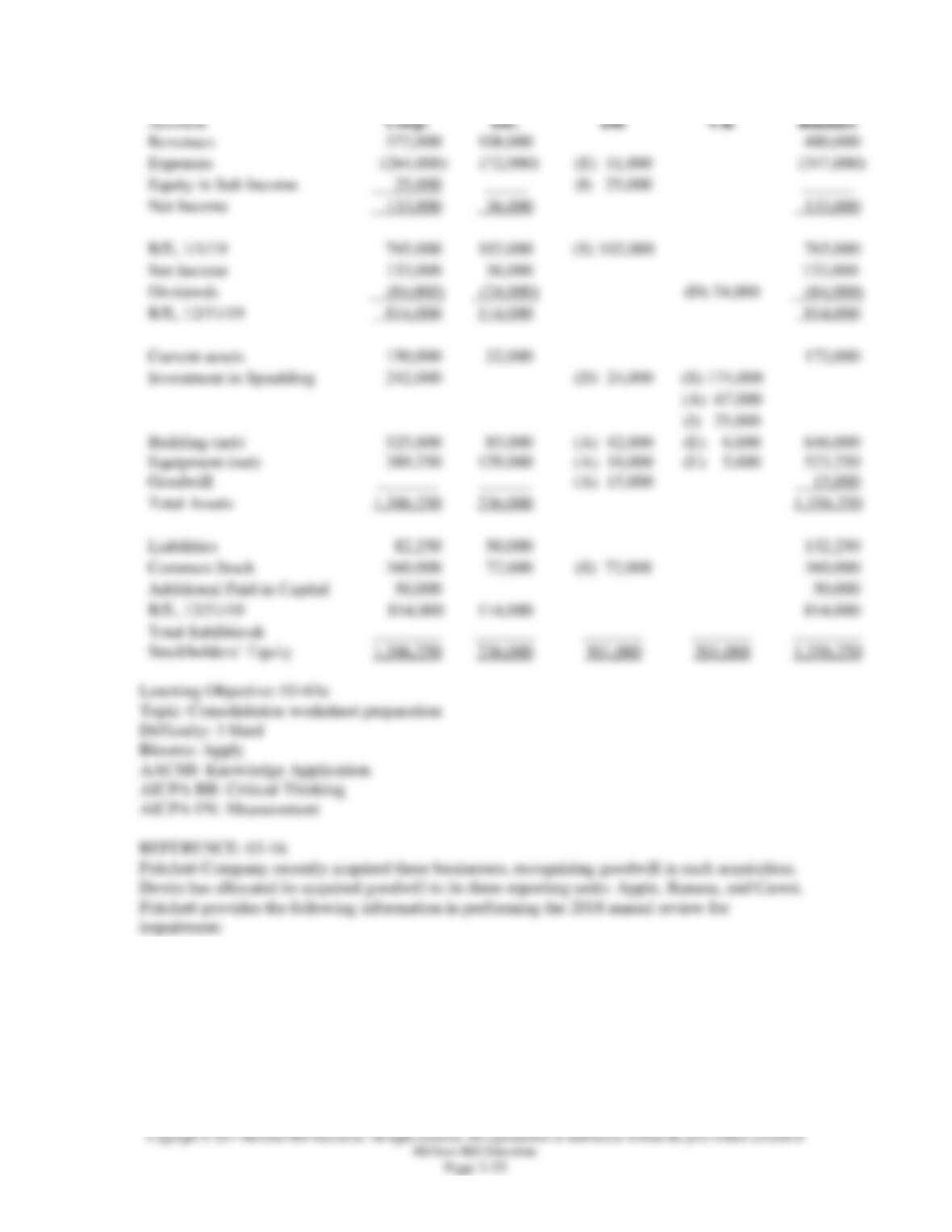
Account
Corp.
Inc.
DR
CR
Balance
Revenues
372,000
108,000
480,000
Expenses
(264,000)
(72,000)
(E) 11,000
(347,000)
Equity in Sub Income
25,000
_____
(I) 25,000
______
Net Income
133,000
36,000
133,000
R/E, 1/1/19
765,000
102,000
(S) 102,000
765,000
Net Income
133,000
36,000
133,000
Dividends
(84,000)
(24,000)
(D) 24,000
(84,000)
R/E, 12/31/19
814,000
114,000
814,000
Current assets
150,000
22,000
172,000
Investment in Spaulding
242,000
(D) 24,000
(S) 174,000
(A) 67,000
(I) 25,000
Building (net)
525,000
85,000
(A) 42,000
(E) 6,000
646,000
Equipment (net)
389,250
129,000
(A) 10,000
(E) 5,000
523,250
Goodwill
_______
______
(A) 15,000
15,000
Total Assets
1,306,250
236,000
1,356,250
Liabilities
82,250
50,000
132,250
Common Stock
360,000
72,000
(S) 72,000
360,000
Additional Paid-in Capital
50,000
50,000
R/E, 12/31/19
814,000
114,000
814,000
Total liabilities&
________
_______
_______
_______
________
Stockholders’ Equity
1,306,250
236,000
301,000
301,000
1,356,250
Learning Objective: 03-03a
Topic: Consolidation worksheet preparation
Difficulty: 3 Hard
Blooms: Apply
AACSB: Knowledge Application
AICPA BB: Critical Thinking
AICPA FN: Measurement
REFERENCE: 03-16
Pritchett Company recently acquired three businesses, recognizing goodwill in each acquisition.
Destin has allocated its acquired goodwill to its three reporting units: Apple, Banana, and Carrot.
Pritchett provides the following information in performing the 2018 annual review for
impairment:
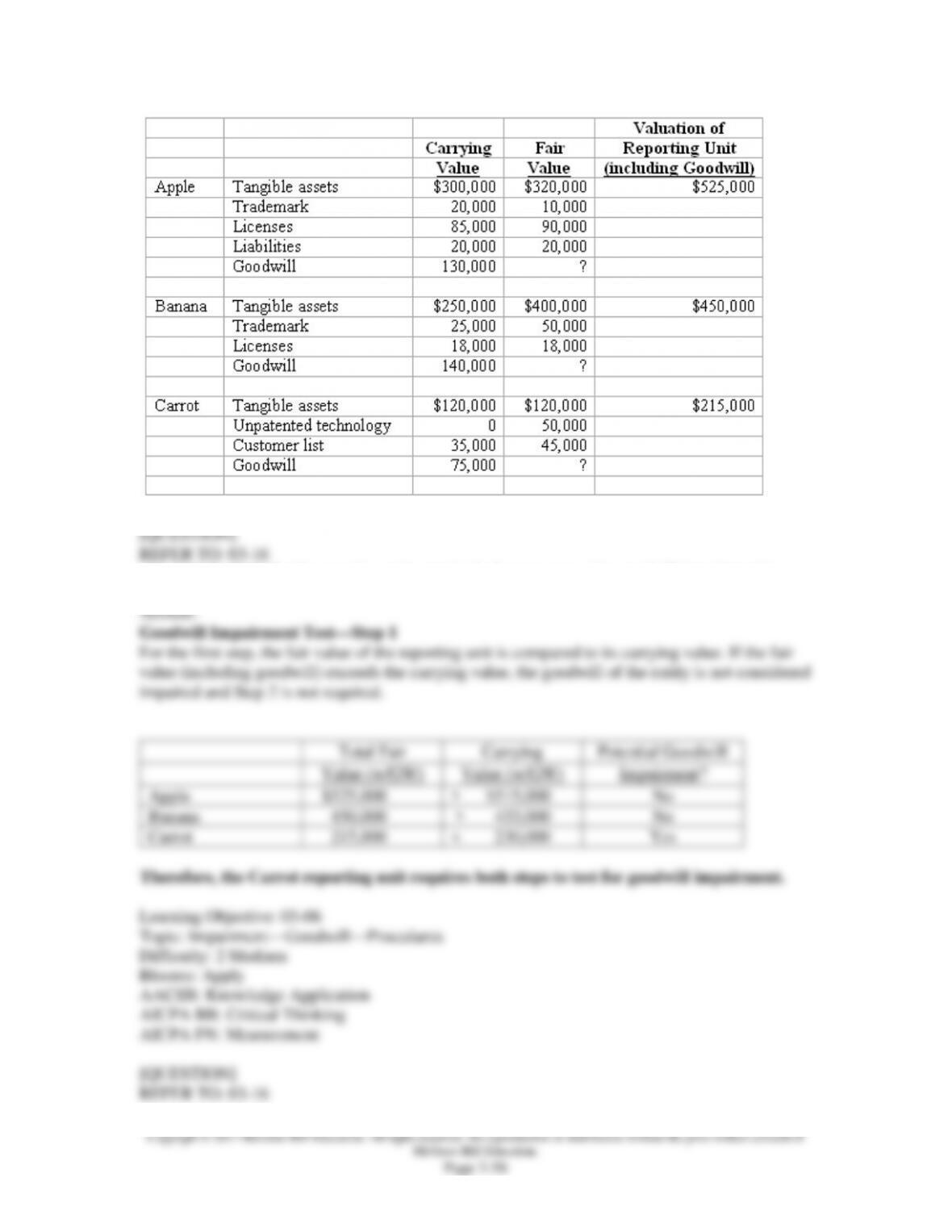
115. Which of Pritchett’s reporting units require both steps to test for goodwill impairment?
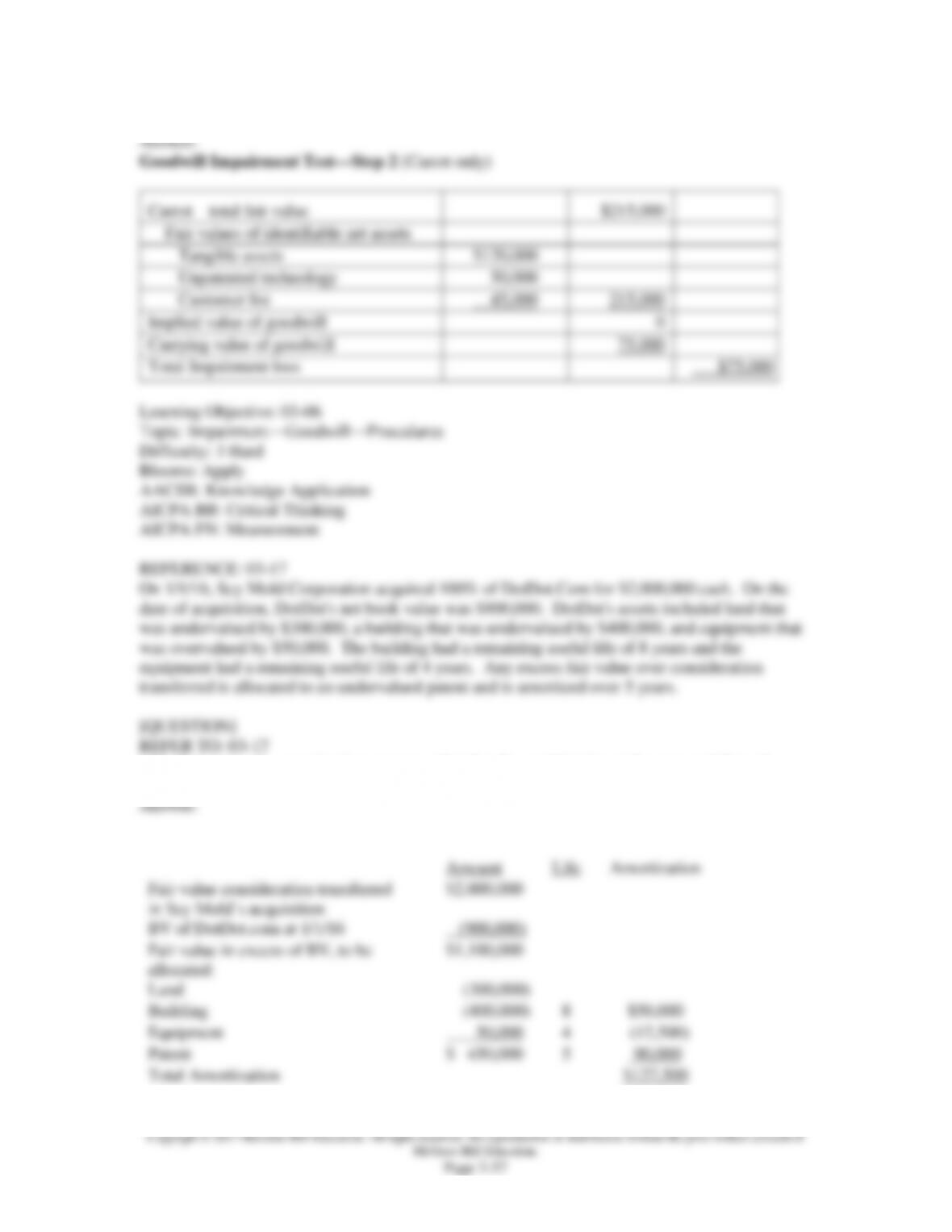
116. How much goodwill impairment should Pritchett report for 2018?
117. Determine the amortization expense related to the combination at the year-end date of
12/31/16.
Copyright © 2017 McGraw-Hill Education. All rights reserved. No reproduction or distribution without the prior written consent of
McGraw-Hill Education.
Page 3-58
Learning Objective: 03-03
Topic: Amortization calculations
Difficulty: 2 Medium
Blooms: Apply
AACSB: Knowledge Application
AICPA BB: Critical Thinking
AICPA FN: Measurement
[QUESTION]
REFER TO: 03-17
118. Determine the amortization expense related to the consolidation at the year-end date of
12/31/24.
119. For each of the following situations, select the best answer that applies to consolidating
financial information subsequent to the acquisition date:
(A) Initial value method.
(B) Partial equity method.
(C) Equity method.
(D) Initial value method and partial equity method but not equity method.
(E) Partial equity method and equity method but not initial value method.
(F) Initial value method, partial equity method, and equity method.
_____1. Method(s) available to the parent for internal record-keeping.
_____2. Easiest internal record–keeping method to apply.
_____3. Income of the subsidiary is recorded by the parent when earned.
_____4. Designed to create a parallel between the parent’s investment accounts and changes in
the underlying equity of the acquired company.
_____5. For years subsequent to acquisition, requires the *C entry.
_____6. Uses the cash basis for income recognition.
_____7. Investment account remains at initially recorded amount.
_____8. Dividends received by the parent from the subsidiary reduce the parent’s investment
account.
_____9. Often referred to in accounting as a single-line consolidation.
_____10. Increases the investment account for subsidiary earnings, but does not decrease the
subsidiary account for equity adjustments such as amortizations.
Copyright © 2017 McGraw-Hill Education. All rights reserved. No reproduction or distribution without the prior written consent of
McGraw-Hill Education.
Page 3-59
Topic: Investment methods―Identify and differentiate
Difficulty: 3 Hard
Blooms: Understand
AACSB: Reflective Thinking
AICPA BB: Critical Thinking
AICPA FN: Measurement
ADDITIONAL QUESTIONS COVERING APPENDIX MATERIAL AND NEW LO: 03-09
[QUESTION]
120. Private companies, with respect to goodwill:
A) May elect to amortize it over a period of 15 years.
B) Must treat it as an intangible asset with an indefinite life.
C) Must amortize it over a 12-year period.
D) May amortize goodwill if the value of the company does not exceed $10 million.
E) May treat goodwill as a definite lived intangible asset with a 10-year useful life.
121. How is the goodwill impairment process simplified for private companies?