Copyright © 2017 McGraw-Hill Education. All rights reserved. No reproduction or distribution without the prior written consent of
McGraw-Hill Education.
Page 3-21
Topic: Consolidation balances―Calculate
Difficulty: 2 Medium
Blooms: Apply
AACSB: Knowledge Application
AICPA BB: Critical Thinking
AICPA FN: Measurement
Feedback: FV $1,250 – Excess Amortization ($250 / 2) $125 × 2 = $1,000
[QUESTION]
REFER TO: 03-05
46. Compute the amount of Hurley’s land that would be reported in a December 31, 2018,
consolidated balance sheet.
A) $ 900.
B) $1,300.
C) $ 400.
D) $1,450.
E) $2,200.
47. Compute the amount of Hurley’s long-term liabilities that would be reported in a December
31, 2018, consolidated balance sheet.
A) $1,700.
B) $1,800.
C) $1,650.
D) $1,750.
E) $3,500.
48. Assume the equity method is applied. How much equity income will Kaye report on its
internal accounting records as a result of Fiore’s operations?
A) $400
B) $300
C) $380
D) $280
E) $480
49. Assume the partial equity method is applied. How much equity income will Kaye report on
its internal accounting records as a result of Fiore’s operations?
A) $400
B) $300
C) $380
D) $280
E) $480
50. Assume the initial value method is applied. How much equity income will Kaye report on its
internal accounting records as a result of Fiore’s operations?
A) $400
B) $300
C) $380
D) $100
E) $210
Copyright © 2017 McGraw-Hill Education. All rights reserved. No reproduction or distribution without the prior written consent of
McGraw-Hill Education.
Page 3-23
Topic: Investment and income―Initial value method
Difficulty: 2 Medium
Blooms: Apply
AACSB: Knowledge Application
AICPA BB: Critical Thinking
AICPA FN: Measurement
Feedback: 2018 Dividends = $100
[QUESTION]
REFER TO: 03-06
51. Assume the partial equity method is used. In the years following acquisition, what additional
worksheet entry must be made for consolidation purposes, but is not required for the equity
method?
A)
Retained earnings
20
Investment in Fiore
20
B)
Investment in Fiore
20
Retained earnings
20
C)
Expenses
20
Investment in Fiore
20
D)
Expenses
20
Retained earnings
20
E)
Retained earnings
20
Additional paid-in capital
20
A) Entry A.
B) Entry B.
C) Entry C.
D) Entry D.
E) Entry E.
52. Assume the initial value method is used. In the year subsequent to acquisition, what
additional worksheet entry must be made for consolidation purposes that is not required for the
equity method?
A)
Investment in Fiore
380
Retained earnings
380
B)
Retained earnings
380
Investment in Fiore
380
C)
Investment in Fiore
280
Retained earnings
280
D)
Retained earnings
280
Investment in Fiore
280
E)
Additional paid-in capital
280
Retained earnings
280
A) Entry A.
B) Entry B.
C) Entry C.
D) Entry D.
E) Entry E.
53. Hoyt Corporation agreed to the following terms in order to acquire the net assets of Brown
Company on January 1, 2018:
(1.) To issue 400 shares of common stock ($10 par) with a fair value of $45 per share.
(2.) To assume Brown’s liabilities which have a book value of $1,600 and a fair value of $1,500.
On the date of acquisition, the consideration transferred for Hoyt’s acquisition of Brown would be
A) $18,000.
B) $16,500.
C) $20,000.
D) $18,500.
E) $19,500.
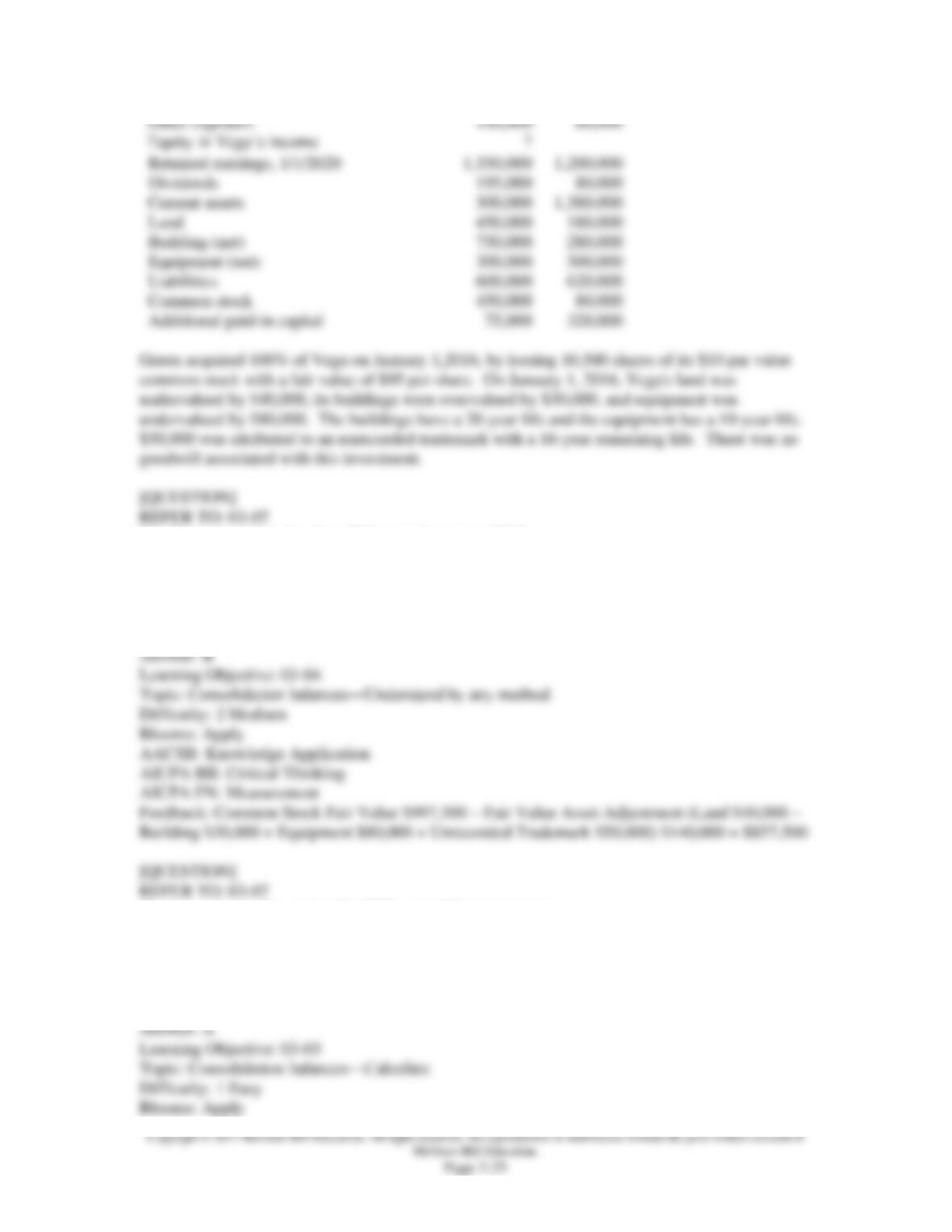
2020. Several of Green’s accounts have been omitted.
Green
Vega
Revenues
$900,000
$500,000
Cost of goods sold
360,000
200,000
Depreciation expense
140,000
40,000
Copyright © 2017 McGraw-Hill Education. All rights reserved. No reproduction or distribution without the prior written consent of
McGraw-Hill Education.
Page 3-25
Other expenses
100,000
60,000
Equity in Vega’s income
?
Retained earnings, 1/1/2020
1,350,000
1,200,000
Dividends
195,000
80,000
Current assets
300,000
1,380,000
Land
450,000
180,000
Building (net)
750,000
280,000
Equipment (net)
300,000
500,000
Liabilities
600,000
620,000
Common stock
450,000
80,000
Additional paid-in capital
75,000
320,000
Green acquired 100% of Vega on January 1,2016, by issuing 10,500 shares of its $10 par value
common stock with a fair value of $95 per share. On January 1, 2016, Vega’s land was
undervalued by $40,000, its buildings were overvalued by $30,000, and equipment was
undervalued by $80,000. The buildings have a 20-year life and the equipment has a 10-year life.
$50,000 was attributed to an unrecorded trademark with a 16-year remaining life. There was no
goodwill associated with this investment.
[QUESTION]
REFER TO: 03-07
54. Compute the book value of Vega at January 1, 2016.
A) $ 997,500.
B) $ 857,500.
C) $1,200,000.
D) $1,600,000.
E) $ 827,500.
55. Compute the December 31, 2020, consolidated revenues.
A) $1,400,000.
B) $ 800,000.
C) $ 500,000.
D) $1,590,375.
E) $1,390,375.
Copyright © 2017 McGraw-Hill Education. All rights reserved. No reproduction or distribution without the prior written consent of
McGraw-Hill Education.
Page 3-26
AACSB: Knowledge Application
AICPA BB: Critical Thinking
AICPA FN: Measurement
Feedback: $900,000 + $500,000 = $1,400,000
[QUESTION]
REFER TO: 03-07
56. Compute the December 31, 2020, consolidated total expenses.
A) $620,000.
B) $280,000.
C) $900,000.
D) $909,625.
E) $299,625.
57. Compute the December 31, 2020, consolidated buildings.
A) $1,037,500.
B) $1,007,500.
C) $1,000,000.
D) $1,022,500.
E) $1,012,500.
58. Compute the December 31, 2020, consolidated equipment.
A) $800,000.
B) $808,000.
C) $840,000.
D) $760,000.
E) $848,000.
59. Compute the December 31, 2020, consolidated land.
A) $220,000.
B) $180,000.
C) $670,000.
D) $630,000.
E) $450,000.
60. Compute the December 31, 2020, consolidated trademark.
A) $50,000.
B) $46,875.
C) $ 0.
D) $34,375.
E) $37,500.
Copyright © 2017 McGraw-Hill Education. All rights reserved. No reproduction or distribution without the prior written consent of
McGraw-Hill Education.
Page 3-28
[QUESTION]
REFER TO: 03-07
61. Compute the December 31, 2020, consolidated common stock.
A) $450,000.
B) $530,000.
C) $555,000.
D) $635,000.
E) $525,000.
62. Compute the December 31, 2020, consolidated additional paid-in capital.
A) $210,000.
B) $75,000.
C) $1,102,500.
D) $942,500.
E) $525,000.
63. Compute the December 31, 2020 consolidated retained earnings.
A) $1,645,375.
B) $1,350,000.
C) $1,565,375.
D) $1,840,375.
E) $1,265,375.
Copyright © 2017 McGraw-Hill Education. All rights reserved. No reproduction or distribution without the prior written consent of
McGraw-Hill Education.
Page 3-29
AICPA FN: Measurement
Feedback: Parent Beg RE: $1,350,000 + Consolidated Net Income $490,375 – Consolidated
Dividends $195,000 = Consolidated RE $1,645,375
[QUESTION]
64. One company acquires another company in a combination accounted for under the
acquisition method. The acquiring company decides to apply the initial value method in
accounting for the combination. What is one reason the acquiring company might have made this
decision?
A) It is the only method allowed by the SEC.
B) It is relatively easy to apply.
C) It is the only internal reporting method allowed by generally accepted accounting principles.
D) Operating results on the parent’s financial records reflect consolidated totals.
E) When the initial method is used, no worksheet entries are required in the consolidation
process.
65. One company acquires another company in a combination accounted for under the acquisition
method. The acquiring company decides to apply the equity method in accounting for the
combination. What is one reason the acquiring company might have made this decision?
A) It is the only method allowed by the SEC.
B) It is relatively easy to apply.
C) It is the only internal reporting method allowed by generally accepted accounting principles.
D) Operating results on the parent’s financial records reflect consolidated totals.
E) When the equity method is used, no worksheet entries are required in the consolidation
process.
66. When is a goodwill impairment loss recognized?
A) Annually on a systematic and rational basis.
B) Never.
C) When both the fair value of a reporting unit and its associated implied goodwill fall below
their respective carrying values.
D) If the fair value of a reporting unit falls below its original acquisition price.
E) Whenever the fair value of the entity declines significantly.
Copyright © 2017 McGraw-Hill Education. All rights reserved. No reproduction or distribution without the prior written consent of
McGraw-Hill Education.
Page 3-30
Answer: C
Learning Objective: 03-05
Topic: Impairment―Goodwill―Rationale
Difficulty: 2 Medium
Blooms: Remember
AACSB: Reflective Thinking
AICPA BB: Critical Thinking
AICPA FN: Measurement
[QUESTION]
67. Which of the following will result in the recognition of an impairment loss on goodwill?
A) Goodwill amortization is to be recognized annually on a systematic and rational basis.
B) Both the fair value of a reporting unit and its associated implied goodwill fall below their
respective carrying values.
C) The fair value of the entity declines significantly.
D) The fair value of a reporting unit falls below the original consideration transferred for the
acquisition.
E) The entity is investigated by the SEC and its reputation has been severely damaged.
68. If Goehler applies the equity method in accounting for Kenneth, what is the consolidated
balance for the Equipment account as of December 31, 2018?
A) $1,080,000.
B) $1,104,000.
C) $1,100,000.
D) $1,468,000.
E) $1,475,000.
Copyright © 2017 McGraw-Hill Education. All rights reserved. No reproduction or distribution without the prior written consent of
McGraw-Hill Education.
Page 3-31
Blooms: Apply
AACSB: Knowledge Application
AICPA BB: Critical Thinking
AICPA FN: Measurement
Feedback: Excess amortizations: (120,000-90,000=30,000/10 = 3,000 per year).
2018 Balance Goehler Bv 975,000+ Kenneth BV 105,000 + Fair value adjustment 30,000 –
amortization for 2017 and 2018 (3,000 × 2) = 1,104,000
[QUESTION]
REFER TO: 03-08
69. If Goehler applies the partial equity method in accounting for Kenneth, what is the
consolidated balance for the Equipment account as of December 31, 2018?
A) $1,080,000.
B) $1,104,000.
C) $1,100,000.
D) $1,468,000.
E) $1,475,000.
70. If Goehler applies the initial value method in accounting for Kenneth, what is the
consolidated balance for the Equipment account as of December 31, 2018?
A) $1,080,000.
B) $1,104,000.
C) $1,100,000.
D) $1,468,000.
E) $1,475,000.
Copyright © 2017 McGraw-Hill Education. All rights reserved. No reproduction or distribution without the prior written consent of
McGraw-Hill Education.
Page 3-32
AICPA FN: Measurement
Feedback: Same as above,
[QUESTION]
71. How is the fair value allocation of an intangible asset allocated to expense when the asset has
no legal, regulatory, contractual, competitive, economic, or other factors that limit its life?
A) Equally over 20 years.
B) Equally over 40 years.
C) Equally over 20 years with an annual impairment review.
D) No amortization, but annually reviewed for impairment and adjusted accordingly.
E) No amortization over an indefinite period time.
72. What will Harrison record as its Investment in Rhine on January 1, 2017?
A) $400,000.
B) $403,142.
C) $406,000.
D) $409,142.
E) $416,500.
73. Assuming Rhine generates cash flow from operations of $27,200 in 2017, how will Harrison
record the $16,500 payment of cash on April 15, 2018 in satisfaction of its contingent obligation?
A) Debit Contingent performance obligation $16,500, and Credit Cash $16,500.
B) Debit Contingent performance obligation $3,142, debit Loss from revaluation of contingent
performance obligation $13,358, and Credit Cash $16,500.
C) Debit Investment in Subsidiary and Credit Cash, $16,500.
D) Debit Goodwill and Credit Cash, $16,500.
E) No entry.
74. When recording consideration transferred for the acquisition of Rhine on January 1, 2017,
Harrison will record a contingent performance obligation in the amount of:
A) $ 628.40
B) $ 2,671.60
C) $ 3,142.00
D) $13,358.00
E) $16,500.00
75. What will Beatty record as its Investment in Gataux on January 1, 2017?
A) $12,000.
B) $20,000.
C) $23,461.
D) $26,345.
E) $26,500.
76. Using the acquisition method, how will Beatty record the stock contingency?
A) Credit Contingent Performance Obligation, $20,000.
B) Debit Additional Paid-In Capital, $20,000.
C) Credit Additional Paid-In Capital, $2,884.
D) Debit Contingent Performance Obligation, $2,884.
E) No entry.
77. On April 1, 2018, Beatty stock closes with a market value of $8.98 per share. How many
shares of stock, rounded to the next whole number, must it issue to the former owners of Gateax?
A) 682
B) 2,000
C) 2,228
D) 2,884
E) 6,000
78. Prince Company acquires Duchess, Inc. on January 1, 2016. At the date of acquisition,
Duchess has long-term debt with a fair value of $1,500,000 and a carrying amount of $1,200,000.
With respect to long-term debt consolidation worksheet adjustments in periods following the
acquisition, which of the following is correct:
A) Debit Interest Expense and Credit Long-Term Debt Expense.
B) Prince must recognize an increase in interest expense if the amount is material.
C) Do not adjust the value of the debt because Prince is not obligated to repay the debt.
D) Credit Long-Term Debt and Debit Interest Expense on the balance sheet of Duchess
E) Debit Long-Term Debt and Credit Interest Expense
79. With respect to the recognition of goodwill in a business combination, which of the following
statements is true?
A) Only US GAAP requires recognition of goodwill when the fair value of the consideration
transferred exceeds the net fair value of assets and liabilities.
B) US GAAP standards require goodwill to be allocated to reporting units expected to benefit
from the goodwill.
C) Only IFRS standards require annual assessments for goodwill impairment.
D) IFRS requires a reporting unit’s implied fair value for goodwill to be calculated as the excess
of such unit’s fair value over the fair value of its identifiable net assets.
E) Neither US GAAP, nor IFRS, provide that goodwill impairments will not be recoverable once
recognized.
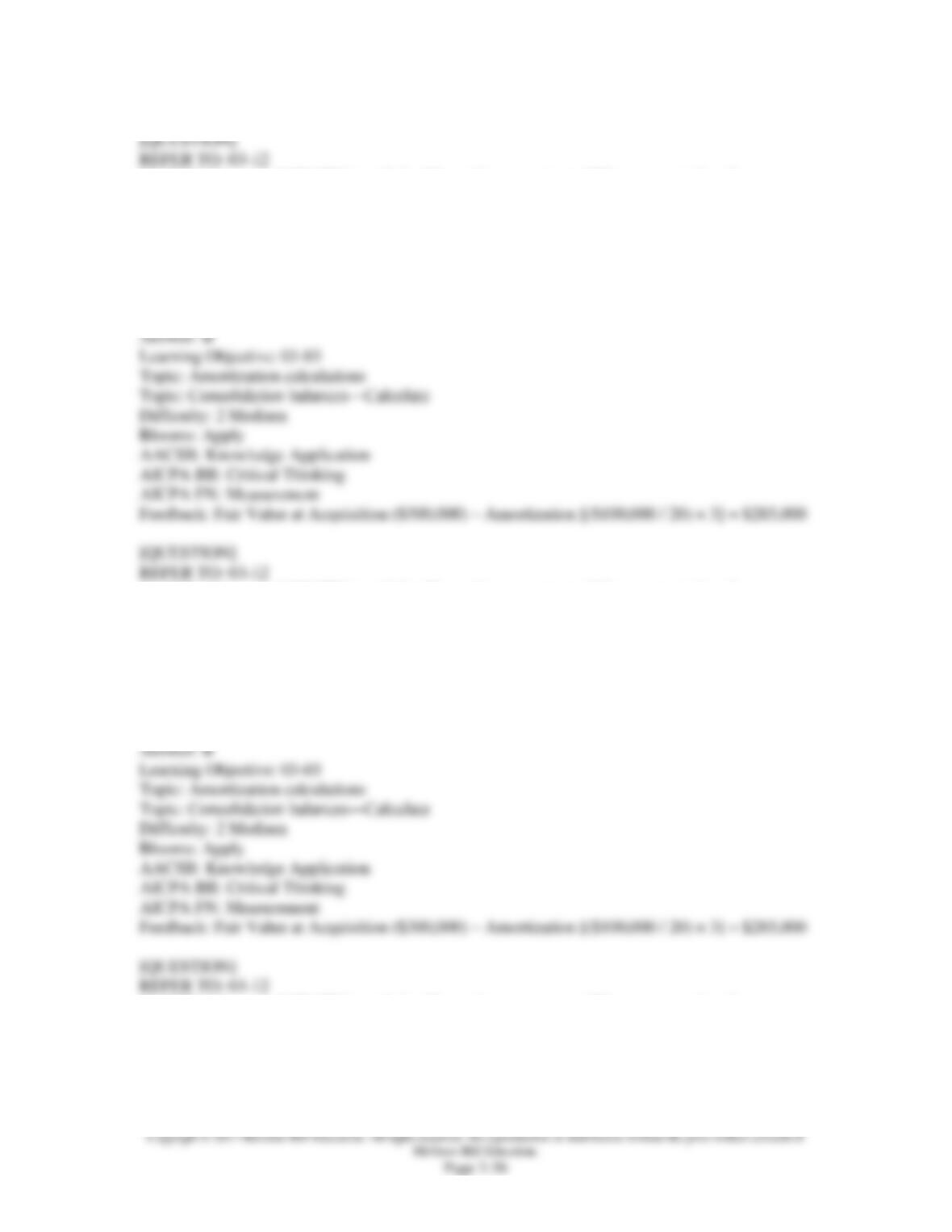
80. If Watkins pays $450,000 in cash for Glen, what amount would be represented as the
subsidiary’s Building in a consolidation at December 31, 2019, assuming the book value of the
building at that date is still $200,000?
A) $200,000.
B) $285,000.
C) $290,000.
D) $295,000.
E) $300,000.
81. If Watkins pays $400,000 in cash for Glen, what amount would be represented as the
subsidiary’s Building in a consolidation at December 31, 2019, assuming the book value of the
building at that date is still $200,000?
A) $200,000.
B) $285,000.
C) $260,000.
D) $268,000.
E) $300,000.
82. If Watkins pays $450,000 in cash for Glen, what amount would be represented as the
subsidiary’s Equipment in a consolidation at December 31, 2019, assuming the book value of the
equipment at that date is still $80,000?
A) $70,000.
B) $73,500.
C) $75,000.
D) $76,500.
E) $80,000.
83. If Watkins pays $450,000 in cash for Glen, what acquisition-date fair value allocation, net of
amortization, should be attributed to the subsidiary’s Equipment in consolidation at December 31,
2019?
A) ($5,000).
B) $80,000.
C) $75,000.
D) $73,500.
E) ($3,500).
84. If Watkins pays $300,000 in cash for Glen, at what amount would the subsidiary’s Building
be represented in a January 2, 2017 consolidation?
A) $200,000.
B) $225,000.
C) $273,000.
D) $279,000.
E) $300,000.
Copyright © 2017 McGraw-Hill Education. All rights reserved. No reproduction or distribution without the prior written consent of
McGraw-Hill Education.
Page 3-38
AICPA FN: Measurement
Feedback: Fair Value at Acquisition = $300,000
[QUESTION]
REFER TO: 03-12
85. If Watkins pays $450,000 in cash for Glen, and Glen earns $50,000 in net income and pays
$20,000 in dividends during 2017, what amount representing Glen would be reflected in
consolidated net income for the year ended December 31, 2017?
A) $20,000 under the initial value method.
B) $30,000 under the partial equity method.
C) $50,000 under the partial equity method.
D) $44,500 under the equity method.
E) $45,500 regardless of the internal accounting method used.
86. According to the FASB ASC regarding the testing procedures for Goodwill Impairment, the
proper procedure for conducting impairment testing is:
A) Goodwill recognized in consolidation may be amortized uniformly and only tested if the
amortization method originally chosen is changed.
B) Goodwill recognized in consolidation must only be impairment tested prior to disposal of the
consolidated unit to eliminate the impairment of goodwill from the gain or loss on the sale of that
specific entity.
C) Goodwill recognized in consolidation may be impairment tested in a two-step approach, first
by quantitative assessment of the possible impairment of the fair value of the unit relative to the
book value, and then a qualitative assessment as to why the impairment, if any, occurred for
disclosure.
D) Goodwill recognized in consolidation may be impairment tested in a two-step approach, first
by qualitative assessment of the possibility of impairment of the unit fair value relative to the
book value, and then quantitative assessments as to how much impairment, if any, occurred for
disclosure.
E) Goodwill recognized in consolidation may be impairment tested in a two-step approach, first
by qualitative assessment of the possibility of impairment of the unit fair value relative to the
book value, and then quantitative assessments as to how much impairment, if any, occurred for
asset write-down.
Copyright © 2017 McGraw-Hill Education. All rights reserved. No reproduction or distribution without the prior written consent of
McGraw-Hill Education.
Page 3-39
AACSB: Reflective Thinking
AICPA BB: Critical Thinking
AICPA FN: Measurement
[QUESTION]
87. When is a goodwill impairment loss recognized?
A) Only after both a quantitative and qualitative assessment of the fair value of goodwill of a
reporting unit.
B) After only definitive quantitative assessments of the fair value of goodwill is completed.
C) After only definitive qualitative assessments of the fair value of goodwill is completed.
D) If the fair value of a reporting unit falls to zero or below its original acquisition price.
E) Never.
88. For an acquisition when the subsidiary retains its incorporation, which method of internal
recordkeeping is the easiest for the parent to use?
89. For an acquisition when the subsidiary retains its incorporation, which method of internal
recordkeeping gives the most accurate portrayal of the accounting results for the entire business
combination?
90. For an acquisition when the subsidiary maintains its incorporation, under the partial equity
method, what adjustments are made to the balance of the investment account?
91. From which methods can a parent choose for its internal recordkeeping related to the
operations of a subsidiary?
92. For recognized intangible assets that are considered to possess indefinite lives, what is the
accounting treatment for purposes of income recognition?
93. What is the partial equity method? How does it differ from the equity method? What are its
advantages and disadvantages compared to the equity method?