File: Chapter 03 – Consolidations – Subsequent to the Date of Acquisition
Multiple Choice:
1. Which one of the following accounts would not appear in the consolidated financial statements
at the end of the first fiscal period of the combination?
A) Goodwill.
B) Equipment.
C) Investment in Subsidiary.
D) Common Stock.
E) Additional Paid-In Capital.
2. Which of the following internal record-keeping methods can a parent choose to account for a
subsidiary acquired in a business combination?
A) Initial value or book value.
B) Initial value, lower-of-cost-or-market-value, or equity.
C) Initial value, equity, or partial equity.
D) Initial value, equity, or book value.
E) Initial value, lower-of-cost-or-market-value, or partial equity.
3. Which one of the following varies between the equity, initial value, and partial equity methods
of accounting for an investment?
A) The amount of consolidated net income.
B) Total assets on the consolidated balance sheet.
C) Total liabilities on the consolidated balance sheet.
D) The balance in the investment account on the parent‘s books.
E) The amount of consolidated cost of goods sold.
Copyright © 2017 McGraw-Hill Education. All rights reserved. No reproduction or distribution without the prior written consent of
McGraw-Hill Education.
Page 3-2
AACSB: Reflective Thinking
AICPA BB: Critical Thinking
AICPA FN: Measurement
[QUESTION]
4. Under the partial equity method, the parent recognizes income when
A) Dividends are received from the investee.
B) Dividends are declared by the investee.
C) The related expense has been incurred.
D) The related contract is signed by the subsidiary.
E) It is earned by the subsidiary.
5. An impairment model is used
A) To assess whether asset write-downs are appropriate for indefinite-lived assets.
B) To calculate the fair value of intangible assets.
C) To calculate the amortization of indefinite-lived assets over their useful lives.
D) To determine whether the fair value of assets should be recognized.
E) To determine the likelihood that the fair value of an assumed liability will increase.
6. Racer Corp. acquired all of the common stock of Tangiers Co. in 2016. Tangiers maintained
its incorporation. Which of Racer’s account balances would vary between the equity method and
the initial value method?
A) Goodwill, Investment in Tangiers Co., and Retained Earnings.
B) Expenses, Investment in Tangiers Co., and Equity in Subsidiary Earnings.
C) Investment in Tangiers Co., Equity in Subsidiary Earnings, and Retained Earnings.
D) Common Stock, Goodwill, and Investment in Tangiers Co.
E) Expenses, Goodwill, and Investment in Tangiers Co.
Copyright © 2017 McGraw-Hill Education. All rights reserved. No reproduction or distribution without the prior written consent of
McGraw-Hill Education.
Page 3-3
Learning Objective: 03-03a
Learning Objective: 03-03b
Topic: Investment methods―Identify and differentiate
Difficulty: 3 Hard
Blooms: Understand
AACSB: Reflective Thinking
AICPA BB: Critical Thinking
AICPA FN: Measurement
[QUESTION]
7. How does the partial equity method differ from the equity method?
A) In the total assets reported on the consolidated balance sheet.
B) In the treatment of dividends.
C) In the total liabilities reported on the consolidated balance sheet.
D) Under the partial equity method, subsidiary income does not increase the balance in the
parent’s investment account.
E) Under the partial equity method, the balance in the investment account is not decreased by
amortization on allocations made in the acquisition of the subsidiary.
8. Jansen Inc. acquired all of the outstanding common stock of Merriam Co. on January 1, 2017,
for $257,000. Annual amortization of $19,000 resulted from this acquisition. Jansen reported net
income of $70,000 in 2017 and $50,000 in 2018 and paid $22,000 in dividends each year.
Merriam reported net income of $40,000 in 2017 and $47,000 in 2018 and paid $10,000 in
dividends each year. What is the Investment in Merriam Co. balance on Jansen’s books as of
December 31, 2018, if the equity method has been applied?
A) $286,000.
B) $295,000.
C) $276,000.
D) $344,000.
E) $324,000.
9. Which of the following is not an example of an intangible asset?
A) Customer list
B) Database
C) Lease agreement
D) Broken equipment
E) Trademark
10. Parrett Corp. acquired one hundred percent of Jones Inc. on January 1, 2016, at a price in
excess of the subsidiary’s fair value. On that date, Parrett’s equipment (ten-year life) had a book
value of $360,000 but a fair value of $480,000. Jones had equipment (ten-year life) with a book
value of $240,000 and a fair value of $350,000. Parrett used the partial equity method to record
its investment in Jones. On December 31, 2018, Parrett had equipment with a book value of
$250,000 and a fair value of $400,000. Jones had equipment with a book value of $170,000 and a
fair value of $320,000. What is the consolidated balance for the Equipment account as of
December 31, 2018?
A) $387,000.
B) $497,000.
C) $508.000.
D) $537,000.
E) $570,000.
Copyright © 2017 McGraw-Hill Education. All rights reserved. No reproduction or distribution without the prior written consent of
McGraw-Hill Education.
Page 3-5
Kaltop earned net income for 2017 of $126,000 and paid dividends of $48,000 during the year.
[QUESTION]
REFER TO: 03-01
11. The 2017 total excess amortization of fair-value allocations is calculated to be
A) $4,000.
B) $6,400.
C) ($2,400).
D) ($1,000).
E) $3,800.
12. In Cale’s accounting records, what amount would appear on December 31, 2017 for equity in
subsidiary earnings?
A) $77,000.
B) $79,000.
C) $125,000.
D) $127,000.
E) $81,800.
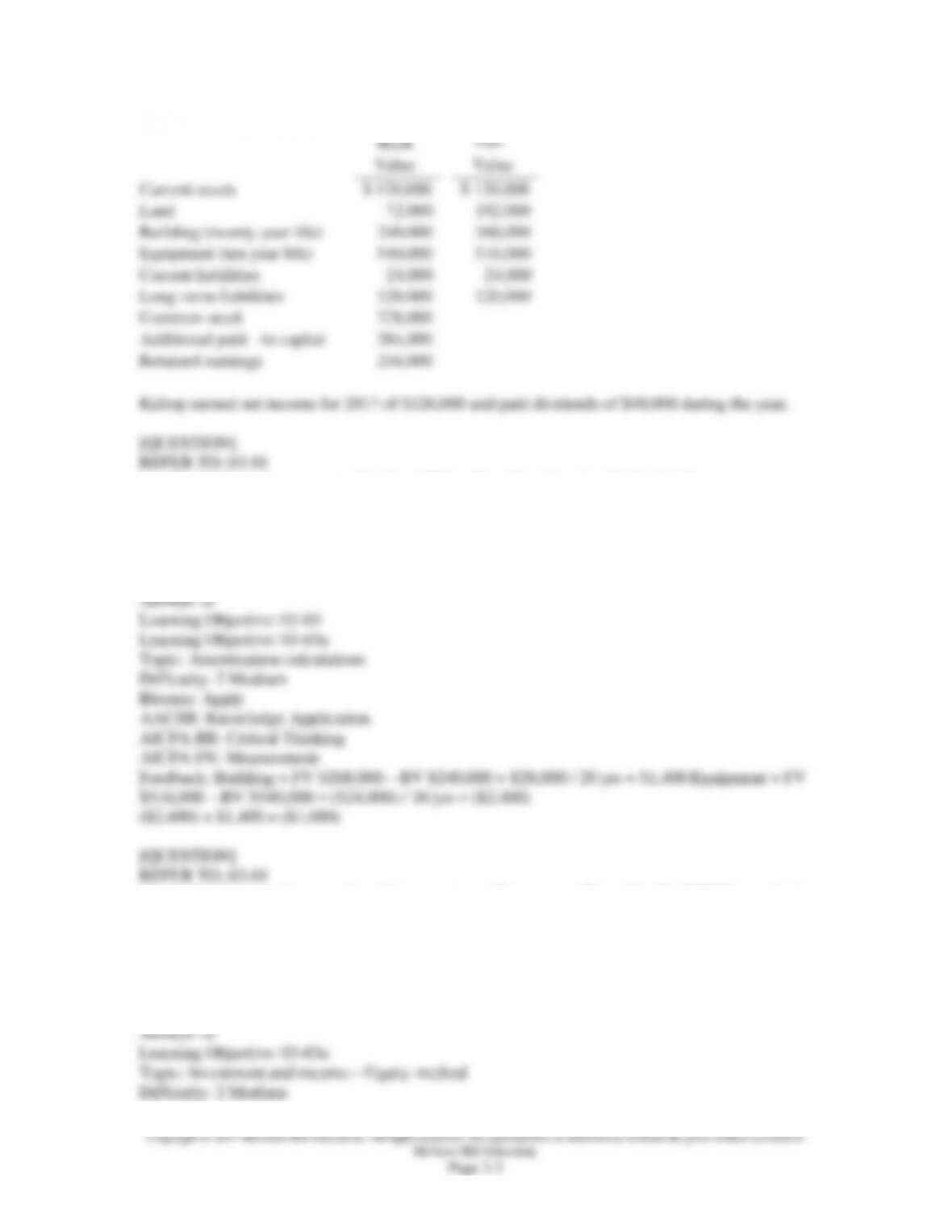
Fair
Book
Value
Value
Current assets
$ 120,000
$ 120,000
Land
72,000
192,000
Building (twenty year life)
240,000
268,000
Equipment (ten year life)
540,000
516,000
Current liabilities
24,000
24,000
Long
–
term liabilities
120,000
120,000
Common stock
228,000
Additional paid
–
in capital
384,000
Retained earnings
216,000
Copyright © 2017 McGraw-Hill Education. All rights reserved. No reproduction or distribution without the prior written consent of
McGraw-Hill Education.
Page 3-6
Blooms: Apply
AACSB: Knowledge Application
AICPA BB: Critical Thinking
AICPA FN: Measurement
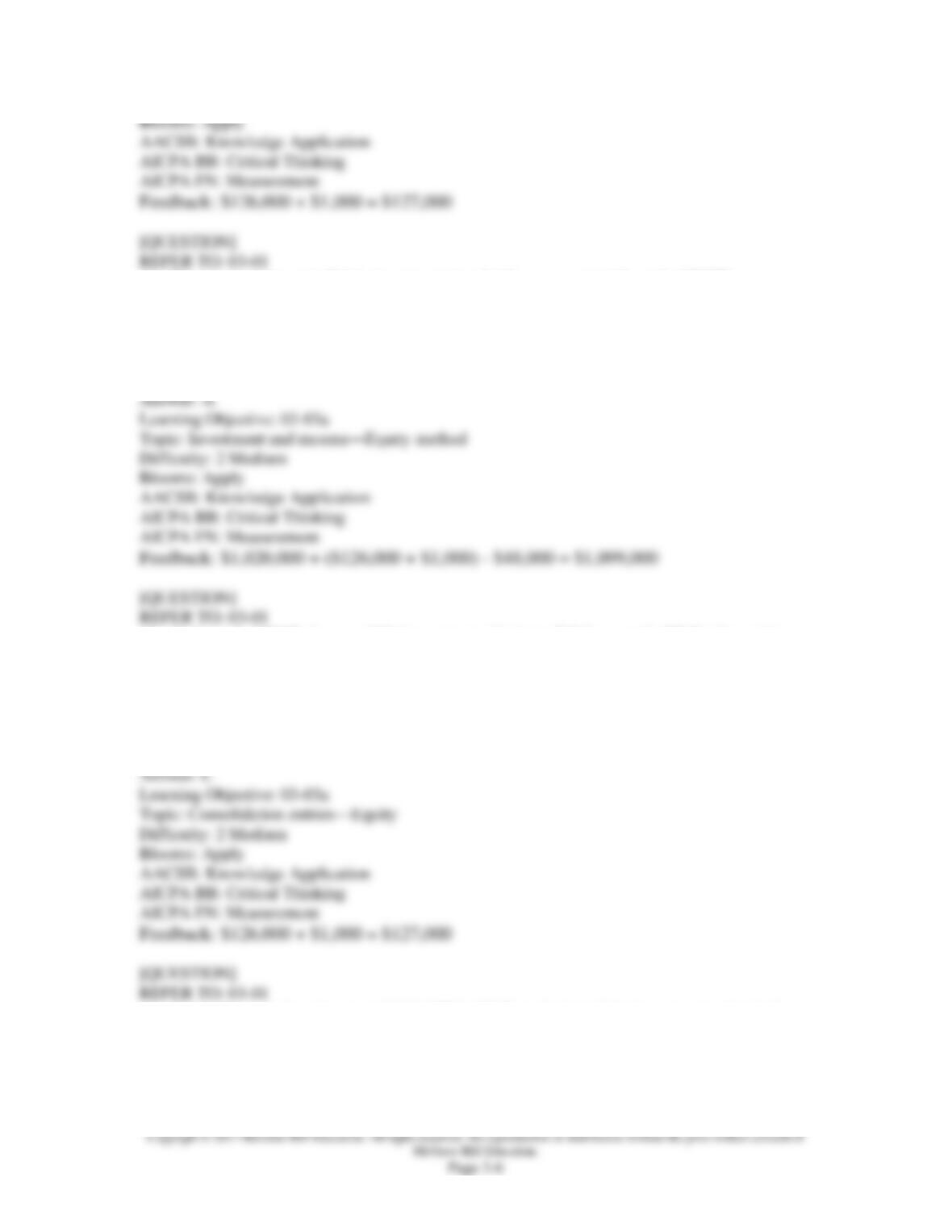
Feedback: $126,000 + $1,000 = $127,000
[QUESTION]
REFER TO: 03-01
13. What is the balance in Cale’s investment in subsidiary account at the end of 2017?
A) $1,099,000.
B) $1,020,000.
C) $1,096,200.
D) $1,098,000.
E) $1,144,400.
14. At the end of 2017, the consolidation entry to eliminate Cale’s accrual of Kaltop’s earnings
would include a credit to Investment in Kaltop Co. for
A) $124,400.
B) $126,000.
C) $127,000.
D) $ 76,400.
E) $ 0.
15. If Cale Corp. had net income of $444,000 in 2017, exclusive of the investment, what is the
amount of consolidated net income?
A) $569,000.
B) $570,000.
C) $571,000.
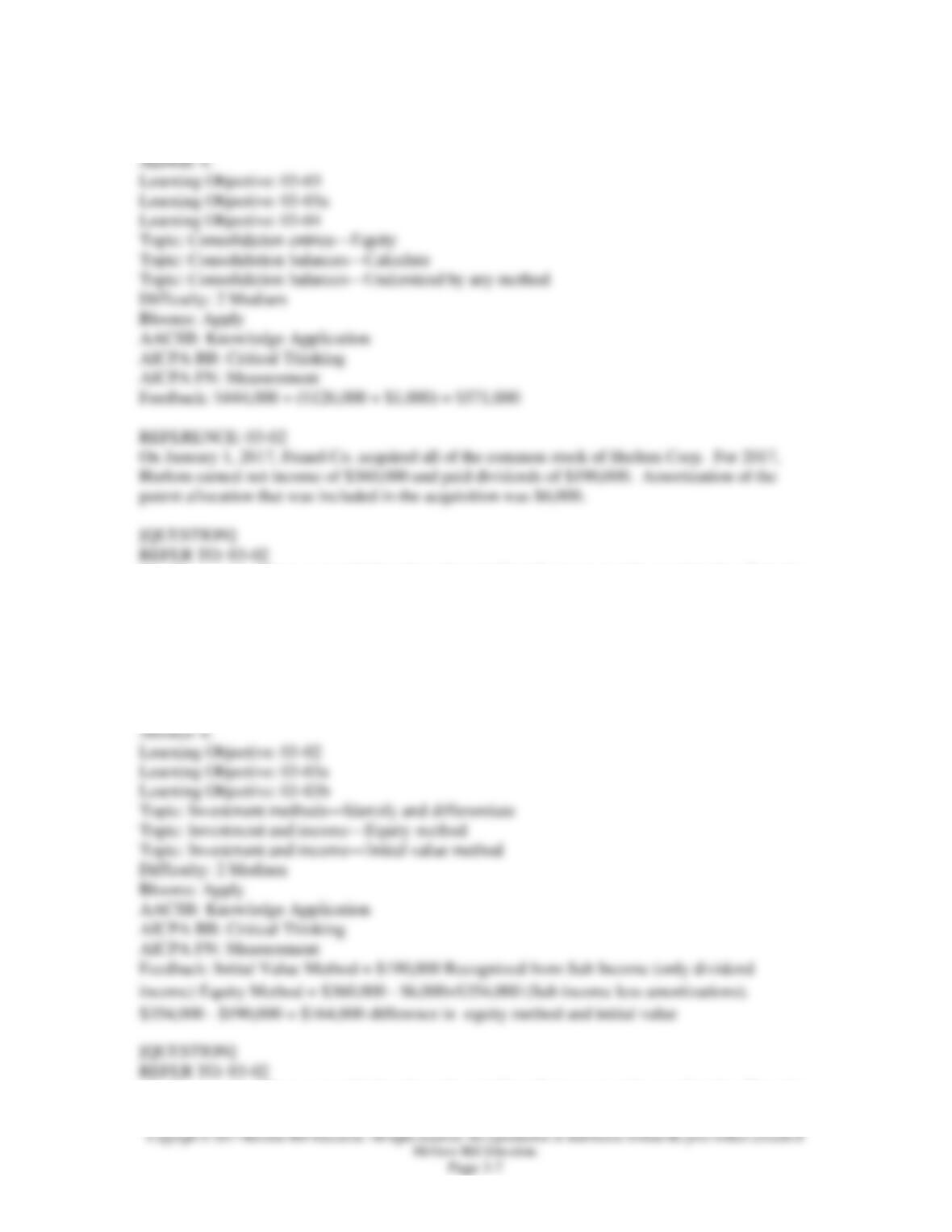
D) $566,400.
E) $444,000.
16. How much difference would there have been in Franel’s income with regard to the effect of
the investment, between using the equity method or using the initial value method of internal
recordkeeping?
A) $190,000.
B) $360,000.
C) $164,000.
D) $354,000.
E) $150,000.
17. How much difference would there have been in Franel’s income with regard to the effect of
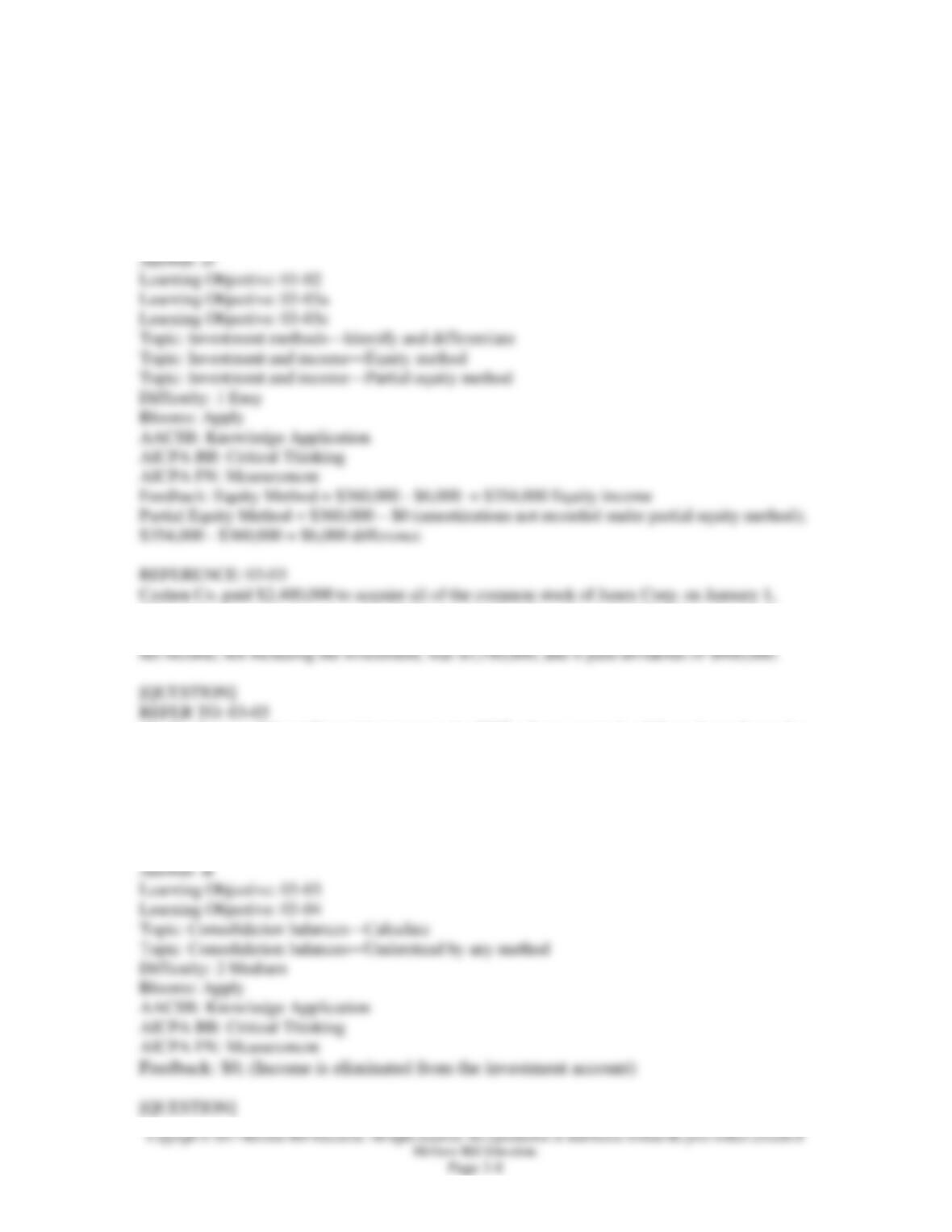
the investment, between using the equity method or using the partial equity method of internal
recordkeeping?
A) $170,000.
B) $354,000.
C) $164,000.
D) $ 6,000.
E) $174,000.
2017. Janex’s reported earnings for 2017 totaled $432,000, and it paid $120,000 in dividends
during the year. The amortization of allocations related to the investment was $24,000. Cashen’s
18. On the consolidated financial statements for 2017, what amount should have been shown for
Equity in Subsidiary Earnings?
A) $432,000.
B) $ -0-
C) $408,000.
D) $120,000.
E) $288,000.
Copyright © 2017 McGraw-Hill Education. All rights reserved. No reproduction or distribution without the prior written consent of
McGraw-Hill Education.
Page 3-9
REFER TO: 03-03
19. On the consolidated financial statements for 2017, what amount should have been shown for
consolidated dividends?
A) $ 900,000.
B) $1,020,000.
C) $ 876,000.
D) $ 996,000.
E) $ 948,000.
20. What is the amount of consolidated net income for the year 2017?
A) $3,180,000.
B) $3,612,000.
C) $3,300,000.
D) $3,588,000.
E) $3,420,000.
Jans
Tysk
Revenues
$1,080,000
$840,000
Expenses
480,000
600,000
Investment income
Not given
0
Retained earnings, 1/1/18
840,000
600,000
Dividends paid
132,000
70,000
[QUESTION]
REFER TO: 03-04
21. If the partial equity method had been applied, what was 2018 consolidated net income?
A) $840,000.
B) $768,400.
C) $822,000.
D) $240,000.
E) $600,000.
22. If the equity method had been applied, what would be the Investment in Tysk Corp. account
balance within the records of Jans at the end of 2018?
A) $612,100.
B) $744,000.
C) $774,150.
D) $372,000.
E) $844,150.
Copyright © 2017 McGraw-Hill Education. All rights reserved. No reproduction or distribution without the prior written consent of
McGraw-Hill Education.
Page 3-11
AICPA BB: Critical Thinking
AICPA FN: Measurement
Feedback: Initial Investment $372,000
2016 Entries: $180,000 – $70,000 – $18,000 = $92,000
2017 Entries: $216,000 – $70,000 – $18,000 = $128,000
2018 Entries: $240,000 – $70,000 – $18,000 = $152,000
$372,000 + $92,000 + $128,000 + $152,000 = $744,000
[QUESTION]
23. Red Co. acquired 100% of Green, Inc. on January 1, 2017. On that date, Green had land
with a book value of $42,000 and a fair value of $52,000. Also, on the date of acquisition, Green
had a building with a book value of $200,000 and a fair value of $390,000. Green had equipment
with a book value of $350,000 and a fair value of $280,000. The building had a 10-year
remaining useful life and the equipment had a 5-year remaining useful life. In Red’s December
31, 2017 consolidated worksheet, what total amount of excess fair over book value
amortization expense adjustments should Red recognize resulting from its 100%
acquisition of Green?
A) $43,000.
B) $33,000.
C) $ 5,000.
D) $15,000.
E) $0.
24. All of the following are acceptable methods to account for a majority-owned investment in
subsidiary except
A) The equity method.
B) The initial value method.
C) The partial equity method.
D) The fair-value method.
E) Book value method.
Copyright © 2017 McGraw-Hill Education. All rights reserved. No reproduction or distribution without the prior written consent of
McGraw-Hill Education.
Page 3-12
AICPA BB: Critical Thinking
AICPA FN: Measurement
[QUESTION]
25. Under the equity method of accounting for an investment:
A) The investment account remains at initial value.
B) Dividends received are recorded as revenue.
C) Goodwill is amortized over 20 years.
D) Income reported by the subsidiary increases the investment account.
E) Dividends received increase the investment account.
26. Under the partial equity method of accounting for an investment,
A) The investment account remains at initial value.
B) Dividends received are recorded as revenue.
C) The allocations for excess fair value allocations over book value of net assets at date of
acquisition are applied over their useful lives to reduce the investment account.
D) Amortization of the excess of fair value allocations over book value is ignored in regard to the
investment account.
E) Dividends received increase the investment account.
27. Under the initial value method, when accounting for an investment in a subsidiary,
A) Dividends received by the subsidiary decrease the investment account.
B) The investment account is adjusted to fair value at year-end.
C) Income reported by the subsidiary increases the investment account.
D) The investment account does not change from year to year.
E) Dividends received are ignored.
Copyright © 2017 McGraw-Hill Education. All rights reserved. No reproduction or distribution without the prior written consent of
McGraw-Hill Education.
Page 3-13
AICPA BB: Critical Thinking
AICPA FN: Measurement
[QUESTION]
28. According to GAAP regarding amortization of goodwill, which of the following statements is
true?
A) Goodwill recognized in consolidation must be amortized over 20 years.
B) Goodwill recognized in consolidation must be expensed in the period of acquisition.
C) Goodwill recognized in consolidation will not be amortized but subject to an annual test for
impairment.
D) Goodwill recognized in consolidation can never be written off.
E) Goodwill recognized in consolidation must be amortized over 40 years.
29. When a company applies the initial value method in accounting for its investment in a
subsidiary, and the subsidiary reports income in excess of dividends paid, what entry would be
made for a consolidation worksheet for the second year?
A)
Retained earnings
Investment in subsidiary
B)
Investment in subsidiary
Retained earnings
C)
Investment in subsidiary
Equity in subsidiary’s income
D)
Equity in subsidiary’s income
Investment in subsidiary
E)
Additional paid-in capital
Retained earnings
30. When a company applies the initial value method in accounting for its investment in a
subsidiary and the subsidiary reports income less than dividends paid, what entry would be made
for a consolidation worksheet in the second year?
A)
Retained earnings
Investment in subsidiary
B)
Investment in subsidiary
Retained earnings
C)
Investment in subsidiary
Equity in subsidiary’s income
D)
Investment in subsidiary
Additional paid-in capital
E)
Retained earnings
Additional paid-in capital
31. When a company applies the partial equity method in accounting for its investment in a
subsidiary and the subsidiary’s equipment has a fair value greater than its book value, what
consolidation worksheet entry is made in a year subsequent to the initial acquisition of the
subsidiary?
A)
Retained earnings
Investment in subsidiary
B)
Investment in subsidiary
Retained earnings
C)
Investment in subsidiary
Equity in subsidiary’s income
D)
Investment in subsidiary
Additional paid-in capital
E)
Retained earnings
Additional paid-in capital
32. When consolidating parent and subsidiary financial statements, which of the following
statements is true?
A) Goodwill is never recognized.
B) Goodwill required is amortized over 20 years.
C) Goodwill may be recorded on the parent company’s books.
D) The value of any goodwill should be tested annually for impairment in value.
E) Goodwill should be expensed in the year of acquisition.
33. When consolidating a subsidiary under the equity method, which of the following statements
is true with regard to the subsidiary subsequent to the year of acquisition?
A) All net assets are revalued to fair value and must be amortized over their useful lives.
B) Only net assets that had excess fair value over book value when acquired by the parent must
be amortized over their useful lives.
C) All depreciable net assets are revalued to fair value at date of acquisition and must be
amortized over their useful lives.
D) Only depreciable net assets that have excess fair value over book value must be amortized
over their useful lives.
E) Only assets that have excess fair value over book value must be amortized over their useful
lives.
34. Which of the following is not a factor to be considered when determining the useful life of an
intangible asset?
A) Legal, regulatory or contractual provisions.
B) The effects of obsolescence.
C) The expected use of the asset by the organization.
D) The fair value of the asset.
E) The level of maintenance expenditures that will be required to obtain expected future benefits.
Copyright © 2017 McGraw-Hill Education. All rights reserved. No reproduction or distribution without the prior written consent of
McGraw-Hill Education.
Page 3-16
AICPA BB: Critical Thinking
AICPA FN: Measurement
[QUESTION]
35. Which of the following is false regarding contingent consideration in business combinations?
A) Contingent consideration payable in cash is reported under liabilities.
B) Contingent consideration payable in stock shares is reported under stockholders’ equity.
C) Contingent consideration is recorded because of its substantial probability of eventual
payment.
D) The contingent consideration fair value is recognized as part of the acquisition regardless of
whether eventual payment is based on future performance of the target firm or future stock price
of the acquirer.
E) Contingent consideration is reflected in the acquirer’s balance sheet at the present value of the
potential expected future payment.
36. With respect to identifiable intangible assets other than goodwill, which of the following is
true?
A) If the value of the identified asset meets a de minimis exception, the entity may elect to treat it
as goodwill.
B) An identifiable intangible asset with an indefinite useful life must be assessed for impairment
once every three years.
C) If the average fair value of the asset is less than the average carrying amount of the asset with
respect to, and determined for, the preceding three-year period, the asset is considered impaired
and the entity may recognize a loss.
D) A quantitative evaluation of value is required each year regardless of circumstances.
E) If a qualitative assessment of the asset performed by an entity indicates impairment is likely, a
quantitative assessment must be performed to determine whether there has been a loss in fair
value.
37. Consolidated net income using the equity method for an acquisition combination is computed
as follows:
A) Parent company’s revenues from its own operations plus subsidiary retained earnings.
B) Parent’s reported net income plus subsidiary dividends.
C) Combined revenues less combined expenses less equity in subsidiary’s earnings less
amortization of fair-value allocations in excess of book value.
D) Parent’s revenues less expenses for its own operations plus the equity from subsidiary’s
earnings less subsidiary dividends.
E) None of these answer choices are correct.
Debit
Credit
Cash
$ 500
Accounts receivable
600
Inventory
800
Buildings (net) (5 year life)
1,500
Equipment (net) (2 year life)
1,000
Land
900
Accounts payable
$ 400
Long
–
term liabilities (due 12/31/20)
1,800
Common stock
1,000
Additional paid
–
in capital
600
Retained earnings
_____
1,500
Total
$5,300
$5,300
Net income and dividends reported by Hurley for 2017 and 2018 follow:
2017
2018
Net income
$100
$120
Dividends
30
40
The fair value of Hurley’s net assets that differ from their book values
are listed below:
Fair Value
Buildings
$ 1,200
Equipment
1,250
Land
1,300
Long
–
term liabilities
1,700
38. Compute the consideration transferred in excess of book value acquired at January 1, 2017.
A) $ 150.
B) $ 700.
C) $2,200.
D) $ 550.
E) $2,900.
39. Compute goodwill, if any, at January 1, 2017.
A) $ 150.
B) $ 250.
C) $ 700.
D) $1,200.
E) $ 550.
40. Compute the amount of Hurley’s inventory that would be reported in a January 1, 2017,
consolidated balance sheet.
A) $800.
B) $100.
C) $900.
D) $150.
E) $ 0.
Copyright © 2017 McGraw-Hill Education. All rights reserved. No reproduction or distribution without the prior written consent of
McGraw-Hill Education.
Page 3-19
Learning Objective: 03-03
Topic: Consolidation balances―Calculate
Difficulty: 2 Medium
Blooms: Apply
AACSB: Knowledge Application
AICPA BB: Critical Thinking
AICPA FN: Measurement
Feedback: Fair Value at Acquisition = $800
[QUESTION]
REFER TO: 03-05
41. Compute the amount of Hurley’s buildings that would be reported in a December 31, 2017,
consolidated balance sheet.
A) $1,560.
B) $1,260.
C) $1,440.
D) $1,160.
E) $1,140.
42. Compute the amount of Hurley’s equipment that would be reported in a December 31, 2017,
consolidated balance sheet.
A) $1,000.
B) $1,250.
C) $ 875.
D) $1,125.
E) $ 750.
Copyright © 2017 McGraw-Hill Education. All rights reserved. No reproduction or distribution without the prior written consent of
McGraw-Hill Education.
Page 3-20
REFER TO: 03-05
43. Compute the amount of Hurley’s long-term liabilities that would be reported in a December
31, 2017, consolidated balance sheet.
A) $1,800.
B) $1,700.
C) $1,725.
D) $1,675.
E) $3,500.
44. Compute the amount of Hurley’s buildings that would be reported in a December 31, 2018,
consolidated balance sheet.
A) $1,620.
B) $1,380.
C) $1,320.
D) $1,080.
E) $1,500.
45. Compute the amount of Hurley’s equipment that would be reported in a December 31, 2018,
consolidated balance sheet.
A) $ 0.
B) $1,000.
C) $1,250.
D) $1,125.
E) $1,200.