
AACSB: Analytic
AICPA BB: Critical Thinking
AICPA FN: Measurement
Blooms: Apply
Difficulty: 2 Medium
Learning Objective: 02-05 Determine the total fair value of the consideration transferred for an acquisition and allocate
that fair value to specific subsidiary assets acquired (including goodwill); and liabilities assumed; or a gain on bargain
purchase.
Learning Objective: 02-06 Prepare the journal entry to consolidate the accounts of a subsidiary if dissolution takes place.
Learning Objective: 02-07 Prepare a worksheet to consolidate the accounts of two companies that form a business
combination if dissolution does not take place.
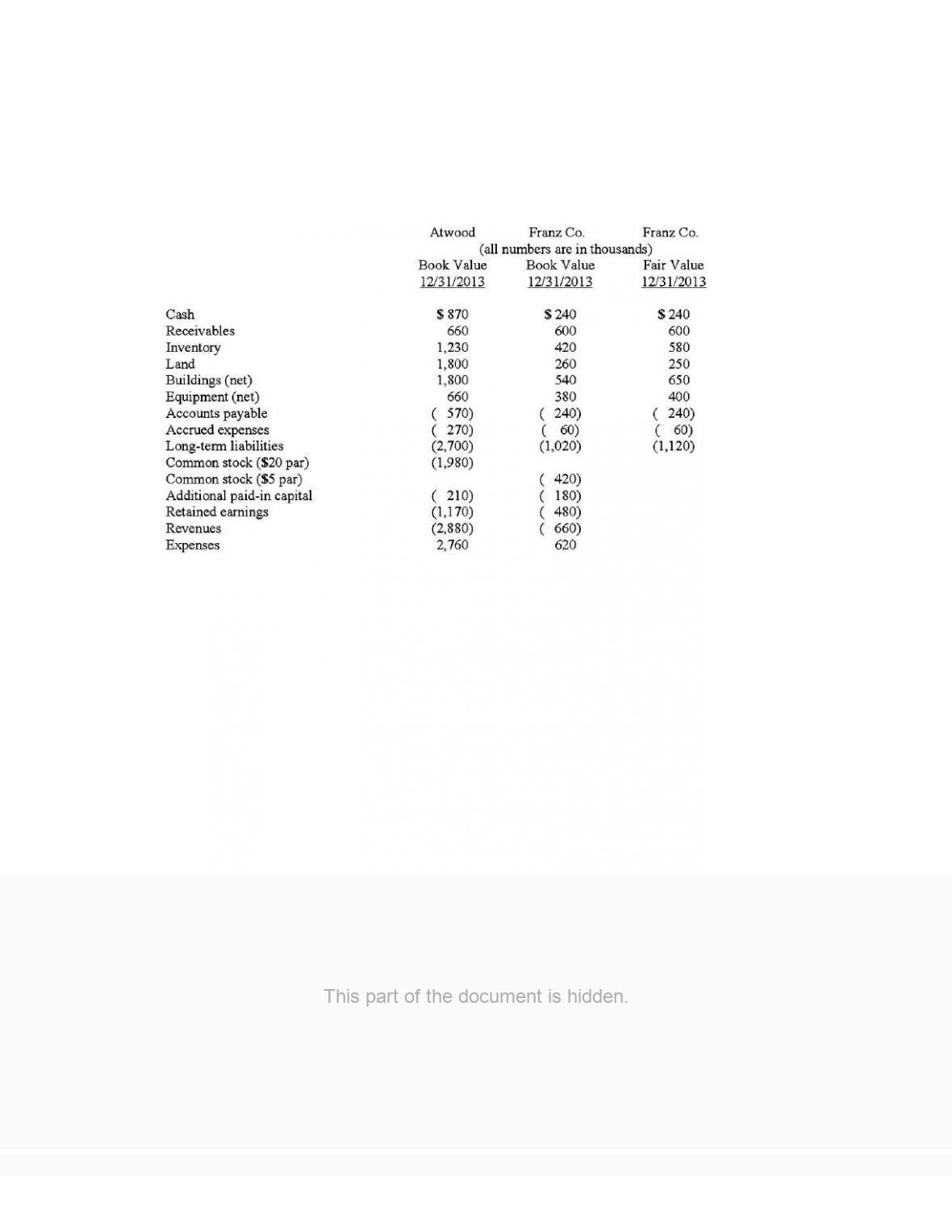
66.
The financial balances for the Atwood Company and the Franz Company as of December
31, 2013, are presented below. Also included are the fair values for Franz Company’s net
assets.
Note: Parenthesis indicate a credit balance
Assume an acquisition business combination took place at December 31, 2013. Atwood
issued 50 shares of its common stock with a fair value of $35 per share for all of the
outstanding common shares of Franz. Stock issuance costs of $15 (in thousands) and
direct costs of $10 (in thousands) were paid.
Compute consolidated retained earnings at the date of the acquisition.
A.
$1,160.
B.
$1,170.
C.
$1,280.
D.
$1,290.
E.
$1,640.
$1,170 + ($2,880 – $2760 – $10) = $1,280

AACSB: Analytic
AICPA BB: Critical Thinking
AICPA FN: Measurement
Blooms: Apply
Difficulty: 3 Hard
Learning Objective: 02-04 Describe the valuation principles of the acquisition method.
Learning Objective: 02-05 Determine the total fair value of the consideration transferred for an acquisition and allocate
that fair value to specific subsidiary assets acquired (including goodwill); and liabilities assumed; or a gain on bargain
purchase.
Learning Objective: 02-06 Prepare the journal entry to consolidate the accounts of a subsidiary if dissolution takes place.
Learning Objective: 02-07 Prepare a worksheet to consolidate the accounts of two companies that form a business
combination if dissolution does not take place.
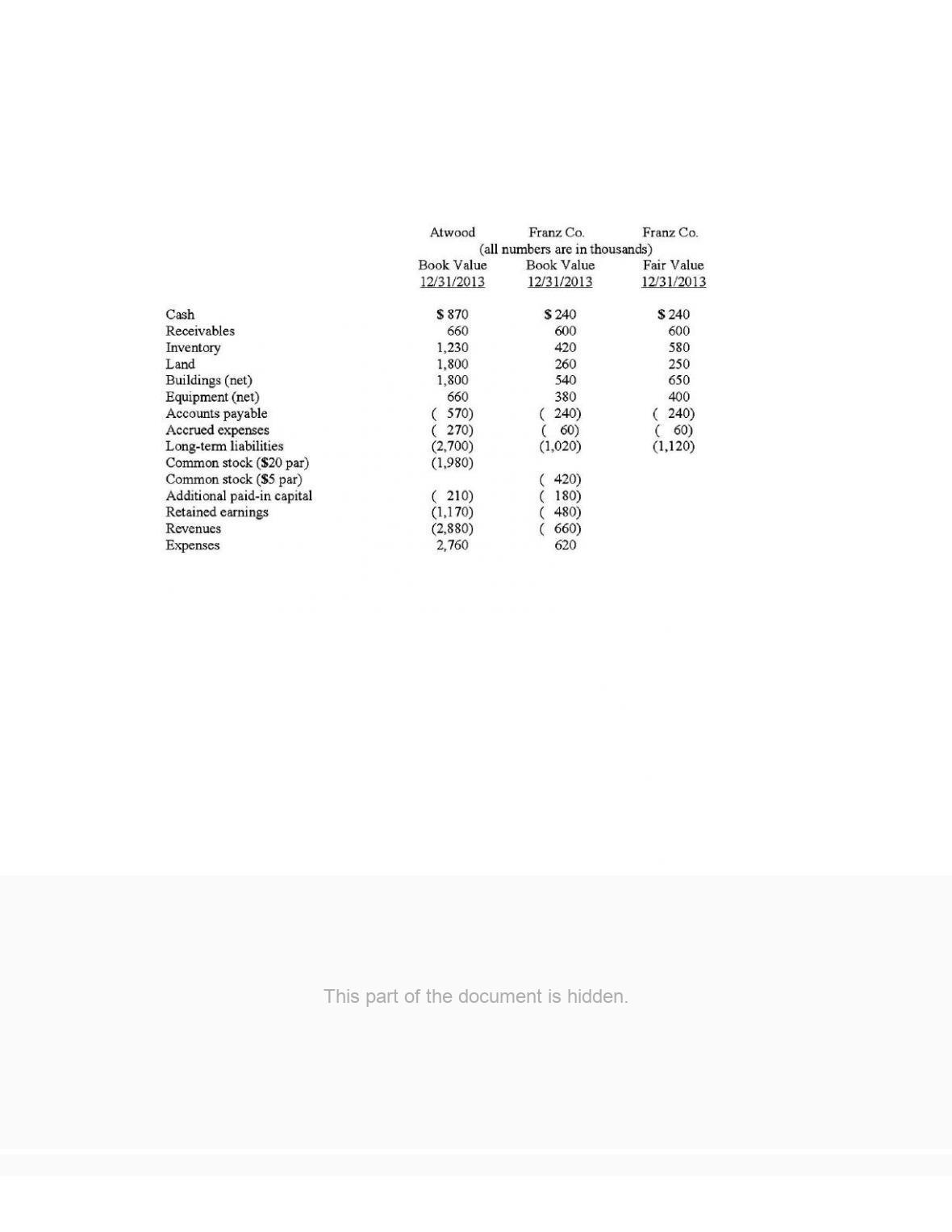
67.
The financial balances for the Atwood Company and the Franz Company as of December
31, 2013, are presented below. Also included are the fair values for Franz Company’s net
assets.
Note: Parenthesis indicate a credit balance
Assume an acquisition business combination took place at December 31, 2013. Atwood
issued 50 shares of its common stock with a fair value of $35 per share for all of the
outstanding common shares of Franz. Stock issuance costs of $15 (in thousands) and
direct costs of $10 (in thousands) were paid.
Compute consolidated revenues at the date of the acquisition.
A.
$3,540.
B.
$2,880.
C.
$1,170.
D.
$1,650.
E.
$4,050.
$2,880 Revenues of the Parent Only

AACSB: Analytic
AICPA BB: Critical Thinking
AICPA FN: Measurement
Blooms: Apply
Difficulty: 2 Medium
Learning Objective: 02-06 Prepare the journal entry to consolidate the accounts of a subsidiary if dissolution takes place.
Learning Objective: 02-07 Prepare a worksheet to consolidate the accounts of two companies that form a business
combination if dissolution does not take place.
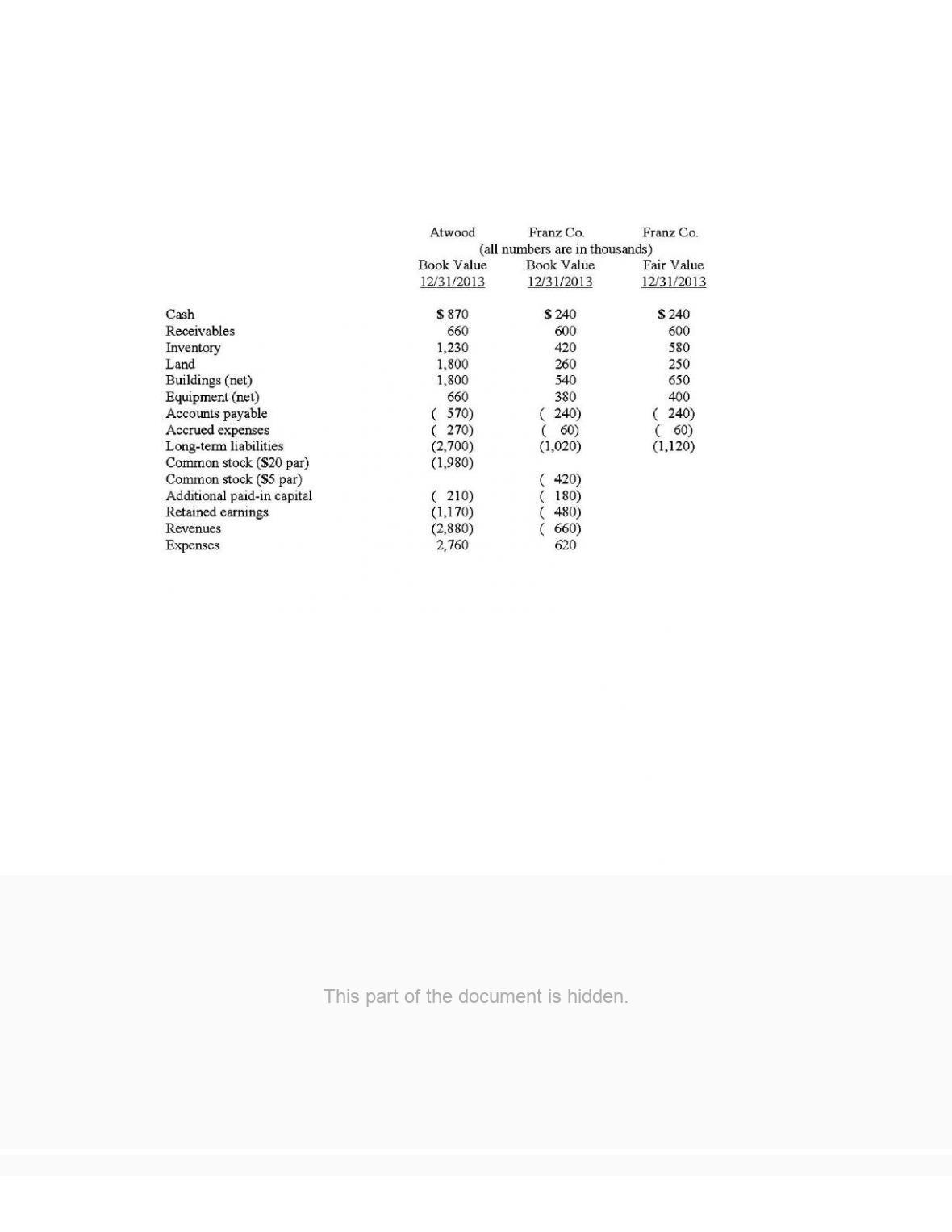
68.
The financial balances for the Atwood Company and the Franz Company as of December
31, 2013, are presented below. Also included are the fair values for Franz Company’s net
assets.
Note: Parenthesis indicate a credit balance
Assume an acquisition business combination took place at December 31, 2013. Atwood
issued 50 shares of its common stock with a fair value of $35 per share for all of the
outstanding common shares of Franz. Stock issuance costs of $15 (in thousands) and
direct costs of $10 (in thousands) were paid.
Compute consolidated cash at the completion of the acquisition.
A.
$1,350.
B.
$1,085.
C.
$1,110.
D.
$870.
E.
$845.
$870 + $240 – $15 – $10 = $1,085

AACSB: Analytic
AICPA BB: Critical Thinking
AICPA FN: Measurement
Blooms: Apply
Difficulty: 2 Medium
Learning Objective: 02-05 Determine the total fair value of the consideration transferred for an acquisition and allocate
that fair value to specific subsidiary assets acquired (including goodwill); and liabilities assumed; or a gain on bargain
purchase.
Learning Objective: 02-06 Prepare the journal entry to consolidate the accounts of a subsidiary if dissolution takes place.
Learning Objective: 02-07 Prepare a worksheet to consolidate the accounts of two companies that form a business
combination if dissolution does not take place.
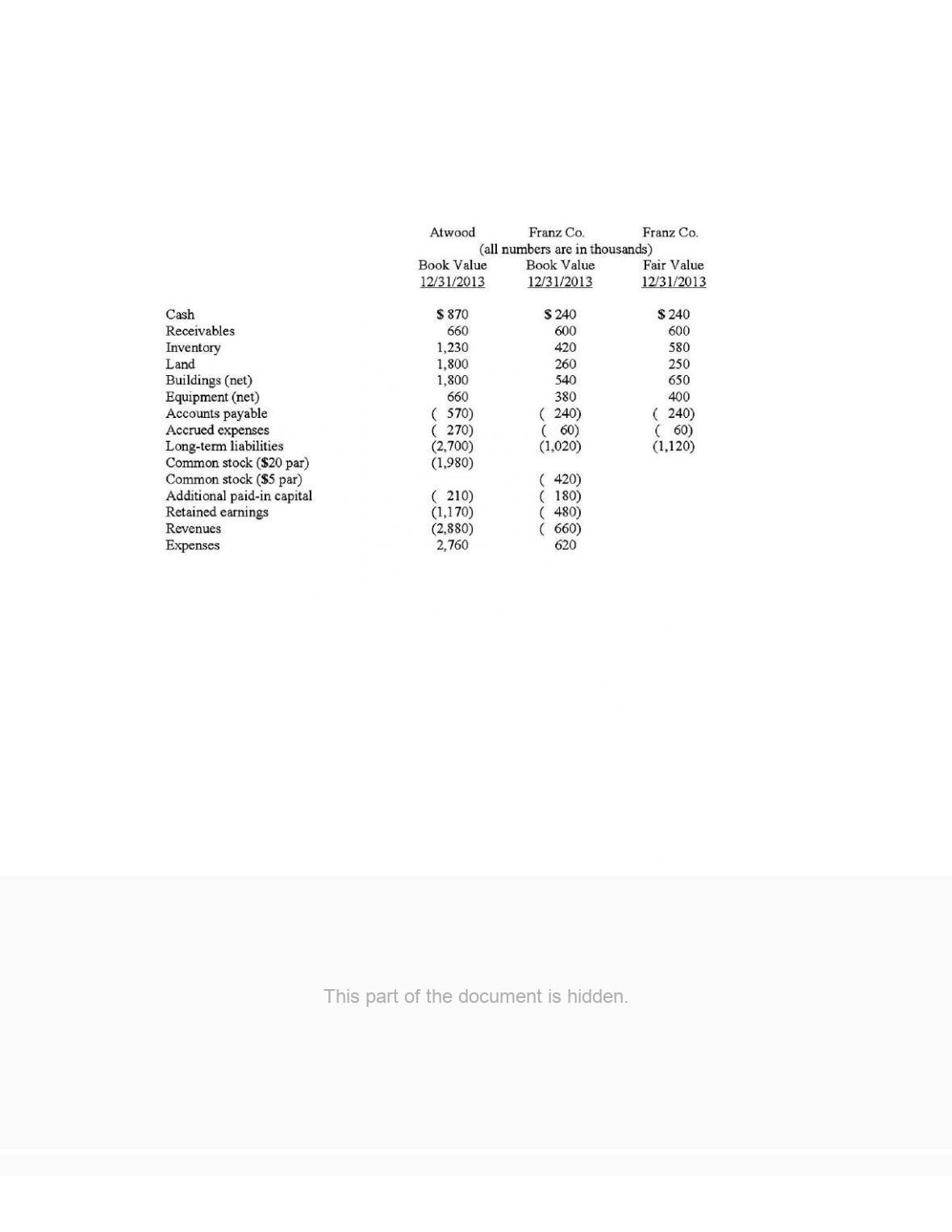
69.
The financial balances for the Atwood Company and the Franz Company as of December
31, 2013, are presented below. Also included are the fair values for Franz Company’s net
assets.
Note: Parenthesis indicate a credit balance
Assume an acquisition business combination took place at December 31, 2013. Atwood
issued 50 shares of its common stock with a fair value of $35 per share for all of the
outstanding common shares of Franz. Stock issuance costs of $15 (in thousands) and
direct costs of $10 (in thousands) were paid.
Compute consolidated expenses at the date of the acquisition.
A.
$2,760.
B.
$2,770.
C.
$2,785.
D.
$3,380.
E.
$3,390.
$2,760 + $10 = $2,770

AACSB: Analytic
AICPA BB: Critical Thinking
AICPA FN: Measurement
Blooms: Apply
Difficulty: 2 Medium
Learning Objective: 02-05 Determine the total fair value of the consideration transferred for an acquisition and allocate
that fair value to specific subsidiary assets acquired (including goodwill); and liabilities assumed; or a gain on bargain
purchase.
Learning Objective: 02-06 Prepare the journal entry to consolidate the accounts of a subsidiary if dissolution takes place.
Learning Objective: 02-07 Prepare a worksheet to consolidate the accounts of two companies that form a business
combination if dissolution does not take place.

70.
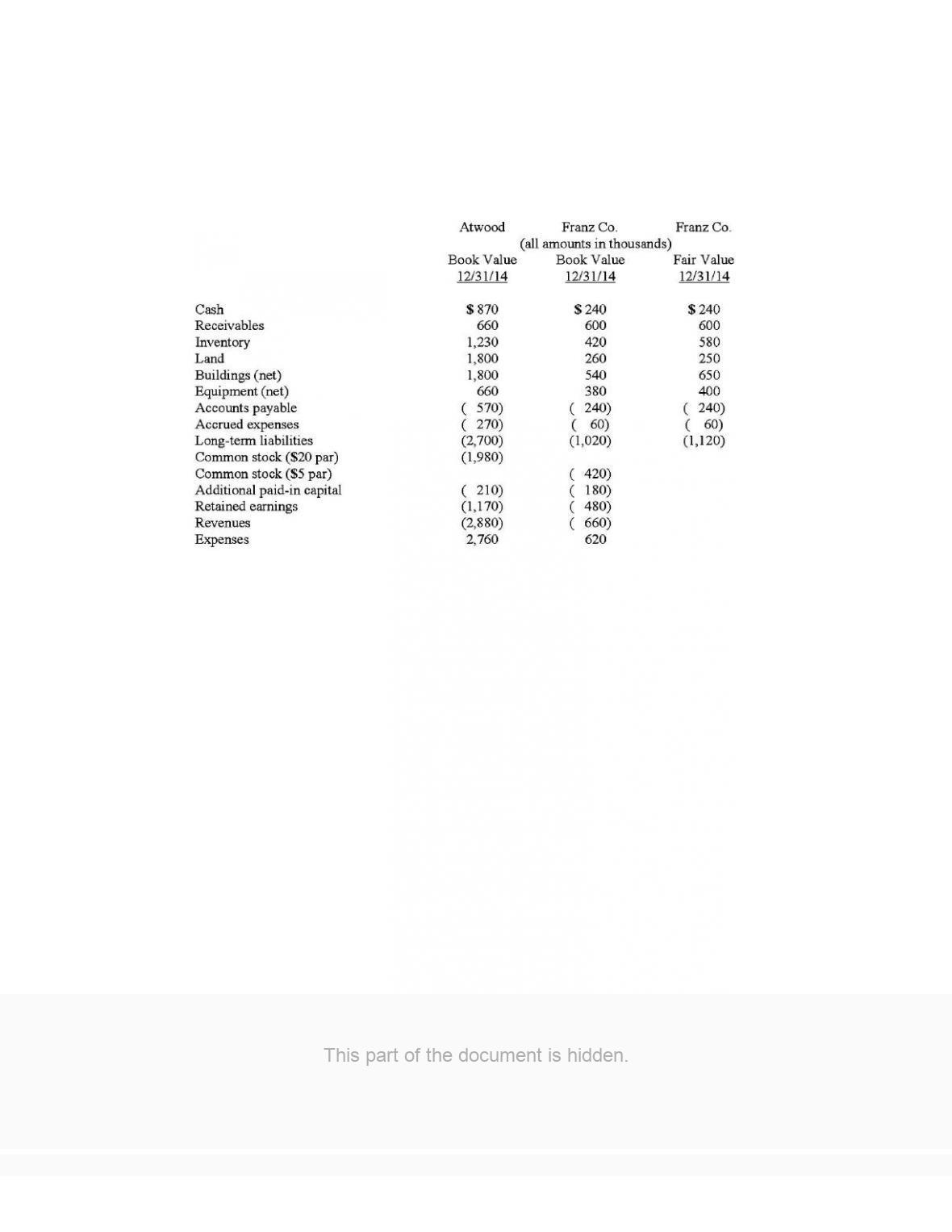
Presented below are the financial balances for the Atwood Company and the Franz
Company as of December 31, 2012, immediately before Atwood acquired Franz. Also
included are the fair values for Franz Company’s net assets at that date.
Note: Parenthesis indicate a credit balance
Assume a business combination took place at December 31, 2012. Atwood issued 50
shares of its common stock with a fair value of $35 per share for all of the outstanding
common shares of Franz. Stock issuance costs of $15 (in thousands) and direct costs of
$10 (in thousands) were paid to effect this acquisition transaction. To settle a difference
of opinion regarding Franz’s fair value, Atwood promises to pay an additional $5.2 (in
thousands) to the former owners if Franz’s earnings exceed a certain sum during the next
year. Given the probability of the required contingency payment and utilizing a 4% discount
rate, the expected present value of the contingency is $5 (in thousands).
Compute the investment to be recorded at date of acquisition.
A.
$1,750.
B.
$1,755.
C.
$1,725.
D.
$1,760.

E.
$1,765.
$35 × 50 shares = $1,750 + $5 = $1,755
AACSB: Analytic
AICPA BB: Critical Thinking
AICPA FN: Measurement
Blooms: Apply
Difficulty: 2 Medium
Learning Objective: 02-04 Describe the valuation principles of the acquisition method.
Learning Objective: 02-07 Prepare a worksheet to consolidate the accounts of two companies that form a business
combination if dissolution does not take place.

71.
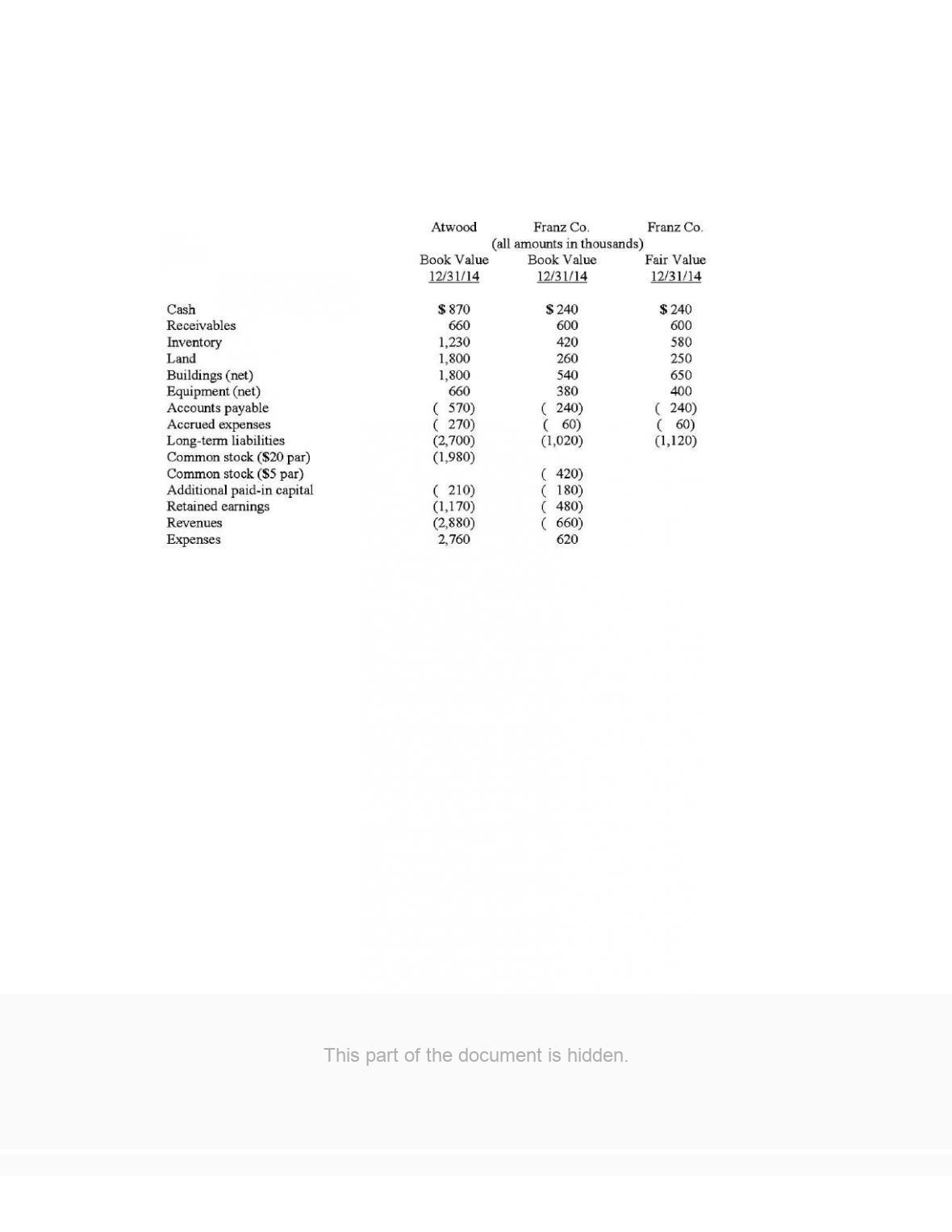
Presented below are the financial balances for the Atwood Company and the Franz
Company as of December 31, 2012, immediately before Atwood acquired Franz. Also
included are the fair values for Franz Company’s net assets at that date.
Note: Parenthesis indicate a credit balance
Assume a business combination took place at December 31, 2012. Atwood issued 50
shares of its common stock with a fair value of $35 per share for all of the outstanding
common shares of Franz. Stock issuance costs of $15 (in thousands) and direct costs of
$10 (in thousands) were paid to effect this acquisition transaction. To settle a difference
of opinion regarding Franz’s fair value, Atwood promises to pay an additional $5.2 (in
thousands) to the former owners if Franz’s earnings exceed a certain sum during the next
year. Given the probability of the required contingency payment and utilizing a 4% discount
rate, the expected present value of the contingency is $5 (in thousands).
Compute consolidated inventory at date of acquisition.
A.
$1,650.
B.
$1,810.
C.
$1,230.
D.
$580.

E.
$1,830.
$1,230 BV + $580 FV = $1,810
AACSB: Analytic
AICPA BB: Critical Thinking
AICPA FN: Measurement
Blooms: Apply
Difficulty: 2 Medium
Learning Objective: 02-05 Determine the total fair value of the consideration transferred for an acquisition and allocate
that fair value to specific subsidiary assets acquired (including goodwill); and liabilities assumed; or a gain on bargain
purchase.
Learning Objective: 02-06 Prepare the journal entry to consolidate the accounts of a subsidiary if dissolution takes place.
Learning Objective: 02-07 Prepare a worksheet to consolidate the accounts of two companies that form a business
combination if dissolution does not take place.

72.
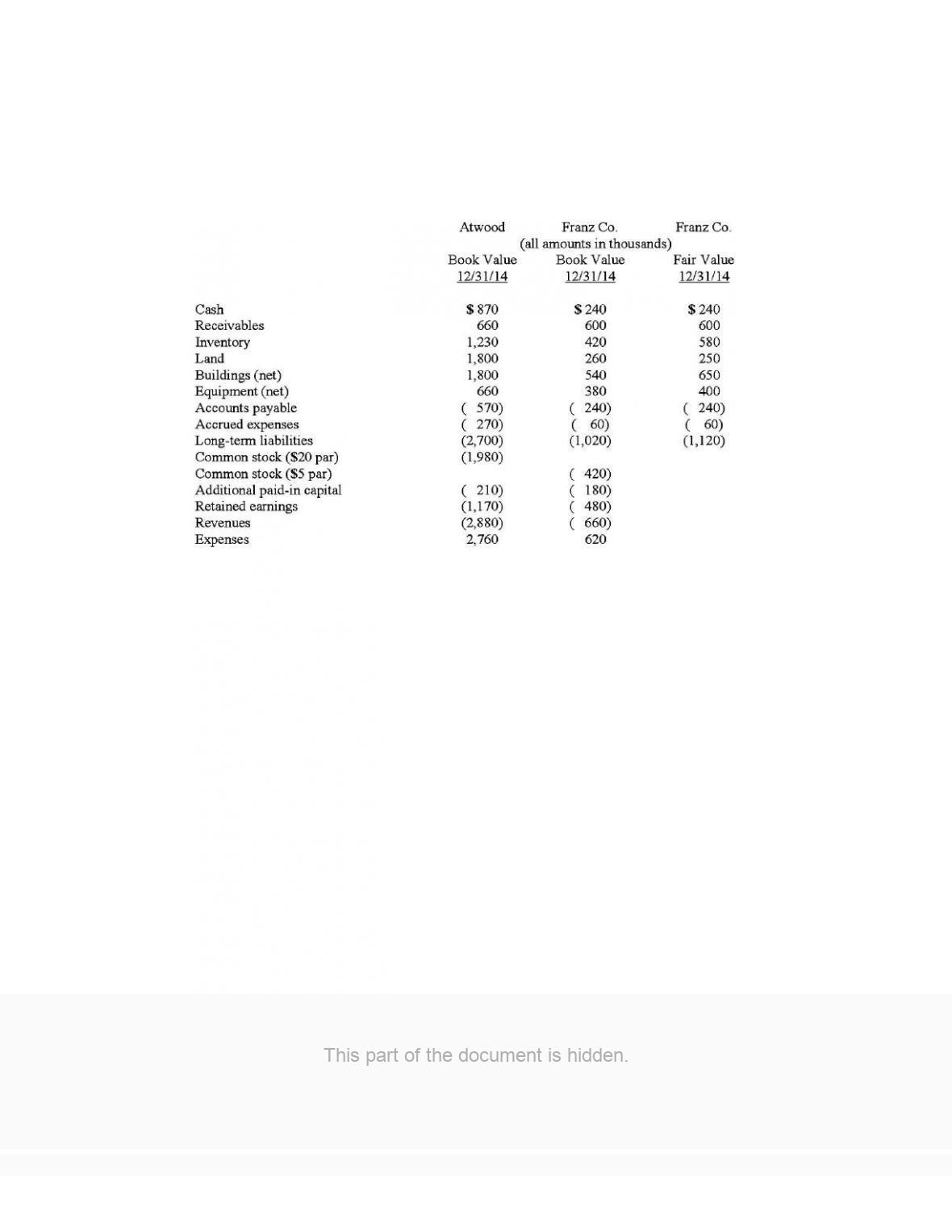
Presented below are the financial balances for the Atwood Company and the Franz
Company as of December 31, 2012, immediately before Atwood acquired Franz. Also
included are the fair values for Franz Company’s net assets at that date.
Note: Parenthesis indicate a credit balance
Assume a business combination took place at December 31, 2012. Atwood issued 50
shares of its common stock with a fair value of $35 per share for all of the outstanding
common shares of Franz. Stock issuance costs of $15 (in thousands) and direct costs of
$10 (in thousands) were paid to effect this acquisition transaction. To settle a difference
of opinion regarding Franz’s fair value, Atwood promises to pay an additional $5.2 (in
thousands) to the former owners if Franz’s earnings exceed a certain sum during the next
year. Given the probability of the required contingency payment and utilizing a 4% discount
rate, the expected present value of the contingency is $5 (in thousands).
Compute consolidated land at date of acquisition.
A.
$2,060.
B.
$1,800.
C.
$260.
D.
$2,050.

E.
$2,070.
$1,800 BV + $250 FV = $2,050
AACSB: Analytic
AICPA BB: Critical Thinking
AICPA FN: Measurement
Blooms: Apply
Difficulty: 2 Medium
Learning Objective: 02-05 Determine the total fair value of the consideration transferred for an acquisition and allocate
that fair value to specific subsidiary assets acquired (including goodwill); and liabilities assumed; or a gain on bargain
purchase.
Learning Objective: 02-06 Prepare the journal entry to consolidate the accounts of a subsidiary if dissolution takes place.
Learning Objective: 02-07 Prepare a worksheet to consolidate the accounts of two companies that form a business
combination if dissolution does not take place.

73.
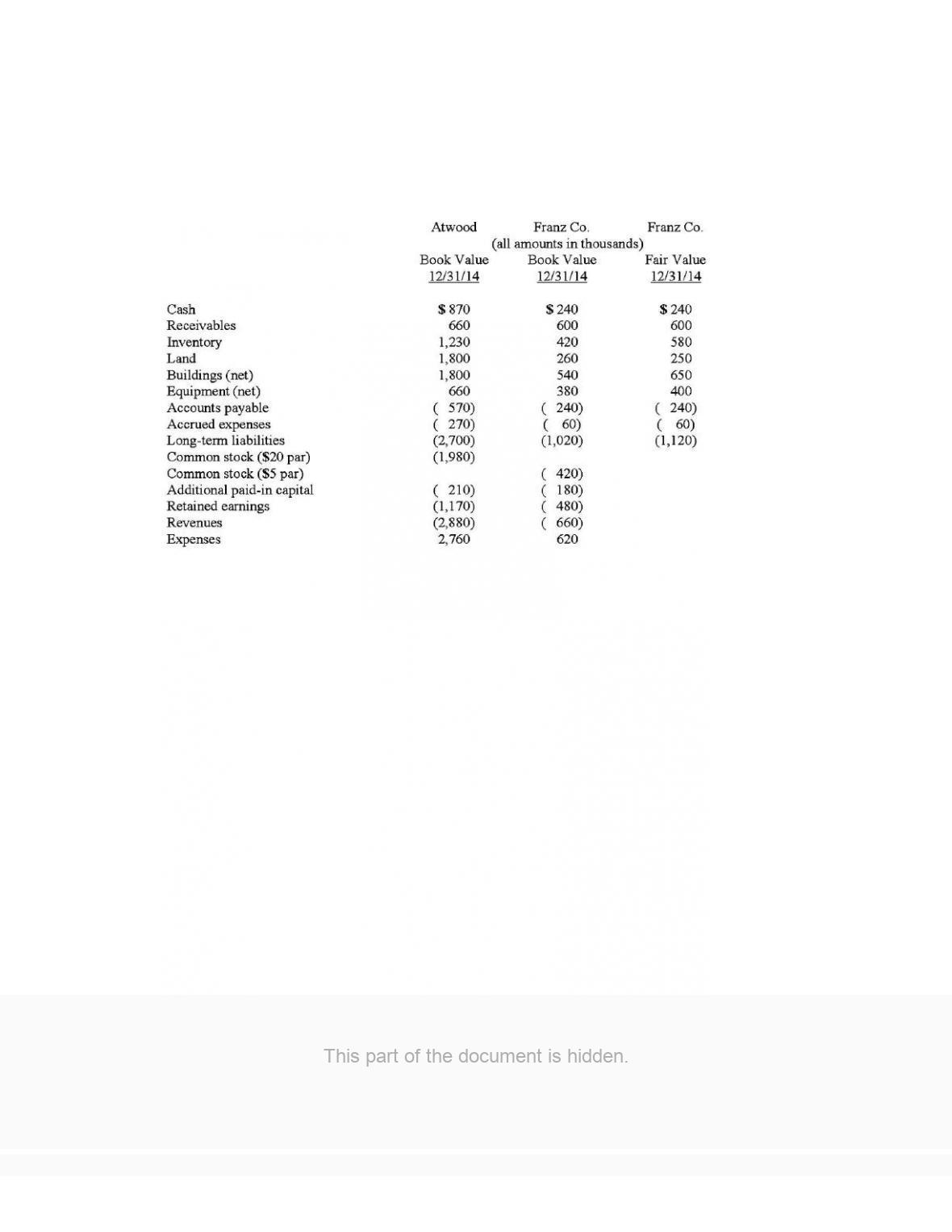
Presented below are the financial balances for the Atwood Company and the Franz
Company as of December 31, 2012, immediately before Atwood acquired Franz. Also
included are the fair values for Franz Company’s net assets at that date.
Note: Parenthesis indicate a credit balance
Assume a business combination took place at December 31, 2012. Atwood issued 50
shares of its common stock with a fair value of $35 per share for all of the outstanding
common shares of Franz. Stock issuance costs of $15 (in thousands) and direct costs of
$10 (in thousands) were paid to effect this acquisition transaction. To settle a difference
of opinion regarding Franz’s fair value, Atwood promises to pay an additional $5.2 (in
thousands) to the former owners if Franz’s earnings exceed a certain sum during the next
year. Given the probability of the required contingency payment and utilizing a 4% discount
rate, the expected present value of the contingency is $5 (in thousands).
Compute consolidated buildings (net) at date of acquisition.
A.
$2,450.
B.
$2,340.
C.
$1,800.
D.
$650.