$1,030
($800 Consideration) – ($1,030 BV/FV) = $230 Bargain Purchase Gain
AACSB: Analytic
AICPA BB: Critical Thinking
AICPA FN: Measurement
Blooms: Apply
Difficulty: 2 Medium
Learning Objective: 02-04 Describe the valuation principles of the acquisition method.
Learning Objective: 02-05 Determine the total fair value of the consideration transferred for an acquisition and allocate
that fair value to specific subsidiary assets acquired (including goodwill); and liabilities assumed; or a gain on bargain
purchase.
Learning Objective: 02-06 Prepare the journal entry to consolidate the accounts of a subsidiary if dissolution takes place.
Learning Objective: 02-07 Prepare a worksheet to consolidate the accounts of two companies that form a business
combination if dissolution does not take place.
46.
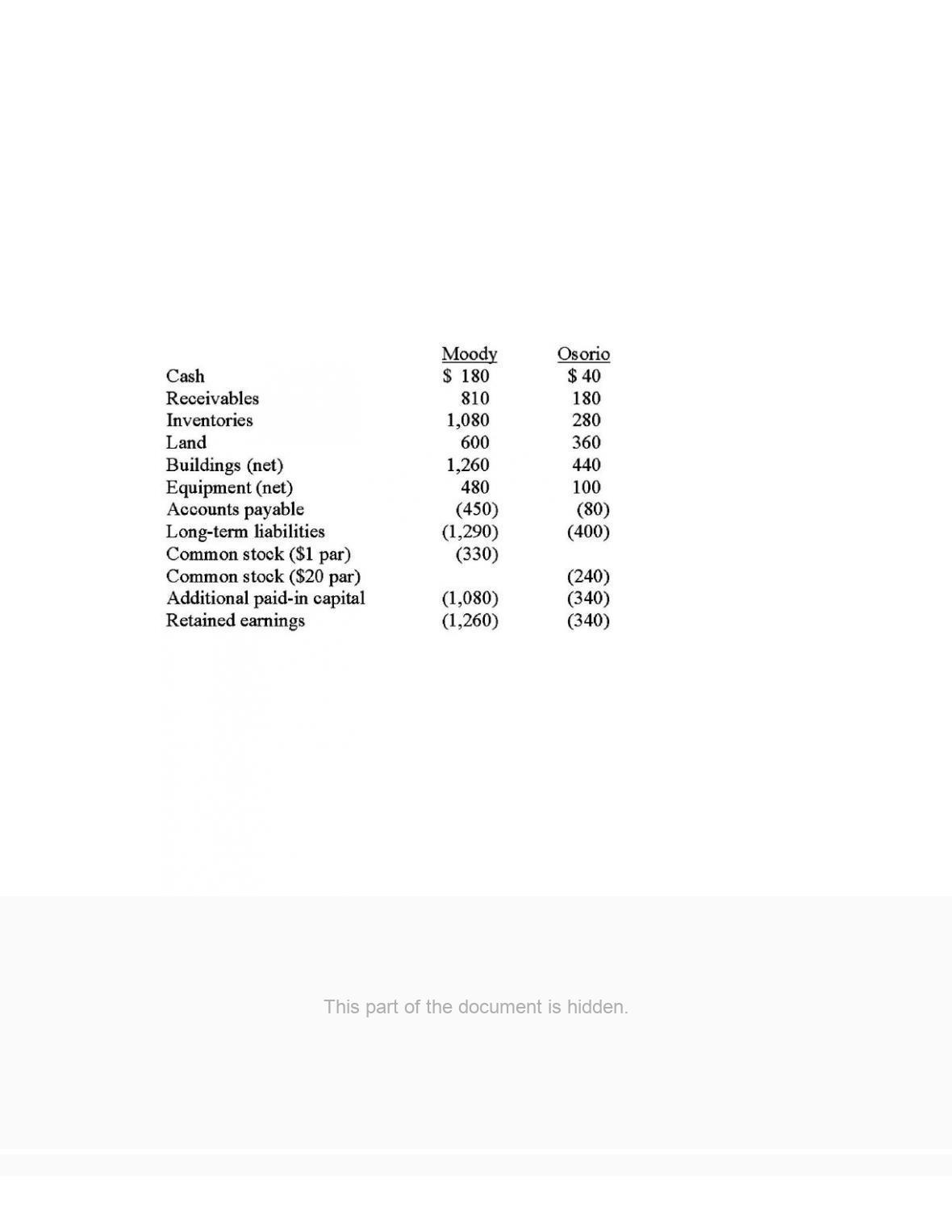
On January 1, 2013, the Moody Company entered into a transaction for 100% of the
outstanding common stock of Osorio Company. To acquire these shares, Moody issued
$400 in long-term liabilities and 40 shares of common stock having a par value of $1 per
share but a fair value of $10 per share. Moody paid $20 to lawyers, accountants, and
brokers for assistance in bringing about this acquisition. Another $15 was paid in
connection with stock issuance costs. Prior to these transactions, the balance sheets for
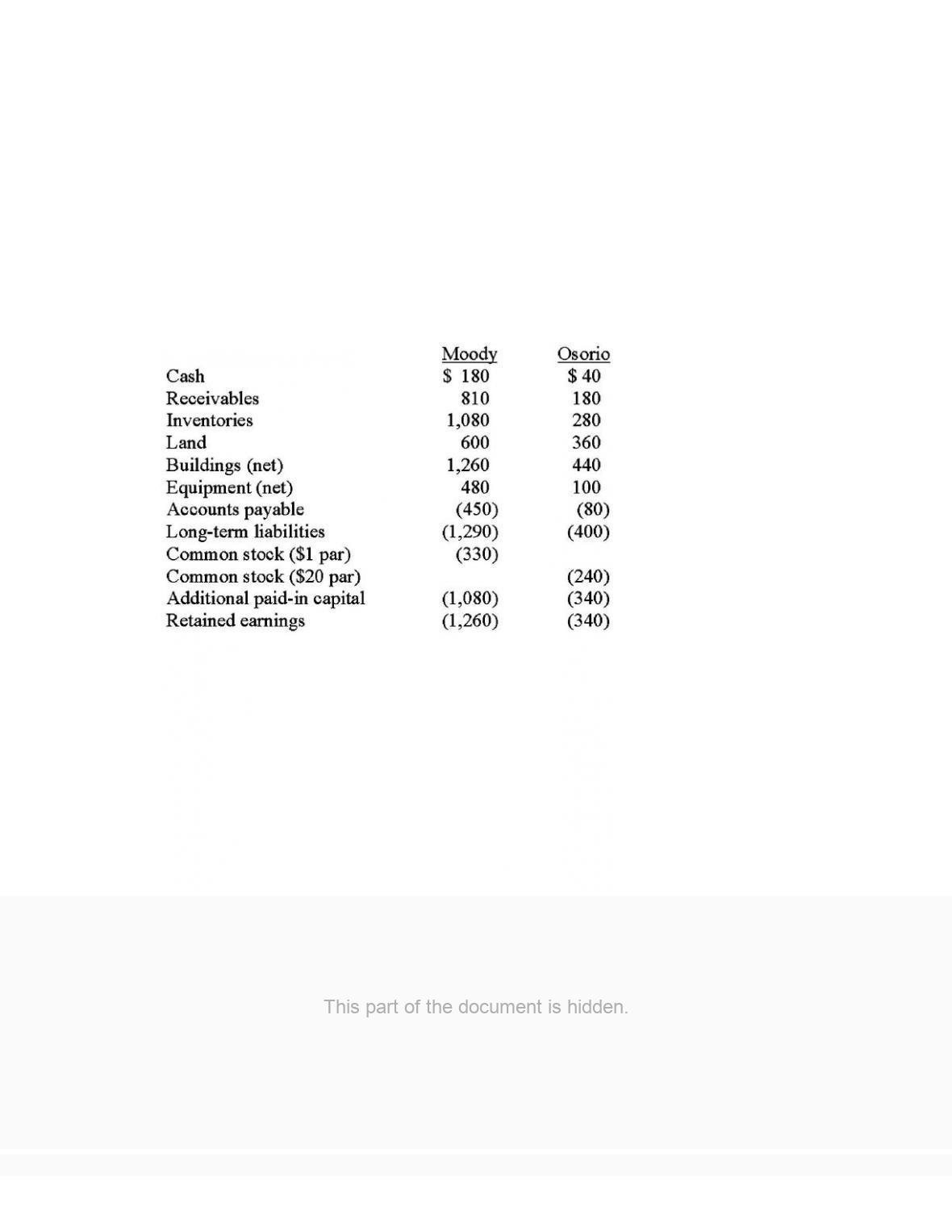
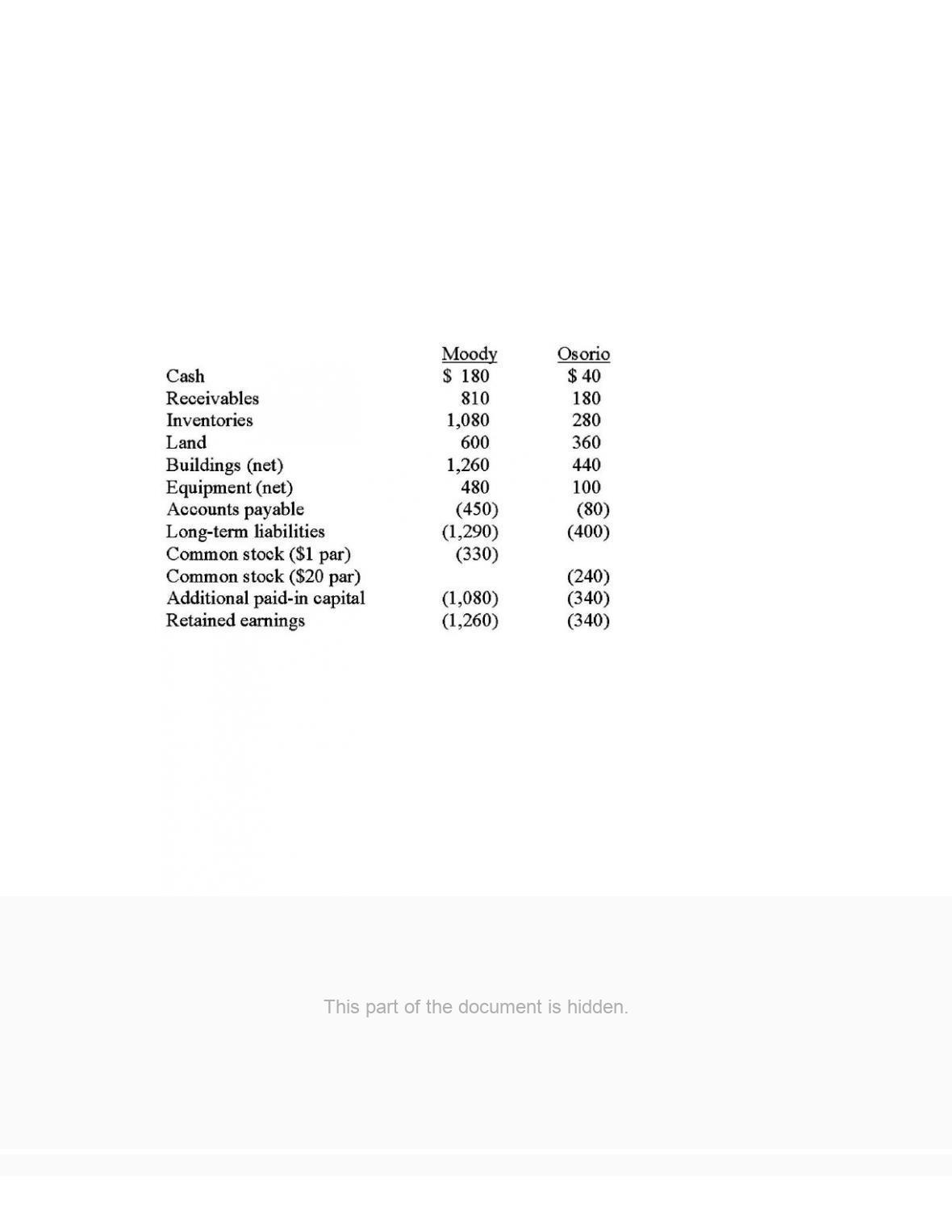
the two companies were as follows:
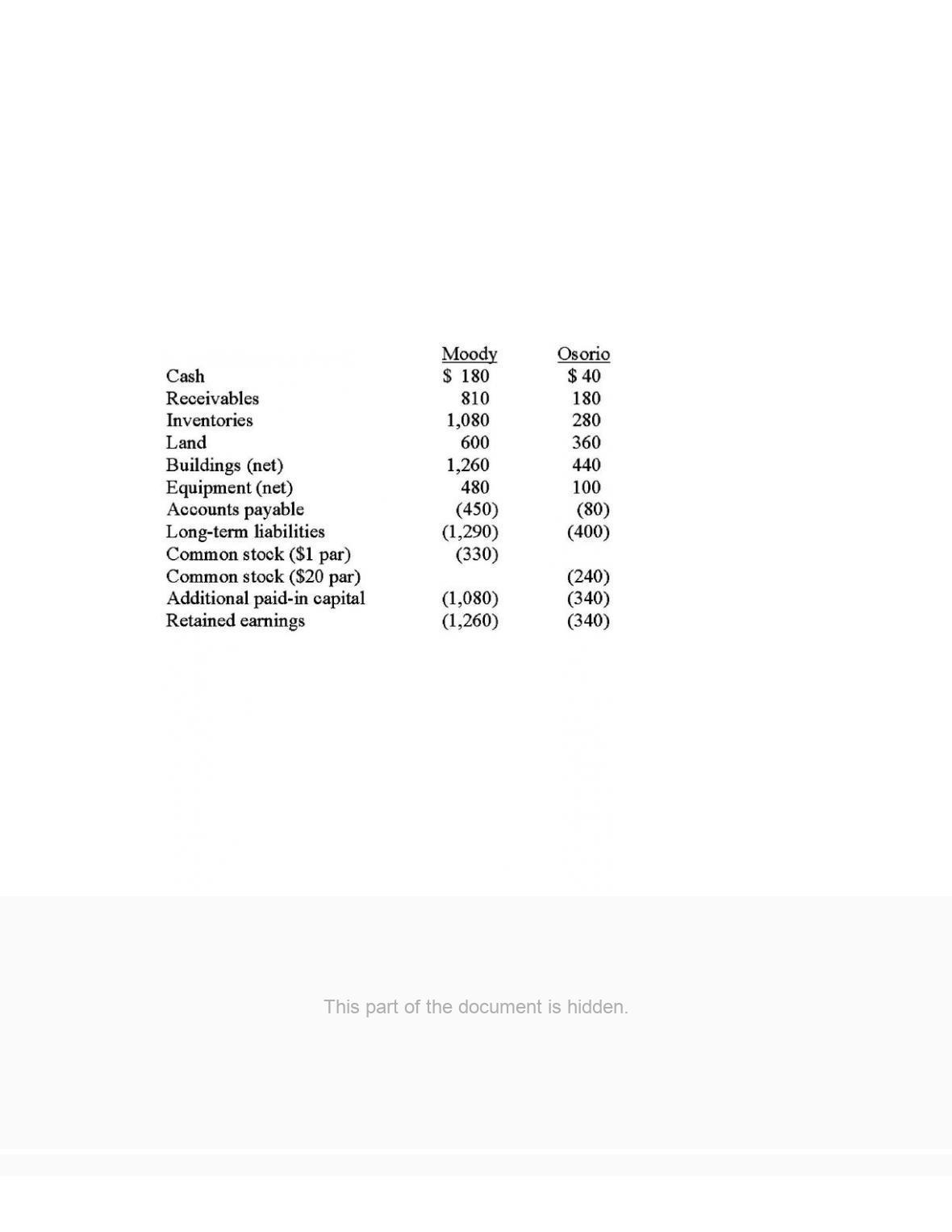
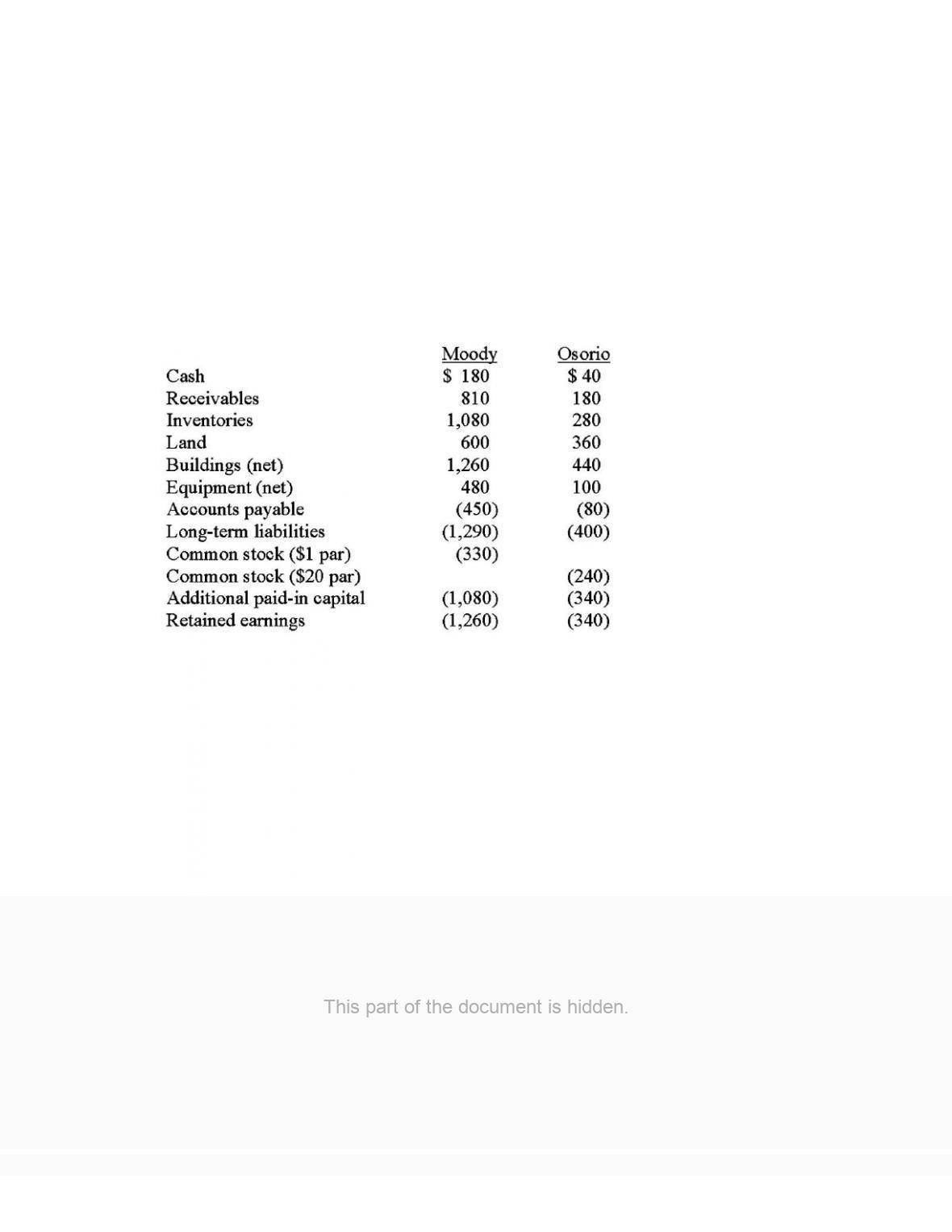
Note: Parentheses indicate a credit balance.
In Moody’s appraisal of Osorio, three assets were deemed to be undervalued on the
subsidiary’s books: Inventory by $10, Land by $40, and Buildings by $60.
Compute the amount of consolidated inventories at date of acquisition.
A.
$1,080.
B.
$1,350.
C.
$1,360.
D.
$1,370.
E.
$290.
$1,080 + $280 + $10 = $1,370
AACSB: Analytic
AICPA BB: Critical Thinking
AICPA FN: Measurement
Blooms: Apply
Difficulty: 2 Medium
Learning Objective: 02-05 Determine the total fair value of the consideration transferred for an acquisition and allocate
that fair value to specific subsidiary assets acquired (including goodwill); and liabilities assumed; or a gain on bargain
purchase.
Learning Objective: 02-06 Prepare the journal entry to consolidate the accounts of a subsidiary if dissolution takes place.
Learning Objective: 02-07 Prepare a worksheet to consolidate the accounts of two companies that form a business
combination if dissolution does not take place.
47.
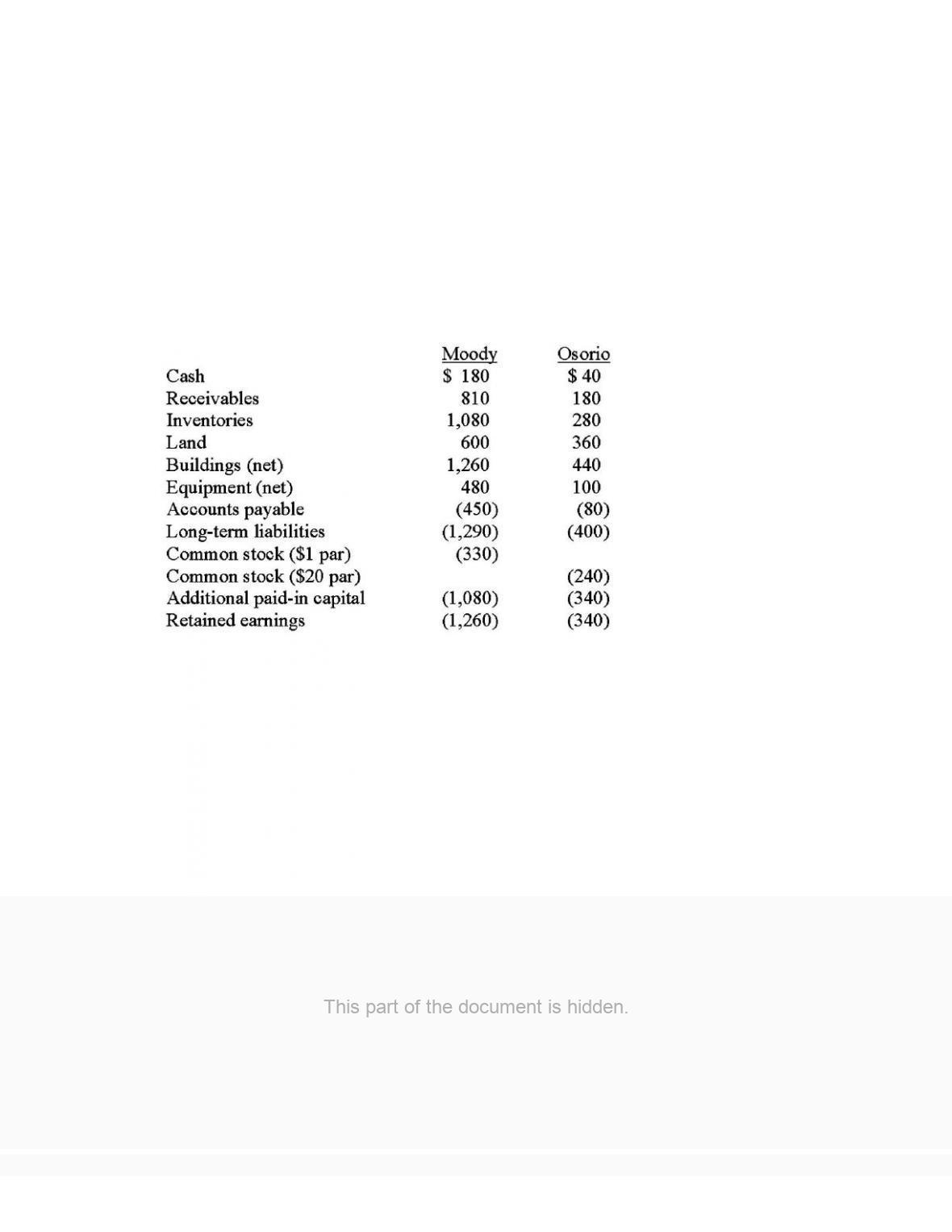
On January 1, 2013, the Moody Company entered into a transaction for 100% of the
outstanding common stock of Osorio Company. To acquire these shares, Moody issued
$400 in long-term liabilities and 40 shares of common stock having a par value of $1 per
share but a fair value of $10 per share. Moody paid $20 to lawyers, accountants, and
brokers for assistance in bringing about this acquisition. Another $15 was paid in
connection with stock issuance costs. Prior to these transactions, the balance sheets for
the two companies were as follows:
Note: Parentheses indicate a credit balance.
In Moody’s appraisal of Osorio, three assets were deemed to be undervalued on the
subsidiary’s books: Inventory by $10, Land by $40, and Buildings by $60.
Compute the amount of consolidated buildings (net) at date of acquisition.
A.
$1,700.
B.
$1,760.
C.
$1,640.
D.
$1,320.
E.
$500.
$1,260 + $440 + $60 = $1,760
AACSB: Analytic
AICPA BB: Critical Thinking
AICPA FN: Measurement
Blooms: Apply
Difficulty: 2 Medium
Learning Objective: 02-05 Determine the total fair value of the consideration transferred for an acquisition and allocate
that fair value to specific subsidiary assets acquired (including goodwill); and liabilities assumed; or a gain on bargain
purchase.
Learning Objective: 02-06 Prepare the journal entry to consolidate the accounts of a subsidiary if dissolution takes place.
Learning Objective: 02-07 Prepare a worksheet to consolidate the accounts of two companies that form a business
combination if dissolution does not take place.
48.
On January 1, 2013, the Moody Company entered into a transaction for 100% of the
outstanding common stock of Osorio Company. To acquire these shares, Moody issued
$400 in long-term liabilities and 40 shares of common stock having a par value of $1 per
share but a fair value of $10 per share. Moody paid $20 to lawyers, accountants, and
brokers for assistance in bringing about this acquisition. Another $15 was paid in
connection with stock issuance costs. Prior to these transactions, the balance sheets for
the two companies were as follows:
Note: Parentheses indicate a credit balance.
In Moody’s appraisal of Osorio, three assets were deemed to be undervalued on the
subsidiary’s books: Inventory by $10, Land by $40, and Buildings by $60.
Compute the amount of consolidated land at date of acquisition.
A.
$1,000.
B.
$960.
C.
$920.
D.
$400.
E.
$320.
$600 + $360 + $40 = $1,000
AACSB: Analytic
AICPA BB: Critical Thinking
AICPA FN: Measurement
Blooms: Apply
Difficulty: 2 Medium
Learning Objective: 02-05 Determine the total fair value of the consideration transferred for an acquisition and allocate
that fair value to specific subsidiary assets acquired (including goodwill); and liabilities assumed; or a gain on bargain
purchase.
Learning Objective: 02-06 Prepare the journal entry to consolidate the accounts of a subsidiary if dissolution takes place.
Learning Objective: 02-07 Prepare a worksheet to consolidate the accounts of two companies that form a business
combination if dissolution does not take place.
49.
On January 1, 2013, the Moody Company entered into a transaction for 100% of the
outstanding common stock of Osorio Company. To acquire these shares, Moody issued
$400 in long-term liabilities and 40 shares of common stock having a par value of $1 per
share but a fair value of $10 per share. Moody paid $20 to lawyers, accountants, and
brokers for assistance in bringing about this acquisition. Another $15 was paid in
connection with stock issuance costs. Prior to these transactions, the balance sheets for
the two companies were as follows:
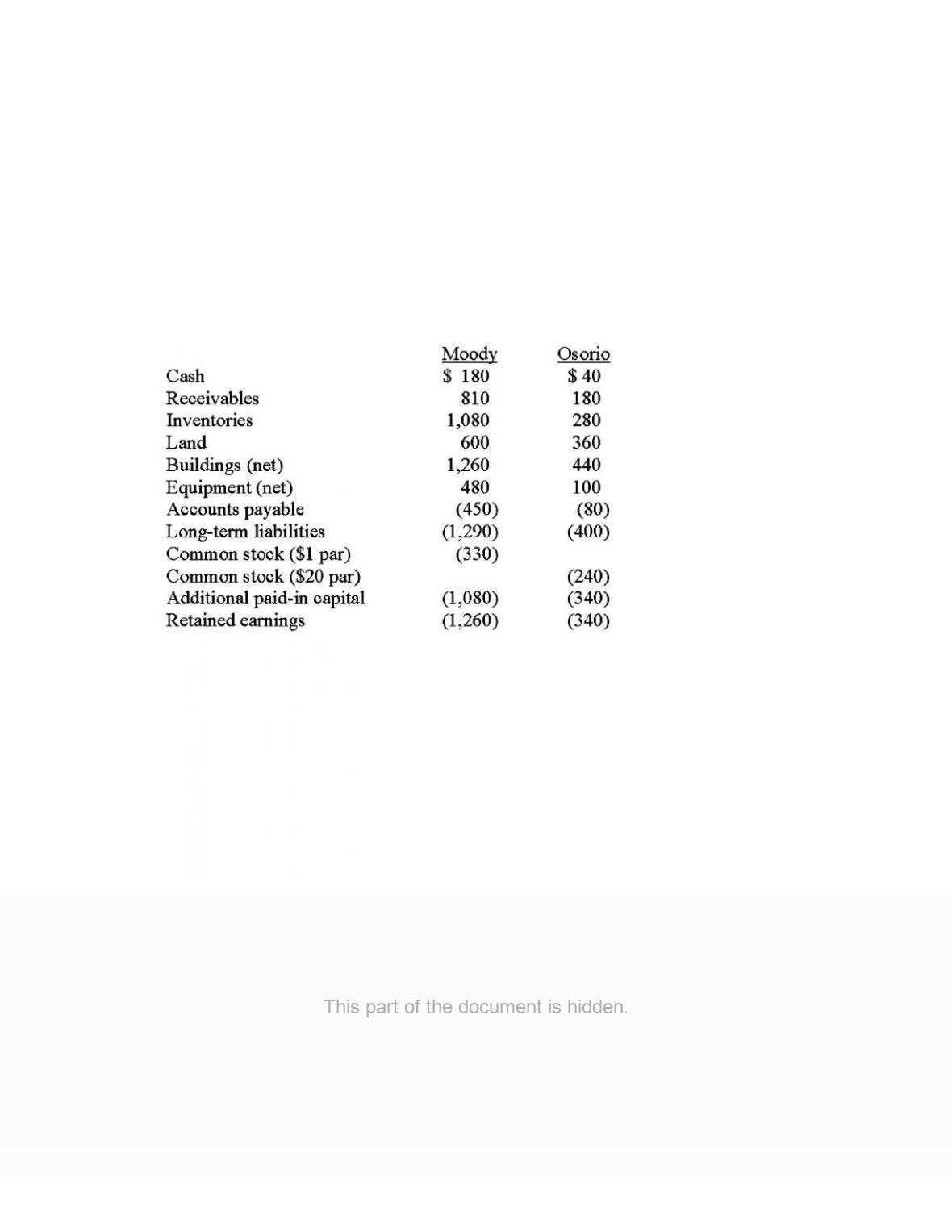
Note: Parentheses indicate a credit balance.
In Moody’s appraisal of Osorio, three assets were deemed to be undervalued on the
subsidiary’s books: Inventory by $10, Land by $40, and Buildings by $60.
Compute the amount of consolidated equipment at date of acquisition.
A.
$480.
B.
$580.
C.
$559.
D.
$570.
E.
$560.
$480 + $100 = $580
AACSB: Analytic
AICPA BB: Critical Thinking
AICPA FN: Measurement
Blooms: Apply
Difficulty: 2 Medium
Learning Objective: 02-05 Determine the total fair value of the consideration transferred for an acquisition and allocate
that fair value to specific subsidiary assets acquired (including goodwill); and liabilities assumed; or a gain on bargain
purchase.
Learning Objective: 02-06 Prepare the journal entry to consolidate the accounts of a subsidiary if dissolution takes place.
Learning Objective: 02-07 Prepare a worksheet to consolidate the accounts of two companies that form a business
combination if dissolution does not take place.
50.
On January 1, 2013, the Moody Company entered into a transaction for 100% of the
outstanding common stock of Osorio Company. To acquire these shares, Moody issued
$400 in long-term liabilities and 40 shares of common stock having a par value of $1 per
share but a fair value of $10 per share. Moody paid $20 to lawyers, accountants, and
brokers for assistance in bringing about this acquisition. Another $15 was paid in
connection with stock issuance costs. Prior to these transactions, the balance sheets for
the two companies were as follows:
Note: Parentheses indicate a credit balance.
In Moody’s appraisal of Osorio, three assets were deemed to be undervalued on the
subsidiary’s books: Inventory by $10, Land by $40, and Buildings by $60.
Compute the amount of consolidated common stock at date of acquisition.
A.
$370.
B.
$570.
C.
$610.
D.
$330.
E.
$530.
$330 + ($1.00 × 40 shares) = $370
AACSB: Analytic
AICPA BB: Critical Thinking
AICPA FN: Measurement
Blooms: Apply
Difficulty: 2 Medium
Learning Objective: 02-04 Describe the valuation principles of the acquisition method.
Learning Objective: 02-05 Determine the total fair value of the consideration transferred for an acquisition and allocate
that fair value to specific subsidiary assets acquired (including goodwill); and liabilities assumed; or a gain on bargain
purchase.
Learning Objective: 02-06 Prepare the journal entry to consolidate the accounts of a subsidiary if dissolution takes place.
Learning Objective: 02-07 Prepare a worksheet to consolidate the accounts of two companies that form a business
combination if dissolution does not take place.
51.
On January 1, 2013, the Moody Company entered into a transaction for 100% of the
outstanding common stock of Osorio Company. To acquire these shares, Moody issued
$400 in long-term liabilities and 40 shares of common stock having a par value of $1 per
share but a fair value of $10 per share. Moody paid $20 to lawyers, accountants, and
brokers for assistance in bringing about this acquisition. Another $15 was paid in
connection with stock issuance costs. Prior to these transactions, the balance sheets for
the two companies were as follows:
Note: Parentheses indicate a credit balance.
In Moody’s appraisal of Osorio, three assets were deemed to be undervalued on the
subsidiary’s books: Inventory by $10, Land by $40, and Buildings by $60.
Compute the amount of consolidated additional paid-in capital at date of acquisition.
A.
$1,080.
B.
$1,420.
C.
$1,065.
D.
$1,425.
E.
$1,440.
$1,080 + ($9.00 × 40 shares) – $15 Issuance Costs = $1,425
AACSB: Analytic
AICPA BB: Critical Thinking
AICPA FN: Measurement
Blooms: Apply
Difficulty: 3 Hard
Learning Objective: 02-04 Describe the valuation principles of the acquisition method.
Learning Objective: 02-05 Determine the total fair value of the consideration transferred for an acquisition and allocate
that fair value to specific subsidiary assets acquired (including goodwill); and liabilities assumed; or a gain on bargain
purchase.
Learning Objective: 02-06 Prepare the journal entry to consolidate the accounts of a subsidiary if dissolution takes place.
Learning Objective: 02-07 Prepare a worksheet to consolidate the accounts of two companies that form a business
combination if dissolution does not take place.
52.
On January 1, 2013, the Moody Company entered into a transaction for 100% of the
outstanding common stock of Osorio Company. To acquire these shares, Moody issued
$400 in long-term liabilities and 40 shares of common stock having a par value of $1 per
share but a fair value of $10 per share. Moody paid $20 to lawyers, accountants, and
brokers for assistance in bringing about this acquisition. Another $15 was paid in
connection with stock issuance costs. Prior to these transactions, the balance sheets for
the two companies were as follows:
Note: Parentheses indicate a credit balance.
In Moody’s appraisal of Osorio, three assets were deemed to be undervalued on the
subsidiary’s books: Inventory by $10, Land by $40, and Buildings by $60.
Compute the amount of consolidated cash after recording the acquisition transaction.
A.
$220.
B.
$185.
C.
$200.
D.
$205.
E.
$215.
($180 – $20 – $15 Parent) = $145 + ($40 Sub) = $185
AACSB: Analytic
AICPA BB: Critical Thinking
AICPA FN: Measurement
Blooms: Apply
Difficulty: 2 Medium
Learning Objective: 02-05 Determine the total fair value of the consideration transferred for an acquisition and allocate
that fair value to specific subsidiary assets acquired (including goodwill); and liabilities assumed; or a gain on bargain
purchase.
Learning Objective: 02-06 Prepare the journal entry to consolidate the accounts of a subsidiary if dissolution takes place.
Learning Objective: 02-07 Prepare a worksheet to consolidate the accounts of two companies that form a business
combination if dissolution does not take place.
53.
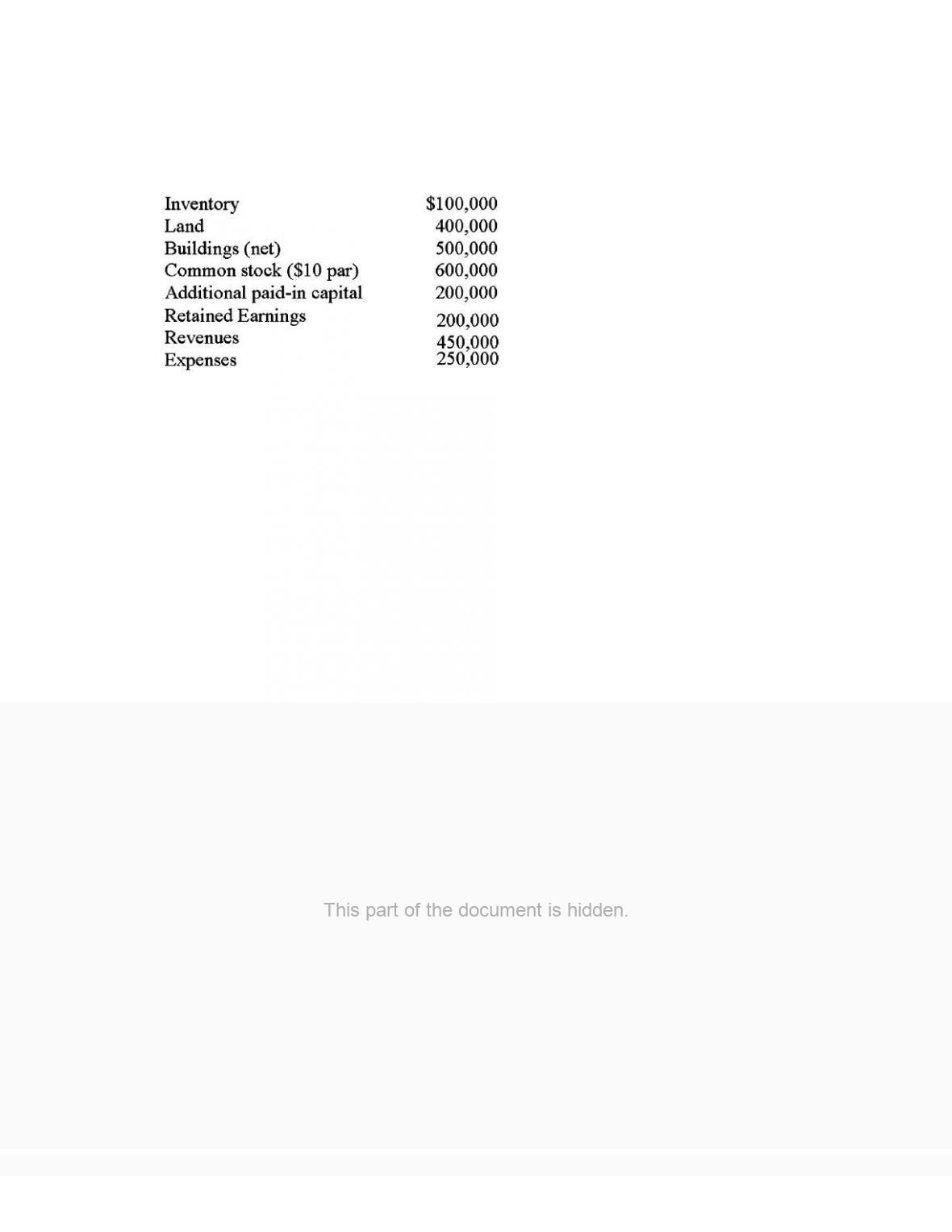
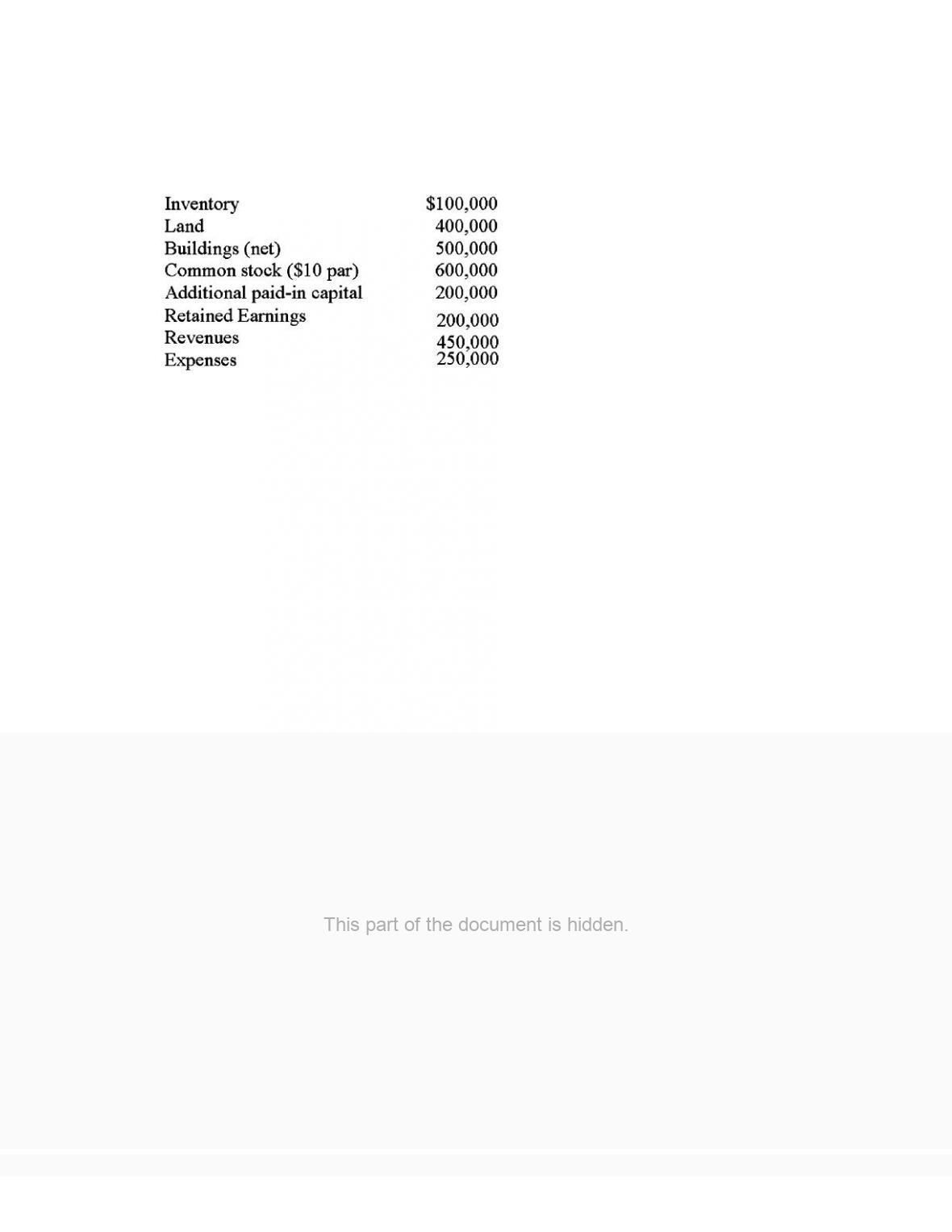
Carnes has the following account balances as of May 1, 2012 before an acquisition
transaction takes place.
The fair value of Carnes’ Land and Buildings are $650,000 and $550,000, respectively. On
May 1, 2012, Riley Company issues 30,000 shares of its $10 par value ($25 fair value)
common stock in exchange for all of the shares of Carnes’ common stock. Riley paid
$10,000 for costs to issue the new shares of stock. Before the acquisition, Riley has
$700,000 in its common stock account and $300,000 in its additional paid-in capital
account.
On May 1, 2012, what value is assigned to Riley’s investment account?
A.
$150,000.
B.
$300,000.
C.
$750,000.
D.
$760,000.
E.
$1,350,000.
$25 × 30,000 shares = $750,000

AACSB: Analytic
AICPA BB: Critical Thinking
AICPA FN: Measurement
Blooms: Apply
Difficulty: 1 Easy
Learning Objective: 02-07 Prepare a worksheet to consolidate the accounts of two companies that form a business
combination if dissolution does not take place.
54.
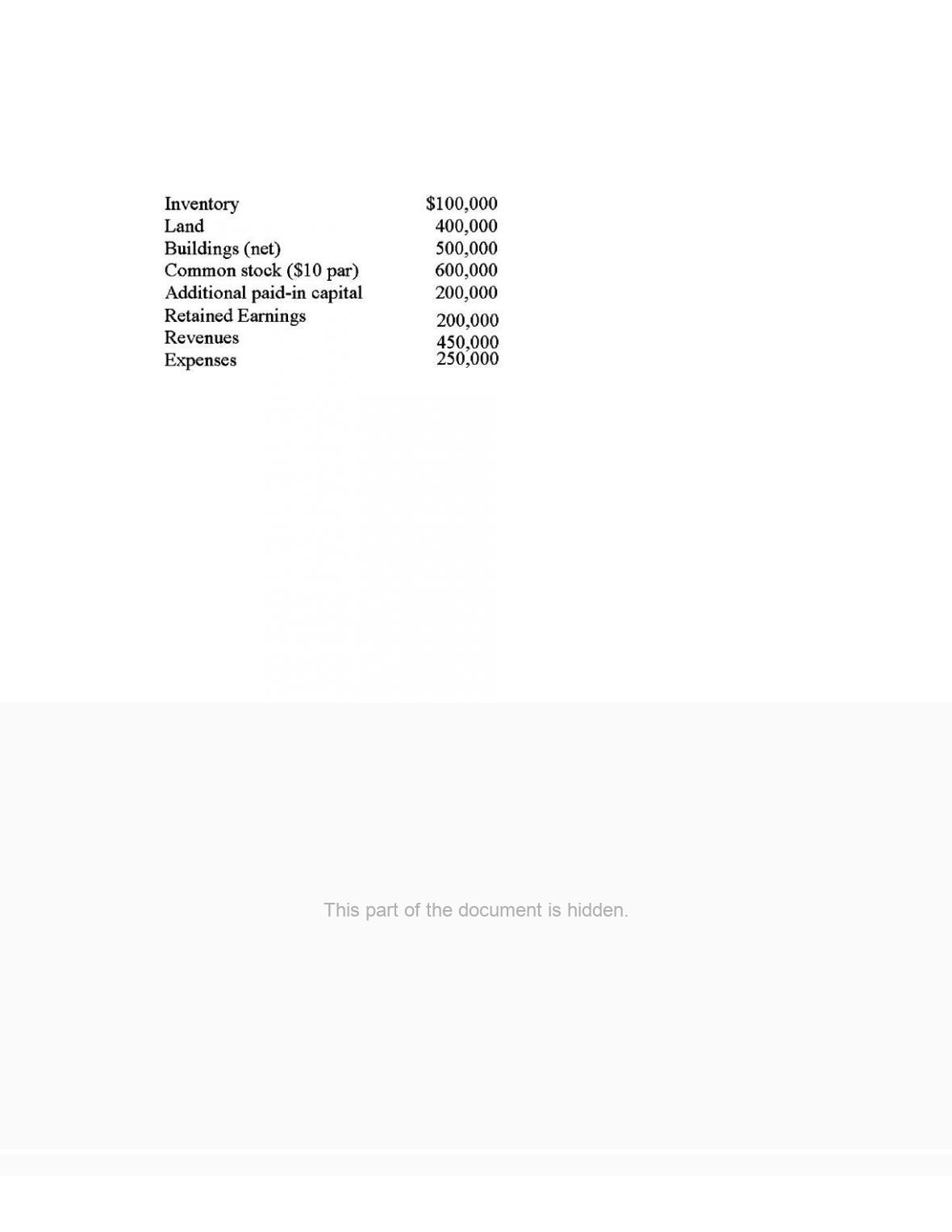
Carnes has the following account balances as of May 1, 2012 before an acquisition
transaction takes place.
The fair value of Carnes’ Land and Buildings are $650,000 and $550,000, respectively. On
May 1, 2012, Riley Company issues 30,000 shares of its $10 par value ($25 fair value)
common stock in exchange for all of the shares of Carnes’ common stock. Riley paid
$10,000 for costs to issue the new shares of stock. Before the acquisition, Riley has
$700,000 in its common stock account and $300,000 in its additional paid-in capital
account.
At the date of acquisition, by how much does Riley’s additional paid-in capital increase or
decrease?
A.
$0.
B.
$440,000 increase.
C.
$450,000 increase.
D.
$640,000 increase.
E.
$650,000 decrease.
$15 × 30,000 shares = $450,000 – $10,000 = $440,000

AACSB: Analytic
AICPA BB: Critical Thinking
AICPA FN: Measurement
Blooms: Apply
Difficulty: 1 Easy
Learning Objective: 02-04 Describe the valuation principles of the acquisition method.
Learning Objective: 02-05 Determine the total fair value of the consideration transferred for an acquisition and allocate
that fair value to specific subsidiary assets acquired (including goodwill); and liabilities assumed; or a gain on bargain
purchase.
Learning Objective: 02-06 Prepare the journal entry to consolidate the accounts of a subsidiary if dissolution takes place.
Learning Objective: 02-07 Prepare a worksheet to consolidate the accounts of two companies that form a business
combination if dissolution does not take place.
55.
Carnes has the following account balances as of May 1, 2012 before an acquisition
transaction takes place.
The fair value of Carnes’ Land and Buildings are $650,000 and $550,000, respectively. On
May 1, 2012, Riley Company issues 30,000 shares of its $10 par value ($25 fair value)
common stock in exchange for all of the shares of Carnes’ common stock. Riley paid
$10,000 for costs to issue the new shares of stock. Before the acquisition, Riley has
$700,000 in its common stock account and $300,000 in its additional paid-in capital
account.
What will be Riley’s balance in its common stock account as a result of this acquisition?
A.
$300,000.
B.
$990,000.
C.
$1,000,000.
D.
$1,590,000.
E.
$1,600,000.
$700,000 + ($10 × 30,000 shares) = $1,000,000