18.
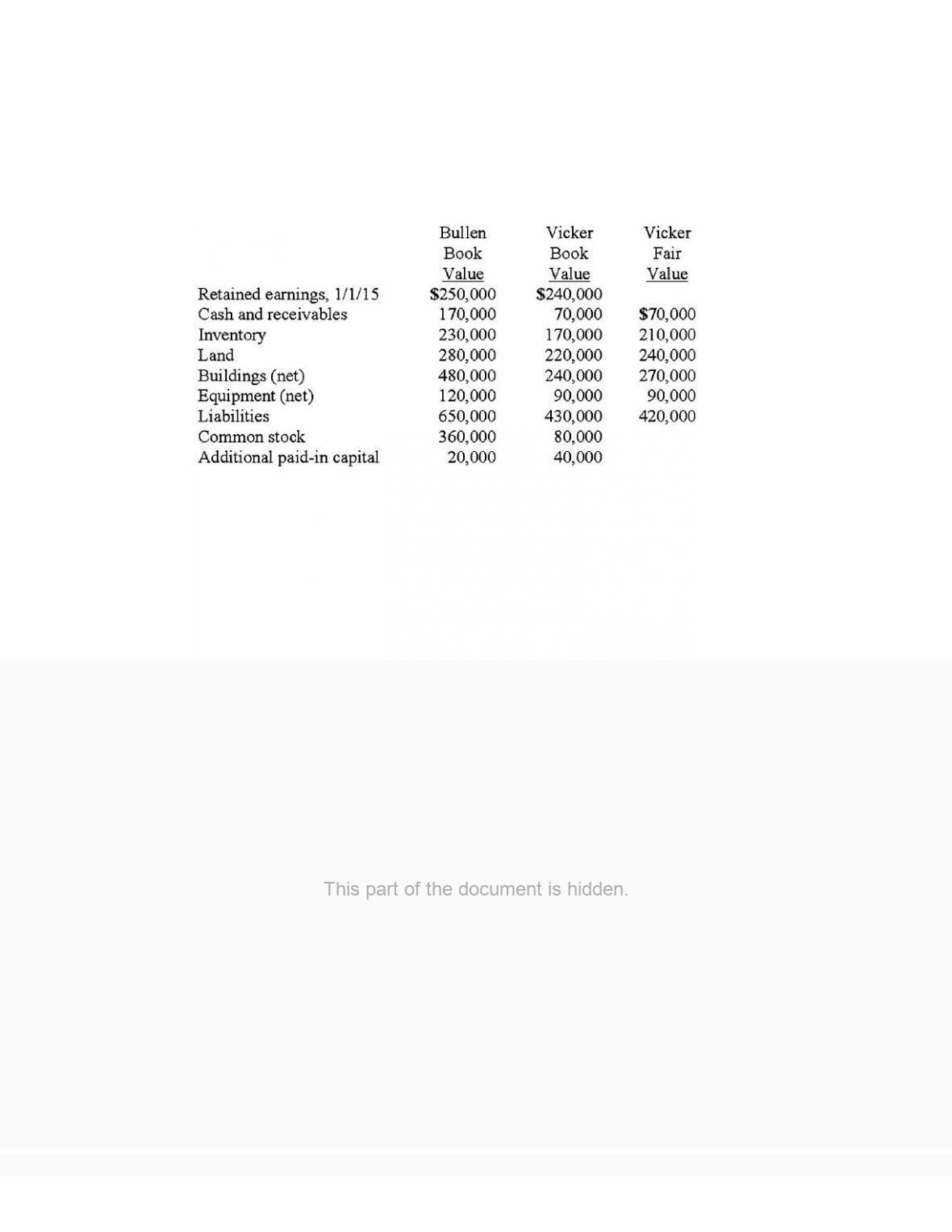
Bullen Inc. acquired 100% of the voting common stock of Vicker Inc. on January 1, 2013.
The book value and fair value of Vicker’s accounts on that date (prior to creating the
combination) follow, along with the book value of Bullen’s accounts:
Assume that Bullen issued preferred stock with a par value of $240,000 and a fair value of
$500,000 for all of the outstanding shares of Vicker in an acquisition business
combination. What will be the balance in the consolidated Inventory and Land accounts?
A.
$440,000, $496,000.
B.
$440,000, $520,000.
C.
$425,000, $505,000.
D.
$400,000, $500,000.
E.
$427,000, $510,000.
Inventory $230,000 BV + $210,000 FV = $440,000
Land $280,000 BV + $240,000 FV = $520,000

AACSB: Analytic
AICPA BB: Critical Thinking
AICPA FN: Measurement
Blooms: Apply
Difficulty: 2 Medium
Learning Objective: 02-05 Determine the total fair value of the consideration transferred for an acquisition and allocate
that fair value to specific subsidiary assets acquired (including goodwill); and liabilities assumed; or a gain on bargain
purchase.
Learning Objective: 02-06 Prepare the journal entry to consolidate the accounts of a subsidiary if dissolution takes place.
Learning Objective: 02-07 Prepare a worksheet to consolidate the accounts of two companies that form a business
combination if dissolution does not take place.
19.
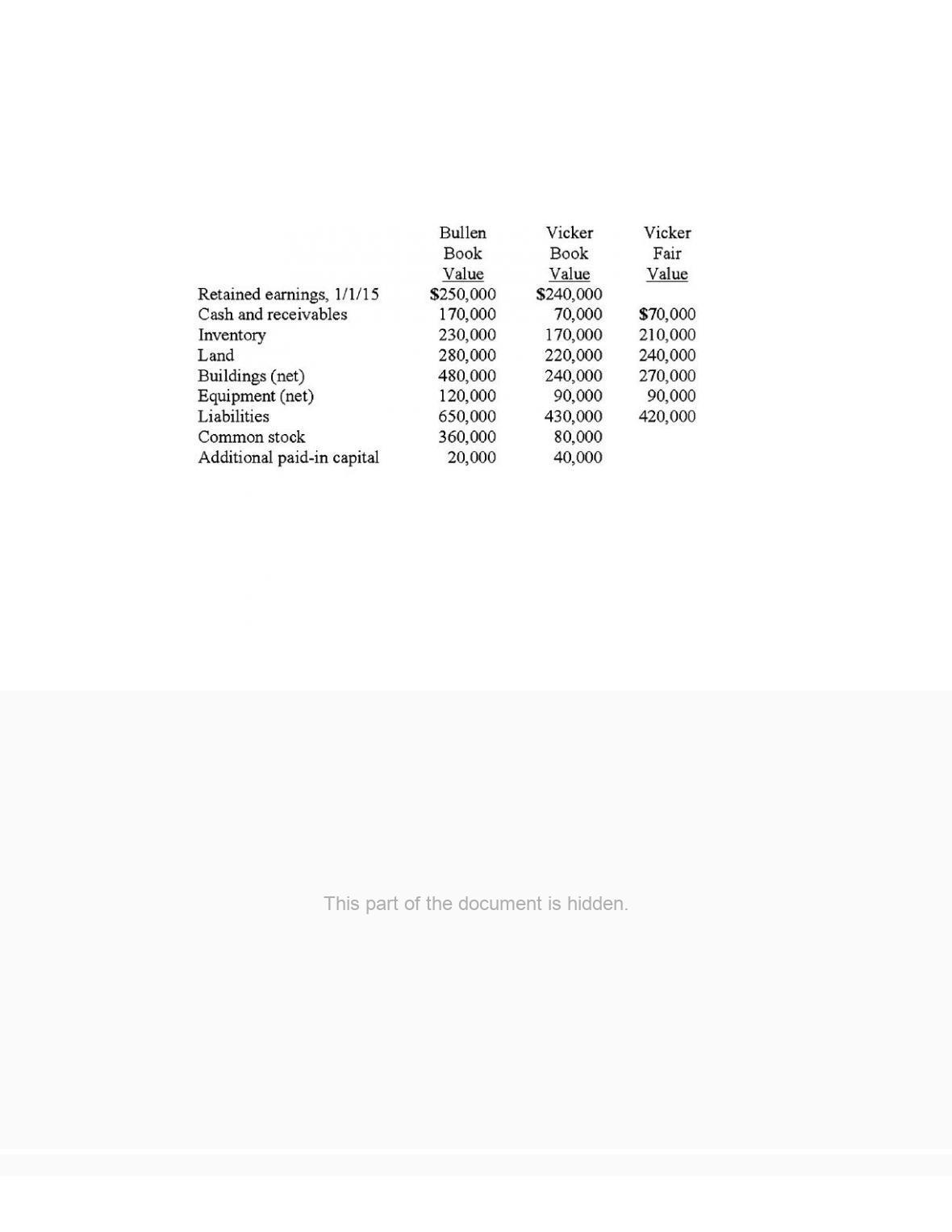
Bullen Inc. acquired 100% of the voting common stock of Vicker Inc. on January 1, 2013.
The book value and fair value of Vicker’s accounts on that date (prior to creating the
combination) follow, along with the book value of Bullen’s accounts:
Assume that Bullen paid a total of $480,000 in cash for all of the shares of Vicker. In
addition, Bullen paid $35,000 to a group of attorneys for their work in arranging the
combination to be accounted for as an acquisition. What will be the balance in
consolidated goodwill?
A.
$0.
B.
$20,000.
C.
$35,000.
D.
$55,000.
E.
$65,000.
$480,000 – ($80,000 CS + $40,000 APIC + $240,000 R/E + $100,000 FV) = $20,000 Excess

AACSB: Analytic
AICPA BB: Critical Thinking
AICPA FN: Measurement
Blooms: Apply
Difficulty: 2 Medium
Learning Objective: 02-05 Determine the total fair value of the consideration transferred for an acquisition and allocate
that fair value to specific subsidiary assets acquired (including goodwill); and liabilities assumed; or a gain on bargain
purchase.
Learning Objective: 02-06 Prepare the journal entry to consolidate the accounts of a subsidiary if dissolution takes place.
Learning Objective: 02-07 Prepare a worksheet to consolidate the accounts of two companies that form a business
combination if dissolution does not take place.

20.
Prior to being united in a business combination, Botkins Inc. and Volkerson Corp. had the
following stockholders’ equity figures:
Botkins issued 56,000 new shares of its common stock valued at $3.25 per share for all of
the outstanding stock of Volkerson.
Assume that Botkins acquired Volkerson on January 1, 2012. At what amount did Botkins
record the investment in Volkerson?
A.
$56,000.
B.
$182,000.
C.
$209,000.
D.
$261,000.
E.
$312,000.
$3.25 × 56,000 = $182,000
AACSB: Analytic
AICPA BB: Critical Thinking
AICPA FN: Measurement
Blooms: Apply
Difficulty: 1 Easy
Learning Objective: 02-04 Describe the valuation principles of the acquisition method.
Learning Objective: 02-05 Determine the total fair value of the consideration transferred for an acquisition and allocate

21.
Prior to being united in a business combination, Botkins Inc. and Volkerson Corp. had the
following stockholders’ equity figures:
Botkins issued 56,000 new shares of its common stock valued at $3.25 per share for all of
the outstanding stock of Volkerson.
Assume that Botkins acquired Volkerson on January 1, 2012. Immediately afterwards, what
is consolidated Common Stock?
A.
$456,000.
B.
$402,000.
C.
$274,000.
D.
$276,000.
E.
$330,000.
$220,000 + ($1.00 × 56,000) = $276,000
AACSB: Analytic
AICPA BB: Critical Thinking
AICPA FN: Measurement
Blooms: Apply
Difficulty: 2 Medium
Learning Objective: 02-05 Determine the total fair value of the consideration transferred for an acquisition and allocate
that fair value to specific subsidiary assets acquired (including goodwill); and liabilities assumed; or a gain on bargain
purchase.

22.
Chapel Hill Company had common stock of $350,000 and retained earnings of $490,000.
Blue Town Inc. had common stock of $700,000 and retained earnings of $980,000. On
January 1, 2013, Blue Town issued 34,000 shares of common stock with a $12 par value
and a $35 fair value for all of Chapel Hill Company’s outstanding common stock. This
combination was accounted for as an acquisition. Immediately after the combination, what
was the total consolidated net assets?
A.
$2,520,000.
B.
$1,190,000.
C.
$1,680,000.
D.
$2,870,000.
E.
$2,030,000.
$700,000 + $980,000 + ($35 × 34,000) = $2,870,000
AACSB: Analytic
AICPA BB: Critical Thinking
AICPA FN: Measurement
Accessibility: Keyboard Navigation
Blooms: Apply
Difficulty: 2 Medium
Learning Objective: 02-05 Determine the total fair value of the consideration transferred for an acquisition and allocate
that fair value to specific subsidiary assets acquired (including goodwill); and liabilities assumed; or a gain on bargain
purchase.
Learning Objective: 02-06 Prepare the journal entry to consolidate the accounts of a subsidiary if dissolution takes place.
Learning Objective: 02-07 Prepare a worksheet to consolidate the accounts of two companies that form a business
combination if dissolution does not take place.

23.
Which of the following is a
not
a reason for a business combination to take place?
A.
Cost savings through elimination of duplicate facilities.
B.
Quick entry for new and existing products into domestic and foreign markets.
C.
Diversification of business risk.
D.
Vertical integration.
E.
Increase in stock price of the acquired company.
AACSB: Reflective thinking
AICPA BB: Critical Thinking
AICPA FN: Measurement
Accessibility: Keyboard Navigation
Blooms: Remember
Difficulty: 1 Easy
Learning Objective: 02-01 Discuss the motives for business combinations.

24.
Which of the following statements is true regarding a statutory merger?
A.
The original companies dissolve while remaining as separate divisions of a newly
created company.
B.
Both companies remain in existence as legal corporations with one corporation now a
subsidiary of the acquiring company.
C.
The acquired company dissolves as a separate corporation and becomes a division of
the acquiring company.
D.
The acquiring company acquires the stock of the acquired company as an investment.
E.
A statutory merger is no longer a legal option.
AACSB: Reflective thinking
AICPA BB: Critical Thinking
AICPA FN: Measurement
Accessibility: Keyboard Navigation
Blooms: Remember
Difficulty: 2 Medium
Learning Objective: 02-03 Define the term business combination and differentiate across various forms of business
combinations.

25.
Which of the following statements is true regarding a statutory consolidation?
A.
The original companies dissolve while remaining as separate divisions of a newly
created company.
B.
Both companies remain in existence as legal corporations with one corporation now a
subsidiary of the acquiring company.
C.
The acquired company dissolves as a separate corporation and becomes a division of
the acquiring company.
D.
The acquiring company acquires the stock of the acquired company as an investment.
E.
A statutory consolidation is no longer a legal option.
AACSB: Reflective thinking
AICPA BB: Critical Thinking
AICPA FN: Measurement
Accessibility: Keyboard Navigation
Blooms: Remember
Difficulty: 2 Medium
Learning Objective: 02-03 Define the term business combination and differentiate across various forms of business
combinations.

26.
In a transaction accounted for using the acquisition method where consideration
transferred exceeds book value of the acquired company, which statement is true for the
acquiring company with regard to its investment?
A.
Net assets of the acquired company are revalued to their fair values and any excess of
consideration transferred over fair value of net assets acquired is allocated to goodwill.
B.
Net assets of the acquired company are maintained at book value and any excess of
consideration transferred over book value of net assets acquired is allocated to
goodwill.
C.
Acquired assets are revalued to their fair values. Acquired liabilities are maintained at
book values. Any excess is allocated to goodwill.
D.
Acquired long-term assets are revalued to their fair values. Any excess is allocated to
goodwill.
AACSB: Reflective thinking
AICPA BB: Critical Thinking
AICPA FN: Measurement
Accessibility: Keyboard Navigation
Blooms: Analyze
Difficulty: 2 Medium
Learning Objective: 02-04 Describe the valuation principles of the acquisition method.
Learning Objective: 02-05 Determine the total fair value of the consideration transferred for an acquisition and allocate
that fair value to specific subsidiary assets acquired (including goodwill); and liabilities assumed; or a gain on bargain
purchase.

27.
In a transaction accounted for using the acquisition method where consideration
transferred is less than fair value of net assets acquired, which statement is true?
A.
Negative goodwill is recorded.
B.
A deferred credit is recorded.
C.
A gain on bargain purchase is recorded.
D.
Long-term assets of the acquired company are reduced in proportion to their fair
values. Any excess is recorded as a deferred credit.
E.
Long-term assets and liabilities of the acquired company are reduced in proportion to
their fair values. Any excess is recorded as an extraordinary gain.
AACSB: Reflective thinking
AICPA BB: Critical Thinking
AICPA FN: Measurement
Accessibility: Keyboard Navigation
Blooms: Remember
Difficulty: 1 Easy
Learning Objective: 02-04 Describe the valuation principles of the acquisition method.
Learning Objective: 02-05 Determine the total fair value of the consideration transferred for an acquisition and allocate
that fair value to specific subsidiary assets acquired (including goodwill); and liabilities assumed; or a gain on bargain
purchase.

28.
Which of the following statements is true regarding the acquisition method of accounting
for a business combination?
A.
Net assets of the acquired company are reported at their fair values.
B.
Net assets of the acquired company are reported at their book values.
C.
Any goodwill associated with the acquisition is reported as a development cost.
D.
The acquisition can only be effected by a mutual exchange of voting common stock.
E.
Indirect costs of the combination reduce additional paid-in capital.
AACSB: Reflective thinking
AICPA BB: Critical Thinking
AICPA FN: Measurement
Accessibility: Keyboard Navigation
Blooms: Remember
Difficulty: 2 Medium
Learning Objective: 02-05 Determine the total fair value of the consideration transferred for an acquisition and allocate
that fair value to specific subsidiary assets acquired (including goodwill); and liabilities assumed; or a gain on bargain
purchase.

29.
Which of the following statements is true?
A.
The pooling of interests for business combinations is an alternative to the acquisition
method.
B.
The purchase method for business combinations is an alternative to the acquisition
method.
C.
Neither the purchase method nor the pooling of interests method is allowed for new
business combinations.
D.
Any previous business combination originally accounted for under purchase or pooling
of interests accounting method will now be accounted for under the acquisition method
of accounting for business combinations.
E.
Companies previously using the purchase or pooling of interests accounting method
must report a change in accounting principle when consolidating those subsidiaries
with new acquisition combinations.
AACSB: Reflective thinking
AICPA BB: Critical Thinking
AICPA FN: Measurement
Accessibility: Keyboard Navigation
Blooms: Remember
Difficulty: 2 Medium
Learning Objective: 02-09 Appendix: Identify the general characteristics of the legacy purchase and pooling of interest
methods of accounting for past business combinations. Understand the effects that persist today in financial statements

30.
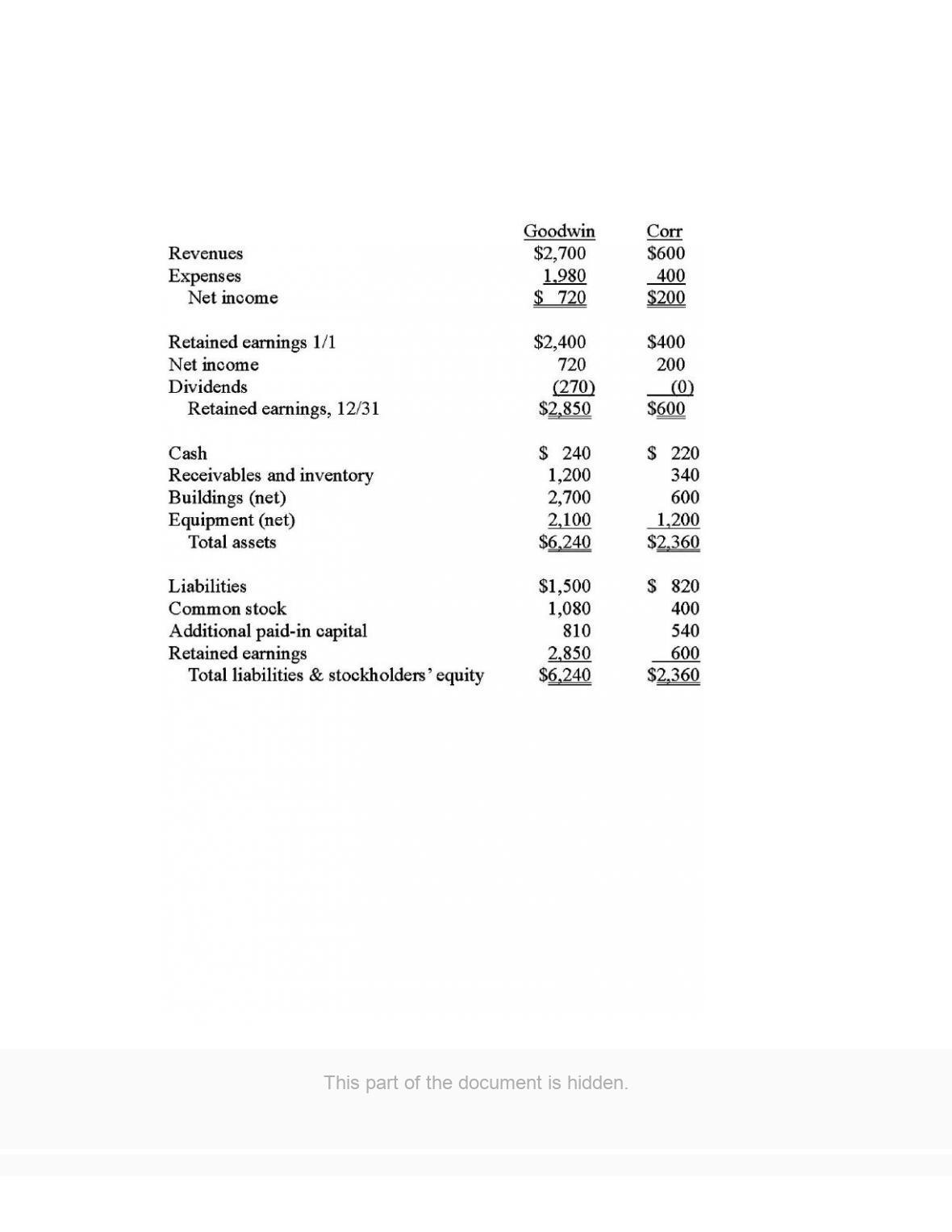
The financial statements for Goodwin, Inc. and Corr Company for the year ended
December 31, 2013, prior to Goodwin’s acquisition business combination transaction
regarding Corr, follow (in thousands):
On December 31, 2013, Goodwin issued $600 in debt and 30 shares of its $10 par value
common stock to the owners of Corr to acquire all of the outstanding shares of that
company. Goodwin shares had a fair value of $40 per share.
Goodwin paid $25 to a broker for arranging the transaction. Goodwin paid $35 in stock
issuance costs. Corr’s equipment was actually worth $1,400 but its buildings were only
valued at $560.
In this acquisition business combination, at what amount is the investment recorded on
Goodwin’s books?
A.
$1,540.
B.
$1,800.

C.
$1,860.
D.
$1,825.
E.
$1,625.
$600 Cash + ($40 × 30 Shares) = $1,800 Investment
AACSB: Analytic
AICPA BB: Critical Thinking
AICPA FN: Measurement
Blooms: Apply
Difficulty: 2 Medium
Learning Objective: 02-07 Prepare a worksheet to consolidate the accounts of two companies that form a business
combination if dissolution does not take place.

31.
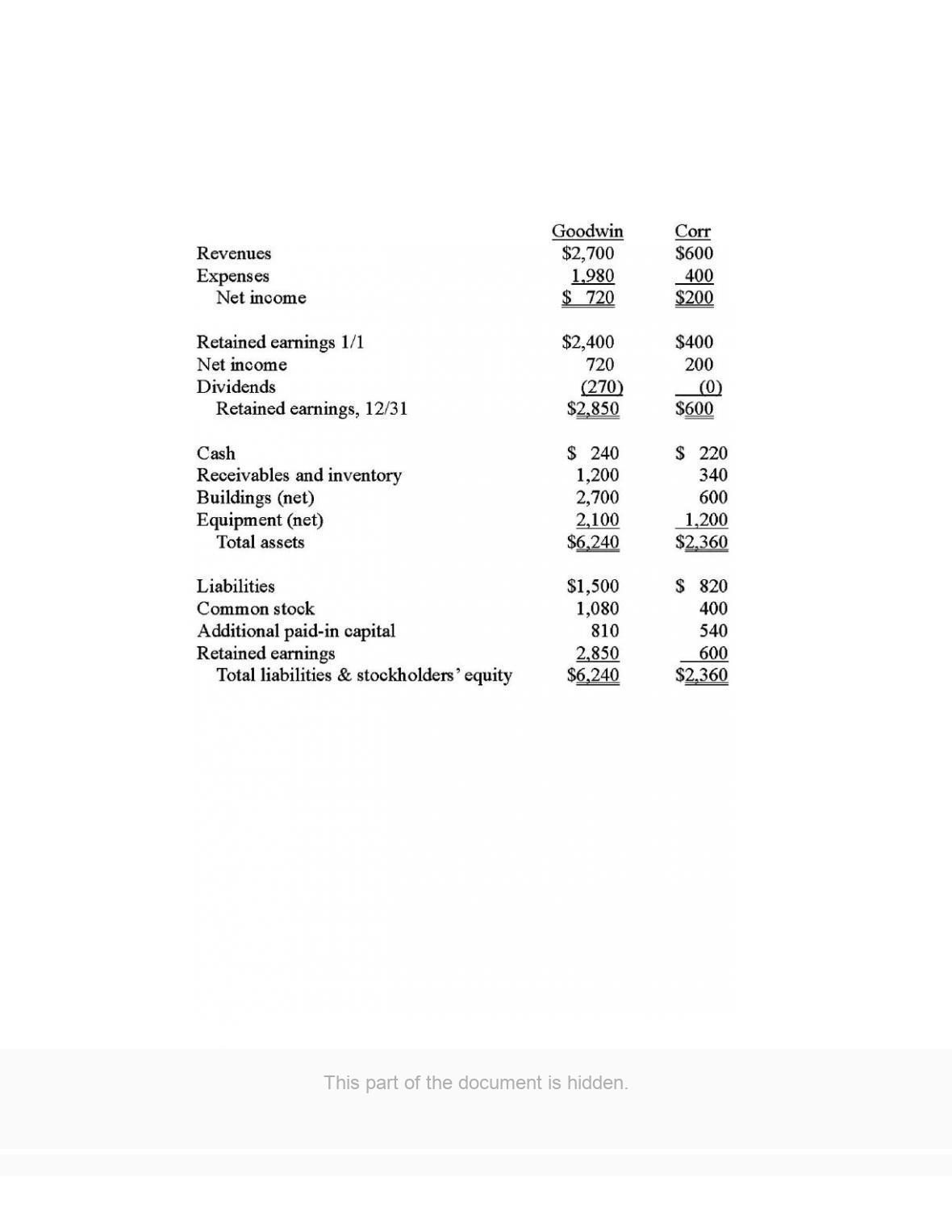
The financial statements for Goodwin, Inc. and Corr Company for the year ended
December 31, 2013, prior to Goodwin’s acquisition business combination transaction
regarding Corr, follow (in thousands):
On December 31, 2013, Goodwin issued $600 in debt and 30 shares of its $10 par value
common stock to the owners of Corr to acquire all of the outstanding shares of that
company. Goodwin shares had a fair value of $40 per share.
Goodwin paid $25 to a broker for arranging the transaction. Goodwin paid $35 in stock
issuance costs. Corr’s equipment was actually worth $1,400 but its buildings were only
valued at $560.
In this acquisition business combination, what total amount of common stock and
additional paid-in capital is added on Goodwin’s books?
A.
$265.
B.
$1,165.

C.
$1,200.
D.
$1,235.
E.
$1,765.
($10 × 30 shares) Common Stock + ($30 × 30 shares) APIC – $35 APIC = $1,165
AACSB: Analytic
AICPA BB: Critical Thinking
AICPA FN: Measurement
Blooms: Apply
Difficulty: 2 Medium
Learning Objective: 02-04 Describe the valuation principles of the acquisition method.
Learning Objective: 02-05 Determine the total fair value of the consideration transferred for an acquisition and allocate
that fair value to specific subsidiary assets acquired (including goodwill); and liabilities assumed; or a gain on bargain
purchase.
Learning Objective: 02-06 Prepare the journal entry to consolidate the accounts of a subsidiary if dissolution takes place.
Learning Objective: 02-07 Prepare a worksheet to consolidate the accounts of two companies that form a business
combination if dissolution does not take place.