
111.
On January 1, 2013, Chester Inc. acquired 100% of Festus Corp.’s outstanding common
stock by exchanging 37,500 shares of Chester’s $2 par value common voting stock. On
January 1, 2013, Chester’s voting common stock had a fair value of $40 per share. Festus’
voting common shares were selling for $6.50 per share. Festus’ balances on the
acquisition date, just prior to acquisition are listed below.

AACSB: Analytic
AICPA BB: Critical Thinking
AICPA FN: Measurement
Blooms: Apply
Difficulty: 2 Medium
Learning Objective: 02-04 Describe the valuation principles of the acquisition method.
Learning Objective: 02-05 Determine the total fair value of the consideration transferred for an acquisition and allocate
that fair value to specific subsidiary assets acquired (including goodwill); and liabilities assumed; or a gain on bargain
purchase.
Learning Objective: 02-06 Prepare the journal entry to consolidate the accounts of a subsidiary if dissolution takes place.
Learning Objective: 02-07 Prepare a worksheet to consolidate the accounts of two companies that form a business
combination if dissolution does not take place.


112.
The financial statements for Jode Inc. and Lakely Corp., just prior to their combination, for
the year ending December 31, 2012, follow. Lakely’s buildings were undervalued on its
financial records by $60,000.

AACSB: Analytic
AICPA BB: Critical Thinking
AICPA FN: Measurement
Blooms: Apply
Difficulty: 2 Medium
Learning Objective: 02-04 Describe the valuation principles of the acquisition method.
Learning Objective: 02-05 Determine the total fair value of the consideration transferred for an acquisition and allocate
that fair value to specific subsidiary assets acquired (including goodwill); and liabilities assumed; or a gain on bargain
purchase.
Learning Objective: 02-07 Prepare a worksheet to consolidate the accounts of two companies that form a business
combination if dissolution does not take place.

113.
The financial statements for Jode Inc. and Lakely Corp., just prior to their combination, for
the year ending December 31, 2012, follow. Lakely’s buildings were undervalued on its
financial records by $60,000.

AACSB: Analytic
AICPA BB: Critical Thinking
AICPA FN: Measurement
Blooms: Apply
Difficulty: 2 Medium
Learning Objective: 02-07 Prepare a worksheet to consolidate the accounts of two companies that form a business
combination if dissolution does not take place.

114.
The financial statements for Jode Inc. and Lakely Corp., just prior to their combination, for
the year ending December 31, 2012, follow. Lakely’s buildings were undervalued on its
financial records by $60,000.

AACSB: Analytic
AICPA BB: Critical Thinking
AICPA FN: Measurement
Blooms: Apply
Difficulty: 2 Medium
Learning Objective: 02-04 Describe the valuation principles of the acquisition method.
Learning Objective: 02-05 Determine the total fair value of the consideration transferred for an acquisition and allocate
that fair value to specific subsidiary assets acquired (including goodwill); and liabilities assumed; or a gain on bargain
purchase.
Learning Objective: 02-07 Prepare a worksheet to consolidate the accounts of two companies that form a business
combination if dissolution does not take place.

115.
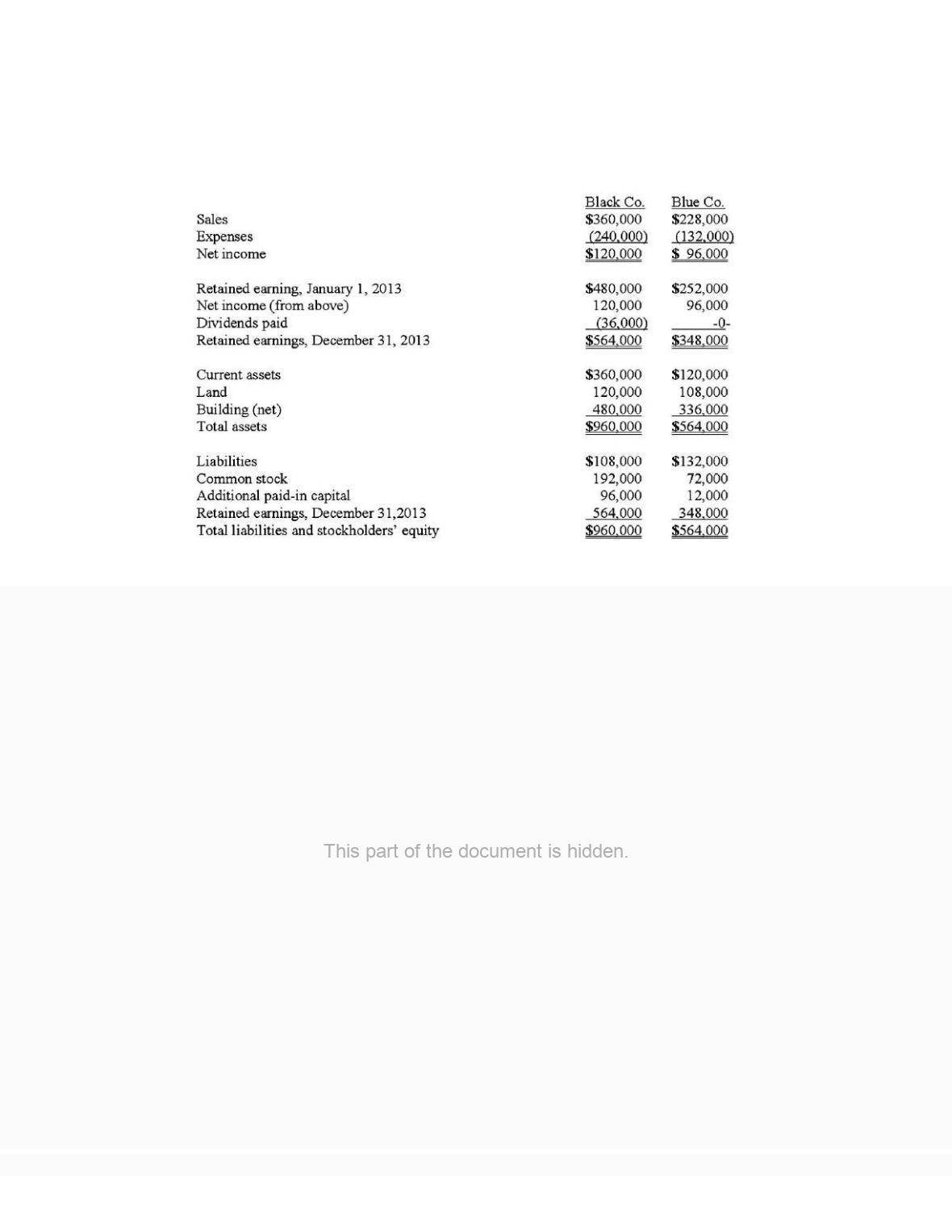
The following are preliminary financial statements for Black Co. and Blue Co. for the year
ending December 31, 2013.
On December 31, 2013 (subsequent to the preceding statements), Black exchanged
10,000 shares of its $10 par value common stock for all of the outstanding shares of Blue.
Black’s stock on that date has a fair value of $50 per share. Black was willing to issue
10,000 shares of stock because Blue’s land was appraised at $204,000. Black also paid
$14,000 to several attorneys and accountants who assisted in creating this combination.
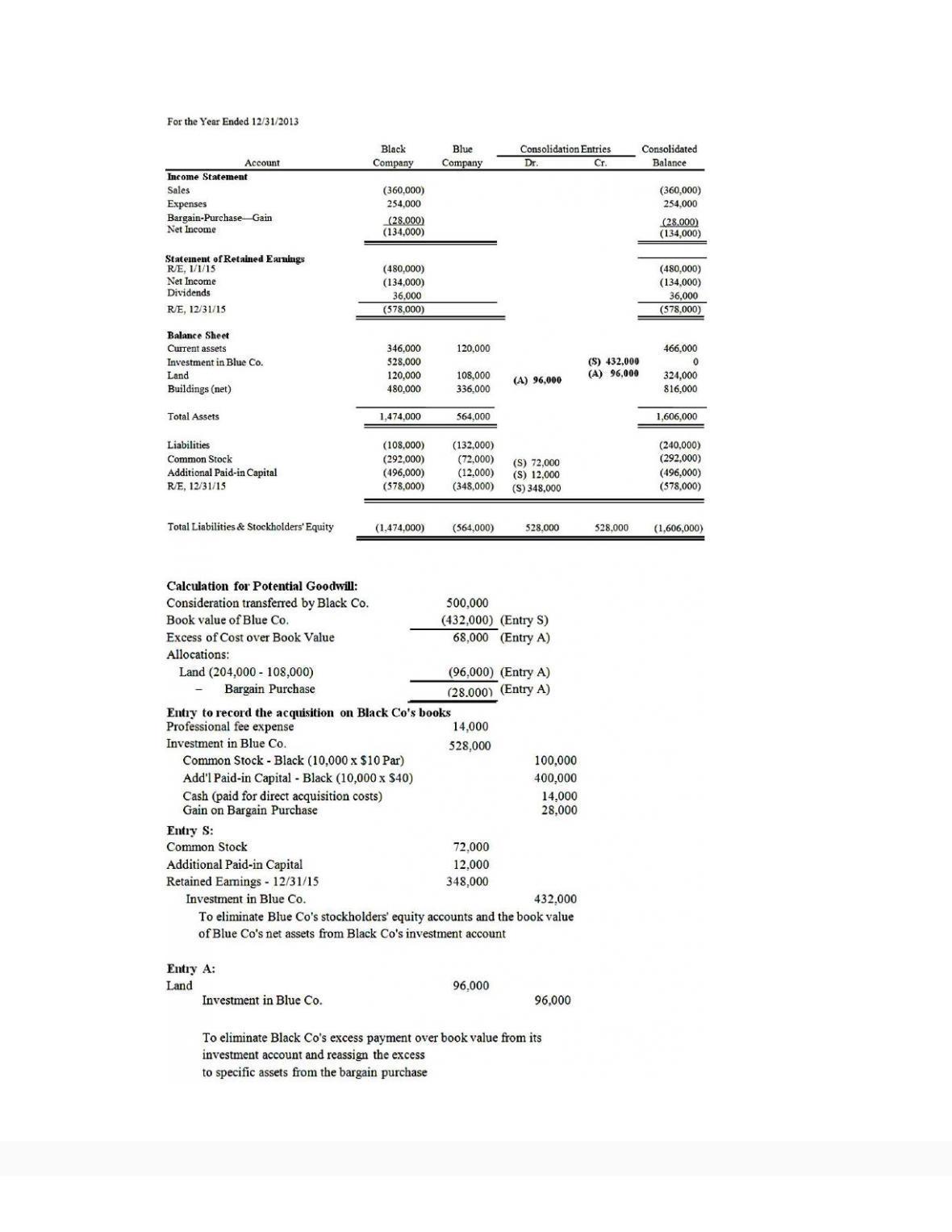
Required:
Assuming that these two companies retained their separate legal identities, prepare a
consolidation worksheet as of December 31, 2013.

AACSB: Analytic
AICPA BB: Critical Thinking
AICPA FN: Measurement
Blooms: Apply
Difficulty: 3 Hard
Learning Objective: 02-04 Describe the valuation principles of the acquisition method.
Learning Objective: 02-05 Determine the total fair value of the consideration transferred for an acquisition and allocate
that fair value to specific subsidiary assets acquired (including goodwill); and liabilities assumed; or a gain on bargain
purchase.
Learning Objective: 02-07 Prepare a worksheet to consolidate the accounts of two companies that form a business
combination if dissolution does not take place.

116.
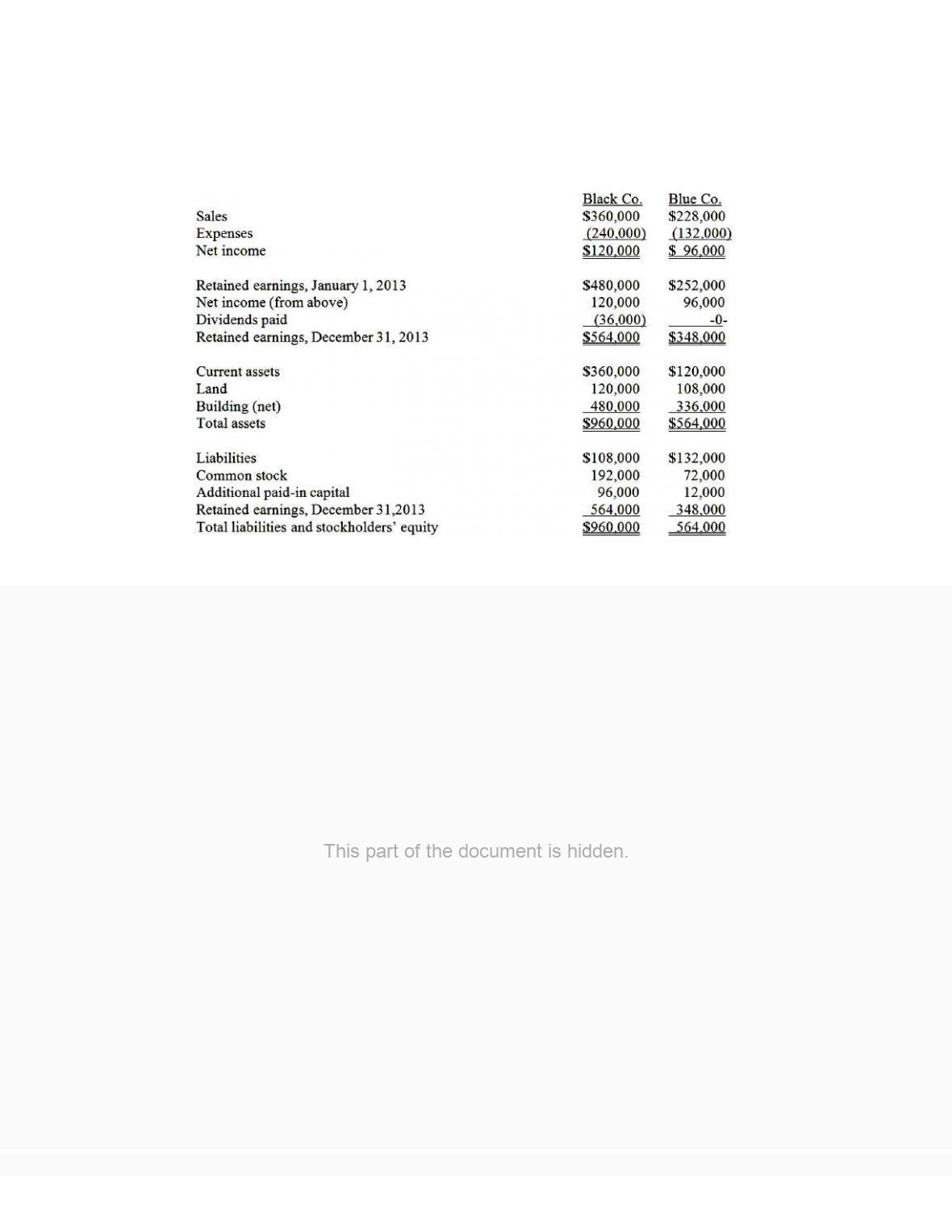
The following are preliminary financial statements for Black Co. and Blue Co. for the year
ending December 31, 2013 prior to Black’s acquisition of Blue.
On December 31, 2013 (subsequent to the preceding statements), Black exchanged
10,000 shares of its $10 par value common stock for all of the outstanding shares of Blue.
Black’s stock on that date has a fair value of $60 per share. Black was willing to issue
10,000 shares of stock because Blue’s land was appraised at $204,000. Black also paid
$14,000 to several attorneys and accountants who assisted in creating this combination.
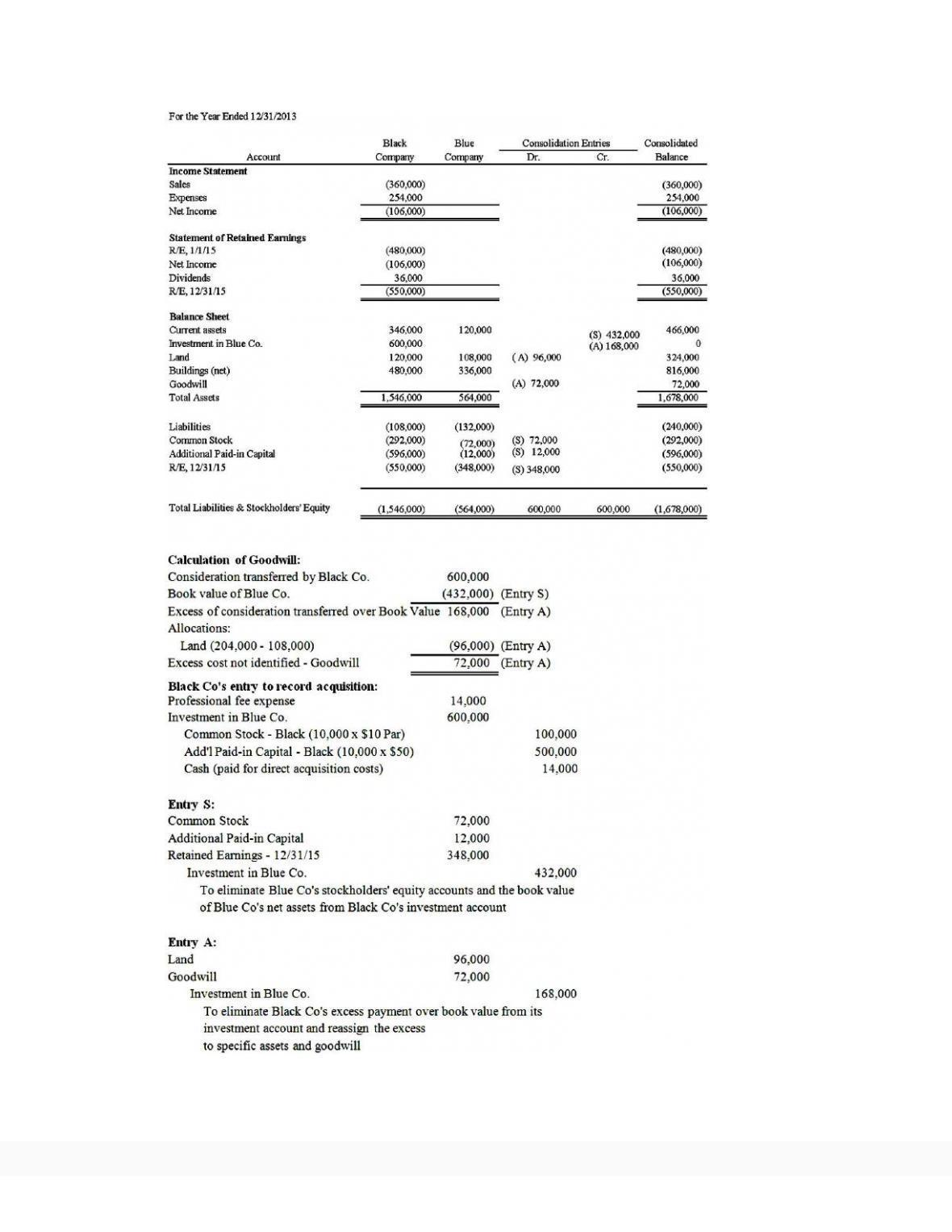
Required:
Assuming that these two companies retained their separate legal identities, prepare a

AACSB: Analytic
AICPA BB: Critical Thinking
AICPA FN: Measurement
Blooms: Apply
Difficulty: 3 Hard
Learning Objective: 02-04 Describe the valuation principles of the acquisition method.
Learning Objective: 02-05 Determine the total fair value of the consideration transferred for an acquisition and allocate
that fair value to specific subsidiary assets acquired (including goodwill); and liabilities assumed; or a gain on bargain
purchase.
Learning Objective: 02-07 Prepare a worksheet to consolidate the accounts of two companies that form a business
combination if dissolution does not take place.

117.
For each of the following situations, select the best letter answer to reflect the effect of
the numbered item on the acquirer’s accounting entry at the date of combination when
separate incorporation will be maintained. Items (4) and (6) require two selections.
(A) Increase Investment account.
(B) Decrease Investment account.
(C) Increase Liabilities.
(D) Increase Common stock.
(E) Decrease common stock.
(F) Increase Additional paid-in capital.
(G) Decrease Additional paid-in capital.
(H) Increase Retained earnings.
(I) Decrease Retained earnings.
_____1. Direct costs.
_____2. Indirect costs.
_____3. Stock issue costs.
_____4. Contingent consideration.

2-219
Copyright © 2015 McGraw-Hill Education. All rights reserved. No reproduction or distribution without the prior written consent of
McGraw-Hill Education.
AACSB: Reflective thinking
AICPA BB: Critical Thinking
AICPA FN: Measurement
Blooms: Understand
Difficulty: 2 Medium
Learning Objective: 02-04 Describe the valuation principles of the acquisition method.
Learning Objective: 02-05 Determine the total fair value of the consideration transferred for an acquisition and allocate
that fair value to specific subsidiary assets acquired (including goodwill); and liabilities assumed; or a gain on bargain
purchase.
Learning Objective: 02-06 Prepare the journal entry to consolidate the accounts of a subsidiary if dissolution takes place.
Learning Objective: 02-07 Prepare a worksheet to consolidate the accounts of two companies that form a business
combination if dissolution does not take place.
Learning Objective: 02-08 Describe the two criteria for recognizing intangible assets apart from goodwill in a business
combination.