
AACSB: Analytic
AICPA BB: Critical Thinking
AICPA FN: Measurement
Blooms: Apply
Difficulty: 3 Hard
Learning Objective: 02-04 Describe the valuation principles of the acquisition method.
Learning Objective: 02-05 Determine the total fair value of the consideration transferred for an acquisition and allocate
that fair value to specific subsidiary assets acquired (including goodwill); and liabilities assumed; or a gain on bargain
purchase.
Learning Objective: 02-06 Prepare the journal entry to consolidate the accounts of a subsidiary if dissolution takes place.
Learning Objective: 02-07 Prepare a worksheet to consolidate the accounts of two companies that form a business
combination if dissolution does not take place.
91.
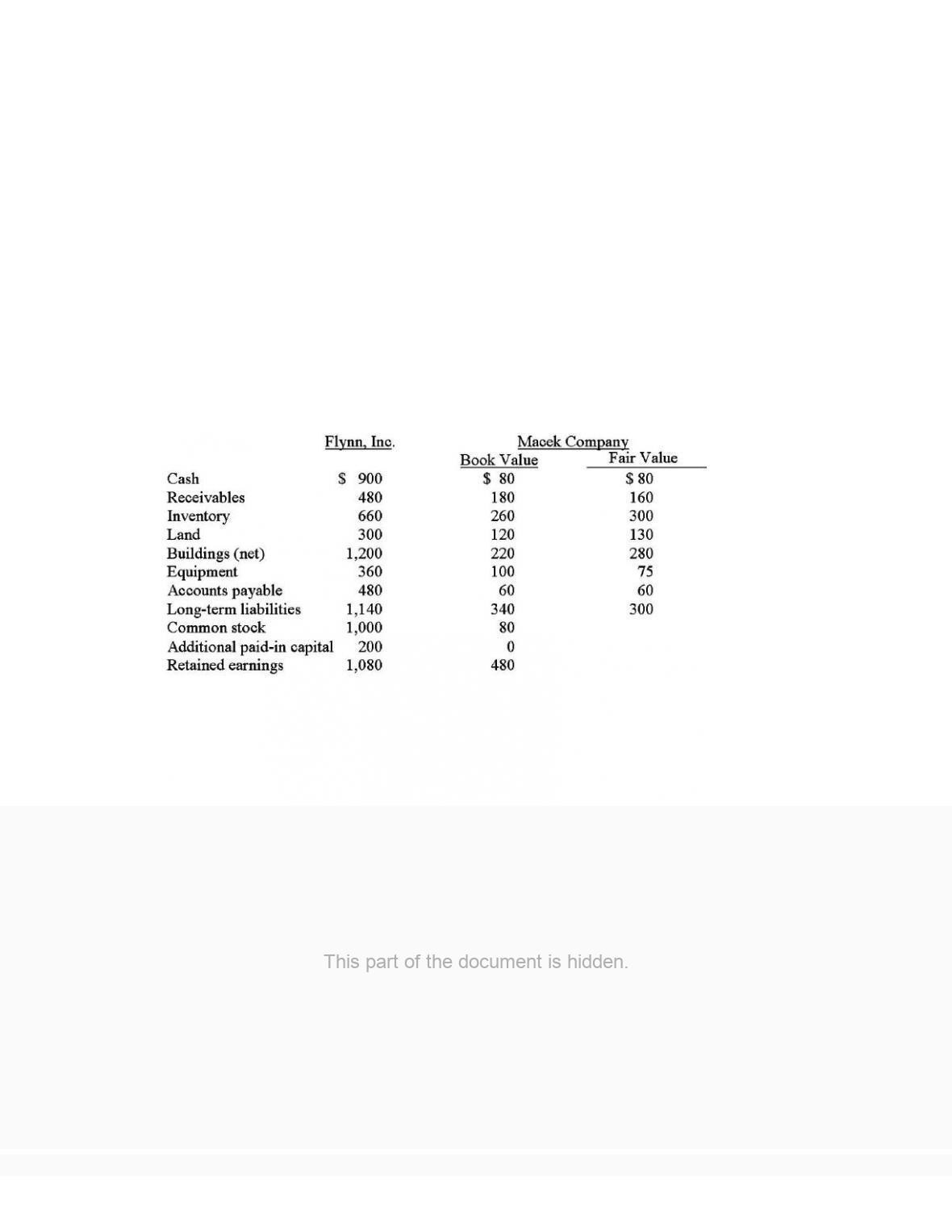
Flynn acquires 100 percent of the outstanding voting shares of Macek Company on
January 1, 2013. To obtain these shares, Flynn pays $400 cash (in thousands) and issues
10,000 shares of $20 par value common stock on this date. Flynn’s stock had a fair value
of $36 per share on that date. Flynn also pays $15 (in thousands) to a local investment
firm for arranging the acquisition. An additional $10 (in thousands) was paid by Flynn in
stock issuance costs.
The book values for both Flynn and Macek as of January 1, 2013 follow. The fair value of
each of Flynn and Macek accounts is also included. In addition, Macek holds a fully
amortized trademark that still retains a $40 (in thousands) value.
The
figures
below
are
in
thousands
. Any related question also is in thousands.
What amount will be reported for consolidated cash after the acquisition is completed?
A.
$475,000.
B.
$500,000.
C.
$555,000.
D.
$580,000.
E.
$875,000.
$900,000 + $80,000 – $400,000 – $15,000 – $10,000 = $555,000

AACSB: Analytic
AICPA BB: Critical Thinking
AICPA FN: Measurement
Blooms: Apply
Difficulty: 3 Hard
Learning Objective: 02-05 Determine the total fair value of the consideration transferred for an acquisition and allocate
that fair value to specific subsidiary assets acquired (including goodwill); and liabilities assumed; or a gain on bargain
purchase.
Learning Objective: 02-06 Prepare the journal entry to consolidate the accounts of a subsidiary if dissolution takes place.
Learning Objective: 02-07 Prepare a worksheet to consolidate the accounts of two companies that form a business
combination if dissolution does not take place.
Essay Questions
92.
What term is used to refer to a business combination in which only one of the original
companies continues to exist?
The appropriate term is
statutory
merger
.
AACSB: Reflective thinking
AICPA BB: Critical Thinking
AICPA FN: Measurement
Blooms: Remember
Difficulty: 2 Medium
Learning Objective: 02-03 Define the term business combination and differentiate across various forms of business
combinations.

93.
How are stock issuance costs accounted for in an acquisition business combination?
Stock issuance costs reduce the balance in the acquirer’s Additional Paid-In Capital in an
acquisition business combination.
AACSB: Reflective thinking
AICPA BB: Critical Thinking
AICPA FN: Measurement
Blooms: Remember
Difficulty: 2 Medium
Learning Objective: 02-05 Determine the total fair value of the consideration transferred for an acquisition and allocate
that fair value to specific subsidiary assets acquired (including goodwill); and liabilities assumed; or a gain on bargain
purchase.
Learning Objective: 02-06 Prepare the journal entry to consolidate the accounts of a subsidiary if dissolution takes place.
Learning Objective: 02-07 Prepare a worksheet to consolidate the accounts of two companies that form a business
combination if dissolution does not take place.

94.
What is the primary difference between recording an acquisition when the subsidiary is
dissolved and when separate incorporation is maintained?
When the subsidiary is dissolved, the acquirer records in its books the fair value of
individual assets and liabilities acquired as well as the resulting goodwill from the
acquisition. However, when separate incorporation is maintained, the acquirer only
records the total fair value of assets and liabilities acquired, as well as the resulting
goodwill, in one account as an investment.
AACSB: Reflective thinking
AICPA BB: Critical Thinking
AICPA FN: Measurement
Blooms: Remember
Difficulty: 2 Medium
Learning Objective: 02-05 Determine the total fair value of the consideration transferred for an acquisition and allocate
that fair value to specific subsidiary assets acquired (including goodwill); and liabilities assumed; or a gain on bargain
purchase.
Learning Objective: 02-06 Prepare the journal entry to consolidate the accounts of a subsidiary if dissolution takes place.
Learning Objective: 02-07 Prepare a worksheet to consolidate the accounts of two companies that form a business
combination if dissolution does not take place.

95.
How are direct combination costs accounted for in an acquisition transaction?
In an acquisition, direct combination costs are expensed in the period of the acquisition.
AACSB: Reflective thinking
AICPA BB: Critical Thinking
AICPA FN: Measurement
Blooms: Remember
Difficulty: 2 Medium
Learning Objective: 02-05 Determine the total fair value of the consideration transferred for an acquisition and allocate
that fair value to specific subsidiary assets acquired (including goodwill); and liabilities assumed; or a gain on bargain
purchase.
Learning Objective: 02-06 Prepare the journal entry to consolidate the accounts of a subsidiary if dissolution takes place.
Learning Objective: 02-07 Prepare a worksheet to consolidate the accounts of two companies that form a business
combination if dissolution does not take place.

96.
Peterman Co. owns 55% of Samson Co. Under what circumstances would Peterman
not
be required to prepare consolidated financial statements?
Peterman would not be required to prepare consolidated financial statements if control of
Samson is temporary or if, despite majority ownership, Peterman does not have control
over Samson. A lack of control might exist if Samson is in a country that imposes
restrictions on Peterman’s actions.
AACSB: Reflective thinking
AICPA BB: Critical Thinking
AICPA FN: Measurement
Blooms: Understand
Difficulty: 2 Medium
Learning Objective: 02-02 Recognize when consolidation of financial information into a single set of statements is
necessary.
Learning Objective: 02-03 Define the term business combination and differentiate across various forms of business
combinations.
97.
How would you account for in-process research and development acquired in a business
combination accounted for as an acquisition?
In-Process Research and Development is capitalized as an asset of the combination and
reported as intangible assets with indefinite lives subject to impairment reviews.
AACSB: Reflective thinking
AICPA BB: Critical Thinking
AICPA FN: Measurement
Blooms: Remember
98.
Elon Corp. obtained all of the common stock of Finley Co., paying slightly less than the fair
value of Finley’s net assets acquired. How should the difference between the
consideration transferred and the fair value of the net assets be treated if the transaction
is accounted for as an acquisition?
The difference between the consideration transferred and the fair value of the net assets
acquired is recognized as a gain on bargain purchase.
AACSB: Reflective thinking
AICPA BB: Critical Thinking
AICPA FN: Measurement
Blooms: Remember
Difficulty: 2 Medium
Learning Objective: 02-04 Describe the valuation principles of the acquisition method.
99.
For acquisition accounting, why are assets and liabilities of the subsidiary consolidated at
fair value?
The acquisition transaction is assumed to occur through an orderly transaction between
market participants at the measurement date of the acquisition. Thus identified assets
and liabilities acquired have been assigned fair value for the transfer to the acquirer and
this is a relevant and faithful representation for consolidation.
AACSB: Reflective thinking
AICPA BB: Critical Thinking
AICPA FN: Measurement
Blooms: Remember
Difficulty: 2 Medium
Learning Objective: 02-04 Describe the valuation principles of the acquisition method.
100.
Goodwill is often acquired as part of a business combination. Why, when separate
incorporation is maintained, does Goodwill not appear on the Parent company’s trial
balance as a separate account?
While the Goodwill does not appear on the Parent company’s books, it is implied as part of
the account called Investment in Subsidiary. During the consolidation process, the
Investment account is broken down into its component parts. Goodwill, along with other
items such as subsidiary fair value adjustments, is then shown separately as part of the
consolidated financial statement balances.
AACSB: Reflective thinking
AICPA BB: Critical Thinking
AICPA FN: Measurement
Blooms: Understand
Difficulty: 2 Medium
Learning Objective: 02-08 Describe the two criteria for recognizing intangible assets apart from goodwill in a business
combination.

101.
How are direct combination costs, contingent consideration, and a bargain purchase
reflected in recording an acquisition transaction?
The acquisition method embraces a fair value concept as measured by the fair value of
consideration transferred. (1) Direct combination costs are expensed as incurred; (2)
Contingent consideration obligations are recognized at their present value of the potential
obligation as part of the acquisition consideration transferred; (3) When a bargain
purchase occurs, the acquirer measures and recognizes the fair values of each of the
assets acquired and liabilities assumed at the date of the combination, and as a result a
gain on the bargain purchase is recognized at the acquisition date.
AACSB: Reflective thinking
AICPA BB: Critical Thinking
AICPA FN: Measurement
Blooms: Remember
Difficulty: 2 Medium
Learning Objective: 02-04 Describe the valuation principles of the acquisition method.
Learning Objective: 02-05 Determine the total fair value of the consideration transferred for an acquisition and allocate
that fair value to specific subsidiary assets acquired (including goodwill); and liabilities assumed; or a gain on bargain
purchase.
Learning Objective: 02-06 Prepare the journal entry to consolidate the accounts of a subsidiary if dissolution takes place.
Learning Objective: 02-07 Prepare a worksheet to consolidate the accounts of two companies that form a business
combination if dissolution does not take place.

102.
How is contingent consideration accounted for in an acquisition business combination
transaction?
The fair value approach of the acquisition method views contingent payments as part of
the consideration transferred. Under this view, contingencies have a value to those who
receive the consideration and represent measurable obligations of the acquirer. The
amount of the contingent consideration is measured as the expected present value of a
potential payment and increases the investment value recorded.
AACSB: Reflective thinking
AICPA BB: Critical Thinking
AICPA FN: Measurement
Blooms: Remember
Difficulty: 2 Medium
Learning Objective: 02-04 Describe the valuation principles of the acquisition method.
103.
How are bargain purchases accounted for in an acquisition business transaction?
A bargain purchase results when the collective fair values of the net identified assets
acquired and liabilities assumed exceed the fair value of consideration transferred. The
assets and liabilities acquired are recorded at their fair values and the bargain purchase is
recorded as a Gain on Bargain Purchase.
AACSB: Reflective thinking
AICPA BB: Critical Thinking
AICPA FN: Measurement
Blooms: Remember
Difficulty: 2 Medium
Learning Objective: 02-04 Describe the valuation principles of the acquisition method.

104.
Describe the accounting for direct costs, indirect costs, and issuance costs under the
acquisition method of accounting for a business combination.
Direct and indirect combination costs are expensed and issuance costs reduce the
otherwise fair value of the consideration issued under the acquisition method of
accounting for business combinations.
AACSB: Reflective thinking
AICPA BB: Critical Thinking
AICPA FN: Measurement
Blooms: Remember
Difficulty: 2 Medium
Learning Objective: 02-05 Determine the total fair value of the consideration transferred for an acquisition and allocate
that fair value to specific subsidiary assets acquired (including goodwill); and liabilities assumed; or a gain on bargain
purchase.
Learning Objective: 02-06 Prepare the journal entry to consolidate the accounts of a subsidiary if dissolution takes place.
Learning Objective: 02-07 Prepare a worksheet to consolidate the accounts of two companies that form a business
combination if dissolution does not take place.

105.
What is the difference in consolidated results between a business combination whereby
the acquired company is dissolved, and a business combination whereby separate
incorporation is maintained?
There is no difference in consolidated results.
AACSB: Reflective thinking
AICPA BB: Critical Thinking
AICPA FN: Measurement
Blooms: Remember
Difficulty: 1 Easy
Learning Objective: 02-06 Prepare the journal entry to consolidate the accounts of a subsidiary if dissolution takes place.
Learning Objective: 02-07 Prepare a worksheet to consolidate the accounts of two companies that form a business
combination if dissolution does not take place.
106.
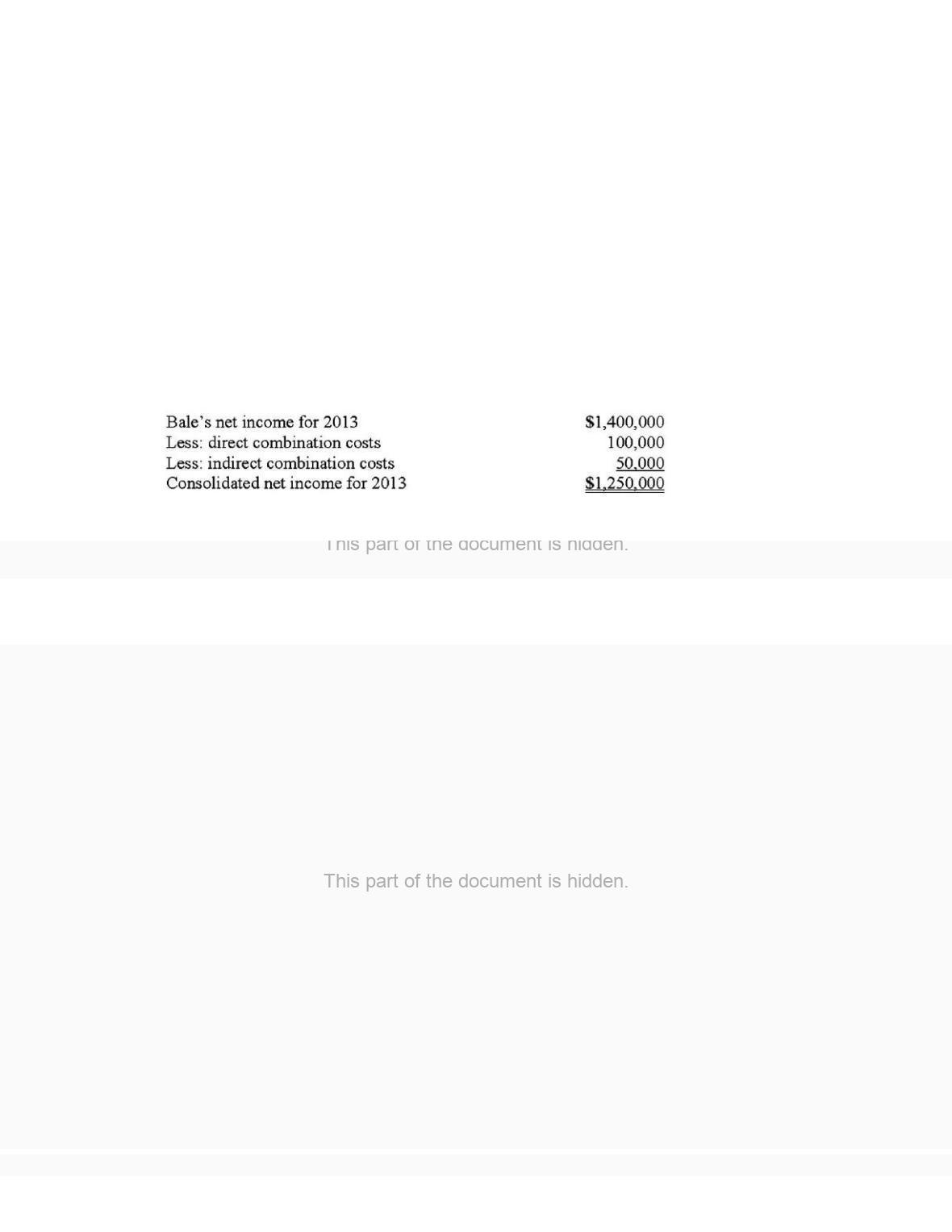
Bale Co. acquired Silo Inc. on December 31, 2013, in an acquisition business combination
transaction. Bale’s net income for the year was $1,400,000, while Silo had net income of
$400,000 earned evenly during the year. Bale paid $100,000 in direct combination costs,
$50,000 in indirect costs, and $30,000 in stock issue costs to effect the combination.
Required:
What is consolidated net income for 2013?
Note: Silo’s net income does not affect consolidated net income until after the date of
acquisition. The combination costs belong to Bale only.
AACSB: Analytic
AICPA BB: Critical Thinking
AICPA FN: Measurement
Blooms: Apply
Difficulty: 2 Medium
Learning Objective: 02-05 Determine the total fair value of the consideration transferred for an acquisition and allocate
that fair value to specific subsidiary assets acquired (including goodwill); and liabilities assumed; or a gain on bargain
purchase.
Learning Objective: 02-06 Prepare the journal entry to consolidate the accounts of a subsidiary if dissolution takes place.
Learning Objective: 02-07 Prepare a worksheet to consolidate the accounts of two companies that form a business
combination if dissolution does not take place.
107.
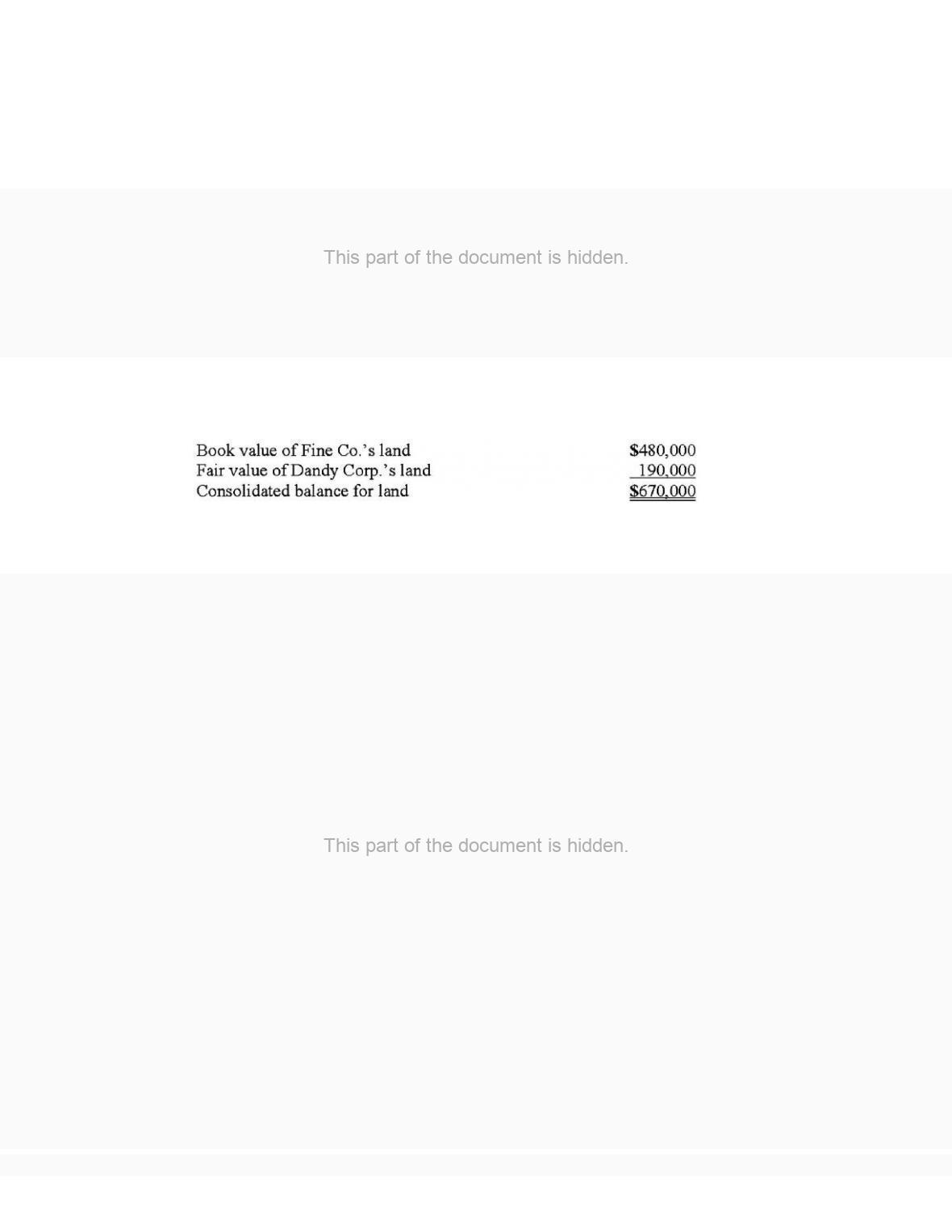
Fine Co. issued its common stock in exchange for the common stock of Dandy Corp. in an
acquisition. At the date of the combination, Fine had land with a book value of $480,000
and a fair value of $620,000. Dandy had land with a book value of $170,000 and a fair
value of $190,000.
Required:
What was the consolidated balance for Land in a consolidated balance sheet prepared at
the date of the acquisition combination?
AACSB: Analytic
AICPA BB: Critical Thinking
AICPA FN: Measurement
Blooms: Apply
Difficulty: 2 Medium
Learning Objective: 02-05 Determine the total fair value of the consideration transferred for an acquisition and allocate
that fair value to specific subsidiary assets acquired (including goodwill); and liabilities assumed; or a gain on bargain
purchase.
Learning Objective: 02-06 Prepare the journal entry to consolidate the accounts of a subsidiary if dissolution takes place.
Learning Objective: 02-07 Prepare a worksheet to consolidate the accounts of two companies that form a business
combination if dissolution does not take place.
108.
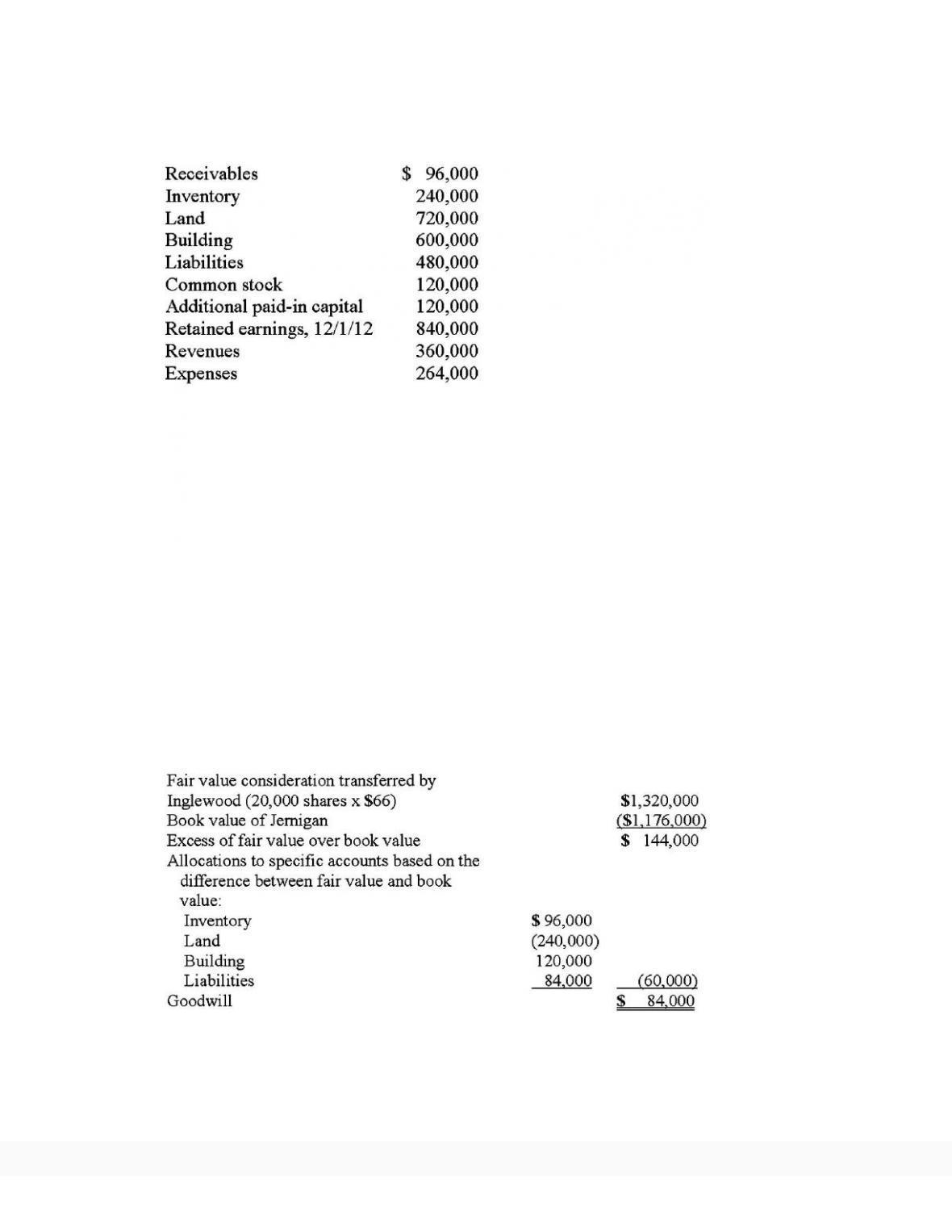
Jernigan Corp. had the following account balances at 12/1/12:
Several of Jernigan’s accounts have fair values that differ from book value. The fair values
are: Land — $480,000; Building — $720,000; Inventory — $336,000; and Liabilities —
$396,000.
Inglewood Inc. acquired all of the outstanding common shares of Jernigan by issuing
20,000 shares of common stock having a $6 par value
,
but a $66 fair value. Stock issuance
costs amounted to $12,000.
Required:
Prepare a fair value allocation and goodwill schedule at the date of the acquisition.

AACSB: Analytic
AICPA BB: Critical Thinking
AICPA FN: Measurement
Blooms: Apply
Difficulty: 2 Medium
Learning Objective: 02-04 Describe the valuation principles of the acquisition method.
Learning Objective: 02-05 Determine the total fair value of the consideration transferred for an acquisition and allocate
that fair value to specific subsidiary assets acquired (including goodwill); and liabilities assumed; or a gain on bargain
purchase.
Learning Objective: 02-06 Prepare the journal entry to consolidate the accounts of a subsidiary if dissolution takes place.
Learning Objective: 02-07 Prepare a worksheet to consolidate the accounts of two companies that form a business
combination if dissolution does not take place.
109.
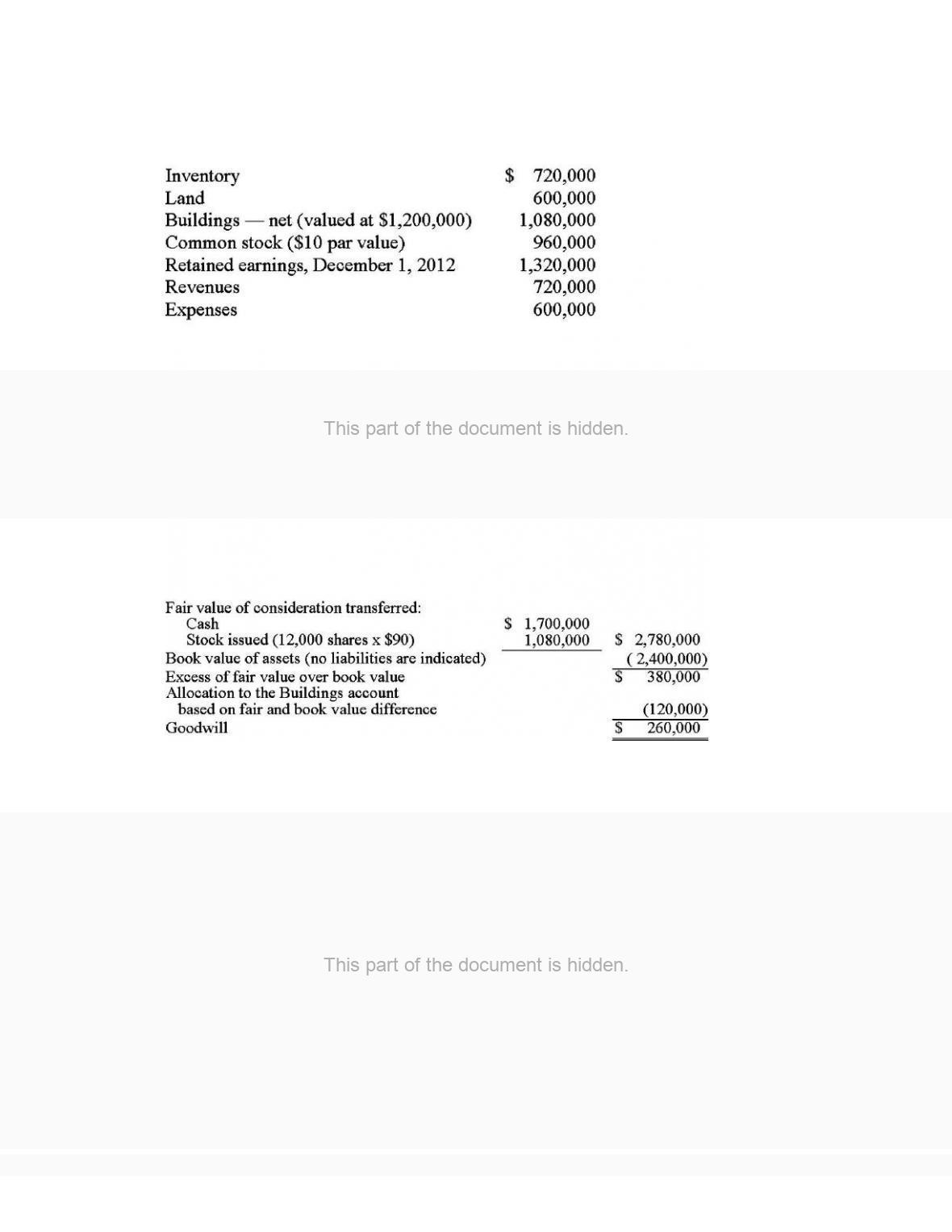
Salem Co. had the following account balances as of December 1, 2012:
Bellington Inc. transferred $1.7 million in cash and 12,000 shares of its newly issued $30
par value common stock (valued at $90 per share) to acquire all of Salem’s outstanding
common stock.
Determine the balance for Goodwill that would be included in a December 1, 2012,
consolidation.
AACSB: Analytic
110.
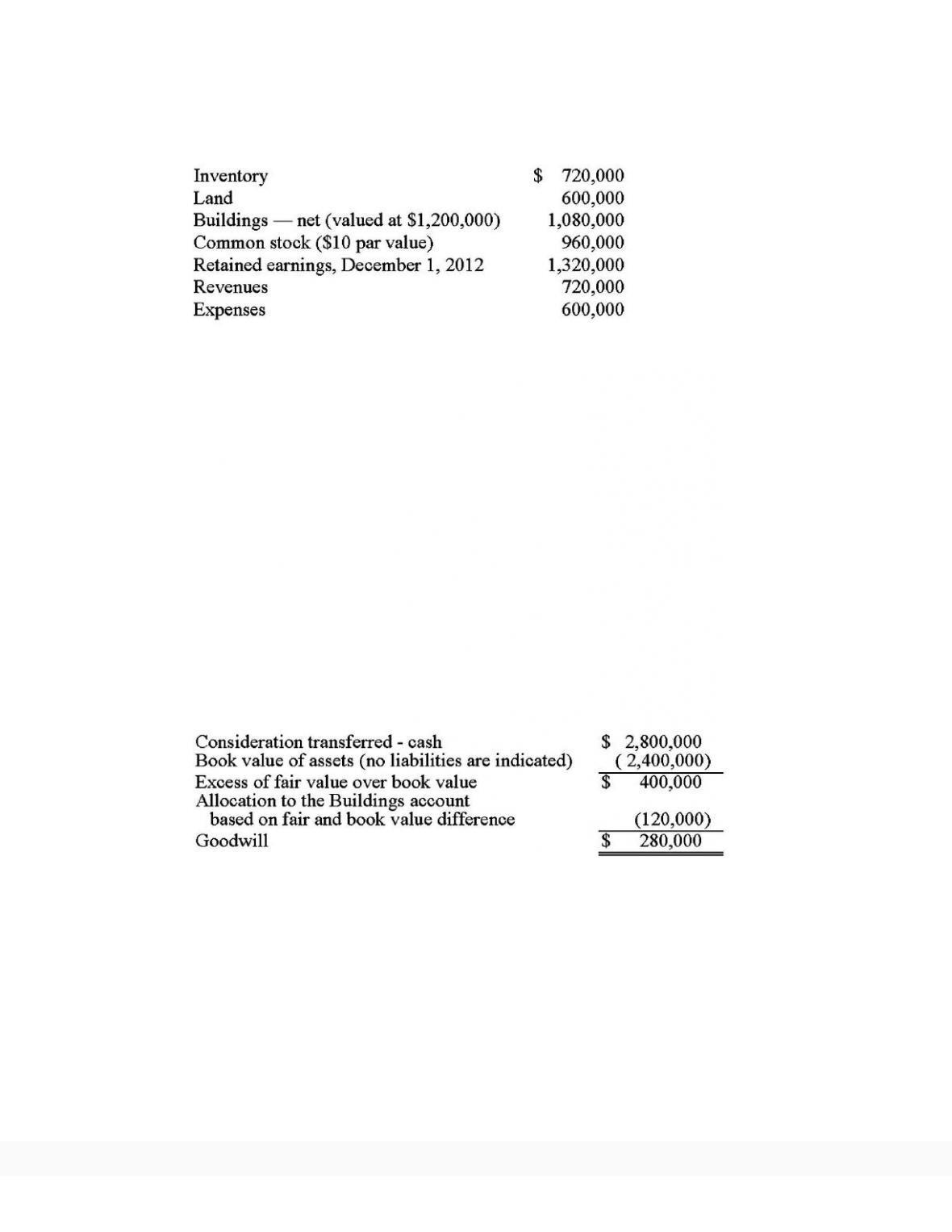
Salem Co. had the following account balances as of December 1, 2012:
Bellington Inc. transferred $1.7 million in cash and 12,000 shares of its newly issued $30
par value common stock (valued at $90 per share) to acquire all of Salem’s outstanding
common stock.
Assume that Bellington paid cash of $2.8 million. No stock is issued. An additional $50,000
is paid in direct combination costs.
Required:
For Goodwill, determine what balance would be included in a December 1, 2012
consolidation.

AACSB: Analytic
AICPA BB: Critical Thinking
AICPA FN: Measurement
Blooms: Apply
Difficulty: 2 Medium
Learning Objective: 02-04 Describe the valuation principles of the acquisition method.
Learning Objective: 02-05 Determine the total fair value of the consideration transferred for an acquisition and allocate
that fair value to specific subsidiary assets acquired (including goodwill); and liabilities assumed; or a gain on bargain
purchase.
Learning Objective: 02-06 Prepare the journal entry to consolidate the accounts of a subsidiary if dissolution takes place.
Learning Objective: 02-07 Prepare a worksheet to consolidate the accounts of two companies that form a business
combination if dissolution does not take place.