
Chapter 02
Consolidation of Financial Information
1.
At the date of an acquisition which is not a bargain purchase, the acquisition method
A.
consolidates the subsidiary’s assets at fair value and the liabilities at book value.
B.
consolidates all subsidiary assets and liabilities at book value.
C.
consolidates all subsidiary assets and liabilities at fair value.
D.
consolidates current assets and liabilities at book value, long-term assets and
liabilities at fair value.
E.
consolidates the subsidiary’s assets at book value and the liabilities at fair value.
AACSB: Reflective thinking
AICPA BB: Critical Thinking
AICPA FN: Measurement
Accessibility: Keyboard Navigation
Blooms: Remember
Difficulty: 1 Easy
Learning Objective: 02-04 Describe the valuation principles of the acquisition method.
Learning Objective: 02-05 Determine the total fair value of the consideration transferred for an acquisition and allocate
that fair value to specific subsidiary assets acquired (including goodwill); and liabilities assumed; or a gain on bargain
purchase.
2.
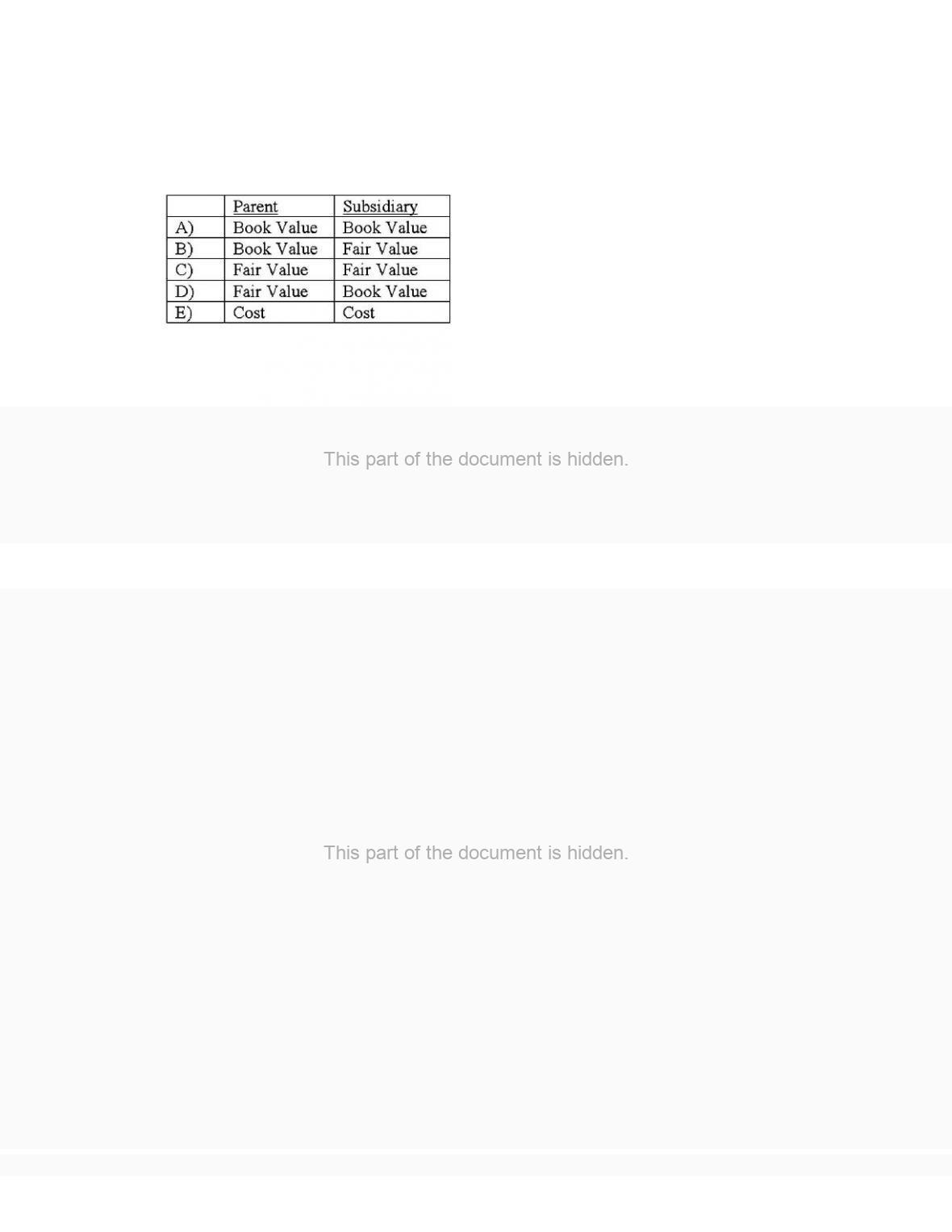
In an acquisition where control is achieved, how would the land accounts of the parent
and the land accounts of the subsidiary be combined?
A.
Option A
B.
Option B
C.
Option C
D.
Option D
E.
Option E
AACSB: Reflective thinking
AICPA BB: Critical Thinking
AICPA FN: Measurement
Blooms: Remember
Difficulty: 2 Medium
Learning Objective: 02-04 Describe the valuation principles of the acquisition method.
Learning Objective: 02-05 Determine the total fair value of the consideration transferred for an acquisition and allocate
that fair value to specific subsidiary assets acquired (including goodwill); and liabilities assumed; or a gain on bargain
purchase.

3.
Lisa Co. paid cash for all of the voting common stock of Victoria Corp. Victoria will
continue to exist as a separate corporation. Entries for the consolidation of Lisa and
Victoria would be recorded in
A.
a worksheet.
B.
Lisa’s general journal.
C.
Victoria’s general journal.
D.
Victoria’s secret consolidation journal.
E.
the general journals of both companies.
AACSB: Reflective thinking
AICPA BB: Critical Thinking
AICPA FN: Measurement
Accessibility: Keyboard Navigation
Blooms: Remember
Difficulty: 1 Easy
Learning Objective: 02-07 Prepare a worksheet to consolidate the accounts of two companies that form a business
combination if dissolution does not take place.

4.
Using the acquisition method for a business combination, goodwill is generally defined as:
A.
Cost of the investment less the subsidiary’s book value at the beginning of the year.
B.
Cost of the investment less the subsidiary’s book value at the acquisition date.
C.
Cost of the investment less the subsidiary’s fair value at the beginning of the year.
D.
Cost of the investment less the subsidiary’s fair value at acquisition date.
E.
is no longer allowed under federal law.
AACSB: Reflective thinking
AICPA BB: Critical Thinking
AICPA FN: Measurement
Accessibility: Keyboard Navigation
Blooms: Remember
Difficulty: 2 Medium
Learning Objective: 02-04 Describe the valuation principles of the acquisition method.
5.
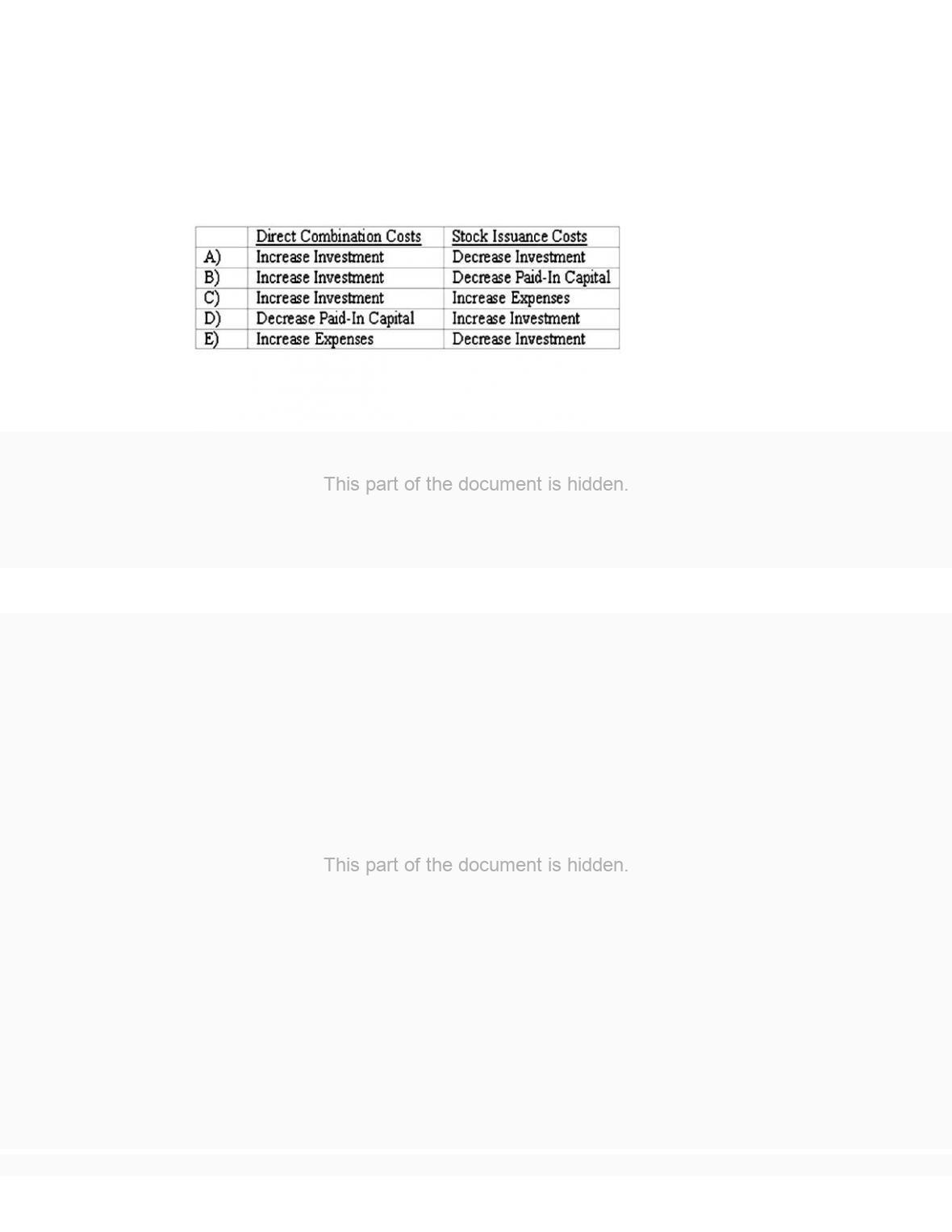
Direct combination costs and stock issuance costs are often incurred in the process of
making a controlling investment in another company. How should those costs be
accounted for in a pre-2009 purchase transaction?
A.
Option A
B.
Option B
C.
Option C
D.
Option D
E.
Option E
AACSB: Reflective thinking
AICPA BB: Critical Thinking
AICPA FN: Measurement
Blooms: Remember
Difficulty: 2 Medium
Learning Objective: 02-09 Appendix: Identify the general characteristics of the legacy purchase and pooling of interest
methods of accounting for past business combinations. Understand the effects that persist today in financial statements
from the use of these legacy methods.
6.
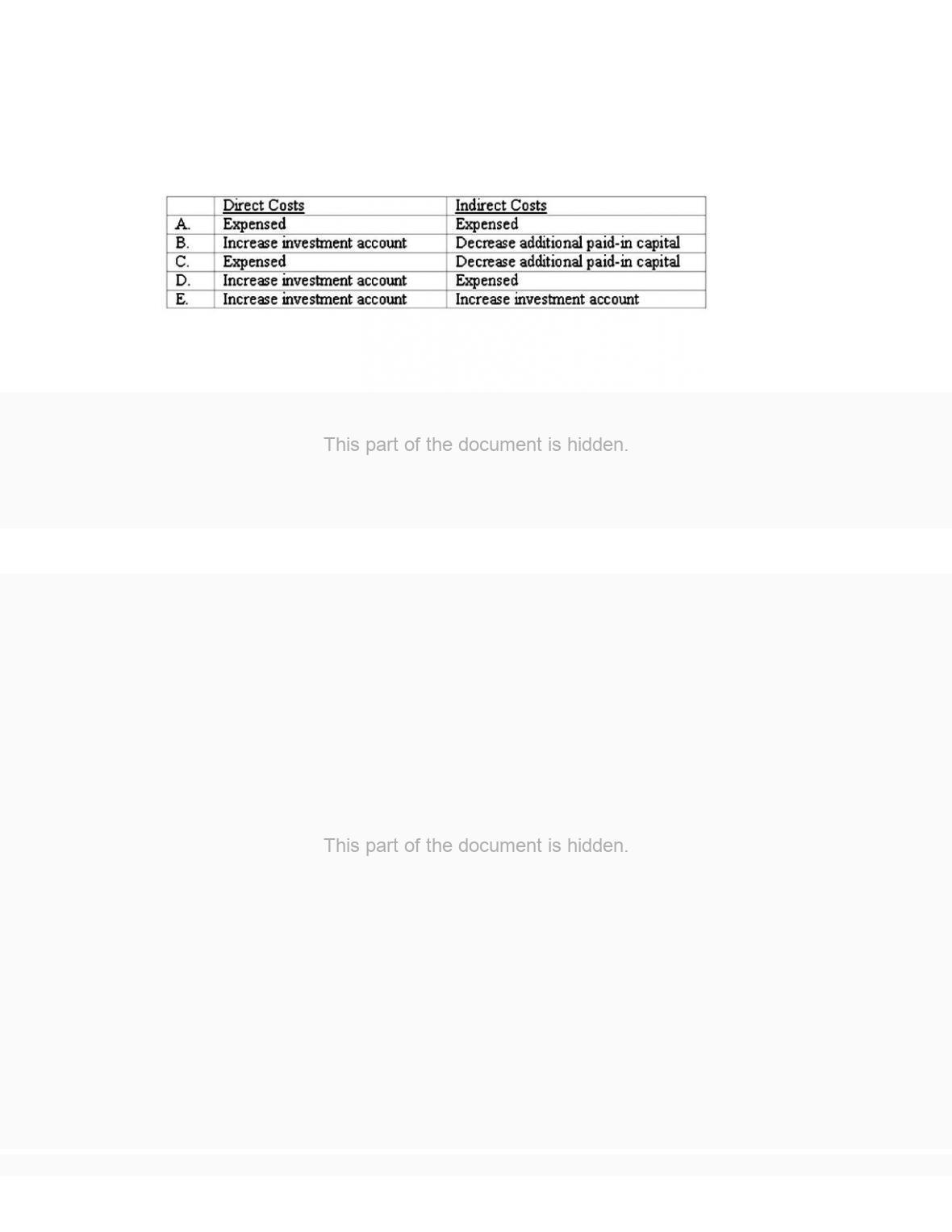
How are direct and indirect costs accounted for when applying the acquisition method for
a business combination?
A.
Option A
B.
Option B
C.
Option C
D.
Option D
E.
Option E
AACSB: Reflective thinking
AICPA BB: Critical Thinking
AICPA FN: Measurement
Blooms: Remember
Difficulty: 1 Easy
Learning Objective: 02-05 Determine the total fair value of the consideration transferred for an acquisition and allocate
that fair value to specific subsidiary assets acquired (including goodwill); and liabilities assumed; or a gain on bargain
purchase.

7.
What is the
primary
accounting difference between accounting for when the subsidiary is
dissolved and when the subsidiary retains its incorporation?
A.
If the subsidiary is dissolved, it will not be operated as a separate division.
B.
If the subsidiary is dissolved, assets and liabilities are consolidated at their book
values.
C.
If the subsidiary retains its incorporation, there will be no goodwill associated with the
acquisition.
D.
If the subsidiary retains its incorporation, assets and liabilities are consolidated at their
book values.
E.
If the subsidiary retains its incorporation, the consolidation is not formally recorded in
the accounting records of the acquiring company.
AACSB: Reflective thinking
AICPA BB: Critical Thinking
AICPA FN: Measurement
Accessibility: Keyboard Navigation
Blooms: Understand
Difficulty: 2 Medium
Learning Objective: 02-06 Prepare the journal entry to consolidate the accounts of a subsidiary if dissolution takes place.
Learning Objective: 02-07 Prepare a worksheet to consolidate the accounts of two companies that form a business
combination if dissolution does not take place.

8.
According to GAAP, the pooling of interest method for business combinations
A.
Is preferred to the purchase method.
B.
Is allowed for all new acquisitions.
C.
Is no longer allowed for business combinations after June 30, 2001.
D.
Is no longer allowed for business combinations after December 31, 2001.
E.
Is only allowed for large corporate mergers like Exxon and Mobil.
AACSB: Reflective thinking
AICPA BB: Critical Thinking
AICPA FN: Measurement
Accessibility: Keyboard Navigation
Blooms: Remember
Difficulty: 1 Easy
Learning Objective: 02-09 Appendix: Identify the general characteristics of the legacy purchase and pooling of interest
methods of accounting for past business combinations. Understand the effects that persist today in financial statements
from the use of these legacy methods.

9.
An example of a difference in types of business combination is:
A.
A statutory merger can only be effected by an asset acquisition while a statutory
consolidation can only be effected by a capital stock acquisition.
B.
A statutory merger can only be effected by a capital stock acquisition while a statutory
consolidation can only be effected by an asset acquisition.
C.
A statutory merger requires dissolution of the acquired company while a statutory
consolidation does not require dissolution.
D.
A statutory consolidation requires dissolution of the acquired company while a
statutory merger does not require dissolution.
E.
Both a statutory merger and a statutory consolidation can only be effected by an asset
acquisition but only a statutory consolidation requires dissolution of the acquired
company.
AACSB: Reflective thinking
AICPA BB: Critical Thinking
AICPA FN: Measurement
Accessibility: Keyboard Navigation
Blooms: Remember
Difficulty: 3 Hard
Learning Objective: 02-03 Define the term business combination and differentiate across various forms of business
combinations.

10.
Acquired in-process research and development is considered as
A.
a definite-lived asset subject to amortization.
B.
a definite-lived asset subject to testing for impairment.
C.
an indefinite-lived asset subject to amortization.
D.
an indefinite-lived asset subject to testing for impairment.
E.
a research and development expense at the date of acquisition.
AACSB: Reflective thinking
AICPA BB: Critical Thinking
AICPA FN: Measurement
Accessibility: Keyboard Navigation
Blooms: Remember
Difficulty: 1 Easy
Learning Objective: 02-08 Describe the two criteria for recognizing intangible assets apart from goodwill in a business
combination.

11.
Which one of the following is a characteristic of a business combination accounted for as
an acquisition?
A.
The combination must involve the exchange of equity securities only.
B.
The transaction establishes an acquisition fair value basis for the company being
acquired.
C.
The two companies may be about the same size, and it is difficult to determine the
acquired company and the acquiring company.
D.
The transaction may be considered to be the uniting of the ownership interests of the
companies involved.
E.
The acquired subsidiary must be smaller in size than the acquiring parent.
AACSB: Reflective thinking
AICPA BB: Critical Thinking
AICPA FN: Measurement
Accessibility: Keyboard Navigation
Blooms: Remember
Difficulty: 1 Easy
Learning Objective: 02-04 Describe the valuation principles of the acquisition method.

12.
Which one of the following is a characteristic of a business combination that is accounted
for as an acquisition?
A.
Fair value only for items received by the acquirer can enter into the determination of
the acquirer’s accounting valuation of the acquired company.
B.
Fair value only for the consideration transferred by the acquirer can enter into the
determination of the acquirer’s accounting valuation of the acquired company.
C.
Fair value for the consideration transferred by the acquirer as well as the fair value of
items received by the acquirer can enter into the determination of the acquirer’s
accounting valuation of the acquired company.
D.
Fair value for only consideration transferred and identifiable assets received by the
acquirer can enter into the determination of the acquirer’s accounting valuation of the
acquired company.
E.
Only fair value of identifiable assets received enters into the determination of the
acquirer’s accounting valuation of the acquired company.
AACSB: Reflective thinking
AICPA BB: Critical Thinking
AICPA FN: Measurement
Accessibility: Keyboard Navigation
Blooms: Understand
Difficulty: 3 Hard
Learning Objective: 02-04 Describe the valuation principles of the acquisition method.

13.
A
statutory
merger
is a(n)
A.
business combination in which only one of the two companies continues to exist as a
legal corporation.
B.
business combination in which both companies continue to exist.
C.
acquisition of a competitor.
D.
acquisition of a supplier or a customer.
E.
legal proposal to acquire outstanding shares of the target’s stock.
AACSB: Reflective thinking
AICPA BB: Critical Thinking
AICPA FN: Measurement
Accessibility: Keyboard Navigation
Blooms: Remember
Difficulty: 2 Medium
Learning Objective: 02-03 Define the term business combination and differentiate across various forms of business
combinations.

14.
How are
stock
issuance
costs
and
direct
combination
costs
treated in a business
combination which is accounted for as an acquisition when the subsidiary will retain its
incorporation?
A.
Stock issuance costs are a part of the acquisition costs, and the direct combination
costs are expensed.
B.
Direct combination costs are a part of the acquisition costs, and the stock issuance
costs are a reduction to additional paid-in capital.
C.
Direct combination costs are expensed and stock issuance costs are a reduction to
additional paid-in capital.
D.
Both are treated as part of the acquisition consideration transferred.
E.
Both are treated as a reduction to additional paid-in capital.
AACSB: Reflective thinking
AICPA BB: Critical Thinking
AICPA FN: Measurement
Accessibility: Keyboard Navigation
Blooms: Remember
Difficulty: 2 Medium
Learning Objective: 02-05 Determine the total fair value of the consideration transferred for an acquisition and allocate
that fair value to specific subsidiary assets acquired (including goodwill); and liabilities assumed; or a gain on bargain
purchase.
Learning Objective: 02-06 Prepare the journal entry to consolidate the accounts of a subsidiary if dissolution takes place.
15.
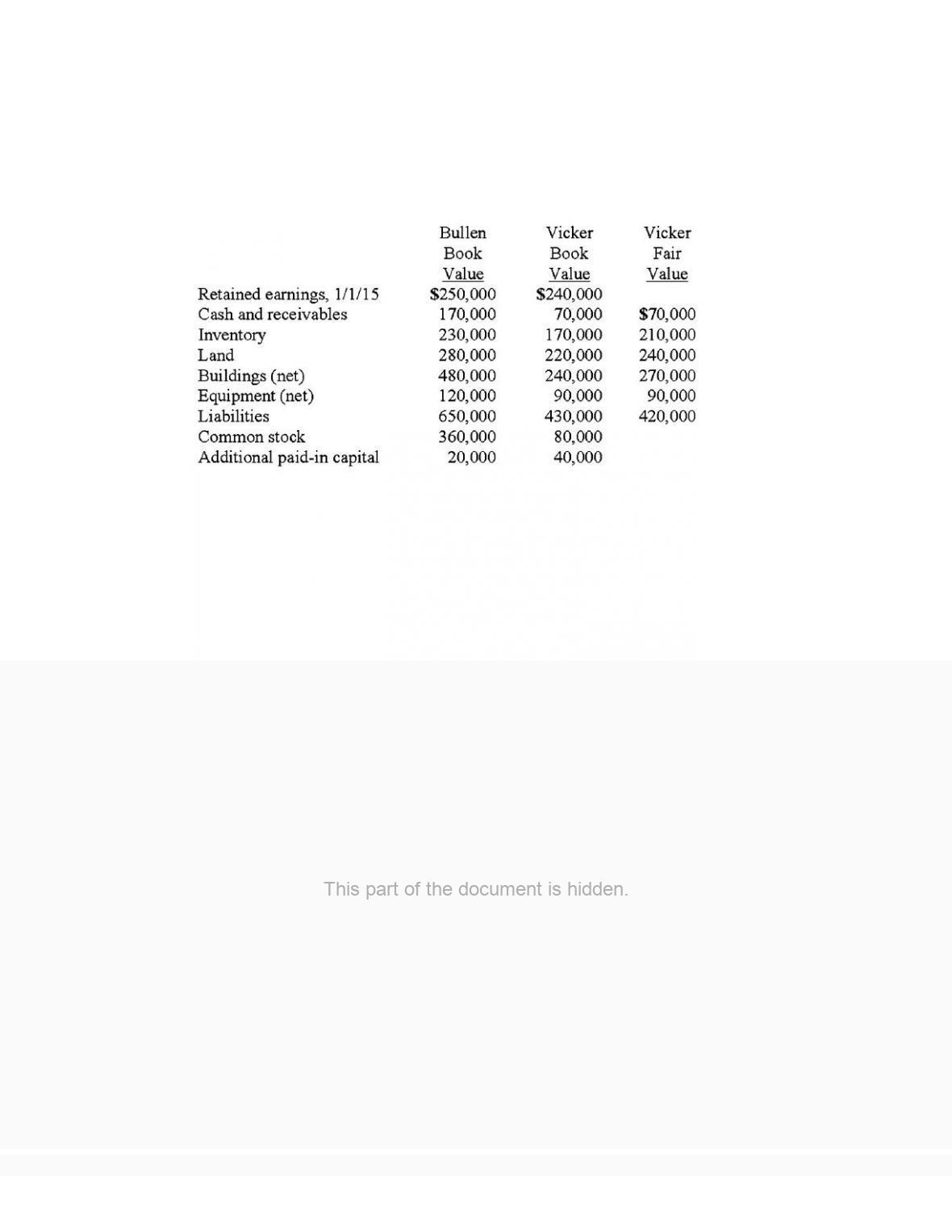
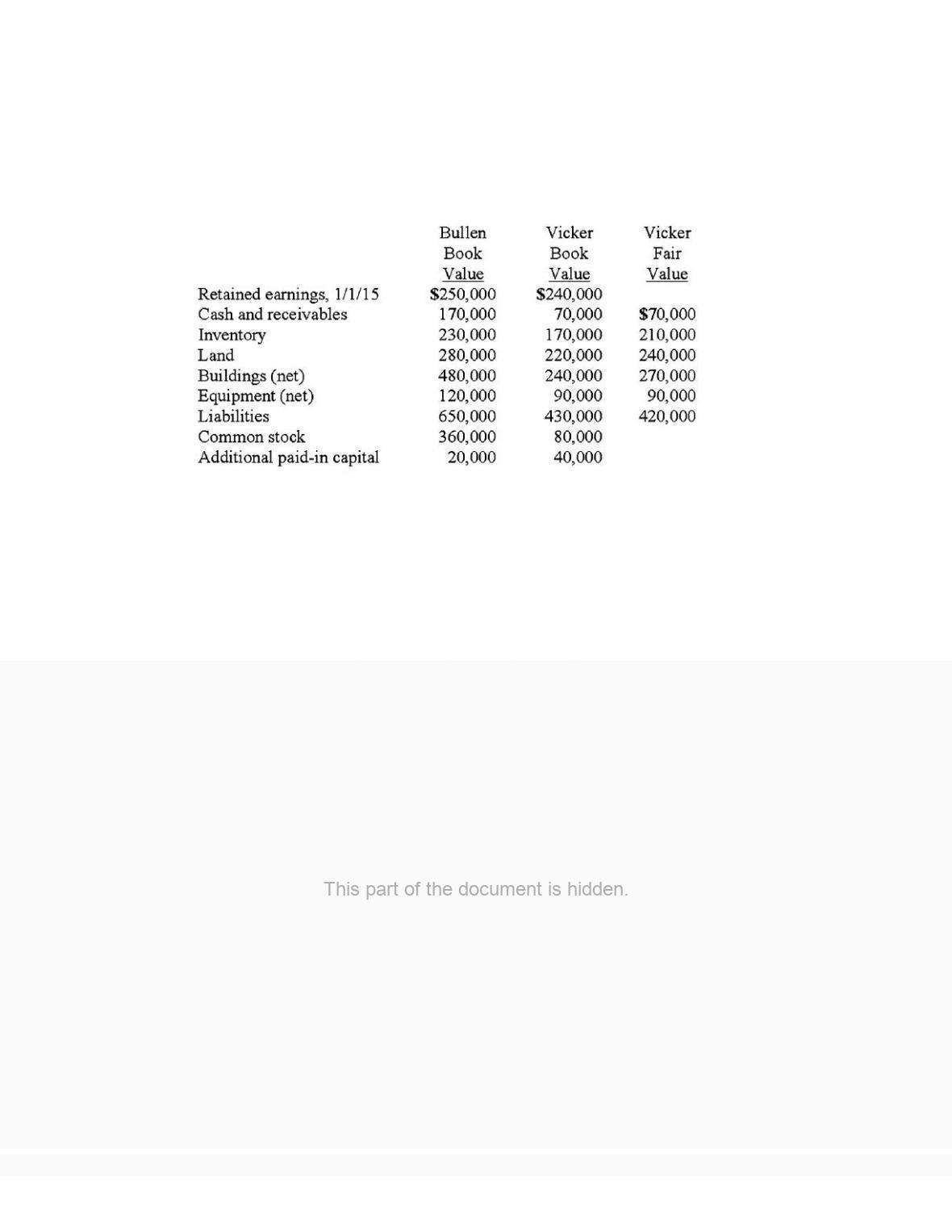
Bullen Inc. acquired 100% of the voting common stock of Vicker Inc. on January 1, 2013.
The book value and fair value of Vicker’s accounts on that date (prior to creating the
combination) follow, along with the book value of Bullen’s accounts:
Assume that Bullen issued 12,000 shares of common stock with a $5 par value and a $47
fair value to obtain all of Vicker’s outstanding stock. In this acquisition transaction, how
much goodwill should be recognized?
A.
$144,000.
B.
$104,000.
C.
$64,000.
D.
$60,000.
E.
$0.
$47 × 12,000 = $564,000 – ($80,000 + $40,000 + $240,000) = $204,000 – $100,000 =
$104,000
FV > BV: Inv +$40,000; Land +$20,000; +Blgs $30,000; +Liab $10,000 = $100,000

AACSB: Analytic
AICPA BB: Critical Thinking
AICPA FN: Measurement
Blooms: Apply
Difficulty: 2 Medium
Learning Objective: 02-04 Describe the valuation principles of the acquisition method.
Learning Objective: 02-05 Determine the total fair value of the consideration transferred for an acquisition and allocate
that fair value to specific subsidiary assets acquired (including goodwill); and liabilities assumed; or a gain on bargain
purchase.
Learning Objective: 02-06 Prepare the journal entry to consolidate the accounts of a subsidiary if dissolution takes place.
Learning Objective: 02-07 Prepare a worksheet to consolidate the accounts of two companies that form a business
combination if dissolution does not take place.
16.
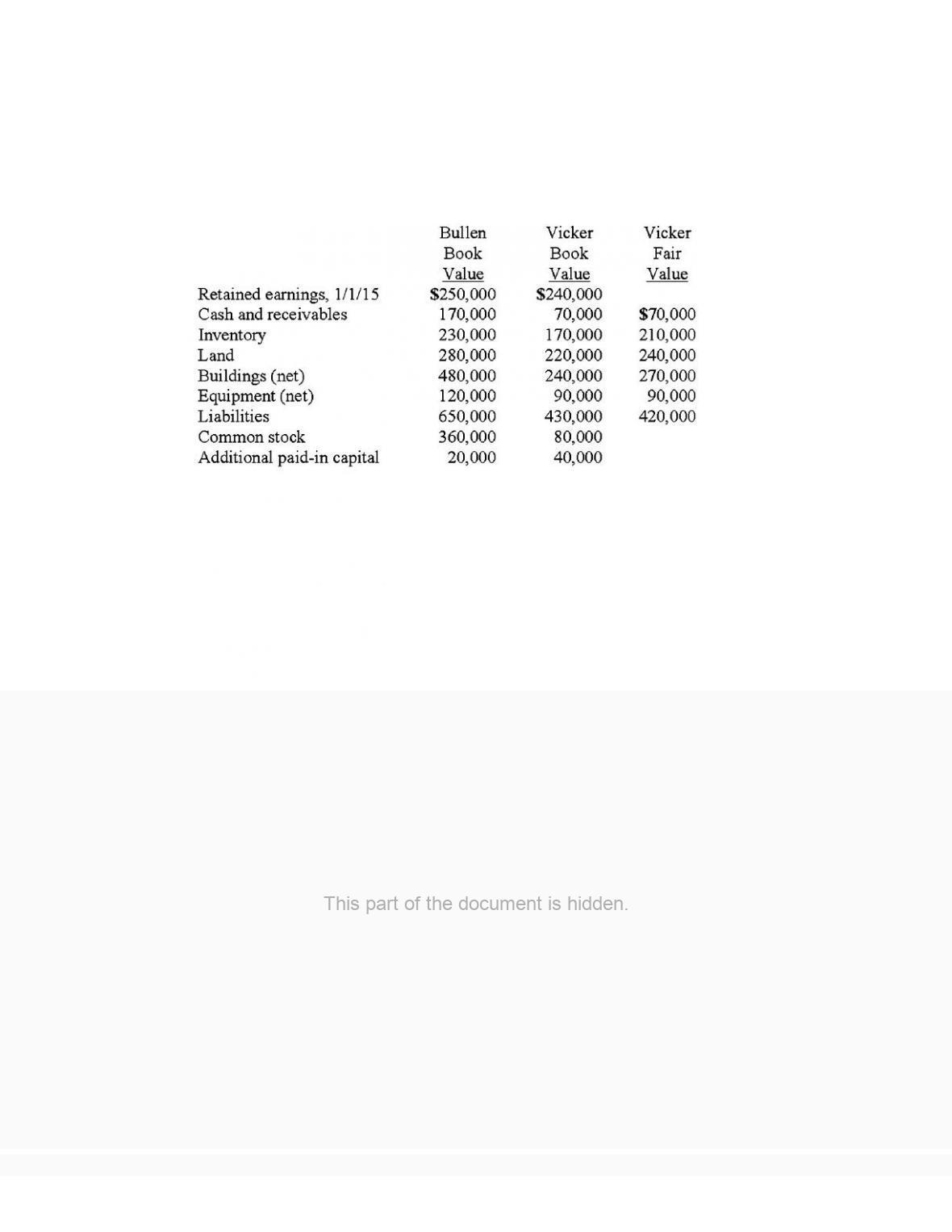
Bullen Inc. acquired 100% of the voting common stock of Vicker Inc. on January 1, 2013.
The book value and fair value of Vicker’s accounts on that date (prior to creating the
combination) follow, along with the book value of Bullen’s accounts:
Assume that Bullen issued 12,000 shares of common stock with a $5 par value and a $42
fair value for all of the outstanding stock of Vicker. What is the consolidated balance for
Land as a result of this acquisition transaction?
A.
$460,000.
B.
$510,000.
C.
$500,000.
D.
$520,000.
E.
$490,000.
$280,000 + $240,000 = $520,000

AACSB: Analytic
AICPA BB: Critical Thinking
AICPA FN: Measurement
Blooms: Apply
Difficulty: 2 Medium
Learning Objective: 02-05 Determine the total fair value of the consideration transferred for an acquisition and allocate
that fair value to specific subsidiary assets acquired (including goodwill); and liabilities assumed; or a gain on bargain
purchase.
Learning Objective: 02-06 Prepare the journal entry to consolidate the accounts of a subsidiary if dissolution takes place.
Learning Objective: 02-07 Prepare a worksheet to consolidate the accounts of two companies that form a business
combination if dissolution does not take place.
17.
Bullen Inc. acquired 100% of the voting common stock of Vicker Inc. on January 1, 2013.
The book value and fair value of Vicker’s accounts on that date (prior to creating the
combination) follow, along with the book value of Bullen’s accounts:
Assume that Bullen issued 12,000 shares of common stock with a $5 par value and a $42
fair value for all of the outstanding shares of Vicker. What will be the consolidated
Additional Paid-In Capital and Retained Earnings (January 1, 2013 balances) as a result of
this acquisition transaction?
A.
$60,000 and $490,000.
B.
$60,000 and $250,000.
C.
$380,000 and $250,000.
D.
$464,000 and $250,000.
E.
$464,000 and $420,000.
$20,000 + ($37 × 12,000) = $464,000 Add’l Paid-In Capital
$250,000 Parent’s R/E Only

AACSB: Analytic
AICPA BB: Critical Thinking
AICPA FN: Measurement
Blooms: Apply
Difficulty: 3 Hard
Learning Objective: 02-04 Describe the valuation principles of the acquisition method.
Learning Objective: 02-05 Determine the total fair value of the consideration transferred for an acquisition and allocate
that fair value to specific subsidiary assets acquired (including goodwill); and liabilities assumed; or a gain on bargain
purchase.
Learning Objective: 02-06 Prepare the journal entry to consolidate the accounts of a subsidiary if dissolution takes place.
Learning Objective: 02-07 Prepare a worksheet to consolidate the accounts of two companies that form a business
combination if dissolution does not take place.