Chapter 18 – Accounting for Not-for-Profit Entities
1. Reciprocal transfers where both parties give and receive something of value are
A) Donated supplies and materials.
B) Unconditional promises to give.
C) Endowment transactions.
D) Exchange transactions.
E) Required contributions.
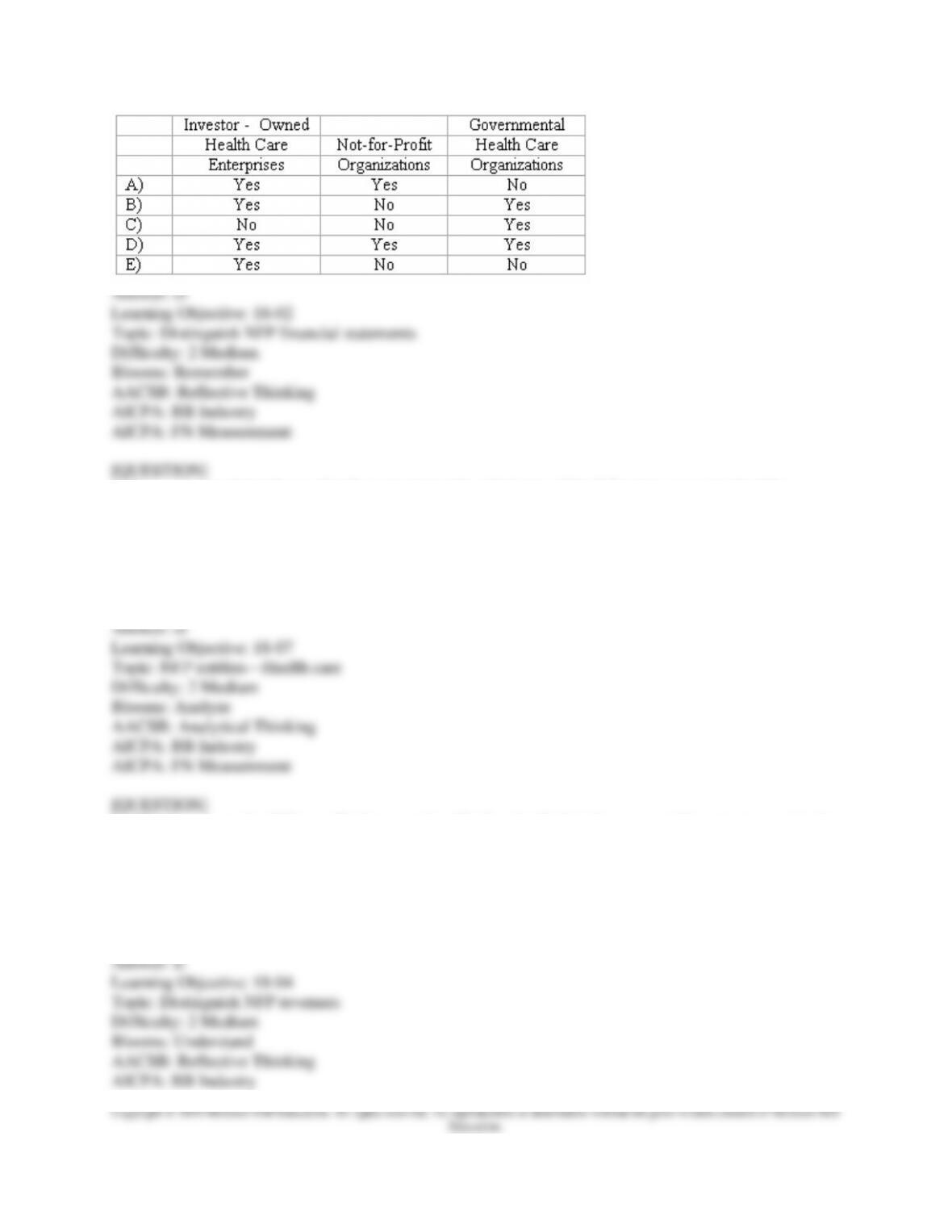
2. Which of the following types of health care entities follow FASB Accounting Standards Codification
for preparing financial statements?
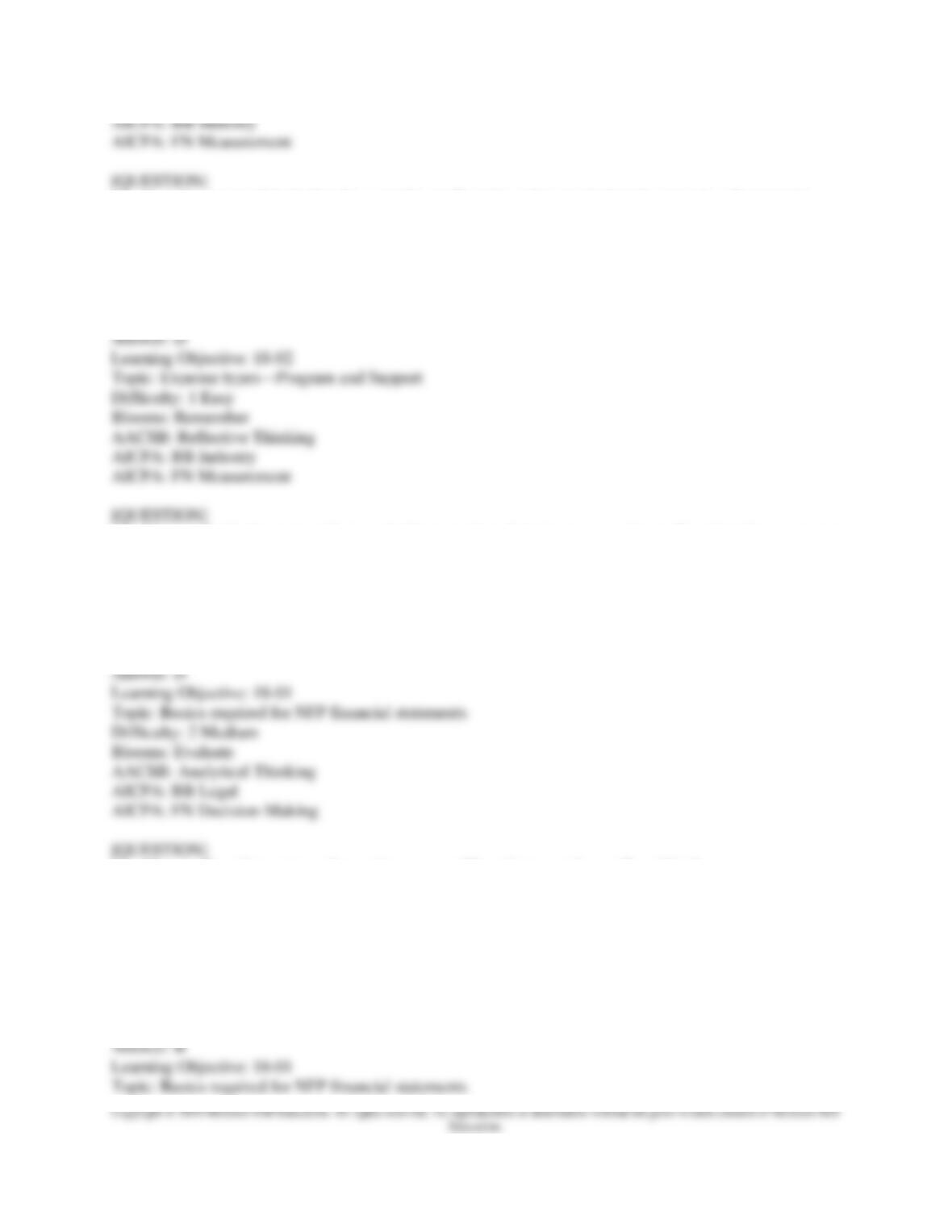
3. Which of the following types of health care entitys recognize depreciation expense?
4. In accruing patient charges for the current month, which one of the following accounts should a
hospital credit?
A) Accounts Payable.
B) Deferred Revenue.
C) Public Support Revenue.
D) Patient Service Revenues.
E) Accounts Receivable.
5. Which account should be credited to record a gift of cash which is from an outside party to an animal
rescue agency and is used for expenses to care for the animals?
A) Non-Operating Gain – Special Revenues.
B) Contractual Adjustments.
C) Patient Service Revenues.
D) Drugs and Medicines.
E) Unrestricted net assets – contributions.

6. Which one of the following financial statements is not required by GAAP regarding a voluntary health
and welfare entity?
A) Statement of Financial Position.
B) Statement of Functional Expenses.
C) Statement of Activities and Changes in Net Assets.
D) Statement of Cash Flows.
E) Statement of Operations.
7. Unconditional transfers of cash or other resources to an entity in a voluntary nonreciprocal transaction
is the GAAP definition of
A) Miscellaneous revenues.
B) Contributions.
C) Unconditional promises to give.
D) Exchange transactions.
E) Pledges.
8. Unconditional promises to transfer cash or other resources to an entity in a voluntary nonreciprocal
transaction is the GAAP definition of
A) Miscellaneous revenues.
B) Contributions.
C) Unconditional promises to give.
D) Exchange transactions.
E) Pledges.

9. Which of the following is a voluntary health and welfare entity?
A) A charity raising money for underprivileged children.
B) A nursing home.
C) A private medical school.
D) A hospital.
E) A preschool.
10. On a statement of functional expenses for a voluntary health and welfare entity, how are expenses
classified?
A) Health services expenses and operating expenses.
B) Program services expenses and administrative services expenses.
C) Program services expenses and supporting services expenses.
D) Operating expenses and supporting services expenses.
E) Operating expenses and administrative expenses.
11. On a Statement of Activities for a not-for-profit entity, what is the minimum required classification
for categories of expenses?
A) Fund-raising expenses and operating expenses.
B) Program services expenses and administrative services expenses.
C) Program services expenses and supporting services expenses.
D) Operating expenses and supporting services expenses.
E) Operating expenses and administrative expenses.
12. On a Statement of Activities for a not-for-profit entity, what are the broad categories of supporting
service costs required to be reported?
A) Fund-raising expenses and operating expenses.
B) Program services expenses and administrative services expenses.
C) Fund-raising expenses and supporting services expenses.
D) Fund-raising expenses and administrative expenses.
E) Operating expenses and administrative expenses.
13. When individuals are considering whether to make a donation to a not-for-profit entity, the answer to
which of the following questions is not typically sought?
A) Will donated funds be used effectively by the entity to accomplish its purpose?
B) Will the donated funds be wasted?
C) How much should this entity receive?
D) Is this entity profitable?
E) Is contributing to this charity a wise allocation of resources?
14. Historically, what pattern of reporting was used by private not-for-profit entities?
(1) The same as used with respect to for-profit entities.
(2) Reporting that utilizes a fund accounting approach.
(3) A pattern of reporting that does not consider the entire entity.
A) 1 only.
B) 2 only.
C) 1 and 2 only.
D) 1, 2 and 3.
E) 2 and 3 only.

15. Which of the following statements is required for voluntary health and welfare entities, but not for
other not-for-profit entities?
A) Statement of Activities and Changes in Net Assets.
B) Statement of Functional Expenses.
C) Statement of Financial Position.
D) Statement of Cash Flows.
E) Statement of Budget to Actual.
16. Prior to ASU 2016-14, what are the three categories of net assets required by GAAP in reporting of a
not-for-profit entity?
A) Unrestricted, Temporarily Restricted, and Permanently Restricted.
B) Unrestricted, Restricted, and Fund Balance.
C) Restricted, Permanently Restricted, and Fund Balance.
D) Unrestricted, Temporarily Restricted, and Fund Balance.
E) None of these answer choices are correct.
17. What is the basis of accounting used in reporting the Statement of Activities?
A) Cash basis.
B) Modified accrual basis.
C) Accrual basis.
D) Either cash basis or accrual basis, depending on the type of revenue.
E) Either modified accrual basis or accrual basis, depending on the type of revenue.
18. When are unconditional promises to give recognized as revenues?
A) In the period the promise is received.
B) In the period the promise is collected.
C) In the period in which the conditions upon which they are contingent are substantially met.
D) In the period in which the conditions upon which they are contingent have begun to be met.
E) Unconditional promises from potential donors are not revenues.
19. With respect to the donations received in 2016, what total amount should be recorded as an increase
to Temporarily Restricted Net Assets?
A) $ 2,000
B) $ 7,000
C) $12,000
D) $15,000
E) $17,000
20. With respect to the donations received in 2016, what amount should be reported in the Statement of
Activities as net increase to Temporarily Restricted Net Assets for the year 2016?
A) $ 2,000
B) $ 7,000
C) $12,000
D) $15,000
E) $17,000
21. What amount should be reclassified on the Statement of Activities for 2017 from the Temporarily
Restricted column to the Unrestricted column?
A) $ 2,000.
B) $ 5,000.
C) $ 7,000.
D) $10,000.
E) $12,000.
22. How are investments in equity securities with readily determinable market values, and their related

unrealized gains and losses, reported by a not-for-profit entity?
A) At lower of cost or market in the Statement of Financial Position, with unrealized losses in the
Statement of Activities.
B) At fair value in the Statement of Financial Position, with unrealized gains and losses in the Statement
of Activities.
C) At lower of cost or market in the Statement of Financial Position, with unrealized losses in
Temporarily Restricted Net Assets.
D) At original cost in the Statement of Financial Position, with unrealized gains and losses in the
Statement of Activities.
E) At original cost in the Statement of Financial Position, with unrealized gains and losses disclosed in
the notes to the financial statements.
23. Which statement below is not correct for financial statements of not-for-profit entities?
A) Pledged contributions are recognized in the accounting period in which pledged by donors.
B) A not-for-profit entity’s Statement of Financial Position includes a section specifically for net assets.
C) Contributed assets are recognized by a not-for-profit entity as public support contribution revenue.
D) Depreciation expense is not recognized by not-for-profit entities.
E) Not-for-profit entities issue a Statement of Activities.
24. A gift to a not-for-profit school that is not restricted by the donor is recorded with a credit to:
A) Fund Balance.
B) Deferred Revenues.
C) Contribution Revenues.
D) Non-Operating Revenues.
E) Encumbrances.

25. Which entry would be the correct entry on the donor’s books when the donor relinquishes control of
an asset, such as cash, which it contributes to a not-for-profit entity?
DEBIT CREDIT
A) Expense-charitable contribution Cash
B) Refundable advance to charity Cash
C) Charitable pledge Cash
D) Cash Liability to beneficiary
E) Cash Refundable advance
26. Which entry would be the correct entry on the donor’s books when the donor retains control of an
asset, such as cash, which it contributes to a not-for-profit entity?
DEBIT CREDIT
A) Expense-charitable contribution Cash
B) Refundable advance to charity Cash
C) Charitable pledge Cash
D) Cash Liability to beneficiary
E) Cash Refundable advance
27. Which entry would be the correct entry on the not-for-profit entity’s books to record a donor’s gift
when the money is simply passing through the not-for-profit entity, it creates no direct benefit, and
control of the assets has been relinquished by the donor?
DEBIT CREDIT

A) Expense-charitable contribution Cash
B) Refundable advance to charity Cash
C) Cash Liability to beneficiary
D) Cash Refundable advance
E) Cash Contribution revenue
28. Which entry would be the correct entry on the not-for-profit entity’s books to record a donor’s gift
when the donor retains power over the assets?
DEBIT CREDIT
A) Expense-charitable contribution Cash
B) Refundable advance to charity Cash
C) Cash Liability to beneficiary
D) Cash Refundable advance
E) Cash Contribution revenue
29. Which entry would be the correct entry to record pledges of $100,000 for a telethon event to raise
money for a not-for-profit public television station? The public television entity estimates that 5% of the
funds will be uncollectible.
DEBIT CREDIT
A) Pledges Receivable $100,000 Unrestricted net assets-contributions $100,000
B) Cash $100,000 Unrestricted net assets-contributions $100,000
C) Pledges Receivable $100,000 Unrestricted net assets-contributions $95,000
Allowance for uncollectible pledges $ 5,000
D) Pledges Receivable $95,000 Unrestricted net assets-contributions $100,000
Allowance for uncollectible
pledges $5,000
E) Cash $95,000 Unrestricted net assets-contributions $100,000
Allowance for uncollectible
pledges $5,000
30. Which entry would be the correct entry to record that a not-for-profit entity collected $80,000 of
amounts pledged and also wrote off $3,000 of amounts pledged that were previously estimated as
amounts uncollectible?
DEBIT CREDIT
A) Pledges Receivable $80,000 Cash $80,000
B) Cash $80,000 Pledges Receivable $80,000
C) Pledges Receivable $80,000 Allowance for uncollectible pledges 3,000
Cash $83,000
D) Cash $80,000 Pledges Receivable $83,000
Allowance for uncollectible
pledges $3,000
E) Cash $80,000 Unrestricted net assets-contributions $83,000
Allowance for uncollectible
pledges $3,000
31. In not-for-profit accounting, an acquisition occurs when one not-for-profit entity obtains:
A) Significant influence over another not-for-profit entity.
B) More than 50% of another not-for-profit entity’s fixed assets.
C) The right to collect more than 20% of pledged contributions.
D) Control over another not-for-profit entity.
E) None of these answer choices are correct. An acquisition can only occur for profit-oriented entities.
32. If the total acquisition value of an acquired not-for-profit entity is greater than the fair value of all
identifiable net assets of the entity, and that entity’s revenues are not generated by rendering goods or
services or from membership dues, then the excess of acquisition value over identifiable net assets is
immediately reported:
A) As goodwill on the consolidated Statement of Position.
B) As a pro-rata increase to the identifiable assets and liabilities acquired.
C) As a direct reduction in unrestricted net assets on the Statement of Financial Position.
D) As a reduction in unrestricted net assets on the Statement of Activities.
E) As an increase in other assets on the Statement of Financial Position.
33. When an acquisition occurs in not-for-profit accounting, recognition of goodwill depends on:
A) Whether control has been achieved by the acquiring not-for-profit entity.
B) Whether the acquired not-for-profit entity has the ability to generate significant amounts of revenue
from providing goods or services or from membership fees, or whether it is expected to generate
primarily contribution and investment revenue in the future.
C) Whether the acquired not-for-profit entity has the ability to generate significant amounts of revenues
from goods or services or membership fees, as well as significant amounts of contribution revenues in the
future.
D) Whether the acquired not-for-profit entity has a history of generating significant revenues of any type.
E) None of these answer choices are correct. Goodwill can only be recognized in an acquisition of a for-
profit entity.
34. Which of the following is not true about a merger of two not-for-profit entities?
A) The two entities will continue to legally exist but there will be a new governing board.
B) Neither entity is considered to be acquired.
C) Identifiable assets and liabilities are not adjusted to their fair values at the date of the merger.
D) The two entities will together form an entirely new entity with a new governing board.
E) There will be no acquisition value or goodwill determination.
35. Which entry would be the correct entry to record that a hospital has provided patient services for
$200,000, of which 25% will be billed to a third party?
DEBIT CREDIT
A) Accounts Receivable-Patients $200,000 Patient Service Revenue $200,000
B) Accounts Receivable-Patients $150,000 Patient Service Revenue $200,000
Accounts Receivable-Third Party $50,000
C) Accounts Receivable-Patients $50,000 Accounts Receivable-Third Party $150,000
Patient Service Revenue $200,000
D) Accounts Receivable-Patients $200,000 Patient Service Revenue $50,000
Accounts Receivable – Third Party $150,000
E) Patient Service Revenue $200,000 Accounts Receivable-Patients $150,000
Accounts Receivable-Third Party $50,000
36. What is the appropriate account to debit when reducing net patient service revenue as a result of
arrangements with third party payors?
A) Contractual Adjustments.
B) Allowance for uncollectible and reduced accounts.
C) Patient Service Revenues.
D) Account Receivable-Patients.
E) Accounts Receivable-Third Party.

37. What is the appropriate account to credit when estimating a portion of health care entity’s receivables
that will prove to be uncollectible?
A) Bad Debt Expense.
B) Allowance for Uncollectible Accounts.
C) Patient Service Revenues.
D) Accounts Receivable.
E) Contractual Adjustments.
38. Not-for-profit entities that are eligible to obtain tax-exempt status under Internal Revenue Code
section 501(c)(4) are
A) Those promoting literacy.
B) Those promoting scientific research.
C) Chambers of Commerce.
D) Professional sports leagues.
E) Those functioning exclusively to promote social welfare.
39. Which of the following topics are not included in the Form 990 which tax-exempt entities file to
maintain their tax-exempt status?
A) Compensation of Officers, Directors, Trustees, Key Employees, Highest Compensated Employees and
Independent Contractors.
B) Donor Disclosure: Identification of Every Donor by Name, Contribution Value & Contribution Type.
C) Statement of Revenue.
D) Balance Sheet.
E) Statement of Functional Expenses.