Topic: Statement of liquidation―Deficit balance
Topic: Schedule of liquidation―Safe capital balances
Topic: Predistribution plan―Order of available cash
37. What is the role of the accountant during the liquidation process?
38. The partnership of Rayne, Marin, and Fulton was being liquidated by the partners. Rayne
was insolvent and did not have enough assets to pay all his personal creditors. Under what
conditions might Rayne’s personal creditors have claimed some of the partnership assets?
39. The Arnold, Bates, Carlton, and Delbert partnership was liquidating. It had paid all its
liabilities and had some assets yet to be sold. The partners had capital account balances of
($50,000), $90,000, $110,000, and $130,000. There was $40,000 cash available for distribution
to the partners. What procedures would be followed to determine the amount of cash that could
safely be distributed to each partner?
Copyright © 2017 McGraw-Hill Education. All rights reserved. No reproduction or distribution without the prior written consent of
McGraw-Hill Education.
Page 15-22
Topic: Statement of liquidation―Deficit balance
Difficulty: 2 Medium
Blooms: Understand
AACSB: Communication
AICPA: BB Legal
AICPA: FN Measurement
[QUESTION]
40. Xygote, Yen, and Zen were partners who were liquidating their partnership. Each partner has
a deficit balance in their respective capital account. Assuming all assets from the partnership
have been liquidated, and all of the liabilities have been paid, how should any additional cash
coming into the partnership be distributed to the partners?
41. What is the purpose of a predistribution plan?
42. What financial report would be prepared for a partnership that has begun liquidation but has
not yet completed the process? What is the purpose of this report?
Copyright © 2017 McGraw-Hill Education. All rights reserved. No reproduction or distribution without the prior written consent of
McGraw-Hill Education.
Page 15-23
Topic: Partnership termination and liquidation―General
Topic: Statement of liquidation―Updated balances
Difficulty: 2 Medium
Blooms: Remember
AACSB: Communication
AICPA: BB Legal
AICPA: FN Measurement
[QUESTION]
43. What events or circumstances might force the termination of a partnership and liquidation of
its assets?
44. Describe the content of a journal entry to record a gain or loss resulting from the liquidation
of a partnership asset for cash.
45. What should occur when a solvent partner has a deficit balance?
Copyright © 2017 McGraw-Hill Education. All rights reserved. No reproduction or distribution without the prior written consent of
McGraw-Hill Education.
Page 15-24
Topic: Partner deficit balance―General
Difficulty: 1 Easy
Blooms: Remember
AACSB: Reflective Thinking
AICPA: BB Legal
AICPA: FN Measurement
[QUESTION]
46. Why is a preliminary distribution of partnership assets prepared?
47. What is a safe cash payment?
48. The Albert, Boynton, and Creamer partnership was in the process of liquidating its assets and
going out of business. Albert, Boynton, and Creamer had capital account balances of $80,000,
$120,000, and $200,000, respectively, and shared profits and losses in the ratio of 1:3:2.
Equipment that had cost $90,000 and had a book value of $60,000 was sold for $24,000 cash.
Required:
Prepare the appropriate journal entry to record the sale of the equipment, distributing any gain or
loss directly to the partners.
Copyright © 2017 McGraw-Hill Education. All rights reserved. No reproduction or distribution without the prior written consent of
McGraw-Hill Education.
Page 15-25
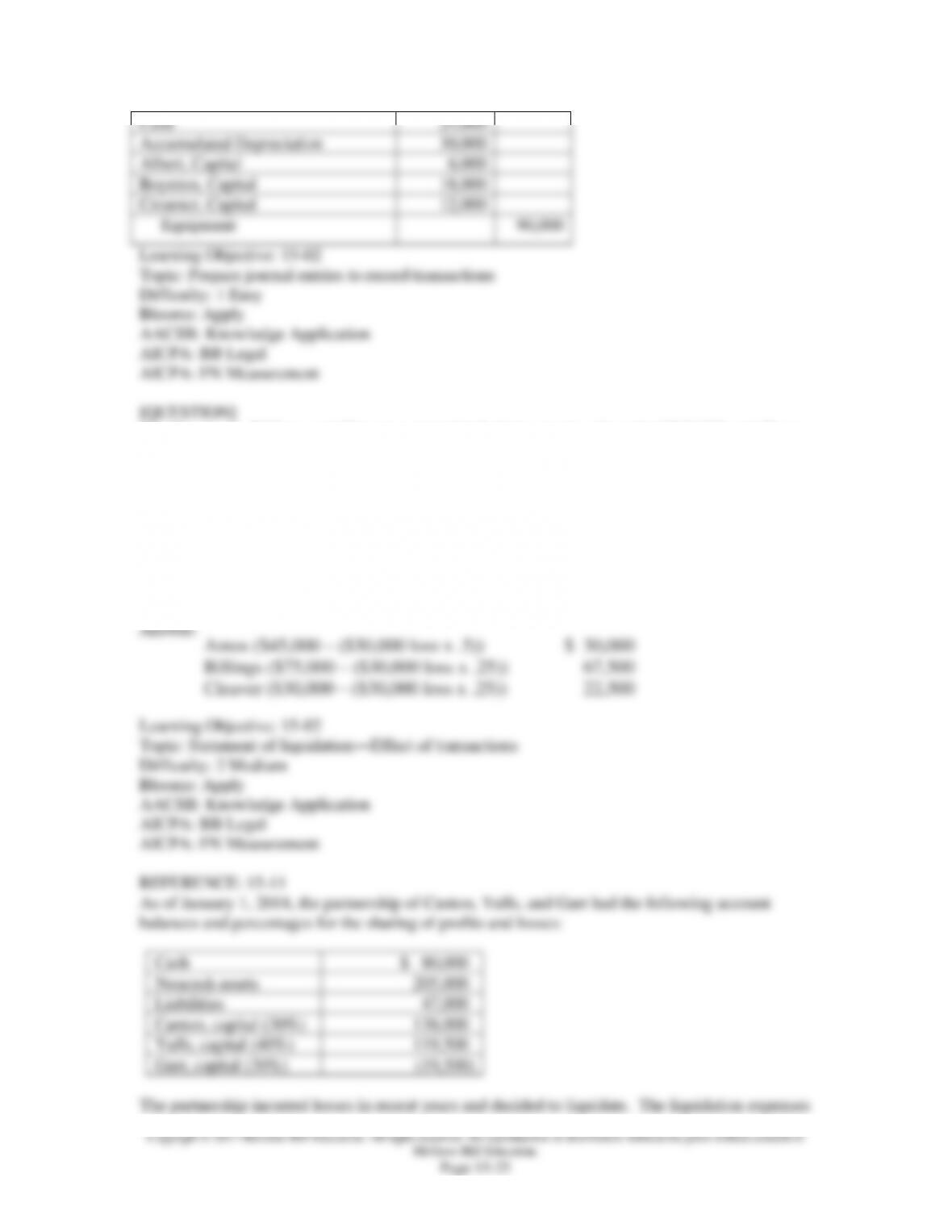
Cash
24,000
Accumulated Depreciation
30,000
Albert, Capital
6,000
Boynton, Capital
18,000
Creamer, Capital
12,000
Equipment
90,000
Learning Objective: 15-02
Topic: Prepare journal entries to record transactions
Difficulty: 1 Easy
Blooms: Apply
AACSB: Knowledge Application
AICPA: BB Legal
AICPA: FN Measurement
[QUESTION]
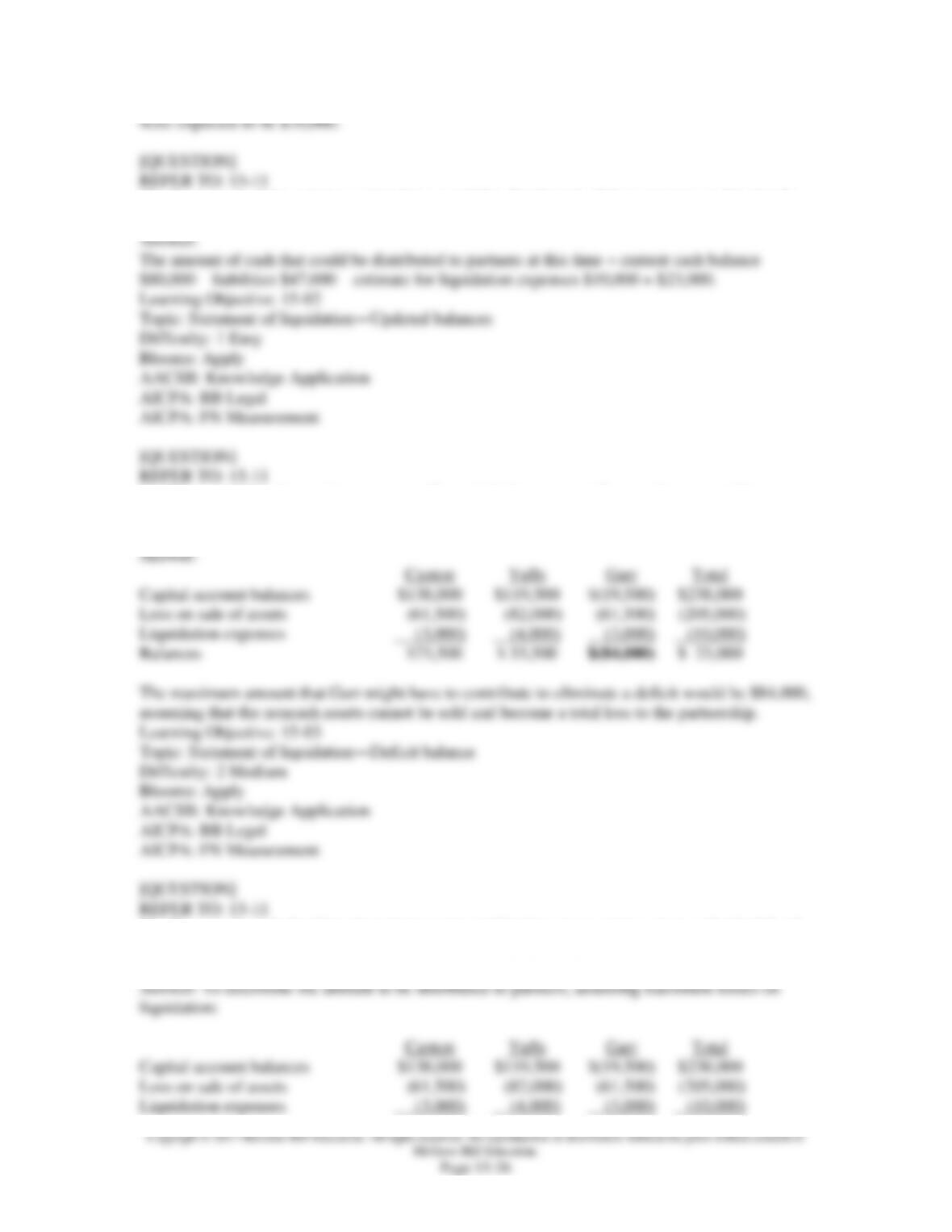
49. The Amos, Billings, and Cleaver partnership had two assets: (1) cash of $40,000 and (2) an
investment with a book value of $110,000. The ratio for sharing profits and losses is 2:1:1. The
balances in the capital accounts were:
Amos, capital: $45,000
Billings, capital: $75,000
Cleaver, capital: $30,000
Required:
If the investment was sold for $80,000, how much cash would each partner receive upon
liquidation?
Cash
$ 80,000
Noncash assets
205,000
Liabilities
47,000
Canton, capital (30%)
138,000
Yulls, capital (40%)
119,500
Garr, capital (30%)
were expected to be $10,000.
[QUESTION]
REFER TO: 15-11
50. How much of the existing cash balance could be distributed safely to partners at this time?
51. What would be the maximum amount Garr might have to contribute to the partnership to
eliminate a deficit balance in his account?
52. How much cash should each partner receive at this time, pursuant to a proposed schedule of
liquidation?
Copyright © 2017 McGraw-Hill Education. All rights reserved. No reproduction or distribution without the prior written consent of
McGraw-Hill Education.
Page 15-27
Balances
$73,500
$ 33,500
$(84,000)
$ 23,000
Allocation of deficit
(36,000)
(48,000)
84,000
0
Balances
$ 37,500
$(14,500)
$ 0
$ 23,000
Allocation of deficit
(14,500)
14,500
_______
______
Safe balance
$ 23,000
$ 0
$ 0
$ 23,000
The entire $23,000 should be distributed to Canton.
Learning Objective: 15-03
Learning Objective: 15-04
Topic: Safe payments―Allocate potential loss―Deficit
Topic: Schedule of liquidation―Safe capital balances
Difficulty: 2 Medium
Blooms: Apply
AACSB: Knowledge Application
AICPA: BB Legal
AICPA: FN Measurement
[QUESTION]
REFER TO: 15-11
53. If the noncash assets are sold for $105,000, what would be the maximum amount of cash that
Canton could expect to receive?
54. A partnership had the following account balances: Cash, $91,000; Other Assets, $702,000;
Liabilities, $338,000; Polk, Capital (50% of profits and losses), $221,000; Garfield, Capital
(30%), $143,000; Arthur, Capital (20%), $91,000. The company liquidated and $10,400 became
available to the partners.
Required:
Who would have received the $10,400?
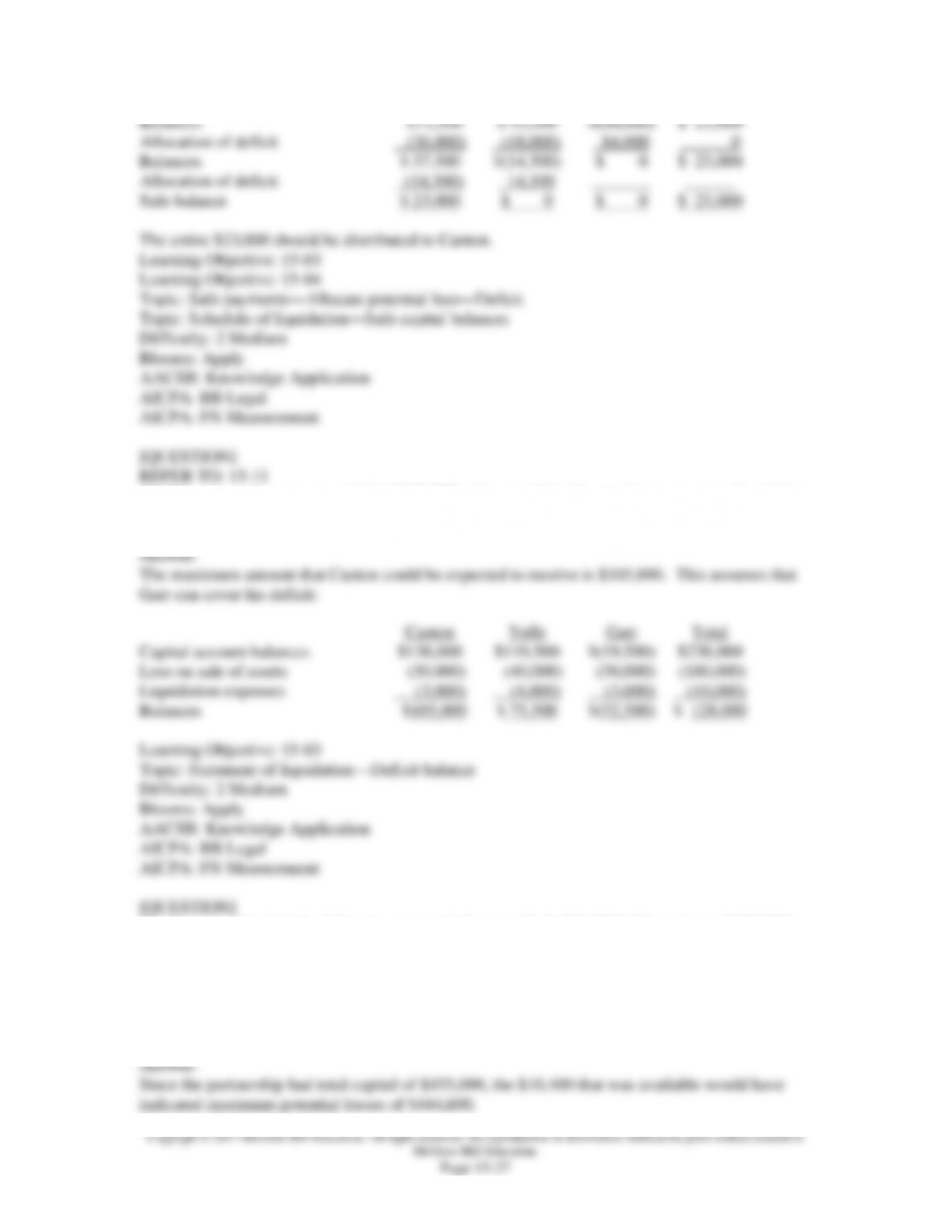
Canton
Capital account balances
$138,000
$119,500
$(19,500)
$238,000
Loss on sale of assets
(30,000)
(40,000)
(30,000)
(100,000)
Liquidation expenses
(3,000)
(4,000)
(3,000)
(10,000)
Balances
$105,000
$ 75,500
$(52,500)
$ 128,000
Learning Objective: 15-03
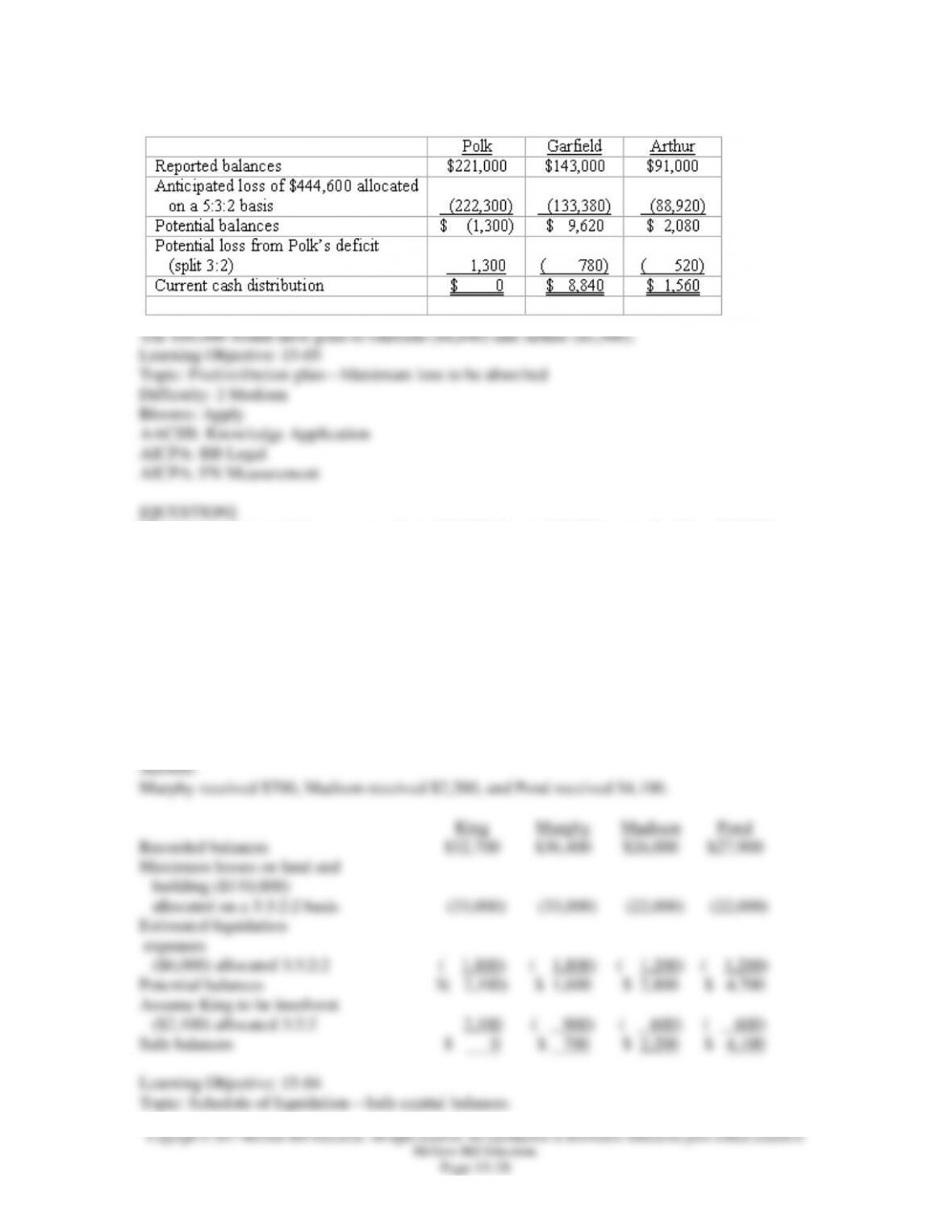
55. A partnership held three assets: Cash, $13,000; Land, $45,000; and a Building, $65,000.
There were no recorded liabilities. The partners anticipated that expenses required to liquidate
their partnership would amount to $6,000. Capital account balances were as follows:
King, Capital: $32,700
Murphy, Capital: 36,400
Madison, Capital: 26,000
Pond, Capital: 27,900
The partners shared profits and losses 30:30:20:20, respectively.
Required:
Prepare a proposed schedule of liquidation, showing how cash could be safely distributed to the
partners at this time.
Copyright © 2017 McGraw-Hill Education. All rights reserved. No reproduction or distribution without the prior written consent of
McGraw-Hill Education.
Page 15-29
Difficulty: 2 Medium
Blooms: Apply
AACSB: Knowledge Application
AICPA: BB Legal
AICPA: FN Measurement
REFERENCE: 15-12
On January 1, 2018, the partners of Won, Cadel, and Dax (who shared profits and losses in the
ratio of 5:3:2, respectively) decided to liquidate their partnership. The trial balance at this date
was as follows:
Debit
Credit
Cash
$ 23,400
Accounts Receivable
85,800
Inventory
67,600
Machinery and equipment, net
245,700
Won, loan
39,000
Accounts payable
$ 68,900
Cadel, loan
26,000
Won, capital
153,400
Cadel, capital
117,000
Dax, capital
96,200
Totals
$ 461,500
$ 461,500
The partners planned an installment program to dispose of the business assets and to minimize
liquidation losses. All available cash, less an amount retained to provide for future expenses, was
to be distributed to the partners at the end of each month. A summary of liquidation transactions
follows:
January
$66,300 was collected on the accounts receivable; the balance was deemed to
be uncollectible.
$49,400 was received for the entire inventory.
$2,600 in liquidation expenses were paid.
$65,000 was paid to outside creditors, after receiving a $3,900 credit memo
from a creditor on January 11.
Cash of $13,000 was retained at the end of the month to cover unrecorded
liabilities and anticipated expenses. The balance of cash was distributed to
the partners.
February
$3,900 in liquidation expenses were paid.
$7,800 in cash was retained at the end of the month to cover unrecorded
liabilities and anticipated expenses.
March
$189,800 was received on the sale of all machinery and equipment.
$6,500 in final liquidation expenses were paid.
No cash was retained as all cash was distributed to partners.
[QUESTION]
REFER TO: 15-12
56. Prepare a schedule to calculate the safe payments to be made to the partners at the end of
January.
Copyright © 2017 McGraw-Hill Education. All rights reserved. No reproduction or distribution without the prior written consent of
McGraw-Hill Education.
Page 15-30
Answer:
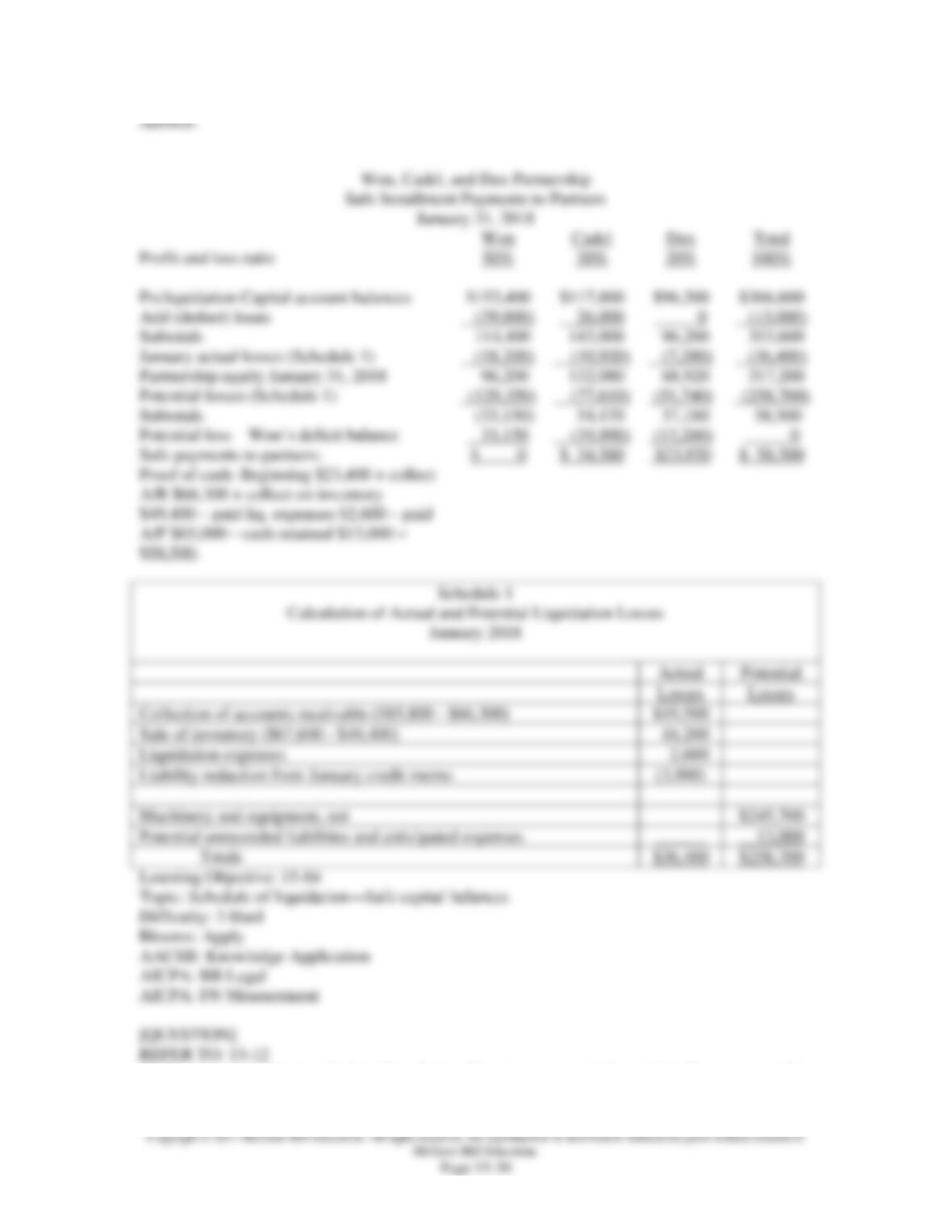
Won, Cadel, and Dax Partnership
Safe Installment Payments to Partners
January 31, 2018
Won
Cadel
Dax
Total
Profit and loss ratio
50%
30%
20%
100%
Preliquidation Capital account balances
$153,400
$117,000
$96,200
$366,600
Add (deduct) loans
(39,000)
26,000
0
(13,000)
Subtotals
114,400
143,000
96,200
353,600
January actual losses (Schedule 1)
(18,200)
(10,920)
(7,280)
(36,400)
Partnership equity January 31, 2018
96,200
132,080
88,920
317,200
Potential losses (Schedule 1)
(129,350)
(77,610)
(51,740)
(258,700)
Subtotals
(33,150)
54,470
37,180
58,500
Potential loss – Won’s deficit balance
33,150
(19,890)
(13,260)
0
Safe payments to partners:
$ 0
$ 34,580
$23,920
$ 58,500
Proof of cash: Beginning $23,400 + collect
A/R $66,300 + collect on inventory
$49,400 – paid liq. expenses $2,600 – paid
A/P $65,000 – cash retained $13,000 =
$58,500.
Schedule 1
Calculation of Actual and Potential Liquidation Losses
January 2018
Actual
Potential
Losses
Losses
Collection of accounts receivable ($85,800 – $66,300)
$19,500
Sale of inventory ($67,600 – $49,400)
18,200
Liquidation expenses
2,600
Liability reduction from January credit memo
(3,900)
Machinery and equipment, net
$245,700
Potential unrecorded liabilities and anticipated expenses
______
13,000
Totals
$36,400
$258,700
Learning Objective: 15-04
Topic: Schedule of liquidation―Safe capital balances
Difficulty: 3 Hard
Blooms: Apply
AACSB: Knowledge Application
AICPA: BB Legal
AICPA: FN Measurement
[QUESTION]
REFER TO: 15-12
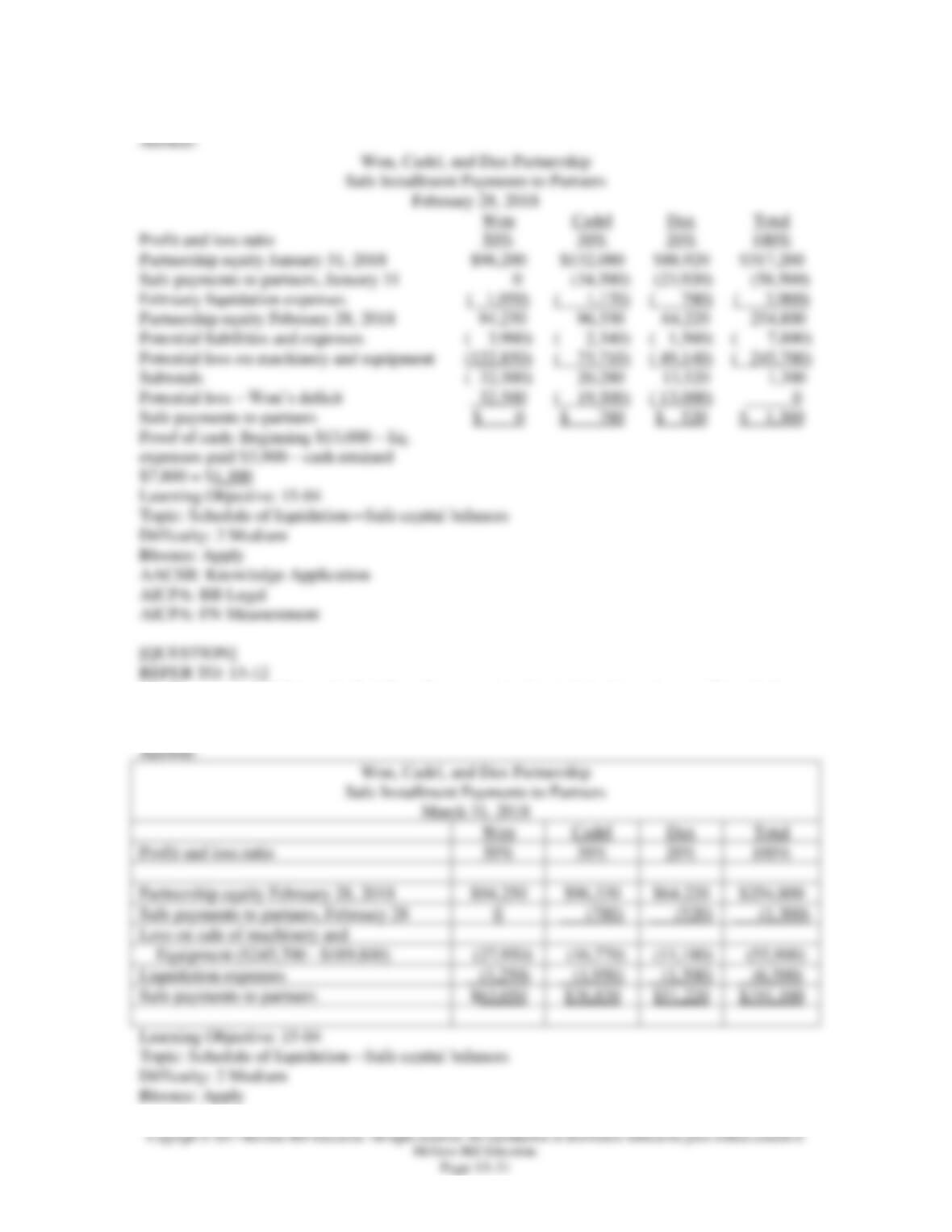
57. Prepare a schedule to calculate the safe installment payments to be made to the partners at the
end of February.
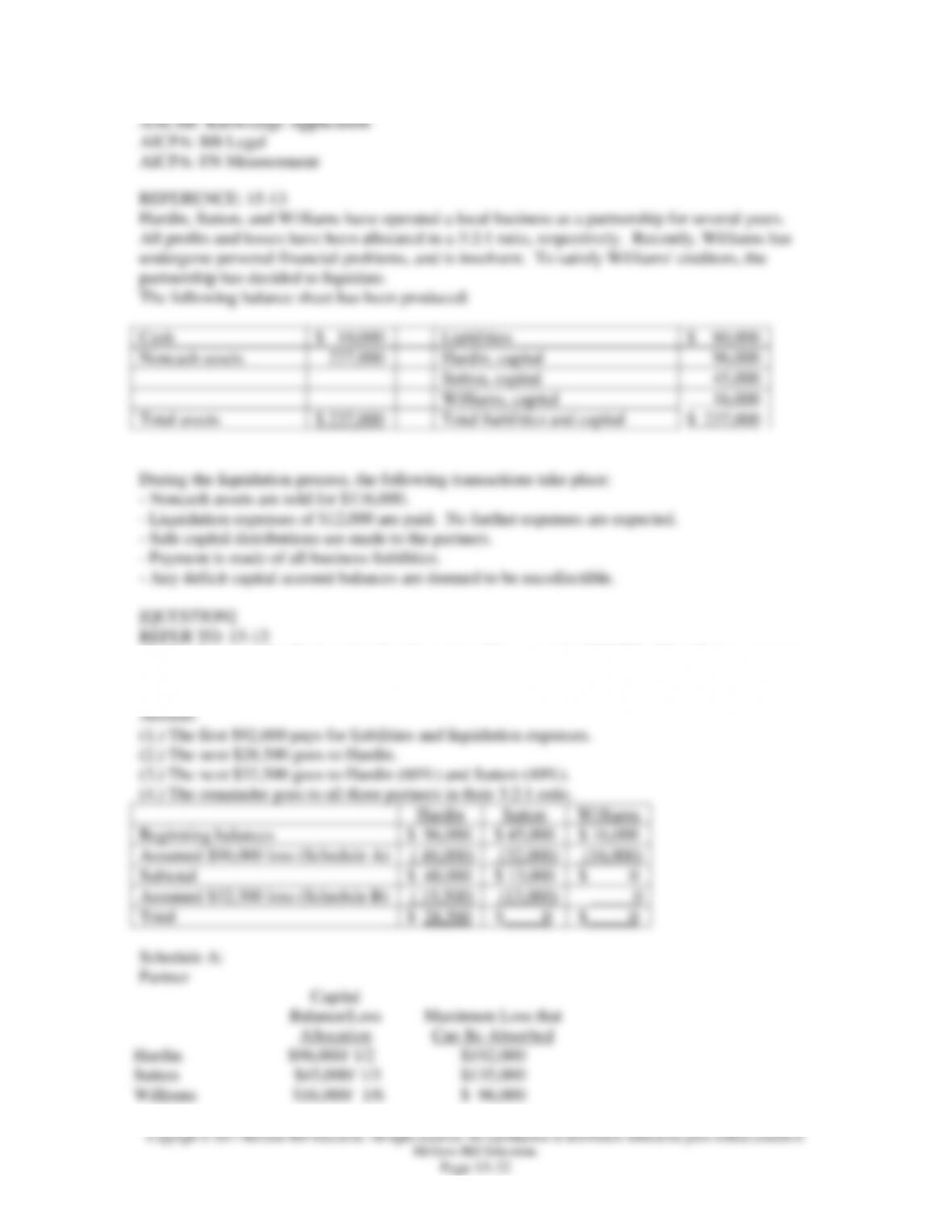
58. Prepare a schedule to calculate the safe payments to be made to the partners at the end of
March.
AACSB: Knowledge Application
AICPA: BB Legal
AICPA: FN Measurement
REFERENCE: 15-13
Hardin, Sutton, and Williams have operated a local business as a partnership for several years.
All profits and losses have been allocated in a 3:2:1 ratio, respectively. Recently, Williams has
undergone personal financial problems, and is insolvent. To satisfy Williams’ creditors, the
partnership has decided to liquidate.
The following balance sheet has been produced:
Cash
$ 10,000
Liabilities
$ 80,000
Noncash assets
227,000
Hardin, capital
96,000
Sutton, capital
45,000
Williams, capital
16,000
Total assets
$ 237,000
Total liabilities and capital
$ 237,000
During the liquidation process, the following transactions take place:
– Noncash assets are sold for $116,000.
– Liquidation expenses of $12,000 are paid. No further expenses are expected.
– Safe capital distributions are made to the partners.
– Payment is made of all business liabilities.
– Any deficit capital account balances are deemed to be uncollectible.
[QUESTION]
REFER TO: 15-13
59. Develop a predistribution plan for this partnership, assuming $12,000 of liquidation expenses
are expected to be paid.
Beginning balances
$ 96,000
Assumed $96,000 loss (Schedule A)
( 48,000)
(32,000)
(16,000)
Subtotal
$ 48,000
Total
$ 28,500
$ 0
Hardin
$96,000/ 1/2
Williams
$16,000/ 1/6
60. Compute safe cash payments after the noncash assets have been sold and the liquidation
expenses have been paid.
61. Prepare journal entries to record the actual liquidation transactions.
Copyright © 2017 McGraw-Hill Education. All rights reserved. No reproduction or distribution without the prior written consent of
McGraw-Hill Education.
Page 15-34
Noncash assets
227,000
Hardin, capital
6,000
Sutton, capital
4,000
Williams capital
2,000
Cash
12,000
Hardin, capital
31,800
Sutton, capital
2,200
Cash
34,000
Liabilities
80,000
Cash
80,000
Hardin, capital
$ 2,700
Sutton, capital
1,800
Williams, capital
$ 4,500
Learning Objective: 15-02
Topic: Prepare journal entries to record transactions
Difficulty: 2 Medium
Blooms: Apply
AACSB: Knowledge Application
AICPA: BB Legal
AICPA: FN Measurement
[QUESTION]
62. Jones, Marge, and Tate LLP decided to dissolve and liquidate the partnership on September
30, 2018. After realization of a portion of the noncash assets, the capital account balances were
Jones $50,000; Marge $40,000; and Tate $15,000. Cash of $35,000 and other assets with a
carrying amount of $100,000 were on hand. Creditors’ claims totaled $30,000. Jones, Marge, and
Tate shared net income and losses in a 2:1:1 ratio, respectively.
Prepare a working paper to compute the amount of cash that may be paid to creditors and to
partners at this time, assuming that no partner is solvent.
Topic: Schedule of liquidation―Safe capital balances
Difficulty: 2 Medium
Blooms: Apply
AACSB: Knowledge Application
AICPA: BB Legal
AICPA: FN Measurement
REFERENCE: 15-14
The balance sheet of Rogers, Dennis & Berry LLP prior to liquidation included the following:
The three partners shared net income and losses in a 5:3:2 ratio, respectively. Noncash assets
were sold for $60,000. Creditors were paid in full, partners were paid $35,000, and the balance of
cash was retained pending future developments.
[QUESTION]
REFER TO: 15-14
63. Record the journal entry for the sale of the noncash assets.
64. Record the journal entry for payment of outstanding liabilities to the creditors.
Copyright © 2017 McGraw-Hill Education. All rights reserved. No reproduction or distribution without the prior written consent of
McGraw-Hill Education.
Page 15-36
Learning Objective: 15-02
Topic: Prepare journal entries to record transactions
Difficulty: 1 Easy
Blooms: Apply
AACSB: Knowledge Application
AICPA: BB Legal
AICPA: FN Measurement
[QUESTION]
REFER TO: 15-14
65. Determine the cash to be retained and prepare a schedule to distribute $35,000 cash to the
partners.
66. Record the journal entry for the cash distribution to the partners.
AACSB: Knowledge Application
AICPA: BB Legal
AICPA: FN Measurement
REFERENCE: 15-15
The partners of Donald, Chief & Berry LLP decided to liquidate on August 1, 2018. The balance
sheet of the partnership is as follows, with the profit and loss ratio of 25%, 45%, and 30%,
respectively. The partners do not expect to incur further liquidation expenses.
DONALD, CHIEF, & BERRY LLP
Balance Sheet
August 1, 2018
Assets
Liabilities & Partners’ Capital
Cash
$ 60,000
Trade accounts payable
$130,000
Loan receivable from Donald
40,000
Loan payable to Chief
60,000
Other assets
500,000
Donald, capital
140,000
Chief, capital
160,000
_______
Berry, capital
110,000
Total
$600,000
Total
$600,000
A portion of the Other Assets with a carrying amount of $200,000 were sold for $140,000, and all
available cash was distributed.
[QUESTION]
REFER TO: 15-15
67. Prepare the journal entry for Donald, Chief & Berry LLP on August 1, 2018, to recognize
proceeds from the sale of Other Assets.
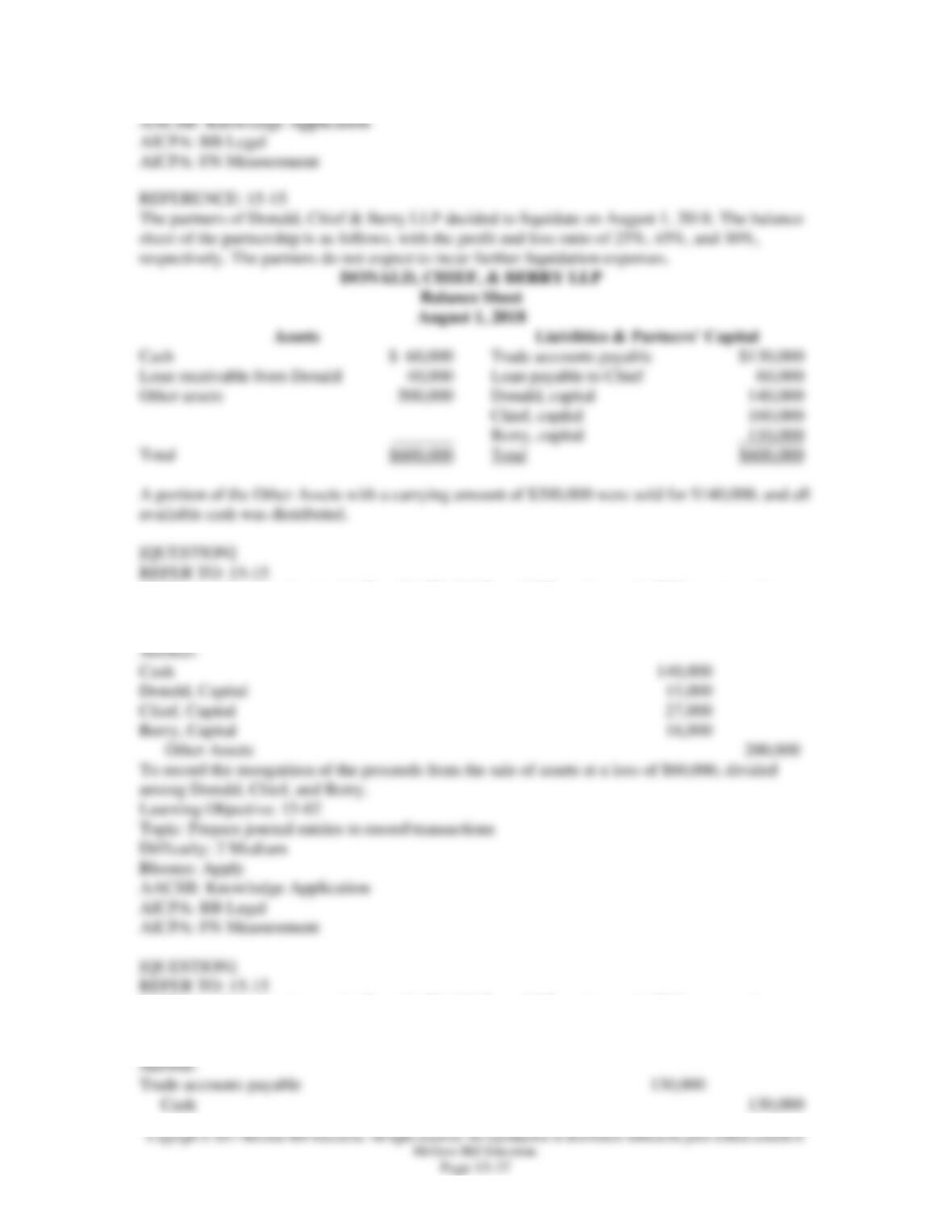
Cash
Donald, Capital
Chief, Capital
Berry, Capital
Other Assets
among Donald, Chief, and Berry.
68. Prepare the journal entry for Donald, Chief & Berry LLP on August 1, 2018, to record
payment of liabilities.
Cash
Copyright © 2017 McGraw-Hill Education. All rights reserved. No reproduction or distribution without the prior written consent of
McGraw-Hill Education.
Page 15-38
To record payment of liabilities.
Learning Objective: 15-02
Topic: Prepare journal entries to record transactions
Difficulty: 1 Easy
Blooms: Apply
AACSB: Knowledge Application
AICPA: BB Legal
AICPA: FN Measurement
[QUESTION]
REFER TO: 15-15
69. Prepare the journal entry for Donald, Chief & Berry LLP on August 1, 2018, to record the
offset of the loan receivable from Donald.
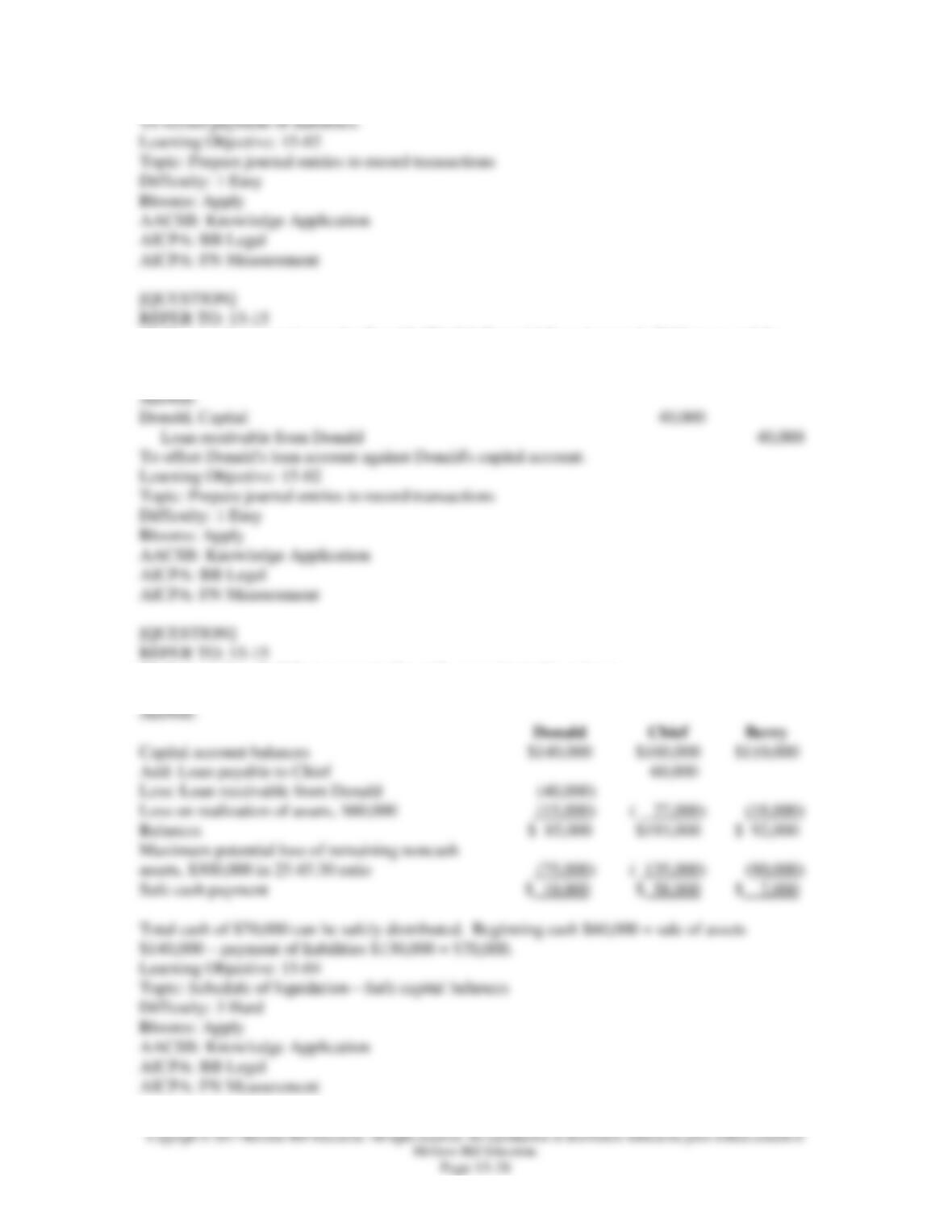
70. Prepare the schedule to compute the cash payments to the partners.
Capital account balances
Less: Loan receivable from Donald
Balances
Safe cash payment
$ 10,000
Loan receivable from Donald
To offset Donald’s loan account against Donald’s capital account.