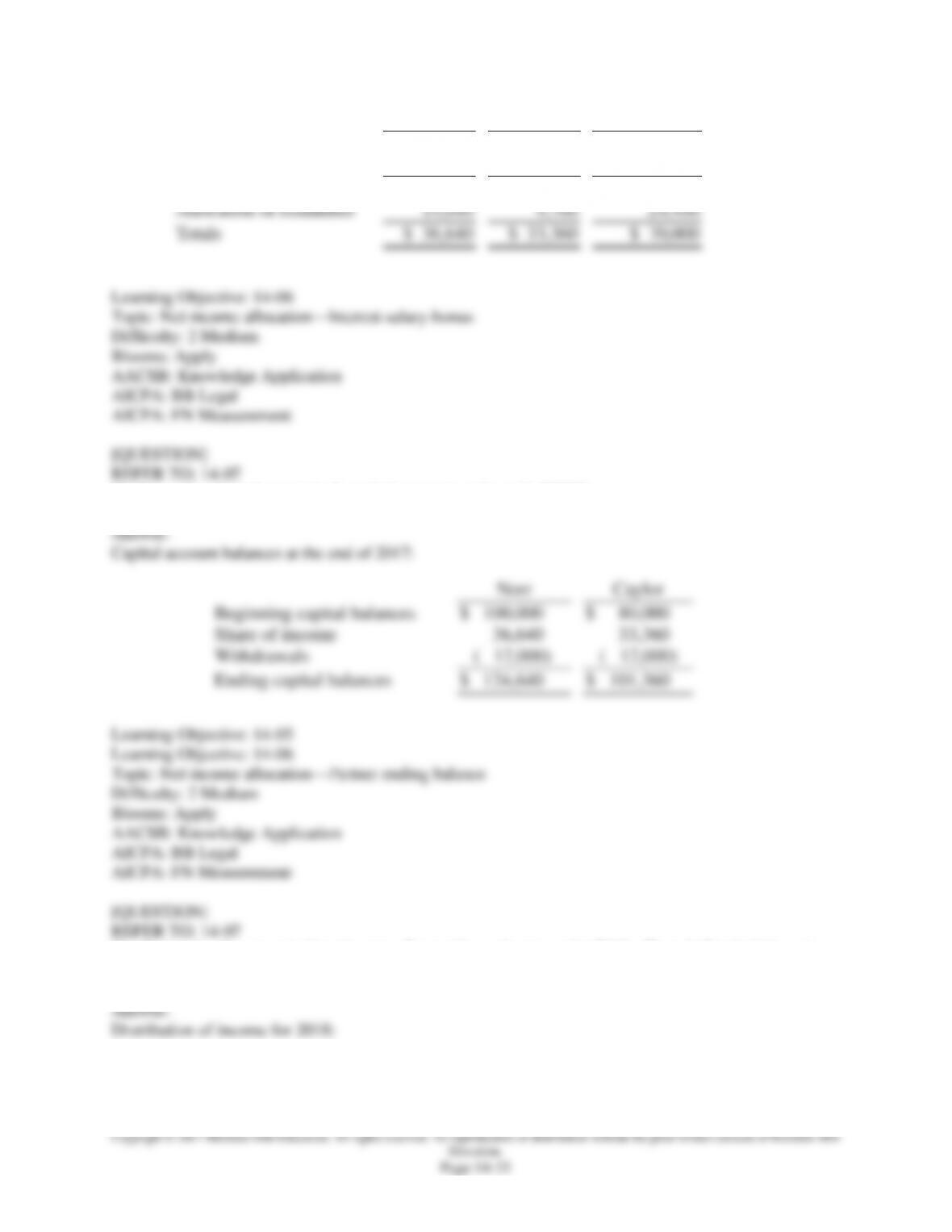
Norr Caylor Total
Interest $ 12,000 $ 9,600 $ 21,600
Compensation 10,000 14,000 24,000
Subtotals $ 22,000 $ 23,600 $ 45,600
Allocation of remainder 14,640 9,760 24,400
Totals $ 36,640 $ 33,360 $ 70,000
Learning Objective: 14-06
Topic: Net income allocation―Interest-salary-bonus
Difficulty: 2 Medium
Blooms: Apply
AACSB: Knowledge Application
AICPA: BB Legal
AICPA: FN Measurement
[QUESTION]
REFER TO: 14-07
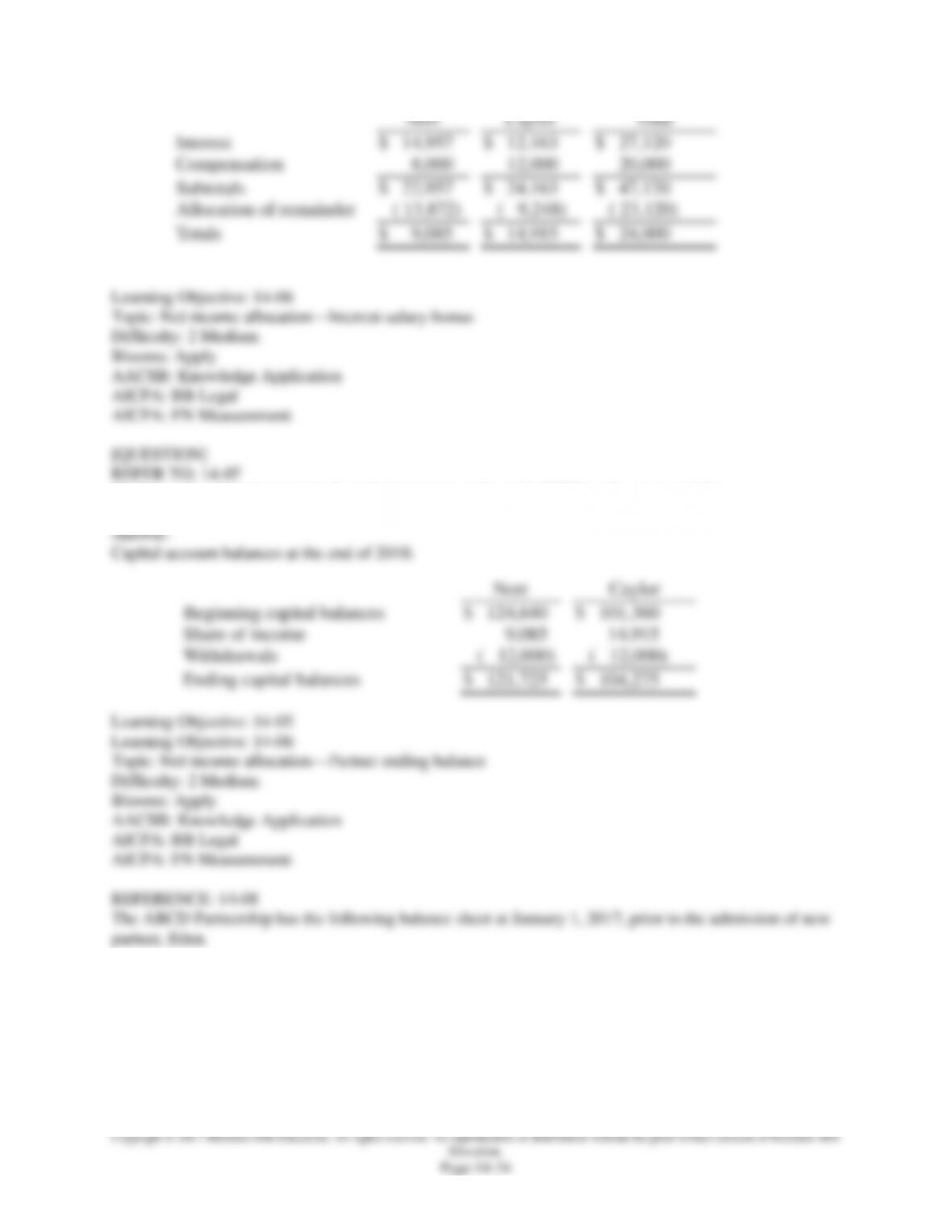
75. Determine the balance in both capital accounts at the end of 2017.
76. Determine the amount of net income allocated to each partner for 2018. (Round all calculations to
the nearest whole dollar).
Copyright © 2017 McGraw-Hill Education. All rights reserved. No reproduction or distribution without the prior written consent of McGraw-Hill
Education.
Page 14-34
Norr Caylor Total
Interest $ 14,957 $ 12,163 $ 27,120
Compensation 8,000 12,000 20,000
Subtotals $ 22,957 $ 24,163 $ 47,120
Allocation of remainder ( 13,872) ( 9,248) ( 23,120)
Totals $ 9,085 $ 14,915 $ 24,000
Learning Objective: 14-06
Topic: Net income allocation―Interest-salary-bonus
Difficulty: 2 Medium
Blooms: Apply
AACSB: Knowledge Application
AICPA: BB Legal
AICPA: FN Measurement
[QUESTION]
REFER TO: 14-07
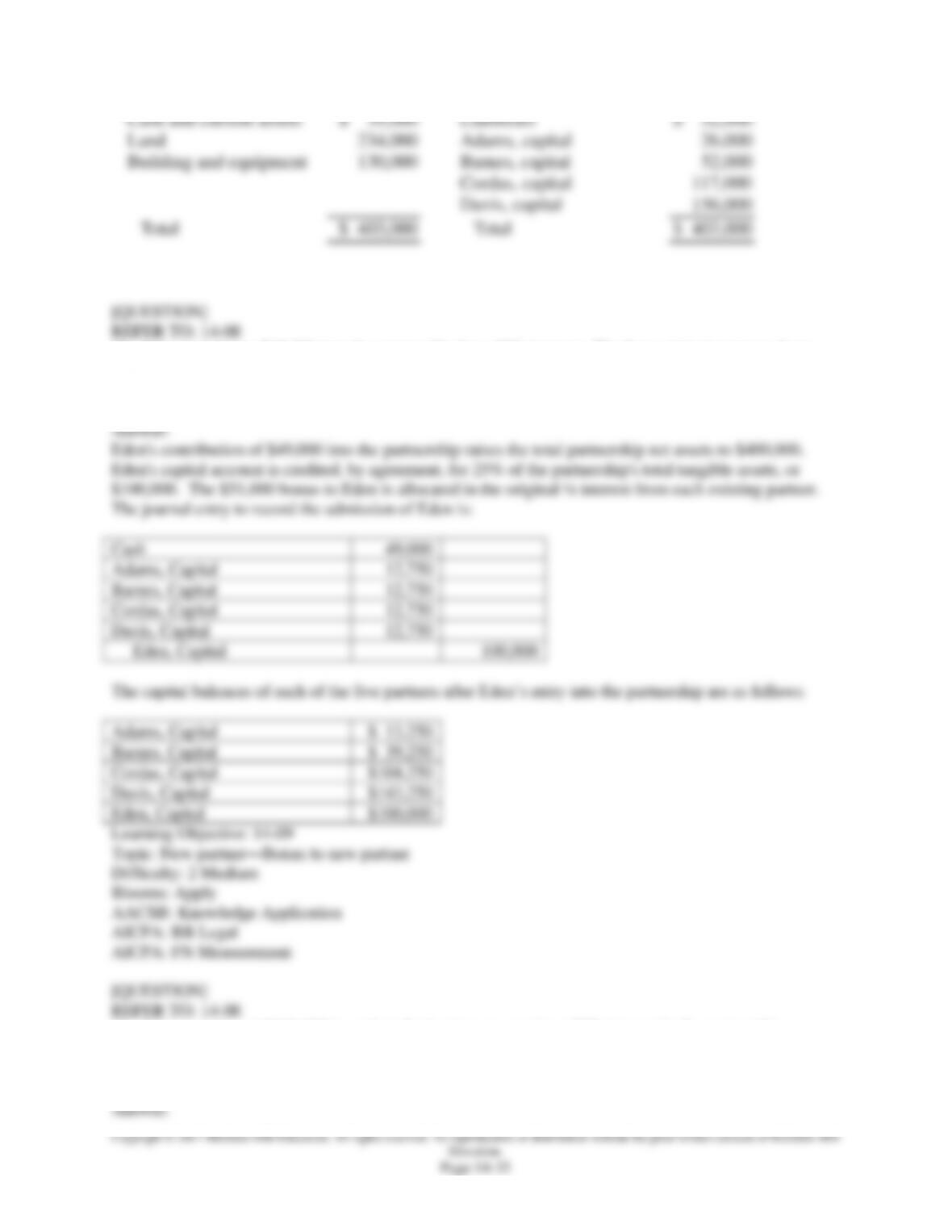
77. Determine the balance in both capital accounts at the end of 2018 to the nearest dollar.
Copyright © 2017 McGraw-Hill Education. All rights reserved. No reproduction or distribution without the prior written consent of McGraw-Hill
Education.
Page 14-35
Cash and current assets $ 39,000 Liabilities $ 52,000
Land 234,000 Adams, capital 26,000
Building and equipment 130,000 Barnes, capital 52,000
Cordas, capital 117,000
Davis, capital 156,000
Total $ 403,000 Total $ 403,000
[QUESTION]
REFER TO: 14-08
78. Eden contributes $49,000 into the partnership for a 25% interest. The four original partners share
profits and losses equally. Using the bonus method, determine the balances for each of the five partners
after Eden joins the partnership.
79. Eden contributed $124,000 in cash to the business to receive a 20% interest in the partnership.
Goodwill was to be recorded. The four original partners shared all profits and losses equally. After Eden
made his investment, what were the individual capital balances?
Copyright © 2017 McGraw-Hill Education. All rights reserved. No reproduction or distribution without the prior written consent of McGraw-Hill
Education.
Page 14-36
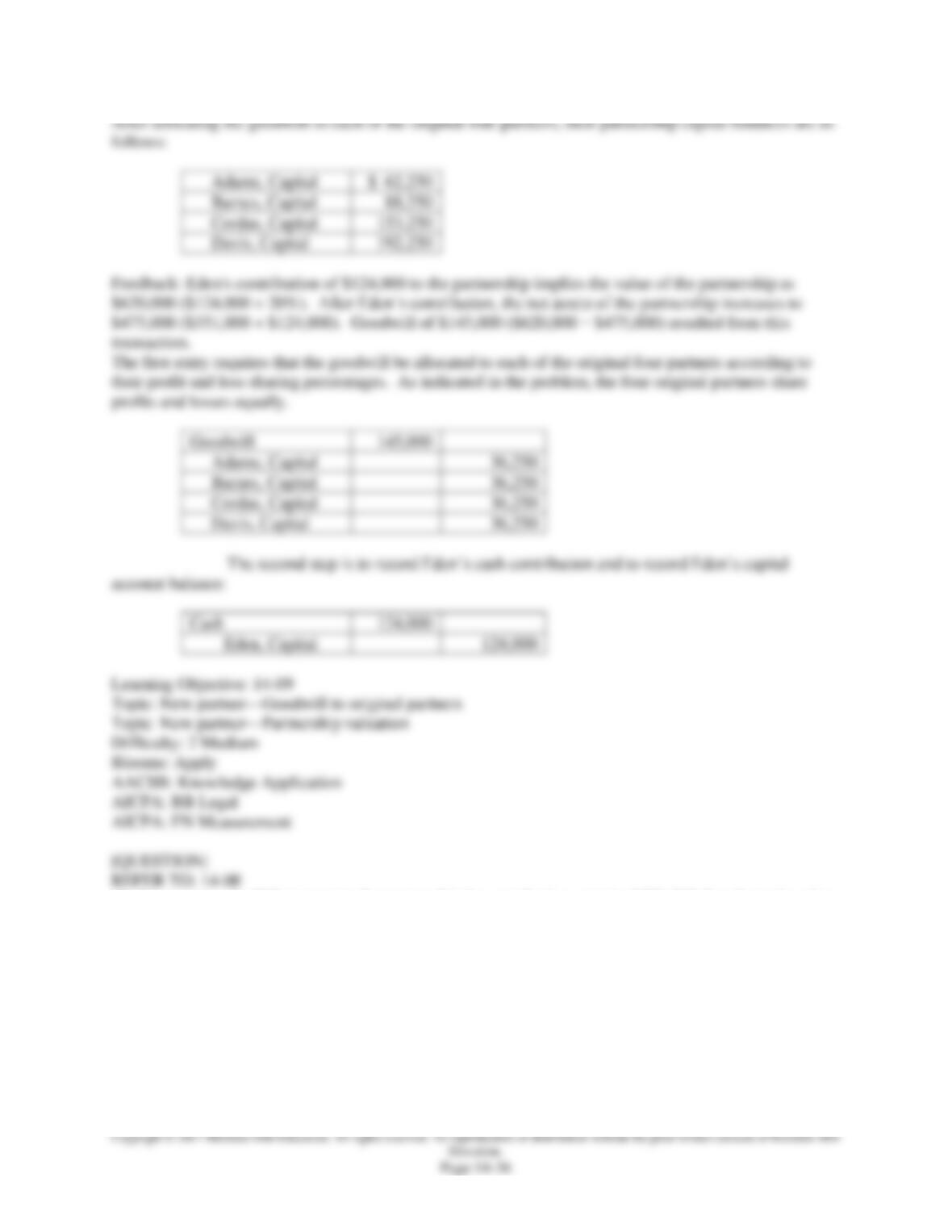
After allocating the goodwill to each of the original four partners, their partnership capital balances are as
follows:
Adams, Capital
$ 62,250
Barnes, Capital
88,250
Cordas, Capital
153,250
Davis, Capital
192,250
Feedback: Eden’s contribution of $124,000 to the partnership implies the value of the partnership as
$620,000 ($124,000 ÷ 20%). After Eden’s contribution, the net assets of the partnership increases to
$475,000 ($351,000 + $124,000). Goodwill of $145,000 ($620,000 − $475,000) resulted from this
transaction.
The first entry requires that the goodwill be allocated to each of the original four partners according to
their profit and loss sharing percentages. As indicated in the problem, the four original partners share
profits and losses equally.
Goodwill
145,000
Adams, Capital
36,250
Barnes, Capital
36,250
Cordas, Capital
36,250
Davis, Capital
36,250
The second step is to record Eden’s cash contribution and to record Eden’s capital
account balance:
Cash
124,000
Eden, Capital
124,000
Learning Objective: 14-09
Topic: New partner―Goodwill to original partners
Topic: New partner―Partnership valuation
Difficulty: 2 Medium
Blooms: Apply
AACSB: Knowledge Application
AICPA: BB Legal
AICPA: FN Measurement
[QUESTION]
REFER TO: 14-08
80. Eden acquired a 20% interest in the partnership by contributing a total of $71,500 directly to the other
four partners. No goodwill is to be recorded. Profits and losses have previously been split according to
the following percentages: Adams, 15%, Barnes, 35%, Cordas, 30%, and Davis, 20%. After Eden made
his investment, what were the individual capital balances?
Feedback:
The partnership’s total net assets are still $351,000, because Eden’s $71,500 went to the partners. Using
the book value method, each of the original partners will give up 20% of their current capital balance to
Eden. The journal entry is:
Adams, Capital
5,200
Barnes, Capital
10,400
Cordas, Capital
23,400
Davis, Capital
31,200
Eden, Capital
70,200
Adams, Capital
$ 20,800
Barnes, Capital
41,600
Cordas, Capital
93,600
Davis, Capital
124,800
Eden, Capital
70,200
81. Eden acquired a 20% interest in the partnership by contributing a total of $71,500 directly to the other
four partners. Goodwill is to be recorded. Profits and losses have previously been split according to the
following percentages: Adams, 15%; Barnes, 35%; Cordas, 30%; and Davis, 20%. After Eden made his
investment, what were the individual capital balances?
Feedback:
Eden’s contribution of $71,500 will go to the original four partners, not into the partnership. $71,500 =
20% of the implied partnership value. $71,500 ÷ .20 = 357,500 = the implied total capital of the
partnership. However, total capital before Eden’s payment to the existing partners is $351,000
($26,000 + $52,000 + $117,000 + 156,000). Thus, goodwill is $6,500 ($357,500 – $351,000)
which is attributed to the existing partners in their existing percentage allocations.
First, the goodwill should be allocated to each of the original four partners:
Goodwill
6,500
Adams, Capital
975
Barnes, Capital
2,275
Cordas, Capital
1,950
Davis, Capital
1,300
The adjusted balances for the four original partners, after allocating goodwill, are:
Adams, Capital
$ 26,975
Barnes, Capital
54,275
Cordas, Capital
118,950
Davis, Capital
157,300
The next step is to allocate 20% of each of the original partners’ balances to Eden:
Adams, Capital
5,395
Barnes, Capital
10,855
Cordas, Capital
23,790
Davis, Capital
31,460
Eden, Capital
71,500
Adams, Capital
$ 21,580
Barnes, Capital
43,420
Cordas, Capital
95,160
Davis, Capital
125,840
Eden, Capital
71,500
82. Prepare the journal entry for the payment to Dean in the dissolution of his partnership interest,
assuming the bonus method is to be applied.
Dean, Capital
60,000
Copyright © 2017 McGraw-Hill Education. All rights reserved. No reproduction or distribution without the prior written consent of McGraw-Hill
Education.
Page 14-39
Hardin, Capital
2,400
Roth, Capital
1,600
Cash
64,000
Feedback: Dean receives $4,000 more than his capital balance. The $4,000 excess distribution reduces the
two remaining partners’ capital balances in their existing profit and loss ratios of 30:20 which is 60% and
40% of the $4,000.
Learning Objective: 14-10
Topic: Withdrawal of partner―Bonus method
Difficulty: 2 Medium
Blooms: Apply
AACSB: Knowledge Application
AICPA: BB Legal
AICPA: FN Measurement
[QUESTION]
REFER TO: 14-09
83. What are the remaining partners’ capital balances after Dean’s interest is dissolved, assuming the
bonus method is applied?
84. Prepare the journal entries for the dissolution of Howell’s partnership interest, assuming the goodwill
method is to be applied.
Howell
$ 60,000
Waldrop
25,000
Feedback:
The $154,000 fair value of the business is $54,000 more than the book value of $100,000 ($60,000 +
$15,000 + $25,000). Of this $54,000, $15,000 is allocated to land and the balance of $39,000 is
attributable to goodwill. The assets of the business are increased with increases to the partners in their
profit and loss ratios. Then Howell’s capital balance will be $84,000 and removed with the payment of
cash.
85. What are the remaining partners’ capital balances after Howell’s interest is dissolved, assuming the
goodwill method is applied?
86. Record the journal entry for the admission of Noris. Goodwill is not to be recorded.
87. Record the journal entry to allocate the salary of Noris.
88. Record the journal entry to record the remainder of net income to the capital accounts.
Copyright © 2017 McGraw-Hill Education. All rights reserved. No reproduction or distribution without the prior written consent of McGraw-Hill
Education.
Page 14-42
AACSB: Knowledge Application
AICPA: BB Legal
AICPA: FN Measurement
[QUESTION]
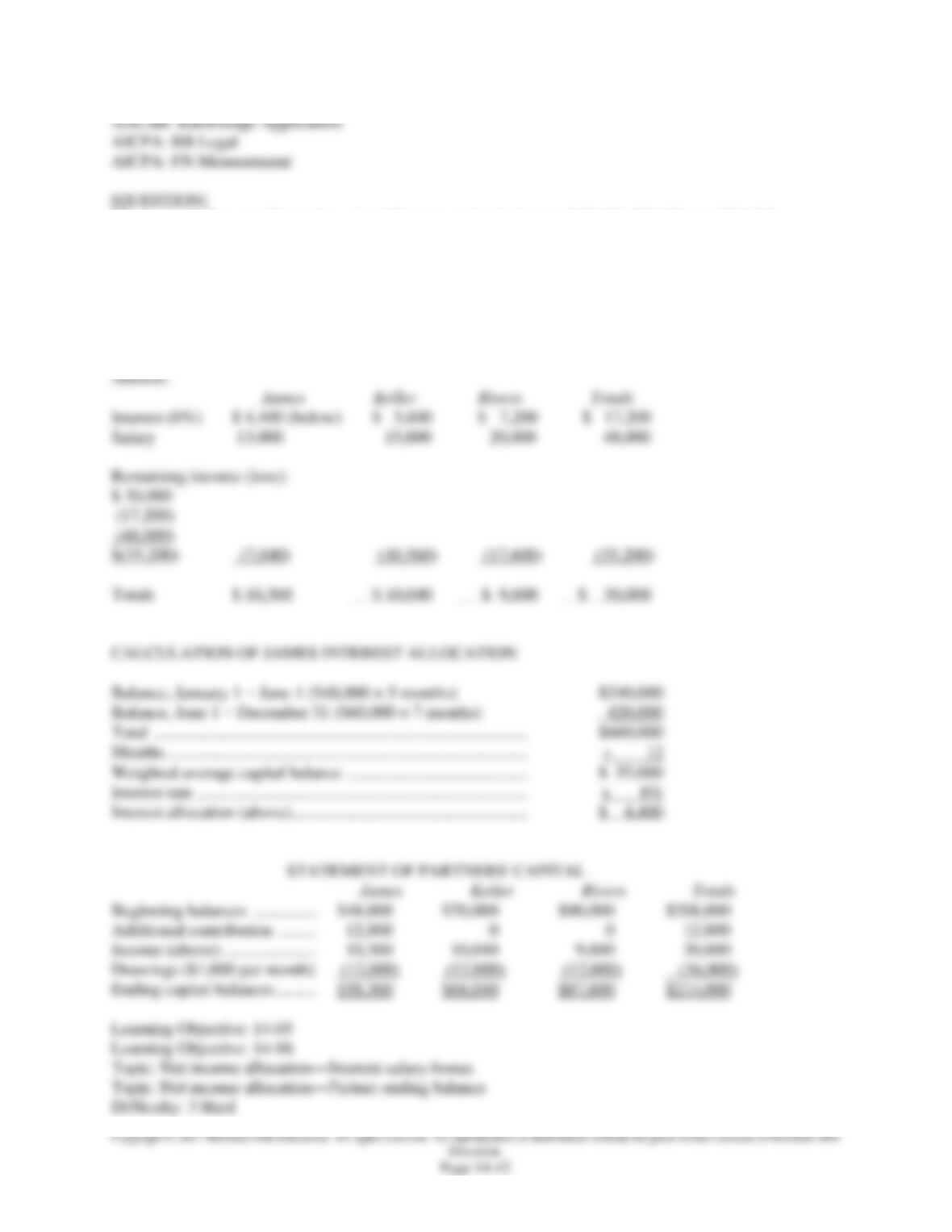
89. James, Keller, and Rivers have the following capital balances; $48,000, $70,000 and $90,000
respectively. Because of a cash shortage James invests an additional $12,000 on June 1st. Each partner
withdraws $1,000 per month. James, Keller, and Rivers receive a salary of $13,000, $15,000 and
$20,000, respectively, for work done during the year. Each partner receives interest of 8% on that
partner’s monthly weighted average capital balance without regard to normal drawings. Any remaining
profits are split 20%, 30%, and 50% respectively. The net income for the year is $30,000. What are the
ending capital balances for each partner?

Copyright © 2017 McGraw-Hill Education. All rights reserved. No reproduction or distribution without the prior written consent of McGraw-Hill
Education.
Page 14-43
Blooms: Apply
AACSB: Knowledge Application
AICPA: BB Legal
AICPA: FN Measurement