B) $ 30,000.
C) $ 45,000.
D) $ 50,000.
E) $200,000.
48. What is the balance of May’s capital account after the new partnership is created?
A) $ 84,000.
B) $100,000.
C) $140,000.
D) $176,000.
E) $200,000.
49. What is the balance of Donald’s capital account after the new partnership is created?
A) $ 84,000.
B) $100,000.
C) $140,000.
D) $176,000.
E) $200,000.
50. What is the balance of Hanes’s capital account after the new partnership is created?
A) $ 84,000.
B) $100,000.
C) $140,000.
D) $176,000.
E) $200,000.
51. What is the new total balance of the partnership accounts?
A) $ 84,000.
B) $140,000.
C) $176,000.
D) $200,000.
E) $400,000.
Copyright © 2017 McGraw-Hill Education. All rights reserved. No reproduction or distribution without the prior written consent of McGraw-Hill
Education.
Page 14-23
[QUESTION]
52. Which of the following could be used as a basis to allocate profits among partners who are active in
the management of the partnership?
1) Allocation of salaries.
2) The number of years with the partnership.
3) The amount of time each partner works.
4) The average capital invested.
A) 1 and 2.
B) 1 and 3.
C) 1, 2, and 4.
D) 1, 3, and 4.
E) 1, 2, 3, and 4.
53. If C is to contribute an amount equal to his book value share of the new partnership, how much
should C contribute?
A) $22,000
B) $20,000
C) $25,000
D) $18,000
E) $10,000
54. C contributes $38,000 to the partnership and the bonus method is used. What amount will be
credited for C’s beginning capital balance?
A) $20,000
B) $25,000
C) $27,600
D) $32,600
E) $38,000
55. If C contributes $40,000 to the partnership and the goodwill method is used, what amount will be
debited for goodwill?
A) $15,000
B) $20,000
C) $25,000
D) $28,000
E) $60,000
56. C contributes $10,000 to the partnership and the goodwill method is used. What will be the result of
the goodwill calculation?
A) Goodwill of $15,000; split among the original partners.
B) Goodwill of $15,000; all to C.
C) Goodwill of $15,000; split among all four partners: P, L, O, and C.
D) Goodwill of $12,000; all to C.
E) Goodwill of $12,000; split among original partners.
Copyright © 2017 McGraw-Hill Education. All rights reserved. No reproduction or distribution without the prior written consent of McGraw-Hill
Education.
Page 14-25
Answer: B
Learning Objective: 14-09
Topic: New partner―Goodwill to new partner
Topic: New partner―Partnership valuation
Difficulty: 3 Hard
Blooms: Apply
AACSB: Knowledge Application
AICPA: BB Legal
AICPA: FN Measurement
Feedback: Total capital after C’s investment and before goodwill = $110,000 ($50,000 + $30,000 +
$20,000 + $10,000). However, the value of the firm is calculated as only $50,000 ($10,000 ÷
.20). Goodwill will be attributed to C calculated as: ($10,000 + Goodwill) = .20 × ($110,000 +
Goodwill). Thus, ($10,000 + Goodwill) = $22,000 + (.20 Goodwill). .80 Goodwill = $12,000.
Goodwill = $12,000 ÷ .80 = $15,000.
REFERENCE: 14-05
Peter, Roberts, and Dana have the following capital balances; $80,000, $100,000 and $60,000,
respectively. The partners share profits and losses 20%, 40%, and 40% respectively.
[QUESTION]
REFER TO: 14-05
57. Roberts retires and is paid $160,000 based on an independent appraisal of the business. If the
goodwill method is used, what is the capital balance of Peter?
A) $ 20,000.
B) $ 60,000.
C) $110,000.
D) $120,000.
E) $230,000.
58. Roberts retires and is paid $160,000 based on an independent appraisal of the business. If the
goodwill method is used, what is the capital balance of Dana?
A) $ 20,000.
B) $ 60,000.
C) $110,000.
D) $120,000.
E) $230,000.
59. What is the total partnership capital after Roberts retires receiving $160,000 and using the goodwill
method?
A) $290,000.
B) $176,000.
C) $ 80,000.
D) $120,000.
E) $230,000.
60. Anne retires and is paid $80,000 based on an independent appraisal of the business. If the goodwill
method is used, what is the capital of the remaining partners?
A) Donald, $55,000; Todd, $60,000
B) Donald, $40,000; Todd, $30,000
C) Donald, $65,000; Todd, $55,000
D) Donald, $15,000; Todd, $30,000
E) Donald, $25,000; Todd, $0
61. Anne retires and is paid $80,000 based on the terms of the original partnership agreement. If the
bonus method is used, what is the capital of the remaining partners?
A) Donald, $40,000; Todd, $30,000
B) Donald, $30,000; Todd, $10,000
C) Donald, $50,000; Todd, $50,000
D) Donald, $24,000; Todd, $18,000
E) Donald, $70,000; Todd, $40,000
62. What is the total partnership capital after Anne retires receiving $80,000 and using the bonus method?
A) $70,000.
B) $40,000.
C) $60,000.
D) $80,000.
E) $42,000.
Copyright © 2017 McGraw-Hill Education. All rights reserved. No reproduction or distribution without the prior written consent of McGraw-Hill
Education.
Page 14-28
Learning Objective: 14-10
Topic: Withdrawal of partner―Bonus method
Difficulty: 1 Easy
Blooms: Apply
AACSB: Knowledge Application
AICPA: BB Legal
AICPA: FN Measurement
Essay:
[QUESTION]
63. What is the dissolution of a partnership?
64. By what methods can a person gain admittance to a partnership?
65. What events cause the dissolution of a partnership?
Copyright © 2017 McGraw-Hill Education. All rights reserved. No reproduction or distribution without the prior written consent of McGraw-Hill
Education.
Page 14-29
AICPA: FN Measurement
[QUESTION]
66. For what events or conditions should the Articles of Partnership make provision?
67. How is accounting for a partnership different from accounting for a corporation?
68. Why are the terms of the Articles of Partnership important to partners?
Copyright © 2017 McGraw-Hill Education. All rights reserved. No reproduction or distribution without the prior written consent of McGraw-Hill
Education.
Page 14-30
Topic: Articles of partnership
Difficulty: 2 Medium
Blooms: Understand
AACSB: Communication
AICPA: BB Legal
AICPA: FN Risk Analysis
[QUESTION]
69. Brown and Green are forming a business as partners. If they do not create a formal written
partnership agreement, what risks are they exposing themselves to?
70. What theoretical argument could be made against the recognition of goodwill when there is a change
in the ownership of a partnership?
Copyright © 2017 McGraw-Hill Education. All rights reserved. No reproduction or distribution without the prior written consent of McGraw-Hill
Education.
Page 14-31
AICPA: FN Measurement
[QUESTION]
71. Under what circumstances does a partner’s balance in his or her capital account have practical
consequences for the partner?
72. Reed, Sharp, and Tucker were partners with capital account balances of $80,000, $100,000, and
$70,000, respectively. They agreed to admit Upton to the partnership. Upton purchased 30% of each
partner’s interest, with payments directly to Reed, Sharp, and Tucker of $32,000, $40,000, and $28,000,
respectively. Before the admission of Upton, the profit and loss sharing ratio was 2:3:2. The partners
agreed to use the book value method to account for the admission of Upton to the partnership.
Required:
Prepare the journal entry to record the admission of Upton to the partnership.
73. Jipsom and Klark were partners with capital account balances of $80,000 and $100,000, respectively.
Looney directly paid $32,000 to Jipsom and $40,000 to Klark for 30% of their interests in the partnership.
Jipsom and Klark shared income in the ratio of 2:3. They believed that revaluation of the partnership was
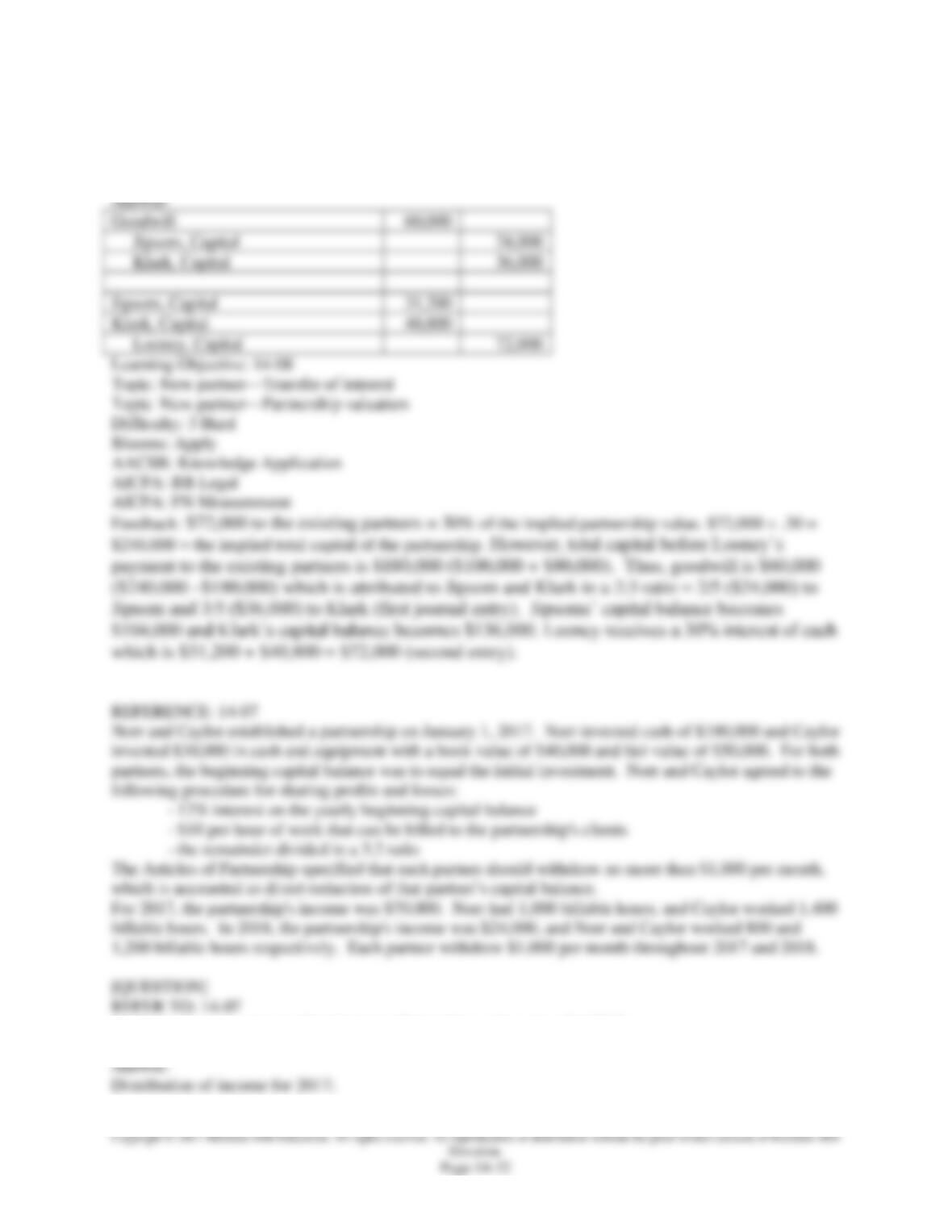
appropriate when a new partner was admitted.
Required:
Prepare the journal entries to record the admission of Looney to the partnership.
74. Determine the amount of net income allocated to each partner for 2017.