File: Chapter 14 – Partnerships: Formation and Operation
1. Cherryhill and Hace had been partners for several years, and they decided to admit Quincy to the
partnership. The accountant for the partnership believed that the dissolved partnership and the newly
formed partnership were two separate entities. What method would the accountant have used for
recording the admission of Quincy to the partnership?
A) The bonus method.
B) The equity method.
C) The goodwill method.
D) The proportionate method.
E) The cost method.
2. When the hybrid method is used to record the withdrawal of a partner, the partnership
A) Revalues assets and liabilities and records goodwill to the continuing partner but not to the
withdrawing partner.
B) Revalues liabilities but not assets, and no goodwill is recorded.
C) Can recognize goodwill but does not revalue assets and liabilities.
D) Revalues assets but not liabilities, and records goodwill to the continuing partner but not to the
withdrawing partner.
E) Revalues assets and liabilities but does not record goodwill.
3. The disadvantages of the partnership form of business organization, compared to corporations, include
A) The legal requirements for formation.
B) Unlimited liability for the partners.
C) The requirement for the partnership to pay income taxes.
D) The extent of governmental regulation.
E) The complexity of operations.
Copyright © 2017 McGraw-Hill Education. All rights reserved. No reproduction or distribution without the prior written consent of McGraw-Hill
Education.
Page 14-2
Difficulty: 1 Easy
Blooms: Understand
AACSB: Reflective Thinking
AICPA: BB Legal
AICPA: FN Measurement
[QUESTION]
4. The advantages of the partnership form of business organization, compared to corporations, include
A) Single taxation.
B) Ease of raising capital.
C) Mutual agency.
D) Limited liability.
E) Difficulty of formation.
5. The dissolution of a partnership occurs
A) Only when the partnership sells its assets and permanently closes its books.
B) Only when a partner leaves the partnership.
C) At the end of each year, when income is allocated to the partners.
D) Only when a new partner is admitted to the partnership.
E) When there is any change in the individuals who make up the partnership.
6. The partnership of Clapton, Seidel, and Thomas is insolvent and will be unable to pay $30,000 in
liabilities that are currently due. What recourse is available to the partnership’s creditors?
A) They must present equal claims to the three partners as individuals.
B) They must try to obtain payment from the partner with the largest capital account balance.
C) They cannot seek remuneration from the partners as individuals.
D) They may seek remuneration from any partner they choose.
E) They must present their claims to the three partners in descending order based on the partners’ capital
account balances.
Copyright © 2017 McGraw-Hill Education. All rights reserved. No reproduction or distribution without the prior written consent of McGraw-Hill
Education.
Page 14-3
Blooms: Understand
AACSB: Reflective Thinking
AICPA: BB Legal
AICPA: FN Risk Analysis
REFERENCE: 14-01
Cleary, Wasser, and Nolan formed a partnership on January 1, 2017, and made capital contributions of
$100,000 (Cleary), $150,000 (Wasser), and $200,000 (Nolan), respectively. With respect to the division
of income, they agreed to the following: (1) interest of an amount equal to 10% of the that partner’s
beginning capital balance for the year; (2) annual compensation of $10,000 to Wasser; and (3) the
remainder of the income or loss to be split among the partners in the following percentages: (a) 20% for
Cleary; (b) 40% for Wasser; and (c) 40% for Nolan. Net income was $150,000 in 2017 and $180,000 in
2018. Each partner withdrew $1,000 for personal use every month during 2017 and 2018.
7. What was Wasser’s total share of net income for 2017?
A) $63,000.
B) $53,000.
C) $58,000.
D) $29,000.
E) $51,000.
8. What was Nolan’s total share of net income for 2017?
A) $63,000.
B) $53,000.
C) $58,000.
D) $29,000.
E) $51,000.
Copyright © 2017 McGraw-Hill Education. All rights reserved. No reproduction or distribution without the prior written consent of McGraw-Hill
Education.
Page 14-4
AICPA: BB Legal
AICPA: FN Measurement
Feedback: Interest on Nolan’s beginning balance of capital contribution ($200,000 × 10% =
$20,000) + Salary ($0) + 40% of the Remaining net income (calculated below) ($38,000) =
$58,000.
Remaining net income: $150,000 – $45,000 (10% of $450,000) − $10,000 (Wasser Salary) =
$95,000, of which 40% is allocated to Nolan = $38,000.
[QUESTION]
REFER TO: 14-01
9. What was Cleary’s total share of net income for 2017?
A) $63,000.
B) $53,000.
C) $58,000.
D) $29,000.
E) $51,000.
10. What was Nolan’s capital balance at the end of 2017?
A) $200,000.
B) $224,000.
C) $238,000.
D) $246,000.
E) $254,000.
Copyright © 2017 McGraw-Hill Education. All rights reserved. No reproduction or distribution without the prior written consent of McGraw-Hill
Education.
Page 14-5
[QUESTION]
REFER TO: 14-01
11. What was Wasser’s capital balance at the end of 2017?
A) $150,000.
B) $160,000.
C) $165,000.
D) $213,000.
E) $201,000.
12. What was Cleary’s capital balance at the end of 2017?
A) $100,000.
B) $117,000.
C) $119,000.
D) $129,000.
E) $153,000.
13. What was the total capital balance for the partnership at December 31, 2017?
A) $600,000.
B) $564,000.
C) $535,000.
D) $523,000.
E) $545,000.
Copyright © 2017 McGraw-Hill Education. All rights reserved. No reproduction or distribution without the prior written consent of McGraw-Hill
Education.
Page 14-6
Learning Objective: 14-06
Topic: Net income allocation―Partner ending balance
Difficulty: 2 Medium
Blooms: Apply
AACSB: Knowledge Application
AICPA: BB Legal
AICPA: FN Measurement
Feedback: Cleary $117,000 + Wasser $201,000 + Nolan $246,000 = $564,000.
Alternatively, beginning capital balances ($100,000 + $150,000 + $200,000) = $450,000 + net
income $150,000 − withdrawals $36,000 = $564,000.
[QUESTION]
REFER TO: 14-01
14. What was the amount of interest attributed to Wasser in the income distribution for 2018?
A) $17,600.
B) $18,800.
C) $20,100.
D) $17,800.
E) $30,100.
15. What was Wasser’s total share of net income for 2018?
A) $34,420.
B) $75,540.
C) $65,540.
D) $70,040.
E) $61,420.
Copyright © 2017 McGraw-Hill Education. All rights reserved. No reproduction or distribution without the prior written consent of McGraw-Hill
Education.
Page 14-7
$113,600 × 40% = $45,440.
[QUESTION]
REFER TO: 14-01
16. What was the remainder portion of net income allocated to Nolan for 2018?
A) $45,440.
B) $58,040.
C) $70,040.
D) $72,000.
E) $82,040.
17. What was Nolan’s total share of net income for 2018?
A) $34,420.
B) $75,540.
C) $65,540.
D) $70,040.
E) $61,420.
18. What was Cleary’s total share of net income for 2018?
A) $34,420.
B) $75,540.
C) $65,540.
D) $70,040.
E) $61,420.
19. What was Nolan’s capital balance at the end of 2018?
A) $139,420.
B) $246,000.
C) $276,540.
D) $279,440.
E) $304,040.
20. What was Wasser’s capital balance at the end of 2018?
A) $201,000.
B) $263,520.
C) $264,540.
D) $304,040.
E) $313,780.
Copyright © 2017 McGraw-Hill Education. All rights reserved. No reproduction or distribution without the prior written consent of McGraw-Hill
Education.
Page 14-9
Blooms: Apply
AACSB: Knowledge Application
AICPA: BB Legal
AICPA: FN Measurement
Feedback: 2018 Beginning Wasser capital balance $201,000 + Interest $20,100 + Salary $10,000
+ 40% of Remaining 2018 net income (calculated below) $45,440 – Withdrawals $12,000 =
$264,540.
Remaining 2018 net income = $180,000 − $56,400 (10% of $564,000) − $10,000 (Wasser
Salary) = $113,600 × 40% = $45,440.
[QUESTION]
REFER TO: 14-01
21. What was Cleary’s capital account balance at the end of 2018?
A) $163,420.
B) $151,420.
C) $139,420.
D) $100,000.
E) $142,000.
22. What was the total capital balance for the partnership at December 31, 2018?
A) $852,000.
B) $780,000.
C) $708,000.
D) $744,000.
E) $594,000.
Copyright © 2017 McGraw-Hill Education. All rights reserved. No reproduction or distribution without the prior written consent of McGraw-Hill
Education.
Page 14-10
Feedback: Cleary 2018 Ending Capital Balance $139,420 + Wasser $264,540 2018 Ending
Capital Balance + Nolan 2018 Ending Capital Balance $304,040 = $708,000.
Alternatively, beginning 2017 capital balances ($100,000 + $150,000 + $200,000) = $450,000 +
2017 net income $150,000 − 2017 withdrawals $36,000 = $564,000 ending 2017 balance + 2018
net income $180,000 − 2018 withdrawals $36,000 = $708,000.
[QUESTION]
REFER TO: 14-01
23. What will be the amount of interest attributed to Cleary in the income distribution for 2019?
A) $15,142.
B) $13,942.
C) $12,942.
D) $14,142.
E) $10,000.
24. Jell and Dell were partners with capital balances of $600 and $800, and an income-sharing ratio of
2:3. They admitted Zell with a 30% interest in the partnership, and the total amount of goodwill credited
to the original partners was $700. What amount did Zell contribute to the business?
A) $900.
B) $560.
C) $600.
D) $590.
E) $630.
25. Jerry, a partner in the JSK partnership, begins the year on January 1, 2018 with a capital balance of
$20,000. The JSK partnership agreement states that Jerry receives 6% interest on his monthly weighted
average capital balance without regard to normal drawings. Each partner draws $5,000 in cash from the
business every quarter. Any withdrawal in excess of that will be accounted for as a direct reduction of the
partner’s capital balance.
• On March 1, 2018, when the partnership tax return for 2017 was completed, Jerry’s capital
account was credited for his share of 2017 profit of $120,000.
• Jerry withdrew $5,000 quarterly, beginning March 31st.
• On September 1, Jerry’s capital account was credited with a special bonus of $60,000 for
business he brought to the partnership.
What amount of interest will be attributed to Jerry for the year 2018 that will go toward his profit
distribution for the year?
A) $6,000.
B) $6,250.
C) $7,950.
D) $8,400.
E) None of these answer choices is correct.
26. What was Young’s total share of net loss for the first year?
A) $ 3,900 loss.
B) $11,700 loss.
C) $10,400 loss.
D) $24,700 loss.
E) $ 9,100 loss.
Copyright © 2017 McGraw-Hill Education. All rights reserved. No reproduction or distribution without the prior written consent of McGraw-Hill
Education.
Page 14-12
Answer: B
Learning Objective: 14-06
Topic: Net income allocation―Interest-salary-bonus
Difficulty: 2 Medium
Blooms: Apply
AACSB: Knowledge Application
AICPA: BB Legal
AICPA: FN Measurement
Feedback: Net loss ($26,000) – Interest ($390,000 total beginning capital × 10%) $39,000 –
Salaries $39,000 = ($104,000) × 50% = Young’s portion ($52,000) + Young’s Interest $14,300 +
Young’s Salary $26,000 = Young’s share of loss ($11,700)
[QUESTION]
REFER TO: 14-02
27. What was Eaton’s total share of net loss for the first year?
A) $ 3,900 loss.
B) $11,700 loss.
C) $10,400 loss.
D) $24,700 loss.
E) $ 9,100 loss.
28. What was Thurman’s total share of net loss for the first year?
A) $ 3,900 loss.
B) $11,700 loss.
C) $10,400 loss.
D) $24,700 loss.
E) $ 9,100 loss.
Copyright © 2017 McGraw-Hill Education. All rights reserved. No reproduction or distribution without the prior written consent of McGraw-Hill
Education.
Page 14-13
$14,300 + Thurman’s Salary $13,000 = Thurman’s share of loss ($3,900)
[QUESTION]
REFER TO: 14-02
29. What was the balance in Young’s Capital account at the end of the first year?
A) $120,900.
B) $118,300.
C) $126,100.
D) $ 80,600.
E) $111,500.
30. What was the balance in Eaton’s Capital account at the end of the first year?
A) $120,900.
B) $118,300.
C) $126,100.
D) $ 80,600.
E) $111,500.
31. What was the balance in Thurman’s Capital account at the end of the first year?
A) $120,900.
B) $118,300.
C) $126,100.
D) $ 80,600.
E) $111,500.
Copyright © 2017 McGraw-Hill Education. All rights reserved. No reproduction or distribution without the prior written consent of McGraw-Hill
Education.
Page 14-14
Answer: C
Learning Objective: 14-05
Topic: Net income allocation―Partner ending balance
Difficulty: 2 Medium
Blooms: Apply
AACSB: Knowledge Application
AICPA: BB Legal
AICPA: FN Measurement
Feedback: Beginning $143,000 + Interest ($143,000 × 10%) $14,300 + Salary $13,000 +
Remainder (30%) ($31,200) – Withdrawals $13,000 = Ending Balance $126,100
[QUESTION]
REFER TO: 14-02
32. What was Young’s total share of net income for the second year?
A) $17,160 income.
B) $ 4,160 income.
C) $19,760 income.
D) $17,290 income.
E) $28,080 income.
33. What was Eaton’s total share of net income for the second year?
A) $17,160 income.
B) $ 4,160 income.
C) $19,760 income.
D) $17,290 income.
E) $28,080 income.
Copyright © 2017 McGraw-Hill Education. All rights reserved. No reproduction or distribution without the prior written consent of McGraw-Hill
Education.
Page 14-15
Feedback: Net income $52,000 – Interest $32,500 (calculated below) – Salaries $39,000 =
($19,500) × 20% = Eaton’s portion ($3,900) + Interest $8,060 + Salary $0 = Eaton’s share of net
income $4,160.
Interest for second year = First year: Beginning capital balance $390,000 − Net loss $26,000 −
Withdrawals $39,000 = Ending capital balance first year (beginning capital balance second year)
$325,000 × 10% = $32,500 Interest for second year.
[QUESTION]
REFER TO: 14-02
34. What was Thurman’s total share of net income for the second year?
A) $17,160 income.
B) $ 4,160 income.
C) $19,760 income.
D) $17,290 income.
E) $28,080 income.
35. What was the balance in Young’s Capital account at the end of the second year?
A) $133,380.
B) $ 84,760.
C) $105,690.
D) $132,860.
E) $ 71,760.
Copyright © 2017 McGraw-Hill Education. All rights reserved. No reproduction or distribution without the prior written consent of McGraw-Hill
Education.
Page 14-16
($9,750) – Withdrawals $13,000 = Ending Balance $133,380
[QUESTION]
REFER TO: 14-02
36. What was the balance in Eaton’s Capital account at the end of the second year?
A) $133,380.
B) $ 84,760.
C) $105,690.
D) $132,860.
E) $ 71,760.
37. What was the balance in Thurman’s Capital account at the end of the second year?
A) $133,380.
B) $ 84,760.
C) $105,690.
D) $132,860.
E) $ 71,760.
38. Which of the following is not a characteristic of a partnership?
A) The partnership itself pays no income taxes.
B) It is easy to form a partnership.
C) Any partner can be held personally liable for all debts of the business.
D) A partnership requires written Articles of Partnership.
E) Each partner has the power to obligate the partnership for liabilities.
Copyright © 2017 McGraw-Hill Education. All rights reserved. No reproduction or distribution without the prior written consent of McGraw-Hill
Education.
Page 14-17
Learning Objective: 14-01
Topic: Advantages and disadvantages of partnerships
Topic: Articles of partnership
Difficulty: 1 Easy
Blooms: Remember
AACSB: Reflective Thinking
AICPA: BB Legal
AICPA: FN Measurement
[QUESTION]
39. Partnerships have alternative legal forms including all of the following except:
A) General Partnership.
B) Limited Partnership.
C) Subchapter S Partnership.
D) Limited Liability Partnership.
E) Limited Liability Company.
40. Which of the following type of organization is classified as a partnership, or similar to a partnership,
for tax purposes?
(I.) Limited Liability Company
(II.) Limited Liability Partnership
(III.) Subchapter S Corporation
A) II only.
B) II and III.
C) I and II.
D) I and III.
E) I, II, and III.
41. Which of the following statements is correct regarding the admission of a new partner?
A) A new partner must purchase a partnership interest directly from the business.
B) The right of co-ownership in the business property can be transferred to a new partner without the
consent of other existing partners.
C) The right to participate in management of the business cannot be conveyed without the consent of
other existing partners.
D) The right to share in profits and losses can be sold to a new partner without the consent of other
existing partners.
E) A new partner always pays book value.
42. Withdrawals from the partnership capital accounts are typically not used
A) To reward partners for work performed in the business.
B) To reduce the partners’ capital account balances at the end of an accounting period.
C) To record interest earned on a partner’s capital balance.
D) To reduce the basic investment that has been made in the business.
E) To record the partnership’s payment of a partner’s personal expense such as income tax.
43. The partnership contract for Hanes and Jones LLP provides that Hanes is to receive a bonus of 20% of
net income (after the bonus) and that the remaining net income is to be divided equally. If the partnership
income before the bonus for the year is $57,600, Hanes’ share of this pre-bonus income is:
A) $28,800.
B) $33,600.
C) $34,560.
D) $35,520.
E) $38,400.
1.2 Bonus = $11,520. Bonus = $9,600. Net income $57,600 − Bonus $9,600 = $48,000 remaining net
Copyright © 2017 McGraw-Hill Education. All rights reserved. No reproduction or distribution without the prior written consent of McGraw-Hill
Education.
Page 14-19
income to divide equally = $24,000 to each partner.
Hanes receives $24,000 + $9,600 = $33,600.
[QUESTION]
44. The partners of Apple, Bere, and Carroll LLP share net income and losses in a 5:3:2 ratio,
respectively. The capital account balances on January 1, 2018, were as follows:
The carrying amounts of the assets and liabilities of the partnership are the same as their current fair
values. Dorr will be admitted to the partnership with a 20% capital interest and a 20% share of net income
and losses in exchange for a cash investment. The amount of cash that Dorr should invest in the
partnership is:
A) $25,000.
B) $30,000.
C) $37,500.
D) $75,000.
E) $90,000.
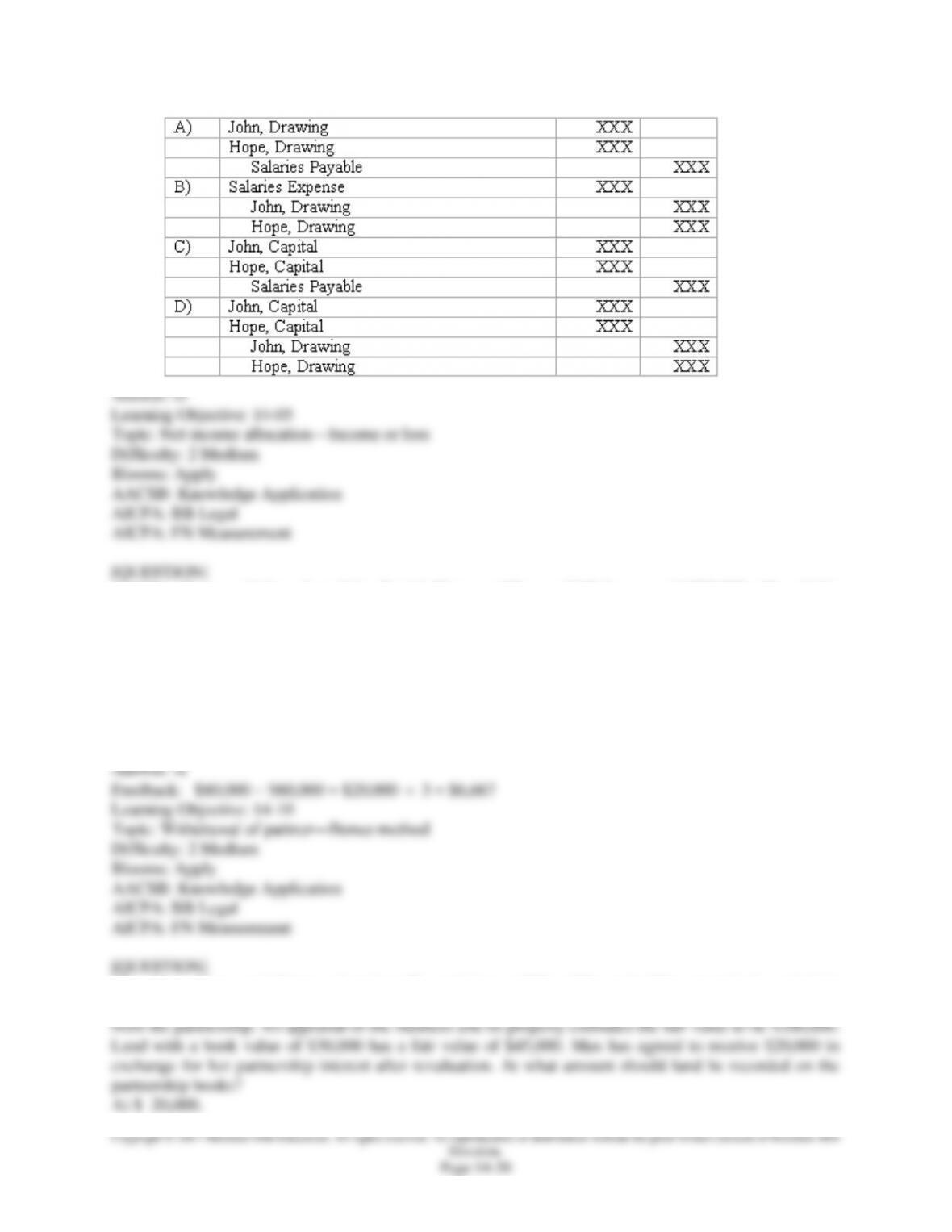
45. The appropriate format of the December 31, 2017 closing entry for John & Hope Limited Liability
Partnership, whose two partners had withdrawn their salaries from the partnership during the year, is:
46. When Danny withdrew from John, Daniel, Harry, and Danny, LLP, he was paid $80,000, although his
capital account balance was only $60,000. The four partners shared net income and losses equally, and no
revaluation will take place. The journal entry to record the effect on John’s capital due to Danny’s
withdrawal would include:
A) $ 6,667 debit to John, Capital.
B) $ 6,667 credit to John, Capital.
C) $20,000 debit to John, Capital.
D) $ 5,000 debit to John, Capital.
E) $ 5,000 credit to John, Capital.
47. Max, Jones and Waters shared profits and losses 20%, 40%, and 40% respectively and their
partnership capital balance is $10,000, $30,000 and $50,000 respectively. Max has decided to withdraw