File: Chapter 10 – Translation of Foreign Currency Financial Statements
1. In accounting, the term translation refers to
A) The calculation of gains or losses from hedging transactions.
B) The calculation of exchange rate gains or losses on individual transactions in foreign currencies.
C) The procedure required to identify a company’s functional currency.
D) The calculation of gains or losses from all transactions for the year.
E) A procedure to prepare a foreign subsidiary’s financial statements for consolidation.
2. What is a company’s functional currency?
A) The currency of the primary economic environment in which it operates.
B) The currency of the country where it has its headquarters.
C) The currency in which it prepares its financial statements.
D) The reporting currency of its parent for a subsidiary.
E) The currency it chooses to designate as such.
3. According to U.S. GAAP, when the local currency is the functional currency, which method is usually
required for translating a foreign subsidiary’s financial statements into the parent’s reporting currency?
A) The temporal method.
B) The current rate method.
C) The current/noncurrent method.
D) The monetary/nonmonetary method.
E) The noncurrent rate method.
Copyright © 2017 McGraw-Hill Education. All rights reserved. No reproduction or distribution without the prior written consent of McGraw-Hill
Education.
Page 10-2
Blooms: Remember
AACSB: Diversity
AACSB: Reflective Thinking
AICPA: BB Global
AICPA: FN Measurement
[QUESTION]
4. In translating a foreign subsidiary’s financial statements, which exchange rate does the current method
require for the subsidiary’s assets and liabilities?
A) The exchange rate in effect when each asset or liability was acquired.
B) The average exchange rate for the current year.
C) A calculated exchange rate based on market value.
D) The exchange rate in effect as of the balance sheet date.
E) The exchange rate in effect at the start of the current year.
5. When using the current rate method, the translation adjustment from translating a foreign subsidiary’s
financial statements should be shown as
A) An asset or liability (depending on the balance) in the consolidated balance sheet.
B) A revenue or expense (depending on the balance) in the consolidated income statement.
C) A component of stockholders’ equity in the consolidated balance sheet.
D) A component of cash flows from financing activities in the consolidated statement of cash flows.
E) An element of the notes which accompany the consolidated financial statements.
[QUESTION]
REFER TO: 10-01
6. Westmore reported sales of £1,500,000 during 2018. What amount (rounded) would have been
included for this subsidiary in calculating consolidated sales?
A) $2,415,000.
B) $2,400,000.
C) $2,385,000.
D) $ 943,396.
E) $ 931,677.
7. On December 31, 2018, Westmore had accounts receivable of £280,000. What amount (rounded)
would have been included for this subsidiary in calculating consolidated accounts receivable?
A) $173,913.
B) $176,100.
C) $445,200.
D) $448,000.
E) $450,800.
Jan. 1
£1 = $1.60
June 30
£1 = $1.64
Dec. 31
£1 = $1.61
Weighted average ra
te for the year
£1 = $1.59
Copyright © 2017 McGraw-Hill Education. All rights reserved. No reproduction or distribution without the prior written consent of McGraw-Hill
Education.
Page 10-4
AICPA: FN Measurement
Feedback: £280,000 × $1.61 = $450,800
[QUESTION]
8. Gunther Co. established a subsidiary in Mexico on January 1, 2018. The subsidiary engaged in the
following transactions during 2018:
What amount of foreign exchange gain or loss would have been recognized in Gunther’s consolidated
income statement for 2018?
A) $800,000 gain.
B) $760,000 gain.
C) $320,000 loss.
D) $280,000 loss.
E) $440,000 loss.
Jan. 1
Sold common stock to Gunther for
5,000,000 pesos.
Purchased inventory throughout the year, 8,000,000 pesos
(¼ of the inventory remained at year end).
Sales for the year totaled 12,000,000 pesos.
Dec. 31
Purchased equipment for 1,000,000 pesos.
Gunther concluded that the subsidiary’s
functional currency
was the dollar.
Exchange rates for 2018 were:
Jan. 1
1 peso = $.20
31
1 peso = $.19
Dec. 31
1 peso = $.16
Weighted average rate for the year
1 peso = $.18
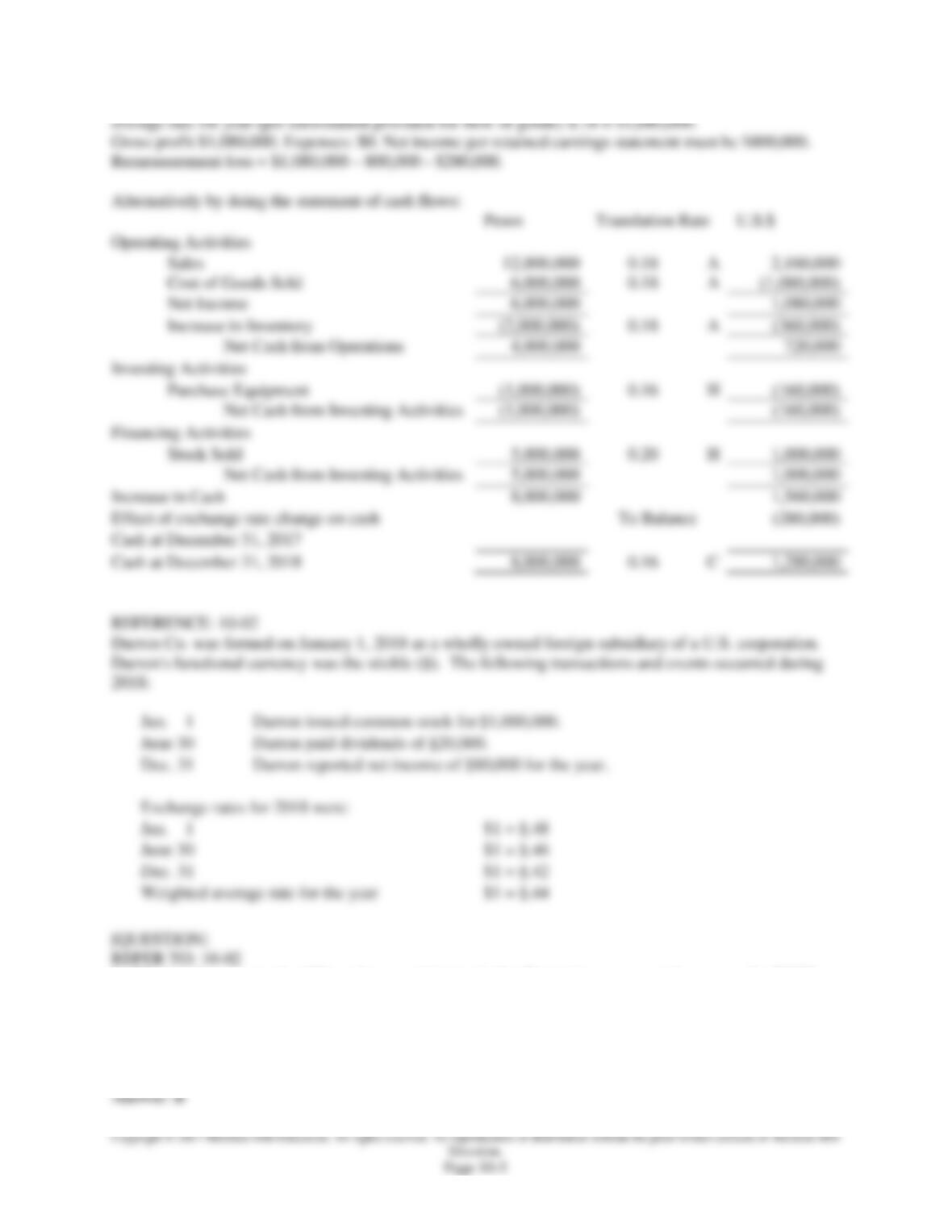
average rate for year (per information provided for flow of goods) $.18 = $1,080,000.
Gross profit $1,080,000. Expenses: $0. Net income per retained earnings statement must be $800,000.
Remeasurement loss = $1,080,000 – 800,000 – $280,000.
Alternatively by doing the statement of cash flows:
Pesos
Translation Rate
U.S.$
Operating Activities
Sales
12,000,000
0.18
A
2,160,000
Cost of Goods Sold
6,000,000
0.18
A
(1,080,000)
Net Income
6,000,000
1,080,000
Increase in Inventory
(2,000,000)
0.18
A
(360,000)
Net Cash from Operations
4,000,000
720,000
Investing Activities
Purchase Equipment
(1,000,000)
0.16
H
(160,000)
Net Cash from Investing Activities
(1,000,000)
(160,000)
Financing Activities
Stock Sold
5,000,000
0.20
H
1,000,000
Net Cash from Investing Activities
5,000,000
1,000,000
Increase in Cash
8,000,000
1,560,000
Effect of exchange rate change on cash
To Balance
(280,000)
Cash at December 31, 2017
Cash at December 31, 2018
8,000,000
0.16
C
1,280,000
REFERENCE: 10-02
Darron Co. was formed on January 1, 2018 as a wholly owned foreign subsidiary of a U.S. corporation.
Darron’s functional currency was the stickle (§). The following transactions and events occurred during
2018:
[QUESTION]
REFER TO: 10-02
9. What exchange rate should have been used in translating Darron’s revenues and expenses for 2018?
A) $1 = §.48.
B) $1 = §.44.
C) $1 = §.46.
D) $1 = §.42.
E) $1 = §.45.
Jan. 1
Darron issued common stock for
§1,000,000.
June 30
Darron paid dividends of §20,000.
Dec. 31
Darron reported net income of §80,000 for the year.
Exchange rates for 2018 were:
Jan. 1
$1 = §.48
June 30
$1 = §.46
Dec. 31
$1 = §.42
Weighted average rate for the year
$1 = §.44
Copyright © 2017 McGraw-Hill Education. All rights reserved. No reproduction or distribution without the prior written consent of McGraw-Hill
Education.
Page 10-6
Learning Objective: 10-01
Learning Objective: 10-02
Topic: Translation method―Choose the rate to use
Topic: Determine whether current rate or temporal method
Difficulty: 1 Easy
Blooms: Apply
AACSB: Diversity
AACSB: Knowledge Application
AICPA: BB Global
AICPA: FN Measurement
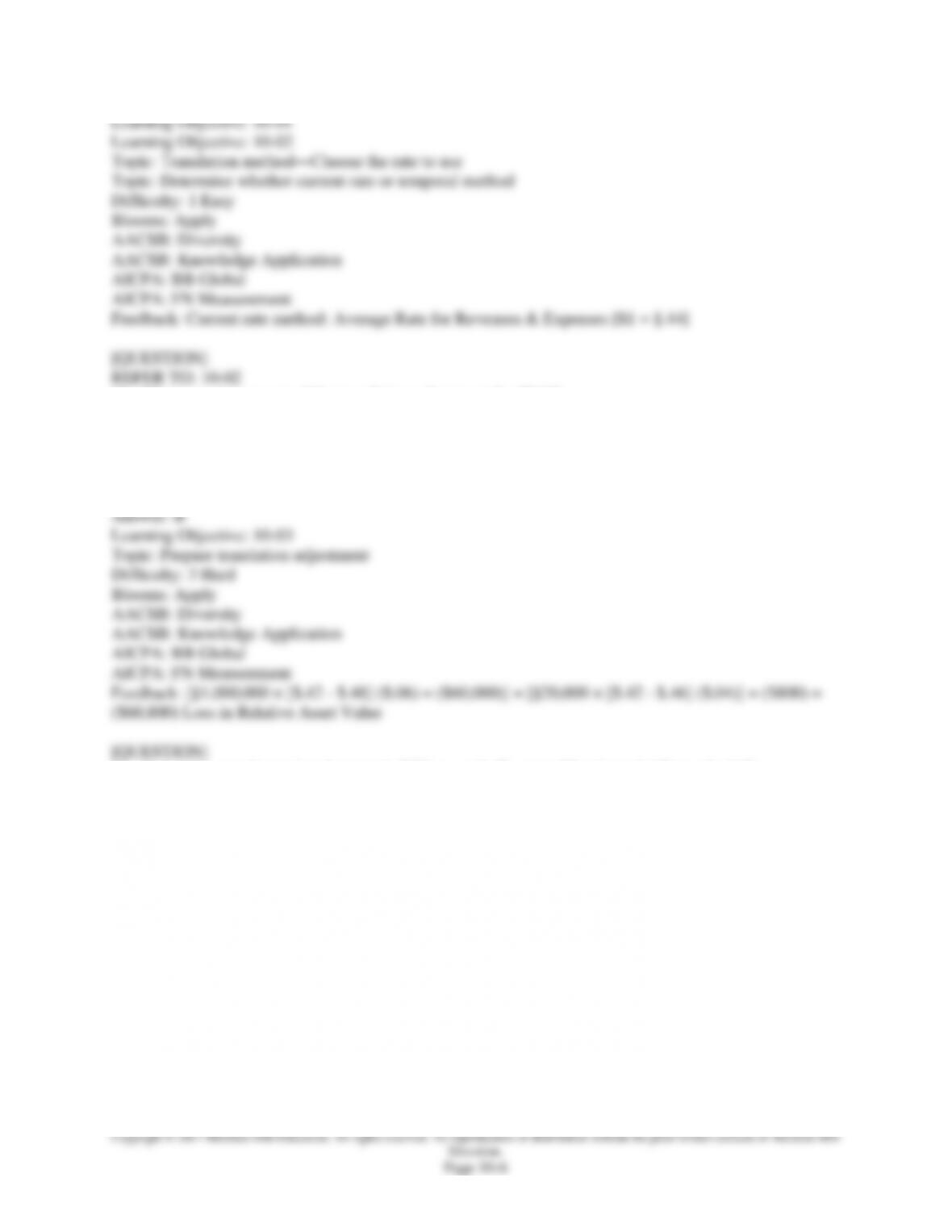
Feedback: Current rate method: Average Rate for Revenues & Expenses [$1 = §.44]
[QUESTION]
REFER TO: 10-02
10. What was the amount of the translation adjustment for 2018?
A) $60,800 decrease in relative value of net assets.
B) $60,800 decrease in relative value of net assets.
C) $61,200 decrease in relative value of net assets.
D) $466,400 increase in relative value of net assets.
E) $26,000 increase in relative value of net assets.
11. Sinkal Co. was formed on January 1, 2018 as a wholly owned foreign subsidiary of a U.S.
corporation. Sinkal’s functional currency was the stickle (§). The following transactions and events
occurred during 2018:
What was the amount of the translation adjustment for 2018?
A) $52,000 decrease in relative value of net assets.
B) $60,400 decrease in relative value of net assets.
Jan. 1
Sinkal issued common stock for
§1,000,000.
June 30
Sinkal paid dividends of §20,000.
Dec. 31
Sinkal reported net income of §80,000 for the year.
Exchange rates for 2018 were:
Jan. 1
§1 = $.42
June 30
§1 = $.46
Dec. 31
§1 = $.48
Weighted average rate for the year
§1 = $.44
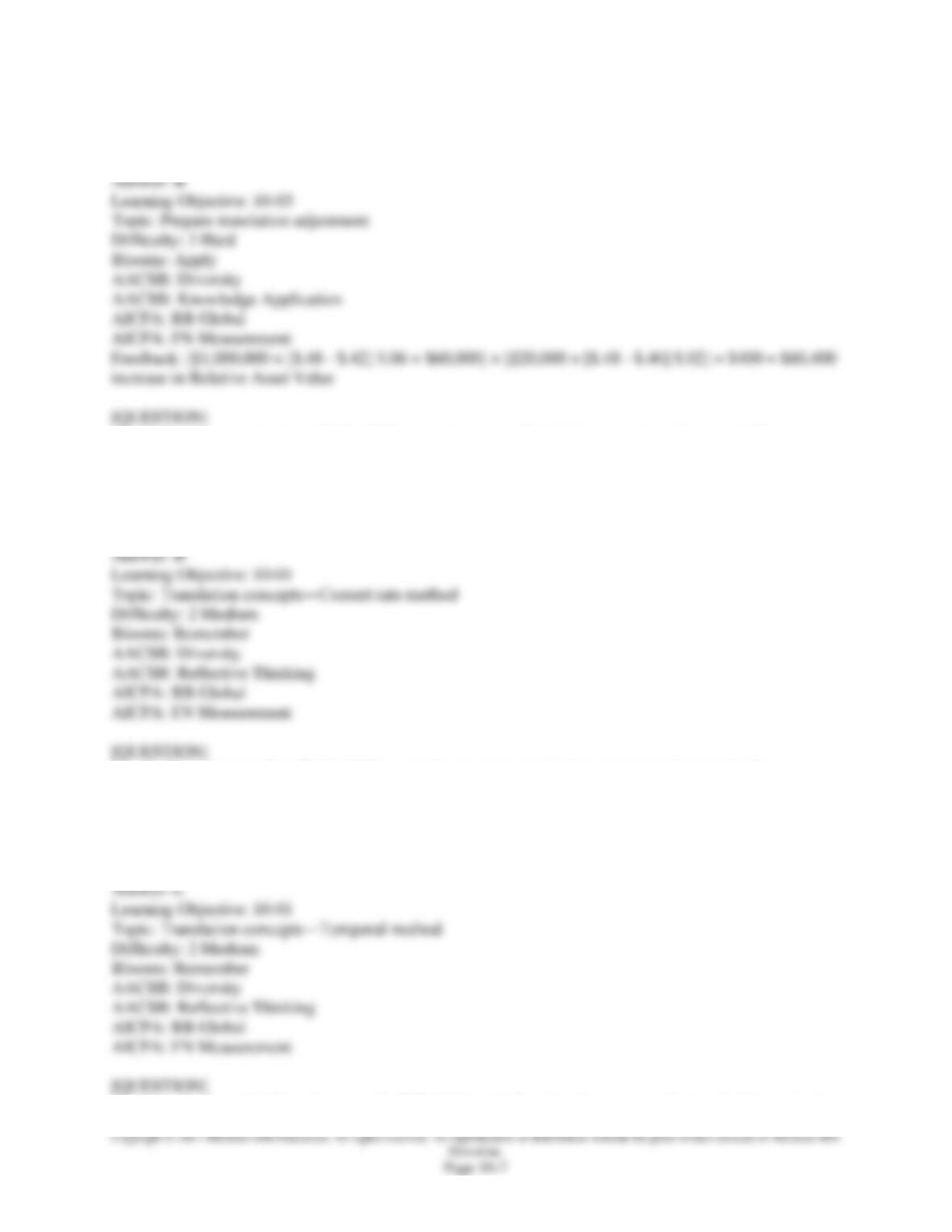
C) $60,400 increase in relative value of net assets.
D) $440,000 decrease in relative value of net assets.
E) $26,000 increase in relative value of net assets.
12. Under the current rate method, which accounts are translated using current exchange rates?
A) All revenues and expenses.
B) All assets and liabilities.
C) Cash, receivables, and most liabilities.
D) All current assets and deferred income.
E) All stockholders’ equity.
13. Under the temporal method, which accounts are remeasured using current exchange rates?
A) All revenues and expenses.
B) All assets and liabilities.
C) Cash, receivables, and most liabilities.
D) All current assets and deferred income.
E) All stockholders’ equity.
14. For a foreign subsidiary that uses the U.S. dollar as its functional currency, what method is required
to ready the financial statements for consolidation?
A) Current/Noncurrent Method.
B) Monetary/Nonmonetary Method.
C) Current Rate Method.
D) Temporal Method.
E) Indirect Method.
15. Which one of the following statements would justify this conclusion?
A) Most of the subsidiary’s sales and purchases were with companies in the U.S.
B) Dilty’s functional currency is the dollar and Dilty is the parent.
C) Dilty’s other subsidiaries all had the dollar as their functional currency.
D) Generally accepted accounting principles require that the subsidiary’s functional currency must be the
dollar if consolidated financial statements are to be prepared.
E) Dilty is located in the U.S.
16. What must Dilty do to ready the subsidiary’s financial statements for consolidation?
A) First translate, then remeasure them.
B) First remeasure, then translate them.
C) State all of the subsidiary’s accounts in U.S. dollars using the exchange rate in effect at the balance
sheet date.
D) Translate them.
E) Remeasure them.
Copyright © 2017 McGraw-Hill Education. All rights reserved. No reproduction or distribution without the prior written consent of McGraw-Hill
Education.
Page 10-9
Difficulty: 1 Easy
Blooms: Understand
AACSB: Diversity
AACSB: Reflective Thinking
AICPA: BB Global
AICPA: FN Measurement
REFERENCE: 10-04
Certain balance sheet accounts of a foreign subsidiary of the Tulip Co. had been stated in U.S. dollars as
follows:
[QUESTION]
REFER TO: 10-04
17. If the subsidiary’s local currency is its functional currency, what total amount should be included in
Tulip’s balance sheet in U.S. dollars?
A) $609,000.
B) $658,000.
C) $602,000.
D) $630,000.
E) $616,000.
18. If the U.S. dollar is the functional currency of this subsidiary, what total amount should be included
Stated at
Current
Historical
Rates
Rates
Accounts receivable
—
current
$ 280,000
$ 308,000
Accounts receivable
—
long
–
term
140,000
154,000
Prepaid insurance
70,000
77,000
Goodwill
112,000
119,000
Totals
$ 602,000
$ 658,000
in Tulip’s balance sheet in U.S. dollars?
A) $609,000.
B) $658,000.
C) $602,000.
D) $630,000.
E) $616,000.
19. What amount would have been reported for this inventory in Porter’s consolidated balance sheet at
December 31, 2017?
A) $24,000.
B) $26,400.
C) $22,800.
D) $27,600.
E) $28,800.
Copyright © 2017 McGraw-Hill Education. All rights reserved. No reproduction or distribution without the prior written consent of McGraw-Hill
Education.
Page 10-11
Difficulty: 1 Easy
Blooms: Apply
AACSB: Diversity
AACSB: Knowledge Application
AICPA: BB Global
AICPA: FN Measurement
Feedback: Current rate method: §120,000 × $.20 = $24,000
[QUESTION]
REFER TO: 10-05
20. What amount would have been reported for cost of goods sold on Porter’s consolidated income
statement at December 31, 2018?
A) $24,000.
B) $26,400.
C) $22,800.
D) $27,600.
E) $28,800.
21. A U.S. company’s foreign subsidiary had the following amounts in stickles (§) in 2018:
The average exchange rate during 2018 was §1 = $.96. The beginning inventory was acquired when the
exchange rate was §1 = $1.20. The ending inventory was acquired when the exchange rate was §1 = $.90.
The exchange rate at December 31, 2018 was §1 = $.84. Assuming that the foreign country had a highly
inflationary economy, at what amount should the foreign subsidiary’s cost of goods sold have been
reflected in the 2018 U.S. dollar income statement?
A) $11,253,600.
B) $11,577,600.
C) $11,649,600.
D) $11,613,600.
E) $11,523,600.
Cost of goods sold
§ 12,000,000
Ending inventory
600,000
Beginning inventory
240,000
Copyright © 2017 McGraw-Hill Education. All rights reserved. No reproduction or distribution without the prior written consent of McGraw-Hill
Education.
Page 10-12
Learning Objective: 10-01
Learning Objective: 10-02
Topic: Temporal method―Cost of goods sold
Topic: Highly inflationary economies
Difficulty: 3 Hard
Blooms: Apply
AACSB: Diversity
AACSB: Knowledge Application
AICPA: BB Global
AICPA: FN Measurement
Feedback: Beginning Inventory [(§240,000 × $1.20) $288,000] – Purchases [Beginning Inventory
§240,000 – COGS §12,000,000 – Ending Inventory §600,000 = §12,360,000 × $.96 = $11,865,600] –
Ending Inventory [(§600,000 × $.90) $540,000] = COGS $11,613,600
[QUESTION]
22. A U.S. company’s foreign subsidiary had the following amounts in stickles (§), the functional
currency, in 2018:
The average exchange rate during 2018 was §1 = $.96. The beginning inventory was acquired when the
exchange rate was §1 = $1.20. The ending inventory was acquired when the exchange rate was §1 = $.90.
The exchange rate at December 31, 2018 was §1 = $.84. At what amount should the foreign subsidiary’s
cost of goods sold have been reflected in the 2018 U.S. dollar income statement?
A) $11,253,600.
B) $11,577,600.
C) $11,520,000.
D) $11,613,600.
E) $11,523,600.
23. A U.S. company’s foreign subsidiary had the following amounts in stickles (§), the functional
currency, in 2018:
Cost of goods sold
§ 12,000,000
Ending inventory
600,000
Beginning inventory
240,000
The average exchange rate during 2018 was §1 = $.96. The beginning inventory was acquired when the
exchange rate was §1 = $1.20. The ending inventory was acquired when the exchange rate was §1 = $.90.
The exchange rate at December 31, 2018 was §1 = $.84. Assuming that the foreign nation for the
subsidiary had a highly inflationary economy, at what amount should that foreign subsidiary’s purchases
have been reflected in the 2018 U.S. dollar income statement?
A) $11,865,600.
B) $11,577,600.
C) $11,520,000.
D) $11,613,600.
E) $11,523,600.
24. An historical exchange rate for common stock of a foreign subsidiary is best described as
A) The rate at date of the acquisition business combination.
B) The rate when the common stock was originally issued for the acquisition transaction.
C) The average rate from date of acquisition to the date of the balance sheet.
D) The rate from the prior year’s balances.
E) The January 1 exchange rate.
25. A net asset balance sheet exposure exists and the foreign currency appreciates. Which of the
following statements is true?
A) There is no translation adjustment.
Cost of goods sold
§ 12,000,000
Ending inventory
600,000
Beginning inventory
240,000
B) There is a transaction loss.
C) There is a transaction gain.
D) There is a negative translation adjustment.
E) There is a positive translation adjustment.
26. A net asset balance sheet exposure exists and the foreign currency depreciates. Which of the
following statements is true?
A) There is no translation adjustment.
B) There is a transaction loss.
C) There is a transaction gain.
D) There is a negative translation adjustment.
E) There is a positive translation adjustment.
27. A net liability balance sheet exposure exists and the foreign currency appreciates. Which of the
following statements is true?
A) There is no translation adjustment.
B) There is a transaction loss.
C) There is a transaction gain.
D) There is a negative translation adjustment.
E) There is a positive translation adjustment.
28. A net liability balance sheet exposure exists and the foreign currency depreciates. Which of the
following statements is true?
A) There is no translation adjustment.
B) There is a transaction loss.
C) There is a transaction gain.
D) There is a negative translation adjustment.
E) There is a positive translation adjustment.
29. Which method of translating a foreign subsidiary’s financial statements is correct if it is assumed that
the parent’s net investment is exposed to foreign exchange risk?
A) Historical rate method.
B) Working capital method.
C) Current rate method.
D) Remeasurement.
E) Temporal method.
30. Which method is used for remeasuring a foreign subsidiary’s financial statements?
A) Historical rate method.
B) Working capital method.
C) Current rate method.
D) Translation.
E) Temporal method.
31. Under the temporal method, inventory at net realizable value would be remeasured for the balance
sheet at what rate?
A) Beginning of the year rate.
B) Average rate.
C) Current rate.
D) Historical rate.
E) Composite amount.
32. Under the current rate method, inventory at net realizable value would be translated for the balance
sheet at what rate?
A) Beginning of the year rate.
B) Average rate.
C) Current rate.
D) Historical rate.
E) Composite amount.
33. Under the temporal method, common stock would be remeasured at what rate?
A) Beginning of the year rate.
B) Average rate.
C) Current rate.
D) Historical rate.
E) Composite amount.
Copyright © 2017 McGraw-Hill Education. All rights reserved. No reproduction or distribution without the prior written consent of McGraw-Hill
Education.
Page 10-17
AICPA: BB Global
AICPA: FN Measurement
[QUESTION]
34. Under the current rate method, common stock would be translated at what rate?
A) Beginning of the year rate.
B) Average rate.
C) Current rate.
D) Historical rate.
E) Composite amount.
35. Under the current rate method, property, plant & equipment would be translated at what rate?
A) Beginning of the year rate.
B) Average rate.
C) Current rate.
D) Historical rate.
E) Composite amount.
36. Under the temporal method, property, plant & equipment would be remeasured at what rate?
A) Beginning of the year rate.
B) Average rate.
C) Current rate.
D) Historical rate.
E) Composite amount.
Copyright © 2017 McGraw-Hill Education. All rights reserved. No reproduction or distribution without the prior written consent of McGraw-Hill
Education.
Page 10-18
AICPA: BB Global
AICPA: FN Measurement
[QUESTION]
37. Under the current rate method, retained earnings would be translated at what rate?
A) Beginning of the year rate.
B) Average rate.
C) Current rate.
D) Historical rate.
E) Composite amount.
38. Under the temporal method, retained earnings would be remeasured at what rate?
A) Beginning of the year rate.
B) Average rate.
C) Current rate.
D) Historical rate.
E) Composite amount.
39. Under the current rate method, depreciation expense would be translated at what rate?
A) Beginning of the year rate.
B) Average rate.
C) Current rate.
D) Historical rate.
E) Composite amount.
Copyright © 2017 McGraw-Hill Education. All rights reserved. No reproduction or distribution without the prior written consent of McGraw-Hill
Education.
Page 10-19
AICPA: BB Global
AICPA: FN Measurement
[QUESTION]
40. Under the temporal method, depreciation expense would be remeasured at what rate?
A) Beginning of the year rate.
B) Average rate.
C) Current rate.
D) Historical rate.
E) Composite amount.
41. Under the temporal method, how would cost of goods sold be remeasured?
A) Beginning of the year rate.
B) Average rate.
C) Current rate.
D) A single historical rate.
E) Historical rates.
42. Under the current rate method, how would cost of goods sold be translated?
A) Beginning of the year rate.
B) Average rate.
C) Current rate.
D) Historical rate.
E) Composite amount.
Copyright © 2017 McGraw-Hill Education. All rights reserved. No reproduction or distribution without the prior written consent of McGraw-Hill
Education.
Page 10-20
AICPA: BB Global
AICPA: FN Measurement
[QUESTION]
43. Where is the translation adjustment reported in the parent company’s financial statements?
A) Net loss in the income statement.
B) Cumulative translation adjustment as a deferred asset.
C) Cumulative translation adjustment as a deferred liability.
D) Accumulated other comprehensive income.
E) Retained earnings.
44. Where is the remeasurement gain or loss reported in the parent company’s financial statements?
A) Net income/loss in the income statement.
B) Cumulative translation adjustment as a deferred asset.
C) Cumulative translation adjustment as a deferred liability.
D) Other comprehensive income.
E) Retained earnings.
45. A highly inflationary economy is defined as
A) Cumulative 5-year inflation in excess of 100%.
B) Cumulative 3-year inflation in excess of 100%.
C) Cumulative 5-year inflation in excess of 90%.
D) Cumulative 3-year inflation in excess of 90%.
E) Any country designated as a company operating in a third-world economy.