[QUESTION]
90. At what amount will Inkblot be reflected in Trycker’s December 31, 2017 balance sheet?
A) $2,400,000.
B) $2,280,000.
C) $2,480,000.
D) $2,800,000.
E) $7,000,000.
91. For each of the following numbered situations below, select the best letter answer concerning
accounting for investments:
(A) Increase the investment account.
(B) Decrease the investment account.
(C) Increase dividend revenue.
(D) No adjustment necessary.
(1.) Income reported by 40% owned investee.
(2.) Income reported by 10% owned investee.
(3.) Loss reported by 40% owned investee.
(4.) Loss reported by 10% investee.
(5.) Change from fair-value method to equity method. Prior income exceeded dividends.
(6.) Change from fair-value method to equity method. Prior income was less than dividends.
(7.) Change from equity method to fair-value method. Prior income exceeded dividends.
(8.) Change from equity method to fair-value method. Prior income was less than dividends.
(9.) Dividends received from 40% investee.
(10.) Dividends received from 10% investee.
(11.) Purchase of additional shares of investee.
(12.) Investor’s share of gross profit from intra-entity inventory sales when using the equity method.
Copyright © 2017 McGraw-Hill Education. All rights reserved. No reproduction or distribution without the prior written consent of McGraw-Hill
Education.
Page 1-41
Topic: Equity method―Investment income
Topic: Report change to equity method
Topic: Report sale of equity investment
Topic: Intra–entity sales of inventory
Difficulty: 2 Medium
Blooms: Analyze
AACSB: Analytical Thinking
AICPA: BB Critical Thinking
AICPA: FN Measurement
[QUESTION]
92. Jarmon Company owns twenty-three percent (23%) of the voting common stock of Kaleski Corp.
Jarmon does not have the ability to exercise significant influence over the operations of Kaleski. What
method should Jarmon use to account for its investment in Kaleski?
93. Idler Co. has an investment in Cowl Corp. for which it uses the equity method. Cowl has suffered
large losses for several years, and the balance in the investment account has been reduced to zero. How
should Idler account for this investment?
94. Which types of transactions, exchanges, or events would indicate that an investor has the ability to
exercise significant influence over the operations of an investee?
Copyright © 2017 McGraw-Hill Education. All rights reserved. No reproduction or distribution without the prior written consent of McGraw-Hill
Education.
Page 1-42
ownership and the concentration of other ownership interests in the investee; (6) investor participation in
the policy-making process of the investee. All of these conditions should be examined to determine
whether the investor has the ability to exercise significant influence over the investee.
Learning Objective: 01-02
Topic: Equity method―Significant influence criterion
Difficulty: 2 Medium
Blooms: Remember
AACSB: Reflective Thinking
AACSB: Communication
AICPA: BB Critical Thinking
AICPA: FN Measurement
[QUESTION]
95. You are auditing a company that owns twenty percent of the voting common stock of another
corporation and uses the equity method to account for the investment. How would you verify that the
equity method is appropriate in this case?
96. How does the use of the equity method affect the investor’s financial statements?
97. What is the primary objective of the equity method of accounting for an investment?
98. What is the justification for the timing of recognition of income under the equity method?
99. What argument could be made against the equity method?
100. How would a change be made from the equity method to the fair value method of accounting for
investments?
Copyright © 2017 McGraw-Hill Education. All rights reserved. No reproduction or distribution without the prior written consent of McGraw-Hill
Education.
Page 1-44
Answer:
A change to the fair value method is appropriate when the investor can no longer exercise significant
influence over the operations of the investee. No retrospective adjustment of previous years’ financial
statements or the balance in the investment account is required. The balance in the investment account at
the time of the change would be treated prospectively as the cost of the investment.
Learning Objective: 01-03
Topic: Equity method―Investment income
Difficulty: 3 Hard
Blooms: Remember
AACSB: Reflective Thinking
AACSB: Communication
AICPA: BB Critical Thinking
AICPA: FN Measurement
[QUESTION]
101. How should an investor account for, and report, an investee’s other comprehensive income (or loss)?
102. When should an investor not use the equity method for an investment of 21% in another corporation?
103. What is the primary objective of the fair value method of accounting for an investment?
Copyright © 2017 McGraw-Hill Education. All rights reserved. No reproduction or distribution without the prior written consent of McGraw-Hill
Education.
Page 1-45
Difficulty: 2 Medium
Blooms: Remember
AACSB: Reflective Thinking
AACSB: Communication
AICPA: BB Critical Thinking
AICPA: FN Measurement
[QUESTION]
104. How would a change be made from the fair value method to the equity method of accounting for
investments?
105. When the fair value option is elected for application to an investment in which the investor has
significant influence over the investee, how would the investor reflect the use of the fair value option in
its balance sheet and in its income statement?
106. Charlie Co. owns 30% of the voting common stock of Turf Services Inc. Charlie uses the equity
method to account for its investment. On January 1, 2018, the balance in the investment account was
$624,000. During 2018, Turf Services reported net income of $120,000 and paid dividends of $30,000.
Any excess of fair value over book value is attributable to goodwill with an indefinite life.
What is the balance in the investment account as of December 31, 2018?
Learning Objective: 01-02
Topic: Equity method―Investment account balance
Difficulty: 2 Medium
Blooms: Apply
AACSB: Knowledge Application
AICPA: BB Critical Thinking
AICPA: FN Measurement
[QUESTION]
107. Tinker Co. owns 25% of the common stock of Harbor Co. and uses the equity method to account for
the investment. During 2018, Harbor reported income of $120,000 and paid dividends of $40,000. Harbor
owns a building with a useful life of twenty years, which was undervalued by $80,000 at the time that
Tinker bought its shares of Harbor’s common stock.
Required:
Prepare a schedule to show the equity income Tinker should recognize for 2018 related to this investment.
108. Aqua Corp. purchased 30% of the common stock of Marcus Co. by paying $500,000. Of this
amount, $50,000 is associated with goodwill.
Required:
Prepare the journal entry to record Aqua’s investment.
Investment in Turf Services Inc.:
Balance at January 1, 2018
$ 624,000
2018 equity income accrual ($120,000 × 30%)
36,000
2018 dividends ($30,000 × 30%)
( 9,000)
Balance at December 31, 2018
$ 651,000
Copyright © 2017 McGraw-Hill Education. All rights reserved. No reproduction or distribution without the prior written consent of McGraw-Hill
Education.
Page 1-47
Learning Objective: 01-04
Topic: Equity method―Basic journal entries
Topic: Equity method―Allocate cost of investment
Difficulty: 2 Medium
Blooms: Apply
AACSB: Knowledge Application
AICPA: BB Critical Thinking
AICPA: FN Measurement
[QUESTION]
109. On January 2, 2018, Heinreich Co. paid $500,000 for 25% of the voting common stock of Jones
Corp. At the time of the investment, Jones had net assets with a book value and fair value of $1,800,000.
During 2018, Jones incurred a net loss of $60,000 and paid dividends of $100,000. Any excess cost over
book value is attributable to goodwill with an indefinite life.
Required:
1) Prepare a schedule to show the amount of goodwill from Heinrich’s investment in Jones.
2) Prepare a schedule to show the balance in Heinreich’s investment account at December 31, 2018.
110. On January 3, 2018, Jenkins Corp. acquired 40% of the outstanding common stock of Bolivar Co.
The journal entry is:
Investment in Marcus Co
500,000
Cash
500,000
The amount of goodwill does not affect the journal entry used to record the
investment.
for $1,200,000. This acquisition gave Jenkins the ability to exercise significant influence over the
investee. The book value of the acquired shares was $950,000. Any excess cost over the underlying book
value was assigned to a patent that was undervalued on Bolivar’s balance sheet. This patent has a
remaining useful life of ten years. For the year ended December 31, 2018, Bolivar reported net income of
$312,000 and paid cash dividends of $96,000.
Required:
Prepare a schedule to show the balance Jenkins should report as its Investment in Bolivar Co. at
December 31, 2018.
111. On January 1, 2018, Spark Corp. acquired a 40% interest in Cranston Inc. for $250,000. On that
date, Cranston’s balance sheet disclosed net assets of $430,000. During 2018, Cranston reported net
income of $100,000 and paid cash dividends of $30,000. Spark sold inventory costing $40,000 to
Cranston during 2018 for $50,000. Cranston used all of this merchandise in its operations during 2018.
Any excess cost over fair value is attributable to an unamortized trademark with a 20-year remaining life.
Required:
Prepare all of Spark’s journal entries for 2018 to apply the equity method to this investment.
Copyright © 2017 McGraw-Hill Education. All rights reserved. No reproduction or distribution without the prior written consent of McGraw-Hill
Education.
Page 1-49
Equity in Investee Income
40,000
To recognize forty percent of income earned during
the period by Cranston Inc., an investment recorded
using the equity method.
Cash
12,000
Investment in Cranston Inc.
12,000
To record collection of dividend from investee
using the equity method
Equity in Investee Income
3,900
Investment in Cranston Inc.
3,900
To reflect amortization of trademark excess over book
value acquired.
**Note: All merchandise was used, so no deferral entry is needed.
Learning Objective: 01-02
Learning Objective: 01-03
Learning Objective: 01-04
Learning Objective: 01-06
Topic: Equity method―Basic journal entries
Topic: Equity method―Investment income
Topic: Equity method―Amortize allocations
Topic: Intra–entity sales of inventory
Difficulty: 3 Hard
Blooms: Apply
AACSB: Knowledge Application
AICPA: BB Critical Thinking
AICPA: FN Measurement
[QUESTION]
112. Wathan Inc. sold $180,000 in inventory to Miller Co. during 2017, for $270,000. Miller resold
$108,000 of this merchandise in 2017 with the remainder to be disposed of during 2018.
Required:
Assuming Wathan owns 25% of Miller and applies the equity method, prepare the journal entry Wathan
should have recorded at the end of 2017 to defer gross profit on intra-entity inventory sales.
Ending inventory ($270,000 – $108,000)
Gross profit markup ($90,000 ÷ $270,000)
Gross profit on intra-entity inventory sales
Ownership percentage
profit to defer to subsequent year
Equity Income – Investment in Miller Co.
Investment in Miller Co.

Copyright © 2017 McGraw-Hill Education. All rights reserved. No reproduction or distribution without the prior written consent of McGraw-Hill
Education.
Page 1-50
Topic: Intra–entity sales of inventory
Difficulty: 3 Hard
Blooms: Apply
AACSB: Knowledge Application
AICPA: BB Critical Thinking
AICPA: FN Measurement
[QUESTION]
113. Jager Inc. holds 30% of the outstanding voting shares of Kinson Co. and appropriately applies the
equity method of accounting. Amortization associated with this investment equals $11,000 per year. For
2018, Kinson reported earnings of $100,000 and paid cash dividends of $40,000. During 2018, Kinson
acquired inventory for $62,400, which was then sold to Jager for $96,000. At the end of 2018, Jager still
held some of this inventory at its intra-entity selling price of $50,000.
Required:
Determine the amount of Equity in Investee Income that Jager should have reported for 2018.
Equity in investee income:
Equity income accrual ($100,000 × 30%)
$ 30,000
Deferral of share of intra-entity gross profit (below)
( 5,250)
Amortization (given)
( 11,000)
Equity in investee income
$ 13,750
Deferral of its share of intra-entity gross profit:
Remaining inventory
—
end of year
$ 50,000
Gross profit percentage ($33,600 ÷ $96,000)
× 35%
Profit within remaining inventory
$ 17,500
Ownership percentage
× 30%
Share of intra-entity gross profit
$ 5,250
[QUESTION]
114. On January 2, 2017, Hull Corp. paid $516,000 for 24% (48,000 shares) of the outstanding common
stock of Oliver Co. Hull used the equity method to account for the investment. At the end of 2017, the
balance in the investment account was $620,000. On January 2, 2018, Hull sold 12,000 shares of Oliver
stock for $12 per share. For 2018, Oliver reported net income of $118,000 and paid dividends of $30,000.
Required:
(A) Prepare the journal entry to record the sale of the 12,000 shares.
(B) After the sale has been recorded, what is the balance in the investment account?
(C) What percentage of Oliver Co. stock does Hull own after selling the 12,000 shares?
(D) Because of the sale of stock, Hull can no longer exercise significant influence over the operations of
Oliver. What effect will this have on Hull’s accounting for the investment?
(E) Prepare Hull’s journal entries related to the investment for the rest of 2018.
Blooms: Apply
AACSB: Knowledge Application
AICPA: BB Critical Thinking
AICPA: FN Measurement
[QUESTION]
115. On January 1, 2018, Jolley Corp. paid $250,000 for 25% of the voting common stock of Tige Co. On
that date, the book value of Tige was $850,000. A building with a carrying value of $160,000 was
actually worth $220,000. The building had a remaining life of twenty years. Tige owned a trademark
valued at $90,000 over cost that was to be amortized over 20 years.
During 2018, Tige sold to Jolley inventory costing $60,000, at a markup of 50% on cost. At the end of the
year, Jolley still owned some of these goods with an intra-entity selling price of $33,000. Jolly uses a
perpetual inventory system.
Tige reported net income of $200,000 during 2018. This amount included a gain of $35,000. Tige paid
dividends totaling $40,000.
Required:
Prepare all of Jolley’s journal entries for 2018 in relation to Tige Co. Assume the equity method is
appropriate for use.
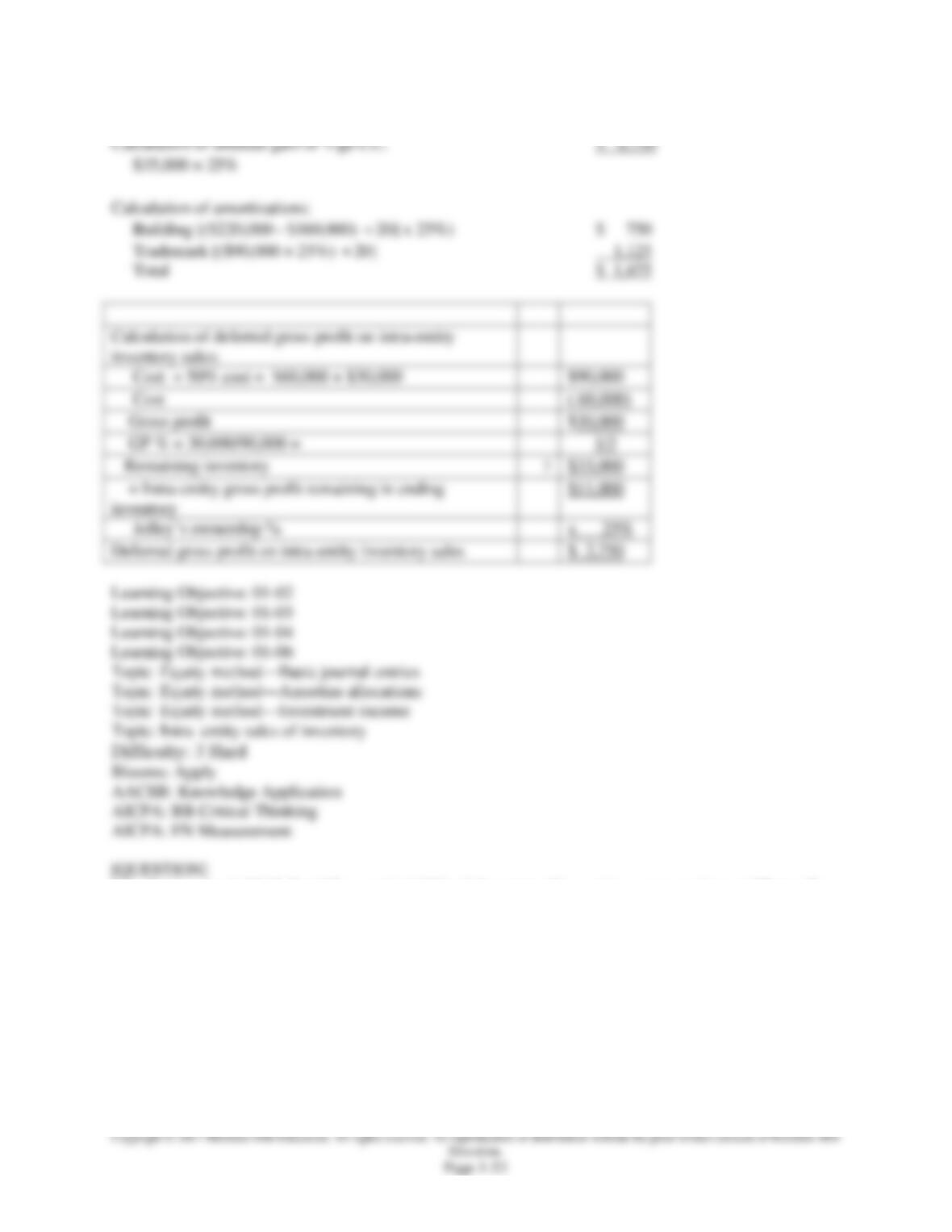
Calculation of unusual gain of Tige Co.:
$ 8,750
$35,000 × 25%
Calculation of amortizations:
Building [($220,000 – $160,000)
20] x 25%)
$ 750
Trademark [($90,000 × 25%)
20]
1,125
Total
$ 1,875
Calculation of deferred gross profit on intra-entity
inventory sales:
Cost + 50% cost = $60,000 + $30,000
$90,000
Cost
( 60,000)
Gross profit
$30,000
GP % = 30,000/90,000 =
1/3
Remaining inventory
ラ
$33,000
= Intra-entity gross profit remaining in ending
inventory
$11,000
Jolley’s ownership %
x 25%
Deferred gross profit on intra-entity inventory sales
$ 2,750
Learning Objective: 01-02
Learning Objective: 01-03
Learning Objective: 01-04
Learning Objective: 01-06
Topic: Equity method―Basic journal entries
Topic: Equity method―Amortize allocations
Topic: Equity method―Investment income
Topic: Intra–entity sales of inventory
Difficulty: 3 Hard
Blooms: Apply
AACSB: Knowledge Application
AICPA: BB Critical Thinking
AICPA: FN Measurement
[QUESTION]
116. On January 1, 2017, Pond Co. acquired 40% of the outstanding voting common shares of Ramp Co.
for $700,000. On that date, Ramp reported assets and liabilities with book values of $2.2 million and
$700,000, respectively. A building owned by Ramp had an appraised value of $300,000, although it had a
book value of only $120,000. This building had a 12-year remaining life and no salvage value. It was
being depreciated on the straight-line basis.
Ramp generated net income of $300,000 in 2017 and a loss of $120,000 in 2018. In each of these two
years, Ramp paid a cash dividend of $70,000 to its stockholders.
During 2017, Ramp sold inventory to Pond that had an original cost of $60,000. The merchandise was
sold to Pond for $96,000. Of this balance, $72,000 was resold to outsiders during 2017 and the remainder
was sold during 2018. In 2018, Ramp sold inventory to Pond for $180,000. This inventory had cost only
$108,000. Pond resold $120,000 of the inventory during 2018 and the rest during 2019.
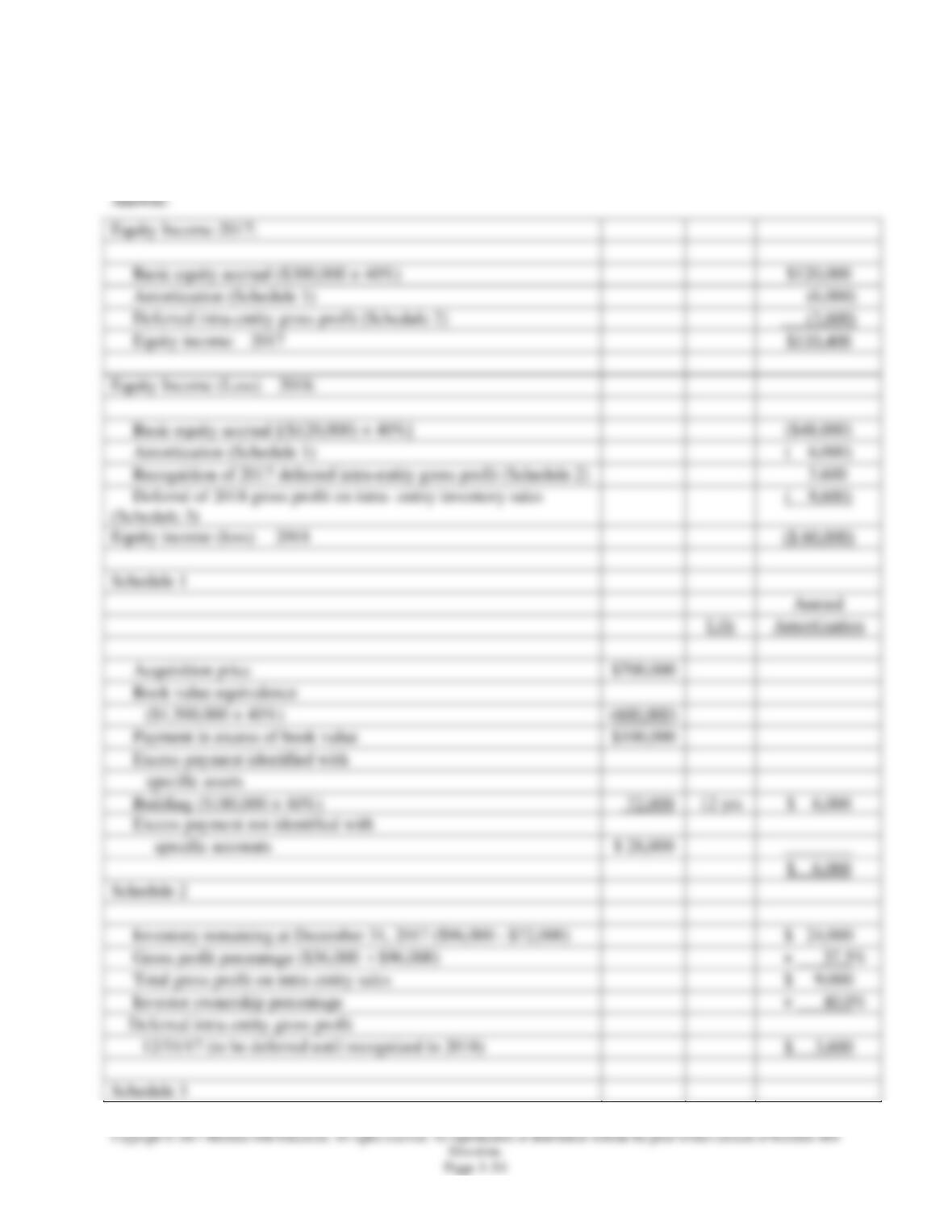
Required:
For 2017 and then for 2018, calculate the equity income to be reported by Pond for external reporting
purposes.
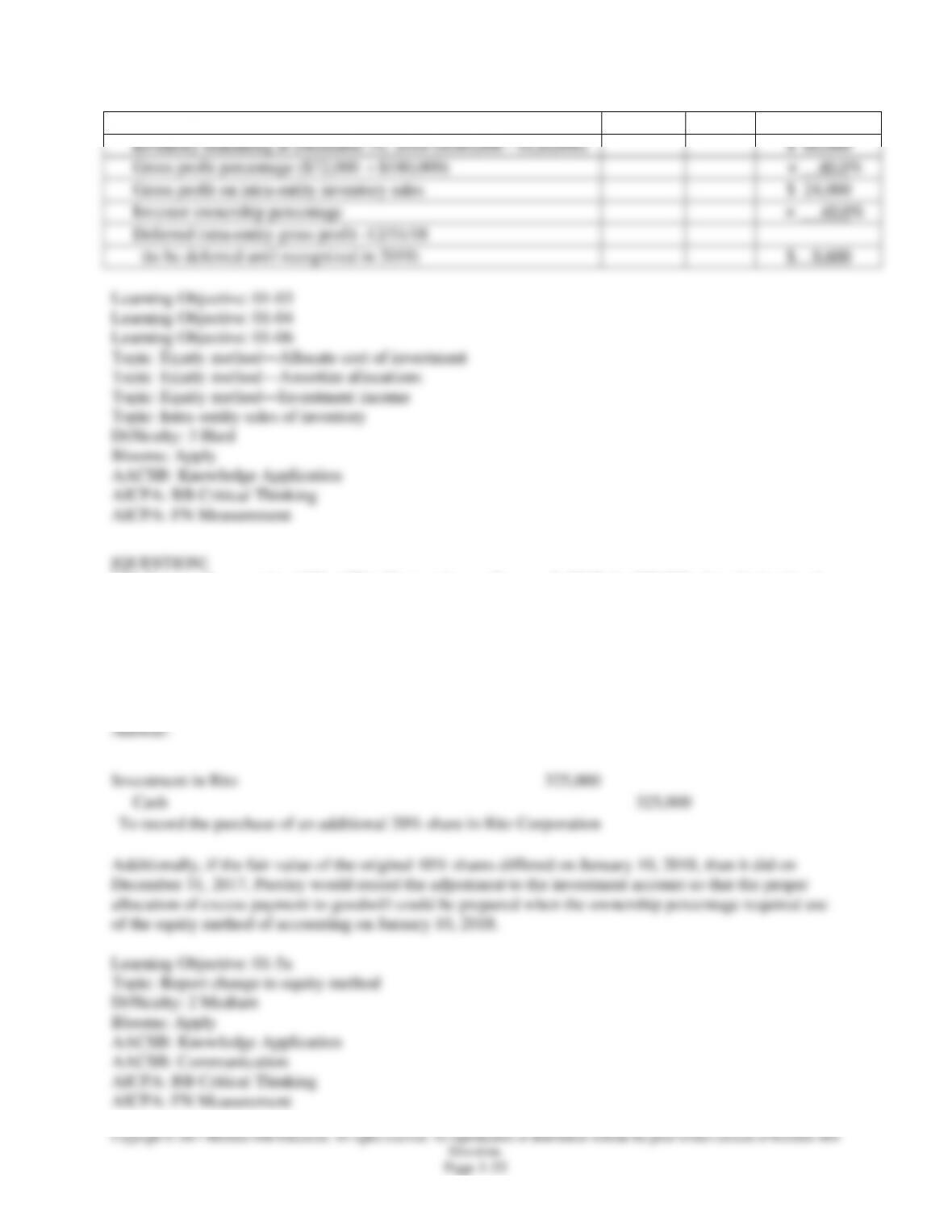
Inventory remaining at December 31, 2018 ($180,000 – $120,000)
$ 60,000
Gross profit percentage ($72,000
$180,000)
× 40.0%
Gross profit on intra-entity inventory sales
$ 24,000
Investor ownership percentage
× 40.0%
Deferred intra-entity gross profit -12/31/18
(to be deferred until recognized in 2019)
$ 9,600
Learning Objective: 01-03
Learning Objective: 01-04
Learning Objective: 01-06
Topic: Equity method―Allocate cost of investment
Topic: Equity method―Amortize allocations
Topic: Equity method―Investment income
Topic: Intra–entity sales of inventory
Difficulty: 3 Hard
Blooms: Apply
AACSB: Knowledge Application
AICPA: BB Critical Thinking
AICPA: FN Measurement
[QUESTION]
117. Pursley, Inc. acquires 10% of Ritz Corporation on January 3, 2017, for $80,000 when the book value
of Ritz was $800,000. Pursley adjusted the investment to its fair value of $162,500 at December 31, 2017.
During 2017 Ritz reported net income of $125,000 and paid dividends of $30,000. On January 10, 2018,
Pursley purchased an additional 20% of Ritz for $325,000, giving Pursley the ability to significantly
influence the operating policies of Ritz. Any excess of cost over book value is attributable to goodwill
with an indefinite life. What journal entry(ies) is(are) required on January 1, 2018?
Investment in Ritz
325,000
Cash
325,000
To record the purchase of an additional 20% share in Ritz Corporation
Additionally, if the fair value of the original 10% shares differed on January 10, 2018, than it did on
December 31, 2017, Pursley would record the adjustment to the investment account so that the proper
allocation of excess payment to goodwill could be prepared when the ownership percentage required use
of the equity method of accounting on January 10, 2018.
Learning Objective: 01-5a
Topic: Report change to equity method
Difficulty: 2 Medium
Blooms: Apply
AACSB: Knowledge Application
AACSB: Communication
AICPA: BB Critical Thinking
AICPA: FN Measurement
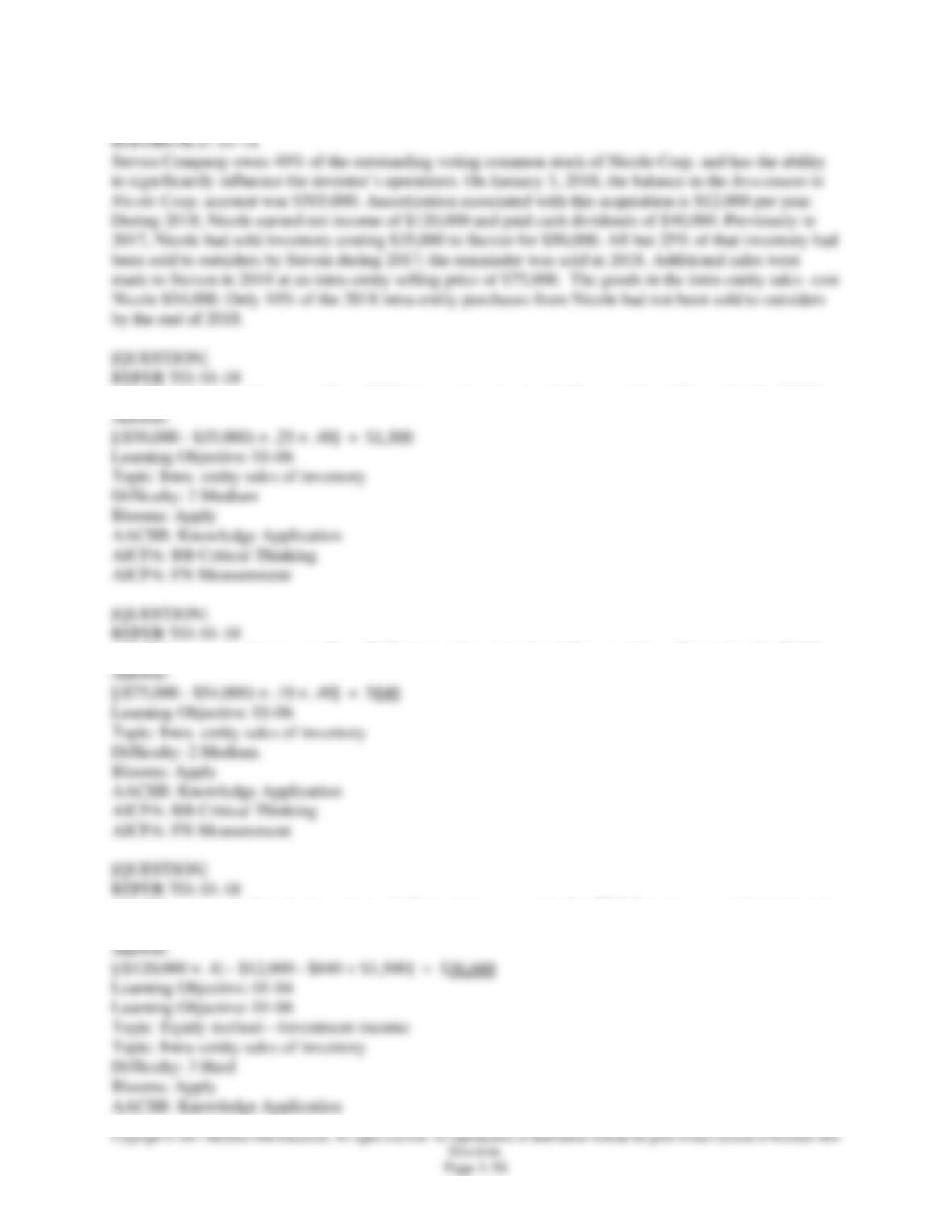
118. What amount of gross profit on 2017 intra-entity sales should Steven defer at December 31, 2017?
119. What amount of gross profit on 2018 intra-entity sales should Steven defer at December 31, 2018?
120. What amount of equity income would Steven have recognized in 2018 from its ownership interest in
Nicole?
Copyright © 2017 McGraw-Hill Education. All rights reserved. No reproduction or distribution without the prior written consent of McGraw-Hill
Education.
Page 1-57
AICPA: BB Critical Thinking
AICPA: FN Measurement
[QUESTION]
REFER TO: 01-18
121. What was the balance in the Investment in Nicole Corp. account at December 31, 2018?