File: Chapter 01 – The Equity Method of Accounting for Investments
Multiple Choice:
1. Gaw Company owns 15% of the common stock of Trace Corporation and used the fair-value method to
account for this investment. Trace reported net income of $110,000 for 2018 and paid dividends of
$60,000 on October 1, 2018. How much income should Gaw recognize on this investment in 2018?
A) $16,500.
B) $ 9,000.
C) $25,500.
D) $ 7,500.
E) $50,000.
2. Yaro Company owns 30% of the common stock of Dew Co. and uses the equity method to account for
the investment. During 2018, Dew reported income of $250,000 and paid dividends of $80,000. There is
no amortization associated with the investment. During 2018, how much income should Yaro recognize
related to this investment?
A) $24,000.
B) $75,000.
C) $99,000.
D) $51,000.
E) $80,000.
3. On January 1, 2018, Pacer Company paid $1,920,000 for 60,000 shares of Lennon Co.’s voting
common stock which represents a 45% investment. No allocation to goodwill or other specific account
was necessary. Significant influence over Lennon was achieved by this acquisition. Lennon distributed a
dividend of $2.50 per share during 2018 and reported net income of $670,000. What was the balance in
the Investment in Lennon Co. account found in the financial records of Pacer as of December 31, 2018?
A) $2,040,500.
B) $2,212,500.
C) $2,260,500.
D) $2,171,500.
E) $2,071,500.
4. An investor should always use the equity method to account for an investment if:
A) It has the ability to exercise significant influence over the operating policies of the investee.
B) It owns 30% of an investee’s stock.
C) It has a controlling interest (more than 50%) of an investee’s stock.
D) The investment was made primarily to earn a return on excess cash.
E) It does not have the ability to exercise significant influence over the operating policies of the investee.
5. On January 1, 2016, Dermot Company purchased 15% of the voting common stock of Horne Corp. On
January 1, 2018, Dermot purchased 28% of Horne’s voting common stock. If Dermot achieves significant
influence with this new investment, how must Dermot account for the change to the equity method?
A) It must use the equity method for 2018 but should make no changes in its financial statements for 2017
and 2016.
B) It should prepare consolidated financial statements for 2018.
C) It must restate the financial statements for 2017 and 2016 as if the equity method had been used for
those two years.
D) It should record a prior period adjustment at the beginning of 2018 but should not restate the financial
statements for 2017 and 2016.
E) It must restate the financial statements for 2017 as if the equity method had been used then.
6. During January 2017, Wells, Inc. acquired 30% of the outstanding common stock of Wilton Co. for
$1,400,000. This investment gave Wells the ability to exercise significant influence over Wilton. Wilton’s
assets on that date were recorded at $6,400,000 with liabilities of $3,000,000. Any excess of cost over
book value of Wells’ investment was attributed to unrecorded patents having a remaining useful life of
ten years.
In 2017, Wilton reported net income of $600,000. For 2018, Wilton reported net income of $750,000.
Dividends of $200,000 were paid in each of these two years. What was the reported balance of Wells’
Investment in Wilson Co. at December 31, 2018?
A) $1,609,000.
B) $1,485,000.
C) $1,685,000.
D) $1,647,000.
E) $1,054,300.
7. On January 1, 2018, Bangle Company purchased 30% of the voting common stock of Sleat Corp. for
$1,000,000. Any excess of cost over book value was assigned to goodwill. During 2018, Sleat paid
dividends of $24,000 and reported a net loss of $140,000. What is the balance in the investment account
on December 31, 2018?
A) $950,800.
B) $958,000.
C) $836,000.
D) $990,100.
E) $956,400.
8. On January 1, 2018, Jordan Inc. acquired 30% of Nico Corp. Jordan used the equity method to account
for the investment. On January 1, 2019, Jordan sold two-thirds of its investment in Nico. It no longer had
the ability to exercise significant influence over the operations of Nico. How should Jordan account for
this change?
A) Jordan should continue to use the equity method to maintain consistency in its financial statements.
B) Jordan should restate the prior years’ financial statements and change the balance in the investment
account as if the fair-value method had been used since 2018.
C) Jordan has the option of using either the equity method or the fair-value method for 2018 and future
years.
D) Jordan should report the effect of the change from the equity to the fair-value method as a
retrospective change in accounting principle.
E) Jordan should use the fair-value method for 2019 and future years, but should not make a retrospective
adjustment to the investment account.
9. Tower Inc. owns 30% of Yale Co. and applies the equity method. During the current year, Tower
bought inventory costing $66,000 and then sold it to Yale for $120,000. At year-end, only $24,000 of
merchandise was still being held by Yale. What amount of intra-entity gross profit must be deferred by
Tower?
A) $ 6,480.
B) $ 3,240.
C) $10,800.
D) $16,200.
E) $ 6,610.
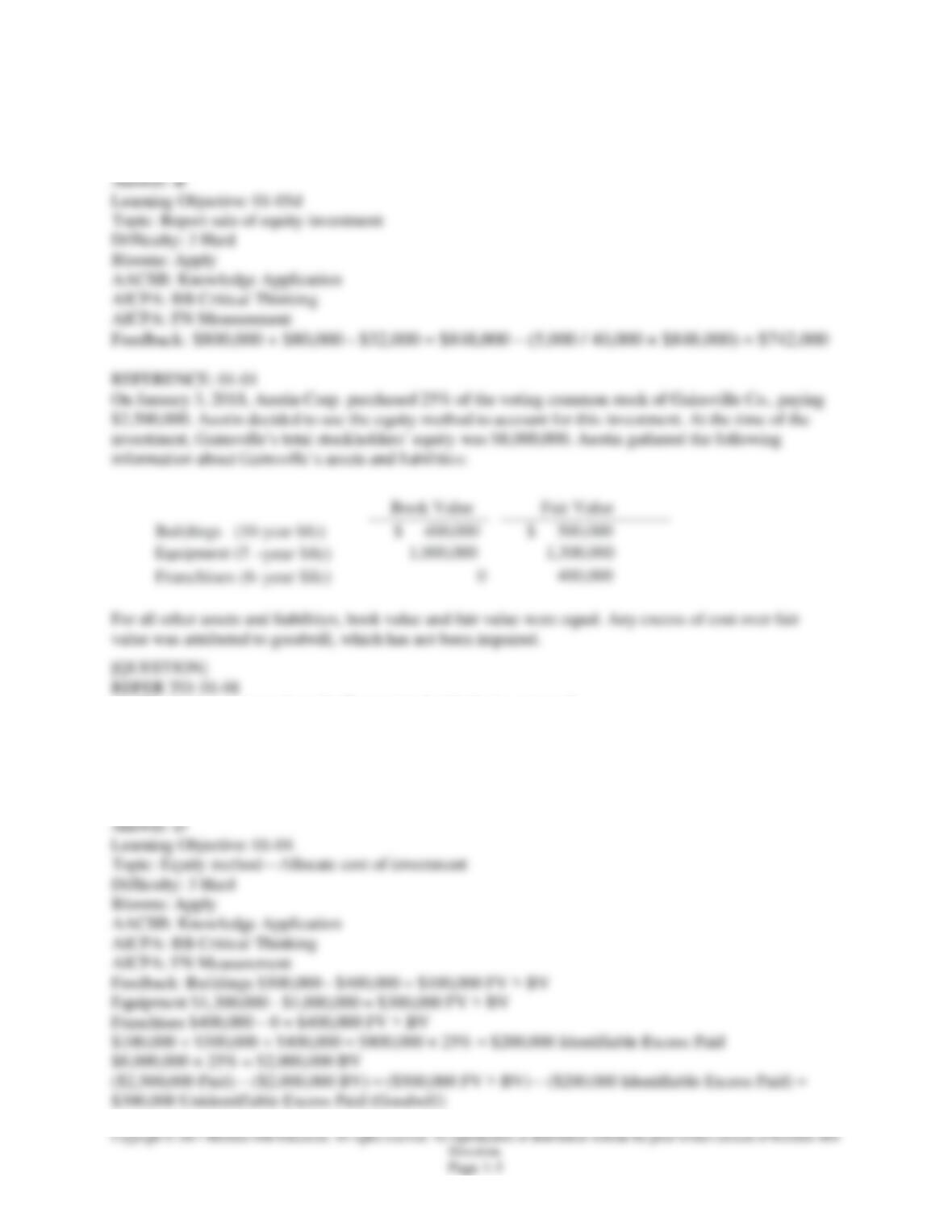
10. On January 4, 2018, Watts Co. purchased 40,000 shares (40%) of the common stock of Adams Corp.,
paying $800,000. There was no goodwill or other cost allocation associated with the investment. Watts
has significant influence over Adams. During 2018, Adams reported income of $200,000 and paid
dividends of $80,000. On January 2, 2019, Watts sold 5,000 shares for $125,000. What was the balance in
the investment account after the shares had been sold?
A) $848,000.
B) $742,000.
C) $723,000.
D) $761,000.
E) $925,000.
11. What is the amount of goodwill associated with the investment?
A) $500,000.
B) $200,000.
C) $0.
D) $300,000.
E) $400,000.
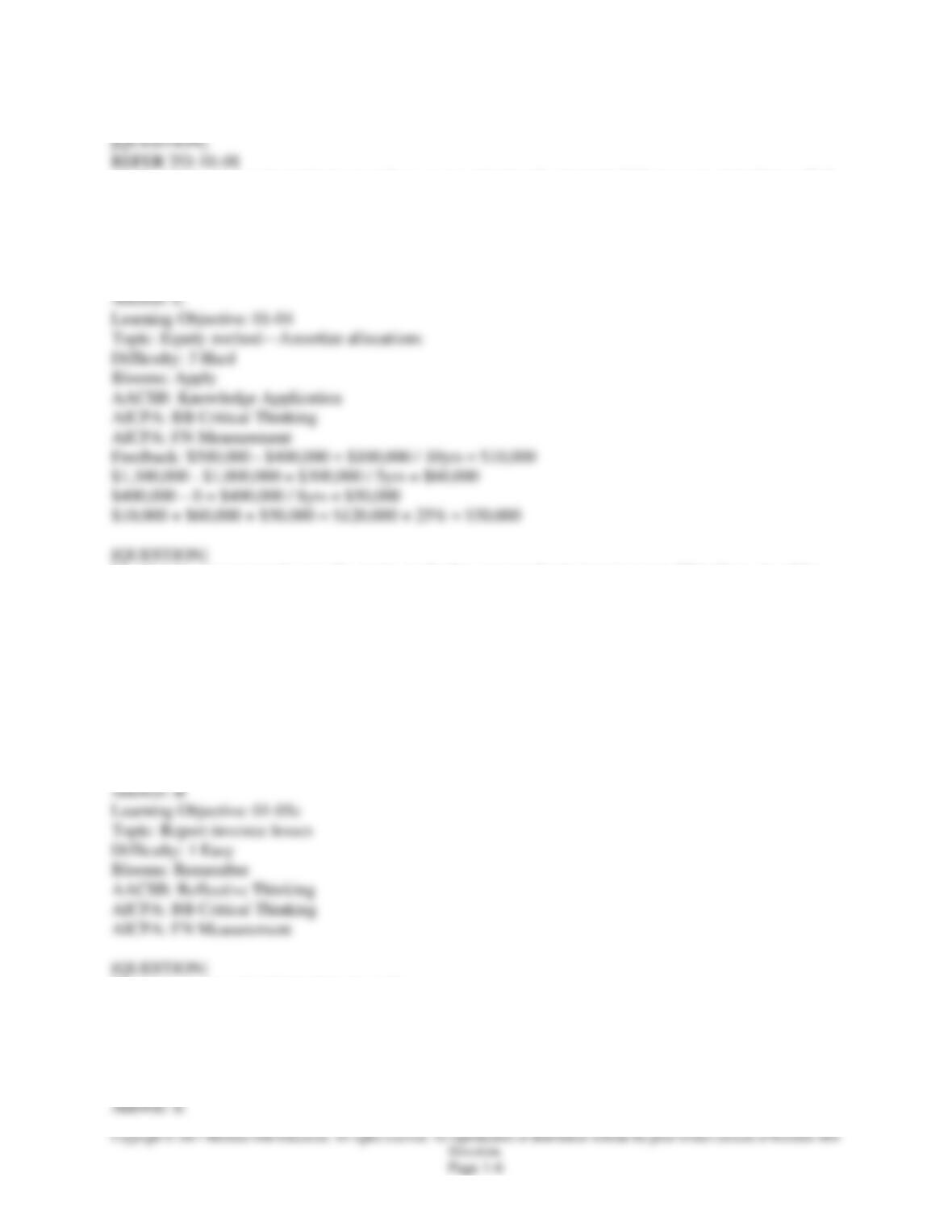
12. For 2018, what is the total amount of excess amortization for Austin’s 25% investment in Gainsville?
A) $ 27,500.
B) $ 20,000.
C) $ 30,000.
D) $120,000.
E) $ 70,000.
13. Club Co. appropriately uses the equity method to account for its investment in Chip Corp. As of the
end of 2018, Chip’s common stock had suffered a significant decline in fair value, which is expected to
recover over the next several months. How should Club account for the decline in value?
A) Club should switch to the fair-value method.
B) No accounting because the decline in fair value is temporary.
C) Club should decrease the balance in the investment account to the current value and recognize a loss
on the income statement.
D) Club should not record its share of Chip’s 2018 earnings until the decline in the fair value of the stock
has been recovered.
E) Club should decrease the balance in the investment account to the current value and recognize an
unrealized loss on the balance sheet.
14. An upstream sale of inventory is a sale:
A) Between subsidiaries owned by a common parent.
B) With the transfer of goods scheduled by contract to occur on a specified future date.
C) In which the goods are physically transported by boat from a subsidiary to its parent.
D) Made by the investor to the investee.
E) Made by the investee to the investor.
Copyright © 2017 McGraw-Hill Education. All rights reserved. No reproduction or distribution without the prior written consent of McGraw-Hill
Education.
Page 1-7
Learning Objective: 01-06
Topic: Intra–entity sales of inventory
Difficulty: 1 Easy
Blooms: Remember
AACSB: Reflective Thinking
AICPA: BB Critical Thinking
AICPA: FN Measurement
REFERENCE: 01-02
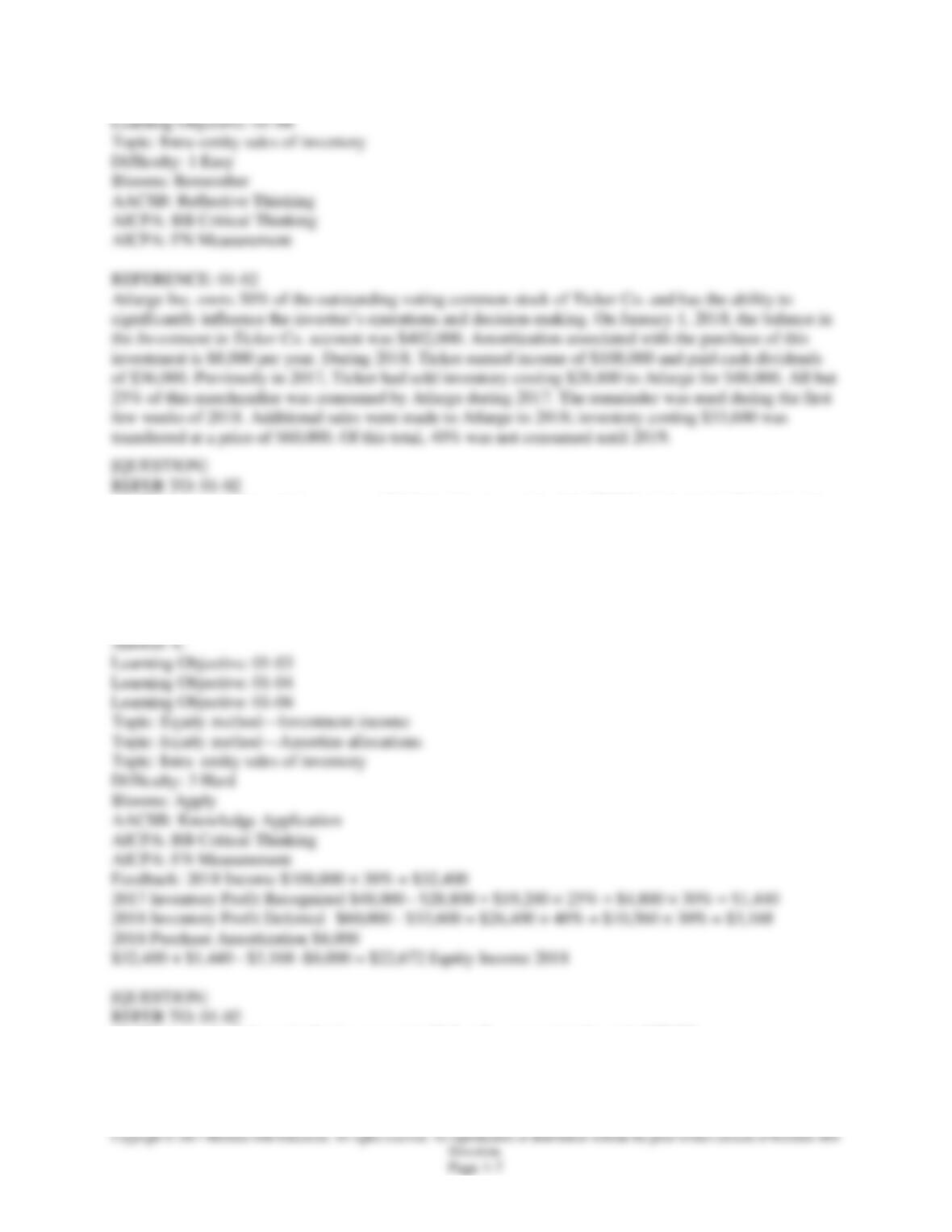
Atlarge Inc. owns 30% of the outstanding voting common stock of Ticker Co. and has the ability to
significantly influence the investee’s operations and decision-making. On January 1, 2018, the balance in
the Investment in Ticker Co. account was $402,000. Amortization associated with the purchase of this
investment is $8,000 per year. During 2018, Ticker earned income of $108,000 and paid cash dividends
of $36,000. Previously in 2017, Ticker had sold inventory costing $28,800 to Atlarge for $48,000. All but
25% of this merchandise was consumed by Atlarge during 2017. The remainder was used during the first
few weeks of 2018. Additional sales were made to Atlarge in 2018; inventory costing $33,600 was
transferred at a price of $60,000. Of this total, 40% was not consumed until 2019.
[QUESTION]
REFER TO: 01-02
15. What amount of equity income would Atlarge have recognized in 2018 from its ownership interest in
Ticker?
A) $19,792.
B) $27,640.
C) $22,672.
D) $24,400.
E) $21,748.
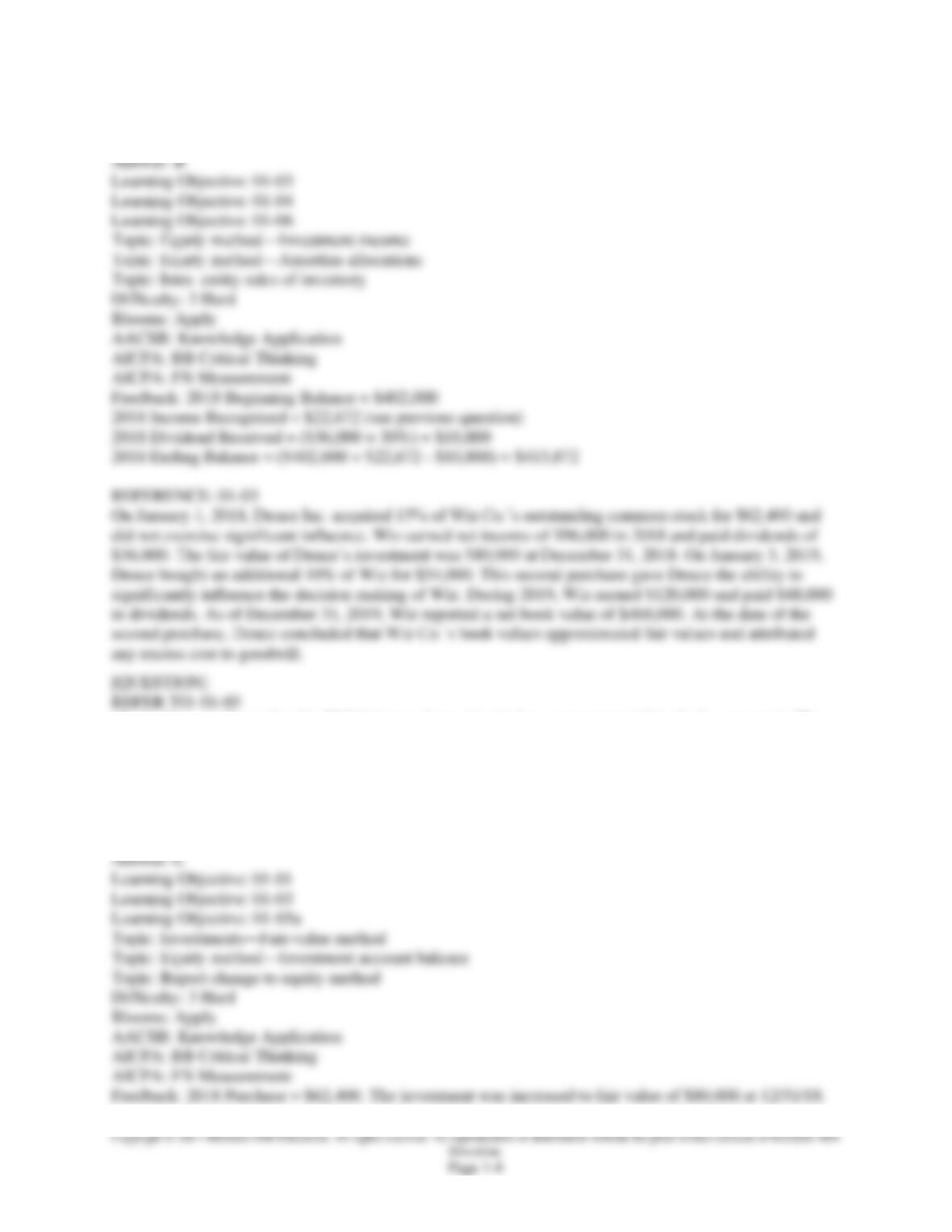
16. What was the balance in the Investment in Ticker Co. account at the end of 2018?
A) $401,136.
B) $413,872.
C) $418,840.
D) $412,432.
E) $410,148.
17. On Deuce’s December 31, 2019 balance sheet, what balance was reported for the Investment in Wiz
Co. account?
A) $117,000.
B) $143,400.
C) $152,000.
D) $134,400.
E) $141,200.
Copyright © 2017 McGraw-Hill Education. All rights reserved. No reproduction or distribution without the prior written consent of McGraw-Hill
Education.
Page 1-9
2019 Income = ($120,000 × 25%) = $30,000
2019 Dividend = ($48,000 × 25%) = $12,000
Ending 2019 Balance = ($80,000 + $54,000 + $30,000 – $12,000) = $152,000
[QUESTION]
REFER TO: 01-03
18. What amount of equity income should Deuce have reported for 2019?
A) $30,000.
B) $16,420.
C) $38,340.
D) $18,000.
E) $32,840.
19. In a situation where the investor exercises significant influence over the investee, which of the
following entries is not actually posted to the books of the investor?
(I) Debit to the Investment account, and a Credit to the Equity in Investee Income account.
(II) Debit to Cash (for dividends received from the investee), and a Credit to Investment Income account .
(III) Debit to Cash (for dividends received from the investee), and a Credit to the Dividend Receivable.
A) Entries I and II.
B) Entries II and III.
C) Entry I only.
D) Entry II only.
E) Entry III only.
20. All of the following would require use of the equity method for investments except:
A) Material intra-entity transactions.
B) Investor participation in the policy-making process of the investee.
C) Valuation at fair value.
D) Technological dependency.
E) Interchange of managerial personnel.
21. All of the following statements regarding the investment account using the equity method are true
except:
A) The investment is recorded at cost.
B) Dividends received are reported as revenue.
C) Net income of investee increases the investment account.
D) Dividends received reduce the investment account.
E) Amortization of fair value over cost reduces the investment account.
22. A company has been using the fair-value method to account for its investment. The company now has
the ability to significantly influence the investee and the equity method has been deemed appropriate.
Which of the following statements is true?
A) A cumulative effect change in accounting principle must occur.
B) A prospective change in accounting principle must occur.
C) A retrospective change in accounting principle must occur.
D) The investor will not receive future dividends from the investee.
E) Future dividends will continue to be recorded as revenue.
23. A company has been using the equity method to account for its investment. The company sells shares
and does not continue to have significant influence. Which of the following statements is true?
A) A cumulative effect change in accounting principle must occur.
B) A prospective change in accounting principle must occur.
C) A retrospective change in accounting principle must occur.
D) The investor will not receive future dividends from the investee.
E) Future dividends will continue to reduce the investment account.
24. When an investor appropriately applies the equity method, how should it account for any investee
Other Comprehensive Income (OCI)?
A) Under the equity method, the investor only recognizes its share of investee’s income from continuing
operations.
B) The OCI would reduce the investment.
C) The OCI would increase the investment.
D) The OCI would not appear on the investor’s income statement but would be a component of
comprehensive income.
E) The OCI would be ignored but shown in the investor’s notes to the financial statements.
25. How should a permanent loss in value of an investment using the equity method be treated?
A) The equity in investee income is reduced.
B) A loss is reported in the same manner as a loss in value of other long-term assets.
C) The investor’s stockholders’ equity is reduced.
D) No adjustment is necessary.
E) Record an offset to cash.
26. Under the equity method, when the company’s share of cumulative losses equals its investment and
the company has no obligation or intention to fund such additional losses, which of the following
statements is true?
A) The investor should change to the fair-value method to account for its investment.
B) The investor should suspend applying the equity method until the investee reports income.
C) The investor should suspend applying the equity method and not record any equity in income of
investee until its share of future profits is sufficient to recover losses that have not previously been
recorded.
D) The cumulative losses should be reported as a prior period adjustment.
E) The investor should report these as equity method losses in its income statement.
27. When an investor sells shares of its investee company, which of the following statements is true?
A) A recognized gain or loss is reported as the difference between selling price and original cost.
B) An recognized gain or loss is reported as the difference between selling price and original cost.
C) A recognized gain or loss is reported as the difference between selling price and carrying value.
D) An unrealized gain or loss is reported as the difference between selling price and carrying value.
E) Any gain or loss is reported as part of comprehensive income.
28. When applying the equity method, how is the excess of cost over book value calculated and accounted
for?
A) The excess is allocated to the difference between fair value and book value multiplied by the percent
ownership of current assets.
B) The excess is allocated to the difference between fair value and book value multiplied by the percent
ownership of total assets.
C) The excess is allocated to the difference between fair value and book value multiplied by the percent
ownership of net assets.
D) The excess is allocated to goodwill.
E) The excess is ignored.
29. After allocating cost in excess of book value, which asset or liability would not be amortized over a
useful life?
A) Cost of goods sold.
B) Property, plant, & equipment.
C) Patents.
D) Goodwill.
E) Bonds payable.
30. Which statement is true concerning unrecognized profits in intra-entity inventory sales when an
investor uses the equity method?
A) The investee must defer upstream ending inventory profits.
B) The investee must defer upstream beginning inventory profits.
C) The investor must defer downstream ending inventory profits.
D) The investor must defer downstream beginning inventory profits.
E) The investor must defer upstream beginning inventory profits.
31. Which statement is true concerning unrecognized profits in intra-entity inventory sales when an
investor uses the equity method?
A) The investor and investee make reciprocal entries to defer and recognize inventory profits.
B) The same adjustments are made for upstream and downstream sales.
C) Different adjustments are made for upstream and downstream sales.
D) No adjustments are necessary.
E) Adjustments will be made only when profits are known upon sale to outsiders.
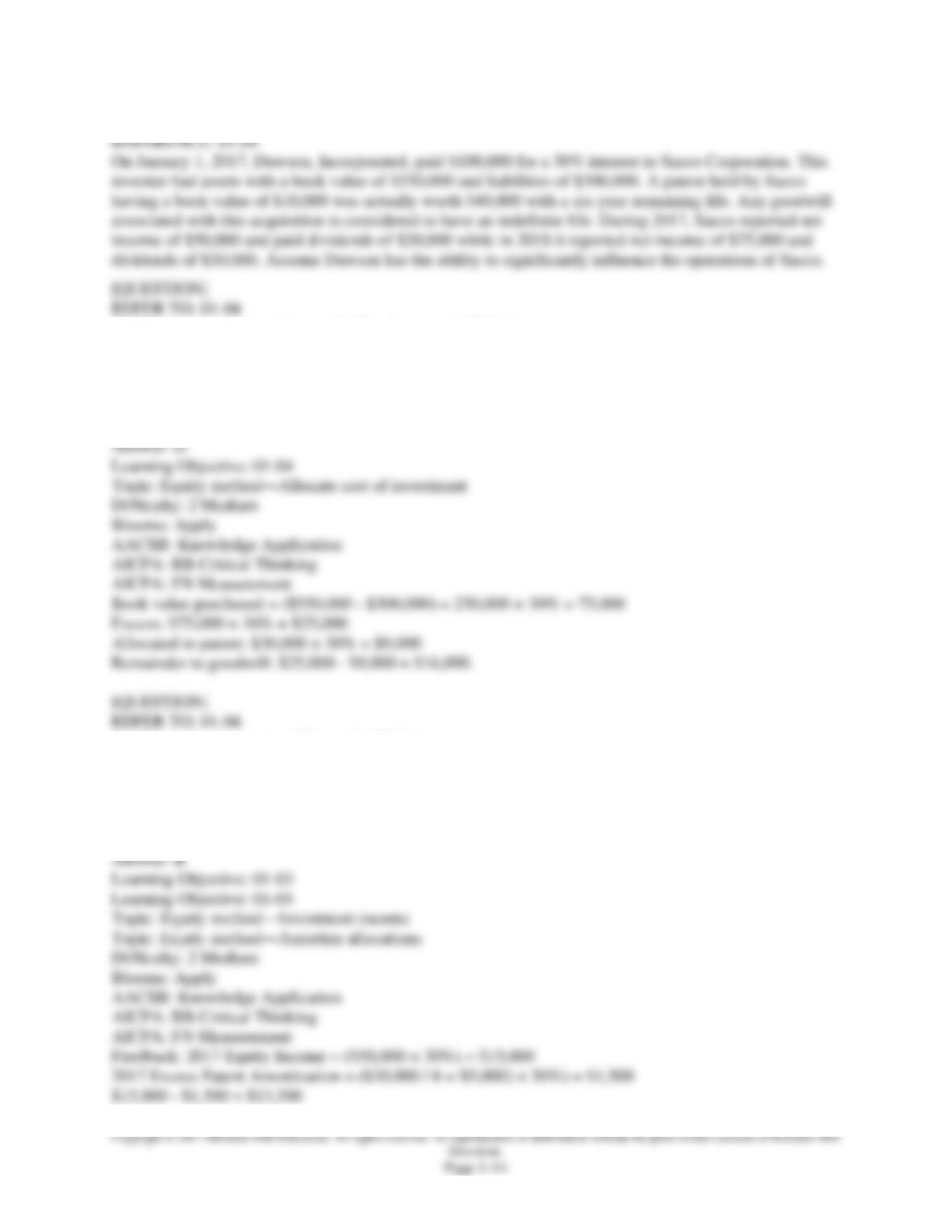
32. The amount allocated to goodwill at January 1, 2017, is
A) $25,000.
B) $13,000
C) $ 9,000.
D) $16,000.
E) $10,000.
33. The equity in income of Sacco for 2017, is
A) $ 9,000.
B) $13,500.
C) $15,000.
D) $ 7,500.
E) $50,000.
34. The equity in income of Sacco for 2018, is
A) $22,500.
B) $21,000.
C) $12,000.
D) $13,500.
E) $75,000.
35. The balance in the Investment in Sacco account at December 31, 2017, is
A) $100,000.
B) $112,000.
C) $106,000.
D) $107,500.
E) $140,000.
36. The balance in the Investment in Sacco account at December 31, 2018, is
A) $119,500.
B) $125,500.
C) $116,500.
D) $118,000.
E) $100,000.
37. The income reported by Dodge for 2017 with regard to the Gates investment is
A) $ 7,500.
B) $ 22,500.
C) $ 15,000.
D) $100,000.
E) $150,000.
38. The income reported by Dodge for 2018 with regard to the Gates investment is
A) $80,000.
B) $30,000.
C) $50,000.
D) $15,000.
E) $75,000.
Copyright © 2017 McGraw-Hill Education. All rights reserved. No reproduction or distribution without the prior written consent of McGraw-Hill
Education.
Page 1-17
Learning Objective: 01-05a
Topic: Equity method―Investment income
Topic: Report change to equity method
Difficulty: 2 Medium
Blooms: Apply
AACSB: Knowledge Application
AICPA: BB Critical Thinking
AICPA: FN Measurement
Feedback: $200,000 × 40% = $80,000
[QUESTION]
REFER TO: 01-05
39. Which of the following is true regarding the change from the fair-value method to the equity method?
A) Dodge must record a debit to additional paid-in capital in the amount of $200,000.
B) Dodge must record a debit to additional paid-in capital for $15,000.
C) Dodge must retrospectively apply the equity method to interests reported under the fair-value method.
D) Dodge must record a debit of $200,000 to the Gates Investment Account.
E) Dodge must record a credit of $15,000 to the Gates Investment Account.
40. The balance in the investment account at December 31, 2018, is
A) $335,000.
B) $355,000.
C) $400,000.
D) $412,500.
E) $480,000.
41. What journal entry will be recorded at the end of 2018 to defer the recognition of the investor’s share
of the intra-entity gross profits?
A)
Equity in income of Reid
$50,400
Investment in Reid
$50,400
B)
Investment in Reid
$50,400
Equity in income of Reid
$50,400
C)
Equity in income of Reid
$15,120
Investment in Reid
$15,120
D)
Investment in Reid
$15,120
Equity in income of Reid
$15,120
A) Entry A.
B) Entry B.
C) Entry C.
D) Entry D.
E) No entry is necessary.
42. What journal entry will be recorded in 2019 to recognize its share of the intra-entity gross profit that
was deferred in 2018?
A)
Equity in income of Reid
$50,400
Investment in Reid
$50,400
B)
Investment in Reid
$50,400
Equity in income of Reid
$50,400
C)
Equity in income of Reid
$15,120
Investment in Reid
$15,120
D)
Investment in Reid
$15,120
Equity in income of Reid
$15,120
A) Entry A.
B) Entry B.
C) Entry C.
D) Entry D.
E) No entry is necessary.
43. What is the balance in the investment account for the 15% ownership interest, at January 1, 2018?
A) $150,000.
B) $172,500.
C) $180,000.
D) $157,500.
E) $170,000
44. How much income did Mehan report from Cook during 2017?
A) $30,000.
B) $22,500.
C) $ 7,500.
D) $ 0.
E) $50,000.
45. How much income did Mehan report from Cook during 2018?
A) $90,000.
B) $110,000.
C) $67,500.
D) $87,500.
E) $78,750.
46. What was the balance in the investment account at December 31, 2018?