20. On April 1, Tarpon Co. made the following expenditures on its printing press:
Purchase of stapling attachment
$8,000
Installation of attachment
2,000
Cleaning and oiling press costs prior to renovation
1,000
Replacement parts for renovation of printing press
1,000
Labor used in press renovation
3,000
The renovation increased the expected life and the attachment increased the
productivity of the press. What are the total expenditures capitalized to the printing
press?
21. On April 1, 2009, Cardot Co., which uses straight-line depreciation, purchased
equipment for $60,000 with a useful life of 7 years and $4,000 salvage value. On April 1,
2013, the equipment was sold for $30,000. What gain should Cardot recognize as a
result of this disposition?
AICPA BB: Critical Thinking AICPA FN: Reporting
Use the information that follows concerning Harrahs, Inc. to answer problems 22 through
24.
Harrahs Corporation purchased a dump truck at the beginning of 2013 at a cost of $60,000. The
truck had an estimated life of 5 years and an estimated residual value of $5,000. On January 1,
2015, the company made major repairs of $3,000 to the truck that extended its life 2 more
years. Starting with 2015, the truck has a remaining life of 5 years. The company uses the
straight-line depreciation method.
22. How much is the book value of the truck to be reported on the balance sheet at the end
of 2014?
23. What amount should be recorded as depreciation expense each year starting in 2015?
Solution:
24. If Harrahs sells the truck at the end of 2015 for $20,000 cash, how much gain or loss
would be recognized?
Solution:
25. Calculate depreciation expense for each of the first two full years of life for an airplane
with a cost of $600,000, residual value of $40,000, and an estimated life of 4 years
under the double-declining-balance depreciation method.
Solution:
AICPA BB: Critical Thinking AICPA FN: Reporting
26. Courtney Corp. has significant stock that can be issued by the company. The managers
are planning to sell the stock for a large profit by fraudulently inflating reported earnings.
They plan to sell the stock after current earnings are reported, then leave for the carnival
in Brazil. To accomplish their devious plans, they purchased inventory for $800,000 and
charged the inventory purchase to equipment that is being depreciated using the
straight-line method with a life of 8 years and no salvage value. If beginning and ending
inventories were correctly stated and a full year’s depreciation is recognized on the
equipment, what is the amount of Courtney’s current net income overstatement?
27. Raymond Corporation is a new business that recycles consumption leftovers. The
investors in Raymond’s stock, expecting losses in the early stages of business, are
impressed with its early net incomes resulting in the ballooning of its stock price to $32 a
share. During the second year of operations, Raymond’s reported net income of
$1,300,000. However, a few months later, independent auditors reported existence of
accounting irregularities concerned with the capitalization of $3 million dollars of
expenditures to Raymond’s land account that should have been expensed. What is the
appropriately adjusted net income for the second year of operations?
AICPA BB: Critical Thinking AICPA FN: Reporting
28. The balance in accumulated depreciation on January 1 and December 31 is $60,000
and $70,000, respectively, during a year in which an asset with a cost of $20,000 and
net book value of $5,000 was sold for $3,000. Calculate the amount of depreciation
expense for the current year.
Use the information that follows to answer problems 29 through 31.
Laney Inc. and Monroe Company each ordered a new computer on January 1, 2014. The cost
of each computer was $3,500. The economic life expectancy of each computer is three years
with a $500 expected salvage value. During the current year Laney and Monroe experienced
identical operating events with the only difference being that Laney used the straight-line
depreciation method, while Monroe used the double-declining-balance depreciation method.
Both became disenchanted with their computers during the year due to the introduction of a new
generation of computers, and on December 31, 2014, each sold the computer for $800.
29. Calculate Laney’s depreciation expense and loss (gain) from the disposal of the
computer.
Solution:

30. Calculate Monroe’s depreciation expense and loss (gain) from the disposal of the
computer.
Solution:
31. Indicate how the current year’s net income statements for Laney and Monroe would
differ.
Solution:
Laney:
32. Mondova Corporation began operations on January 1. Below is Mondova’s current net
income statement and December 31 balance sheet calculated using straight-line
depreciation.
Income Statement
Sales revenue
$20,000
Cost of goods sold
9,000
Gross profit
$ 11,000
Depreciation (Note 1)
3,000
Net income
$ 8,000
Balance Sheet
Current assets
$44,000
Equipment
$20,000
Accumulated depreciation
3,000
17,000
Total assets
$61,000
Liabilities (all current)
$45,000
Shareholders’ equity
16,000
Total liabilities & shareholders’ equity
$61,000
Note 1: Equipment was purchased on January 1. Straight-line depreciation method was used with
9-42 Test Bank – Chapter 9 – Long-Lived Assets
an estimated economic life of 5 years.
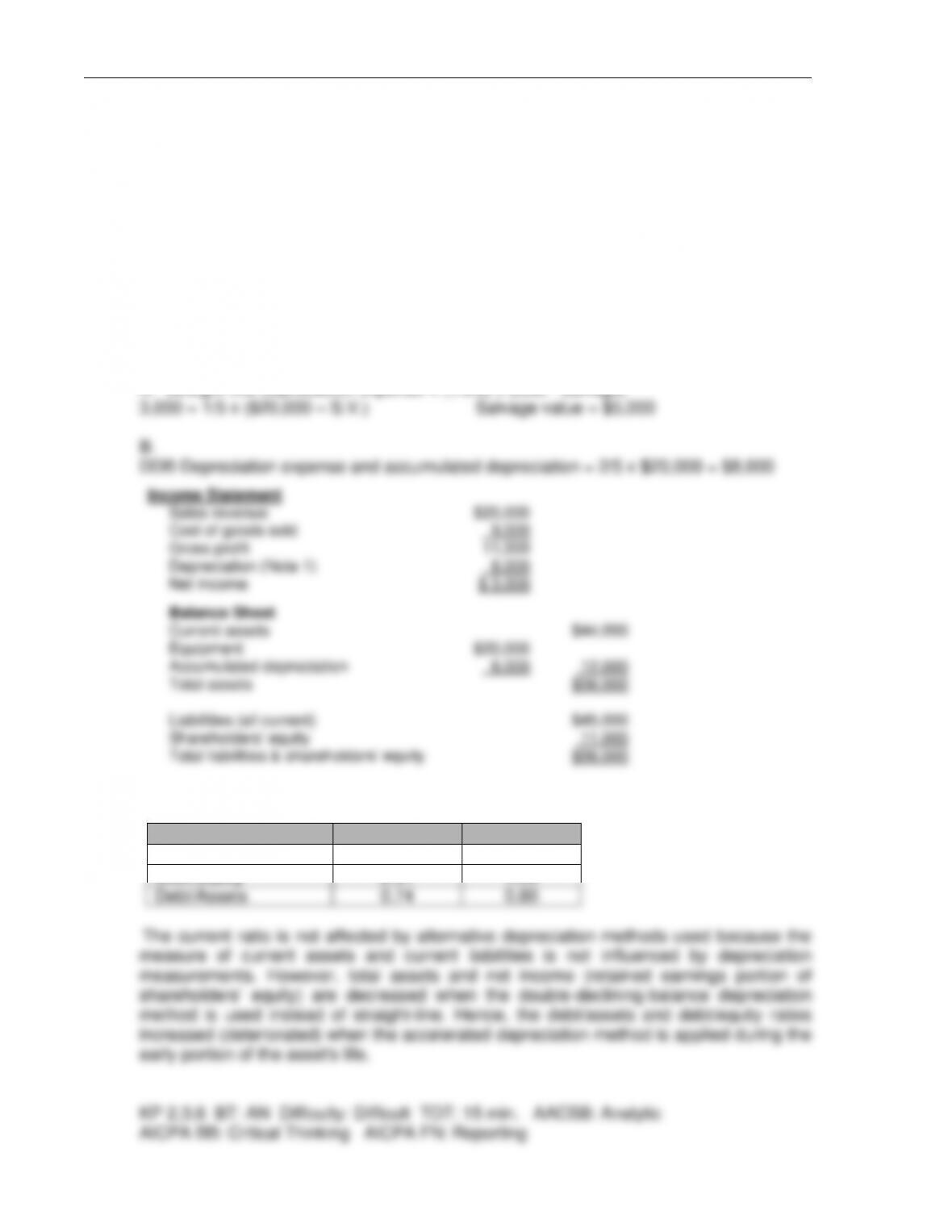
A. Determine the estimated salvage value of the equipment being depreciated using the
straight-line method.
B. Prepare an income statement and balance sheet in the same format as presented
above assuming that Mondova Corporation uses the double-declining-balance
depreciation method. The equipment has an estimated economic life of 5 years.
C. Calculate and compare Mondova’s December 31 current ratio, debt/equity ratio, and
debt to assets ratio using the financial statements constructed using the straight-line
and double-declining-balance methods of depreciation.
Solution:
A. Straight-line depreciation expense = (1/life) x (cost – salvage)
33. Several years ago, Welch Company purchased a copyright. Amortizing occurs on a
straight-line basis over its estimated useful life. The company’s balance sheets follow at
December 31, 2014, and 2013:
(In thousands)
December 31,
2014
December 31,
2013
Copyright, less accumulated amortization of $15,000 (2013)
and $18,000 (2014)
$132,000
$135,000
A. How much amortization expense did Welch record during 2014?
B. Calculate the original cost of the patent.
C. As of December 31, 2014, over how many years has Welch amortized the copyright?
Solution:
A. $3,000
34. On January 1, the balance in accumulated depreciation is $28,000. During the current
year depreciation expense is $10,000 and equipment with a cost of $9,000 was sold for
$3,000 at a loss of $1,000. Calculate the December 31 balance in accumulated
depreciation.
35. The balance of accumulated depreciation on January 1 and December 31, 2013 is
$54,000 and $58,000, respectively. During 2013, depreciation expense is $18,000, and
equipment with a cost of $20,000 is sold for $4,000. Calculate the loss or gain from the
sale of equipment.
9-44 Test Bank – Chapter 9 – Long-Lived Assets
SHORT ESSAY QUESTIONS
1. Dorman Company purchased a new web server on January 1. The following information
and expenditures related to this acquisition were made:
List price
$5,000
Cash price paid
4,200
Transportation-in
300
Insurance during transport
100
Interest paid for the current year related to financing the web server
240
Installation cost
200
One-year maintenance contract
400
Disk drive installed into the web server
1,000
Specify and justify which of the preceding expenditures should be added to the cost of
the web server and disclose that cost. Indicate how the expenditures excluded from the
cost of the web server would be classified.
Solution: The cost of the web server is its cash or cash equivalent price plus all
expenditures necessary to get the asset in place and ready for its intended use. The list
2. Many years ago, a well-known American company publicly advertised with the slogan
“Our most important asset is our employees”. More recently, other companies have
realized that quality employees working in an excellent work environment that respects
those employees produce quality products at a reasonable cost. Although this may be
the foundation for American companies to become more internationally competitive, on
the balance sheet and in your chapter on long-lived assets, there is no recognition of an
employee asset. Why is there not an asset on the balance sheet that recognizes the
contribution of employees to the future profit-making ability of a firm?
Solution: Usually the difficulty of objectively measuring the contribution of a quality
3. On January 1, 2014, Tavis Corp. sold a piece of equipment for $10,000 that it had used
for several years. The equipment had cost $50,000, and the accumulated depreciation
account had a balance of $34,000 at the time of the sale. Describe the effects on the
accounting equation of selling the equipment.
4. Identify the role of the matching principle in accounting for long-lived assets.
Solution: Costs of long-lived assets are capitalized and reported as assets on the
5. What primary objective should management attempt to accomplish when selecting the
depreciation method for tax purposes?
Solution: Management should use the depreciation strategy that provides the
6. What problems are inherent in recording trade-ins of plant assets?
Solution: It is difficult to determine the dollar amount at which the asset received
should be valued on the balance sheet. The asset received in a trade-in should be
7. How do intangible assets differ from long-lived plant assets?
Solution: Intangible assets are characterized by having rights, privileges, and
8. During a meeting of top executives of the Alcorn Corporation, a discussion of the current
downturn of sales and profits was taking place. Expecting vigorous competition to extend
this difficult situation well into the next decade, the executives searched for ways to
soften its impact on the financial statements. Attention was focused upon the company
controller who was answering inquiries concerning the possibility of changing accounting
procedures in order to give shareholders’ the “best view from a bad situation”.
Responding to the inquiries, the controller authoritatively observed: “Alcorn uses a 10-
year expected life on its long-term assets and a salvage value equal to 5% of cost in
calculating depreciation expense using the straight-line method. This policy was quite
conservative in light of the industry average of a 15-year life expectancy and a 10% of
cost salvage value. In light of the 3 billion dollars of depreciable assets (net book value),
switching to the industry average would certainly improve the measured results of
operations.” Everyone was thrilled about the possibility of improving measured profits
except for one middle-top executive. She questioned whether the switch would be
acceptable to the auditor. The controller responded that switching to industry average
expectations would not violate GAAP and would be acceptable to the auditor (whose
firms depends greatly on Alcorn’s account). Alcorn would disclose the change in the
footnotes and the effect of this change on accounting estimates in the current year’s net
income. The questioning executive would not object to the plan to liberalize income
measurement, but stated that it has always been known as a most conservative firm.
And if things ultimately go from bad to worse, Alcorn may get some negative press
concerning the change because of the appearance of delaying disclosure on the income
statement of the financial trouble Alcorn is facing. It was decided to change the
depreciation policy using the industry average expected life and salvage value.
Comment on this change of depreciation measurement in light of generally accepted
accounting principles and the problem of appearance. Include the amount of increase in
net income caused by this change in depreciation parameters.
Solution: Changing estimated life from 10 years to 15 years and salvage value from
Test Bank – Chapter 9 –Long-Lived Assets 9-47
Communication, Reflective AICPA BB: Critical Thinking AICPA FN: Measurement
9. What are post-acquisition expenditures? How are they accounted for?
Solution: Post-acquisition expenditures are costs that either improve an existing
asset, not merely maintain it, or increase its useful life. Costs incurred to improve the
10. How should management choose an acceptable cost allocation method for accounting
purposes?
Solution: The primary selection factor should be based on how well the cost
allocation method matches expenses against the revenues produced. The straight-line
11. Identify the steps necessary in recording the retirement of the long-lived asset.

12. Intangible assets can be divided into two broad categories; those with definite lives, and
those with indefinite lives. Assets with indefinite lives are not subject to amortization
while those with definite lives are. Explain why this is the case and give at least one
example of an intangible asset with a definite life and one example of an intangible asset
with an indefinite live.
13. How do long-lived assets differ from inventory?
Solution: Long-lived assets are assets used in the operations of the business,
providing benefits that extend beyond the current accounting period. Inventory assets
14. The Dayton Symphony recently acquired cellist Carlos Romono from the Cincinnati
Symphony in exchange for violinist Elton Daal. These artists’ contracts are capitalized
and reported as assets by the symphonies. What complications arise in determining the
cost of each artist’s contract for accounting purposes?

Test Bank – Chapter 9 –Long-Lived Assets 9-51
IFRS QUESTIONS
1. Under IFRS a special land account is often found on the balance sheet. This account is
called:
a. Land Improvements
b. Depreciable Land
c. Investment Property
d. Accumulated Depreciation – Land
2. A significant difference in depreciation accounting between US GAAP and IFRS
accounting is that in IFRS:
a. Management has the option of periodically revaluing property, plant and
equipment to market value
b. Management is mandated to revaluing property, plant and equipment to market
value
c. Management may use hypothetical future value in depreciating assets
d. There are no differences in depreciation accounting between US GAAP and IFRS
3. In respect to accounting for fixed assets, IFRS appears to be:
a. Moving away from market-value accounting and toward historical cost
accounting
b. Moving toward market-value accounting and away from historical cost accounting
c. Moving toward hypothetical future value accounting
d. There is no discernable trend