Test Bank – Chapter 9 –Long-Lived Assets 9-21
62. The following items represent common post acquisition expenditures incurred on
equipment.
A. Replacement of defective parts
B. Rewiring costs to increase operating speed
C. Painting costs
D. Repair of the major circuitry of the equipment
Identify which of these items are considered to be maintenance items.
a. A and C
b. C only
c. A, B, and C
d. A, C, and D
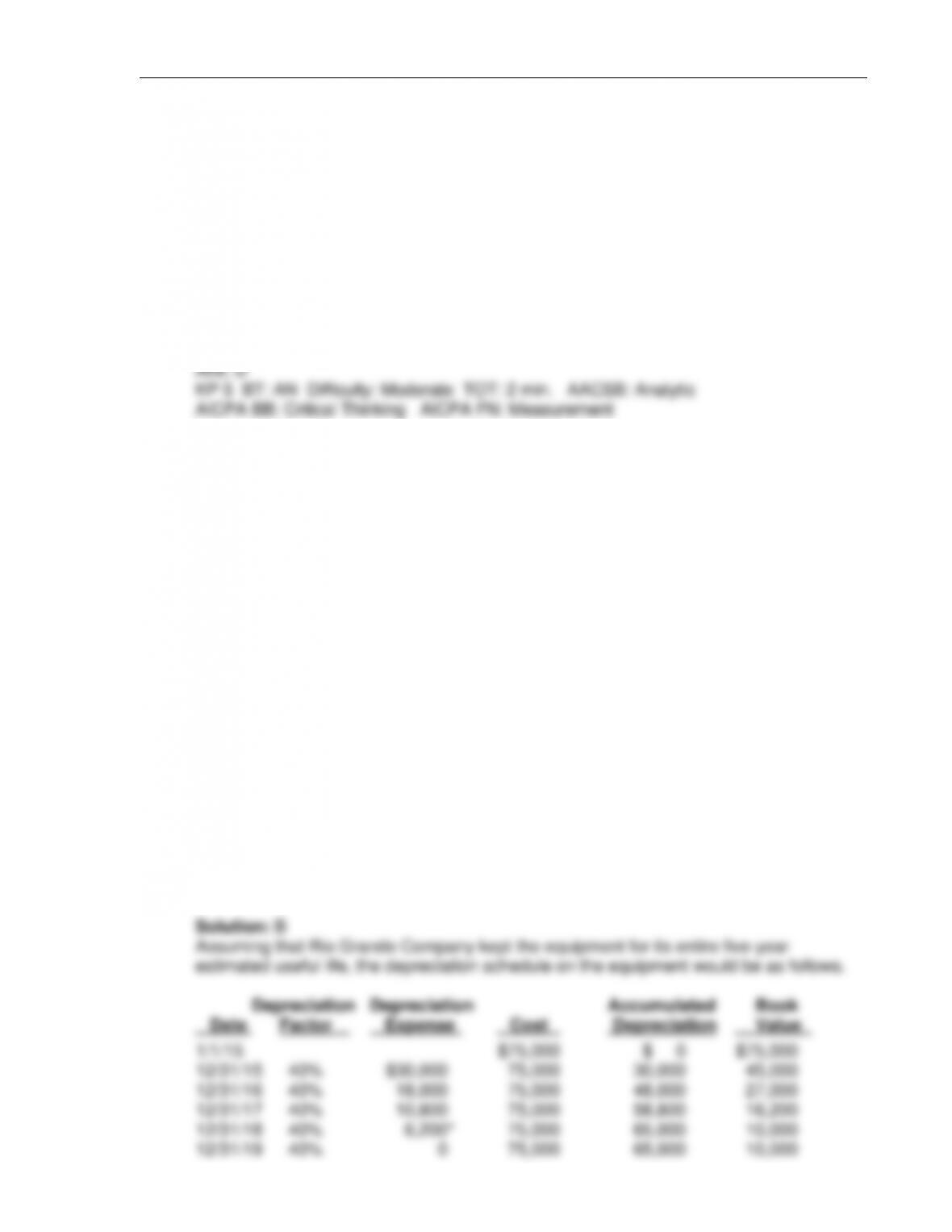
63. Rio Grande Company purchased equipment on January 1, 2015 for $75,000. The
estimated useful life of the equipment is 5 years, the salvage value is $10,000, and the
company uses the double-declining balance method to depreciate fixed assets. Which
of the following journal entries would Rio Grande record if the equipment is scrapped
after three years?
a. Equipment ……………………………………………………………………. 75,000
Gain on Disposal of Equipment ……………………………….. 16,200
Accumulated Depreciation—Equipment …………………… 58,800
b. Accumulated Depreciation—Equipment ………………………….. 58,800
Loss on Disposal of Equipment ………………………………………. 16,200
Equipment …………………………………………………………….. 75,000
c. Accumulated Depreciation—Equipment ………………………….. 58,800
Cash …………………………………………………………………………… 16,200
Equipment …………………………………………………………….. 75,000
d. Depreciation Expense ……………………………………………………. 58,800
Loss on Disposal of Equipment ………………………………………. 16,200
Equipment …………………………………………………………….. 75,000
9-22 Test Bank – Chapter 9 – Long-Lived Assets
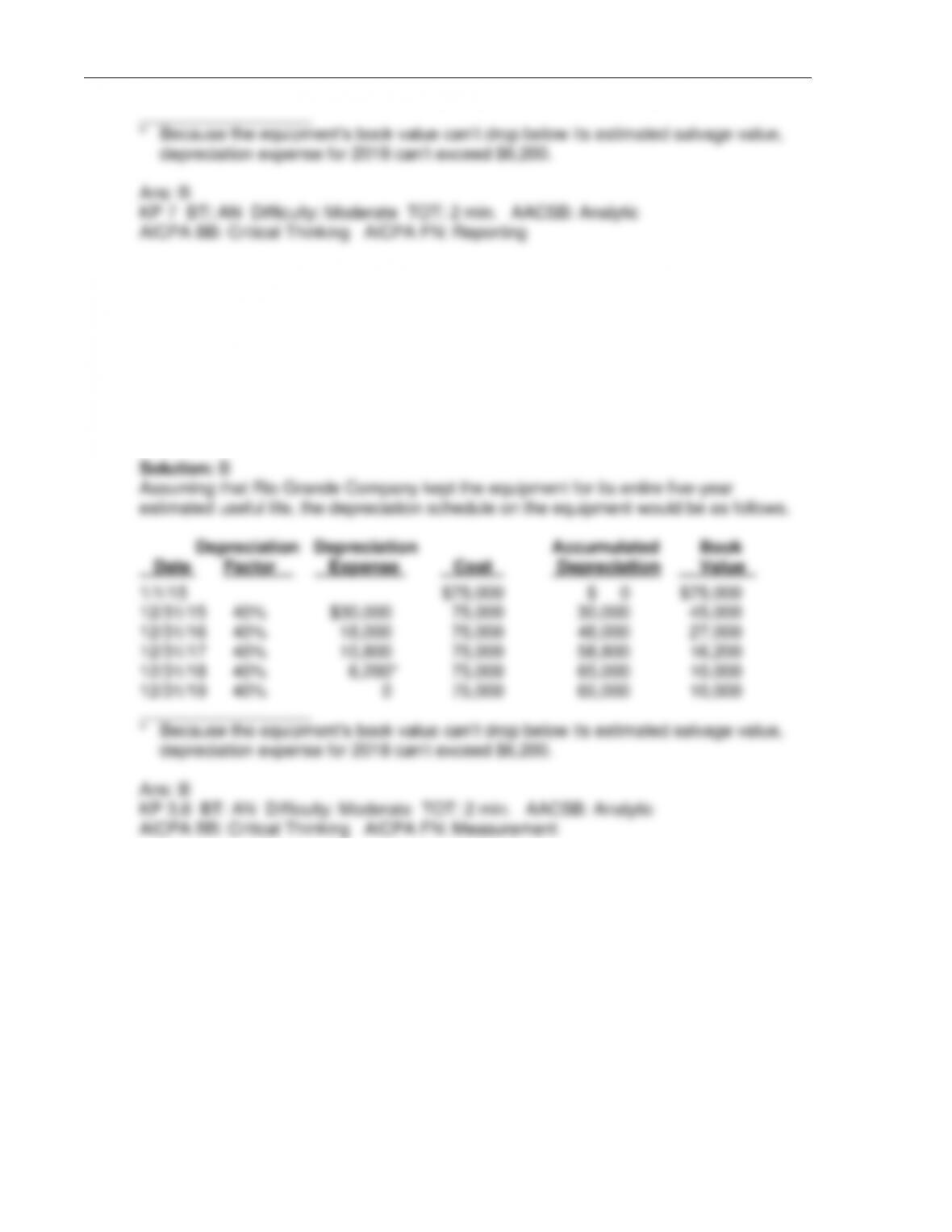
64. Rio Grande Company purchased equipment on January 1, 2015 for $75,000. The
estimated useful life of the equipment is 5 years, the salvage value is $10,000, and the
company uses the double-declining balance method to depreciate fixed assets. How
much depreciation would Rio Grande record for the fourth year of the equipment’s use?
a. $6,480
b. $6,200
c. $5,616
d. $6,000
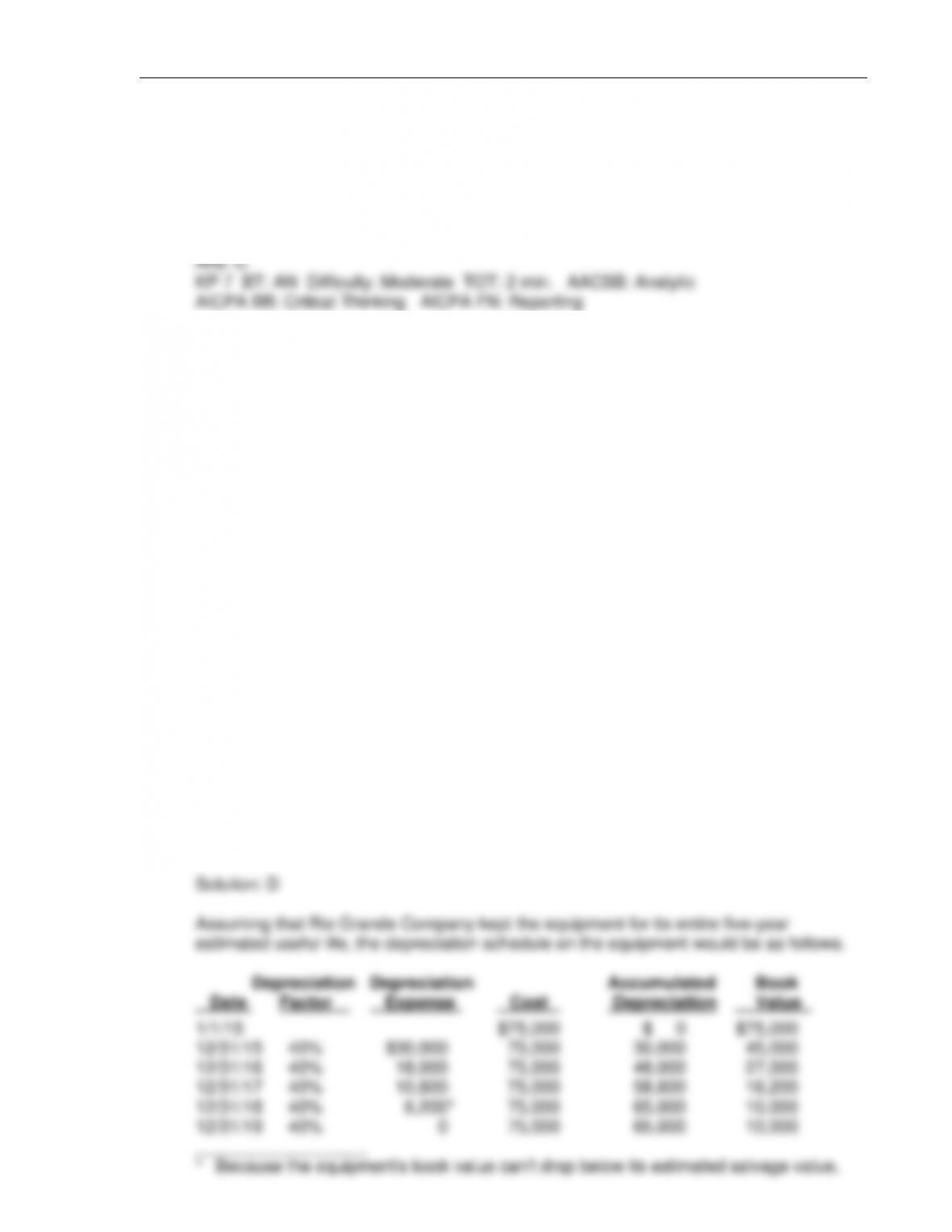
65. Rio Grande Company purchased equipment on January 1, 2015 for $75,000. The
estimated useful life of the equipment is 5 years, the salvage value is $10,000, and the
company uses the double-declining balance method to depreciate fixed assets. Which
of the following journal entries would Rio Grande record if the equipment is scrapped
after five years?
a. Equipment …………………………………………………………………… 75,000
Gain on Disposal of Equipment ……………………………….. 10,000
Accumulated Depreciation—Equipment ………………….. 65,000
b. Accumulated Depreciation—Equipment …………………………. 75,000
Equipment ……………………………………………………………. 75,000
c. Accumulated Depreciation—Equipment …………………………. 65,000
Test Bank – Chapter 9 –Long-Lived Assets 9-23
Loss on Disposal of Equipment ………………………………………. 10,000
Equipment …………………………………………………………….. 75,000
d. Depreciation Expense ……………………………………………………. 65,000
Loss on Disposal of Equipment ………………………………………. 10,000
Equipment …………………………………………………………….. 75,000
66. Rio Grande Company purchased equipment on January 1, 2015 for $75,000. The
estimated useful life of the equipment is 5 years, the salvage value is $10,000, and the
company uses the double-declining balance method to depreciate fixed assets. Which
of the following journal entries would Rio Grande record if the equipment is sold for
$17,000 after three years?
a. Equipment ……………………………………………………………………. 75,000
Loss on Disposal of Equipment ………………………………………. 800
Cash ……………………………………………………………………… 17,000
Accumulated Depreciation—Equipment …………………… 58,800
b. Cash …………………………..………………………………………………… 17,000
Gain on Disposal of Equipment ……………………………….. 6,200
Equipment …………………………………………………………….. 10,800
c. Cash …………………………………………………………………………… 17,000
Depreciation Expense ……………………………………………………. 10,800
Loss on Disposal of Equipment ………………………………………. 47,200
Equipment …………………………………………………………….. 75,000
d. Cash …………………………………………………………………………… 17,000
Accumulated Depreciation—Equipment ………………………… 58,800
Equipment …………………………………………………………….. 75,000
Gain on Sale of Fixed Assets ……………………………………. 800
9-24 Test Bank – Chapter 9 – Long-Lived Assets
depreciation expense for 2018 can’t exceed $6,200.
67. Rio Grande Company purchased equipment on January 1, 2015 for $75,000. The
estimated useful life of the equipment is 5 years, the salvage value is $10,000, and the
company uses the double-declining balance method to depreciate fixed assets. Which
of the following would be included in the journal entry that Rio Grande would record at
the end of the fifth year, if the equipment and $19,000 cash are traded for a dissimilar
fixed asset with a FMV of $25,000?
a. A credit to Fixed Assets for $25,000.
b. A credit to Equipment for $10,000.
c. A credit to Gain on Disposal of Equipment for $4,000.
d. A debit to Loss on Disposal of Equipment for $4,000.
Test Bank – Chapter 9 –Long-Lived Assets 9-25
MATCHING QUESTIONS
1. For each account listed in 1 through 12 below, identify which reporting section (a through
d) each would appear on a company’s financial statements. You may use each letter
more than once or not at all.
Reporting Sections of Financial Statements
a. Balance sheet—property, plant, and equipment
b. Balance sheet—intangible assets
c. Balance sheet—other
d. Income statement
_____ 1. Depreciation expense
_____ 2. Accumulated depreciation
_____ 3. Betterments
_____ 4. Oil reserve
_____ 5. Land
_____ 6. Organizational costs
_____ 7. Amortization expense
_____ 8. Total amortization since inception
_____ 9. Gain on sale of patent
_____ 10. Copyright
_____ 11. Patents
_____ 12. Goodwill
Solution:
2. For each transaction numbered 1 through 6 below, identify its effects on the accounting
equation by selecting from the effects listed in a through f. You may use each letter more
than once or not at all.
Accounting Effects
a. – A and – SE (Retained Earnings)
b. + A and + SE (Retained Earnings)
c. – A and – L
d. – A and – SE (Contributed Capital)
e. + A and + L
f. No change in total A, L, or SE
____ 1. Equipment is purchased by incurring a long-term mortgage payable and
paying the balance in cash
____ 2. Paid for transportation of equipment shipped from the vendor to our plant
____ 3. Paid for speeding ticket received while transporting the equipment to the
manufacturing plant
____ 4. Depreciated the equipment during the first year of use
____ 5. Paid for lubrication and periodic tune ups of the equipment
____ 6. Sold the equipment, receiving more money than its book value
9-26 Test Bank – Chapter 9 – Long-Lived Assets
KP 2,4 BT: AP Difficulty: Easy TOT: 4 min. AACSB: Analytic
AICPA BB: Critical Thinking AICPA FN: Reporting
3. For each transaction numbered 1 through 5 below, identify in which account listed in a
through d it would be reported. You may use each letter more than once or not at all.
Accounts
a. Land
b. Buildings
c. Equipment
d. Not capitalized
_____ 1. Freight charges related to the acquisition costs of a production machine
_____ 2. Interest costs incurred during the construction period of a building built by a
company for its own use
_____ 3. Costs paid to clear land
_____ 4. Annual painting costs of an office building
_____ 5. Sales taxes paid related to a machine purchased
4. For each cost that appears in items 1 through 6 below, select the account in which it would
be included and reported from those listed in a through c. You may use more than one
answer for each cost. If the cost is not capitalized, place an X in the space provided.
Accounts
a. Land
b. Buildings
c. Equipment
_____ 1. Installation costs of a special attachment to newly acquired equipment
_____ 2. Freight costs for shipping the equipment into our manufacturing facility
_____ 3. Costs of repairing a hole knocked in the wall during installation of new
equipment
_____ 4. Interest costs on a mortgage loan used to purchase a newly acquired building
_____ 5. Property taxes paid on land for the current year on which a new building was
erected
_____ 6. Training session to teach faculty how to use computer projection equipment
recently installed in classrooms
5. Select the method of depreciation listed in a through c that is best for each purpose
listed in items 1 through 5.
Methods
a. Straight-line
b. Units-of-production
c. Double-declining-balance
1. _______ Creates the largest net income in the early years of life
2. _______ Erratic due to unpredictable sales levels
3. _______ Creates the smallest taxable income in the early years of life
4. _______ Technological competitive changes are rapid
6. For each transaction numbered 1 through 5 below, identify which effect(s) (a through d)
that each transaction would have on the current and debt/equity ratios. You may use
each letter more than once or not at all. Some transactions have two answers.
Effects
a. Decreases current ratio
b. Increases current ratio
c. Decreases debt/equity ratio
d. Increases debt/equity ratio
____ 1. Equipment is purchased by incurring a long-term note payable and paying the
balance in cash
____ 2. Paid for transportation of equipment shipped from a supplier
____ 3. Depreciated the equipment during the first year of use
____ 4. Paid for lubrication and periodic maintenance of the equipment
____ 5. Sold the equipment, receiving more money than its book value
7. For each transaction numbered 1 through 6 below, identify which accounting
treatment—capitalized or expensed—should be used to properly account for the
transactions. You may use each letter more than once or not at all.
Accounting Treatments
E. Expensed immediately
C. Capitalized as part of the cost of the new asset
______1. Freight costs on production equipment in transit
______2. Sales tax on equipment purchase
______3. Damaged during installation and repair costs
______4. Interest paid on construction loan during the building period
______5. Survey costs by contractor
______6. Construction insurance to cover theft or vandalism during building
construction
Test Bank – Chapter 9 –Long-Lived Assets 9-29
SHORT PROBLEMS
1. Lincoln Co. purchased a piece of property (land and building) at a tax sale for $110,000.
Reliable estimates of the fair market values of the land and building are $34,000 and
$70,000, respectively. What is the gain that Lincoln Co. should record from this
advantageous purchase?
2. On December 1, Dominican Corp. purchased a tract of land for $325,000 to be used as
a factory site. An old unusable building on the land was razed (torn down), and the
salvaged materials from the demolition were sold. These cash expenditures and receipts
and other costs incurred during December are as follows:
Demolition of old building
$11,000
Proceeds from sale of salvaged materials
5,000
Legal fees to transfer land title
3,000
Title guarantee insurance
1,000
Calculate the balance in Dominican’s Land account on its December 31 balance sheet.
3. Land and a building were purchased for $90,000. A reliable market value of the land is
$40,000 and for the building, $80,000. What are the separate costs assigned to the land
and building?
4. Apple Inc. purchased a used pickup truck with an advertised price of $18,900 for
$17,000 cash. While Jeff, the CEO, was driving the truck to get supplies, he was
stopped by a highway patrol woman and received a $50 speeding ticket and a warning
for a nonfunctioning brake light. Jeff had failed to notice when this problem when he
purchased the truck. If Jeff knew about the brake light condition, he would have paid
only $16,500 for the car. The cost, not under warranty, of replacing the brake light was
$50. Calculate the cost to be capitalized to the truck account.

5. Arnez Company purchased a building and equipment for $110,000. Although a reliable
market value of the building could not be determined, the equipment’s market value is
$70,000. What are the separate costs assigned to the building and equipment?
6. On January 1, Hampton Company paid $48,000 for a new delivery truck. It was
estimated that the truck would be driven 100,000 miles during the next 5 years, at which
time it would have a salvage value of $3,000. During the first and second years, the
odometer registered 22,000 and 40,000 miles, respectively. How much is accumulated
depreciation using the activity (miles driven) method at the end of year 2?
Solution:
7. On January 1, 2015, Blackwell Company paid $88,000 for a new delivery truck. It was
estimated that the truck would be driven 300,000 miles during the next 6 years, at which
time it would have a salvage value of $7,000. At the end of the first and second years,
the odometer registered 48,000 and 88,000 miles, respectively. Show how the plant
asset would appear in Blackwell Company’s balance sheet at December 31, 2009
assuming the company uses the activity method depreciation.
Solution:
AICPA BB: Critical Thinking AICPA FN: Reporting
8. Harvey Ltd. purchased land and building in exchange for 50,000 shares of its stock that
is trading on the New York Stock Exchange at $20 a share. Although the market values
of the purchased assets are unknown, the current assessed value of the land is
$300,000 and the building is $600,000. How much is assigned to the land and to the
building?
9-32 Test Bank – Chapter 9 – Long-Lived Assets
Solution:
9. On January 1, Bisbee Co. paid $80,000 for a new truck. It was estimated that the truck
would be driven 400,000 miles during the next 8 years, at which time it would have a
salvage value of $8,000. At the end of the first and second years, the odometer
registered 45,000 and 97,000 miles, respectively. Calculate the book value of the truck
using straight-line depreciation at the end of the second year.
Solution:
10. On January 1, Marriott Company paid $80,000 for a copy machine. It was estimated that
the machine would produce 200,000 copies over the next 8 years, at which time it would
have a salvage value of $8,000. During the first and second years, the copies totaled
24,000 and 51,000, respectively. Calculate accumulated depreciation using the double-
declining-balance method at the end of year two.
Solution:
11. On January 1, Weston Company paid $88,000 for a copy machine. It was estimated that
the machine would produce 1,000,000 copies over the next 8 years, at which time it
would have a salvage value of $8,000. During the first and second years, the copies
totaled 180,000 and 300,000, respectively. Calculate depreciation expense using the
activity method for each of the first two years.
Solution:

12. On January 1, equipment is purchased for $55,000 with an 8-year life expectancy and
salvage value of $5,000. If the double-declining-balance method is used, calculate the
book value of the equipment at the end of year 2.
Solution:
13. On January 1, equipment is purchased for $40,000 with an 20-year life expectancy and
salvage value of $4,000. If the double-declining-balance method is used, how much
depreciation expense is recorded for the first year?
14. On September 30, 2015, equipment is purchased for $50,000 with a 4-year life
expectancy and salvage value of $2,000. If the double-declining-balance method is
used, calculate depreciation expense for the year ending December 31, 2015.
15. Zack Co. incurred the following costs related to equipment during November 2015.
1. Purchase equipment for $90,000, terms 3/15, net 45. Paid within 15 day.
2. Had the equipment installed and paid the installer $2,000.
3. Paid the freight bill for the truck that delivered the equipment for $1,000.
4. Advertised a new product that will be produced by the new equipment, $3,400.
5. Sales taxes paid on the equipment amounted to $3,800.
Calculate the cost of the equipment.

16. Carson Co. purchased a printer for $10,000, for which it paid $1,000 a month for 10
months. Carson had the option of paying $9,500 cash for the printer but chose the
delayed payment plan. It cost Carson $80 to transport the printer to its place of business
and $200 for installing and initial timing adjustments to the printer. Calculate the cost of
the printer.
17. On January 1, Barton Co. purchased land with a usable building on it for $425,000. At
the time of purchase, the fair market values of the land and building were $170,000 and
$340,000, respectively. What is the cost Barton should allocate to land?
18. On January 1, Summers Co. purchased equipment with a 10-year life and zero salvage
value for $900,000. Summers uses the straight-line method on its financial statements
and double-declining-balance method on its income tax returns. By what amount does
the tax deduction for depreciation exceed depreciation expense on Summers’s income
statements for each of the first two years?
Solution:
19. Farmdale Company’s President purchased an extremely used automobile on November
1 by paying $2,000. He immediately had it towed to his mechanic who overhauled the
auto in order to get the car ready to be safely driven. The cost of the tow was $40 and
the initial overhaul was $1,500. While driving from his mechanic’s garage, he ran over a
nail that punctured a tire and cost $35 to repair. Calculate the cost of the auto.