1. Which one of the following should be classified as land on the balance sheet?
a. A shed that houses the company’s equipment.
b. Mineral rights representing gold in the soil
c. Two tracts of property that houses the company’s backup computer site
d. Sidewalks and driveways which lead to the company’s office building
2. Which of the following long-lived assets is not amortized or depreciated to an expense?
a. Equipment use in production of inventory goods
b. Land improvements
c. Land
d. Company computers replaced every two years
3. A company which complains that although their income is quite satisfactory, cash is not
available for dividends because of the high cost of replacing fixed assets in operating in
an economic environment where:
a. inflation is non-existent.
b. the balance sheet value of long-lived assets is more than their replacement value.
c. the prices of long-lived assets have been decreasing over an extended period of
time.
d. expenditures required to replace long-lived assets are greater than depreciation
expense.
4. Which one of the following actions will help solve a cash shortage problem?
a. Issue common stock in exchange for plant assets
b. Recognize depreciation expense
c. Purchased long-lived asset by issuing long-term debt
d Retire plant assets at salvage value
5. The purpose of recording depreciation expense is to:
a. provide cash necessary to replace plant assets when they are used up.
b. record the balance sheet amount of plant assets at replacement value.
c. match expenses with revenues using a reasonable systematic method.
d. gain a better understanding of estimating the extraction of natural resources.
6. Monroe Co. purchased a tract of land paying $100,000 in cash and assumed an existing
mortgage of $60,000. The municipal tax bill disclosed an assessed valuation of
$180,000. The amount Monroe should record as land connected with this acquisition is:
a. $100,000.
b. $160,000.
c. $180,000.
d. $200,000.
7. The process of allocating the cost of plant and equipment over the time period of which
they are used is referred to as:
a. depreciation.
b. depletion.
c. amortization.
d. deferred costs.
8. The process of expensing the cost of a gold mine as gold is withdrawn is referred to as:
a. amortization.
b. depletion.
c. depreciation.
d. decomposition.
9. The process of expensing the cost of patents over an extended period of years is
referred to as:
a. classification.
b. depletion.
c. depreciation.
d. amortization.
10. Accumulated depreciation is an account which:
a. adjusts plant and equipment so that its balance sheet value approximates its
replacement cost.
b. is a long-term liability.
c. is equal to total depreciation expense recorded and decreases total plant and
equipment.
d. reduces intangible assets.
11. An increase in accumulated depreciation:
a. increases total assets.
b. decreases total assets.
c. decreases the current ratio.
d. increases the quick ratio.
12. During extended periods of rising prices of plant and equipment, the amount required to
replace long-lived assets is typically:
a. less than total accumulated depreciation of those assets.
b. equal to the sum of all the depreciation recognized on those assets.
c. less than the balance sheet value of those assets.
d. greater than the sum of total depreciation expense recognized on those assets.
13. On January 1, a company purchased land with a usable building on it for $270,000. At
the time of purchase, the fair market values of the land and building were $120,000 and
$200,000, respectively. The gain from the purchase of the land and building is:
a. $0.
b. $50,000.
c. $80,000.
d. $320,000.
14. Equipment with a cost of $22,000 and accumulated depreciation of $15,000 was retired
with a gain of $1,000. The cash received from the disposition of equipment is:
a. $7,000.
b. $8,000.
c. $6,000.
d. $14,000.
9-4 Test Bank – Chapter 9 – Long-Lived Assets
15. Moss Company purchased a building costing $800,000 on January 1, 2015. Moss is
depreciating the building over 80 years using the straight-line method with no salvage
value. The economic life of the building is expected to be 40 years. As a result of Moss’s
accounting procedure, its 2015:
a. earnings per share is understated and debt/equity ratio is overstated.
b. earnings per share is understated and debt/equity ratio is understated.
c. earnings per share is overstated and debt/equity ratio is overstated.
d. earnings per share is overstated and debt/equity ratio is understated.
16. The Favre Company made the following expenditures related to its building:
Annual repainting of exterior
$ 1,700
Replacement of old fiberglass shingles with a fireproof tile roof
33,000
Major improvements to electrical system required to run new machinery
18,000
The amount of the preceding expenditures that should be immediately expensed is:
a. $0.
b. $1,700.
c. $34,700.
d. $19,700.
17. Depreciation is an expense that does not use cash during the period in which it is
recognized. When did (will) the cash outflow associated with the asset occur?
a. When the asset is retired
b. There is no cash outflow associated with depreciation or the asset.
c. When the replacement cost of the asset increases
d. When the asset was acquired
18. The balance in accumulated depreciation on January 1 and December 31 is $15,000
and $19,000, respectively, during a year in which no assets were disposed. Depreciation
expense during the year is:
a. $19,000.
b. $15,000.
c. $4,000.
d. $34,000.

Test Bank – Chapter 9 –Long-Lived Assets 9-5
19. On January 1, Comicon Corp. purchased land with a usable building on it for $300,000.
At the time of purchase, the fair market values of the land and building were $100,000
and $150,000, respectively. Comicon depreciates the building using the straight-line
method over 20 years with an expected $24,000 residual value. The annual depreciation
expense on the building is:
a. $0.
b. $5,000.
c. $7,800.
d. $10,800.
20. On January 1, Scion Co. purchased land with a usable building on it for $210,000. At the
time of purchase, the fair market values of the land and building were $80,000 and
$160,000, respectively. Scion assigned the entire purchase cost of $240,000 to land.
Scion should depreciate the building using the straight-line method over 20 years with an
expected zero residual value. As a result of Scion’s treatment of the purchase of land
and building, its current net income is:
a. understated by $10,500.
b. understated by $7,000.
c. overstated by $7,000.
d. overstated by $10,500.
21. The balance in accumulated depreciation on January 1 and December 31 is $12,000
and $9,000, respectively, during a year in which an asset with a cost of $4,000 and net
book value of $0 was retired. Depreciation expense for the current year is:
a. $9,000.
b. $3,000.
c. $1,000.
d. $7,000.
22. Which one of the following depreciation methods will typically result in the smallest
amount of current taxes paid during the early periods of an asset’s life?
a. 150% declining balance method.
b. Units of production method.
c. Double-declining-balance method.
d. Straight-line method.
23. Which one of the following depreciation methods will typically result in the smallest
earnings per share during the early periods of an asset’s life?
a. 150% declining balance method.
b. Units of production method.
c. Double-declining-balance method.
d. Straight-line method.
24. Sandeep Inc. uses double-declining-balance depreciation for an asset with a 4-year life
expectancy and no salvage value. Depreciation expense for the second year of the
asset’s life is calculated by:
a. [2 x Book Value]/4
b. [2 x (Cost – Salvage Value]/4
c. [(2 x Book Value)/4] – Accumulated Depreciation
d. [2 x Cost]/4
25. Kristin, Inc. depreciates its plant assets over a 10-year life with a 10% salvage value.
Using straight-line depreciation, which calculation will Kristin use during year 2 of the
asset’s life?
a. 10% x (Cost – Salvage Value)
b. (Cost – Salvage Value)/10 x 10%
c. Book Value x 10%
d. Book Value x [10% – Salvage Value]
26. Forgetting to record depreciation expense during 2015:
a. understates the debt/equity ratio.
b. understates the current ratio.
c. overstates the debt/equity ratio.
d. overstates the current ratio.
27. If the straight-line method of depreciation of an asset with a 5-year life expectancy and
no salvage value is used, then the percentage of cost that is recognized as depreciation
expense for the first two years of the asset’s life is, respectively,
a. 25% and 25%.
b. 40% and 20%.
c. 40% and 40%.
9-8 Test Bank – Chapter 9 – Long-Lived Assets
d. 20% and 20%.
28. On January 1, 2015, Lane Company made a $12,000 expenditure on a fully depreciated
machine. The expenditure increased the expected life of the new machine for two years
until December 31, 2016. Lane uses straight-line depreciation with no salvage value.
However, Lane erroneously expensed this capital expenditure. As a result of this error,
a. 2015 income is overstated by $3,000 and 2016 income is understated by $3,000.
b. 2015 income is understated by $6,000 and 2016 income is overstated by $6,000.
c. 2015 income is understated by $6,000 and 2016 income is overstated by $3,000.
d. 2015 income is understated by $6,000 and 2015 income is correctly stated.
29. A machine was purchased on January 1 for $50,000. The machine has an estimated
useful life of 10 years with a salvage value of $2,000. Under the double-declining-
balance, depreciation expense for each of the first two years is, respectively,
a. $12,000 and $12,000.
b. $10,000 and $8,000.
c. $12,000 and $9,500.
d. $12,500 and $12,500.
30. A machine was purchased on January 1 for $100,000. The machine has an estimated
useful life of 5 years with a salvage value of $10,000. Under the double-declining-
balance method, depreciation expense for each of the first two years is, respectively,
a. $45,000 and $22,500.
b. $40,000 and $24,000.
c. $45,000 and $ 27,500.
d. $22,500 and $ 22,500.
31. Failure to record depreciation expense during a year:
a. understates net income.
b. overstates total assets.
c. overstates total debt.
d. overstates contributed capital.

Test Bank – Chapter 9 –Long-Lived Assets 9-9
32. A machine was purchased on January 1 for $100,000. The machine has an estimated
useful life of 4 years with a salvage value of $20,000. Under the straight-line method,
accumulated depreciation at the end of year 2 is:
a. $25,000
b. $22,500
c. $50,000
d. $40,000
33. Natural resource costs:
a. include rights, privileges, and benefits of an economic resource that have no physical
existence.
b. are depreciated.
c. include the cost of the equipment used to extract the natural resource.
d. include the cost of acquiring the rights to extract natural resources.
34. A machine was purchased on January 1 for $100,000. The machine has an estimated
useful life of 5 years with a salvage value of $20,000. Under the straight-line method, the
book value and the accumulated depreciation of the machine at the end of year two is
respectively,
a. $60,000 and $40,000
b. $68,000 and $32,000
c. $40,000 and $60,000
d. $48,000 and $32,000
35. Which one of the following will impact the amount of depreciation expensed throughout
the life of plant assets?
a. The amount of capitalized cost.
b. Maintenance costs throughout the asset’s useful life.
c. The expected cost of a replacement asset.
d. The current market value.
36. Which one of the costs below should be included as part of the cost of land?
a. Razing an old building.
b. Cost of a building permit.
c. Cost of driveways.
d. Shrubs and trees with limited lives.
37. When companies construct their own long-lived assets, all costs required to get the
asset into operating condition must be:
a. expensed immediately.
b. included in the long-lived asset’s cost.
c. recognized as a maintenance cost.
d. treated as a cost necessary to maintain the plant asset’s current level of productivity.
38. Salvage value is:
a. a method of depreciating plant assets.
b. the dollar amount that can be recovered when the asset is sold, traded, or scrapped.
c. an asset’s current estimated market value.
d. a physical obsolescence condition.
39. Which one of the following is not one of the questions asked when accounting for long-
lived assets?
a. Over what period of time should this cost be allocated?
b. What dollar amount should be included in the capitalized cost of the long-lived
asset?
c. At what rate should this cost be allocated?
d. How much will a replacement asset cost?
40. Which of the following is the least problematic factor to determine when preparing to
calculate depreciation?
a. useful life.
b. estimated salvage value.
c. technical obsolescence.
d. acquisition cost.

9-12 Test Bank – Chapter 9 – Long-Lived Assets
41. Once a company establishes that an estimated useful life of a plant asset has changed
significantly:
a. the plant asset must be disposed.
b. the change must be made for the current and future years.
c. a correcting journal entry must be made.
d. the previous year’s financial statements must be corrected.
42. The calculation of a ‘depreciation base’ requires subtracting:
a. the salvage value from the asset’s book value.
b. the asset’s book value from its original cost.
c. the asset’s salvage value from its capitalized cost.
d. accumulated depreciation from the asset’s original cost.
43. The units of production method of depreciation:
a. allocates the cost of the long-lived asset based on an activity.
b. allocates an equal amount of plant asset cost to each accounting period.
c. is an accelerated method.
d. is used when an asset has no salvage value.
44. During 2015, Erie Inc. developed a new process for packaging products. Erie paid its
employees $450,000 over the past five years in developing this process. On January 1,
2015, Erie paid $12,000 to register the packaging patent. The company believes the
patent will produce profits for 10 years. The patent has a 17-year legal life. How much
amortization expense should be recognized during 2015?
a. $27,118
b. $46,200
c. $1,200
d. $647
AICPA BB: Critical Thinking AICPA FN: Reporting
45. One primary reason management may choose a particular depreciation method is:
a. to save cash for the replacement of the plant asset.
b. to avoid violation of debt covenants tied to net income.
c. to decrease the cash flows of the company.
9-14 Test Bank – Chapter 9 – Long-Lived Assets
d. to hide judgment errors that managers have made during the accounting period.
46. Once a plant asset becomes fully depreciated, the:
a. asset may no longer be used.
b. asset may still be used.
c. asset should be retired.
d. cost of the asset must be removed from the accounting records.
47. When a plant asset is sold, its original cost and its:
a. market value must be removed from the accounting records.
b. accumulated depreciation must be removed from the accounting records.
c. salvage value must be expensed immediately.
d. related maintenance costs must be transferred to the income statement immediately.
48. When a plant asset is traded in for a similar asset, the valuation of the new plant asset
should be:
a. at the original cost of the old asset.
b. at the fair market value of the asset given up, or the asset received, whichever is
more clearly evident.
c. at the replacement cost of the old asset.
d. at the value at which the new asset received was carried in the accounting records of
the manufacturer.
49. Intangible assets differ from plant assets in that they:
a. are consumed in the current accounting period.
b. include prepaid expenses that extend beyond the current accounting period.
c. have no physical existence.
d. are matched against the revenue in the period the related revenue is recognized.
50. Which one of the following costs would be capitalized as an ‘organizational cost’?
a. Goodwill

Test Bank – Chapter 9 –Long-Lived Assets 9-15
b. Underwriting a company’s first stock issuance
c. Copyrights
d. None of the above
51. Jeter Inc. acquired machinery on January 1, 2009 at a cost of $55,000. The machinery
was depreciated over five years using the straight line method and a salvage value of
$2,000. In 2015 the machinery was sold for $3,000. The income statement for 2015 will
reflect which of the following:
a. Gain of $1,000
b. Gain of $3,000
c. Loss of $52,000
d. No gain or loss
52. On December 1, Douglas Corp. purchased a tract of land for $285,000 to be used as a
factory site. An old unusable building on the land was razed (torn down), and the
salvaged materials from the demolition were sold. These cash expenditures and receipts
and other costs incurred during December are as follows:
Demolition of old building
$51,000
Proceeds from sale of salvaged materials
8,000
Legal fees to transfer land title
7,000
Title guarantee insurance
2,500
What would be the balance in Douglas’s Land account on its December 31 balance
sheet?
a. $285,000
b. $337,500
c. $340,500
d. $331,000
53. Land and a building were purchased for $240,000. A reliable market value of the land is
$75,000 and for the building, $225,000. What are the respective separate costs
assigned to the land and building?
a. $75,000 and $225,000
b. $75,000 and $165,000
c. $60,000 and $180,000
d. $80,000 and $160,000
Solution: C
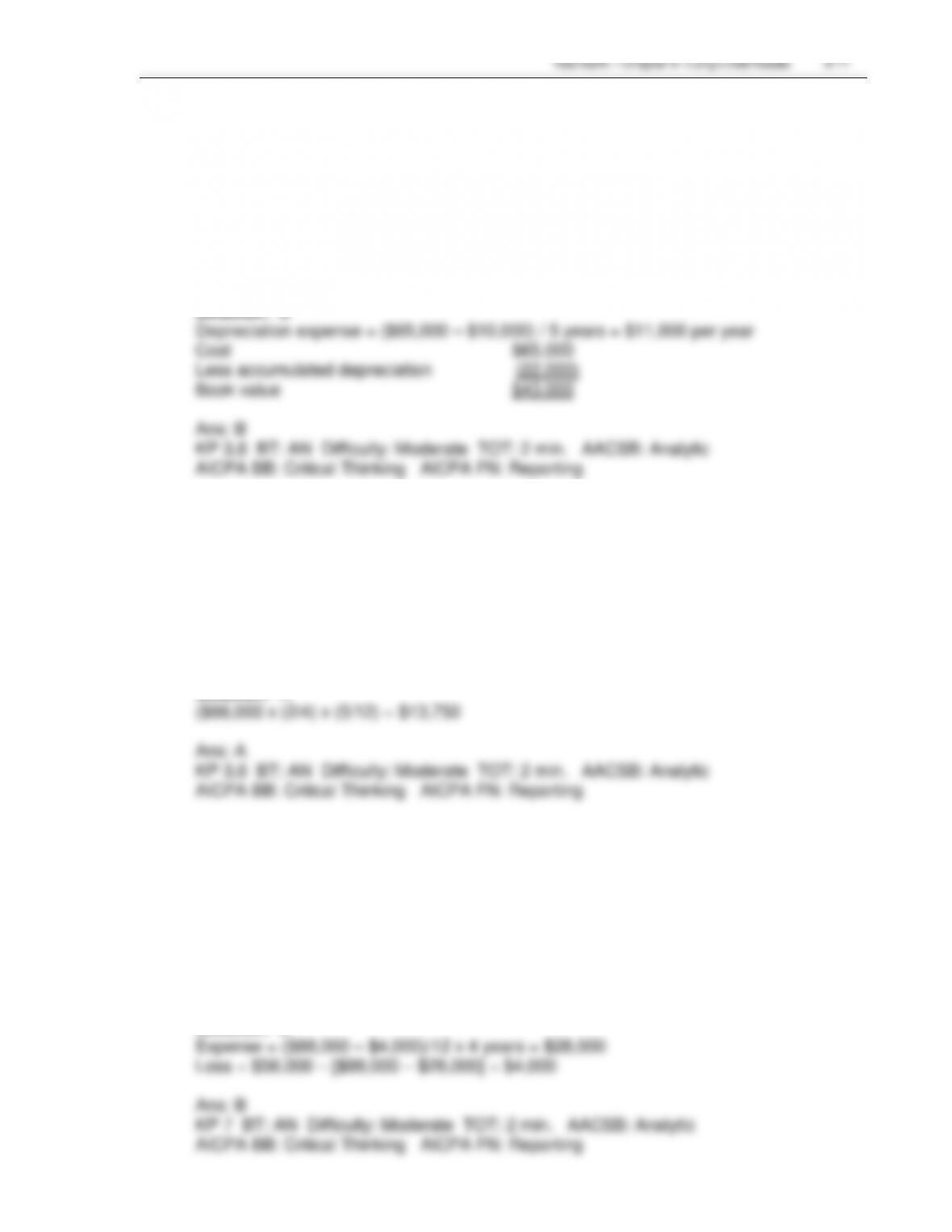
54. On January 1, Eagle Co. paid $65,000 for a new truck. It was estimated that the truck
would be driven 300,000 miles during the next 5 years, at which time it would have a
salvage value of $10,000. At the end of the first and second years, the odometer
registered 55,000 and 115,000 miles, respectively. What is the book value of the truck
using straight-line depreciation at the end of the second year?
a. $47,000
b. $43,000
c. $43,533
d. $56,000
Solution: B
55. On July 31, 2015, equipment is purchased for $66,000 with a 4-year life expectancy and
salvage value of $5,000. If the double-declining-balance method is used, calculate
depreciation expense for the year ending December 31, 2015.
a. $13,750
b. $12,708
c. $33,000
d. $31,000
Solution: A
56. On February 1, 2013, James Co., which uses straight-line depreciation, purchased
equipment for $88,000 with a useful life of 12 years and $4,000 salvage value. On
February 1, 2017, the equipment was sold for $56,000. Which of the following would
James recognize as a result of this disposition?
a. $7,000 loss
b. $4,000 loss
c. $4,000 gain
d. No gain or loss
Solution: B

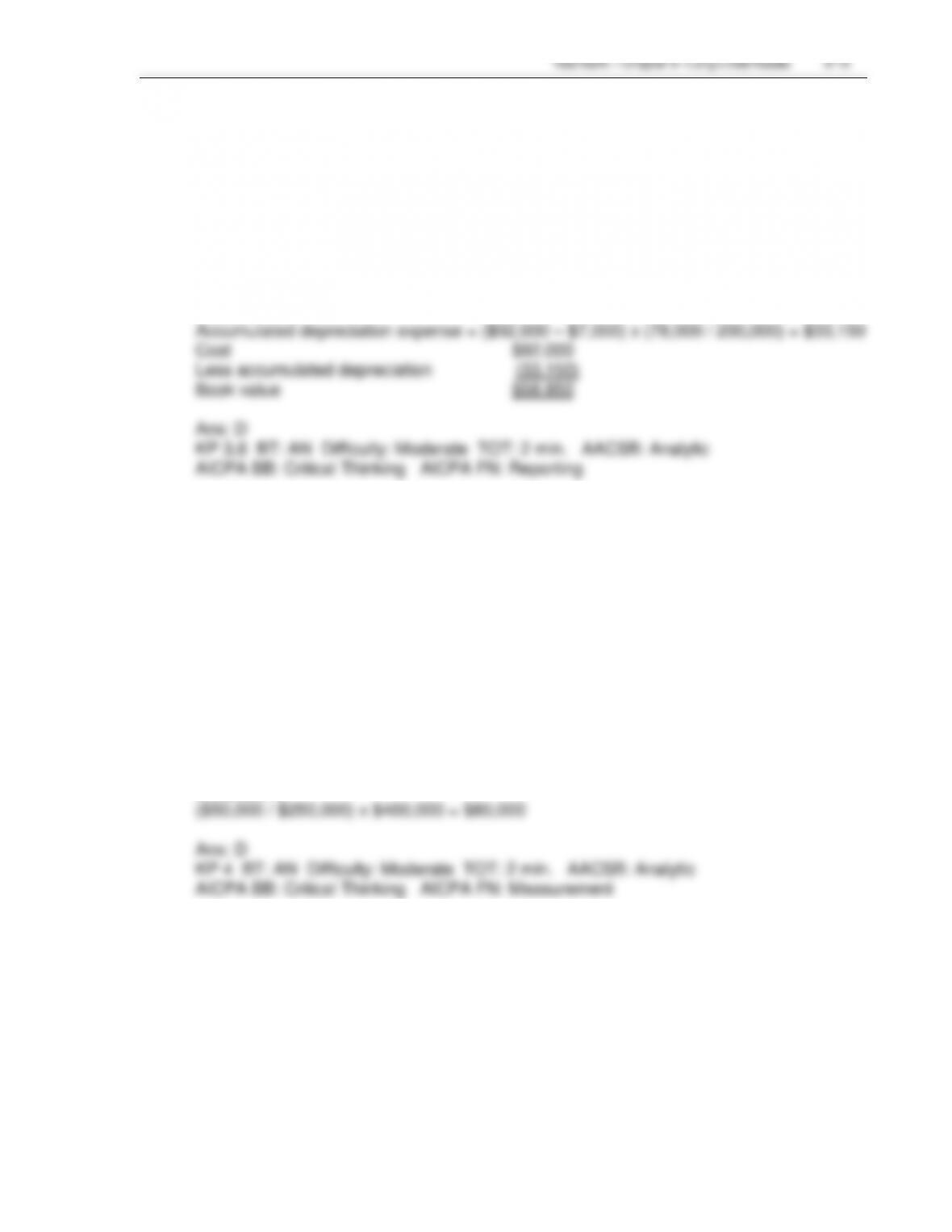
57. On January 1, Mondale Co. paid $92,000 for a new truck. It was estimated that the truck
would be driven 200,000 miles during the next 8 years, at which time it would have a
salvage value of $7,000. At the end of the first three years, the odometer registered
27,000, 53,000, and 78,000 miles, respectively. What is the book value of the truck using
the activity method of depreciation at the end of the third year?
a. $67,150
b. $24,850
c. $51,850
d. $58,850
Solution: D
58. Farmdale Company purchased three assets for $400,000. These assets have fair
market values as follows:
Land $ 75,000
Equipment 125,000
Inventory 50,000
If you were Farmdale’s accountant, how much of the lump sum purchase would you
allocate to the inventory?
a. $100,000
b. $120,000
c. $200,000
d. $80,000
Solution: D
59. Farmdale Company purchased three assets for $400,000. These assets have fair
market values as follows:
Land $ 75,000
Equipment 125,000
Inventory 50,000
If you were Farmdale’s accountant, how much of the lump sum purchase would you
allocate to the land?
a. $75,000
b. $120,000
c. $200,000
d. $80,000
9-20 Test Bank – Chapter 9 – Long-Lived Assets
60. Farmdale Company purchased three assets for $400,000. These assets have fair
market values as follows:
Land $ 75,000
Equipment 125,000
Inventory 50,000
If you were Farmdale’s accountant, how much of the lump sum purchase would you
allocate to the equipment?
a. $100,000
b. $120,000
c. $200,000
d. $80,000
61. The following items represent common post acquisition expenditures incurred on
equipment.
A. An overhaul to increase useful life of the equipment
B. Cost of a muffler to reduce equipment noise
C. Lubrication service
D. Costs of redesign to increase output
Identify which of these items are considered to be betterments.
a. A only
b. A, B, and D
c. A and D
d. A and B