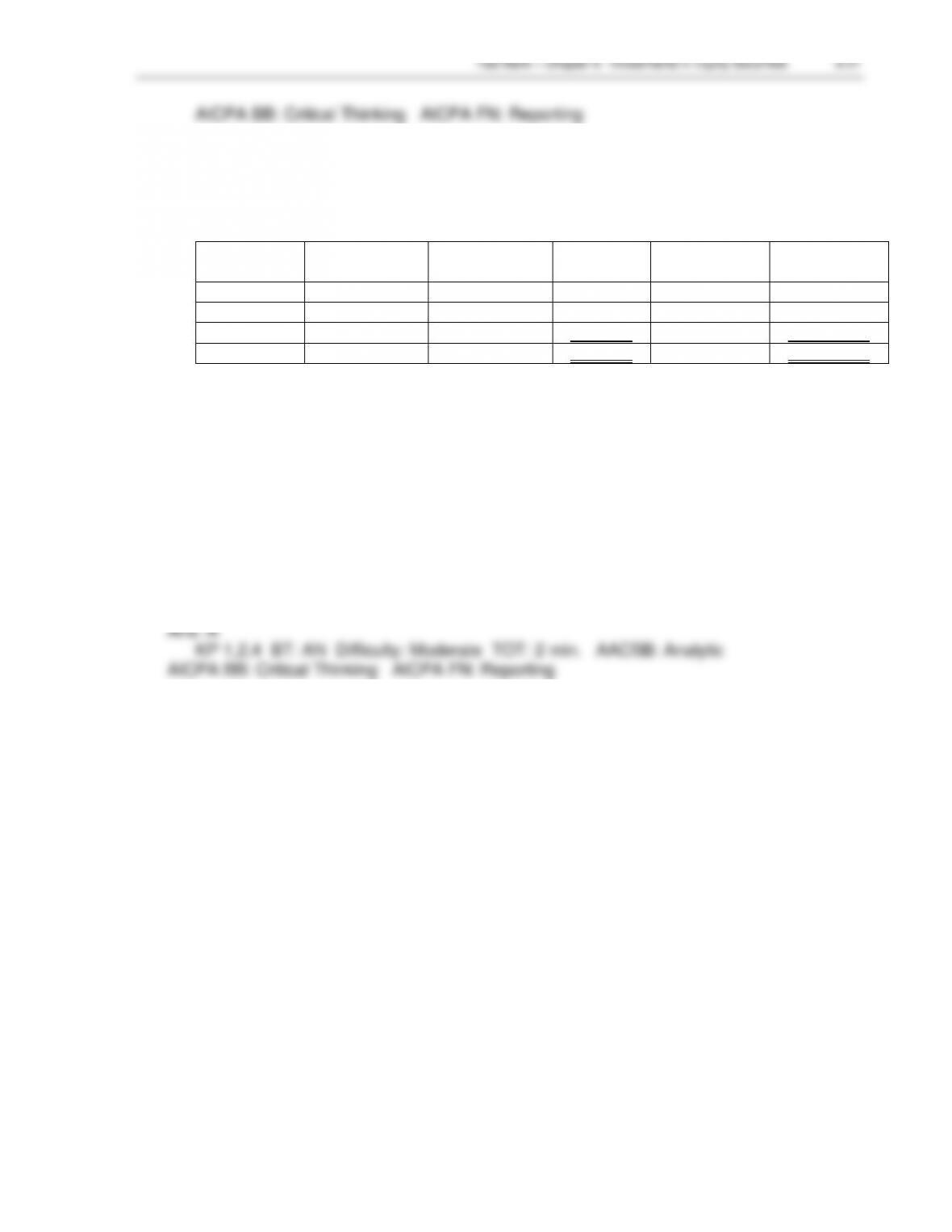
56. The following information related to the marketable security investments of Solo
Company. Securities held on December 31, 2014, as described in the table below. AAA
and BBB are classified as trading securities and CCC is classified as an available-for-
sale security.
Securities
No. of
Shares
Cost/Share
Total
Cost
Value/Share
Total Market
Value
AAA
100
$29
$2,900
$34
$3,400
BBB
250
30
7,500
28
7,000
CCC
150
16
2,400
20
3,000
$12,800
$13,400
Early in 2015, Solo sold all of its investment in AAA securities for $36 per share.
The journal entry to record the 2015 revaluation of the AAA securities would be:
a. Trading Securities 500
Unrealized Gain on Trading Securities 500
b. Unrealized Loss on Trading Securities 500
Trading Securities 500
c. Unrealized Loss on Trading Securities 500
Cash 500
d. Trading Securities 500
Realized Gain on Trading Securities 500
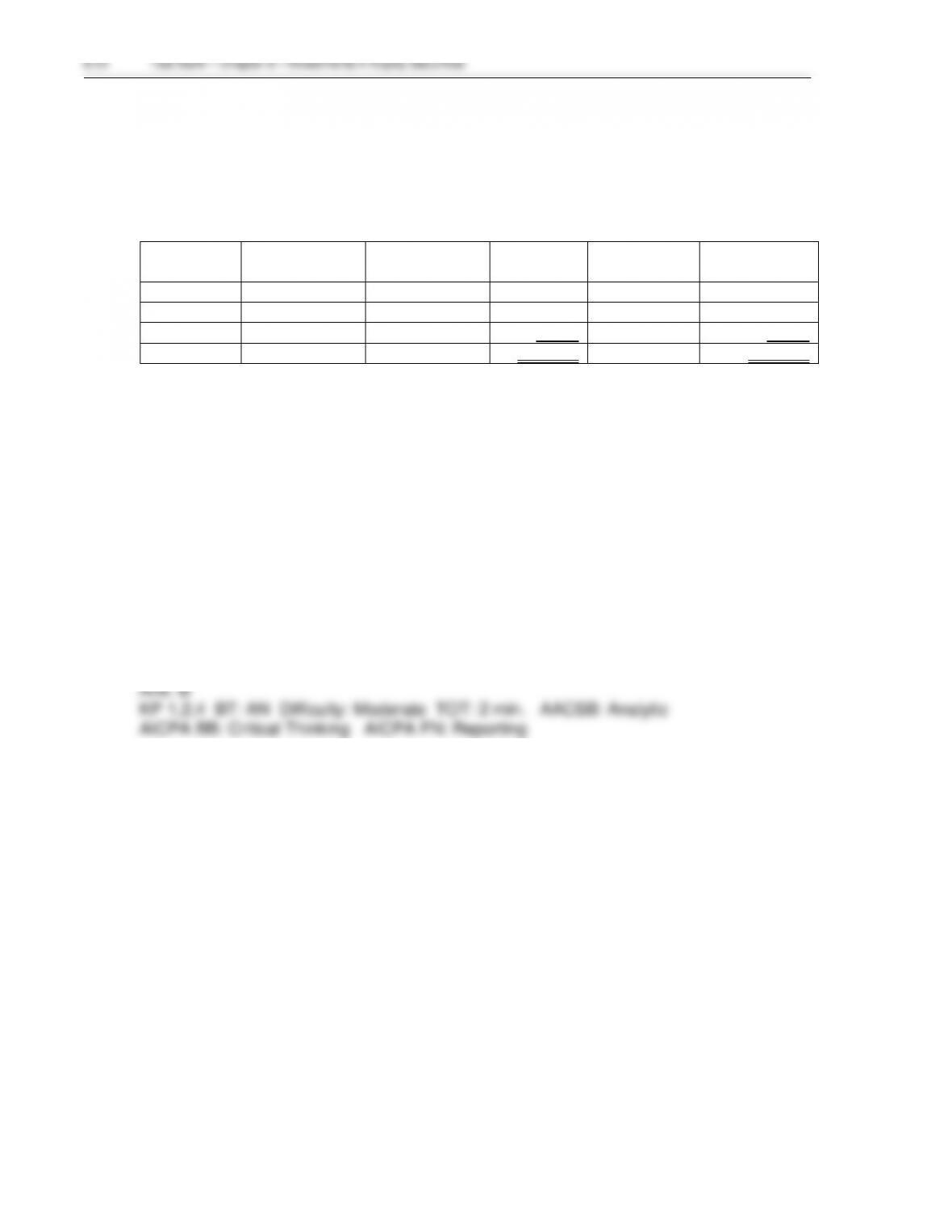
57. The following information related to the marketable security investments of Solo
Company. Securities held on December 31, 2014, as described in the table below. AAA
and BBB are classified as trading securities and CCC is classified as an available-for-
sale security.
Securities
No. of Shares
Cost/Share
Total Cost
Value/Share
Total Market
Value
AAA
100
$29
$2,900
$34
$3,400
BBB
250
30
7,500
28
7,000
CCC
150
16
2,400
20
3,000
$12,800
$13,400
Early in 2015, the company sold 50 shares of BBB for $26 per share. During 2015, Solo
received dividends of $3 per share on the remaining 200 shares of BBB. The per-share
market value of BBB on December 31, 2015 was $24. During 2016, Solo sold the
remaining 200 shares of BBB stock for $26 per share.
The journal entry to record the 2014 revaluation of the BBB securities would be:
a. Trading Securities 500
Unrealized Gain on Trading Securities 500
b. Unrealized Loss on Trading Securities 500
Trading Securities 500
c. Unrealized Loss on Trading Securities 500
Cash 500
d. Trading Securities 500
Realized Gain on Trading Securities 500
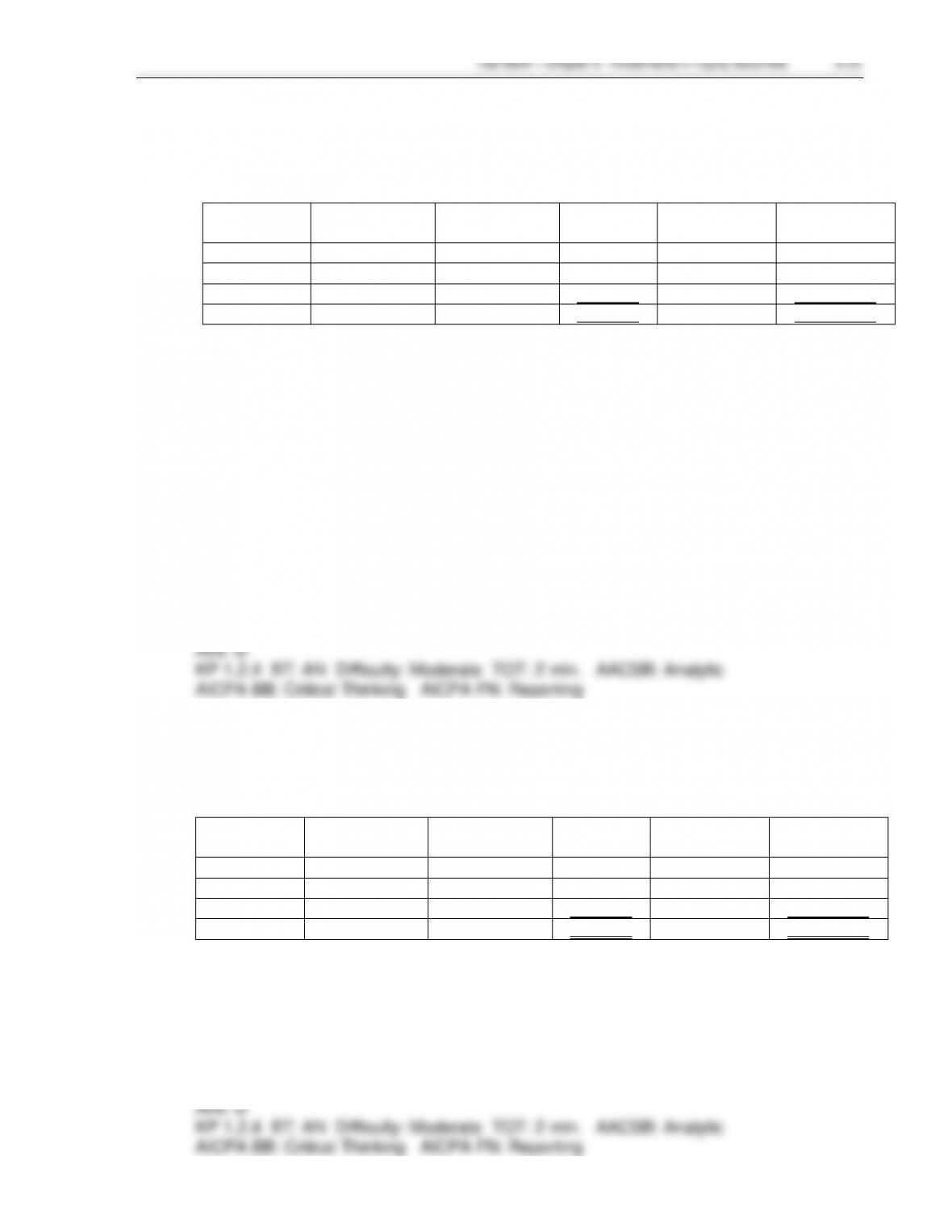
58. The following information related to the marketable security investments of Solo
Company. Securities held on December 31, 2014, as described in the table below. AAA
and BBB are classified as trading securities and CCC is classified as an available-for-
sale security.
Securities
No. of
Shares
Cost/Share
Total
Cost
Value/Share
Total Market
Value
AAA
100
$29
$2,900
$34
$3,400
BBB
250
30
7,500
28
7,000
CCC
150
16
2,400
20
3,000
$12,800
$13,400
During 2015, Solo received word that dividends of $2.50 per share were declared, but
not yet received on the 150 shares of CCC stock. The per-share market value of CCC
on December 31, 2015, was $18. During 2016, Solo sold 150 shares of CCC for $22
per share.
The journal entry to record the 2014 revaluation of the CCC securities would be:
a. Available-for-Sale Securities 600
Realized Gain on Available-for-Sale Securities 600
b. Unrealized Loss on Available-for-Sale Securities 600
Available-for-Sale Securities 600
c. Realized Loss on Available-for-Sale Securities 600
Available-for-Sale Securities 600
d. Available-for-Sale Securities 600
Unrealized Price Increase on Available-for-Sale Securities 600
59. The following information related to the marketable security investments of Solo
Company. Securities held on December 31, 2014, as described in the table below. AAA
and BBB are classified as trading securities and CCC is classified as an available-for-
sale security.
Securities
No. of
Shares
Cost/Share
Total
Cost
Value/Share
Total Market
Value
AAA
100
$29
$2,900
$34
$3,400
BBB
250
30
7,500
28
7,000
CCC
150
16
2,400
20
3,000
$12,800
$13,400
Early in 2015, Solo sold all of its investment in AAA securities for $36 per share.
The journal entry to record the 100 shares of AAA stock sold in 2015 will include:
a. A debit to Trading Securities for $3,400.
b. A credit to Unrealized Loss on Trading Securities for $200.
c. A credit to Realized Loss on Sale of Trading Securities for $200.
d. A credit to Realized Gain on Sale of Trading Securities for $200.

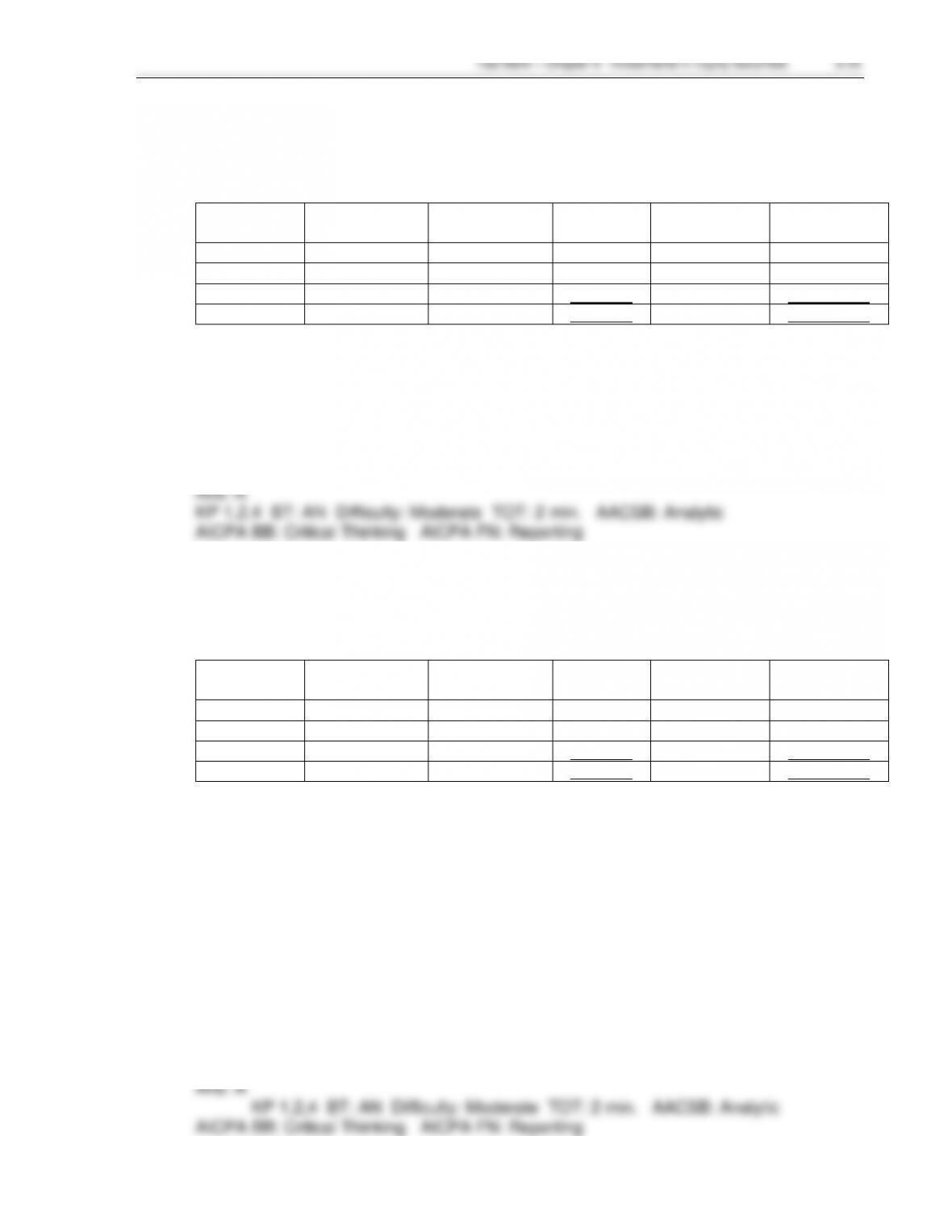
60. The following information related to the marketable security investments of Solo
Company. Securities held on December 31, 2014, as described in the table below. AAA
and BBB are classified as trading securities and CCC is classified as an available-for-
sale security.
Securities
No. of
Shares
Cost/Share
Total
Cost
Value/Share
Total Market
Value
AAA
100
$29
$2,900
$34
$3,400
BBB
250
30
7,500
28
7,000
CCC
150
16
2,400
20
3,000
$12,800
$13,400
Early in 2015, the company sold 50 shares of BBB for $26 per share.
The journal entry to record the 50 shares of BBB stock sold in 2015 will include:
a. A credit to Trading Securities for $1,400.
b. A credit to Unrealized Loss on Trading Securities for $100.
c. A credit to Realized Loss on Sale of Trading Securities for $100.
d. A debit to Realized Gain on Sale of Trading Securities for $100.
61. The following information related to the marketable security investments of Solo
Company. Securities held on December 31, 2014, as described in the table below. AAA
and BBB are classified as trading securities and CCC is classified as an available-for-
sale security.
Securities
No. of
Shares
Cost/Share
Total
Cost
Value/Share
Total Market
Value
AAA
100
$29
$2,900
$34
$3,400
BBB
250
30
7,500
28
7,000
CCC
150
16
2,400
20
3,000
$12,800
$13,400
Early in 2015, the company sold 50 shares of BBB for $26 per share. During 2015, Solo
received dividends of $3 per share on the remaining 200 shares of BBB, and dividends
of $2.50 per share were declared, but not yet received on the 150 shares of CCC stock.
The per-share market values of BBB and CCC on December 31, 2015, were $24 and
$18, respectively. During 2016, Solo sold the remaining 200 shares of BBB stock for
$26 per share and the 150 shares of CCC for $22 per share.
The journal entry to record the dividends received on the BBB securities and the
dividends declared on the CCC stock in 2015 will include:
a. A credit to Dividend Revenue for $975.
b. A credit to Dividend Payable for $375.
c. A credit to Cash for $600.
d. A debit to Dividend Expense for $375.

62. The following information related to the marketable security investments of Solo
Company. Securities held on December 31, 2014, as described in the table below. AAA
and BBB are classified as trading securities and CCC is classified as an available-for-
sale security.
Securities
No. of
Shares
Cost/Share
Total
Cost
Value/Share
Total Market
Value
AAA
100
$29
$2,900
$34
$3,400
BBB
250
30
7,500
28
7,000
CCC
150
16
2,400
20
3,000
$12,800
$13,400
Early in 2015, the company sold 50 shares of BBB for $26 per share. During 2015, Solo
received dividends of $3 per share on the remaining 200 shares of BBB, and dividends
of $2.50 per share were declared, but not yet received on the 150 shares of CCC stock.
The per-share market values of BBB and CCC on December 31, 2015, were $24 and
$18, respectively. During 2016, Solo sold the remaining 200 shares of BBB stock for
$26 per share and the 150 shares of CCC for $22 per share.
The journal entry to record the revaluation of BBB shares in 2015 is:
a. Trading Securities 800
Unrealized Gain on Trading Securities 800
b. Unrealized Loss on Trading Securities 800
Trading Securities 800
c. Unrealized Loss on Trading Securities 600
Cash 600
d. Trading Securities 800
Realized Gain on Trading Securities 800
63. The following information related to the marketable security investments of Solo
Company. Securities held on December 31, 2014, as described in the table below. AAA
and BBB are classified as trading securities and CCC is classified as an available-for-
sale security.
Securities
No. of
Shares
Cost/Share
Total
Cost
Value/Share
Total Market
Value
AAA
100
$29
$2,900
$34
$3,400
BBB
250
30
7,500
28
7,000
CCC
150
16
2,400
20
3,000
$12,800
$13,400
During 2015, Solo received word that dividends of $2.50 per share were declared, but
not yet received on the 150 shares of CCC stock. The per-share market value of CCC
on December 31, 2015, was $18. During 2016, Solo sold 150 shares of CCC for $22
per share.
8-28 Test Bank – Chapter 8 – Investments in Equity Securities
The journal entry to record the revaluation of CCC shares in 2015 is:
a. Available-for-Sale Securities 300
Unrealized Gain on Available-for-Sale Securities 300
b. Unrealized Price Increase on Available-for-Sale Securities 300
Available-for-Sale Securities 300
c. Realized Loss on Available-for-Sale Securities 300
Available-for-Sale Securities 300
d. Available-for-Sale Securities 400
Unrealized Price Increase on Available-for-Sale Securities 400
64. The following information related to the marketable security investments of Solo
Company. Securities held on December 31, 2014, as described in the table below. AAA
and BBB are classified as trading securities and CCC is classified as an available-for-
sale security.
Securities
No. of
Shares
Cost/Share
Total
Cost
Value/Share
Total Market
Value
AAA
100
$29
$2,900
$34
$3,400
BBB
250
30
7,500
28
7,000
CCC
150
16
2,400
20
3,000
$12,800
$13,400
Early in 2015, the company sold 50 shares of BBB for $26 per share. During 2015, Solo
received dividends of $3 per share on the remaining 200 shares of BBB. The per-share
market value of BBB on December 31, 2015, was $24. During 2016, Solo sold the
remaining 200 shares of BBB stock for $26 per share.
The journal entry to record the sale of 200 shares of BBB stock in 2016 is:
a. Cash 5,200
Trading Securities 4,800
Unrealized Gain on Trading Securities 400
b. Cash 5,200
Unrealized Loss on Trading Securities 400
Trading Securities 4,800
c. Cash 5,200
Trading Securities 4,800
Realized Gain on Trading Securities 400
d. Trading Securities 6,000
Realized Gain on Trading Securities 800
Cash 5,200
65. The following information related to the marketable security investments of Solo
Company. Securities held on December 31, 2014, as described in the table below. AAA
and BBB are classified as trading securities and CCC is classified as an available-for-
sale security.
Securities
No. of
Shares
Cost/Share
Total
Cost
Value/Share
Total Market
Value
AAA
100
$29
$2,900
$34
$3,400
BBB
250
30
7,500
28
7,000
CCC
150
16
2,400
20
3,000
$12,800
$13,400
During 2015, Solo received word that dividends of $$2.50 per share were declared, but
not yet received on the 150 shares of CCC stock. The per-share market value of CCC
on December 31, 2015, was $18. During 2016, Solo sold 150 shares of CCC for $22
per share.
The journal entry to record the sale of 150 shares of CCC stock in 2016 would include:
a. A debit to Cash for $2,700.
b. A debit to Unrealized Price Increase on Available-for-Sale Securities for $300.
c. A debit to Unrealized Gain on Available-for-Sale Securities for $900.
d. A debit to Available-for-Sale Securities for $3,300.
66. Under GAAP, market values based on quoted prices in active markets for identical
securities are called:
a. Level 1 measurements
b. Level 2 measurements
c. Level 3 measurements
d. None of the above
67. Under GAAP, market values based on less reliable, unobservable inputs for securities
are called:
a. Level 1 measurements
b. Level 2 measurements
c. Level 3 measurements
d. None of the above
8-30 Test Bank – Chapter 8 – Investments in Equity Securities
MATCHING QUESTIONS
1. Each transaction numbered 1 through 5 below involves an equity security originally
acquired at a cost of $1,000. Identify the effect each transaction has on the current ratio
and earnings per share by selecting from the effects listed in a through f. You may use
each letter more than once or not at all.
Effects
a. Increase in current ratio and earnings per share.
b. Does NOT change earnings per share or the current ratio.
c. Does NOT change earnings per share; may impact the current ratio under certain
conditions.
d. Decrease in current ratio and earnings per share.
e. Increases earnings per share.
f. Can’t determine the direction of changes in at least one ratio from the event given.
____ 1. Trading securities with a current balance sheet value of $1,200 are sold for
$1,100.
____ 2. Trading securities with a current balance sheet value of $800 are sold for
$800.
____ 3. Trading securities with a current balance sheet value of $1,200 are sold for
$1,300.
____ 4. Available-for-sale securities have a market value of $800 at yearend.
____ 5. Available-for-sale securities have a market value of $1,200 at yearend.
KP 2,4 BT: AN Difficulty: Moderate TOT: 4 min. AACSB: Analytic
AICPA BB: Critical Thinking AICPA FN: Measurement
2. Each transaction listed in 1 through 4 relates to an investment in a long-term equity
security. Place the letter that corresponds to the effect (a through h) the transaction has
on the accounting equation in the space provided. You may use each letter more than
once or not at all.
Accounting Effects
a. + A and + L
b. + A and + SE (Contributed Capital)
c. + A and + SE (Retained Earnings)
d. – A and – L
e. – A and – SE (Contributed Capital)
f. – A and – SE (Retained Earnings)
g. + A and – A
h. The event is not reported on financial statements.
____ 1. Under the cost method, the investee company declares a cash dividend.
____ 2. Under the equity method, the investee company declares a cash dividend.
____ 3. Under the cost method, the investee company recognizes net income.
____ 4. Under the equity method, the investee company recognizes net income.

3. For each transaction numbered 1 through 4 below, identify which effect (a through f) the
transaction is most likely to cause. You may use each letter more than once or not at all.
Effects
a. Increase in current ratio and earnings per share
b. Decrease in current ratio and earnings per share
c. Does NOT change the current ratio; increases earnings per share
d. Increases the current ratio; does NOT change earnings per share
e. Does not change the current ratio or earnings per share
f. Can’t determine the effect
_____ 1. The cost method is used for an investment in long-term equity securities,
and the investee company declares a cash dividend.
_____ 2. The equity method is used for an investment in long-term equity securities
and the investee company declares a cash dividend.
_____ 3. The cost method is used for an investment in long-term equity securities
and the investee company recognizes net income.
_____ 4. The equity method is used for an investment in long-term equity securities
and the investee company recognizes net income.
4. Each transaction listed in 1 through 4 below relates to a long-term investment is equity
securities. Select the letters of the accounting effects (a through h) and place them in the
space provided. Transactions may have more than one answer.
Accounting Terms
a. Increase assets
b. Increase shareholders’ equity (Contributed Capital)
c. Increase shareholders’ equity (Retained Earnings)
d. Decrease liabilities
e. Decrease shareholders’ equity (Retained Earnings)
f. Decrease assets
g. Increase liabilities
h. The event is not communicated on financial statements.
_____ 1. Using the equity method the market price of the investment increases
above its cost.
_____ 2. Using the cost method the market price of the investment increases
above its cost.
_____ 3. Using the equity method, the investee company recognizes a net loss
for the year.
_____ 4. An investment in a 40%-owned subsidiary is sold for more than its
carrying value.
5. For each transaction numbered 1 through 4 below, identify which effect (a through g)
would most likely occur as a result of the transaction. You may use each letter more than
once or not at all.
Effects
a. Increase in current ratio and earnings per share
b. Decreases current ratio; increases earnings per share
c. Increases current ratio; does NOT change earnings per share
d. Decrease in current ratio and earnings per share
e. Decreases current ratio; does NOT change earnings per share
f. Does not change the current ratio or earnings per share
g. Can’t determine the direction of changes in the current ratio
_____ 1. Trading equity securities are purchased for $1,000 cash.
_____ 2. Trading securities that cost $1,000 have a yearend market value of $800.
_____ 3. Trading securities that cost $1,000 have a yearend market value of
$1,200.
_____ 4. Trading securities that cost $1,000 that have a current balance sheet
value of $800 are sold for $900.
6. For each transaction listed in 1 through 9, place the letter (a through g) of the best effect
in the space provided. You may use each letter more than once or not at all.
Effects
a. + A and + L
b. + A and + SE (on income statement)
c. + A and + SE (comprehensive income component)
d. – A and – L
e. – A and – SE (on income statement)
f. – A and – SE (comprehensive income component)
g. No change in total A, L, or SE
1.
Trading equity securities are purchased for $900 cash.
2.
Trading securities with a cost of $600 have a market value of $350 when the
financial statements are produced.
3.
Trading securities with a cost of $12,000 have a market value of $14,000 when the
financial statements are produced.
4.
Trading securities with an original cost of $3,000 and a balance sheet value of
$700 are sold for $800.
5.
Trading securities with an original cost of $4,000 and a balance sheet value of
$4,500 are sold for $4,300.
6.
Trading securities with an original cost of $9,000 and a balance sheet value of
$7,800 are sold for $7,800.
7.
Trading securities with an original cost of $4,000 and a balance sheet value of
$4,500 are sold for $4,600.
8.
Available-for-sale securities with a cost of $7,000 have a market value of $5,200
when the financial statements are produced.
9.
Available-for-sale securities with a cost of $7,000 have a market value of $7,200
8-34 Test Bank – Chapter 8 – Investments in Equity Securities
when the financial statements are produced.
Test Bank – Chapter 8 – Investments in Equity Securities 8-35
SHORT PROBLEMS
1. Trading securities were purchased at a cost of $5,000. Their current market value is
$4,000. Prepare the December 31 adjusting journal entry.
2. Prepare the December 31 journal entry that adjusts available-for-sale securities that
were purchased at a cost of $5,000 when current market value is $4,000.
3. On December 31, the cost and market price of trading securities are $5,000 and $9,000,
respectively. Give the appropriate adjusting entry on December 31.
4. On December 31, the cost and market price of available-for-sale securities are $5,000
and $9,000, respectively. Give the appropriate adjusting entry on December 31.
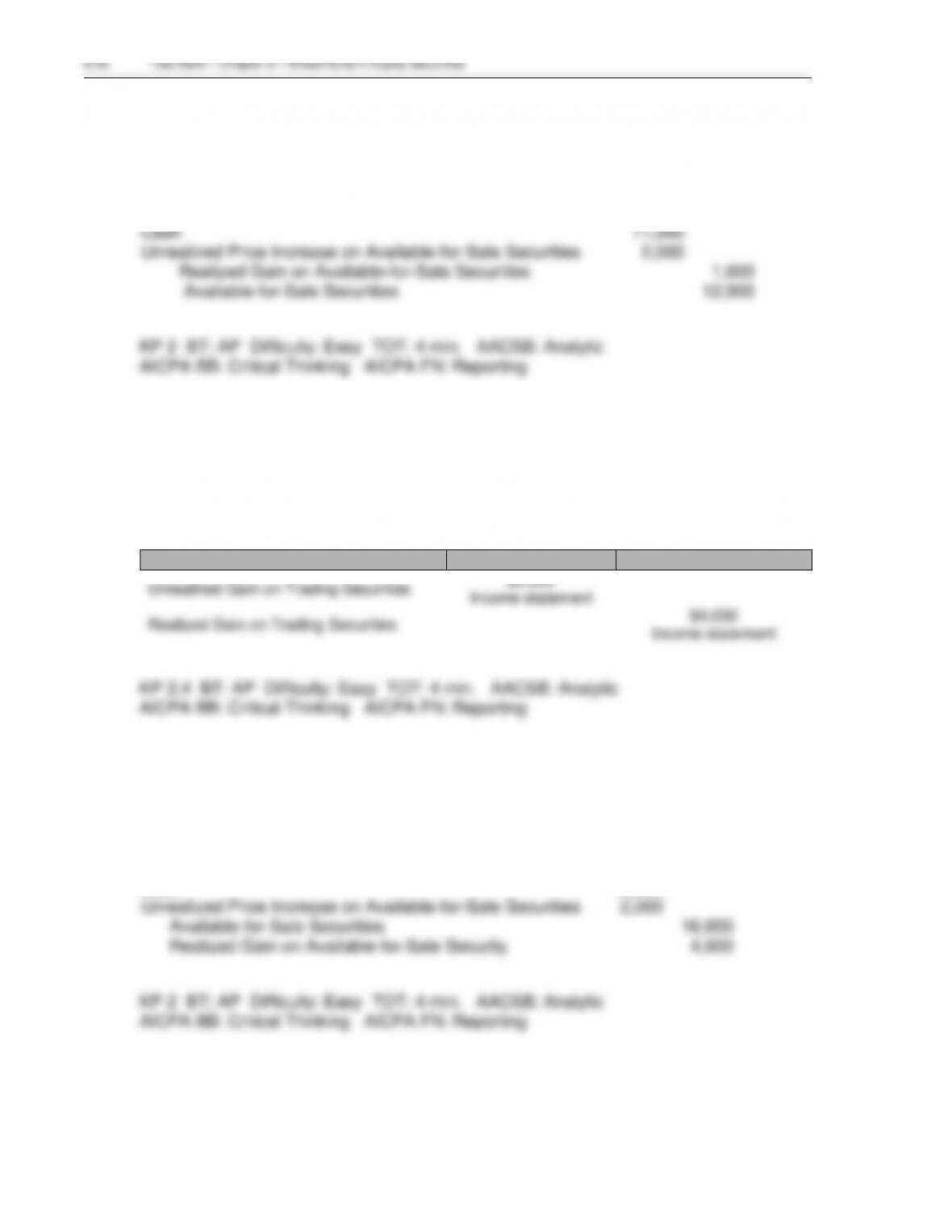
5. On December 31, 2015, available-for-sale securities with an original cost of $10,000
have a carrying value on the balance sheet equal to their market value of $12,000. On
January 5, 2016, those securities are sold for $11,000. Give the appropriate entry to
record the sale of the available-for-sale securities.
Solution:
Cash
11,000
Unrealized Price Increase on Available-for-Sale Securities
2,000
Realized Gain on Available-for-Sale Securities
1,000
Available-for-Sale Securities
12,000
KP 2 BT: AP Difficulty: Easy TOT: 4 min. AACSB: Analytic
AICPA BB: Critical Thinking AICPA FN: Reporting
6. On December 31, 2015, trading securities with an original cost of $45,000 have a market
value of $47,000. On January 11, 2016, those trading securities are sold for $51,000.
Determine the gains or losses in 2015 and 2016 associated with these trading securities.
Clearly label whether the gains or losses are realized or unrealized. Name the financial
statement on which each is reported.
Solution:
2015
2016
Unrealized Gain on Trading Securities
$2,000
Income statement
Realized Gain on Trading Securities
$4,000
Income statement
KP 2,4 BT: AP Difficulty: Easy TOT: 4 min. AACSB: Analytic
AICPA BB: Critical Thinking AICPA FN: Reporting
7. On December 31, 2015, available-for-sale securities with an original cost of $14,000
have a carrying value on the balance sheet equal to their market value of $16,000. On
January 11, 2016, those securities are sold for $18,000. Give the appropriate entry to
record the sale of the available-for-sale securities.
Solution:
Cash
18,000
Unrealized Price Increase on Available-for-Sale Securities
2,000
Available-for-Sale Securities
16,000
Realized Gain on Available-for-Sale Security
4,000
KP 2 BT: AP Difficulty: Easy TOT: 4 min. AACSB: Analytic
AICPA BB: Critical Thinking AICPA FN: Reporting
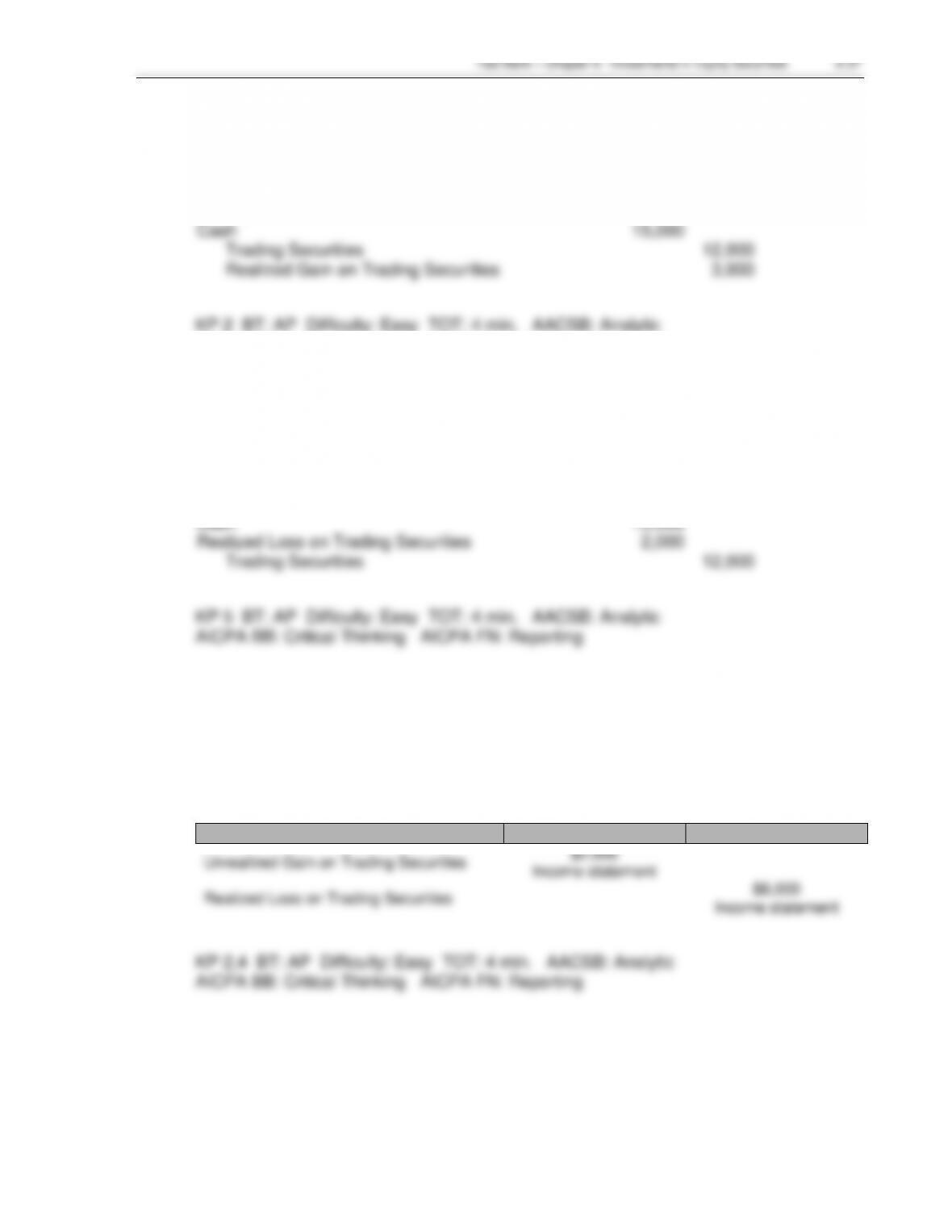
8. On December 31, 2015, trading securities with an original cost of $10,000 have a
carrying value on the balance sheet equal to their market value of $12,000. On January
11, 2016, those trading securities are sold for $15,000. Prepare the appropriate entry to
record the sale of the trading securities.
Solution:
Cash
15,000
Trading Securities
12,000
Realized Gain on Trading Securities
3,000
KP 2 BT: AP Difficulty: Easy TOT: 4 min. AACSB: Analytic
AICPA BB: Critical Thinking AICPA FN: Reporting
9. On December 31, 2015, trading securities with an original cost of $10,000 have a
carrying value on the balance sheet equal to their market value of $12,000. On January
5, 2016, those trading securities are sold for $10,000. Give the appropriate entry to
record the sale of the trading securities.
Solution:
Cash
10,000
Realized Loss on Trading Securities
2,000
Trading Securities
12,000
KP 5 BT: AP Difficulty: Easy TOT: 4 min. AACSB: Analytic
AICPA BB: Critical Thinking AICPA FN: Reporting
10. On December 31, 2015, trading securities with an original cost of $45,000 have a market
value of $47,000. On January 5, 2016, those trading securities are sold for $41,000.
Determine the gains or losses in 2015 and 2016 associated with these trading securities.
Clearly label whether the gains or losses are realized or unrealized. Name the financial
statement on which each is reported.
Solution:
2015
2016
Unrealized Gain on Trading Securities
$2,000
Income statement
Realized Loss on Trading Securities
$6,000
Income statement
KP 2,4 BT: AP Difficulty: Easy TOT: 4 min. AACSB: Analytic
AICPA BB: Critical Thinking AICPA FN: Reporting
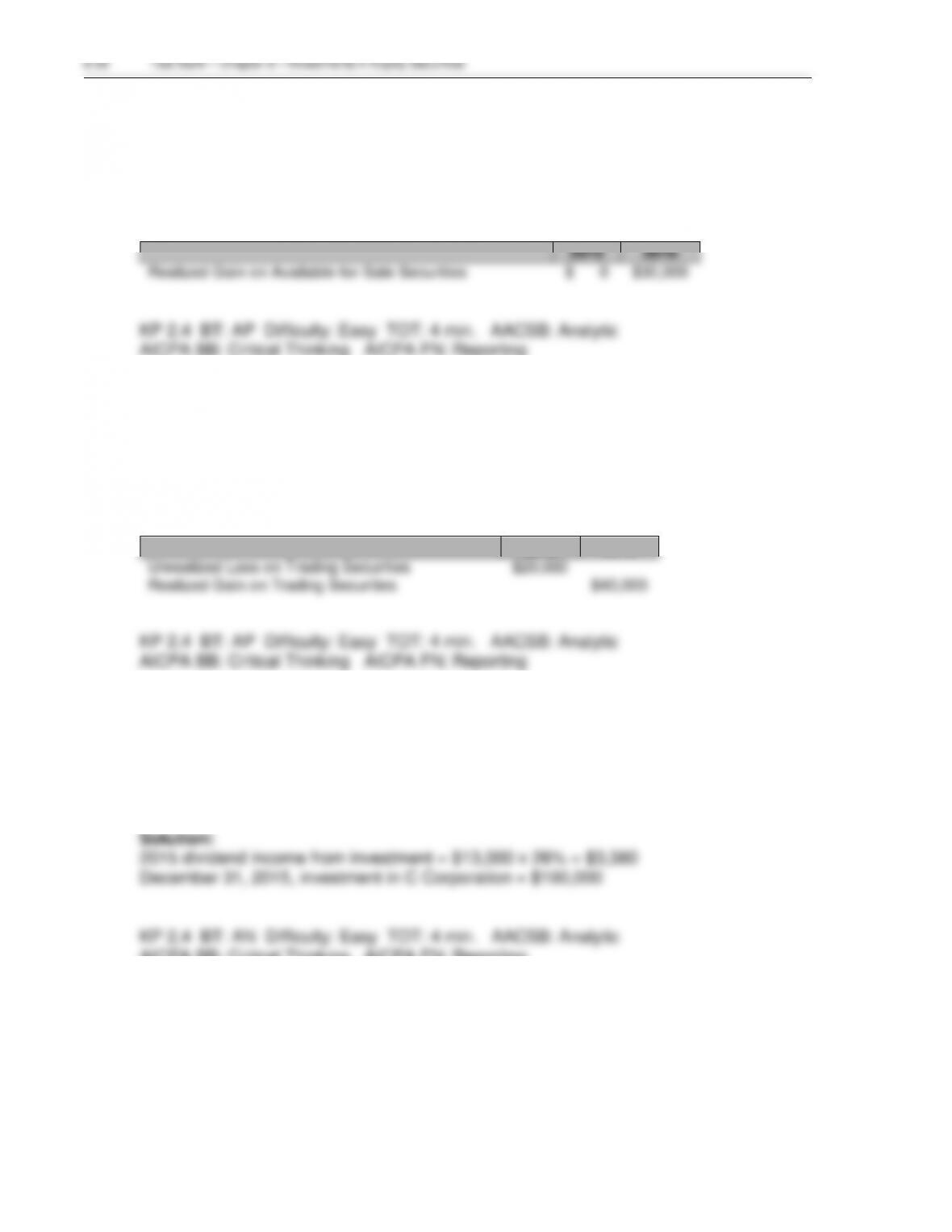
11. On December 31, 2015, available-for-sale securities with an original cost of $100,000
have a market value of $110,000. On January 11, 2016, the available-for-sale securities
are sold for $130,000. Determine the gains or losses in 2015 and 2016 associated with
these securities that must be reported on the income statements. Indicate whether the
gains or losses are realized or unrealized.
Solution:
2015
2016
Realized Gain on Available–for-Sale Securities
$ 0
$30,000
KP 2,4 BT: AP Difficulty: Easy TOT: 4 min. AACSB: Analytic
AICPA BB: Critical Thinking AICPA FN: Reporting
12. On October 10, 2015, Marcus Inc. buys trading securities with an original cost of
$100,000. On December 31, 2015, they have a market value of $80,000. On March 9,
2016, those securities are sold for $120,000. Determine the gains or losses in 2015 and
2016 associated with these trading securities that will be reported on the income
statement. Indicate whether the gains or losses are realized or unrealized.
Solution:
2015
2016
Unrealized Loss on Trading Securities
$20,000
Realized Gain on Trading Securities
$40,000
KP 2,4 BT: AP Difficulty: Easy TOT: 4 min. AACSB: Analytic
AICPA BB: Critical Thinking AICPA FN: Reporting
13. On January 4, 2015, Harrison Corp. purchased 26% of C Corporation’s voting stock for
$100,000. During 2015, C recorded income of $200,000 and paid total dividends of
$13,000. Harrison uses the cost method to account for this investment. Calculate
Harrison’s income from the C investment and the December 31, 2015, balance sheet
value of its long-term equity investment in C.
AICPA BB: Critical Thinking AICPA FN: Reporting