Test Bank – Chapter 7 – Merchandise Inventory 7-21
70. Grey Manufacturing had the following transaction:
• Grey received an order to sell inventory with a cost of $50,000, and debited
Accounts Receivable and credited Sales. The goods were shipped to the
customer on December 31, 2015, and received on January 2, 2016.
If the terms of the sale were FOB shipping point and Grey included all these items in its
ending inventory of 12/31/15, which of the following is the best statements regarding this
treatment?
a. Grey made no mistake and rightfully included the items in its inventory until January
2, 2016.
b. Grey made a mistake and wrongly understated ending inventory.
c. Grey made a mistake and wrongly understated Cost of Goods Sold.
d. Grey made a mistake and wrongly understated Retained Earnings.
71. Grey Manufacturing had the following transaction:
• Grey ordered $67,000 of inventory on December 30, 2015. The inventory
was shipped on December 31, 2015, with the terms FOB destination. Grey
received the inventory on January 3, 2016.
If Grey included all these items in it ending inventory of 12/31/15, which of the following
is the best statement regarding this treatment?
a. Grey made no mistake and rightfully included the items in its ending inventory for
12/31/15.
b. Grey made a mistake and wrongly overstated Inventory.
c. Grey made a mistake and wrongly overstated Cost of Goods Sold.
d. Grey made a mistake and wrongly overstated Retained Earnings.
7-22 Test Bank – Chapter 7 – Merchandise Inventory
MATCHING QUESTIONS
1. For each cost numbered 1 through 8 below, identify which accounting treatment (a
through c) would most likely be used in accounting for the cost. You may use each letter
more than once or not at all.
Users
a. Added to cost of inventory
b. Deducted from cost of inventory
c. Not part of cost of inventory
1. Cash price of goods purchased for resale
2. Transportation cost of goods shipped to customers
3. Transportation cost of goods shipped from suppliers FOB shipping point
4. Cash discount taken on purchases of inventory
5. Transportation cost of goods being shipped to consignee
6. Assembly costs of products which will be sold to customers
7. Insurance cost paid while inventory is in transit from suppliers
8. Excise, sales, use, value added, and other fees and taxes paid on the purchase of inventory
Solution:
2. For each item listed in 1 through 4, place the letter of the accounting effect (a through e)
in the space provided. You may use each letter more than once or not at all.
Accounting Effects
a. Current ratio and earnings per share increase.
b. Current ratio and earnings per share are not affected.
c. Current ratio increases and earnings per share decreases.
d. Current ratio decreases and earnings per share increases.
e. Current ratio and earnings per share decrease.
____ 1. During a period of increasing inventory and rising prices, a company decides
to use FIFO instead of LIFO.
____ 2. During a period of increasing inventory and rising prices, a company decides
to use averaging instead of FIFO.
____ 3. During a period of static prices, a company decides to use FIFO instead of
LIFO.
____ 4. A company applies lower-of-cost-or-market for valuing ending inventory when
market price is less than cost.
Test Bank – Chapter 7 – Merchandise Inventory 7-23
KP 4 BT: AN Difficulty: Moderate TOT: 1 min. AACSB: Analytic
AICPA BB: Critical Thinking AICPA FN: Measurement
3. For each item listed in 1 through 2, place the letter of the accounting effect (a through e)
in the space provided. You may use each letter more than once or not at all.
Accounting Effects
a. Current ratio and earnings per share increase.
b. Current ratio and earnings per share decrease.
c. Current ratio increases and earnings per share decreases.
d. Current ratio decreases and earnings per share increases.
e. Current ratio and earnings per share are not affected.
____ 1. A company applies lower-of-cost-or-market for valuing ending inventory when
cost is greater than market price.
____ 2. During an extended period of constant prices, a company uses LIFO instead of
FIFO.
4. For each item listed in 1 through 7, place the letter (a through e) of the accounting effect
in the space provided. You may use each letter more than once or not at all.
Accounting Effects
a. Assets and net income increase
b. Assets and net income decrease
c. Assets decrease and net income increases
d. Assets increase and net income decreases
e. Assets and net income are not affected
____ 1. During a period of increasing inventory and rising prices, a company decides to
use FIFO instead of LIFO.
____ 2. During a period of increasing inventory and rising prices, a company decides to
use averaging instead of FIFO.
____ 3. During a period of increasing inventory and increasing prices, a company uses
the LIFO method, which creates the largest cost of goods sold.
____ 4. A company applies lower-of-cost-or-market for valuing ending inventory when
market price is less than cost.
____ 5. A company applies lower-of-cost-or-market for valuing ending inventory when
cost is less than market price.
____ 6. During an extended period of constant prices, a company adopts LIFO instead
of FIFO.
7-24 Test Bank – Chapter 7 – Merchandise Inventory
SHORT PROBLEMS
1. Bisbee Ltd. has been fraudulently overstating its inventory in order to “pump up” a
lagging income. It started this practice on January 1, 2015 and overstated the 2015
income by $9,000. By what amount will they have to overstate December 31, 2016
inventory in order to overstate 2016 income by $14,000?
Use the information that follows concerning Bradley Corporation to answer problems 2–
5.
Bradley Corporation began business on January 1. During January, Bradley reported the
following:
January 1 purchase:
100 units @ $10 =
$1,000
January 10 purchase:
150 units @ $14 =
$2,100
January sales:
200 units
2. Determine the amount of inventory to report on Bradley’s balance sheet at January 31
under the FIFO cost flow assumption.
3. Determine the amount of inventory to report on Bradley’s balance sheet at January 31
under the LIFO cost flow assumption.
4. Determine the amount of the inventory valuation on January 31 under the averaging cost
flow assumption.

5. Determine the amount of cost of goods sold under the FIFO cost flow assumption for the
month of January.
6. Warren Trading pays for its inventory purchases with cash. Beginning inventory is
$3,000, purchases were $19,000, and cost of goods sold is $18,000. Determine the cost
of Warren’s ending inventory.
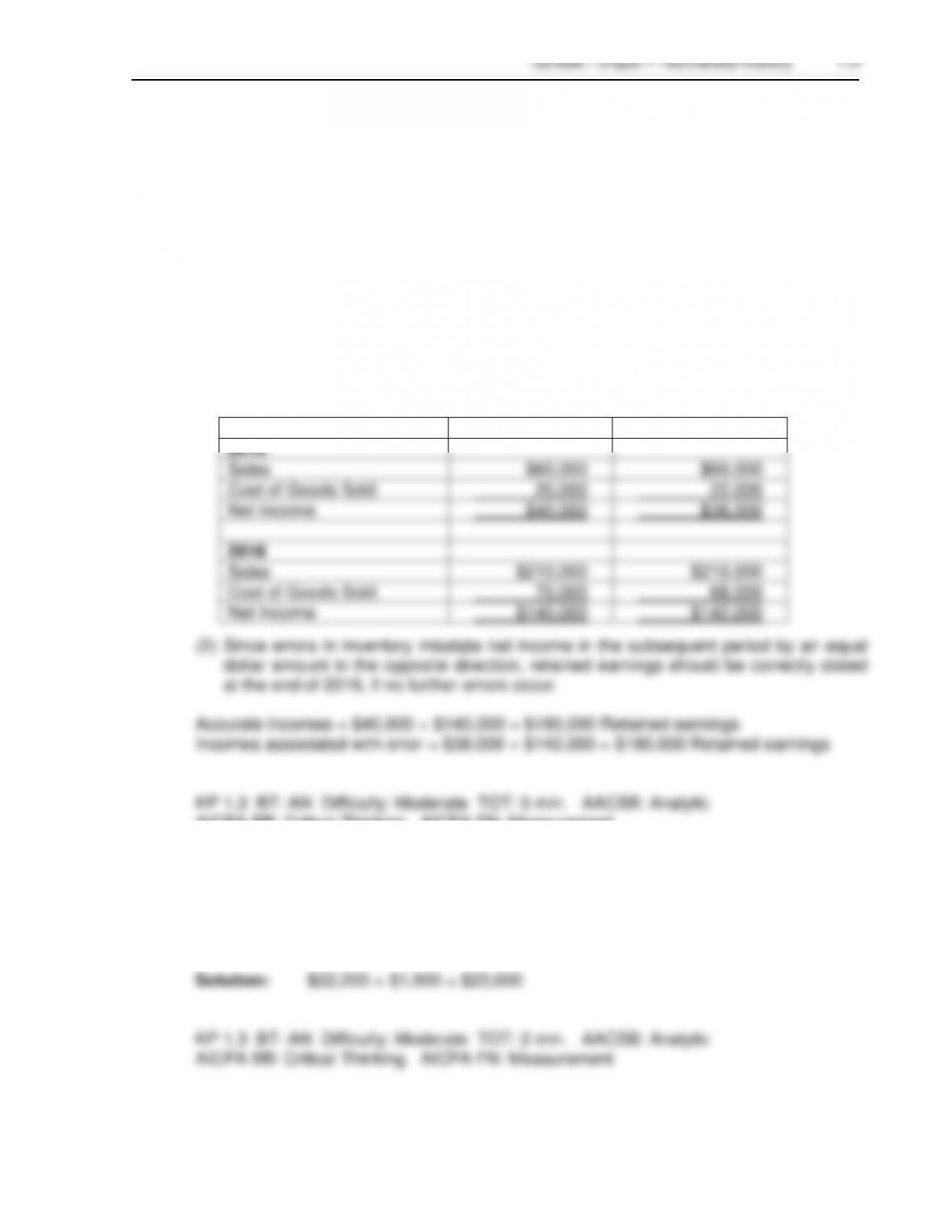
9. The management of Dayton Ltd. erroneously understated its inventory during 2015 by
$28,000. Using the information below and assuming there are no distributions of
retained earnings: (1) present a brief analysis with the accurate numbers and the
numbers in error and (2) explain whether retained earnings would be overstated,
understated, or be indifferent to the error at the end of 2016.
2015 Sales: $60,000
2015 Purchases: $50,000
2015 Cost of Goods Sold (before inventory error) $20,000
2016 Sales: $210,000
2016 Purchases: $60,000
2016 Cost of Goods Sold (based on error numbers): $68,000
Solution:
(1)
Sales
Sales
AICPA BB: Critical Thinking AICPA FN: Measurement
10. Yale Co. has valued its beginning and ending inventories at $4,000 and $7,000,
respectively, during a period where cost of goods sold was $22,000. An auditor found an
error in the valuation of the ending inventory and insisted that it be restated to $6,000.
Calculate the adjusted cost of goods sold resulting from the inventory restatement.
If Accurate
With 2015 Error
11. Summers Company began business on August 1, 2015. During August, Summers made
the following purchases:
August 3
100 units @ $10
$1,000
August 21
300 units @ $20
$6,000
Other information provided:
August sales
350 units at $50 each
August expenses excluding cost of goods sold
$7,200
August 31 current assets excluding inventory
$34,000
August 31 current liabilities
$26,000
Calculate Summers’ August 31 ending inventory under the FIFO and LIFO cost flow
assumptions.
Solution:
AICPA BB: Critical Thinking AICPA FN: Measurement
12. Yogi Company began operations on July 1. Below is its July income statement and the
current portion of its balance sheet dated July 31. Each unit is sold for $80. Under the
LIFO method of inventory, Yogi reported the following:
July 3
Purchased 60 units @ $50
$3,000
July 14
Purchased 40 units @ $60
2,400
Cost of goods available
$5,400
July 31
Inventory (10 @ $50)
500
Cost of goods sold
$4,900
Complete the following income statement and current portion of the balance sheet for
Yogi for July using the FIFO cost flow assumption instead of LIFO.
Sales revenue . . . . . . . . . . . . . . . . . _____________________
Cost of goods sold . . . . . . . . . . . . . ._____________________
Gross profit . . . . . . . . . . . . . . . . . . . _____________________
Solution:
13. A firm fraudulently overstated its December 31, 2014 and 2015 inventories by $4,000
and $7,000, respectively. What is the amount of 2014 and 2015 overstatements of cost
of goods sold which results from these inventory overstatements?
Solution:
Use the information that follows concerning Yarley’s Gift Store to answer problems 14-17.
Grandma’s Gift Store inventory and purchase information for July is as follows:
July 1
Beginning inventory
500 @ $4
July 10
Purchase
800 @ $5
July 31
Ending inventory
300
14. Grandma’s Gift Store uses the FIFO cost flow assumption. Calculate its cost of goods
sold for the month of July and its ending inventory at July 31.
15. Grandma’s Gift Store uses the LIFO cost flow assumption. Calculate its cost of goods
sold for July and its ending inventory at July 31.
16. Grandma’s Gift Store uses the averaging cost flow assumption. Calculate its cost of
goods sold for July and its inventory at July 31.
Solution:

17. By what amount would Grandma’s working capital on July 31 under FIFO exceed
working capital using LIFO?
Use the information that follows concerning Ruby Company to answer problems 18 through 20.
Ruby Company sells office supplies. Below is a list of purchases and sales for the month
of January:
Date
Inventory Balances
Purchases
January 1
Beginning inventory
10 @ $6
January 4
Purchase
40 @ $7
January 18
Purchase
40 @ $8
January 31
Ending inventory
20 units
18. Ruby uses the FIFO cost flow assumption. Calculate its January cost of goods sold.
19. Ruby uses the LIFO cost flow assumption. Calculate its January cost of goods sold.
20. Ruby uses the averaging cost flow assumption. Calculate its January cost of goods sold.
Solution: [(10 x $6) + (40 x $7) + (40 x $8)]/90 = $7.33; 70 x $7.33 = $513
21. Toyz’s Retail Store sold $900 of merchandise to Ebony Inc. on April 3, terms, 2/10 EOM.
On April 8, Ebony returned $200 of the merchandise that was defective. The original
merchandise sold cost Toyz $600 with terms N30, but of this amount, $70 was returned.
Toyz received payment from Ebony on April 10. What amount of sales and cost of goods
sold should Toyz record for these transactions?
KP 1,3 BT: AN Difficulty: Moderate TOT: 2 min. AACSB: Analytic
AICPA BB: Critical Thinking AICPA FN: Measurement
Use the information that follows concerning Edward Company to answer problems 22 and 23.
Edward Company began business on January 1. During January, Edward made the
following purchases:
January 3:
100 units @ $30
$3,000
January 21:
400 units @ $20
$8,000
January sales:
320 units @ $40
$12,800
Other information:
January expenses excluding cost of goods sold
$ 800
January 31 current assets excluding inventory
11,000
January 31 current liabilities
6,000
Number of shares of common stock
300
22. Calculate Edward’s January earnings per share under the FIFO and LIFO cost flow
assumptions.
23. Calculate Edward’s January current ratio under the FIFO and LIFO cost flow
assumptions.
24. Nokia Inc. reported beginning inventory of $90,000, ending inventory of $23,000,
purchases of $128,000, purchase returns of $2,000, and transportation-in of $3,000.
Calculate cost of goods sold.
Test Bank – Chapter 7 – Merchandise Inventory 7-33
KP 1 BT: AN Difficulty: Moderate TOT: 3 min. AACSB: Analytic
AICPA BB: Critical Thinking AICPA FN: Measurement
25. Ramiro Co. has valued its beginning and ending inventories at $4,000 and $5,000,
respectively, during a period where purchases totaled $150,000. An auditor found errors
in the ending inventory valuation and insisted that it be restated to $6,000. Calculate the
adjusted cost of goods sold resulting from the inventory restatement.
26. Morrie Produce began operations on July 1. Below is its income statement for the month
of July and the current portion of its balance sheet dated July 31.
Sales revenue
$45,000
Cost of goods sold (Note 1)
12,000
Gross profit
33,000
Operating expenses
4,700
Net income
$28,300
Current assets:
Cash
$8,000
Accounts receivable
4,000
Inventory
500
Total current assets
$12,500
Current liabilities:
Accounts payable
$ 9,000
Notes payable
4,000
Total current liabilities
$13,000
Note 1: Morrie uses the LIFO method of inventory valuation.
July 1
Purchased 80 units @ $30
$ 2,400
July 17
Purchased 180 units @ $60
10,800
Cost of goods available
13,200
July 31 Inventory
(40 @ $30)
1,200
Cost of goods sold
$12,000
Complete the following income statement and current portion of the balance sheet for
Morrie for July using the FIFO cost flow assumption instead of LIFO.
Sales revenue . . . . . . . . . . . . . . . . . _____________________
Cost of goods sold . . . . . . . . . . . . . ._____________________
Gross profit . . . . . . . . . . . . . . . . . . . _____________________
Operating expenses. . . . . . . . . . . . . _____________________
Net income. . . . . . . . . . . . . . . . . . . . _____________________
Current assets:
Inventory. . . . . . . . . . . . . . . . . . ._____________________
Solution:
Sales revenue
$45,000
Cost of goods sold
10,800
Gross profit
34,200
Operating expenses
4,700
Net income
$29,500
Inventory (40 x $60)
$ 2,400
KP 3,4 BT: AN Difficulty: Difficult TOT: 8 min. AACSB: Analytic
AICPA BB: Critical Thinking AICPA FN: Measurement
27. Mamma’s Cafe assigned the following costs to inventory on December 31:
Cash purchase costs
$6,000
Commissions paid to Mamma’s sales staff
230
Transportation-in costs
310
Cell phone charges for Mamma’s’ CEO
400
Handling cost associated with unloading the inventory
150
Labor and overhead costs attributable to repackaging inventory
280
Total cost
$7,370
Current net income
$24,000
Determine the correct December 31 inventory and recalculate current net income that is
appropriate under generally accepted accounting principles. Justify your new valuation
of inventory.
Test Bank – Chapter 7 – Merchandise Inventory 7-35
SHORT ESSAY QUESTIONS
1. Please explain the statement that “a LIFO liquidation creates ‘phantom’ income”.
Solution: A LIFO liquidation occurs when the current year’s higher-priced inventory
is all sold off causing penetration (i.e., sale) of the LIFO inventory layers that had
2. Identify the options a manager has in measuring the cost of inventory as it flows through
the accounting system.
3. What effect does management’s perception of the ‘capital market’ have on selecting an
inventory costing method?
Solution: Investors in the capital market prefer companies with higher net income
amounts and larger amounts of assets. In periods of rising prices, FIFO reports a lower
4. If an entity overstates its ending inventory for the current year, what are the effects on
assets, cost of goods sold, retained earnings, and total stockholders’ equity for the
current year?
5. During a period of rapidly rising inventory prices and a significant increase in inventory, a
financial analyst made the following statement:
“I rank a company’s earning power by using earnings per share. You do not need to be a
rocket scientist and know all that accounting mumbo-jumbo in order to compare earnings
per share of two companies to obtain a ranking of their earnings power.”
Respond to the statement made by the financial analyst concerning the implications of
choosing an inventory valuation method.
Solution: During a period of significantly increasing prices and inventory, the choice
of FIFO or LIFO inventory valuation methods can significantly influence measured
current assets and income for corporations that carry significant inventory and whose
6. How do inventories of manufacturing companies differ from inventories of merchandising
companies?
Solution: Manufacturing companies have three inventories: raw materials, work in
7. Explain the concept of hidden reserves as it applies to the lower-of-cost-or-market rule.
Solution: The lower-of-cost-or-market rule recognizes price decreases immediately,
but price increases are not recognized until the inventory is sold in an actual transaction.
8. The chief investment officer of a large mutual fund made the following statement:
“I prefer to use the debt/equity ratio instead of the debt/asset ratio because the latter
ratio is sensitive to the measure of inventory where accountants can choose LIFO, FIFO,
or weighted averaging. Therefore, I use the debt/equity ratio so that I do not have to
worry about which inventory valuation method the accountant used when I run
comparisons between companies.”
Comment on the preceding statement.
Solution: Although it is true that the particular inventory valuation method does
influence the measure of assets and, therefore, the debt/asset ratio, it is not true that the
9. Why is the lower-of-cost-or-market rule necessary in accounting?
Solution: When the market value of inventory, its replacement cost, is lower than
10. After studying a financial accounting text, your roommate asserts that what is interesting
about accountants is that they always measure what actually happens. Having studied
inventory, you disagree with your roommate’s assertion. Present an argument refuting
your roommate’s position that accountants measure what actually happens in context of
knowledge acquired after reading the chapter entitled “Merchandise Inventory.”
Solution: Accountants measure cost of goods sold and inventory by applying a cost
11. If an entity understates its ending inventory for the current period, what is the effect on
cost of goods sold and inventory carry over to the next year. Explain why.
12. Explain the relationship between the valuation of inventory and income measurement.
Solution: Inventory costs are capitalized on the balance sheet as assets because
they provide future economic benefits. The dollar amount at which the inventory is
Test Bank – Chapter 7 – Merchandise Inventory 7-39
IFRS QUESTIONS
1. Which of the following inventory cost flow assumptions is not allowed under IFRS?
A. FIFO
B. Average Cost
C. FISH
D. LIFO
2. When applying the lower-of-cost-or-market rule, IFRS uses the market value which is
A. Normally the realizable value or the amount at which the inventory could be sold
B. Normally the replacement cost or the cost of replacing the inventory
C. Normally the hypothetical future value
D. IFRS does not use the lower-of-cost or market rule.