1. Portland Supplies Co. mistakenly excluded $3,000 of goods from its December 31, 2015
physical inventory count. Its December 31, 2016 inventory amount was correct. As a
result of this error,
a. 2015 income is overstated by $3,000.
b. 2015 ending inventory is overstated by $3,000.
c. 2016 income is overstated by $3,000.
d. 2016 cost of goods sold is overstated by $3,000.
2. Which one of the following expenditures should not be included in the cost of inventory?
a. Transportation-out
b. Purchase cost
c. Packaging cost
d. Transportation-in
3. Michael Manufacturers fraudulently overstated its December 31, 2015 and December
31, 2016 inventory by $3,000 and $6,000, respectively. As a result of these
overstatements,
a. 2015 income is overstated by $3,000 and 2016 income is overstated by $3,000.
b. 2015 income is overstated by $3,000 and 2016 income is overstated by $6,000.
c. 2015 income is overstated by $3,000 and 2016 income is accurate.
d. 2015 and 2016 incomes are not affected.
4. Jackson Roper fraudulently overstated its December 31, 2015 inventory by $8,000. As a
result of this overstatement,
a. the 2015 earnings per share is overstated.
b. the 2015 current ratio is understated.
c. the 2015 cost of goods sold amount is overstated.
d. net income is overstated for 2016, and net income for 2015 is correct.
5. If a company desires to increase its inventory, then it should:
a. sell more goods than it purchases during the period.
b. purchase more goods than it sells during the period.
c. purchase the same amount of goods that it sells.
d. increase its selling prices to a level that customers would not be willing to purchase.
6. Cagey Trading Inc. counted $2,000 of inventory twice during its December 31, 2015
physical inventory count. Its December 31, 2016 inventory amount is correct. As a result
of this error,
a. 2015 ending inventory is overstated by $2,000.
b. 2015 income is understated by $2,000.
c. 2016 income is overstated by $2,000.
d. 2016 cost of goods sold is understated by $2,000.
7. Washington Co. mistakenly omitted $4,000 of merchandise from its inventory on
December 31, 2015. Its December 31, 2016, inventory is correct. As a result of this
error,
a. earnings per share is overstated for 2015 and overstated for 2016.
b. total income for 2015 and 2016 combined is correct.
c. the current ratio is overstated on December 31, 2015 and is correct on December 31,
2016.
d. ending inventory is understated at December 31, 2016.
8. Parker Books purchased 200 books, paying $10 each. Parker paid the $40 shipping
costs and $30 binding repair fees so that those books could be sold. How much is the
cost of inventory?
a. $2,000
b. $2,040
c. $2,030
d. $2,070
9. A company deliberately and inappropriately included interest costs on its December 31
inventory. Which one of the following statements is true for the company’s December 31
financial statements?
a. Earnings per share is understated.
b. Inventory turnover ratio is understated.
c. The current ratio is understated.
d. Cost of goods sold is overstated.
10. Dole Produce Ltd. counted $700 of inventory twice in its December 31, 2015 inventory.
On December 31, 2016, it mistakenly omitted $200 of merchandise from its inventory. As
a result of these errors:
a. net income is overstated by $700 in 2015 and understated by $200 in 2016.
b. net income in understated by $700 in 2015 and overstated by $200 in 2016.
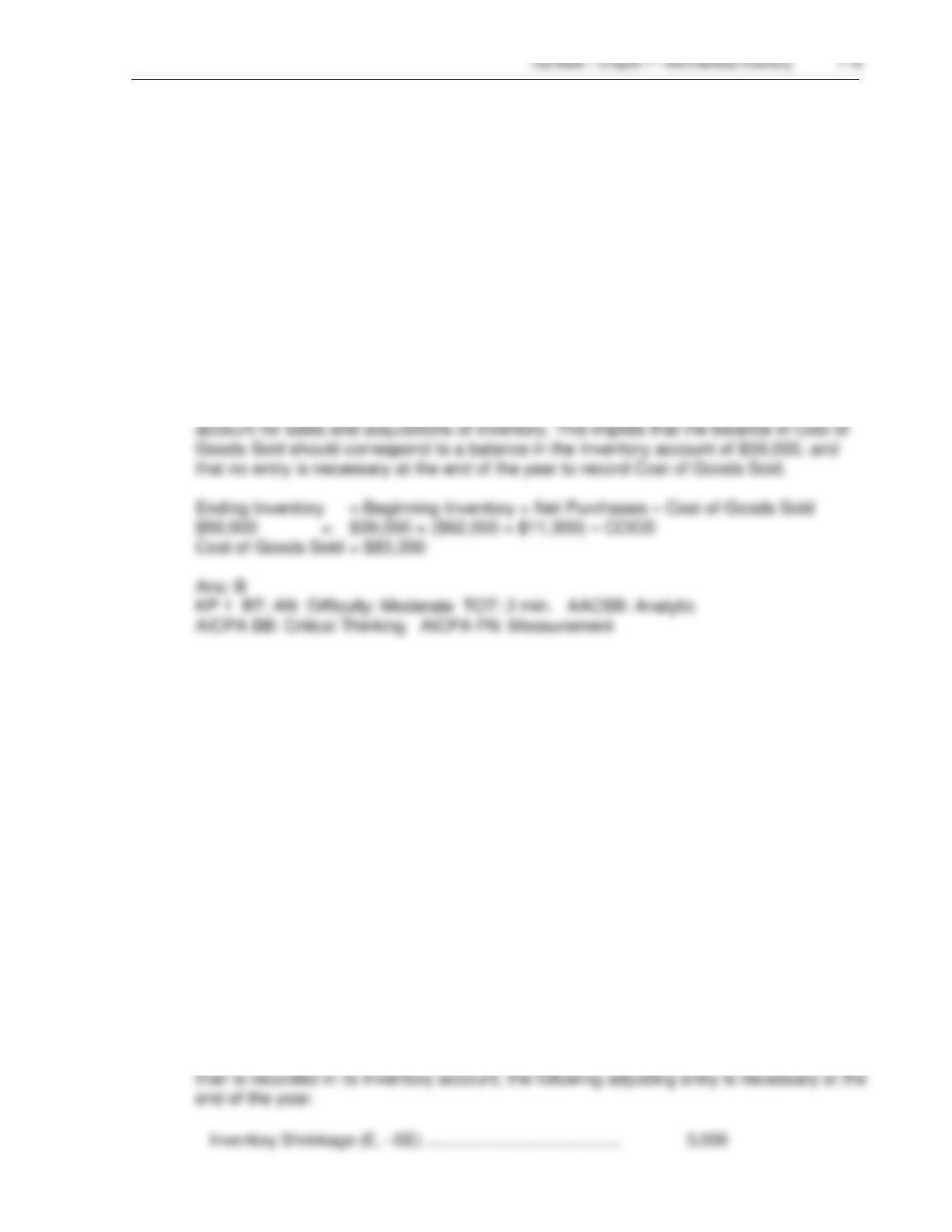
c. net income is overstated by $700 in 2015 and understated by $900 in 2016.
d. total net income for 2015 and 2016 is correct.
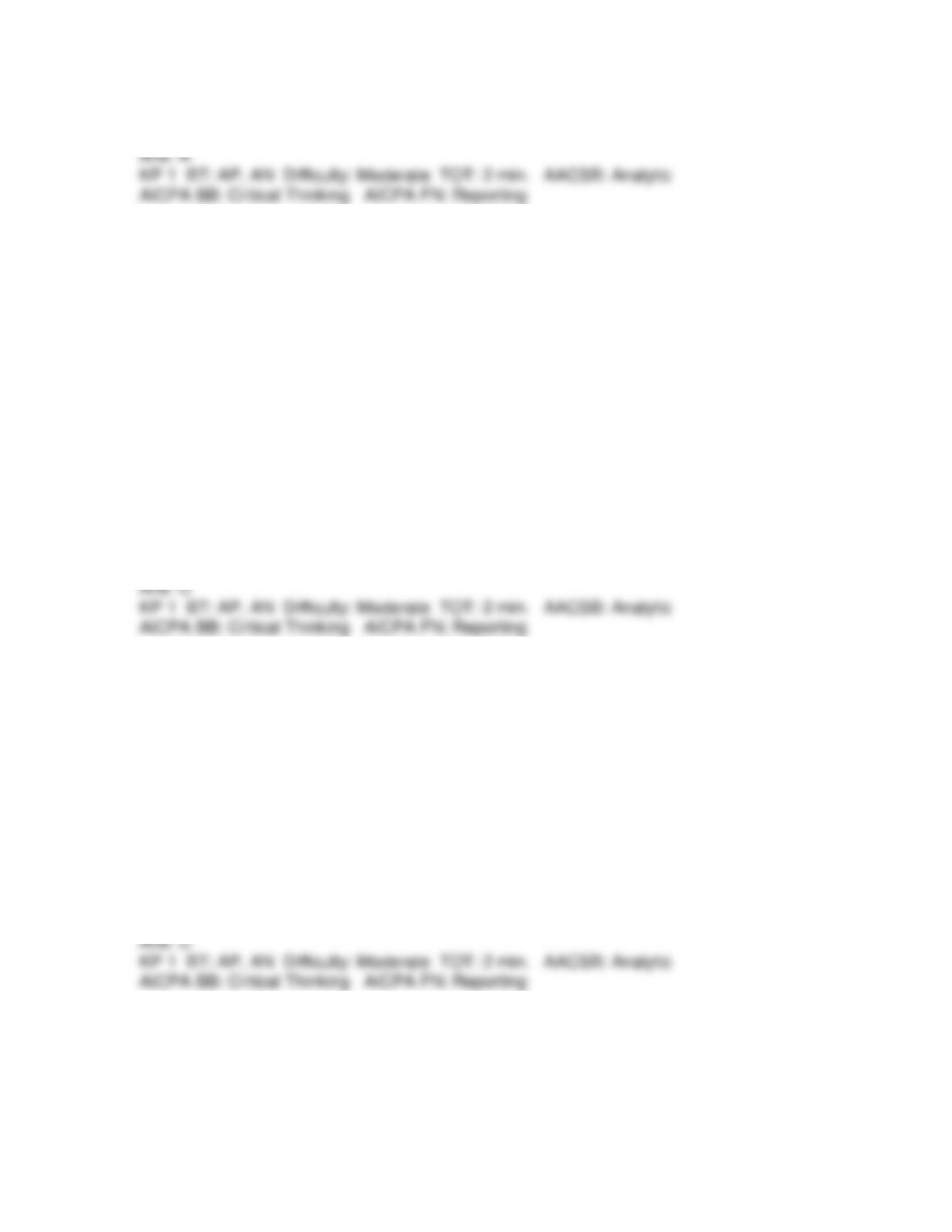
11. Kemp Clothing has cost of goods sold of $14,000 with beginning and ending inventories
of $4,000 and $2,000, respectively. Purchases during the period are:
a. $ 8,000.
b. $ 9,000.
c. $10,000.
d. $11,000.
e. $12,000.
12. Which one of the following expenditures should not be included in the cost of inventory?
a. Purchase cost
b. Transportation-in
c. Packaging cost
d. Capitalized equipment cost
13. Mars Hardware sold 20 drills for $8 each. Each drill cost $4. Which journal entry is
required at the time of sale under a perpetual inventory system?
a.
Cash
160
Sales
160
b.
Cash
160
Inventory
160
c.
Cash
160
Cost of Goods Sold
80
Sales
160
Inventory
80
d.
Cash
160
Inventory
80
Gain from Sale
80
14. Wood Inc. sells automobiles at $6,000 above its costs and uses the specific identification
method for inventory. Below are the cars and the costs Wood paid for the inventory
before the sale.
Auto 1: $35,000
Auto 2: $17,500
Auto 3: $19,500
Auto 4: $23,000
Auto 5: $26,000
If Wood sells Auto 3 and Auto 5 for cash, which of the following would be included in the
journal entries it uses to record the sale and recognize the cost of the inventory?
a. A debit to Cost of Goods Sold for $45,500.
b. A credit to Sales for $45,500.
c. A credit to Inventory for $57,500.
d. A credit to Sales for $12,000.
15. Vic’s Produce purchased 50 boxes of tomatoes for a total of $400. It paid $20 for
shipping tomatoes to a customer and $15 for repackaging them into smaller boxes. The
cost of these tomatoes is:
a. $400.
b. $420.
c. $415.
d. $435.
16. Simon Cereal purchased 100 pounds of cornflakes for $100. Transportation cost to
Simon’s production facility was $25 for the barrel of cornflakes shipped FOB destination.
Simon paid $60 for 100 one-pound biodegradable plastic bags into which the cornflakes
were placed. The cost of each one-pound bag of cornflakes is:
a. $1.00.
b. $1.25.
c. $1.60.
d. $1.75.
17. Beginning inventory is valued at $7,000, purchases are $15,000 and ending inventory is
valued at $9,000. Cost of goods sold is:
a. $23,000.
b. $16,000.
c. $30,000.
d. $13,000.
18. Victoria Fashions Clothing Store uses the perpetual method of accounting for inventory.
During the current year, purchases are $30,000 and cost of goods sold is $25,000.
Beginning inventory is valued at $4,000 and ending inventory was taken on December
31 and valued at $6,000. Inventory shortage expense for the current year is:
a. $0.
b. $2,000.
c. $3,000.
d. $5,000.
19. During a year of decreasing prices and decreasing inventory, which cost flow
assumption would measure the greatest net income?
a. FIFO
b. LIFO
c. Averaging
d. Both a and c are correct.
20. During a year of rising prices and increasing inventory, which cost flow assumption
would yield the greatest current ratio?
a. Averaging
b. LIFO
c. FIFO
d. Both a and c are correct.
21. During a year of rising prices and increasing inventory, which cost flow assumption
would measure the smallest net income?
a. LIFO
b. FIFO
c. Averaging
d. All methods measure income the same.
22. During a year of rising prices and increasing inventory, which cost flow assumption
would measure the smallest working capital ratio?
a. FIFO
b. LIFO
c. Averaging
d. Working capital is not sensitive to inventory cost flow assumptions.
23. The President and CEO of Quinn Manufacturing receives a cash bonus equal to 1% of
audited net income during the current year. During a period of rising prices and
increasing inventory, which inventory cost flow assumption would measure the smallest
compensation expense and greatest cash position for Quinn Manufacturing?
a. FIFO
b. NIFO
c. Averaging
d. LIFO
24. Unusually high income resulted when Vincent Inc. cut back its inventory levels. This
effect is:
a. backed by the LIFO elimination rule.
b. expected in most industries.
c. achieved through using the lower-of-cost-or-market rule.
d. called LIFO liquidation.
25. During a year of rising prices and increasing inventory, which cost flow assumption
would measure the largest inventory turnover ratio?
a. FIFO
b. LIFO
c. Averaging
d. The inventory turnover ratio is not sensitive to inventory cost flow assumptions.
26. During a period of rising prices and increasing inventory, which cost flow assumption
used on both federal income tax returns and financial reports would provide a company
with the greatest cash position?
a. FIFO
b. LIFO
c. Averaging
d. TIFO
27. During a year of falling prices, which cost flow assumption would measure the strongest
cash flow position?
a. LIFO
b. FIFO
c. Averaging
d. Net income will remain the same under all methods.
28. During a year of falling prices, which cost flow assumption would yield the greatest
current ratio?
a. FIFO
b. LIFO
c. Averaging
d. Lower-of-cost or market
29. If a company uses the LIFO cost flow assumption on its federal income tax return in
order to minimize its tax payment, then it:
a. must use LIFO on its financial statements.
b. must use FIFO on its financial statements.
c. may use any cost flow assumption permitted by GAAP on its financial statements.
d. must correct the error at the beginning of the next accounting period.
30. An excessively low inventory turnover ratio may reveal that:
a. customers are delaying their payments on account.
b. the selling price of inventory is too high.
c. sales returns have decreased significantly.
d. the company is selling too much inventory.
31. Carmelo Inc. has an inventory turnover ratio of 25. Carmelo’s average number of day’s
inventory is:
a. Less than 10.
b. Between 10 and 12.
c. More than 12.
d. Unable to be determined based on this limited information.
32. Under generally accepted accounting principles, a company can choose a cost flow
assumption for valuing cost of goods sold that can result in different income
measurement. However, it can’t frequently change the cost flow assumption adopted in
order to measure the highest income possible because of the:
a. conservatism principle.
b. going concern principle.
c. stable-dollar principle.
d. consistency principle.
33. During an extended period of constant prices, which cost flow assumption would
generally measure the largest earnings per share?
a. FIFO
b. LIFO
c. Weighted average
d. All of the above assumptions would result in equal earnings per share during an
extended period of constant prices.
34. At which point in accounting for inventory in a perpetual system is determining the cost
of goods sold amount an issue?
a. When the inventory is acquired.
b. As the inventory is carried in the warehouse and held for sale.
c. As the ending inventory is counted.
d. As the inventory is sold.
35. Items should be included in the company’s inventory if they are:
a. being used in the production of income.
b. held in anticipation of an increase in value.
c. being held for sale.
d. sold during the period.
36. Which one of the following should be included in Camden’s inventory at December 31,
2015?
a. Goods shipped FOB shipping point on December 31, 2015, from Camden to a
customer.
b. Goods in the Camden’s warehouse on December 31, 2015, waiting to be shipped to
a customer.
c. Goods ordered from one of Camden’s suppliers on December 31, 2015, shipped
FOB destination on December 31, 2010, which arrived January 2, 2016.
d. Goods sold and shipped to a customer on December 31, 2015, terms FOB
destination, which were delivered on December 31, 2016.
37. Which one of the following companies would likely carry the largest percentage of
inventory as compared to its other assets?
a. Ernst & Young, CPAs
b. Merrill Lynch Investment Brokers
c. The Magic Kingdom at Disney World
d. Jim’s Ford Dealership
38. When prices remain the same, which cost flow assumption would generally measure the
largest current ratio?
a. FIFO
b. LIFO
c. Averaging
d. All of the above assumptions would result in equal current ratios during an extended
period of constant prices.
39. When accounting for inventory consignments, the issue which helps determine whether
or not the inventory cost should be included on a company’s balance sheet is:
a. whether the inventory is physically located in the company’s warehouse.
b. who actually owns title to the inventory.
c. who will ultimately sell the inventory to the consumer.
d. when the inventory will be sold.
40. Specific identification is a method of accounting for inventory:
a. which eliminates the need for tracking the cost of inventory items.
b. that allocates the oldest cost to the first units sold.
c. that often allows a manager to manipulate net income and the ending inventory
value.
d. commonly used in periods of rising prices.
41. Selecting an inventory cost flow assumption will most likely be impacted by which one of
the following?
a. The physical flow of the inventory goods.
b. The cost of the company’s plant and equipment.
c. Income taxes.
d. The cost flow assumptions most often used by other companies.
42. All of the following are typically associated with Japanese business inventory accounting
except:
a. the use of the average assumption for inventory cost.
b. shared business risks.
c. slow inventory turnover.
d. lower levels of inventory.
43. Inventory reported on the balance sheet of a manufacturing company consists of:
a. raw materials and the cost of labor to convert the raw materials to finished products.
b. raw materials, the cost of labor to convert the raw materials, and an allocated portion
of manufacturing overhead cost.
c. the cost of the raw materials used.
d. raw materials, the cost of labor to convert the raw materials, and all major corporate
overhead costs.
44. The LIFO conformity rule requires a company that uses:
a. the LIFO assumption for computing cost of goods sold on its tax return to also use
the LIFO assumption in preparing its financial statements.
b. any inventory cost assumption to use the LIFO cost assumption for tax purposes.
c. the LIFO assumption for computing cost of goods sold on its financial statements to
also use LIFO on its tax return.
d. the LIFO assumption to avoid paying taxes on inventory profits.
45. During a period of rising prices and inventories, a company whose current ratio is
dangerously close to the minimum specified by agreement with a major creditor would
prefer which cost flow assumption?
a. FIFO
b. LIFO
c. Averaging
d. The company would be indifferent as to which cost flow assumption is adopted.
46. Selling more inventory than was purchased during the current period may often cause
old, smaller costs that were carried as part of the company’s beginning inventory, to be
moved to the income statement and reported as cost of goods sold. This is called:
a. the LIFO conformity rule.
b. LIFO liquidation.
c. the LIFO reserve rule.
d. lower-of-cost-or-market accounting.
47. During a period of rising prices and inventories, a company whose debt/equity ratio is
dangerously close to the minimum specified by agreement with a major creditor would
prefer which cost flow assumption?
a. FIFO
b. LIFO
c. Averaging
d. The company would be indifferent as to which cost flow assumption is adopted.
48. During a period of changing inventory prices, which of the following is NOT immediately
sensitive to the particular cost flow assumption adopted?
a. Net income
b. Current ratio
c. Gross profit
d. Working capital
e. Quick ratio
49. Under the lower-of-cost-or-market rule, market is:
a. the selling price of inventory items.
b. the original cost paid for inventory.
c. used to value inventory if it is less than its recorded cost.
d. the amount of cash the company expects to collect from the sale of an inventory
item.
50. Which of the following policies would increase a firm’s current inventory turnover ratio?
a. Reduction of the average inventory that supports a constant amount of sales
b. An decrease in the units of inventory sold while holding average inventory constant
c. Increase of inventory by adopting a Just-in-Time production schedule
d. Saving new purchases of inventory until the following year instead of this year
51. If the market value of inventory is greater than its cost, then the application of the lower-
of-cost-or-market rule would:
a. decrease both the current ratio and net income.
b. decrease the current ratio but not change net income.
c. not change the current ratio but decrease net income.
d. change neither the current ratio nor net income.
52. During a period of rising prices and inventories, which method causes cash flows to be
stronger?
a. FIFO
b. LIFO
c. Averaging
d. The company would be indifferent as to which cost flow assumption is adopted.
53. Which of the following should not be included in inventory cost for a car dealership?
a. The costs of transporting the cars from the factory to the dealership
b. Cost of new car preparation for customers
c. The salary and commission of the salesman who sells the vehicle
d. The cost of adding a CD player to the vehicles before the vehicle is offered for sale
54. If the market value of inventory is less than its cost, then application of the lower–of-cost-
or-market rule would:
a. increase earnings and decrease the current ratio.
b. decrease earnings and increase the current ratio.
c. decrease earnings and decrease the current ratio.
d. cause no change to earnings or the current ratio.
55. What is the impact on the financial statements of an overstatement of ending inventory?
a. Next year’s ending inventory will be overstated.
b. Next year’s net income will be overstated.
c. Current year’s net income will be overstated.
d. Next year’s ending inventory will be understated.
Test Bank – Chapter 7 – Merchandise Inventory 7-15
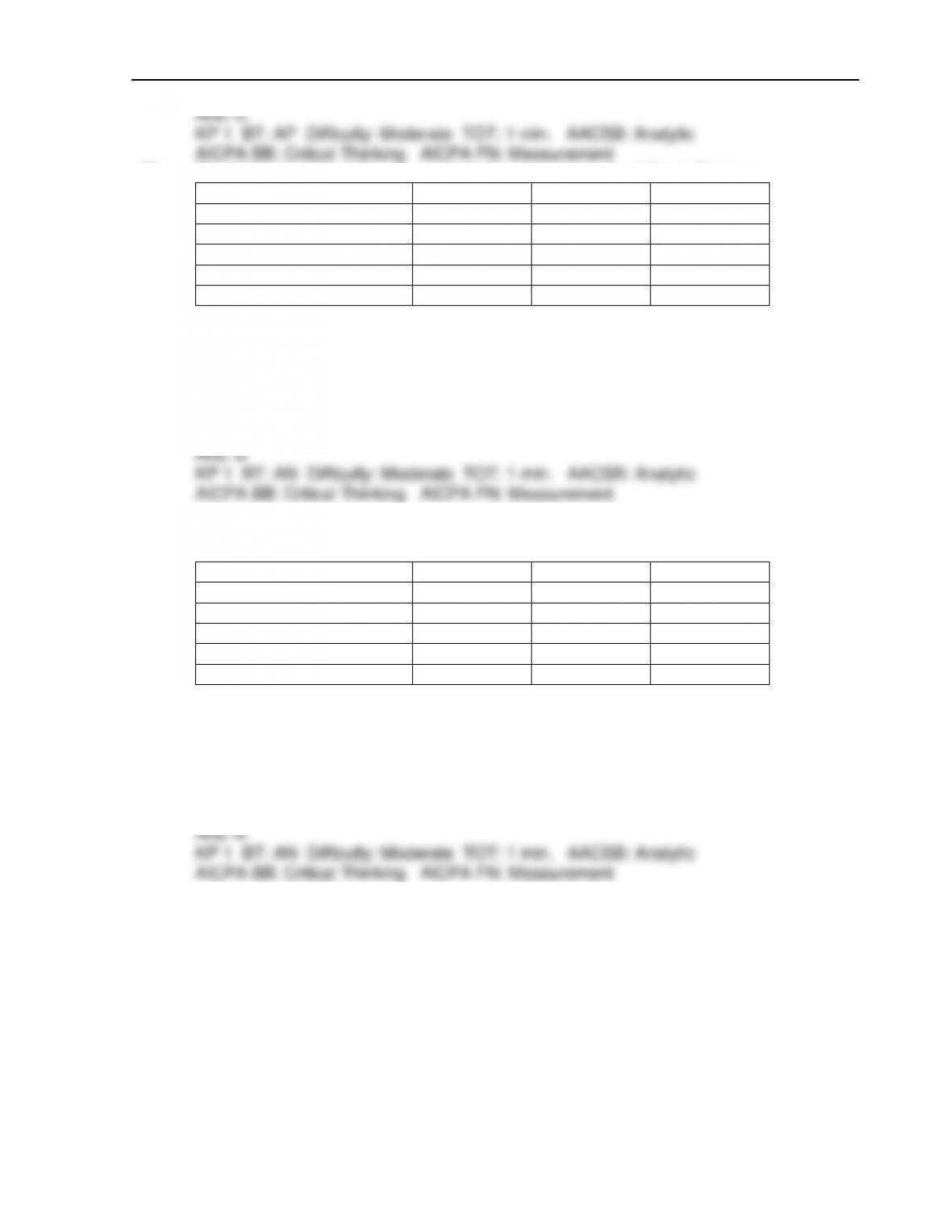
56. The following information comes from the annual reports of Devin Designs.
2017
2016
2015
Beginning inventory
?
?
2,250
Purchases
12,652
?
?
Goods available for sale
?
?
12,899
Ending inventory
?
2,662
?
Cost of goods sold
12,213
10,908
10,490
What is the Purchases amount for 2015?
a. $4,713
b. $2,397
c. $81
d. $10,649
57. The following information comes from the annual reports of Devin Designs.
2017
2016
2015
Beginning inventory
?
?
2,250
Purchases
12,652
?
?
Goods available for sale
?
?
12,899
Ending inventory
?
2,662
?
Cost of goods sold
12,213
10,908
10,490
What is the ending inventory amount for 2015?
a. $4,713
b. $2,409
c. $81
d. $10,583
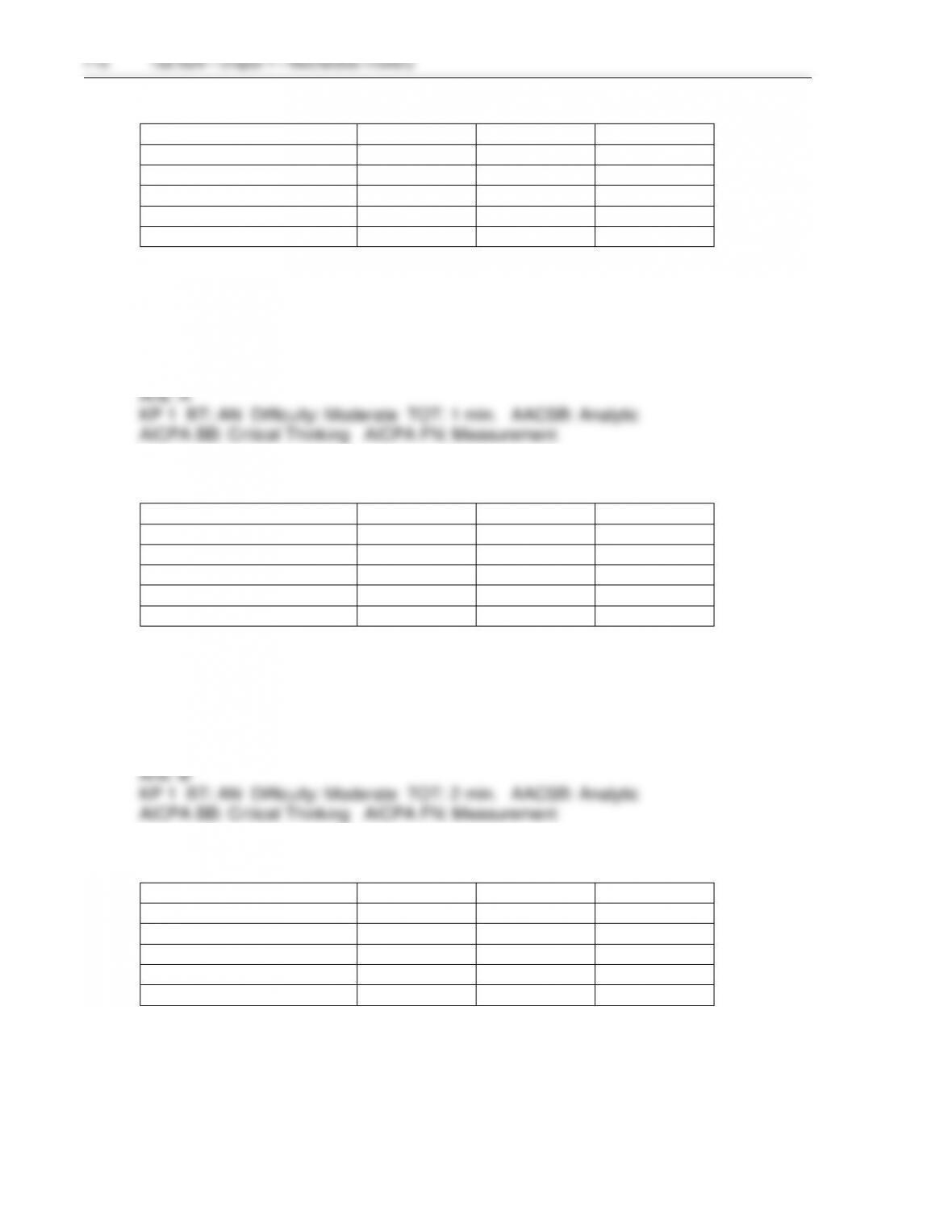
58. The following information comes from the annual reports of Devin Designs.
2017
2016
2015
Beginning inventory
?
?
2,250
Purchases
12,652
?
?
Goods available for sale
?
?
12,899
Ending inventory
?
2,662
?
Cost of goods sold
12,213
10,908
10,490
What is the beginning inventory amount for 2016?
a. $2,409
b. $13,570
c. $10,502
d. $8,246
59. The following information comes from the annual reports of Devin Designs.
2017
2016
2015
Beginning inventory
?
?
2,250
Purchases
12,652
?
?
Goods available for sale
?
?
12,899
Ending inventory
?
2,662
?
Cost of goods sold
12,213
10,908
10,490
What is the amount of purchases for 2016?
a. $8,246
b. $11,161
c. $13,570
d. $10,643
60. The following information comes from the annual reports of Devin Designs.
2017
2016
2015
Beginning inventory
?
?
2,250
Purchases
12,652
?
?
Goods available for sale
?
?
12,899
Ending inventory
?
2,662
?
Cost of goods sold
12,213
10,908
10,490
What is the amount of goods available for sale for 2016?
a. $8,246
b. $11,173
c. $13,570
d. $10,643
Test Bank – Chapter 7 – Merchandise Inventory 7-17
61. The following information comes from the annual reports of Devin Designs.
2017
2016
2015
Beginning inventory
?
?
2,250
Purchases
12,652
?
?
Goods available for sale
?
?
12,899
Ending inventory
?
2,662
?
Cost of goods sold
12,213
10,908
10,490
What is the beginning inventory amount for 2017?
a. $439
b. $8,246
c. $10,908
d. $2,662
62. The following information comes from the annual reports of Devin Designs.
2017
2016
2015
Beginning inventory
?
?
2,250
Purchases
12,652
?
?
Goods available for sale
?
?
12,899
Ending inventory
?
2,662
?
Cost of goods sold
12,213
10,908
10,490
What is the amount of goods available for sale for 2017?
a. $11,347
b. $15,314
c. $13,957
d. $24,865
63. The following information comes from the annual reports of Devin Designs.
2017
2016
2015
Beginning inventory
?
?
2,250
Purchases
12,652
?
?
Goods available for sale
?
?
12,899
Ending inventory
?
2,662
?
Cost of goods sold
12,213
10,908
10,490
What is the ending inventory amount for 2017?
a. $24,865
7-18 Test Bank – Chapter 7 – Merchandise Inventory
b. $3,101
c. $2,223
d. $15,314
64. Forrest’s Crab House purchased Florida stone crab on account on November 10, 2015,
for a gross price of $87,000. Forrest also purchased farm-raised catfish on account on
November 11, 2015 for a gross price of $25,000. The terms of both sales were 2/15,
n/30. Forrest paid for the first purchase on November 19, 2015, and for the second
purchase on November 30. If he uses the perpetual inventory method, his journal entry
for November 19 would include:
a. a debit to Inventory for $1,740.
b. a debit to Inventory for $85,260.
c. a credit to Inventory for $1,740.
d. a credit to Accounts Payable for $87,000
Solution:
65. Forrest’s Crab House purchased Florida stone crab on account on November 10, 2015,
for a gross price of $87,000. Forrest also purchased farm-raised catfish on account on
November 11, 2015 for a gross price of $25,000. The terms of both sales were 2/15,
n/30. Forrest paid for the first purchase on November 19, 2015, and for the second
purchase on November 30. If he uses the perpetual inventory method, which of the
following journal entries would Forrest make for November 30?
a. Inventory 25,000
Accounts Payable 25,000
b. Accounts Payable 25,000
Cash 25,000
c. Accounts Payable 25,000
Cash 24,500
Inventory 500
d. Accounts Payable 24,500
Cash 24,500
66. Gump Supplies has the following information:
Beginning inventory $39,000
Inventory purchases 92,000
Transportation-in 11,300
An inventory count taken at year end indicates that inventory with a cost of $56,000 is on
hand as of December 31, 2015. Assume that inventory purchases and transportation-in
are both reflected in the inventory account, which shows an ending balance of $59,000.
What is the amount of the cost of goods sold?
a. $123,300
b. $83,300
c. $60,700
d. $100,700
Solution: With the perpetual method, the balance in the Cost of Goods Sold
account is perpetually updated for sales of inventory, as is the balance in the Inventory
67. Gump Supplies has the following information:
Beginning inventory $39,000
Inventory purchases 92,000
Transportation-in 11,300
An inventory count taken at year end indicates that inventory with a cost of $56,000 is on
hand as of December 31, 2015. Assume that inventory purchases and transportation-in
are both reflected in the inventory account, which shows an ending balance of $59,000.
Which of the following would be the best adjusting journal entry to make at the end of the
period with respect to this information?
a. Inventory Shrinkage 3,000
Inventory 3,000
b. Inventory 3,000
Inventory Overage 3,000
c. Inventory 3,000
Purchases 3,000
d. Cost of Goods Sold 3,000
Sales 3,000
Solution: Since the physical count indicates that Gump has $3,000 less inventory
7-20 Test Bank – Chapter 7 – Merchandise Inventory
Inventory (–A) ………………………………………………… 3,000
68. Dakota Industries has two items in inventory as of December 31, 2015. Each item was
purchased for $52. Company management chose to write down Item #1 to $39, which
at year-end was assessed to be its market value. Management did not write down Item
#2 because its market value was estimated to be greater than $52. During 2015, each
item was sold for $63 cash.
The journal entry for the write down of Item #1 would include which of the following?
a. Loss on Inventory Write-down …………………………………. 24
Inventory …………………………………………………… 24
b. Inventory ………………………………………………………………. 13
Loss on Inventory Write-down ………………………. 13
c. Loss on Inventory Write-down …………………………………. 13
Inventory …………………………………………………… 13
d. Inventory ………………………………………………………………. 24
Loss on Inventory Write-down ………………………. 24
69. Dakota Industries has two items in inventory as of December 31, 2015. Each item was
purchased for $52. Company management chose to write down Item #1 to $39, which
at year-end was assessed to be its market value. Management did not write down Item
#2 because its market value was estimated to be greater than $52. During 2015, each
item was sold for $63 cash.
If Dakota uses the perpetual inventory method, which of the following would be included
in the entry or entries to record the sale of Item #1?
a. A debit to Sales for $63.
b. A credit to Inventory for $52.
c. A debit to Cost of Goods Sold for $39.
d. A credit to Cost of Goods Sold for $52.