Test Bank – Chapter 5 – Using Financial Statement Information 5-21
54. Rudy Company has total assets, liabilities, and shareholders’ equity of $28,000,
$21,000, and $7,000, respectively. Assume no material change occurred during the year
to totals on the balance sheet. What amount of long-term debt must Rudy exchange for
new shares of common stock issued in order to decrease its debt/equity ratio to 1.0?
a. $17,500
b. $7,000
c. $14,000
d. $21,000
55. Samson Company has common stock of $120,000 and retained earnings of $140,000 at
yearend. During the year, 20,000 shares of stock were outstanding. Net income was
reported as $80,000. What is the company’s earnings per share?
a. $4.00
b. $1.07
c. $0.73
d. $10.25
Solution:
56. Grey Company has a current ratio of 0.35 and return on equity of 0.04 Which of the
following statements is the best regarding Grey’s profitability and solvency?
a. Grey is very profitable, but not very solvent.
b. Grey is very profitable and very solvent.
c. Grey is not very profitable, but very solvent.
d. Grey is not very profitable and not very solvent.
Solution:
57. Pasky Company has the following financial data on January 1, 2015 and January 1,
2014.
1/1/15
1/1/14
Cash
$35,000
$71,000
Accounts receivable
69,000
33,000
Marketable securities
9,000
30,000
Inventory
87,000
105,000
Net plant and equipment
120,000
96,000
Current liabilities
$42,000
$71,000
Long-term debt
147,000
90,000
Shareholders’ equity
131,000
174,000
In terms of the quick and current ratio, which of the following statements is true?
a. Pasky’s short-term solvency position has improved.
b. Pasky’s short-term solvency position has declined.
c. Pasky’s short-term solvency position has remained the same
d. Pasky’s quick ratio is increasing, but its current ratio is decreasing.
Solution:
(in thousands)
1/01/15
1/01/14
Current ratio = Current assets / Current liabilities =
= ($35+ $69 + $9 + $87)/$42 =
4.76
= ($71 + $33 + $30 + $105)/$71 =
3.41
Quick ratio = Quick assets / Current liabilities =
= ($35 + $69 + $9)/$42 =
2.69
= ($71 + $33 + $30)/$71 =
1.89
Pasky’s short-term solvency position has improved significantly. Its current ratio has
increased from 3.41 to 4.76, and the quick ratio has increased from 1.89 to 2.69.
Ans: A
KP 2,5 BT: AN Difficulty: Difficult TOT: 4 min. AACSB: Analytic
AICPA BB: Critical Thinking AICPA FN: Measurement, Decision Modeling
58. Walker Company has the following assets on January 1, 2015 and January 1, 2014.
1/1/15
1/1/14
Cash
$450,001
$366,000
Accounts receivable
302,000
333,000
Marketable securities
36,000
30,000
Inventory
87,000
105,000
Net plant and equipment
120,000
96,000
If Walker’s quick ratio is 3.00 for 2015, what is the amount of its current liabilities?
a. $325,000
b. $263,000
c. $285,000
d. There is not enough information to answer this question.
Solution:
59. Norton Company has the following assets on January 1, 2015 and January 1, 2014.
1/1/15
1/1/14
Cash
$430,000
$370,000
Accounts receivables
?
333,000
Marketable securities
36,000
130,000
Inventory
220,000
?
Net plant and equipment
120,000
129,000
If Norton’s current ratio is 2.20 for 2014 and its current liabilities are $600,000, what is
the amount of its inventory?
a. $197,000
b. $487,000
c. $238,636
d. There is not enough information to answer this question.
Solution:
60. Norton Company has the following assets on January 1, 2015 and January 1, 2014.
1/1/15
1/1/14
Cash
$430,000
$370,000
Accounts receivables
?
333,000
Marketable securities
186,000
130,000
Inventory
220,000
?
Net plant and equipment
120,000
129,000
If Norton’s quick ratio is 2.50 for 2015 and its current liabilities are $500,000, what is the
amount of its accounts receivables?
a. $324,000
b. $204,000
c. $634,000
d. There is not enough information to answer this question.
Solution:
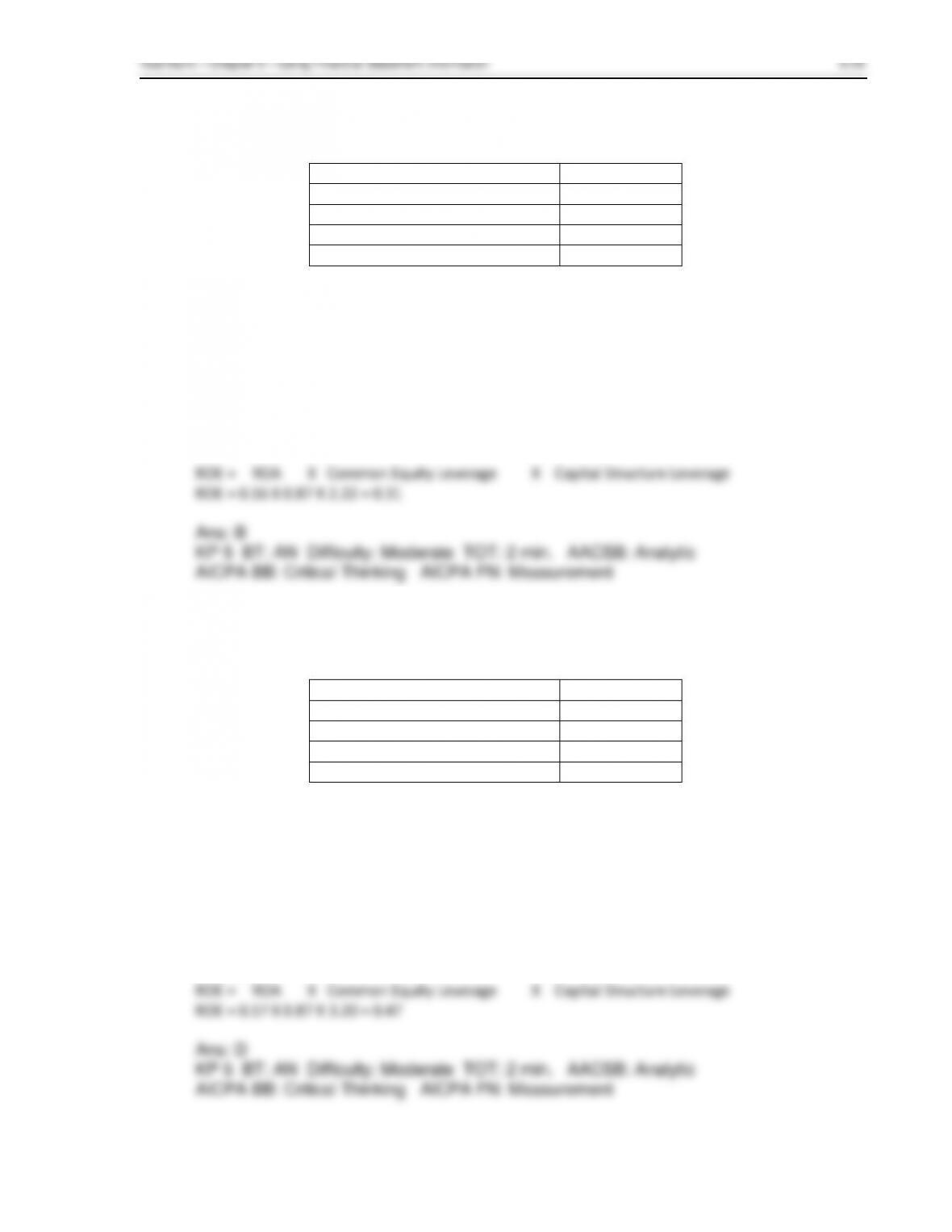
61. The following ratios were computed from the financial statement of Darren Technologies:
2016
2015
2014
Return on equity
0.30
0.27
0.23
Return on assets
0.17
0.20
0.22
Common equity leverage
0.87
0.90
0.92
Capital structure leverage
2.22
1.60
1.24
Profit margin
0.11
0.10
0.09
Asset turnover
1.69
2.27
2.87
Which of the following statements is true?
a. There has been a steady decline in ROE from 2014 through 2016.
b. The increase in ROA is due primarily to the changes in asset turnover.
c. The changes in ROA could be due to increasing sales.
d. The change in ROA could be due to a large increase in the asset base of the
company.
62. Assume that the following financial ratios were computed from the 2015 financial
statements of Florida Industries:
Return on sales (profit margin)
0.30
Return on assets
0.16
Common equity leverage
0.87
Capital structure leverage
2.22
Asset turnover
1.69
What was the return on equity for Florida in 2015?
a. 4%
b. 31%
c. 51%
d. 11%
Solution:
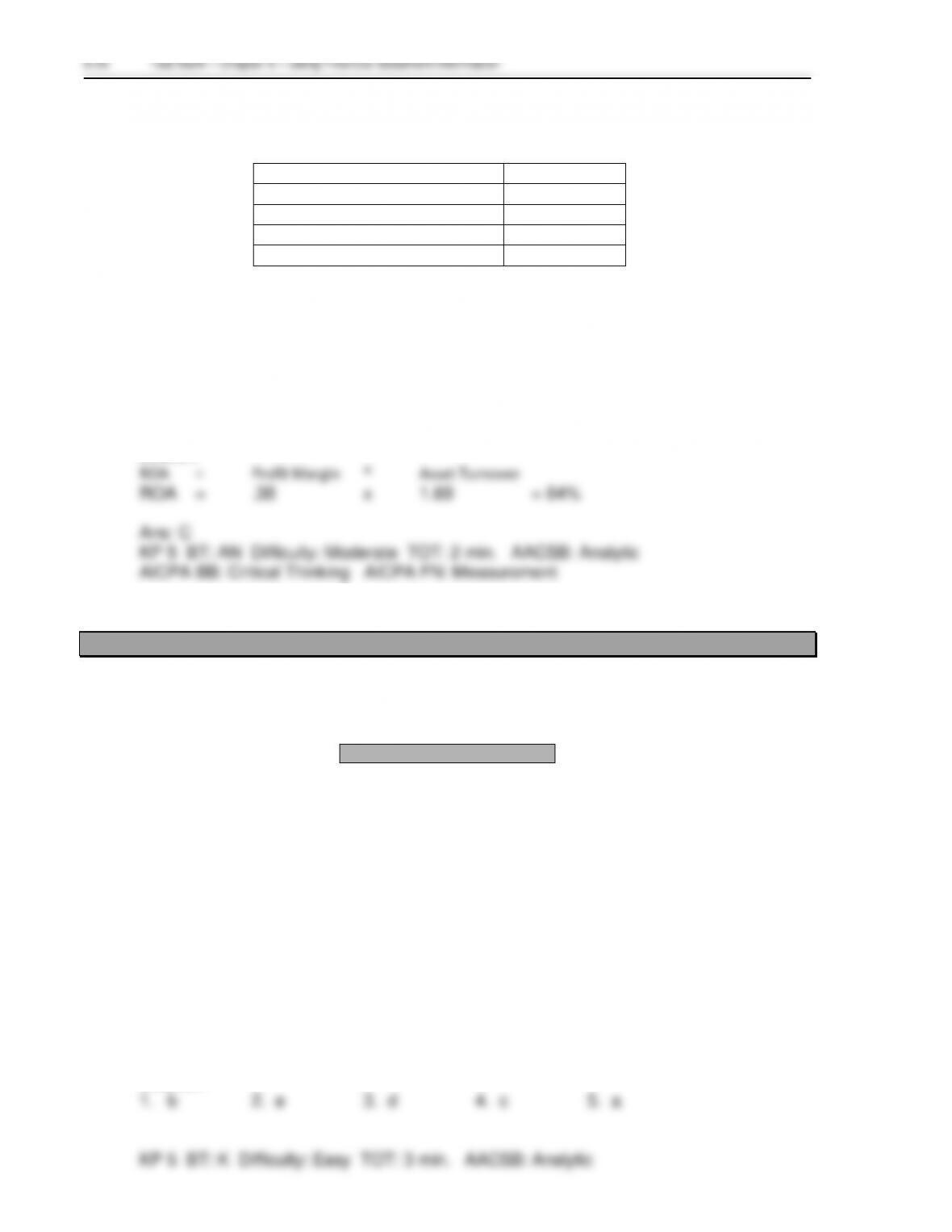
63. Assume that the following financial ratios were computed from the 2015 financial
statements of Florida Industries:
Return on sales (profit margin)
0.29
Return on assets
0.17
Common equity leverage
0.87
Capital structure leverage
2.22
Asset turnover
1.69
If Florida holds its other ratios constant in 2016, but increases its capital structure
leverage ratio to 3.20, what will be the 2016 return on equity?
a. 15%
b. 51%
c. 86%
d. 47%
Solution:
64. Assume that the following financial ratios were computed from the 2015 financial
statements of Florida Industries:
Return on sales (profit margin)
0.30
Return on assets
0.17
Common equity leverage
0.87
Capital structure leverage
2.22
Asset turnover
1.69
If Florida holds its other ratios constant in 2016, but increases its profit margin to 38%,
what will be the 2016 return on assets?
a. 5%
b. 78%
c. 64%
d. 51%
Solution:
MATCHING QUESTIONS
1. Match the correct ratio name from the list below labeled a through g with each formula
appearing in items 1 through 5.
Ratios
a. Price/earnings ratio
b. Quick ratio
c. Earnings per share
d. Current ratio
e. Return on assets
f. Return on equity
g. Inventory turnover
____ 1. (Cash + accounts receivable + marketable securities) / current liabilities
____ 2. (Net income + interest expense) / average total assets
____ 3. Current assets / current liabilities
____ 4. Net income / average number of shares of common stock
____ 5. Market price per share / earnings per share
Solution:
Test Bank – Chapter 5 – Using Financial Statement Information 5-27
AICPA BB: Critical Thinking AICPA FN: Measurement
2. Match the correct ratio name from the list below labeled a through f with the ratio
formulas appearing in items 1 through 4.
Ratios
a. Debt/equity ratio
b. Financial leverage
c. Return on sales
d. Price/earnings ratio
e. Return on equity
f. Dividend yield ratio
____ 1. Market price per share / earnings per share
____ 2. Dividends per share / market price per share
____ 3. Average total liabilities / average total shareholders’ equity
____ 4. Net income / average shareholders’ equity
Solution:
3. Match the correct ratio category from the list below labeled a through e with each ratio
that appears in items 1 through 12.
Ratio Categories
a. Profitability ratio
b. Leverage ratio
c. Solvency ratio
d. Asset turnover ratio
e. Market ratio
1.
Current ratio
7.
Debt/equity ratio
2.
Return on equity
8.
Inventory turnover
3.
Receivables turnover
9.
Return on assets
4.
Return on sales
10.
Long-term debt ratio
5.
Dividend yield ratio
11.
Price/earnings ratio
6.
Quick ratio
12.
Return on investment
Solution:

4. For each characteristic which appears numbered from 1 through 5 below, select the
correct factor which should be considered in each assessment as listed in items a
through e.
Factors to Consider
a. Management bias
b. Financial flexibility
c. Liquidity
d. Operating performance
e. Off-balance-sheet financing
____ 1. Ability to get cash from sale of assets and issuance of debt or stock
____ 2. Avoiding reporting financial responsibilities on the balance sheet
____ 3. Measured by profitability and activity ratios and cash provided by operations
____ 4. Delaying the sale of inventory until the following year because current profits
are satisfactory
____ 5. Ability to convert existing assets into cash
Solution:
5-30 Test Bank – Chapter 5 – Using Financial Statement Information
SHORT PROBLEMS
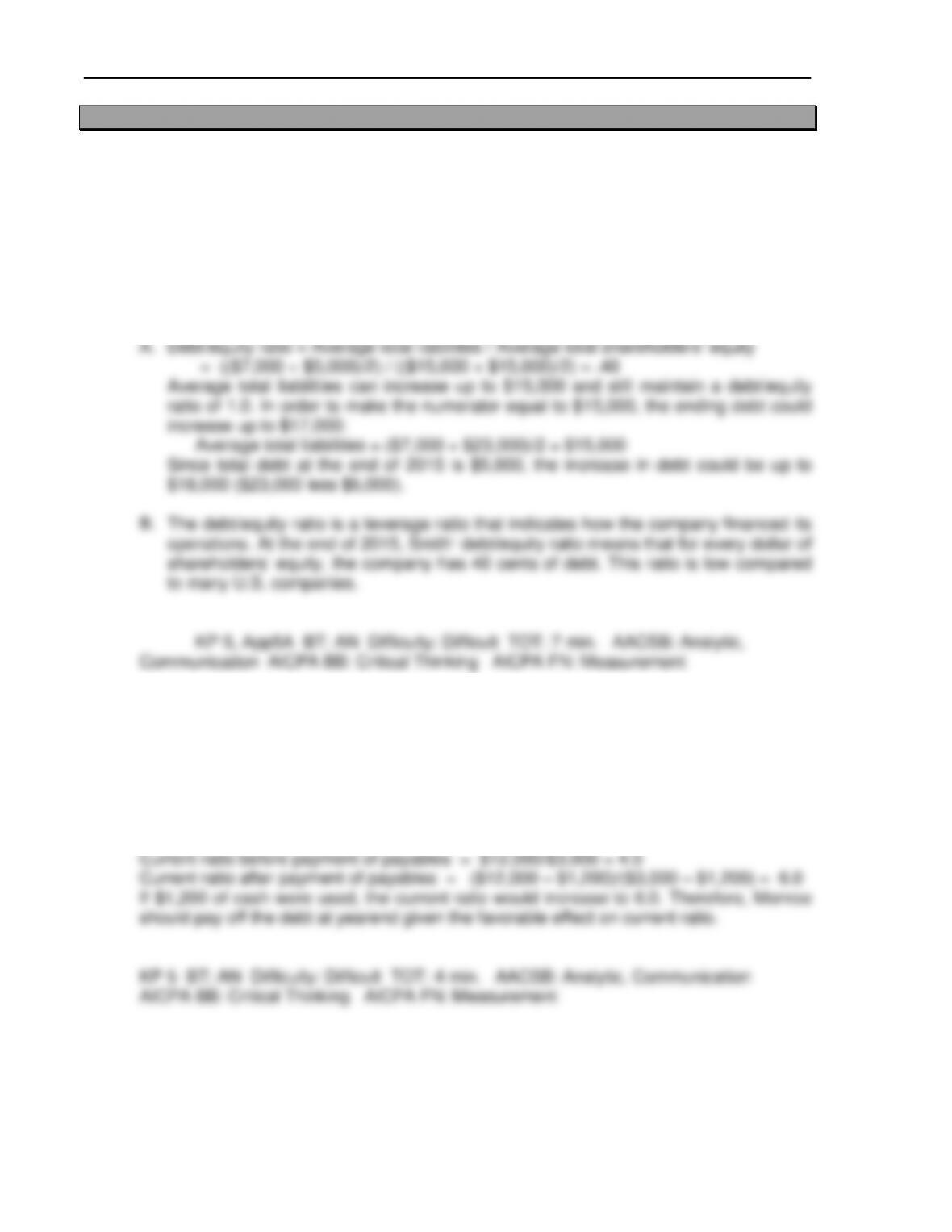
1. Smith Company has total assets, liabilities, and shareholders’ equity of $22,000, $7,000,
and $15,000, respectively, at the beginning of 2015. At the end of 2015, total assets,
liabilities, and shareholders’ equity were reported at $20,000, $5,000, and $15,000,
respectively.
A. How much additional debt can Smith incur and still have its debt/equity ratio remain
less than or equal to 1.00?
B. What information does the debt/equity ratio provide you?
Solution:
2. Monroe Company has current assets, current liabilities, and long-term liabilities of
$12,000, $3,000, and $9,000, respectively. Within these amounts, $1,200 is accounts
payable, and $1,500 is accounts receivable. What effect will the payment of the
accounts payable have on the current ratio? Should Monroe pay the accounts payable
on the last day of the year? Explain.
Solution:
Test Bank – Chapter 5 – Using Financial Statement Information 5-31
Use the information that follows taken from Carter Company’s financial statements for the years
ending December 31, 2015 and 2014 to answer problems 3 through 9.
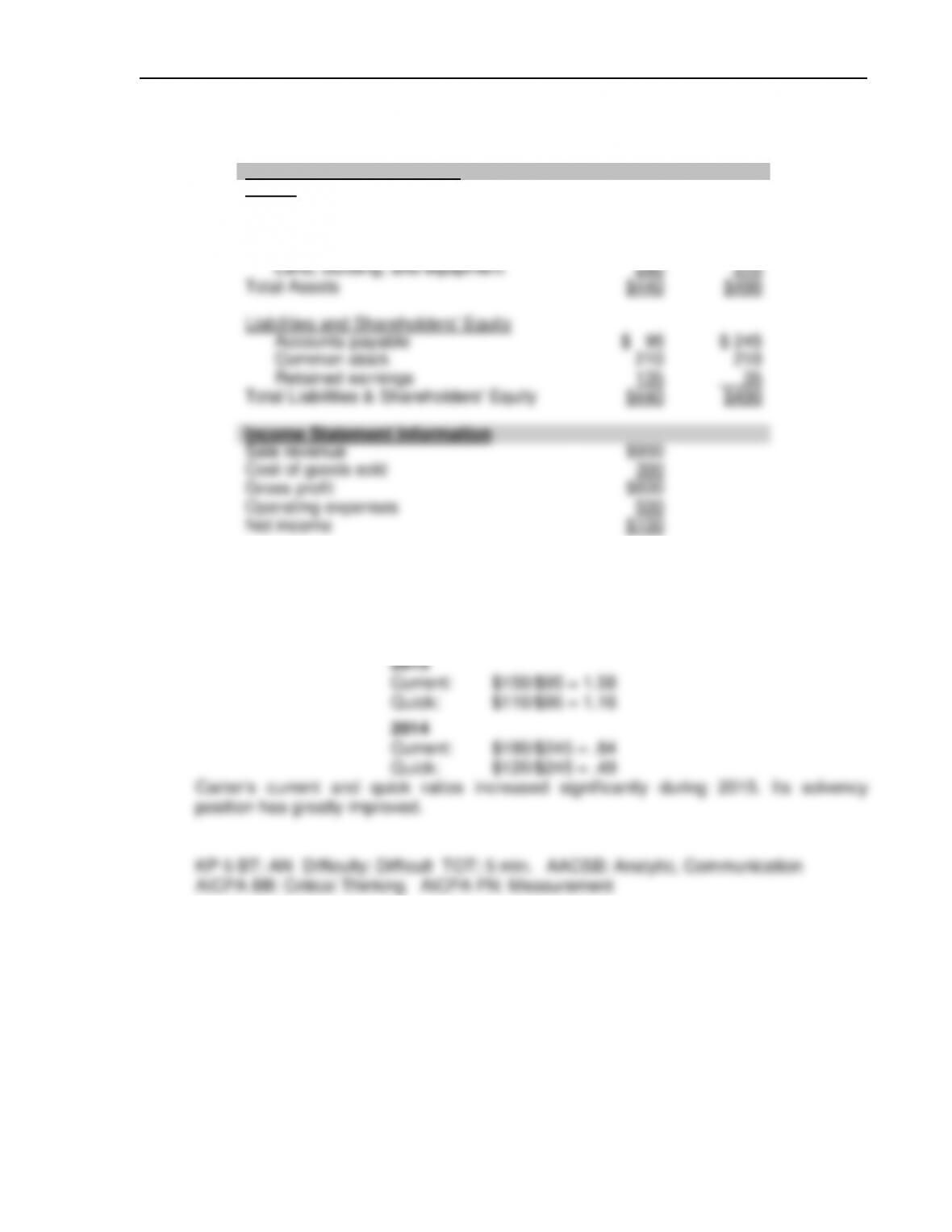
Balance Sheet Information
2015
2014
Assets
Cash
$ 70
$ 80
Accounts receivable
40
40
Inventory
40
60
Land, building, and equipment
290
310
Total Assets
$440
$490
Liabilities and Shareholders’ Equity
Accounts payable
$ 95
$ 245
Common stock
210
210
Retained earnings
135
35
Total Liabilities & Shareholders’ Equity
$440
$490
Income Statement Information
Sale revenue
$900
Cost of goods sold
300
Gross profit
$600
Operating expenses
500
Net income
$100
3. Using the two solvency ratios (current and quick), indicate whether Carter’s solvency
position improved or deteriorated during 2015.
Solution:
Carter has the following solvency ratios on December 31:
2015
Current:
$150/$95 = 1.58
Quick:
$110/$95 = 1.16
2014
Current:
$180/$245 = .84
Quick:
$120/$245 = .49
Carter’s current and quick ratios increased significantly during 2015. Its solvency
position has greatly improved.
KP 5 BT: AN Difficulty: Difficult TOT: 5 min. AACSB: Analytic, Communication
AICPA BB: Critical Thinking AICPA FN: Measurement
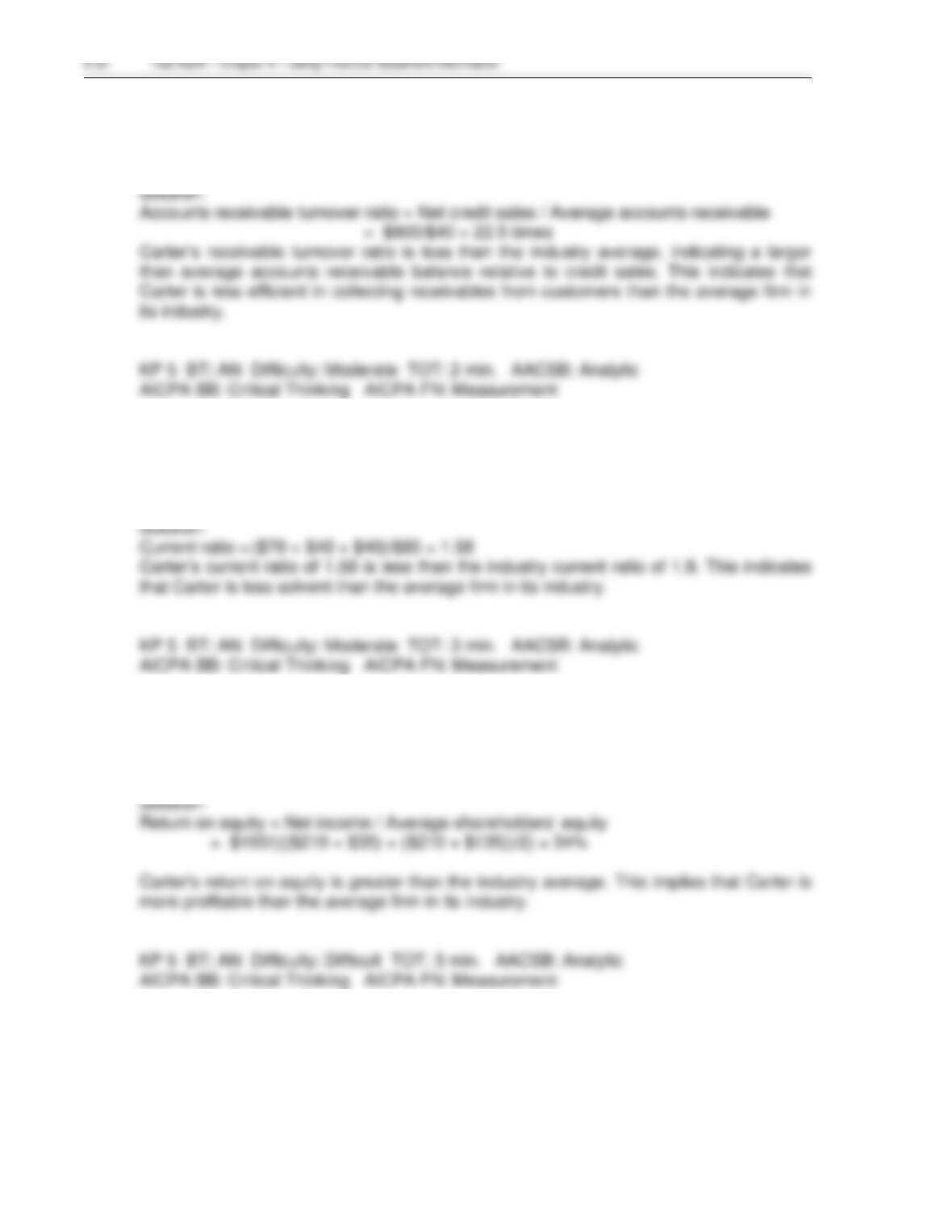
4. If the industry in which Carter is a member has an average accounts receivable turnover
of 27 times, determine if in 2015, Carter is more or less efficient at converting sales to
cash than the average firm in its industry. Assume all sales were credit sales.
5. If the industry in which Carter is a member has an average current ratio of 1.9,
determine if, on December 31, 2015, Carter is more or less solvent than the average firm
in its industry as measured by its current ratio.
6. If the industry in which Carter is a member has an average return on equity of 22%,
determine if in 2015, Carter is more or less profitable than the average firm in its
industry.
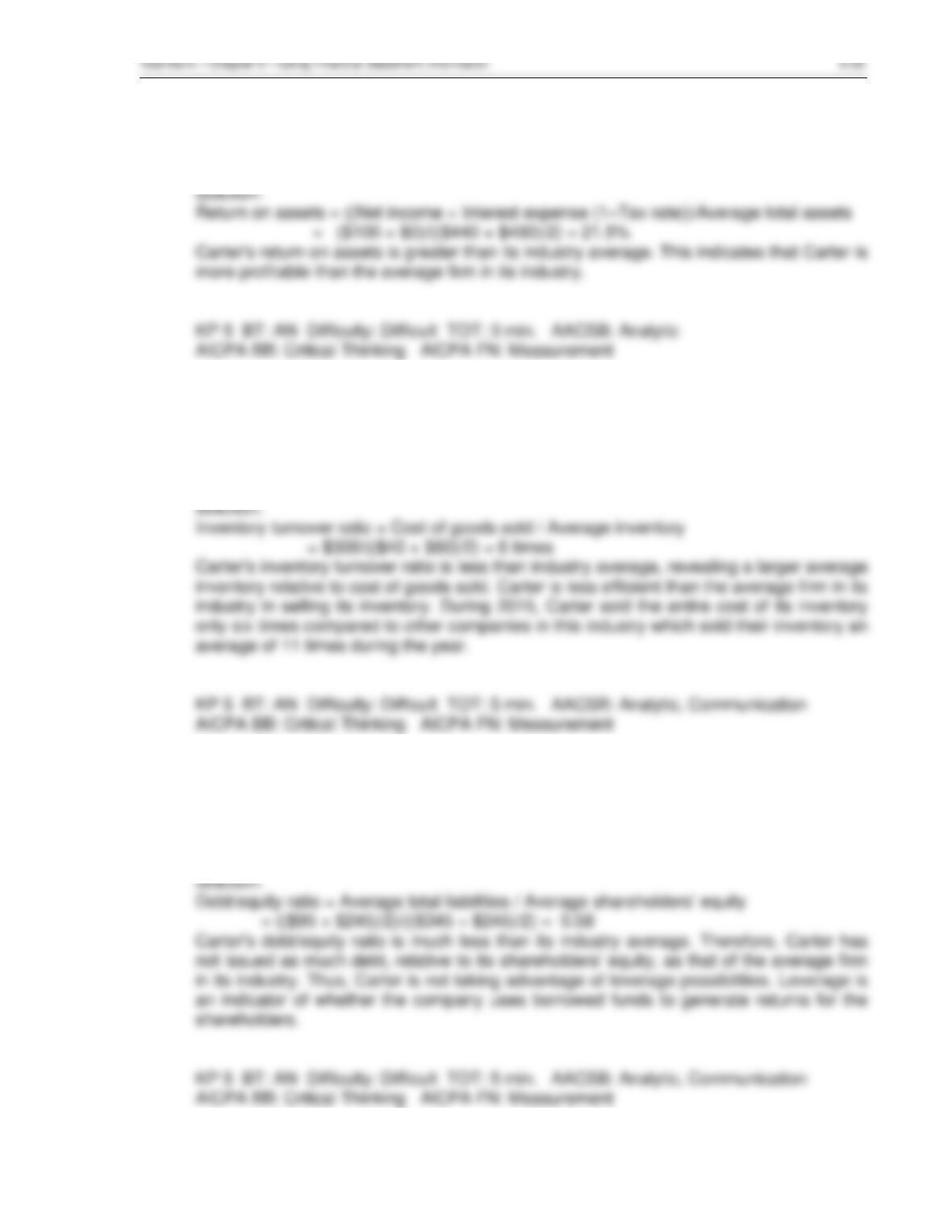
7. The industry in which Carter is a member has an average return on assets of 18%.
Carter reported no interest expense during 2015. Determine if Carter is more or less
profitable in 2015 than the average firm in its industry.
8. If the industry in which Carter is a member has an inventory turnover of 11 times,
determine if in 2015, Carter is more or less efficient at converting inventory into sold
units than the average firm in its industry. Explain what information this ratio provides
you.
9. The industry in which Carter is a member has an average debt/equity ratio of 0.83.
Determine if, as measured by the debt/equity ratio on December 31, 2015, Carter is
taking full advantage of investing borrowed capital in its operations relative to that of the
average firm in its industry. Explain.