
Test Bank – Chapter 12 – Shareholders’ Equity 12–37
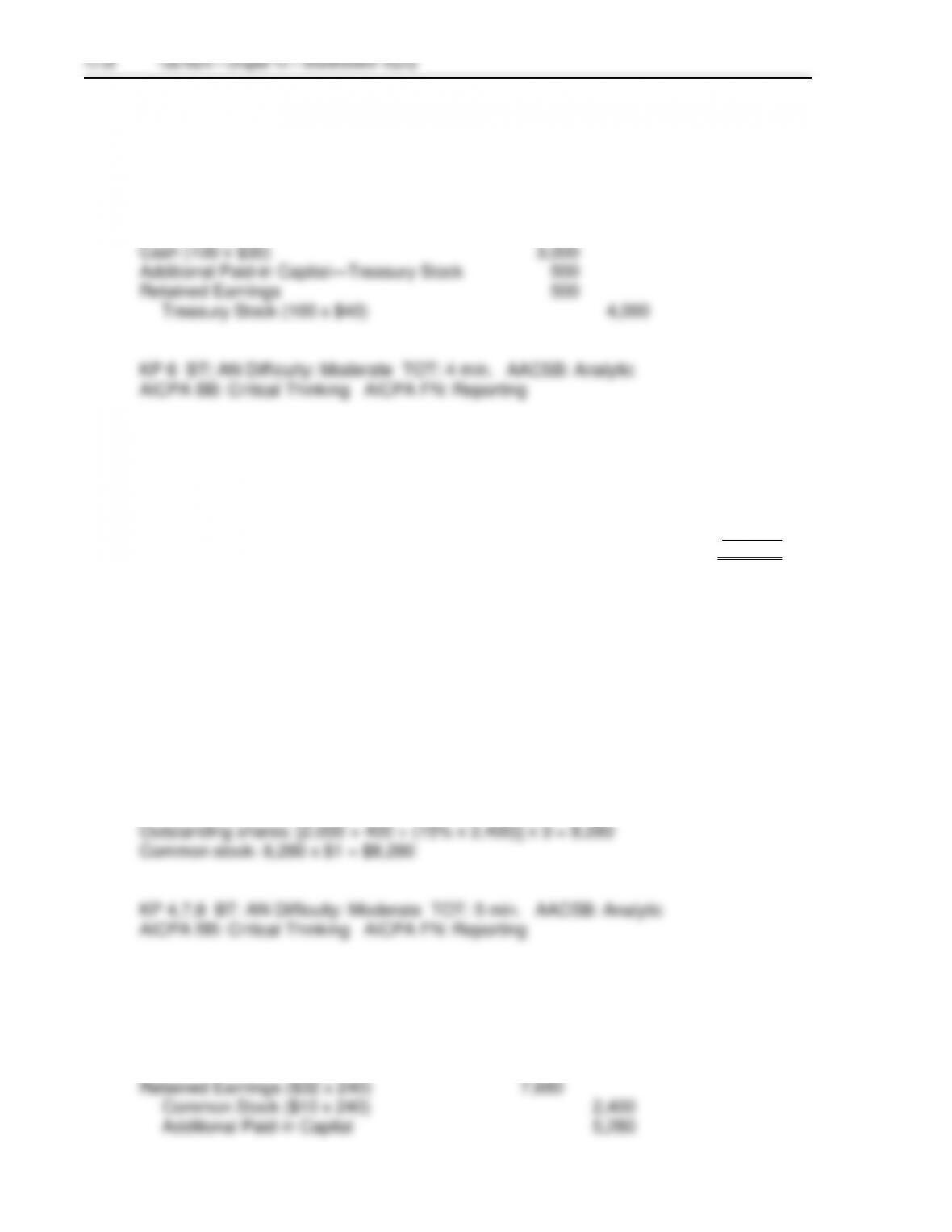
15. On January 23, Bayshore Corporation, for the first time in its short history, purchased
200 shares of its own common stock for $40 a share. On March 31, it sold 100 of those
shares for $45 a share and properly recorded $500 as additional paid-in capital. On April
15, it sold the remaining 100 shares for $30 a share. Prepare the journal entry to record
the April 15th transaction.
Solution:
Cash (100 x $30)
3,000
Additional Paid-in Capital—Treasury Stock
500
Retained Earnings
500
Treasury Stock (100 x $40)
4,000
KP 6 BT: AN Difficulty: Moderate TOT: 4 min. AACSB: Analytic
AICPA BB: Critical Thinking AICPA FN: Reporting
16. The shareholders’ equity section of Maven Corporation’s balance sheet as of December
31, 2014 is as follows:
Common stock, $1 par; authorized, 6,000 shares; 2,000 shares issued
$ 2,000
Additional paid-in capital
60,000
Retained earnings
58,000
Total shareholders’ equity
$120,000
The following events occurred during 2015:
• February 1 – 400 shares of authorized and unissued common stock were sold for $4
per share.
• June 16 – A 15% stock dividend was declared and issued. Market value per share is
currently $18.
• October 11 – A three-for-one split was carried out. Market value was $21 per share.
• November 4 – A cash dividend of $4.20 per share was declared, payable January 12
to shareholders of record on November 30.
How many shares of common stock are outstanding at December 31, 2015? Determine
the balance in the common stock account at December 31, 2015.
Solution:
17. An 8% stock dividend was declared and distributed on 3,000 shares of par $10 common
stock when its market price was $32. Prepare the journal entry required by the stock
dividend.
Solution:
Retained Earnings ($32 x 240)
7,680
Common Stock ($10 x 240)
2,400
Additional Paid-in Capital
5,280
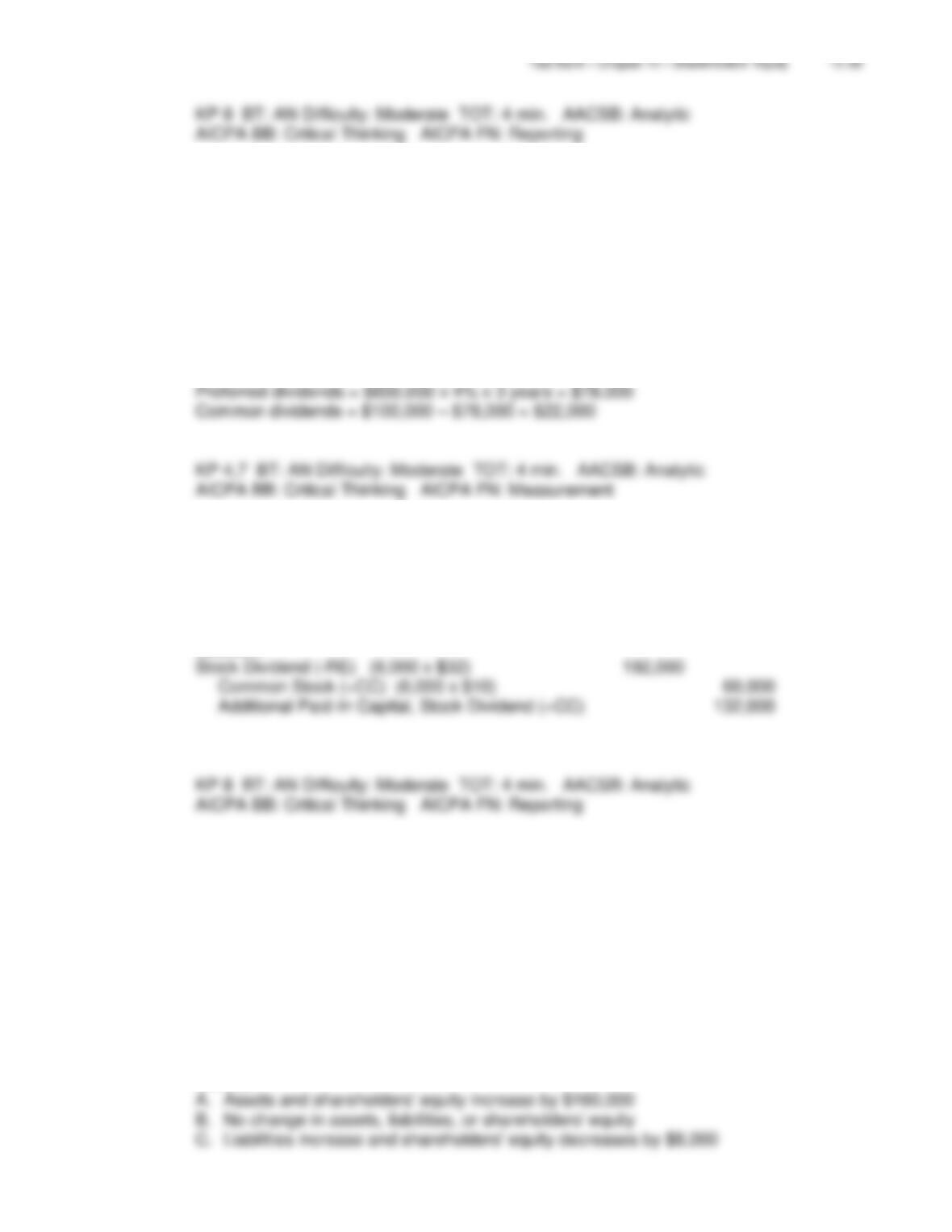
18. Cullen Distribution Corporation’s contributed capital section of its balance sheet follows:
Preferred stock: $10 par, 4%
$650,000
Common stock: $8 par
400,000
During the last two years, Cullen Distribution Corporation did not declare any dividends
to its shareholders. This year, Cullen declares and pays total dividends of $100,000.
Calculate the dividends paid separately to preferred and common shareholders if the
preferred stock is cumulative.
Solution:
19. A 10% stock dividend was declared and distributed to shareholders of 60,000
outstanding shares of Meadville Company’s $10 par value common stock; at that time
the common stock’s market price was $32. Prepare the journal entry required by the
stock dividend.
Solution:
Stock Dividend (-RE) (6,000 x $32)
192,000
Common Stock (+CC) (6,000 x $10)
60,000
Additional Paid-In Capital, Stock Dividend (+CC)
132,000
KP 8 BT: AN Difficulty: Moderate TOT: 4 min. AACSB: Analytic
AICPA BB: Critical Thinking AICPA FN: Reporting
20. A sequence of events affecting the shareholders’ equity section of Malabar Corporation
follows:
A. On January 21, 8,000 shares of $10 par value common stock were issued for
$160,000.
B. On May 16, a 3-for-1 stock split was distributed.
C. On December 23, $8,000 of cash dividends on outstanding common stock were
declared. The dividends will be paid in 30 days.
For each entry, state how the event changed assets, liabilities, and shareholders’ equity.
Solution:

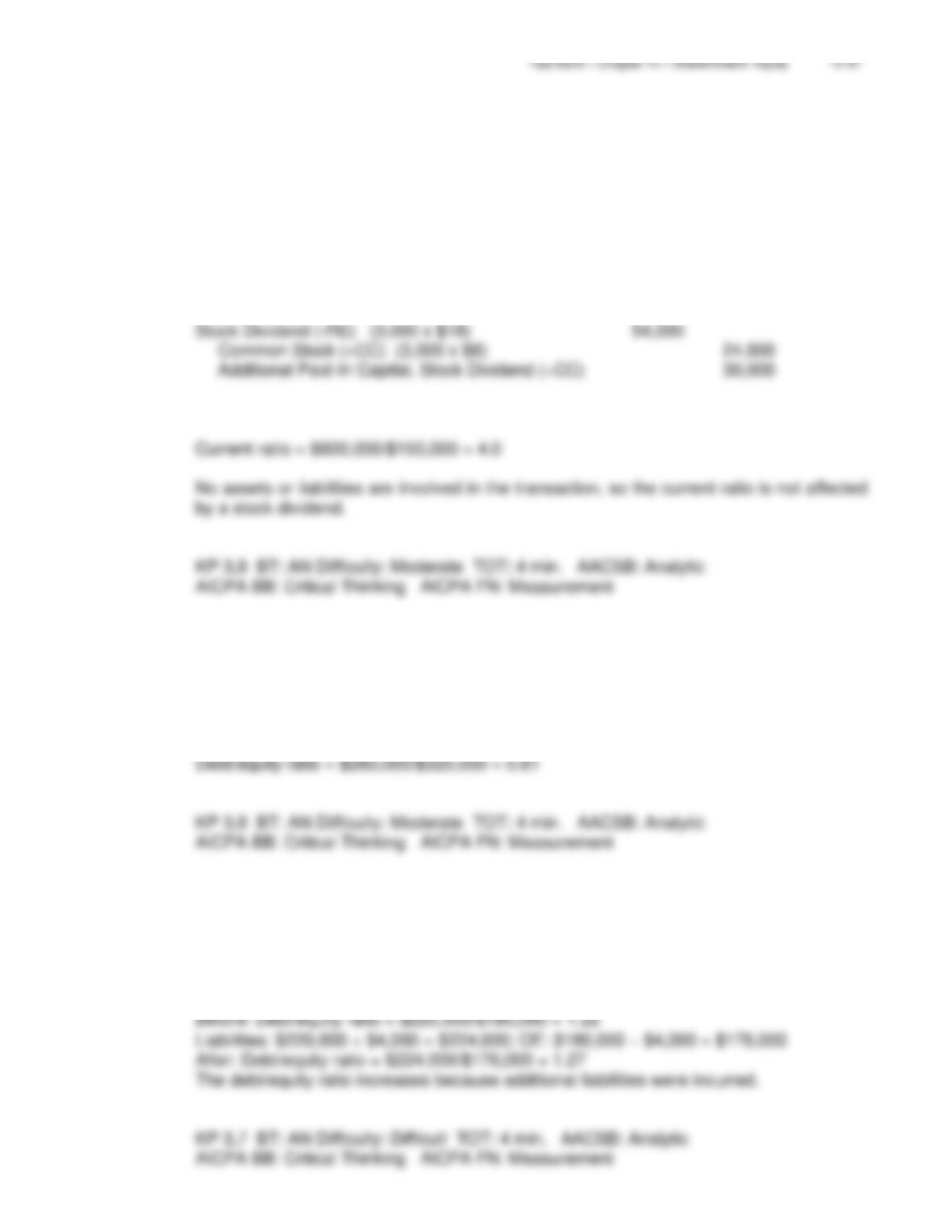
21. Immediately before a 15% stock dividend was declared and distributed on 20,000 shares
of par $8 stock, the market price of the Coolidge Corporation’s stock was $18. Coolidge
has total liabilities of $150,000 and total shareholders’ equity of $450,000.
Required:
(1) Give the journal entry to record the declaration and distribution of the stock dividend.
(2) Calculate Coolidge’s current ratio immediately after the stock dividend and comment.
Solution:
Stock Dividend (-RE) (3,000 x $18)
54,000
Common Stock (+CC) (3,000 x $8)
24,000
Additional Paid-In Capital, Stock Dividend (+CC)
30,000
Current ratio = $600,000/$150,000 = 4.0
No assets or liabilities are involved in the transaction, so the current ratio is not affected
by a stock dividend.
KP 3,8 BT: AN Difficulty: Moderate TOT: 4 min. AACSB: Analytic
AICPA BB: Critical Thinking AICPA FN: Measurement
22. Immediately before a 3-for-1 stock split was declared and distributed on 20,000 shares
of par $80 stock, Mikah Company has total liabilities of $260,000 and total shareholders’
equity of $320,000. Calculate Mikah Company’s debt/equity ratio immediately after the
stock split.
Solution:
23. Immediately before a $4,000 cash dividend was declared on 20,000 shares of par $80
stock, Sea Breeze Corporation has total liabilities of $220,000 and total shareholders’
equity of $180,000. Calculate Sea Breeze’s debt/equity ratio before and after the
declaration of the cash dividend and indicate the effect the declaration had on this ratio.
Solution:

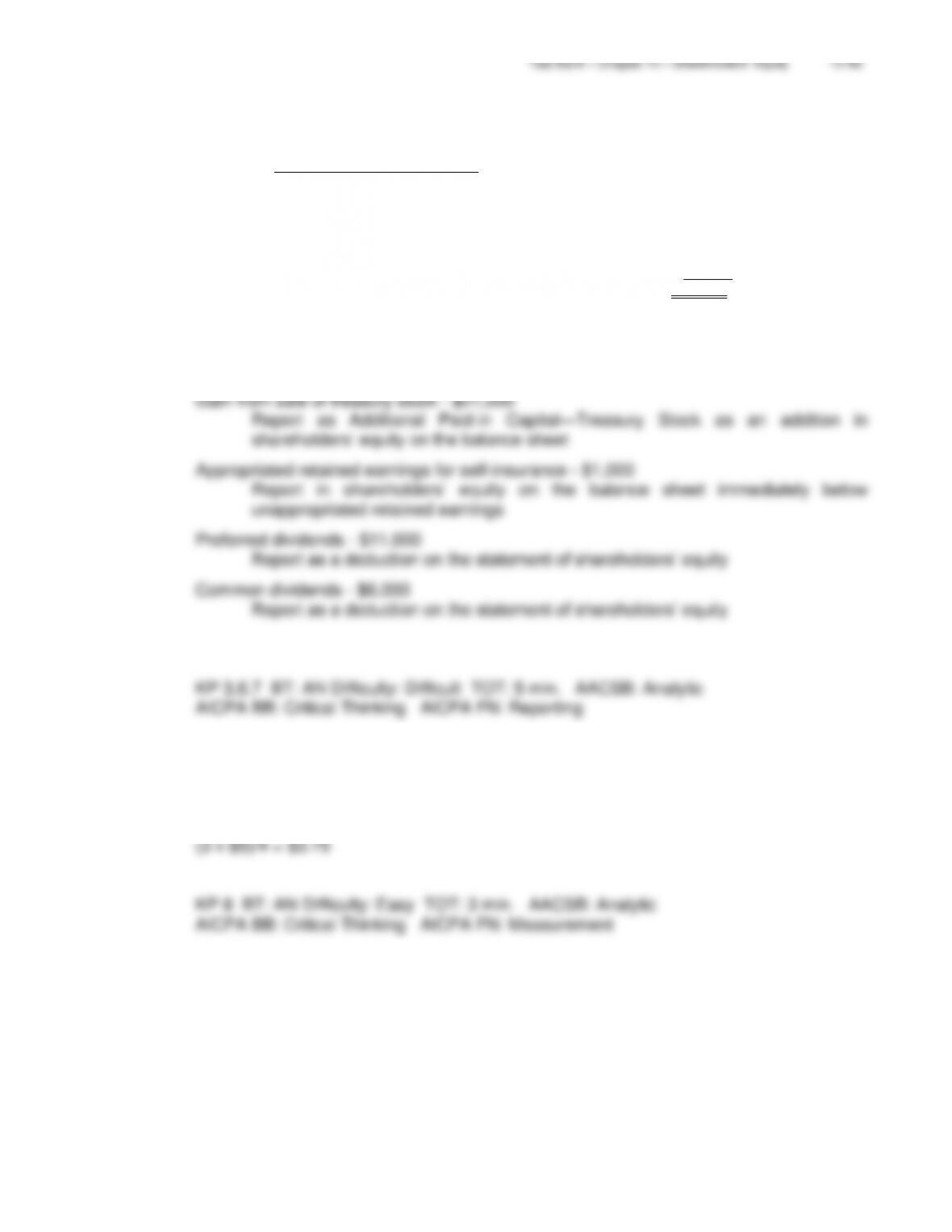
24. Tropical Corporation has the following amounts as other revenue and expenses on its
income statement.
Other revenue and expenses:
Gain from sale of treasury stock
$21,000
Interest revenue
4,200
Gain from sale of land
18,000
Appropriated retained earnings for self-insurance
(1,000)
Preferred dividends
(11,000)
Common dividends
(6,000)
Total
$25,200
List the items that do not belong on the income statement and indicate where each
should be reported.
Solution:
25. If a corporation distributes a 4-for-3 stock split on its $5 common stock, how much is the
par value after the split?
Solution:
26. Gomer Paper Corporation has the following balance sheet accounts immediately
preceding an investing and financing decision:
Current assets
$67,000
Long-lived assets
75,000
Current liabilities
28,500
Long-term liabilities
22,000
Contributed capital
60,000
Retained earnings
30,000
A long-term debt covenant specifies that Gomer Paper’s debt/equity ratio cannot be
greater than 1.0 and its current ratio must be at least 2.0.
Gomer Paper is going to invest $70,000 in new equipment. It is considering two methods
of financing the investment. It can use $10,000 of its own money and obtain $60,000
from the issue of long-term debt. Alternatively, Gomer Paper can use $15,000 of its own
money and obtain the remaining financing from the issue of stock.
A. Recalculate the balance sheet amounts given above for each of the two financing
alternatives immediately after financing is achieved and the investment is
undertaken.
B. Use numerical calculations to determine if the debt covenants are respected under
each of the two financing alternatives. If the covenants are broken for each
alternative, suggest financing options that Gomer Paper might use to finance the
$70,000 investment in equipment.
Solution:
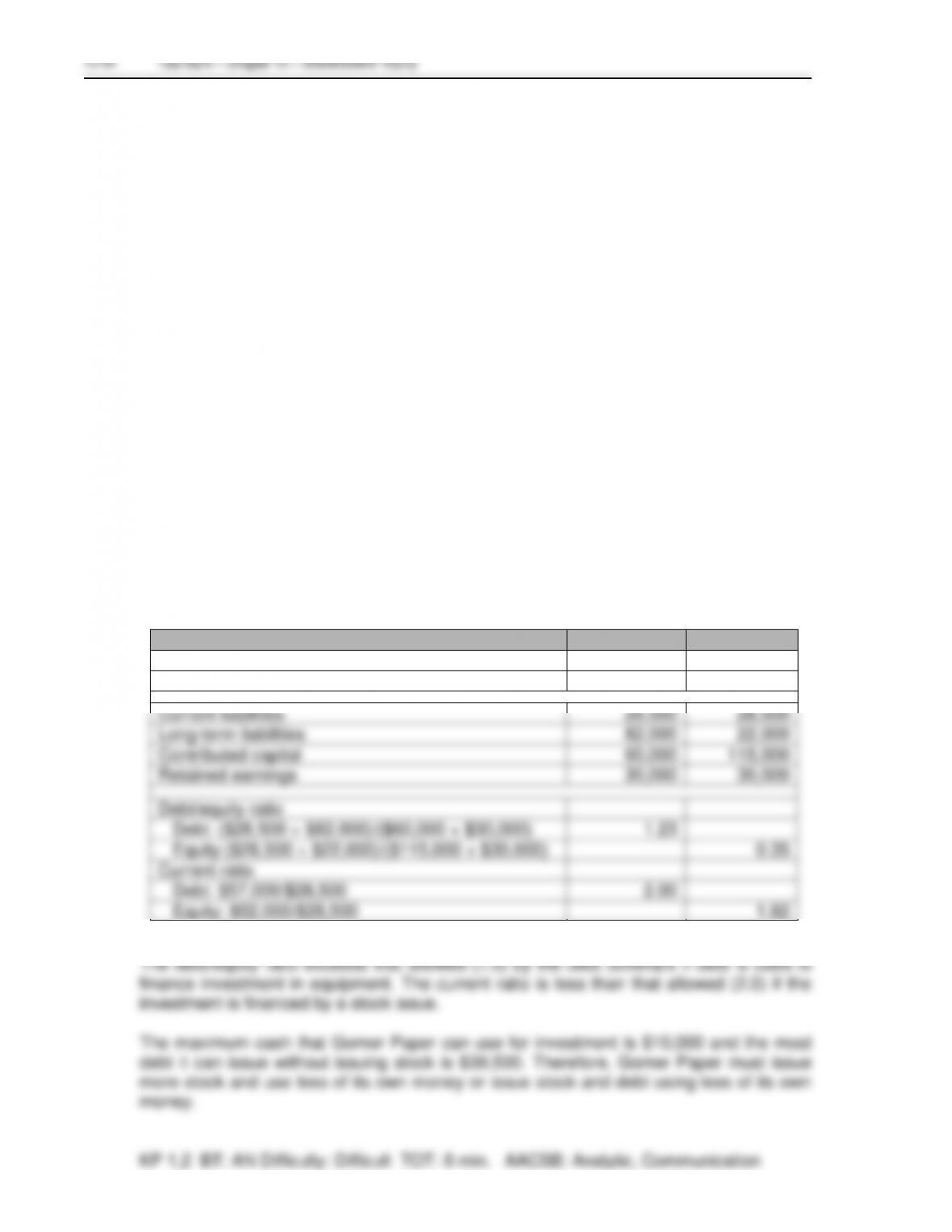
A.
Debt Issue
Stock Issue
Current assets
$ 57,000
$ 52,000
Long-lived assets
145,000
145,000
Current liabilities
28,500
28,500
Long-term liabilities
82,000
22,000
Contributed capital
60,000
115,000
Retained earnings
30,000
30,000
Debt/equity ratio
Debt: ($28,500 + $82,000)/($60,000 + $30,000)
1.23
Equity:($28,500 + $22,000)/($115,000 + $30,000)
0.35
Current ratio
Debt: $57,000/$28,500
2.00
Equity: $52,000/$28,500
1.82
B:
Test Bank – Chapter 12 – Shareholders’ Equity 12–45
AICPA BB: Critical Thinking AICPA FN: Reporting
SHORT ESSAY QUESTIONS
1. Seneca Corporation has the following balance sheet accounts immediately preceding an
investing and financing decision:
Current assets
$ 430,000
Long-lived assets
1,070,000
Current liabilities
120,000
Long-term liabilities
630,000
Contributed capital
100,000
Retained earnings
650,000
A long-term debt covenant specifies that Seneca’s debt/equity ratio cannot be greater
than 1.0 and current ratio cannot be less than 2.0.
Seneca is going to invest $600,000 in a new machine that will keep Seneca Corporation
in an excellent competitive position in a very competitive industry. In order to finance this
investment, Seneca will use its cash, issue long-term debt, and issue common stock.
However, besides having to adhere to the debt covenants, Mr. Seneca, the sole owner
of Seneca Corporation, will not issue more than $100,000 of common stock so that he
can retain at least a 50% ownership in his corporation.
Can Seneca Corporation finance the $600,000 investment and still adhere to the debt
covenants and allow Seneca to retain at least 50% ownership? If Seneca cannot finance
the machine within the parameters given, suggest possible means for Seneca to finance
the needed acquisition of the machine.
Solution:
The $600,000 investment cannot be raised within the parameters set by the debt
covenants or fulfill Mr. Seneca’s desire to retain control of his corporation. The current
12–46 Test Bank – Chapter 12 – Shareholders’ Equity
balance sheet. Third, nonvoting preferred stock might be issued. If this market is
available, Mr. Seneca can increase shareholders’ equity without diluting his ownership of
the corporation. Finally, Seneca might be able to secure personal debt and use that
money to buy stock in his company. If he could obtain $105,000 at what may likely be a
2. For what reasons might a company purchase treasury stock?
Solution:
The most common reason companies purchase treasury stock is to support employee
compensation plans. This makes stock available to distribute to employees as they
3. What rights do preferred shareholders have that common shareholders do not?
Solution:
Preferred shareholders usually receive dividend payments before common
shareholders, assuming that the board declares a dividend. Since the amount of
4. Identify the two components of shareholders’ equity. How do they differ?
Solution:
Shareholders’ equity consists of contributed capital and earned capital. Contributed
5. Explain par value.
Solution:
Par value is an arbitrary amount assigned to a share of stock. It has little legal or
6. Which characteristics make equity financing more advantageous than debt financing?
Solution:
Equity financing represents amounts contributed from a company‘s owners. No legal
7. What factors influence corporate dividend strategies?
Solution:
Factors that influence a company’s dividend strategy include the nature, financial
condition, legal constraints, and the desired image of the company. In order to declare
8. How does the behavior of stock prices relate to the riskiness of equity securities?
Solution:
Stock prices are usually more volatile than bond prices on the major security exchanges
9. Why is debt financing considered less expensive than equity financing?
Solution:
Issuing debt is attractive because interest payments are tax deductible—that is, interest
10. How do the book value and market value of stock compare?
Solution:
Market value is the amount at which stock can be exchanged on the open market. This
11. How is the excess of cash receipts over the original cost of treasury stock accounted for
and reported in financial statements?
Solution:
When cash is received in an amount that exceeds the original cost of treasury stock, the
12. What makes preferred stock questionable in classification?
Solution:
Preferred stock, an equity investment, has characteristics that resemble debt. Preferred
13. What balance sheet condition does a deficit create?
Solution:
A deficit is a negative balance in retained earnings on the balance sheet. In determining
the net worth of a company, total liabilities are subtracted from total assets. A deficit in
14. What is the purpose of the date of record?
Solution:
The date of record serves as a point in time for determining specifically who the
15. How does an appropriation of retained earnings affect the income statement and assets
of a company?
Solution:
16. What is the purpose of a prior period adjustment?
Solution:
17. From a business perspective, how does a stock split differ from a small stock dividend?
How are they similar?
Solution:
A stock dividend requires a company to distribute additional shares of stock to existing
shareholders. An investor who previously held 10 shares when a company issues a 10
percent dividend now holds 11 shares. A stock split modifies the par value of stock. The
IFRS Question
1. Under US GAAP, companies must provide a description of the changes in
comprehensive income as either a separate statement or as a part of the statement of
changes in stockholders’ equity. Under IFRS, companies must also provide a description
of the changes in comprehensive income in a:
A. Statement of Recognized Income and Expense

12–52 Test Bank – Chapter 12 – Shareholders’ Equity
B. Statement of Unrecognized Income and Expense
C. Statement of Retained Earnings
D. Income Statement