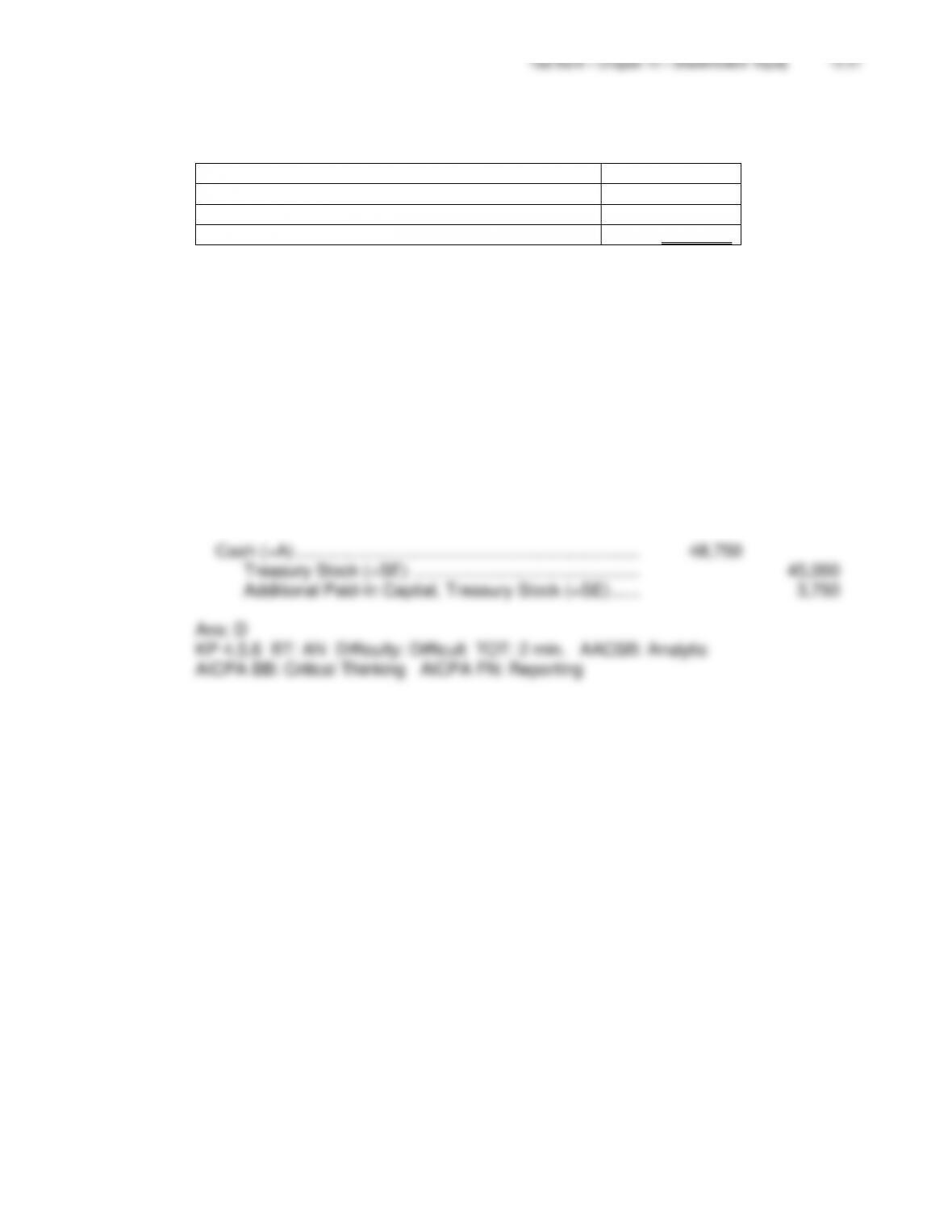
55. The shareholders’ equity section of the Jason Company as of December 31, 2015 is as
follows:
Common stock
$180,000
Additional paid-in capital (Common stock)
110,000
Retained earnings
160,000
Total shareholders’ equity
$450,000
On January 15, the company repurchased 1,500 shares of its own stock at $60 for
treasury stock. On January 16, as part of a compensation package, the company
reissued half of the treasury shares to executives who exercised stock options for $20
per share. On January 28, the company reissued the remainder of the treasury stock on
the open market for $65 per share. Which of the following would be included in the
journal entry recorded on January 28?
a. a credit to Treasury Stock for $48,750.
b. a credit to Additional Paid-In Capital, Treasury Stock for $48,750.
c. a debit to Cash for $45,000.
d. a credit to Additional Paid-In Capital, Treasury Stock for $3,750.
Solution:
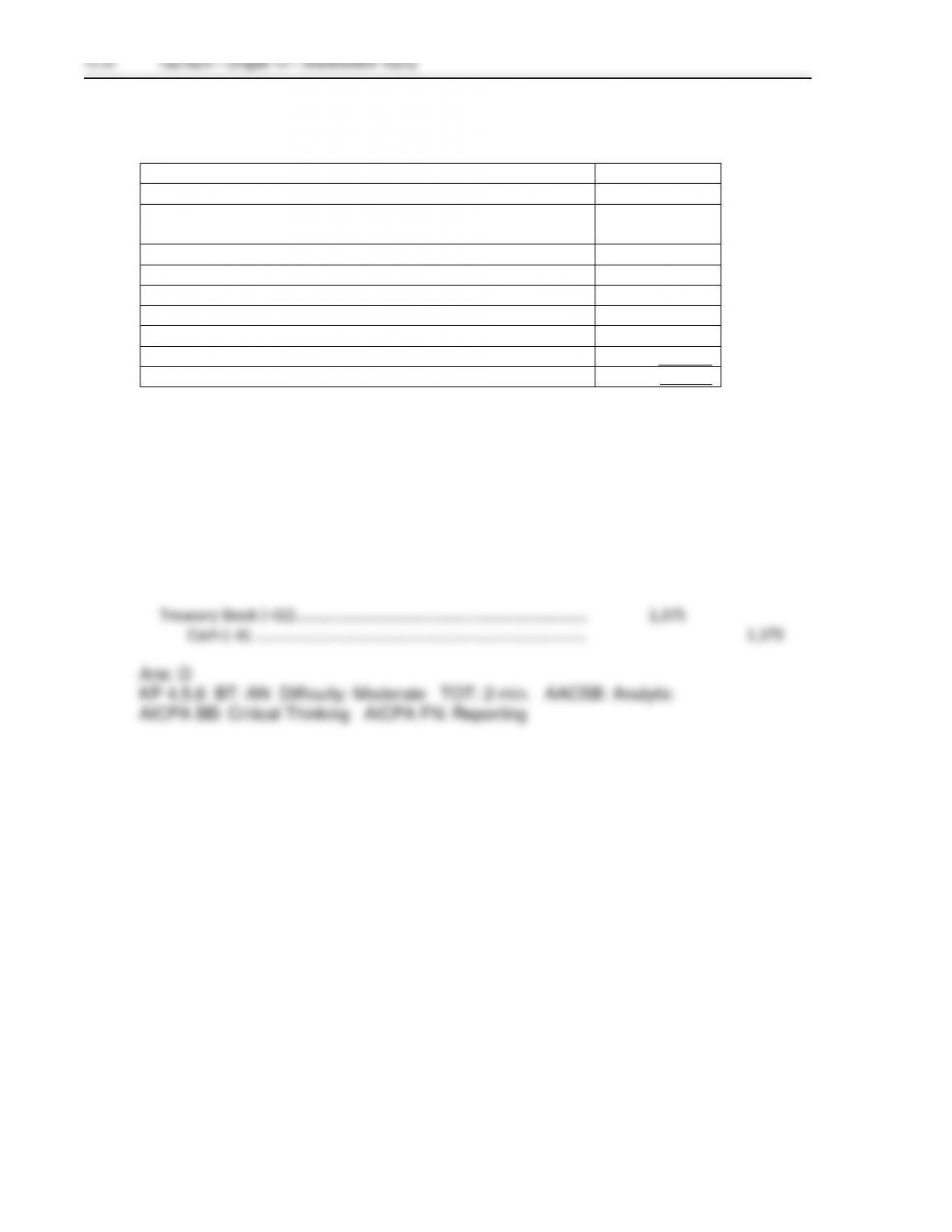
56. The shareholders’ equity section of Winters Company contained the following balances
as of December 31, 2015:
Preferred stock (10%, $15 par value, cumulative)
$1,500
Preferred stock (12%, $10 par value , noncumulative)
1,500
Common stock ($1 par value, 5,000 shares authorized,
3,500 issued and 400 held in treasury)
3,500
Additional paid-in capital:
Preferred stock (10%)
1,050
Preferred stock (12%)
1,275
Common stock
2,345
Retained earnings
4,256
Less: Treasury stock
(5,750)
Total shareholders’ equity
$9,676
During 2016, Winters entered into the following transaction: On May 13, the company
repurchased 55 shares of its common stock in the open market at $25 per share. Which
of the following would be included in the journal entry for May 13?
a. a debit to Cash for $1,375.
b. a credit to Common Stock for $1,375.
c. a debit to Common Stock for $1,375.
d. a debit to Treasury Stock for $1,375.
Solution:
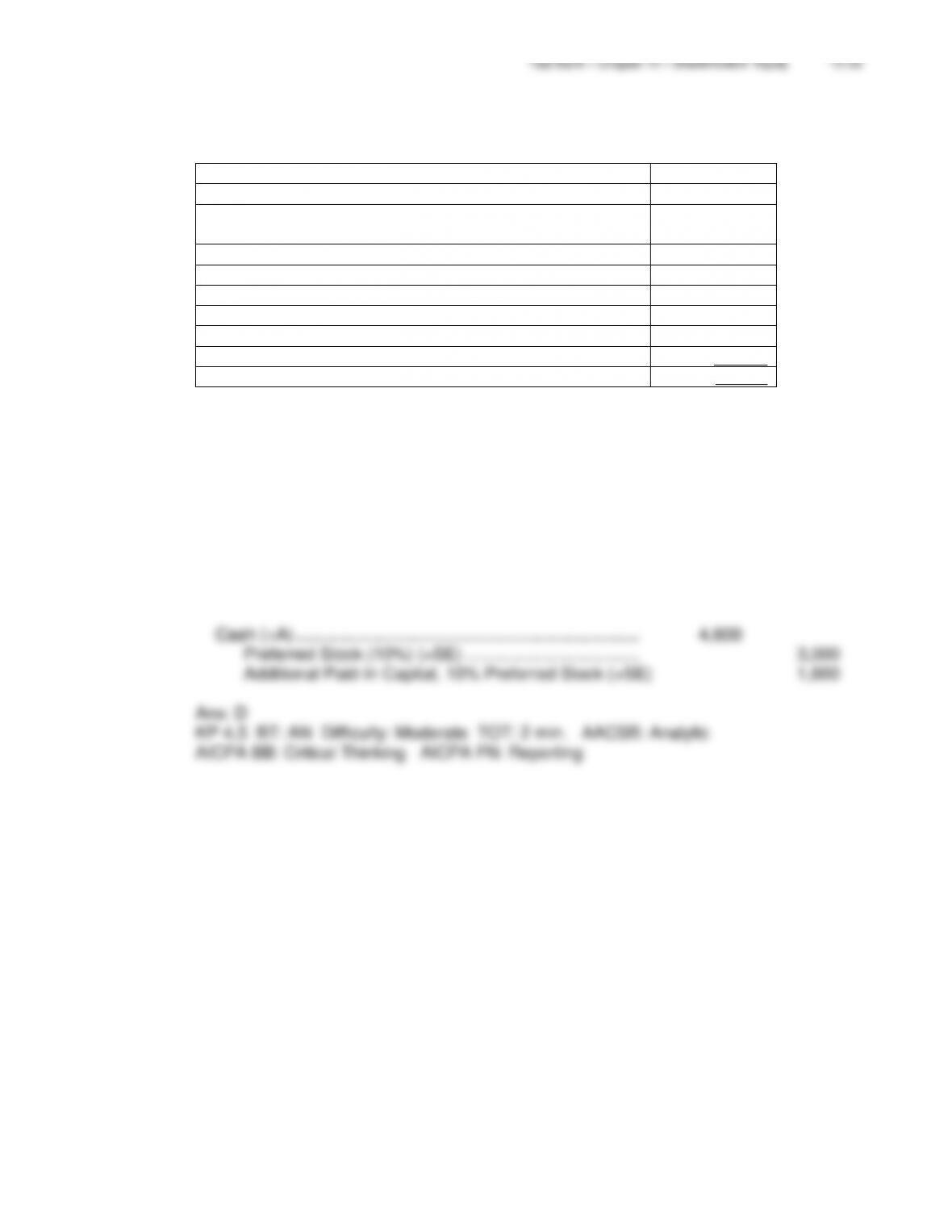
57. The shareholders’ equity section of Winters Company contained the following balances
as of December 31, 2015:
Preferred stock (10%, $15 par value, cumulative)
$1,500
Preferred stock (12%, $10 par value , noncumulative)
1,500
Common stock ($1 par value, 5,000 shares authorized,
3,500 issued and 400 held in treasury)
3,500
Additional paid-in capital:
Preferred stock (10%)
1,050
Preferred stock (12%)
1,275
Common stock
2,345
Retained earnings
4,256
Less: Treasury stock
(5,750)
Total shareholders’ equity
$9,676
During 2016, Winters entered into the following transaction: On September 26, the
company issued 200 shares of its 10 percent preferred stock at $23 per share. Which of
the following would be included in the September 26 journal entry?
a. a debit to Preferred Stock for $3,000.
b. a credit to Cash for $4,600.
c. a debit to Cash for $3,000.
d. a credit to Additional Paid-In Capital, 10% Preferred Stock for $1,600.
Solution:
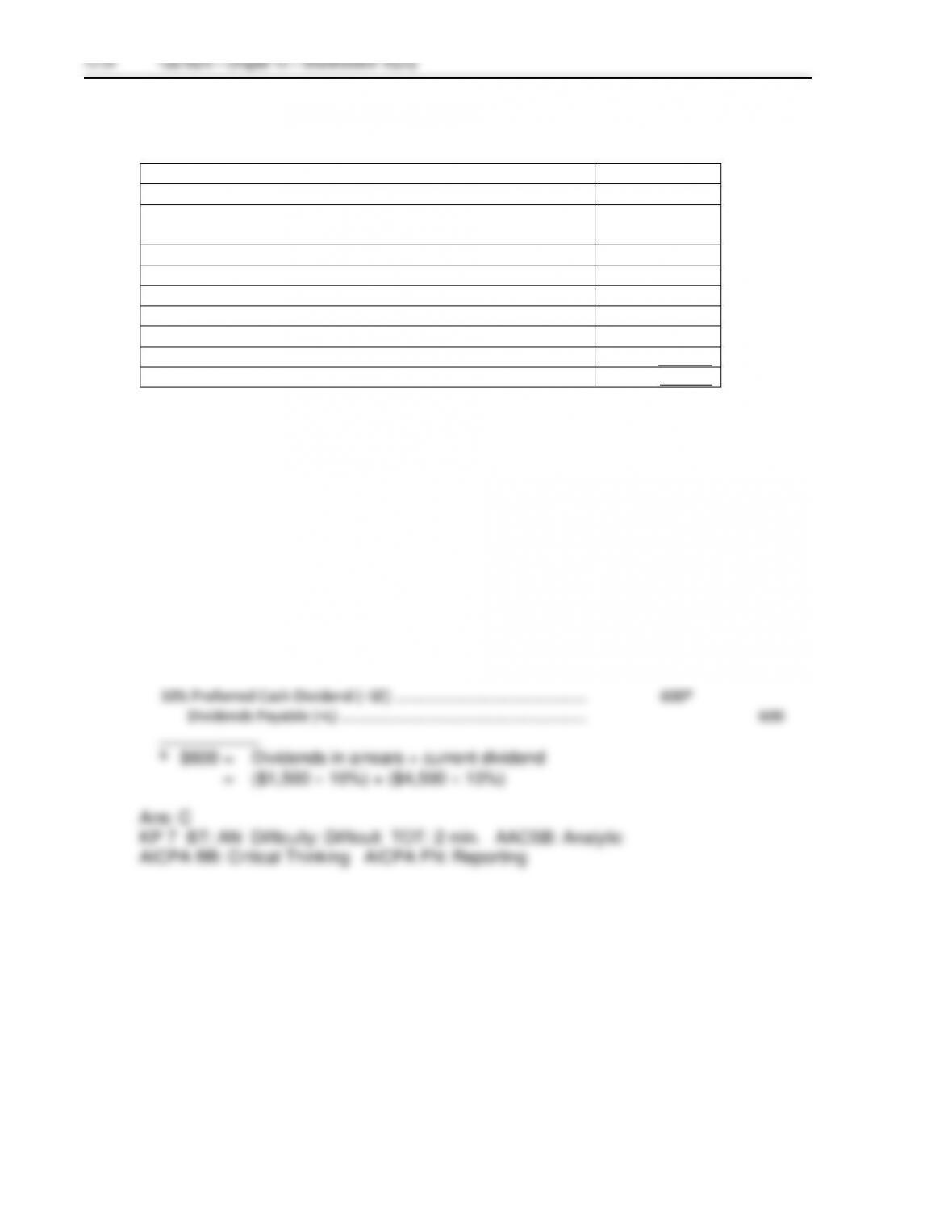
58. The shareholders’ equity section of Winters Company contained the following balances
as of December 31, 2015:
Preferred stock (10%, $15 par value, cumulative)
$1,500
Preferred stock (12%, $10 par value , noncumulative)
1,500
Common stock ($1 par value, 5,000 shares authorized,
3,500 issued and 400 held in treasury)
3,500
Additional paid-in capital:
Preferred stock (10%)
1,050
Preferred stock (12%)
1,275
Common stock
2,345
Retained earnings
4,256
Less: Treasury stock
(5,750)
Total shareholders’ equity
$9,676
On September 26, 2016, Winters issued 200 shares of its 10 percent preferred stock at
$23 per share. On December 2, the company declared a cash dividend of $1,050,
which was paid on December 27. Winters did not declare or pay any dividends during
2015. If Winters uses a separate dividend account for each type of stock, which of the
following would be included in the journal entry to record the declaration of the 10%
Preferred stock dividend?
a. a credit to 10% Preferred Cash Dividend for $600.
b. a debit to Dividend Expense for $600.
c. a credit to Dividends Payable for $600.
d. a debit to Cash for $600.
Solution:
59. The shareholders’ equity section of Winters Company contained the following balances
as of December 31, 2015:
Preferred stock (10%, $15 par value, cumulative)
$1,500
Preferred stock (12%, $10 par value , noncumulative)
1,500
Common stock ($1 par value, 5,000 shares authorized,
3,500 issued and 400 held in treasury)
3,500
Additional paid-in capital:
Preferred stock (10%)
1,050
Preferred stock (12%)
1,275
Common stock
2,345
Retained earnings
4,256
Less: Treasury stock
(5,750)
Total shareholders’ equity
$9,676
During 2016, Winters entered into the following transaction: On December 2, the
company declared a cash dividend of $1,050, which was paid on December 27. Winters
did not declare or pay any dividends during 2015. If Winters uses a separate dividend
account for each type of stock, which of the following would be included in the journal
entry to record the declaration of the 12% Preferred stock dividend?
a. a debit to 12% Preferred Cash Dividend for $180.
b. a debit to Dividend Expense for $180.
c. a debit to Dividends Payable for $180.
d. a debit to Cash for $180.
Solution:
60. The shareholders’ equity section of Winters Company contained the following balances
as of December 31, 2015:
Preferred stock (10%, $15 par value, cumulative)
$1,500
Preferred stock (12%, $10 par value , noncumulative)
1,500
Common stock ($1 par value, 5,000 shares authorized,
3,500 issued and 400 held in treasury)
3,500
Additional paid-in capital:
Preferred stock (10%)
1,050
Preferred stock (12%)
1,275
Common stock
2,345
Retained earnings
4,256
Less: Treasury stock
(5,750)
Total shareholders’ equity
$9,676
During 2016, Winters entered into the following transaction: On December 2, the
company declared a cash dividend of $1,050, which was paid on December 27. Winters
did not declare or pay any dividends during 2015. Based on this information, what
amount of dividends should be declared and paid to shareholders’ with common stock?
a. $350
b. $420
c. $570
d. $385
Solution:
61. The shareholders’ equity section of Samuels Company were reported on the balance
sheets for December 31:
2015
2014
Preferred stock (9%, $50 par value)
$200,000
$120,000
Common stock ($10 par value, 750,000 shares
authorized, 90,000 issued and 5,000 held in
treasury)
540,000
396,000
Additional paid-in capital:
Preferred stock
155,000
55,000
Common stock
336,000
300,000
Retained earnings
575,000
495,000
Less: Treasury stock
(110,000)
——–
Total shareholders’ equity
$1,696,000
$1,366,000
Based on this information, how many shares of preferred stock were issued in 2015 and
what was the average issue price?
a. 4,000 shares and $112.50 per share
b. 160 shares and $88.75 per share
c. 800 shares and $250 per share
d. 1,600 shares and $112.50 per share
Solution:
62. The shareholders’ equity section of Samuels Company were reported on the balance
sheets for December 31:
2015
2014
Preferred stock (9%, $50 par value)
$200,000
$120,000
Common stock ($6 par value, 750,000 shares
authorized, 90,000 issued and 5,000 held in
treasury)
540,000
396,000
Additional paid-in capital:
Preferred stock
155,000
55,000
Common stock
336,000
300,000
Retained earnings
575,000
495,000
Less: Treasury stock
(110,000)
——–
Total shareholders’ equity
$2,180,000
$1,688,000
Based on this information, how many shares of common stock were issued in 2015 and
what was the average issue price?
a. 21,000 shares and $7.82 per share
b. 30,000 share and $6.00 per share
c. 85,000 shares and $9.73 per share
d. 24,000 shares and $7.50 per share
Solution:
Test Bank – Chapter 12 – Shareholders’ Equity 12–29
MATCHING QUESTIONS
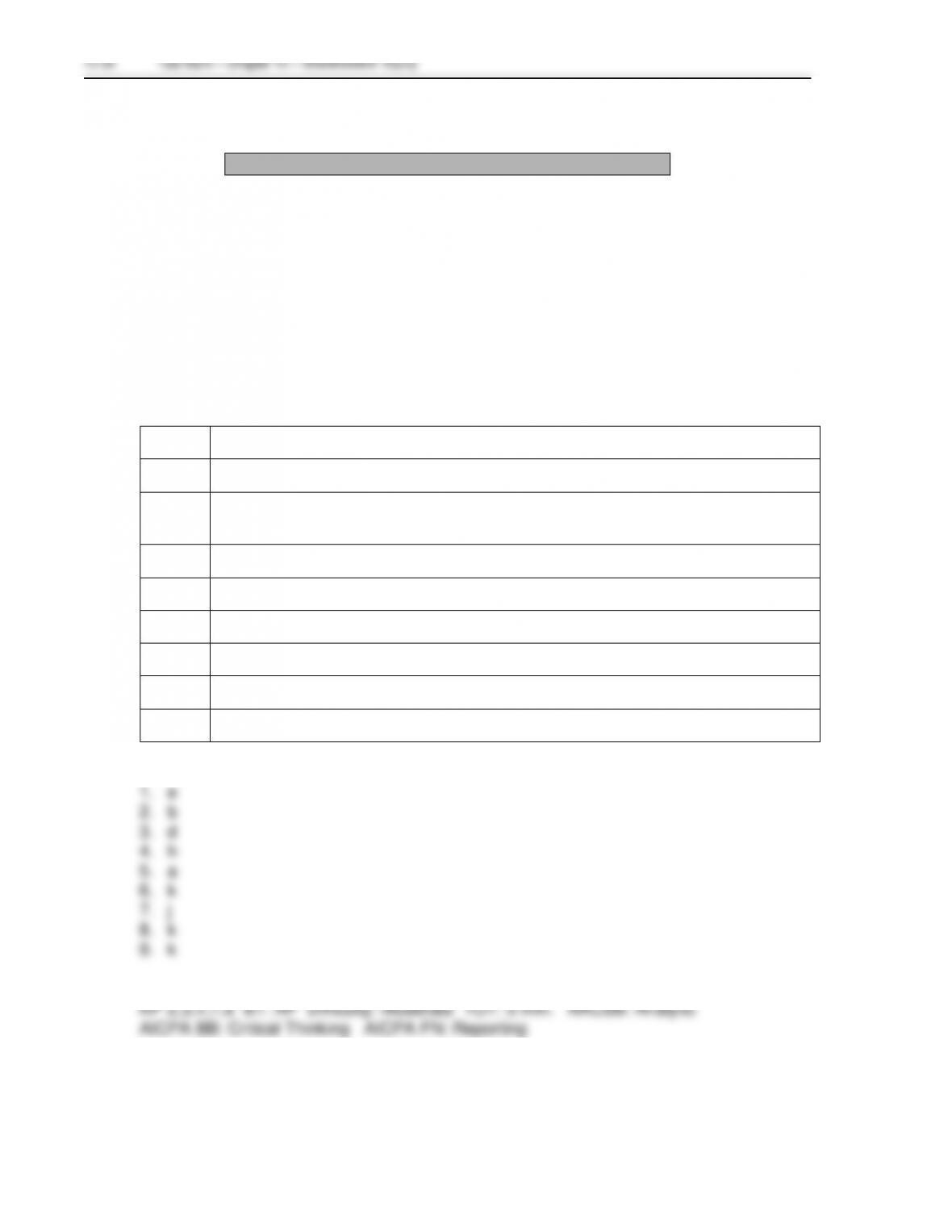
1. Management wishes to obtain financing. For each attribute/characteristic listed in 1
through 5, determine which type of financing it describes from management’s
perspective by placing a D in the space if it applies to debt financing, or E if it applies to
equity financing.
1. No tax savings
2. Credit rating effects
3. Contractual restrictions
4. Contractual future payments
5. Cash flows are discretionary
Solution:
2. Identify the effect of the accounting equation (a through k) of each transaction in 1
through 9 below. You may use each letter more than once or not at all.
Accounting Effects
a.
– A and – L
b.
+ A and + SE (Contributed Capital)
c.
+ A and + SE (Retained Earnings)
d.
+ A and – A
e.
+ A and + L
f.
– A and – SE (Contributed Capital)
g.
– A and – SE (Retained Earnings)
h.
+ L and –SE (Retained Earnings)
i.
– L and + SE (Retained Earnings)
j.
+ SE (Contributed Capital) and – SE (Retained Earnings)
k.
No journal entry or effect
1. Issued debt to finance the purchase of property
2. Issued common stock to finance the purchase of property
3. Used money resulting from retained earnings to finance the purchase of
property
4. Declared cash dividends to shareholders
5. Paid the previously declared dividends
6. Skipped dividends on cumulative preferred stock
7. Declared and distributed a 10% stock dividend
8. Declared a 3:1 stock split
9. The market value of common stock doubled during the year
Solution:
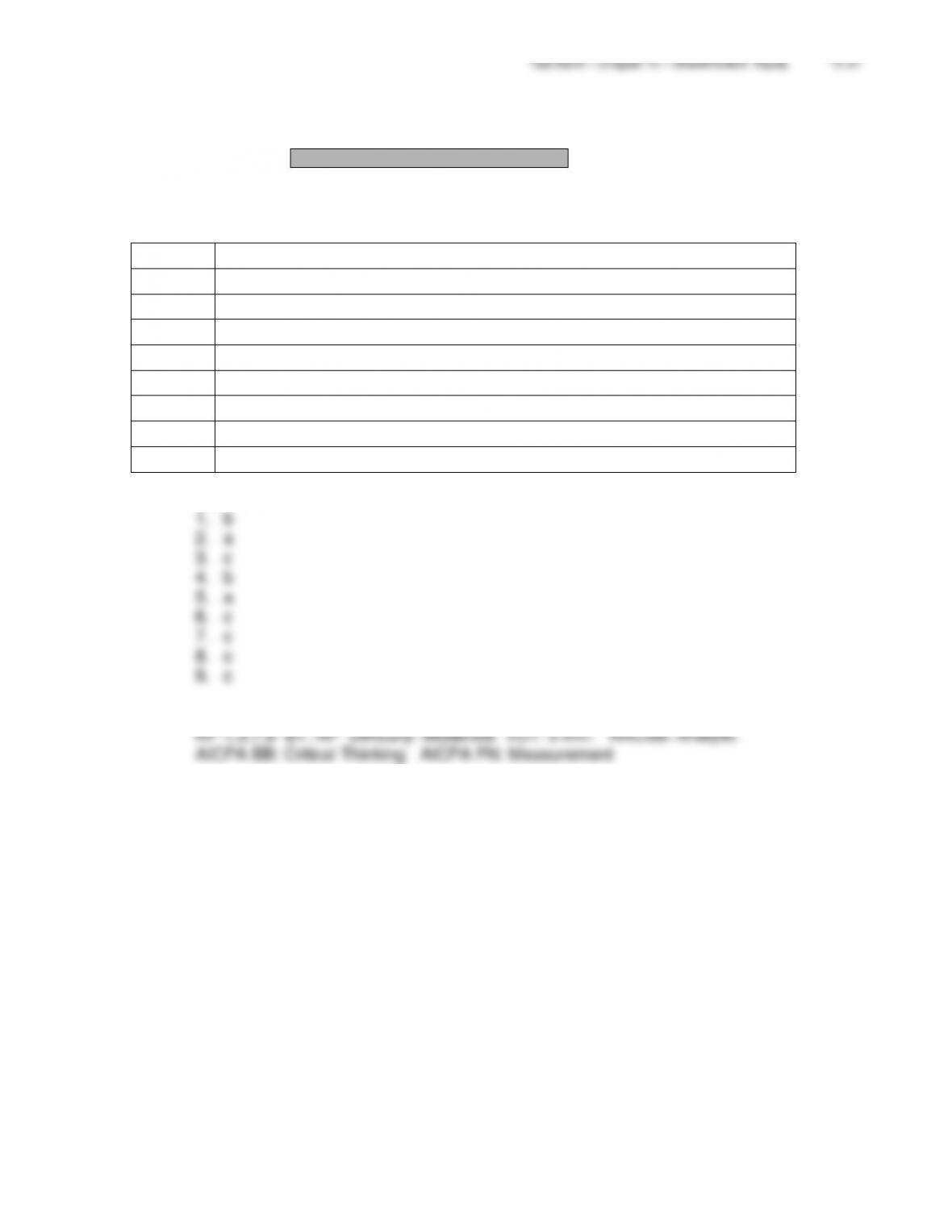
3. Select the effect (a, b, or c) that each transaction listed in 1 through 9 would most likely
cause on the debt/equity ratio.
Effects
a. Decrease in debt/equity ratio
b. Increase in debt/equity ratio
c. Does not change debt/equity ratio
1. Issued debt to finance the purchase of property
2. Issued common stock to finance the purchase of property
3. Used money resulting from profits to finance the purchase of property
4. Declared dividends to shareholders
5. Paid the previously declared dividends
6. Skipped dividends on cumulative preferred stock
7. Declared and paid a 10% stock dividend
8. Declared and paid a 200% stock dividend
9. Distributed a two-for-one stock split
Solution:
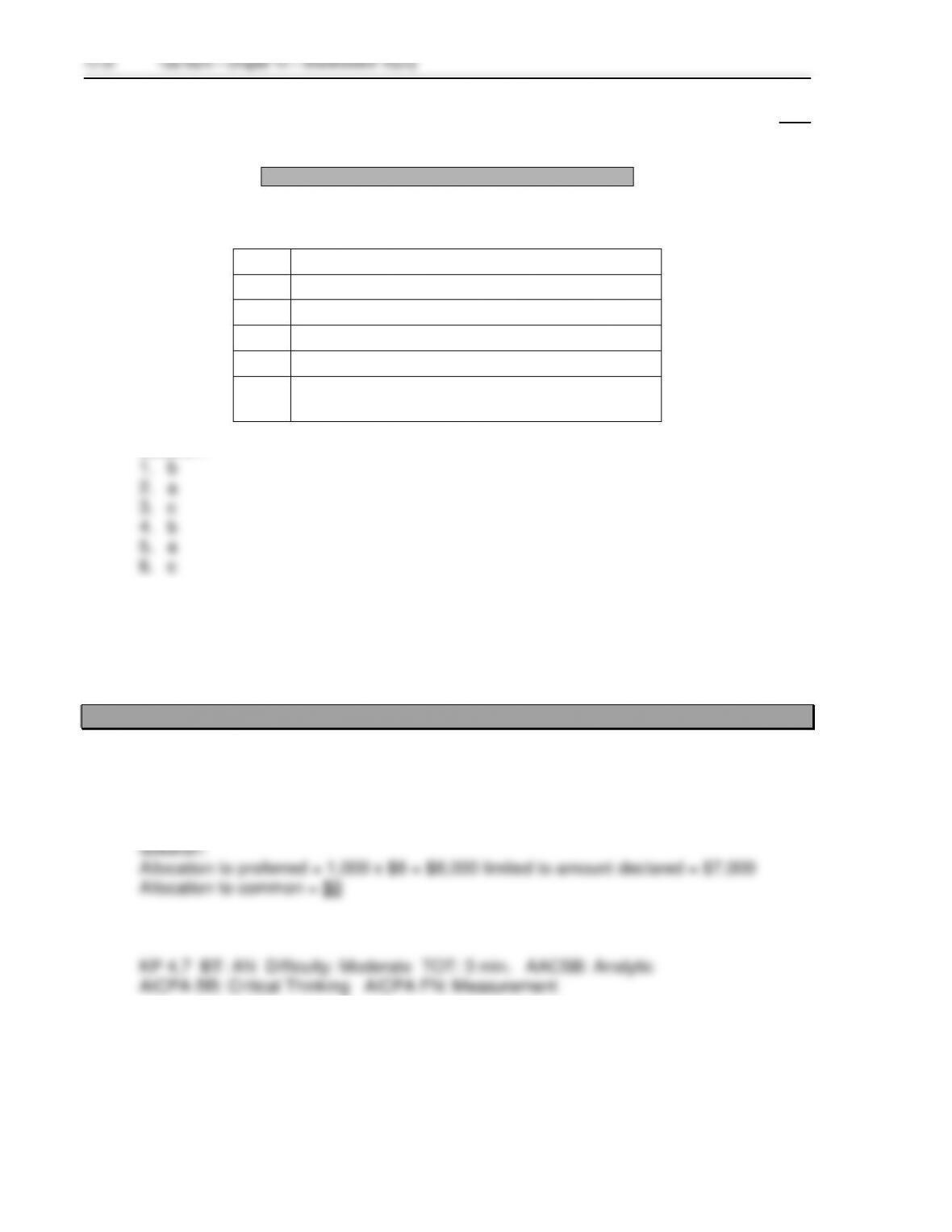
4. Indicate the effect of each of the following transactions (1 through 6) on total
shareholders’ equity by selecting the letter of the effect (a, b, and c) and placing it in the
space provided.
Accounting Effects
a. Decrease in total shareholders’ equity
b. Increase in total shareholders’ equity
c. Does not change total shareholders’ equity
1. Treasury stock is resold at more than cost
2. Operating loss for the period
3. Declaration of a stock dividend
4. Acquisition of machinery for common stock
5. Declaration of cash dividend
6. Payment of cash dividend previously
recorded
Solution:
KP 4,6,7,8, BT: AP Difficulty: Moderate TOT: 4 min. AACSB: Analytic
AICPA BB: Critical Thinking AICPA FN: Reporting
SHORT PROBLEMS
1. Total dividends of $7,000 are declared when one year of dividends are in arrears on
1,000 shares of $8 cumulative preferred stock. How much of the $7,000 of dividends
goes to the common shareholders?
2. The following information from St. Paul Supply, Inc.is provided for 2015 and 2014:
12/31/15
12/31/14
12% Cumulative preferred stock, $20 par
$200,000
$200,000
Common stock, $5 par
40,000
28,000
Additional paid-in capital – common
80,000
50,000
Retained earnings
500,000
500,000
Net income
60,000
40,000
Additional information:
No preferred dividends were declared during 2014. The market price of the common
stock was $25 at December 31, 2015. Calculate the book value per share of common
stock at December 31, 2015.
Solution:
3. Total dividends of $40,000 are declared when one year of dividends is in arrears on
5,000 shares of $3 cumulative preferred stock. Calculate dividends on common stock.
4. Total dividends of $13,000 are declared when two years of dividends are in arrears on
1,000 shares of par $50, 10%, cumulative preferred stock. Calculate the dividends that
were declared on common stock.
5. The board of directors desires to pay $40,000 of dividends to its common shareholders
when two years of dividends are in arrears on 1,000 shares of $20 par, 10% cumulative
preferred stock. How much total dividends must be declared?
6. On January 23, Borders Corporation purchased 1,000 shares of its own common stock
for $30 a share. On March 31, it sold 600 of those shares for $42 a share. How much is
7. Canton Corporation shareholders’ equity section of its balance sheet as of December 31,
2014 is as follows:
Common stock, $5 par value; 40,000 shares authorized
$50,000
Additional paid-in capital
100,000
Retained earnings
180,000
Total
$330,000
The following events occurred during 2015:
• March 3 – 5,000 shares of authorized and unissued common stock were sold for
$22 per share.
• March 16 – Declared a cash dividend of $3 per share payable May 15 to holders
of record on May 5.
A. At March 31, 2015, how many more shares of stock can be issued?
B. At March 31, 2015, how many shares are issued and outstanding?
Solution:
8. If an investor owns 8% of a corporation prior to a 2-for-1 stock split, what percentage
does the investor own after receiving 2 shares of $5 par value stock for each $10 par
value share of stock?
9. The shareholders’ equity section of Campbell Co.’s balance sheet follows:
Common stock, $2 par
$ 80,000
Additional paid-in capital – common
50,000
Additional paid-in capital—treasury stock
600
Retained earnings
25,400
Treasury stock
(2,000)
Total shareholders’ equity
$154,000
A. Assume all of the treasury stock was sold for $4,800. Calculate the following
amounts:
1. Additional paid-in capital—treasury stock
2. Retained earnings
3. Total shareholders’ equity
B. Assume all of the treasury stock was sold for $850. Calculate the following amounts:
1. Additional paid-in capital—treasury stock
2. Retained earnings
3. Total shareholders’ equity
Solution:
A.
Additional paid-in capital—treasury stock ($600 + $2,800)
$ 3,400
Retained earnings (no change)
25,400
Total shareholders’ equity ($80,000 + $50,000 + $3,400 + $25,400)
158,800
B.
Additional paid-in capital – Treasury stock ($600 – $600)
$ 0
Retained earnings ($25,400 – $550)
24,850
Total shareholders’ equity ($80,000 + $50,000 + $0 + $24,850 + $0)
154,850
KP 3,6 BT: AN Difficulty: Difficult TOT: 5 min. AACSB: Analytic
AICPA BB: Critical Thinking AICPA FN: Reporting
10. Immediately before Cavecreek Corporation purchased 4,000 shares of its own common
stock for $25 a share, it had total liabilities of $200,000 and total shareholders’ equity of
$520,000. Calculate Cavecreek’s debt/equity ratio immediately subsequent to the
purchase of the treasury stock.
Solution:
11. Immediately before Zorro Corporation sold 4,000 shares of its own common stock for
$30 a share, it had total liabilities of $200,000 and total shareholders’ equity of $520,000.
Determine Zorro’s debt/equity ratio immediately subsequent to the stock issue.
Solution:
12. Immediately before Cayman Corporation issued 2,000 shares of its common stock for
$15 a share, it had total liabilities of $150,000 and total shareholders’ equity of $300,000.
Cayman had 10,000 shares of common stock outstanding prior to the new issuance.
Calculate Cayman’s debt/equity ratio immediately after the new issuance.
Solution:
13. On January 23, Bennington Corporation, for the first time in its short history, purchased
200 shares of its own common stock for $40 a share. On March 31, it sold 100 of those
shares for $45 a share. Prepare the journal entry recording the March 31st transaction.
Solution:
Cash (100 x $45)
4,500
Treasury Stock (100 x $40)
4,000
Additional Paid-in Capital—Treasury Stock
500
KP 6 BT: AN Difficulty: Moderate TOT: 4 min. AACSB: Analytic
AICPA BB: Critical Thinking AICPA FN: Reporting
14. On January 23, Oakley Co., for the first time in its short history, purchased 200 shares of
its own common stock for $40 a share. On March 31, it sold 100 of those shares for $45
a share and properly recorded $500 as additional paid-in capital. On April 15, it sold the
remaining 100 shares for $35 a share. Prepare the journal entry to record the April 15th
transaction.
Solution:
Cash (100 x $35)
3,500
Additional Paid-in Capital—Treasury Stock
500
Treasury Stock (100 x $40)
4,000
KP 6 BT: AN Difficulty: Moderate TOT: 4 min. AACSB: Analytic