Test Bank – Chapter 11 – Long-Term Liabilities: Notes, Bonds, and Leases 11-21
63. Duncan Industries sold $100,000 of 12 percent bonds on January 1, 2011, when the
market interest rate was 10 percent and received $107,732 for them. The bonds mature
on January 1, 2016 and pay interest on June 30 and December 31. Duncan uses the
effective interest method of amortization. The interest expense for 2011 is:
a. $12,000.00
b. $10,000.00
c. $107,734
d. $9,246
64. Bowlin Company issued $1,000,000 of 9 percent, ten-year bonds for $937,790 on July 1,
2015, when the market rate of interest was 10 percent. The bonds mature in ten years
and pay interest on June 30 and December 31. Bowlin’s fiscal year ends on December
31 and the company uses the effective interest method of amortization. The interest
expense for the six months ending December 31, 2015 is:
a. $50,000.00
b. $45,000.00
c. $46,889.50
d. $93,779.00
65. Bowlin Company issued $1,000,000 of 9 percent, ten-year bonds for $937,790 on July 1,
2015, when the market rate of interest was 10 percent. The bonds mature in ten years
and pay interest on June 30 and December 31. Bowlin’s fiscal year ends on December
31and the company uses the effective interest method of amortization. The book value
of the bonds on December 31, 2015 is:
a. $1,000,000.00
b. $944,011.00
c. $941,452.90
d. $939,679.50
66. Burns Company issued $1,000,000 of 9 percent, ten-year bonds for $937,790 on July 1,
2015, when the market rate of interest was 10 percent. The bonds mature in ten years
and pay interest on June 30 and December 31. Burn’s fiscal year ends on December 31
and the company uses the effective interest method of amortization. The journal entry
on December 31, 2015 will include:
a. a debit to Interest Expense for $45,000.00
b. a credit to Bond Discount for $1,889.50
c. a credit to Interest Payable for $45,000.00
d. a credit to Cash for $46,973.95
67. Barkley Brothers Inc. shows the following information on its balance sheet for December
31, 2015.
Bonds payable
$100,000
Less Unamortized discount
5,350
$94,650
The bonds have a stated annual interest rate of 5 percent and will mature on December
31, 2017. The market value of the bonds as of December 31, 2015, is $98,167.
Assume that Barkley retired the bonds by purchasing them on the open market. The
journal entry to record this purchase would include:
a. a credit to Bonds Payable for $100,000.
b. a debit to Discount on Bonds Payable for $5,350.
c. a credit to Discount on Bonds Payable for $5,350.
d. a debit to Cash for $98,167.
Solution:
Test Bank – Chapter 11 – Long-Term Liabilities: Notes, Bonds, and Leases 11-23
MATCHING QUESTIONS
1. Identify the balance sheet classification (a through e) in which each account description
numbered 1 through 7 would be reported. You may use each letter more than once or
not at all. You may assign more than one category to an account if it can be classified in
more than one category.
Balance Sheet Classifications
a. Current assets
b. Long-term assets
c. Current liabilities
d. Long-term liabilities
e. Not reported on the balance sheet
____1. Loss on redemption
____2. 1-year non-interest-bearing note receivable
____3. Discount on bonds that mature in 3 years
____4. 6-month note payable
____5. Premium on bonds issued that mature in 8 months
____6. Discount on notes payable due in 12 months
____7. Lease liability on a 5-year capital lease paid annually
Solution:
2. Identify the effect(s) as a result of each transaction listed as 1 through 4 below by
placing the letter of the effect on total liabilities and the effect on net income in the two
columns provided. Keep in mind that there are currently no accrued expenses recorded
on the balance sheet as liabilities.
Effects
I. Increase
D. Decrease
X. Does not change
Liabilities
Net Income
1. Acquired the use of equipment under a capital lease
2. A capital lease payment is paid (principal and interest)
3. Periodic interest and amortization of bond discount is
recognized
4. Paid interest on bonds issued at par
Solution:
3. Identify which accounting effect (a through e) occurs as a result of each transaction
numbered 1 through 6. You may use each letter more than once or not at all.
Accounting Effects
a. + A and + L
b. + A and – L
c. – A and – L and – SE
d. – A and – SE
e. – A and + L and – SE
____ 1. Issued a bond payable at a premium
____ 2. Issued a bond payable at a discount
____ 3. Issued a non-interest-bearing note at a discount
____ 4. Paid periodic interest and amortized discount to interest expense
____ 5. Paid periodic interest and amortized premium to interest expense
____ 6. Paid interest on bond payable which was issued at par
Solution:
4. Identify the effect(s) on the debt/equity ratio (a through c) as a result of each transaction
numbered 1 through 6 below. You may use each letter more than once or not at all.
Effects
a. Increase in debt/equity ratio
b. Decrease in debt/equity ratio
c. Does not change debt/equity ratio
____ 1. Acquired the use of equipment under a capital lease
____ 2. Paid the interest portion of the payment on a capital lease
____ 3. Paid the principal portion of the payment on a capital lease
____ 4. Acquired the use of equipment under an operating lease
____ 5. Payment required on an operating lease
Solution:
5. Identify which accounting effect (a through e) occurs as a result of each transaction
numbered 1 through 6. You may use each letter more than once or not at all.
Accounting Effects
a.
+ A and + L
b.
+ A and + SE
c.
– A and – L
d.
– A and – SE
e.
No change in total A, L, SE
____ 1. Acquired the use of equipment under a capital lease
____ 2. Paid the interest portion of the payment on a capital lease
____ 3. Paid the principal portion of the payment on a capital lease
____ 4. Depreciation of equipment leased under a capital lease
____ 5. Acquired the use of equipment under an operating lease
____ 6. Payment required on an operating lease
Solution:
6. Identify the effect(s) on the debt/equity ratio (a through c) as a result of each transaction
numbered 1 through 6 below. You may use each letter more than once or not at all.
Effects
a. Increase in debt/equity ratio
b. Decrease in debt/equity ratio
c. Does not change debt/equity ratio
____ 1. Issued a bond payable at a discount
____ 2. Issued a non-interest-bearing note at a discount
____ 3. Issued an interest-bearing note at a premium
____ 4. Amortized discount to interest expense
____ 5. Paid interest on bonds payable that was issued at par
____ 6. Market value of bonds payable increased after issue date
____ 7. Retired a bond issue by paying cash
Solution:
KP 1,2 BT: AP Difficulty: Moderate TOT: 5 min. AACSB: Analytic
AICPA BB: Critical Thinking AICPA FN: Measurement
SHORT PROBLEMS
1. On January 1, 2015, Lukens Corporation issued 5-year bonds with a $50,000 face
amount and a 6% annual coupon rate paid annually on January 1. The bonds were
issued at $44,166 when the market rate of interest was 9%.
A. Prepare the journal entry to record the issuance of the bonds on January 1, 2015.
Round to the nearest dollar.
B. Were the bonds issued at a premium or discount? How do you know?
Solution:
A. Cash
44,166
Discount on Bonds Payable
5,834
Bonds Payable
50,000
B. The bonds were issued at a discount. Two items reflect this—the issue price is less
than the face amount of the bonds, and the market rate of interest is greater than the
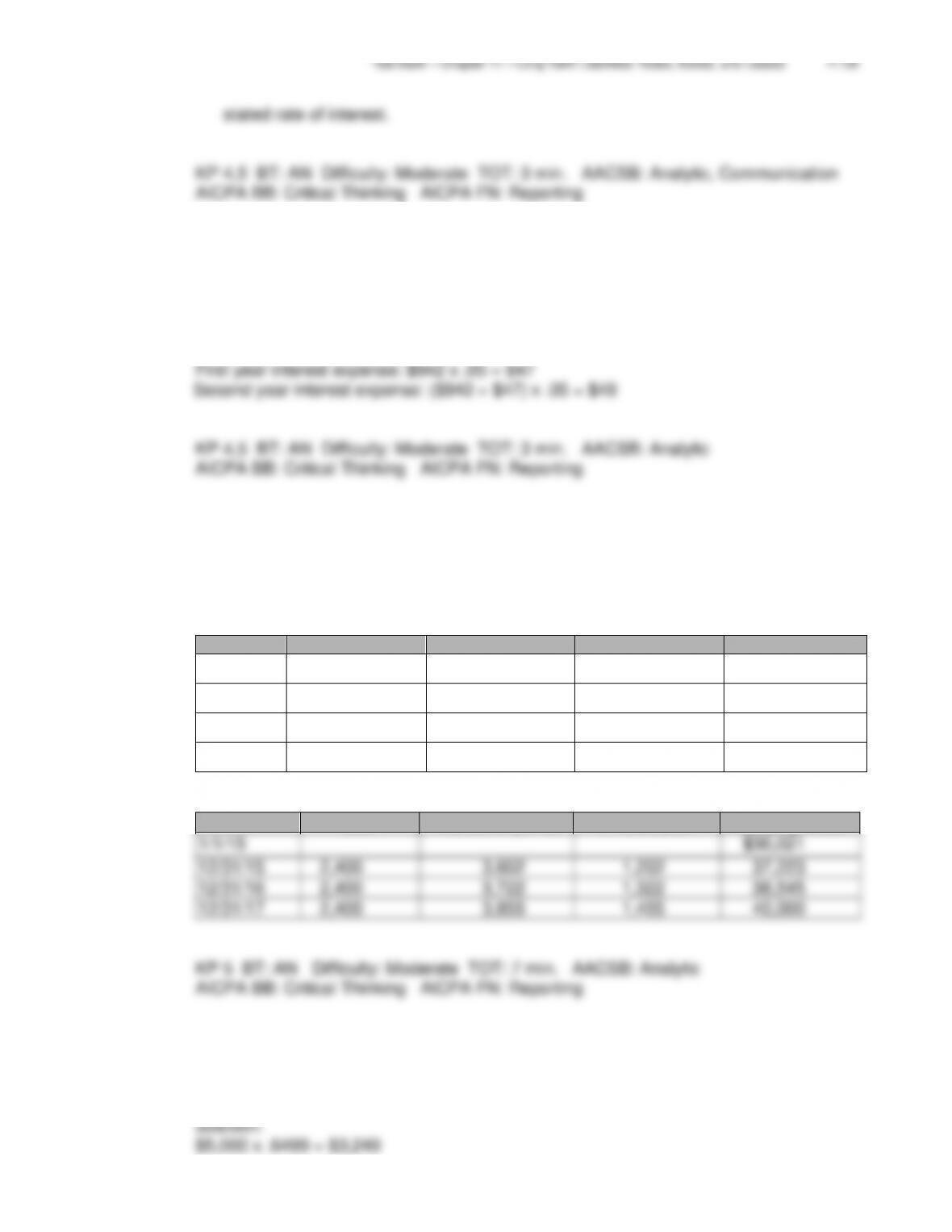
2. On January 1, a 3-year, $1,090 non-interest-bearing note payable was issued for $942
when the market rate of interest was 5%. How much interest expense will Hamlen
recognize in each of the first two years using the effective interest method? Round to the
nearest dollar.
Solution:
3. On January 1, 2015, Hooper Corporation issued 3-year bonds with a $40,000 face
amount and a 6% annual coupon rate paid annually on December 31. The bonds were
issued at $36,021 when the market rate of interest was 10%. Complete the amortization
table for the bonds using the effective interest method. Round all amounts to the nearest
dollar.
Date
Cash
Interest Expense
Amortization
Carrying Value
1/1/15
12/31/15
12/31/16
12/31/17
Solution:
Cash
Interest Expense
Amortization
Carrying Value
1/1/15
$36,021
12/31/15
2,400
3,602
1,202
37,223
12/31/16
2,400
3,722
1,322
38,545
12/31/17
2,400
3,855
1,455
40,000
KP 5 BT: AN Difficulty: Moderate TOT: 7 min. AACSB: Analytic
AICPA BB: Critical Thinking AICPA FN: Reporting
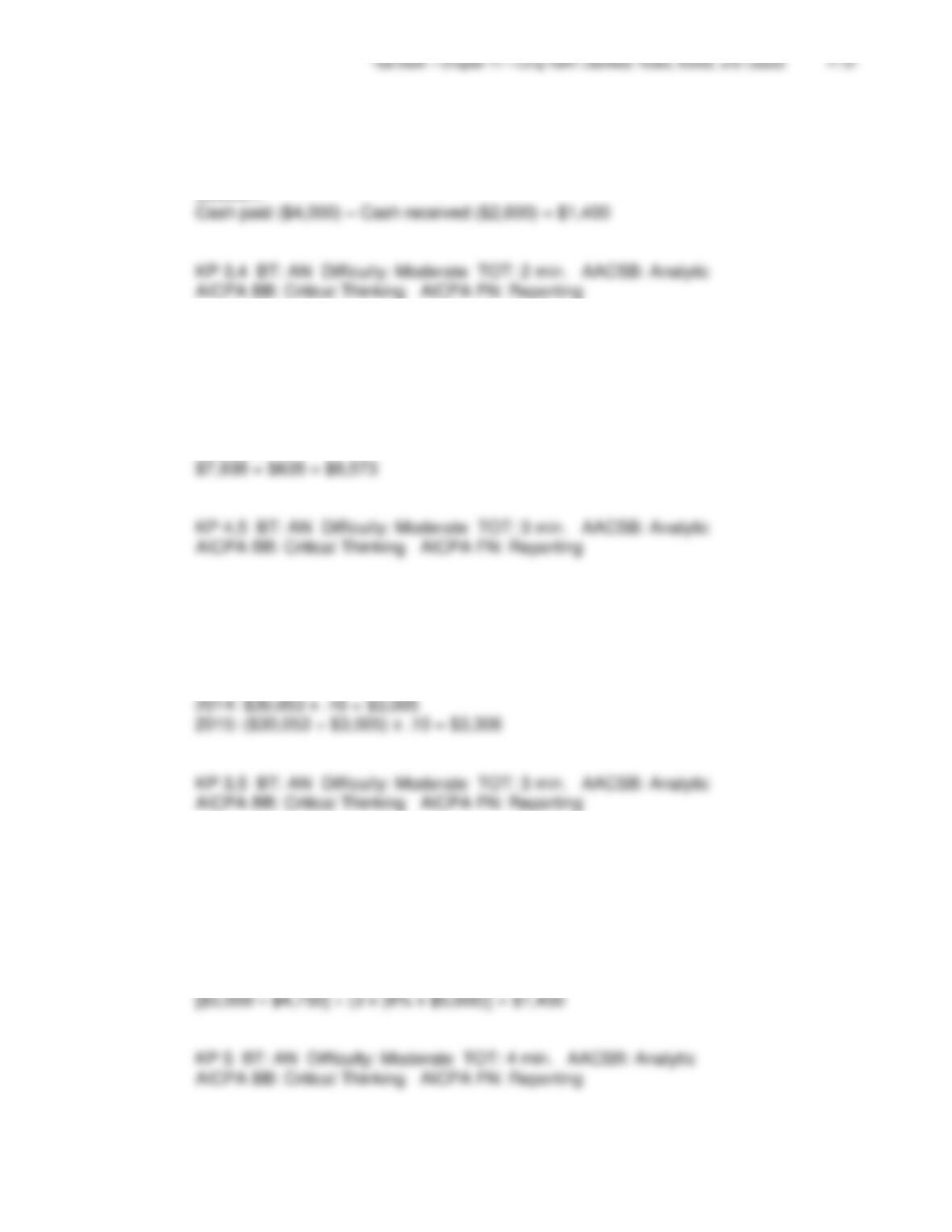
4. On January 1, a 5-year, $5,000 non-interest-bearing note payable was issued when the
market rate of interest was 9%. What are the proceeds from this issue? Round your final
answer to the nearest dollar.

5. On January 1, a 5-year, $4,000 non-interest-bearing note payable was issued for $2,600
when the market rate of interest was 9%. What is the total interest expense that will be
recognized over the life of the note? Round your final answer to the nearest dollar.
Solution:
6. On January 1, a 3-year, $10,000 non-interest-bearing note payable was issued for
$7,938 when the market rate of interest was 8%. Interest expense is recognized using
the effective interest method. Calculate the balance sheet value of the note a year after
its issuance. Round your final answer to the nearest dollar.
Solution:
7. Samuels Corporation issued a $40,000, 3-year, non-interest-bearing note payable on
January 1, 2014. Reflecting a market rate of interest of 10%, Garrison received
$30,053. Calculate interest expense (to the nearest dollar) for 2014 and 2015.
Solution:
8. On January 1, 2014, Pacific Corporation issued a 3-year, 8%, $5,000 bond payable.
Beginning in 2015, interest is payable every January 1 over the life of the bond. The
market rate of interest on January 1, 2014 is 10%. The bond was issued at $4,750.
Calculate the total interest expense over the 3-year life of the bond independent of the
particular accounting method used to recognize interest expense each year.
Solution:
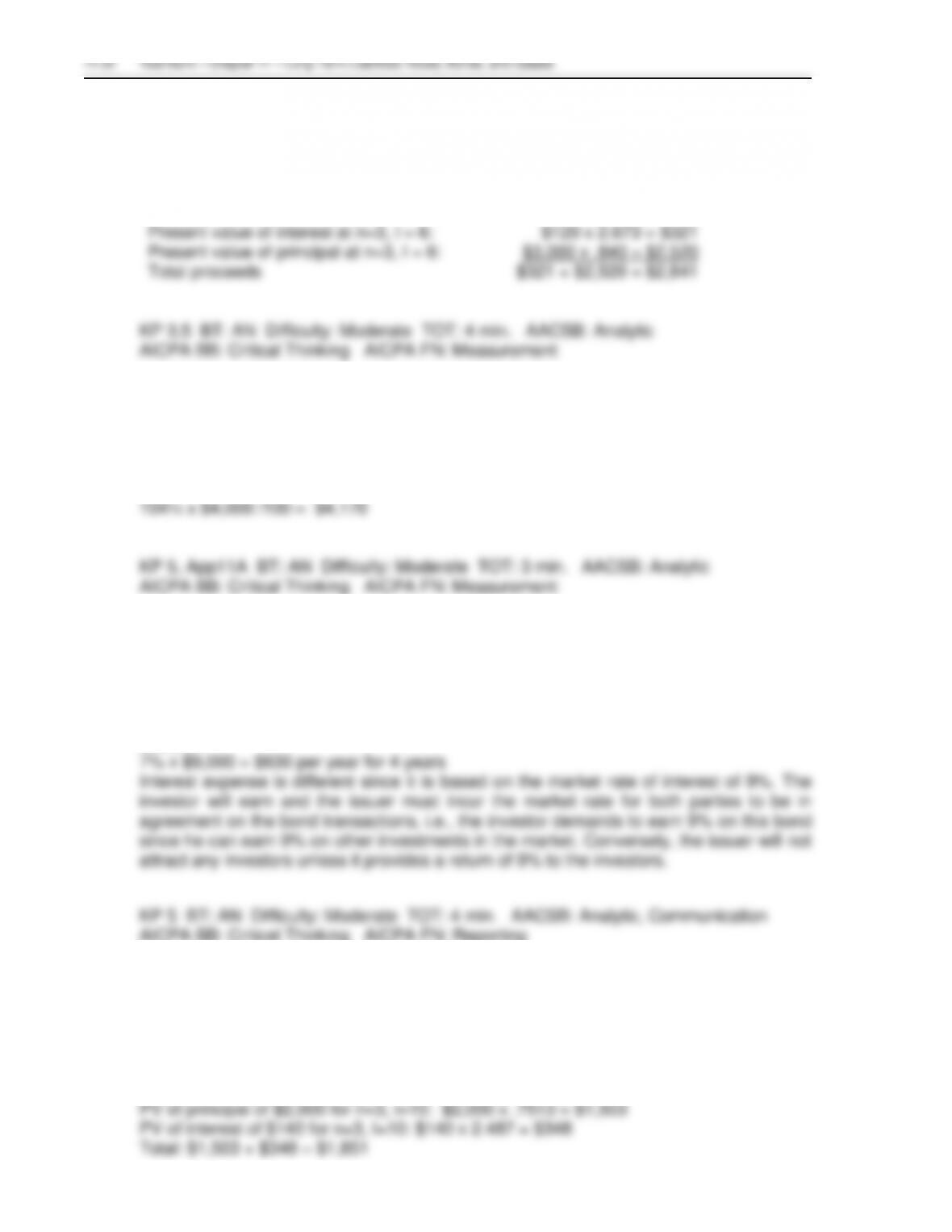
9. On January 1, 2014, Mango Corporation issued a 3-year, 4%, $3,000 bond payable.
Beginning in 2015, interest is payable every year on January 1 over the life of the bond.
The market rate of interest on January 1, 2014 is 6%. What are the proceeds received
by Mercer from the issue of this bond on January 1, 2014?
Solution:
Present value of interest at n=3, I = 6:
$120 x 2.673 = $321
Present value of principal at n=3, I = 6:
$3,000 x .840 = $2,520
Total proceeds
$321 + $2,520 = $2,841
KP 3,5 BT: AN Difficulty: Moderate TOT: 4 min. AACSB: Analytic
AICPA BB: Critical Thinking AICPA FN: Measurement
10. On January 1, 2014, Sheena Corporation issued a 3-year, 7%, $4,000 bond payable.
Beginning in 2015, interest is payable every January 1 over the life of the bond. The
bonds were issued at 104¼. Calculate the issue price.
Solution:
11. On January 1, 2014, Enron Corporation issued a 4-year, 7%, $9,000 bond payable.
Beginning in 2015, interest is payable annually every January 1. The market rate of
interest at issuance is 9%. How much are the interest payments by Enron? Why is the
amount of interest expense different than the cash payments?
Solution:
AICPA BB: Critical Thinking AICPA FN: Reporting
12. On January 1, 2014, Precision Corporation issued a 3-year, 7%, $2,000 bond payable.
Beginning in 2015, interest is payable every January 1 over the life of the bond. The
market rate of interest on January 1, 2014 is 10%. If Precision uses the effective interest
method, what is the balance sheet value of the bond payable on January 1, 2014?
Solution:
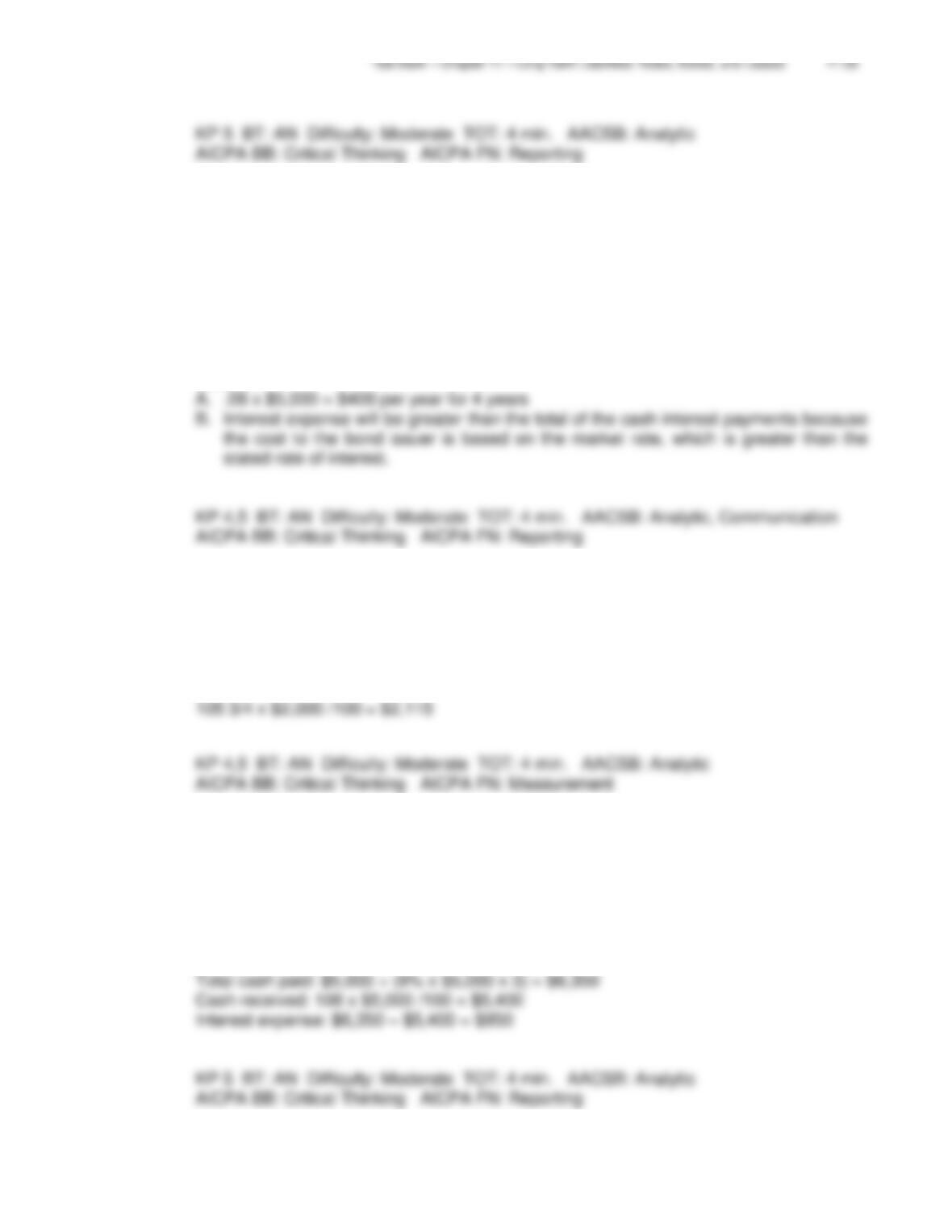
13. On January 1, 2014, Edison Corporation issued a 4-year, 8%, $5,000 bond payable.
Beginning in 2015, interest is payable every January 1 over the life of the bond. The
market rate of interest on January 1, 2014 is 10%.
A. Calculate the contracted cash interest payments by Edison as specified by this bond.
B. Will the total interest expense over the life of the bond be less than or greater than
the total cash payments for interest? Explain.
Solution:
14. On January 1, 2014, Lundell Corporation issued a 5-year, 4%, $2,000 bond payable.
Beginning in 2015, interest is payable every January 1 over the life of the bond. The
bonds were issued at 105 3/4. How much cash did Lundell receive from issuing the
bonds on January 1, 2014?
Solution:
15. On January 1, 2014 Frank Corporation issued a 3-year, 9%, $5,000 bond payable.
Beginning in 2015, interest is payable every January 1 over the life of the bond. The
market rate of interest on January 1, 2014 is 6% when the bonds were issued at 108.
Calculate the total interest expense over the 3-year life of the bond independent of the
particular accounting method used to recognize interest expense each year.
Solution:
16. On January 1, 2014, Field Corporation issued a 3-year, 9%, $5,000 bond payable.
Beginning in 2015, interest is payable every January 1 over the life of the bond. The
market rate of interest on January 1, 2014 is 6%. What is the impact of the debt/equity
ratio as a result of the issuance?
Solution:
17. On December 31, 2014, Creative Corporation issued a 3-year, 9%, $1,000 bond
payable. Beginning in 2015, interest is payable every January 1 over the life of the bond.
The market rate of interest on December 31, 2014 is 5%. If Creative uses the effective
interest method, show how the bonds will appear on Creative’s balance sheet at
December 31, 2014.
Solution:
AICPA BB: Critical Thinking AICPA FN: Reporting
18. On January 1, 2014, Luna Corporation issued a 5-year, 7%, $5,000 bond payable.
Beginning in 2015, interest is payable every January 1 over the life of the bond. The
market rate of interest on January 1, 2014 is 7%. Luna uses the effective interest
method. Calculate the balance sheet value of the bond payable on January 1, 2015.
Solution:
19. On January 1, 2014, Richardson Company leased equipment under a 3-year lease with
payments of $8,000 on January 1, 2015, 2016, and 2017. The present value of the lease
payments at a discount rate of 7% is $20,992. RIchardson uses straight-line depreciation
with no salvage value. The lease is considered a capital lease. Calculate depreciation
expense and interest expense for 2014.
Solution:
20. On January 1, 2015, Foster Corporation issued a 2-year, non-interest-bearing, $4,000
note payable. Interest is payable each December 31 during the life of the note. When the
note was issued, the market rate of interest was 6%. Complete the following
amortization schedule:
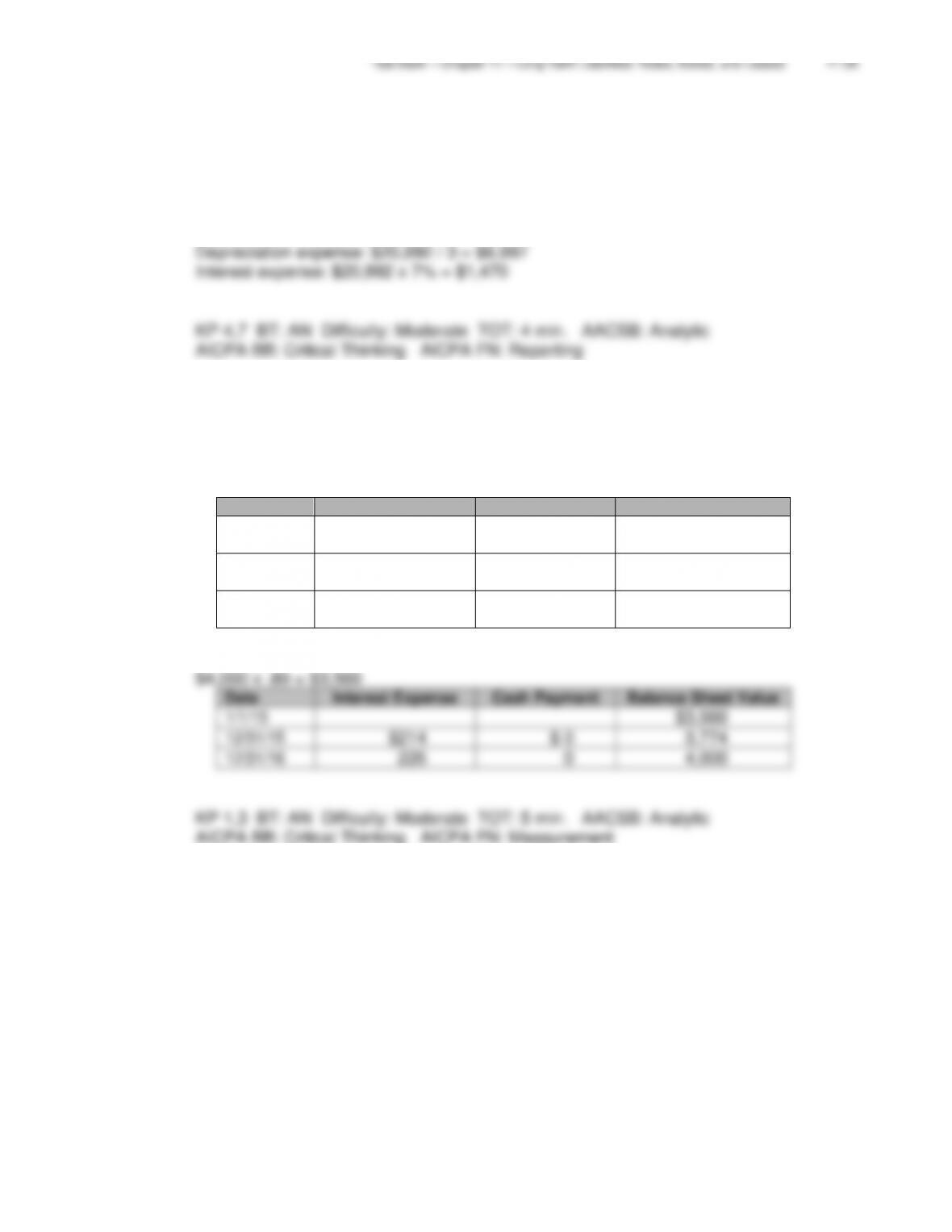
Date
Interest Expense
Cash Payment
Balance Sheet Value
1/1/15
12/31/15
12/31/16
Solution:
Date
Interest Expense
Cash Payment
Balance Sheet Value
1/1/15
$3,560
12/31/15
$214
$ 0
3,774
12/31/16
226
0
4,000
KP 1,3 BT: AN Difficulty: Moderate TOT: 5 min. AACSB: Analytic
AICPA BB: Critical Thinking AICPA FN: Measurement