Test Bank – Chapter 10 – Introduction to Liabilities: Economic Consequences, Current Liabilities, & Contingencies 10-35
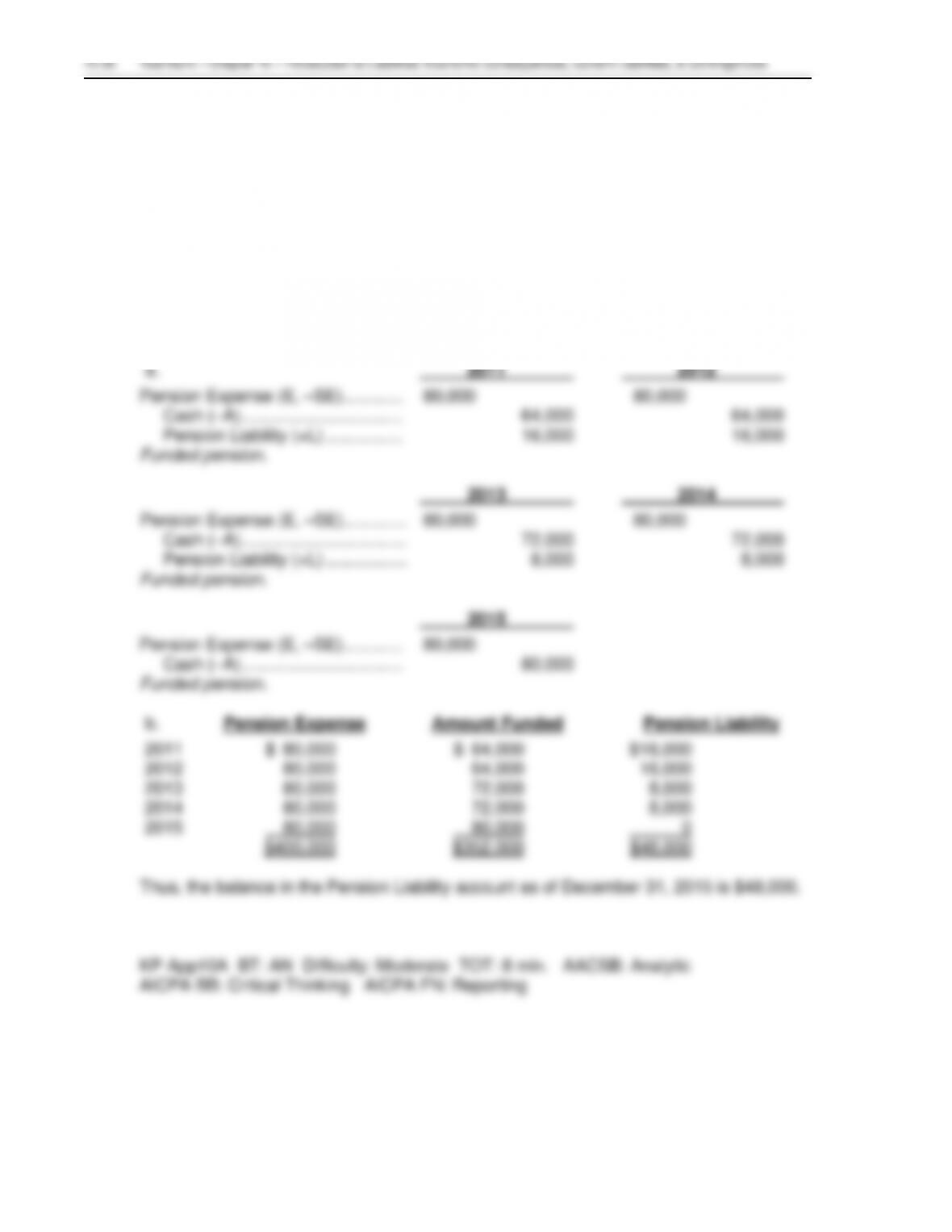
13. Porter Products recognizes expenses for wages, interest and rent when cash payments
are made. The following related cash payments were made during December 2015:
December 5 & 20
Wages in the amount of $15,000 are paid on the 5th and the 20th of
each month for the fifteen days just ended. The next payment will
be on January 5, 2010.
December 15
Paid a semi-annual $300 interest payment on an outstanding note
payable with a face value of $10,000 and a 6 percent annual
interest rate.
As of December 31, the current assets and current liabilities reported on Porter’s
balance sheet were $36,000 and $22,500, respectively. Porter’s income statement
reported net income of $11,250.
Required: Compute Porter’s current ratio and net income if the company were to
account for wages, interest, and rent on an accrual basis.
Solution:
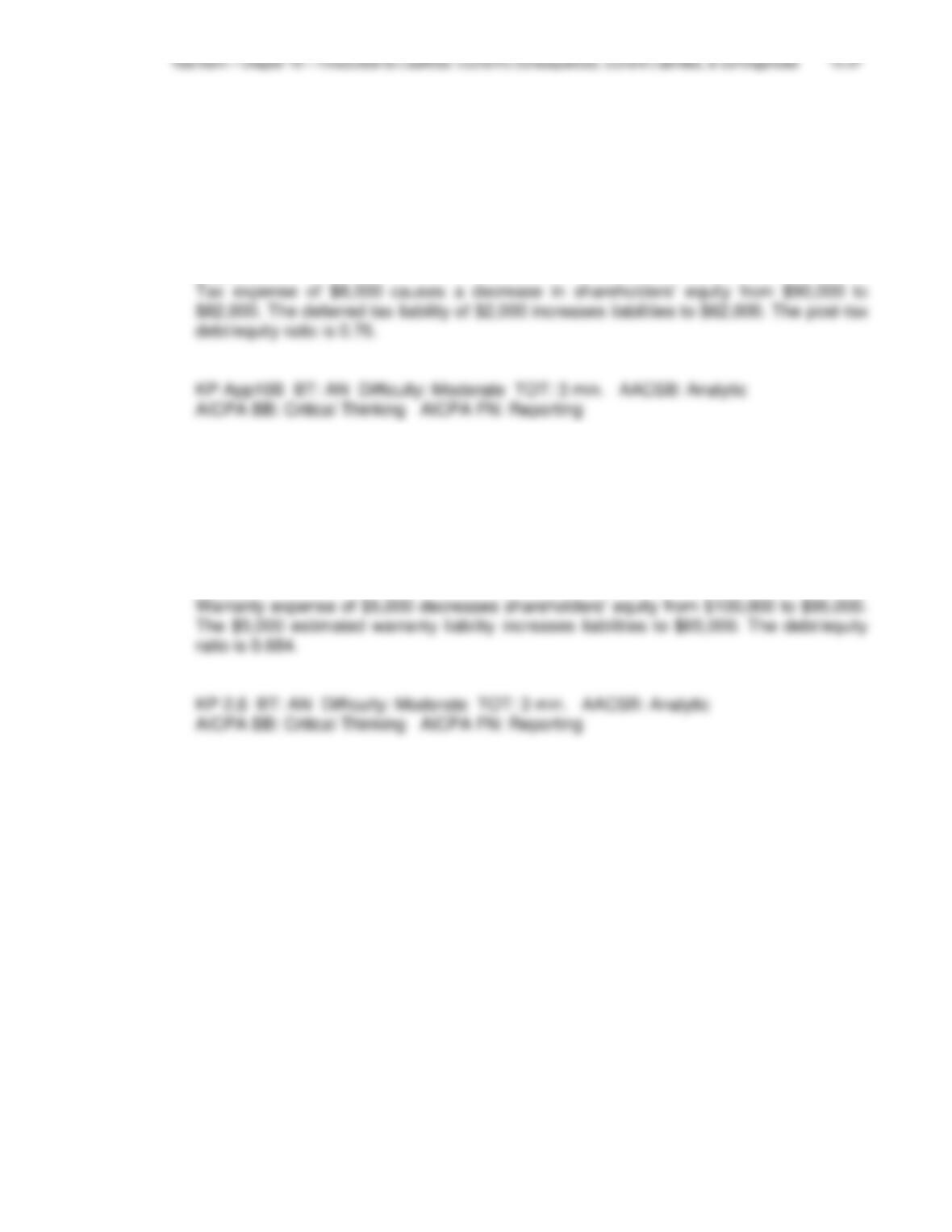
14. Farley Incorporated instituted a defined benefit pension plan for its employees at the
beginning of 2011. An actuarial method that is acceptable under GAAP indicates that
the company should contribute $80,000 each year to the pension fund to cover the
benefits that will be paid to the employees. Farley funded 80% in 2011 and 2012, 90%
in 2013 and 2014, and 100 percent in 2015.
Required:
(1) Prepare the journal entries to accrue the pension liability and fund it for 2011 through
2015.
(2) Compute the balance in the pension liability account as of December 31, 2015.
Solution:
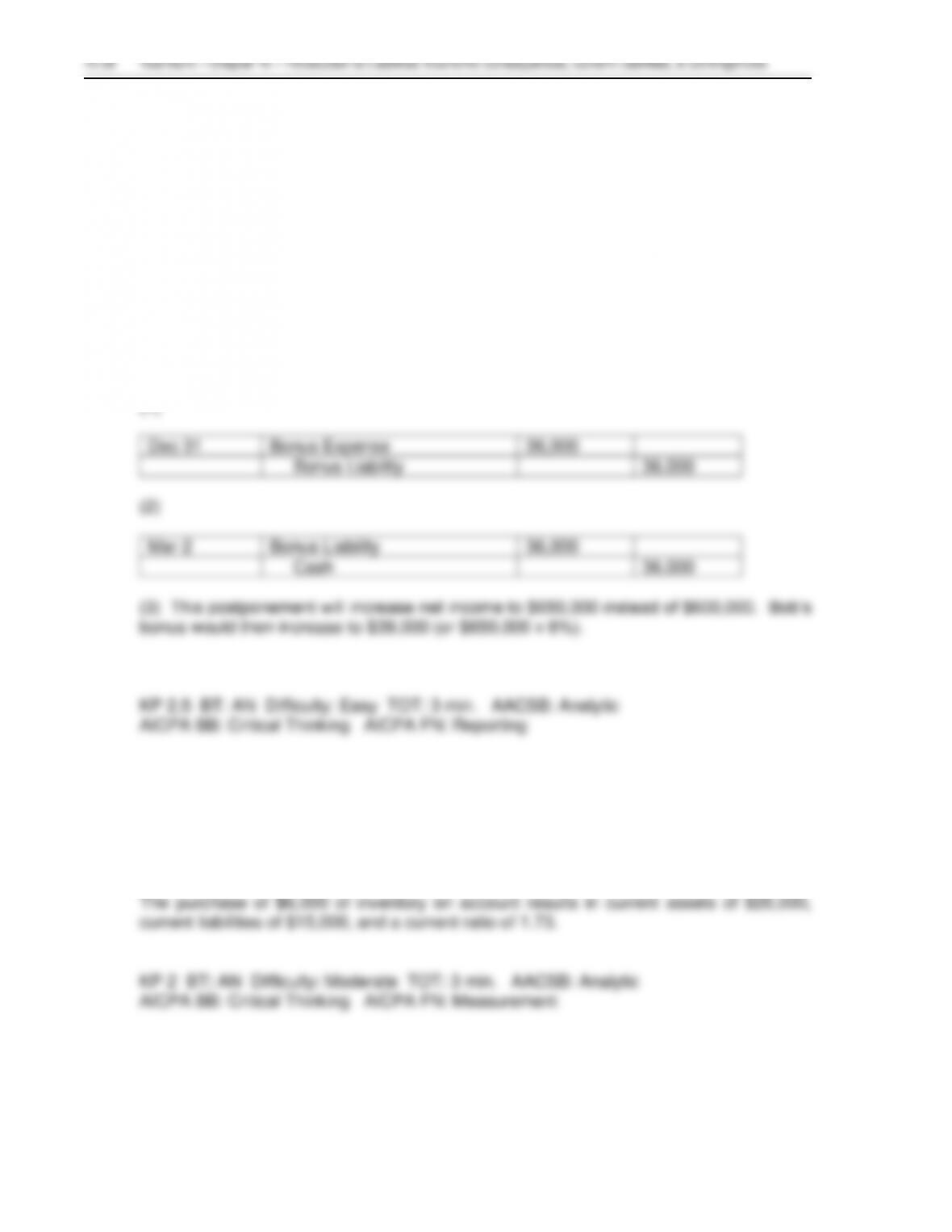
15. On December 31, 2015, Barton Incorporated had total liabilities of $60,000 and total
shareholders’ equity of $90,000, resulting in a debt/equity ratio of 0.67 before income tax
expense is recognized. On December 31, 2015, Barton paid its 2015 income taxes of
$6,000 while its income tax expense on its 2015 income statement was $8,000. This
difference exists because Barton uses straight-line depreciation on its books and double-
declining-balance depreciation on its tax returns. What is Barton’s debt/equity ratio after
the tax expense and deferred tax liability are recognized?
Solution:
16. On December 31, 2015, Carlson Incorporated had total liabilities of $60,000 and total
shareholders’ equity of $100,000, resulting in a debt/equity ratio of 0.60 before warranty
expense is recognized. On December 31, 2015, Carlson estimated warranty expense to
be 5% of sales of $100,000. What is Carlson’s debt/equity ratio after the warranty
expense and related liability is recognized?
Solution:
17. On March 2, 2015, Knight Company’s CFO, Bob Martin, will receive a bonus equal to
6% of net income before income taxes as reported for the year ended December 31,
2014. The current 2014 income statement shows net income before income taxes as
$600,000.
Required:
(1) What journal entry should be made on December 31, 2014?
(2) What journal entry should be made on March 2, 2015?
(3) If Bob decides to postpone $50,000 of 2014 research and development expenditures
until 2015, what impact would this have on his bonus? Explain and show your
calculations.
Solution:
(1)
18. On December 31, 2015, Stanley Co. had current assets of $20,000 (all cash) and
current liabilities of $9,000 in accounts payable, resulting in a current ratio of 2.22. On
December 31, 2015, Stanley purchases $6,000 of inventory on account. Calculate
Stanley’s current ratio after the inventory has been purchased.
Solution:

19. Vista Corporation, producer of computer software packages, began operations on
January 1. It acquired financing from the issuance of common stock for $60,000,000 and
long-term debt for $80,000,000. At the beginning of business operations, Vista produced
the following projected income statement and balance sheet for the first year. All
amounts are in thousands.
Vista Corporation
Projected Income Statement
First Year of Operations
Sales
$100,000
Expenses:
Warranty
$10,000
Depreciation
40,000
Research
20,000
70,000
Operating income before bonus
$ 30,000
Bonus
3,000
Operating income
$ 27,000
Interest expense
7,000
Income before taxes
$ 20,000
Income taxes (40%)
8,000
Net income
$ 12,000
Vista Corporation
Projected Balance Sheet
December 31 of First Year
Assets:
Cash
$ 30,000
Accounts receivable
24,000
Net computers
158,000
Total assets
$212,000
Liabilities & Shareholders’ Equity:
Accounts payable
$ 50,000
Warranty payable
10,000
Long-term debt
80,000
Common stock
60,000
Retained earnings
12,000
Total liabilities and shareholders‘ equity
$212,000
The new president is rather disappointed with these projected results having just quit a
job of which his compensation package was $4,000,000. After examining the forecasts
of a bonus of only $3,000,000, the president decides to use his knowledge of financial
statements to modify his bonus. He meets with the company’s CFO the next day to see
what could be done. He suggested the following possibilities that would boost the first
year’s income:
1. Slash research and development expenditures, which are paid in cash, from $20
million to $10 million.
2. Double the estimated life of the computers, which will decrease depreciation
expense from $40 million to $20 million. Because identical accounting
procedures are used for taxes, no deferred taxes will be generated. Taxes
require immediate payment.
3. Reduce estimated warranty expense from 10% of sales to 7% of sales.
4. Any resultant change in the bonus of 10% of operating income before the bonus
will be paid to the president in cash.
A. Adjacent to the income statement for Year 1, create a new statement using the
alternative accounting procedures and operating decisions.
B. Compare the president’s compensation if the changes in part A are enacted with his
current compensation. What are the ramifications of these changes on the future?
10–40 Test Bank – Chapter 10 – Introduction to Liabilities: Economic Consequences, Current Liabilities, & Contingencies
Solution:
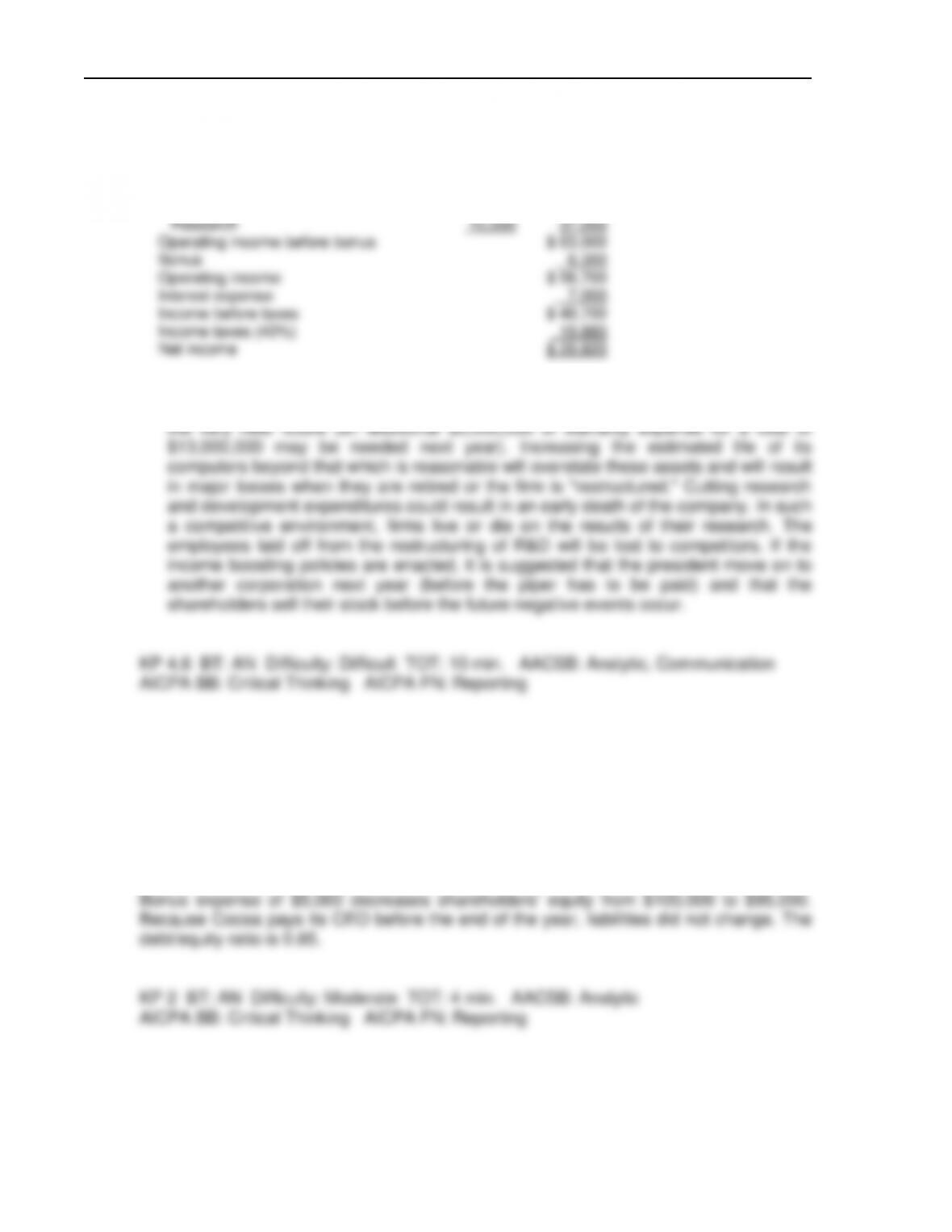
A. (in thousands)
Sales
$100,000
Expenses:
Warranty
$ 7,000
Depreciation
20,000
Research
10,000
37,000
Operating income before bonus
$ 63,000
Bonus
6,300
Operating income
$ 56,700
Interest expense
7,000
Income before taxes
$ 49,700
Income taxes (40%)
19,880
Net income
$ 29,820
B. Although the president now makes $6.3 million, the costs to the company could be
very high. Underestimating warranty expense will require larger warranty expense in
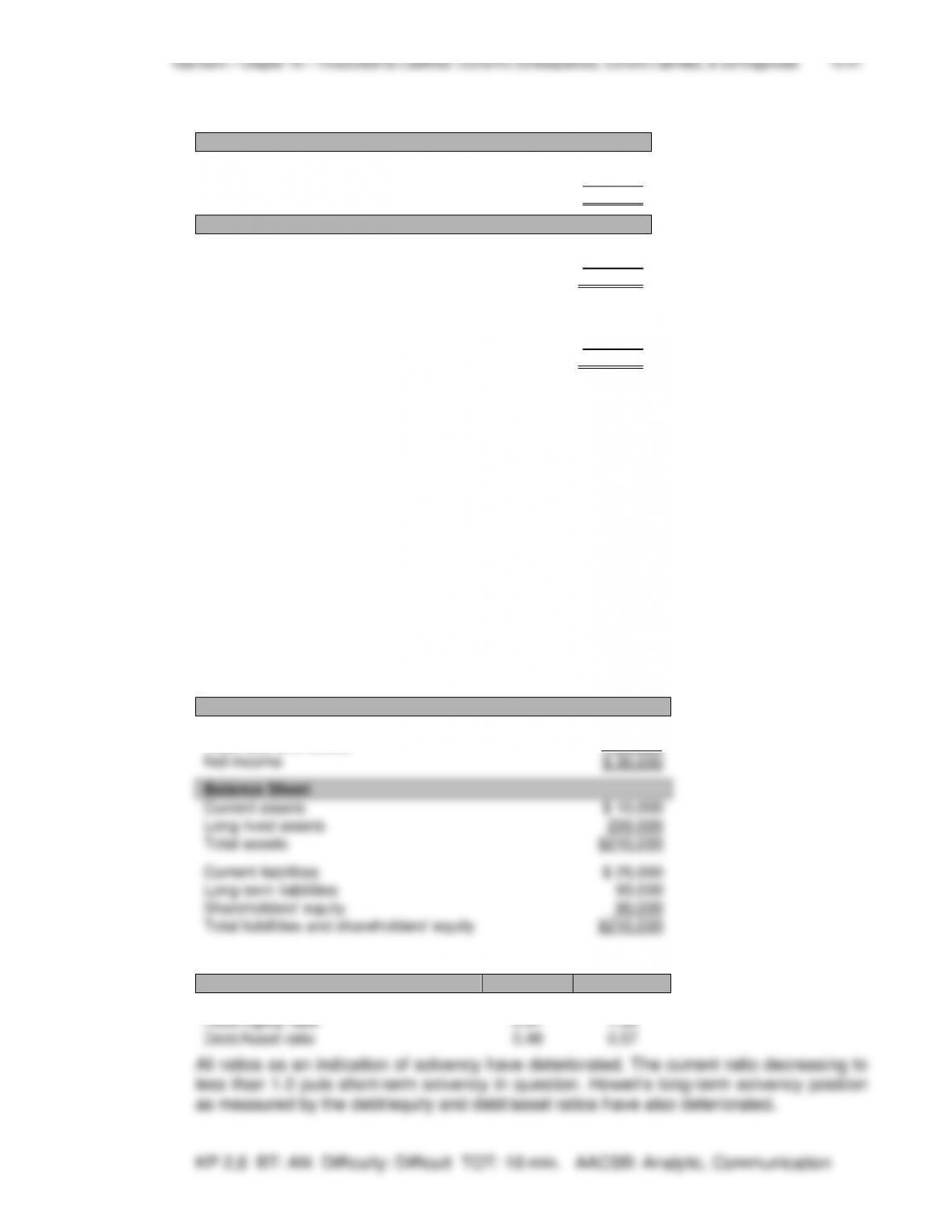
20. On December 31, 2015, Cocoa Incorporated had total liabilities of $80,000 and total
shareholders’ equity of $100,000, resulting in a debt/equity ratio of 0.80 before executive
bonus expense is recognized. During 2015, Cocoa’s CEO earned a 5% bonus on net
income before bonus of $100,000. If Cocoa pays the bonus due its CEO on December
31, 2015, what is Cocoa’s debt/equity ratio after the bonus expense and what related
liability is recognized?
Solution:
21. Howell Incorporated current income statement and December 31 balance sheet follow:
Income Statement
Revenue
$180,000
Expenses and losses
130,000
Net income
$ 50,000
Balance Sheet
Current assets
$ 10,000
Long-lived assets
200,000
Total assets
$210,000
Current liabilities
$ 5,000
Long-term liabilities
95,000
Shareholders’ equity
110,000
Total liabilities and shareholders‘ equity
$210,000
During an audit of Howell’s current financial statements, its auditor discovered that
Howell is a defendant in a $20,000 lawsuit for infringement of patent rights. Howell’s
management, under the advice of its legal counsel, decided that it was only reasonably
probable that they would lose the suit and have to pay $20,000. However, its auditor
disagreed with the treatment of the contingent loss and effectively argued that it is
probable that the lawsuit will require Howell to pay $20,000 in the forthcoming year. The
management of Howell decided to “take a bath” and treat the $20,000 lawsuit consistent
with GAAP on probable conditional liabilities.
A. Reconstruct Howell current income statement and 12/31 balance sheet under the
auditor’s judgment concerning the $20,000 lawsuit
B. Calculate and compare current, debt/equity, and debt/asset ratios resulting from
Howell’s initial and reconstructed financial statements. Comment on Howell’s
solvency.
Solution:
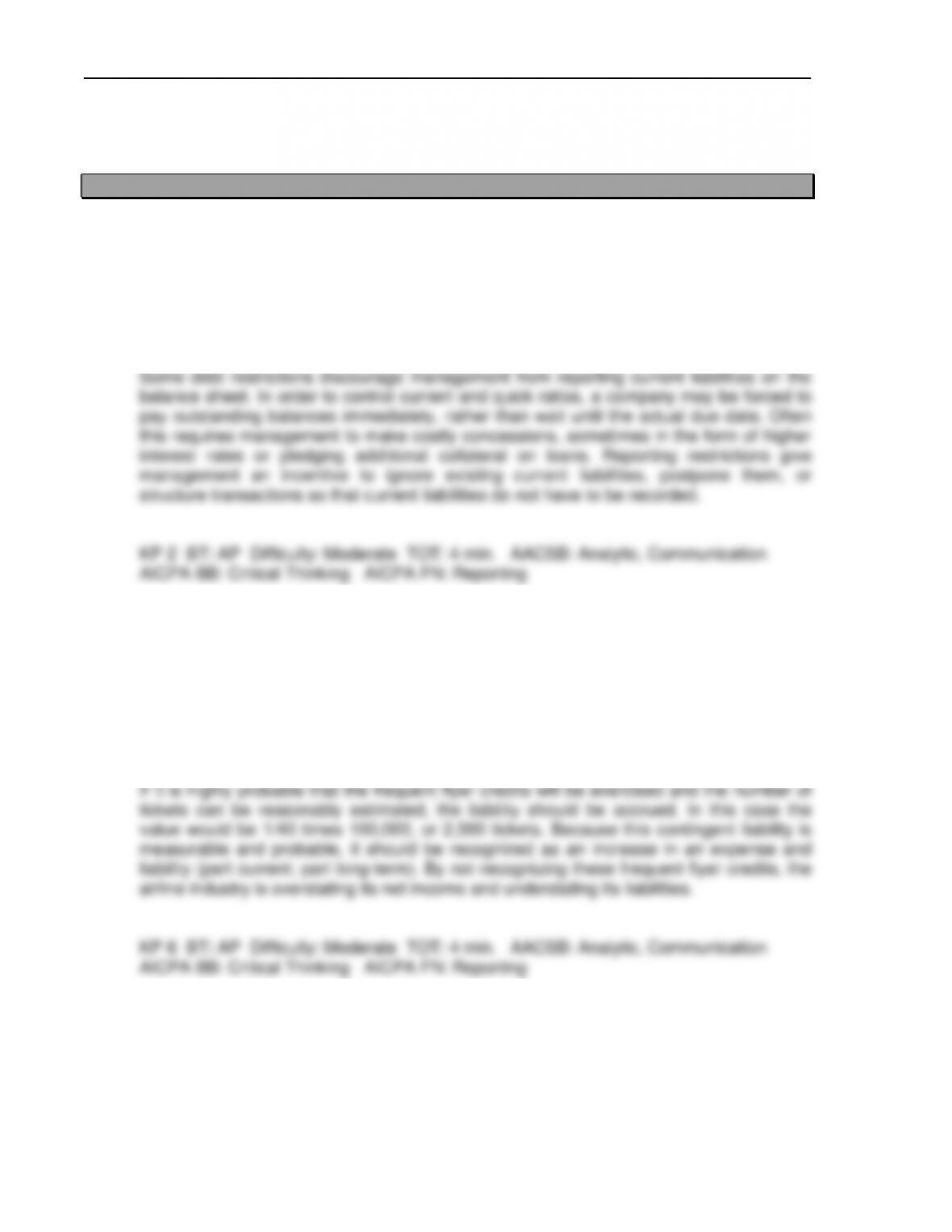
A.
Income Statement
Revenue
$180,000
Expenses and losses
150,000
Net income
$ 30,000
Balance Sheet
Current assets
$ 10,000
Long-lived assets
200,000
Total assets
$210,000
Current liabilities
$ 25,000
Long-term liabilities
95,000
Shareholders’ equity
90,000
Total liabilities and shareholders‘ equity
$210,000
B.
Initial
Revised
Current ratio
2.0
0.40
Debt/Equity ratio
0.91
1.33
Debt/Asset ratio
0.48
0.57
10–42 Test Bank – Chapter 10 – Introduction to Liabilities: Economic Consequences, Current Liabilities, & Contingencies
AICPA BB: Critical Thinking AICPA FN: Reporting
SHORT ESSAY QUESTIONS
1. State laws generally require insurance companies to maintain certain debt and solvency
ratios. Those companies who fail to maintain minimum levels, are subject to severe
penalties, most often affecting the insurance company’s continuation as a going
concern. How may regulatory requirements such as these impact management
decisions?
Solution:
2. A major airline issues frequent flyer credits that allow the passenger to receive credit
toward future flights. For every ticket sold the customer receives a credit which, when 40
are collected, can be exchanged for a free ticket. During the year, the airline company
recorded revenues of $60 million, which represented 100,000 tickets. The airline did not
recognize the flyer credits on its income statement or its balance sheet. In the context of
contingent liabilities, comment on the airline’s accounting procedures.
Solution:
3. What concerns might exist when a company‘s debt ratio increases?
Solution:
A debt ratio is calculated by dividing total liabilities by total assets. This ratio tells users
4. What concerns might management have with additional debt on its balance sheet?
Solution:
Additional debt on the balance sheet can reduce a company’s credit rating making it
difficult to attract capital in the future. If a credit rating service reduces a company’s
5. What three characteristics should all liabilities that appear on the balance sheet have in
common?
Solution:
The characteristics are:
6. During the 1990’s, Golden Inc. entered into long-term contracts with corporate
customers to supply one million ounces of ore for $100 an ounce over the next 5 years.
During the following years, the price of ore increased to $175 an ounce, which Golden
Inc., because it did not hedge the price, would have to pay in order to meet its sales
contracts. Although Golden Inc.’s auditor argued that a $75 million loss and liability
should be recognized, Golden Inc. stated that the amount of the loss cannot be
reasonably estimated prior to the results of renegotiations it was conducting with its
corporate customers. Golden Inc. expected to renegotiate an increase in the initial
contract price of $150 or reduce the amount of ounces to be delivered under the long–
term sales contract. Defend a position of how the long-term contract should be treated
from an accounting perspective.
Solution:
Certainly it appears probable that Golden Inc. will have to pay cash in order to meet its
long-term sales contract. The maximum would be a $75 million loss and liability.
7. Identify the primary problem related to current liabilities.
Solution:
8. How do ‘determinable’ current liabilities differ from ‘contingent’ liabilities?
Solution:
Determinable current liabilities can be precisely measured and the amount of cash
9. Sunshine Company obtained a line of credit with its bank of $4 million. How should
Sunshine Company disclose the line of credit on its financial statements?
Solution:
10. Identify two different third-party collections and explain why they should be reported as
liabilities.
Solution:
Third party collections include payroll tax deductions, insurance premiums or union dues
11. Explain why short-term notes often have a face amount that differs from the cash
received upon signing a note payable. Describe what this difference represents.
Solution:
12. How is unamortized interest on short-term notes payable reported on a balance sheet?
Solution:
Financial institutions often deduct interest from the cash received by the borrower when
13. Harrison Inc. issues community concert season tickets to a number of corporations for
$1,000 each. Revenue is accrued equally throughout the season that the pass is valid.
How should Harrison Inc. report any amounts that have not yet been recognized as
14. Why are gain contingencies typically omitted from financial statement disclosure?
Solution:
Gain contingencies are almost never accrued and are rarely disclosed in footnotes
15. What impact have environmental cleanup costs had on corporate disclosures?
Solution:
The U.S. government established a fund to cleanup pollution and mandate companies to