Test Bank – Chapter 10 – Introduction to Liabilities: Economic Consequences, Current Liabilities, & Contingencies 10-21
62. The following information was taken from the annual report of Jones Inc.
2015
2014
BALANCE SHEET
Deferred income tax liability
$29,700
$28,300
INCOME STATEMENT
Income before taxes
$88,000
Income tax expense
(30,400)
Net income
$57,600
Effective income tax rate 40%
Based on this information, what journal entry should Jones make in 2015 to record its
income taxes?
a. Income Tax Expense …………………………………………….. 30,400
Deferred Income Tax ……………………………………………. 29,700
Deferred Income Tax ………………………………………… 28,300
Income Tax Payable …………………………………………. 31,800
b. Income Tax Expense …………………………………………….. 30,400
Deferred Income Tax ………………………………………… 29,700
Income Tax Payable …………………………………………. 700
c. Income Tax Expense …………………………………………….. 31,800
Deferred Income Tax ………………………………………… 1,400
Income Tax Payable …………………………………………. 30,400
d. Income Tax Expense …………………………………………….. 30,400
Deferred Income Tax ………………………………………… 1,400
Income Tax Payable …………………………………………. 29,000
Solution:
63. The following information was taken from the annual report of Leno Inc.
2015
2014
BALANCE SHEET
Deferred income tax liability
$58,300
$59,400
INCOME STATEMENT
Income before taxes
$108,000
Income tax expense
(40,400)
Net income
$67,600
Effective income tax rate 35%
What is Leno’s conservatism ratio?
a. 0.63
b. 0.91
c. 0.69
d. 0.86
Solution:
64. The following information was taken from the annual report of Leno Inc.
2015
2014
BALANCE SHEET
Deferred income tax liability
$58,300
$59,400
INCOME STATEMENT
Income before taxes
$108,000
Income tax expense
(40,400)
Net income
$67,600
Effective income tax rate 35%
Based on this information, what journal entry should Leno make in 2010 to record its
income taxes?
a. Income Tax Expense …………………………………………….. 40,400
Deferred Income Tax ……………………………………………. 58,300
Deferred Income Tax ………………………………………… 59,400
Income Tax Payable …………………………………………. 39,300
b. Income Tax Expense …………………………………………….. 40,400
Deferred Income Tax ……………………………………………. 19,000
Income Tax Payable …………………………………………. 59,400
c. Income Tax Expense …………………………………………….. 40,400
Deferred Income Tax ……………………………………………. 1,100
Income Tax Payable …………………………………………. 41,500
d. Income Tax Expense …………………………………………….. 40,400
Deferred Income Tax ……………………………………………. 17,900
Income Tax Payable …………………………………………. 58,300
Solution:
65. Julia Used Cars offers a one-year warranty from the date of sale on all cars it sells.
From historic data, Bill Julia estimates that, on average, each car will require the
company to incur warranty cost of $820. The cars sold for an average of $9,500 each.
The following activities occurred during 2015.
Feb
4
Sold five cars.
Mar
23
Sold ten cars.
May
20
Incurred warranty costs of $6,000 on four cars sold in 2014.
July
6
Sold eight cars.
Sep
1
Incurred warranty costs of $5,000 on five cars sold in 2014.
Nov
14
Incurred warranty costs of $4,000 on one car sold in 2014.
Dec
22
Sold twelve cars.
If Julia accrued its warranty liability with a single adjusting entry at year-end, the journal
entry would include:
a. a debit to Contingent Warranty Liability for $28,700
b. a debit to Warranty Expense for $28,700
c. a credit to Parts for $17,220
d. a credit to Cash for $28,700
Solution:
66. Julia Used Cars offers a one-year warranty from the date of sale on all cars it sells.
From historic data, Bill Julia estimates that, on average, each car will require the
company to incur warranty cost of $820. The following activities occurred during 2015.
Feb
4
Sold five cars.
Mar
23
Sold ten cars.
May
20
Incurred warranty costs of $6,000 on four cars sold in 2014.
July
6
Sold eight cars.
Sep
1
Incurred warranty costs of $5,000 on five cars sold in 2014.
Nov
14
Incurred warranty costs of $4,000 on one car sold in 2014.
Dec
22
Sold twelve cars.
If the January 1, 2015 beginning balance in the warranty liability account was $2,500,
what would be the year-end warranty liability balance?
a. $31,200
b. $16,200
c. $11,200
d. $13,700
Solution:
67. Julia Used Cars offers a one-year warranty from the date of sale on all cars it sells.
From historic data, Bill Julia estimates that, on average, each car will require the
company to incur warranty cost of $820. The cars sold for an average of $9,500 each.
The following activities occurred during 2015.
Feb
4
Sold five cars.
Mar
23
Sold ten cars.
May
20
Incurred warranty costs of $3,000 on four cars sold in 2014.
July
6
Sold eight cars.
Sep
1
Incurred warranty costs of $5,000 on five cars sold in 2014.
Nov
14
Incurred warranty costs of $6,000 on one car sold in 2014.
Dec
22
Sold twelve cars.
Assume that the breakdown of warranty costs is 40% parts and 60% wages (paid in
cash). Based on this information, which of the following journal entries would be made
on September 1?
a. Warranty Expense 5,000
Contingent Warranty Liability 5,000
b. Warranty Expense 5,000
Cash 3,000
Parts 2,000
c. Cash 3,000
Parts 2,000
Contingent Warranty Liability 5,000
d. Contingent Warranty Liability 5,000
Cash 3,000
Parts 2,000
Test Bank – Chapter 10 – Introduction to Liabilities: Economic Consequences, Current Liabilities, & Contingencies 10-27
MATCHING QUESTIONS
1. Select the letter of the effect on the debt/equity ratio (a through c) as a result of each
transaction listed in items 1 through 9.
Effects
a.
Increase in debt/equity ratio
b.
Decrease in debt/equity ratio
c.
Does not change debt/equity ratio
____ 1. Amortized the discount of the long-term note payable
____ 2. A portion of long-term debt is paid
____ 3. Accrued salaries at yearend
____ 4. Paid accrued payroll taxes which were accrued last month
____ 5. Paid a bonus amounting to 5% on reported income to the CEO that
was previously accrued
____ 6. Paid costs associated with warranties that were previously accrued
____ 7. Taxes paid which are accrued
____ 8. Accrued income taxes at yearend
____ 9. Accrued estimated coupon redemptions
Solution:

2. For each item numbered 1 through 16 below, select the appropriate effect on liabilities
listed in a through e that each transaction describes. You may use each letter more than
once or not at all. In some cases, two effects are correct.
Effects on Liabilities
a.
Decrease current liabilities
b.
Increase current liabilities
c.
No effect on recorded current liabilities
d.
Accrued contingent liability
e.
Contingent liability disclosed in the notes only
____ 1. Purchased supplies on account.
____ 2. Paid accounts payable.
____ 3. Issued a $1,000 short-term note payable for $970.
____ 4. Amortized the discount of the short-term note payable.
____ 5. A portion of long-term debt is due next year.
____ 6. Declared cash dividends to holders of stock.
____ 7. Paid the cash dividend previously declared.
____ 8. Received money from customers prior to delivery of the product to the
customer.
____ 9. Delivered products to a customer who previously paid for that product.
____ 10. Collected sales tax on behalf of the state government.
____ 11. Accrued payroll taxes that the firm has to pay to the federal government
within three months.
____ 12. Accrued a bonus amounting to 5% on reported income to the CEO.
____ 13. In a lawsuit filed against the firm, counsel indicates that the potential $10,000
loss is remote.
____ 14. In a lawsuit filed against the firm, counsel indicates that the potential $10,000
loss is reasonably possible.
____ 15. In a lawsuit filed against the firm, counsel indicates that the potential $10,000
loss is highly probable.
____ 16. Accrued warranty expense.
Solution:
5. b
6. b
11. b
12. b
3. Select the letter of the effect on the ratios (a through c) as a result of each transaction
listed in items 1 through 16.
Effects
a.
Increase in debt/equity ratio
b.
Decrease in debt/equity ratio
c.
Does not change debt/equity ratio
____ 1. Purchased supplies on account to be used next month.
____ 2. Paid accounts payable.
____ 3. Issued a $1,000 short-term note payable for $970.
____ 4. Amortized the discount of the short-term note payable.
____ 5. A portion of long-term debt is due next year.
____ 6. Declared cash dividends to holders of stock.
____ 7. Paid the cash dividend previously declared.
____ 8. Received money from customer prior to delivery of the product to the
customer.
____ 9. Delivered product to a customer who previously paid for that product.
____ 10. Collected sales tax on behalf of the state government.
____ 11. Accrued payroll taxes the firm has to pay to the federal government within
three months.
____ 12. Paid a bonus (not previously accrued) amounting to 5% on reported income
to the CEO for the current year.
____ 13. A large payment is remotely probable resulting from a lawsuit filed against
the firm.
____ 14. A large payment is reasonably probable resulting from a lawsuit filed against
the firm.
____ 15. A $10,000 payment is highly probable resulting from a lawsuit filed against
the firm.
____ 16. Bondholder converted bond into stock through conversion feature.
Solution:
KP 2,3,4 BT: AP Difficulty: Moderate TOT: 8 min. AACSB: Analytic
10–30 Test Bank – Chapter 10 – Introduction to Liabilities: Economic Consequences, Current Liabilities, & Contingencies
SHORT PROBLEMS
1. On July 1, Falcon Company borrowed $2,000 in return for a one-year note payable with
a maturity value of $2,200. Calculate the balance sheet value of the note on December
31.
Solution:
2. On October 1, Accurate Company borrowed $2,000 in return for a nine-month note
payable with a maturity value of $2,600. Calculate the amount of interest expense and
the balance sheet value for the year ending December 31.
Solution:
3. On October 1, 2015, Brooks Company borrowed $6,000 in return for a nine-month note
payable with a maturity value of $6,600. Fill in the partial balance sheet that appears
below as of December 31, 2015.
Current Liabilities
Solution:
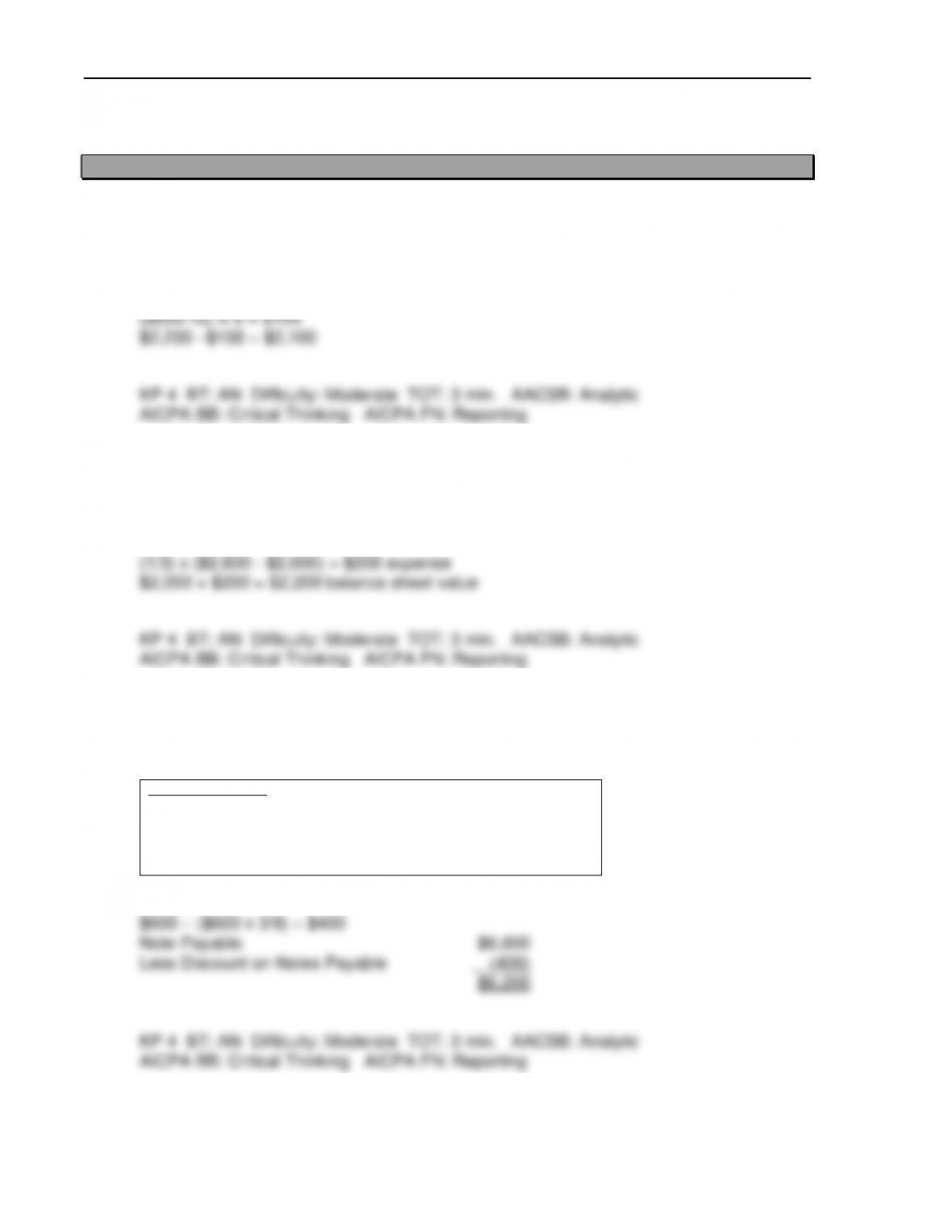
$600 − ($600 x 3/9) = $400
Note Payable
$6,600
Less Discount on Notes Payable
(400)
$6,200
KP 4 BT: AN Difficulty: Moderate TOT: 3 min. AACSB: Analytic
AICPA BB: Critical Thinking AICPA FN: Reporting
4. On July 1, Gordon Company borrowed $10,000 in return for an eight-month note
payable with a maturity value of $10,600. Calculate the amount of interest expense for
the current year.
Test Bank – Chapter 10 – Introduction to Liabilities: Economic Consequences, Current Liabilities, & Contingencies 10-31
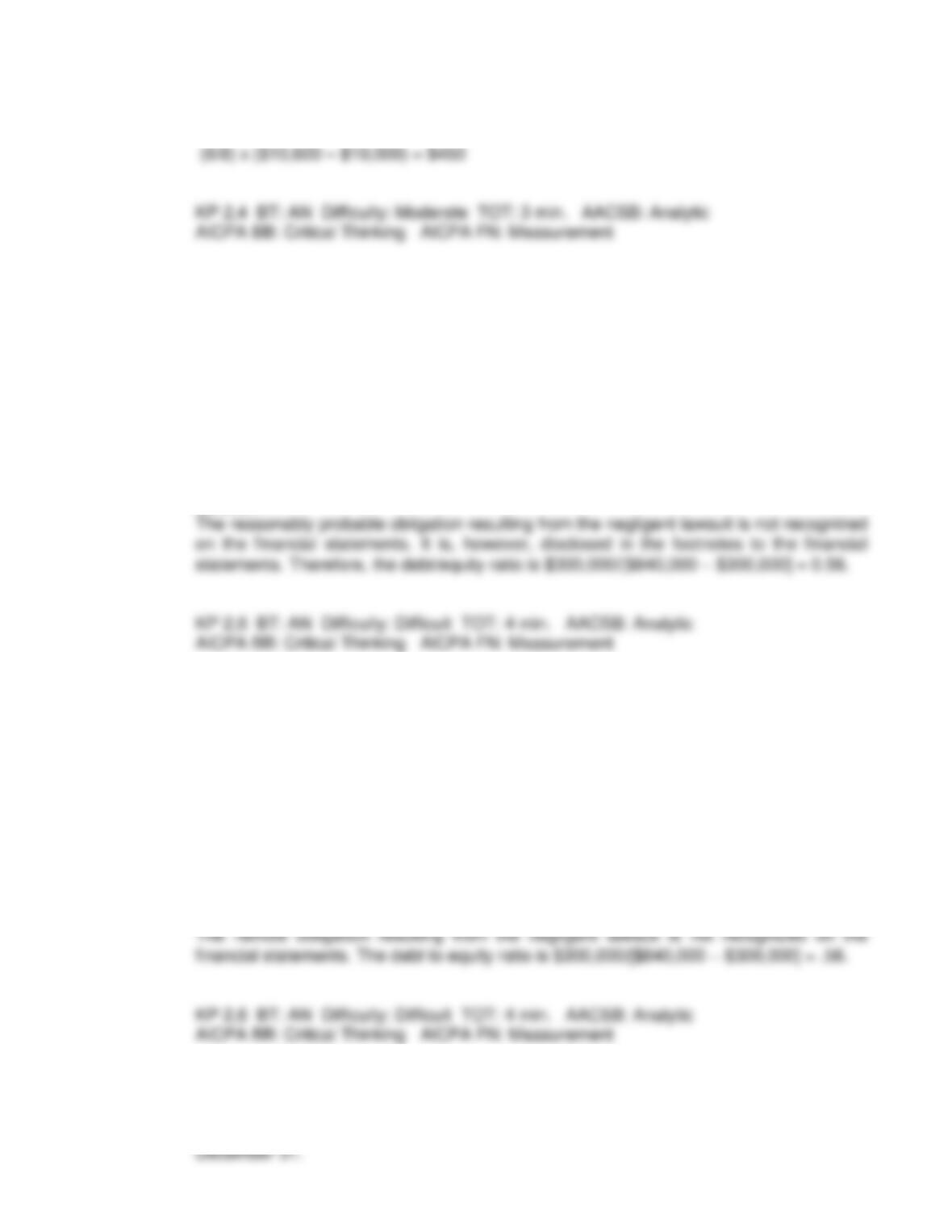
Solution:
5. Bradley Incorporated owns a chain of retail stores. During December of 2015, a
customer slipped in a doorway of its Missouri store and broke his ribs. He is suing
Bradley for $200,000 for negligence. Bradley’s legal counsel believes that it is only
reasonably probable that Bradley will lose its defense of the lawsuit because, although
the doorway was icy due to an ice storm that was occurring at the time of the fall, a sign
on the door warned customers that the doorway was slippery when icy. On December
30, 2015, before considering the effects of this lawsuit, Bradley’s current assets, total
assets, current liabilities, and total liabilities were $420,000, $840,000, $100,000, and
$300,000, respectively. After this event is properly accounted for, calculate Bradley’s
debt/equity ratio on December 31, 2015.
Solution:
6. Pitts Incorporated owns a chain of retail stores. During December of 2015, a customer
slipped in a doorway of its Nebraska store and broke his ribs. He is suing Pitts for
$200,000 for negligence. The legal counsel of Pitts believes that it is remote that Pitts
will lose its defense of the lawsuit because the doorway recently was rebuilt with all-
weather traction stripping and a sign on the door warned customers that the doorway
was slippery when icy. On December 30, 2015, before considering the effects of this
lawsuit, The company’s current assets, total assets, current liabilities, and total liabilities
were $420,000, $840,000, $100,000, and $300,000, respectively. After this event is
properly accounted for, calculate the company’s debt/equity ratio on December 31,
2015.
Solution:
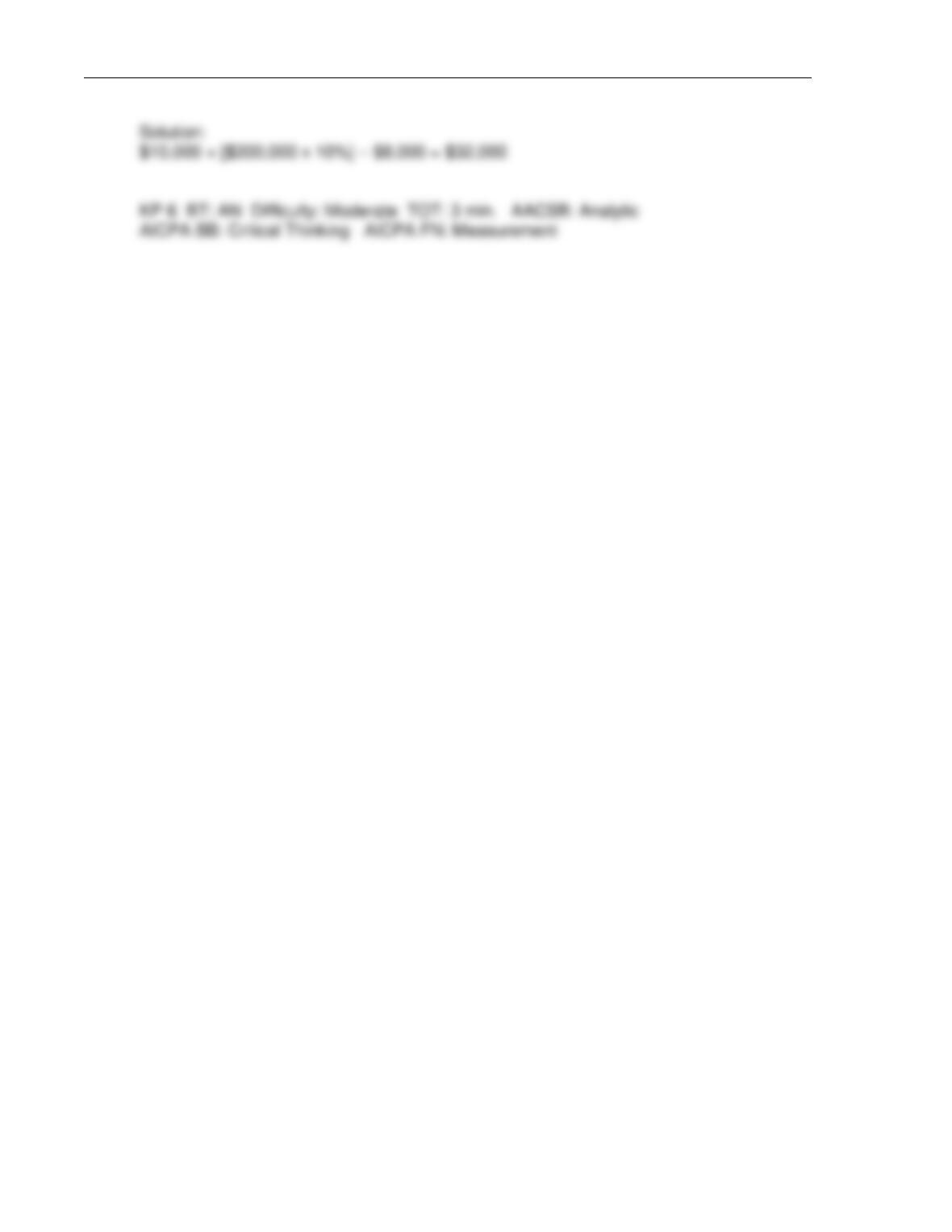
7. Pacific Company estimates warranty expense as 10% of sales. On January 1,
warranties payable was $10,000. During the year, Pacific paid $8,000 to meet its
warranty obligations and recorded sales of $300,000. Calculate warranties payable on
10–32 Test Bank – Chapter 10 – Introduction to Liabilities: Economic Consequences, Current Liabilities, & Contingencies
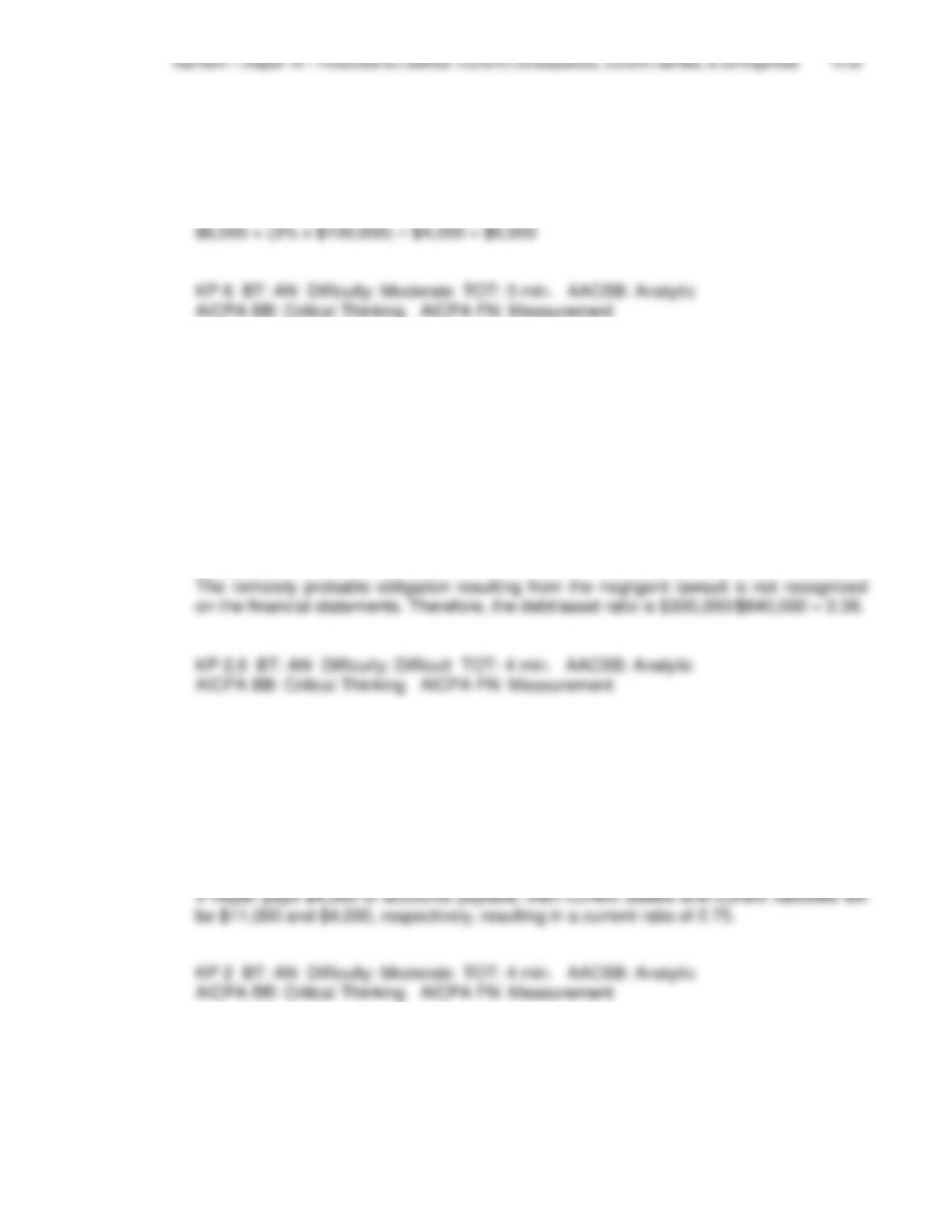
8. On January 1 and December 31, warranties payable were $6,000 and $4,000,
respectively. During the current year, sales were $100,000, upon which 3% was
estimated to be the amount required for future warranty payments. Calculate the amount
paid for warranties during the current year.
Solution:
9. Beacon Incorporated owns a chain of retail stores. During December of 2015, a
customer slipped in a doorway of its Virginia store and broke his ribs. He is suing
Beacon for $200,000 for negligence. Beacon’s legal counsel believes that it is remote
that Beacon will lose its defense of the lawsuit because the doorway recently was rebuilt
with all-weather traction stripping and a sign on the door warned customers that the
doorway was slippery when icy. On December 30, 2015, before considering the effects
of this lawsuit, Beacon’s current assets, total assets, current liabilities, and total liabilities
were $420,000, $840,000, $100,000, and $300,000, respectively. After this event is
properly accounted for, calculate Beacon’s debt/asset ratio on December 31, 2015.
Solution:
10. On December 31, 2015, Roper Company had current assets of $15,000 in cash and
current liabilities of $8,000 in accounts payable, resulting in a current ratio of 1.88. The
company needs to increase its current ratio to 2.75 by December 31, 2016. Calculate the
amount of accounts payable that needs to be paid in order to boost the current ratio to
2.75.
Solution:
11. On December 31, 2015, Seminole Co. had current assets of $25,000 in cash and current
liabilities of $8,000 in accounts payable, resulting in a current ratio of 3.13. The company
estimates that warranty expense for 2015 is 6% of sales that totaled $200,000. Calculate
Seminole’s current ratio after warranty expense is recognized.
Solution:
AICPA BB: Critical Thinking AICPA FN: Measurement
12. As a security analyst for Market Masters, Inc., you have chosen to invest in one high–
tech firm. You have narrowed your choice between RamTech Company or Accutrex
Industries, firms of similar size and direct competitors in the industry. The following
information was taken from their 2015 annual reports:
RamTech
Accutrex
2015
2014
2015
2014
Deferred income tax liability
$ 19,400
$15,600
$ 19,800
$21,800
Income before taxes
163,000
158,500
Income tax expense
(50,000)
(52,500)
Net income
113,000
106,000
Effective income tax rate
35%
35%
Solution: