Test Bank – Chapter 1 – Financial Accounting and Its Economic Context 1-19
64. Which of the following groups make up a company’s audit committee?
a. Auditors.
b. Outside directors from the Board.
c. Company officers.
d. All of the individuals in (a), (b), and (c) are included in the audit committee.
65. Which of the following groups enacted the Sarbanes Oxley Act?
a. FASB
b. AICPA
c. U.S. Congress
d. PCAOB
66. All of the following are false regarding international accounting standards (IAS) except
which of the following?
a. The SEC requires all companies to use IAS.
b. There are no substantive differences between U.S. GAAP and IFRS.
c. The SEC prohibits U.S. stock exchanges from listing non-U.S. companies who follow
IFRS.
d. All public companies in the European Union are required to report using IFRS and
IAS.
1-20 Test Bank – Chapter 1 – Financial Accounting and Its Economic Context
MATCHING QUESTIONS
1. Identify which of the users of financial statement information listed in A through E would
most likely desire and/or benefit from the economic aspects listed in items 1 through 5
below. You may use each letter more than once or not at all.
Users
A. bankers
B. potential investors
C. government agencies
D. customers
E. managers
_______ 1. Want to choose a company to earn returns potentially higher than fixed
income instruments
_______ 2. Need to predict future cash flows necessary for repayment
_______ 3. Want to determine how much tax a company must pay
_______ 4. Want the best product possible for the money
_______ 5. Want to maintain a level of compensation
Solution:
2. For each description listed in items 1 through 4 below, select the letter of the accounting
term (A through F) it best describes. You may use each letter more than once.
Accounting Terms
A.
Asset
B.
Liability
C.
Retained earnings
D.
Revenue
E.
Expenses
F.
Equity investment
_______ 1. Total measured past growth less the amount distributed to owners
_______ 2. A measure of assets generated from the products and services sold
_______ 3. Owed and must be paid in the future
_______ 4. Amount invested in the firm by its owners
Solution:
3. For each financial statement listed in 1 through 4 below, place the letter (A through D) of
the best description in the space provided. You may use each letter more than once or
not at all.
Descriptions
A.
Assets, liabilities, and shareholders’ equity
B.
Increased by net income and decreased by dividends
C.
Operating, investing, and financing activities
D.
Revenues less expenses
_______ 1. Balance sheet
_______ 2. Income statement
_______ 3. The retained earnings section of the statement of shareholders’ equity
_______ 4. Statement of cash flows
Solution:
KP 3 BT: K Difficulty: Easy TOT: 1 min. AACSB: Analytic

4. Identify which accounting document(s) listed in A through D would always provide the
information indicated in items 1 through 5 below. You may use each letter more than
once or not at all. Some items may require more than one answer.
Accounting Documents
A.
Auditor’s report
B.
Management letter
C.
Financial statements
D.
Footnotes
_______ 1. Represents that the financial statements are stated fairly, in all material
respects
_______ 2. Indicates that financial statements were prepared in conformity with
GAAP
_______ 3. Contains assets, liabilities, and equity, as well as income from operations
_______ 4. Explains certain items on the balance sheet
_______ 5. An acceptance of responsibility of financial information provided
Solution:
KP 2,3 BT: K Difficulty: Easy TOT: 1 min. AACSB: Analytic
AICPA BB: Critical Thinking AICPA FN: Reporting
SHORT ANSWER QUESTIONS
1. Which financial statement would you review to determine the amount of cash a company
received from an issue of capital stock during the year?
2. Which financial statement would you review to determine a company’s interest expense?
Solution: income statement
3. What independent party attests that the balance sheet and income statement present
fairly the financial position of the company?
4. Identify the financial statement in which revenues less expenses are reported.
5. What financial statement communicates profits retained and distributions to
shareholders?
6. What financial statement communicates cash flows from operating activities?
7. What financial statement lists and measures assets, liabilities, and shareholders’ equity
at a certain date?
8. What financial statement shows where the money came from and where it went?

9. Identify which financial statement you would review to determine the amount of cash a
company paid to retire its debt.
10. Which source would you review to determine that the financial statements are fairly
stated in accordance with GAAP?
11. Which financial statement would you review to determine if a company’s operating cash
flow is sufficient to pay day-to-day obligations?
12. Which financial statement would best help you understand the increases and decreases
in cash over a period of time?
13. What financial statement would you review to determine if a company’s payroll exceeds
$1,000,000?
14. What financial statement would you review to determine the profitability ratio?
Test Bank – Chapter 1 – Financial Accounting and Its Economic Context 1-27
15. What financial statement would you review to determine whether or not dividends were
distributed during the year?
16. On which financial statement would you find the amount invested by a company’s
owners? What is the name of this amount?
17. On which financial statement(s) would you find the accumulation of total profits and
losses less distributions to owners since the company began operations? What is the
name of this amount?
18. What accounting name is given to one who provides money to a company with the
expectation that it will be paid back with interest?
19. What is the name of a person who provides money to a company who never has to be
paid back but expects periodic cash payments?

20. Identify the responsibilities of the board of directors.
21. Who assesses whether the financial statements fairly represent the financial position
and results of operations?
22. Where would you most likely find statements revealing the assumptions, estimates, and
choices of alternative accounting methods used in the balance sheet?
23. List the names of the financial statements that appear in an annual report.
1-30 Test Bank – Chapter 1 – Financial Accounting and Its Economic Context
SHORT PROBLEMS
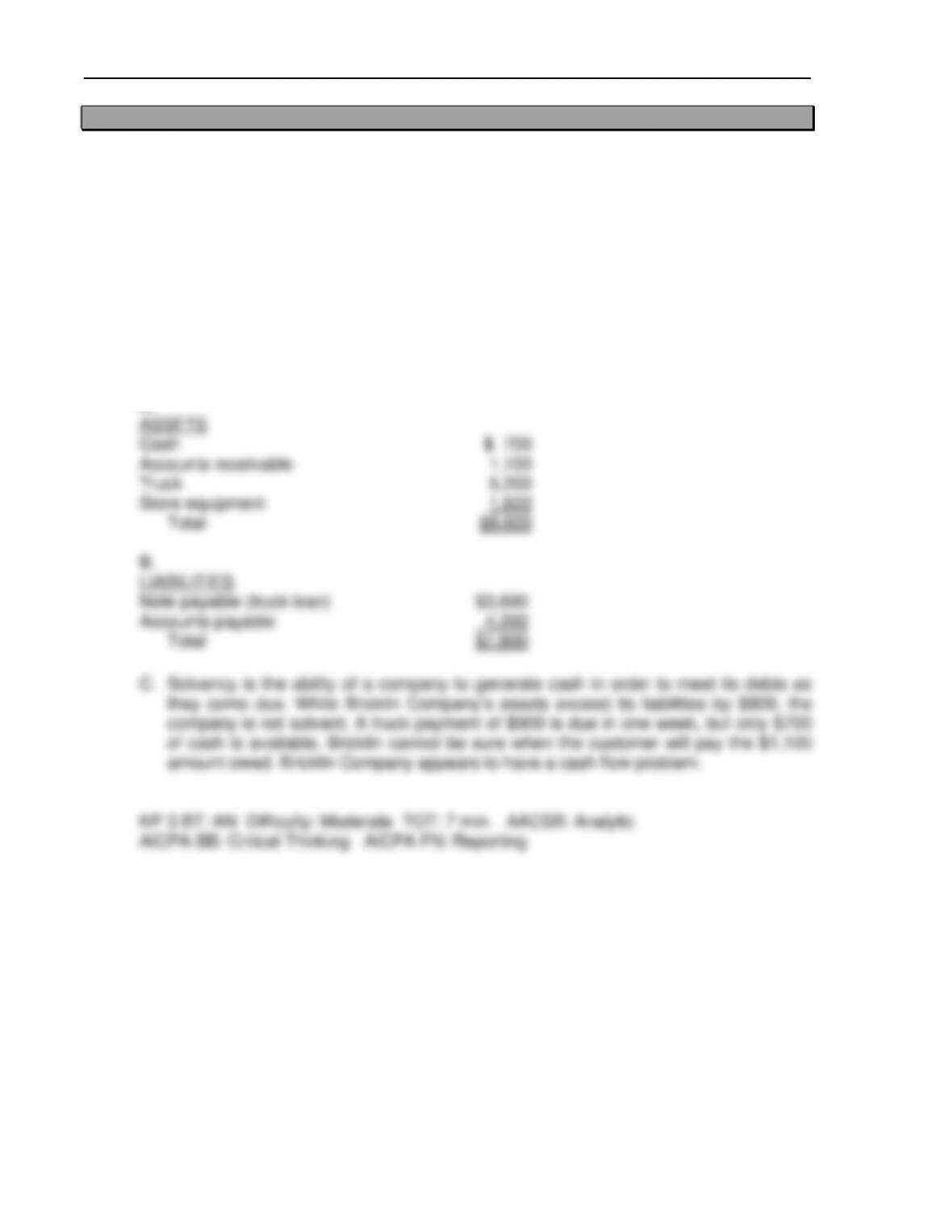
1. Bricklin Company has $700 in its checking account. A customer owes Bricklin $1,100.
The company has store equipment that cost $1,600 and a truck that cost $5,200. Bricklin
Company owes the bank $3,600 on the truck loan of which one payment of $900 is due
in one week, and owes $4,200 to creditors for its monthly operating expenses, including
rent, all of which is due in the next 30 days.
A. List Bricklin Company’s assets and the dollar amount of each.
B. List Bricklin Company’s liabilities and the dollar amount of each.
C. Is Bricklin Company solvent? Explain.
Solution:
A.
2. Matura, Inc. reported the following activities for the year:
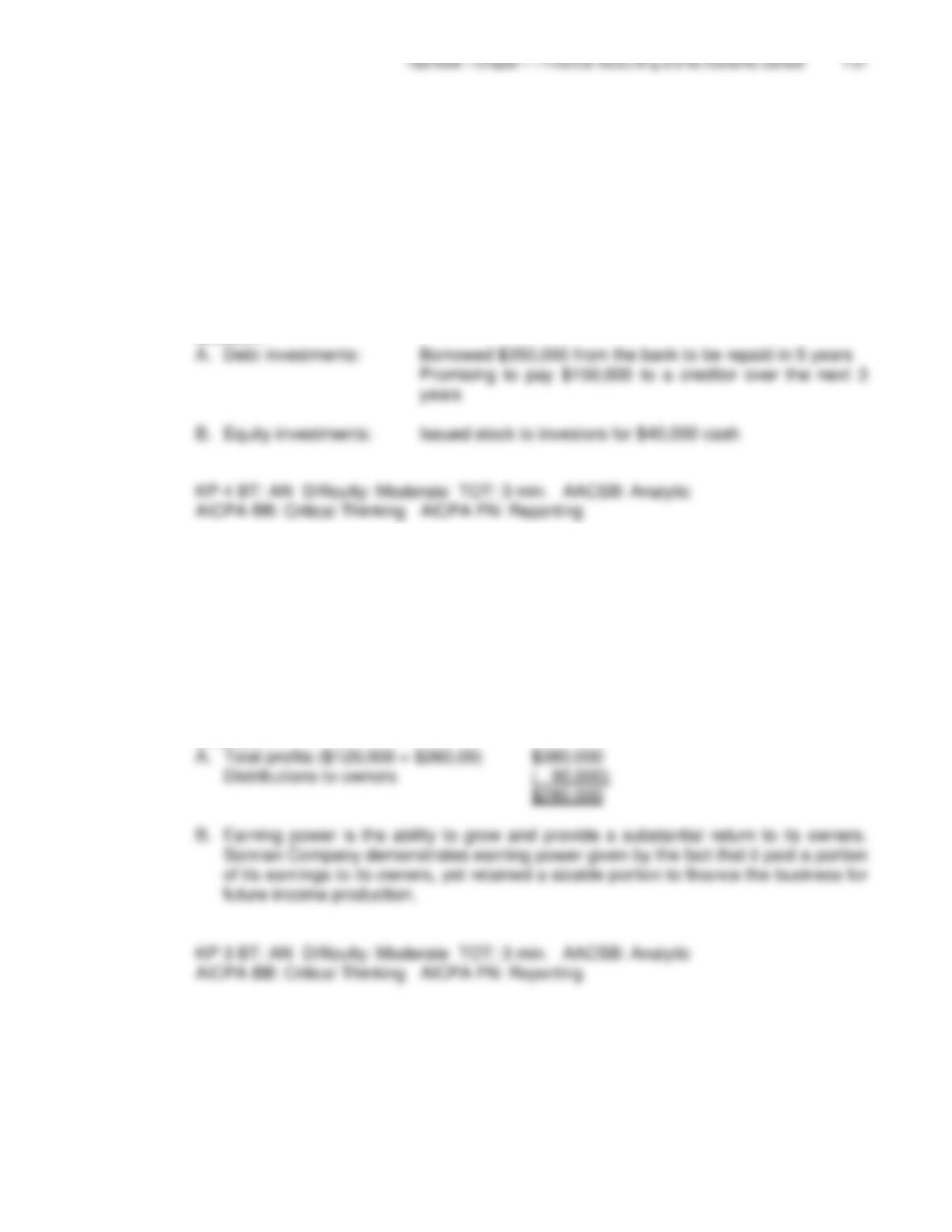
• Borrowed $350,000 from the bank to be repaid in 5 years
• Issued stock to investors for $40,000 cash
• Paid dividends to shareholders totaling $10,000
• Purchased equipment by promising to pay $150,000 to a creditor over the next 3
years
A. Identify which activities are debt investments.
B. Identify which activities are equity investments.
Solution:
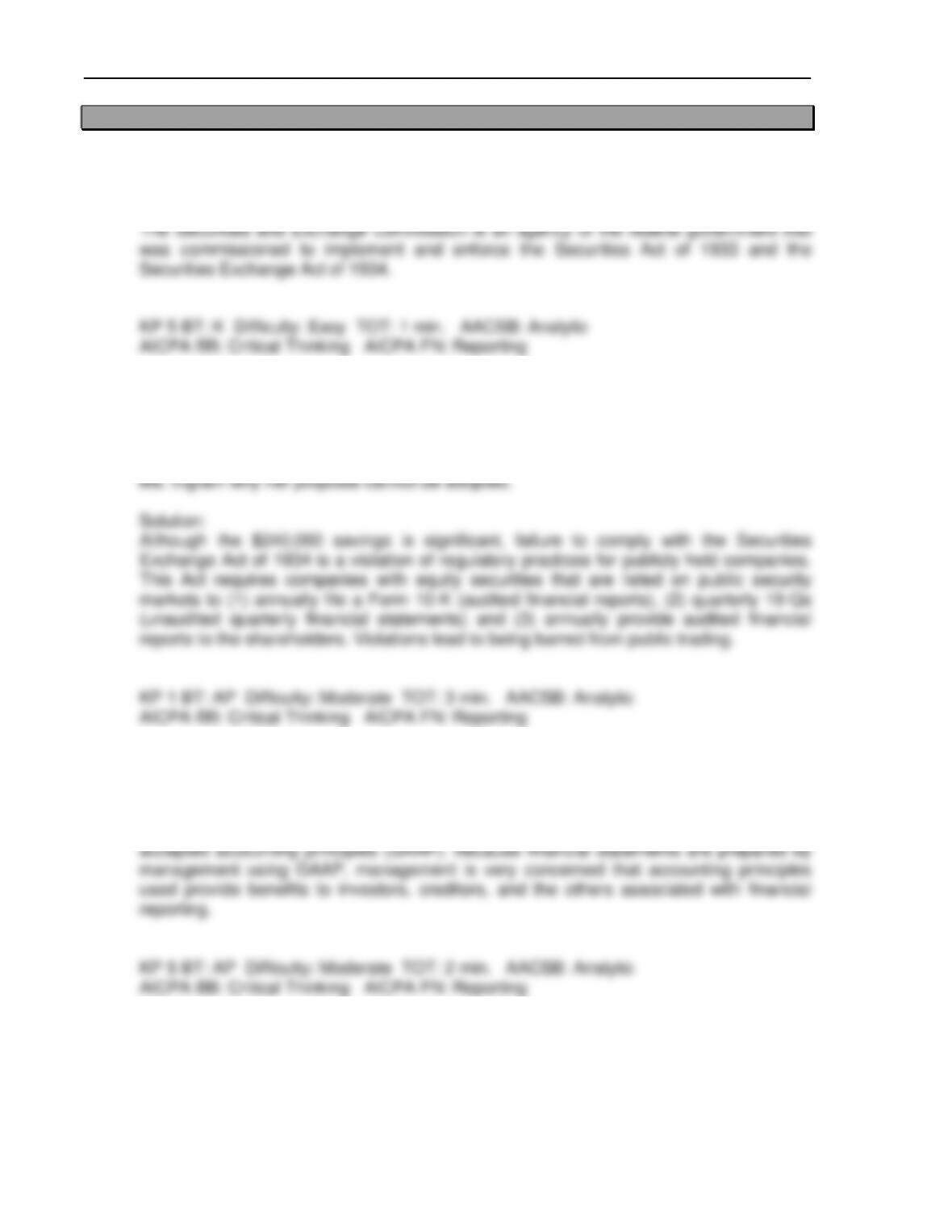
3. Sonnan Company showed profits for the last two years totaling $120,000 and $260,000,
respectively. Sonnan Company paid a total of $90,000 to its owners over the two-year
period.
A. How much remains in Sonnan Company as retained earnings at the end of the
second year of business?
B. Briefly explain the concept of ‘earning power’ as it pertains to Sonnan Company.
Solution:
1-32 Test Bank – Chapter 1 – Financial Accounting and Its Economic Context
SHORT ESSAY QUESTIONS
1. What is the role of the Securities and Exchange Commission?
Solution:
2. Veronica Ingram is the CEO of a small corporation whose stock is traded on public stock
exchange. She has been concerned with the high cost of producing and distributing
annual financial statements. She has proposed that the corporation stop producing these
financial reports which would save the company $240,000 annually. Briefly explain to
3. Why might corporate management want to lobby the FASB?
Solution:
Corporate management and other interested parties wish to influence generally
4. Describe the three components of the statement of cash flows.
Solution:
5. The Sarbanes-Oxley Act was passed by Congress in 2002 in response to a series of
financial and accounting scandals. The purpose of the Act was to bolster corporate
governance and restore confidence in the financial reporting system. Describe one of the
new things that the management of a US public corporation is required to do under this
act.
Solution:
6. Frank Smithson, chief operating officer for Star Master Corporation, has discovered that
two separate and distinct sets of financial statements are being provided—one to the
Internal Revenue Service and the other to its shareholders. He objected to this policy
and is insisting that one set of financial statements be provided to all interested parties.
Provide examples of the needs of the two parties.
Solution:
7. Describe the two components of the income statement.
Solution:
The two components of the income statement are revenues and expenses, the
8. Why must managers understand financial reporting?
Solution:
Managers often use financial statements to assess the financial condition and
9. What information is provided in a management letter? Who signs it?
Solution:
10. What powers does the Securities and Exchange Commission have?
Solution:
The Securities and Exchange Commission has the power to prescribe the accounting

11. What are the two fundamental economic reasons why investors and creditors demand
financial accounting information?
12. What methods of controlling the ethical decisions by managers are common? Why are
these methods necessary?
Solution: