
Chapter 8 NAME
Slutsky Equation
Introduction. It is useful to think of a price change as having two dis-
tinct effects, a substitution effect and an income effect. The substitution
effect of a price change is the change that would have happened if in-
come changed at the same time in such a way that the consumer could
exactly afford her old consumption bundle. The rest of the change in the
consumer’s demand is called the income effect. Why do we bother with
breaking a real change into the sum of two hypothetical changes? Because
we know things about the pieces that we wouldn’t know about the whole
without taking it apart. In particular, we know that the substitution ef-
fect of increasing the price of a good must reduce the demand for it. We
also know that the income effect of an increase in the price of a good is
equivalent to the effect of a loss of income. Therefore if the good whose
price has risen is a normal good, then both the income and substitution
effect operate to reduce demand. But if the good is an inferior good,
income and substitution effects act in opposite directions.
Example: A consumer has the utility function U(x1,x
2)=x1x2and an
income of $24. Initially the price of good 1 was $1 and the price of good 2
was $2. Then the price of good 2 rose to $3 and the price of good 1 stayed
at $1. Using the methods you learned in Chapters 5 and 6, you will find
that this consumer’s demand function for good 1 is D1(p1,p
2,m)=m/2p1
and her demand function for good 2 is D2(p1,p
2,m)=m/2p2. Therefore
initially she will demand 12 units of good 1 and 6 units of good 2. If,
when the price of good 2 rose to $3, her income had changed enough so
that she could exactly afford her old bundle, her new income would have
to be (1 ×12) + (3 ×6) = $30. At an income of $30, at the new prices, she
would demand D2(1,3,30) = 5 units of good 2. Before the change she
bought 6 units of 2, so the substitution effect of the price change on her
demand for good 2 is 5 −6=−1 units. Our consumer’s income didn’t
real ly change. Her income stayed at $24. Her actual demand for good 2
after the price change was D2(1,3,24) = 4. The difference between what
she actually demanded after the price change and what she would have
demanded if her income had changed to let her just afford the old bundle
is the income effect. In this case the income effect is 4 −5=−1 units
of good 2. Notice that in this example, both the income effect and the
substitution effect of the price increase worked to reduce the demand for
good 2.
When you have completed this workout, we hope that you will be
able to do the following:
•Find Slutsky income effect and substitution effect of a specific price
•Show the Slutsky income and substitution effects of a price change
98 SLUTSKY EQUATION (Ch. 8)
•Show the Hicks income and substitution effects of a price change on
•Find the Slutsky income and substitution effects for special util-
•Use an indifference-curve diagram to show how the case of a Giffen
8.1 (0) Gentle Charlie, vegetarian that he is, continues to consume
apples and bananas. His utility function is U(xA,x
B)=xAxB. The price
of apples is $1, the price of bananas is $2, and Charlie’s income is $40 a
day. The price of bananas suddenly falls to $1.
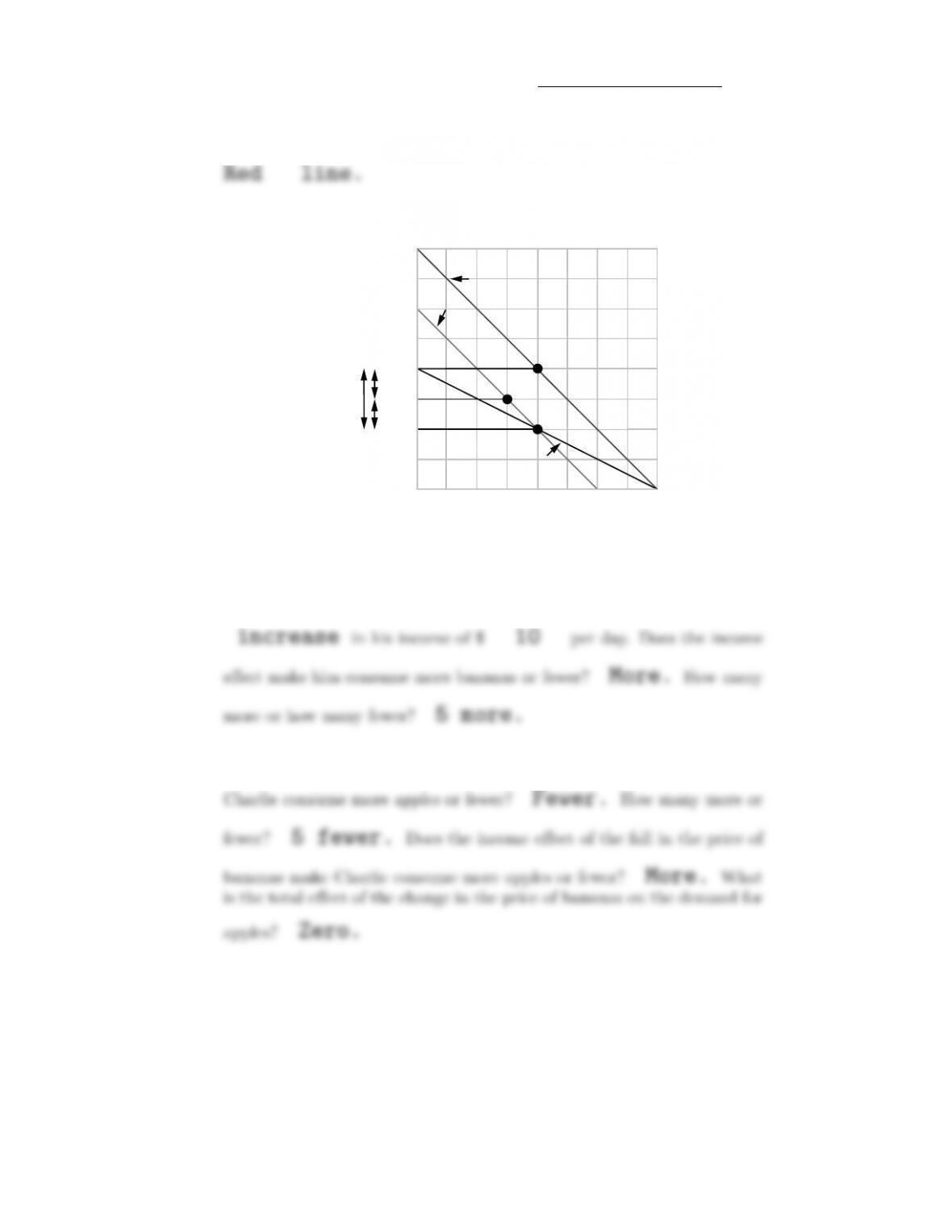
Charlie’s original budget line and put the label Aon his chosen consump-
tion bundle.
(b) If, after the price change, Charlie’s income had changed so that he
could exactly afford his old consumption bundle, his new income would
(c) Does the substitution effect of the fall in the price of bananas make
after the price change. Put the label Con the bundle that he actually
chooses after the price change. Draw 3 horizontal lines on your graph, one
from Ato the vertical axis, one from Bto the vertical axis, and one from
Cto the vertical axis. Along the vertical axis, label the income effect, the
substitution effect, and the total effect on the demand for bananas. Is the
NAME 99
blue line parallel to the red line or the black line that you drew before?
0102030
40
10
20
30
Apples
Bananas
40
a
b
c
Total
Substitution
Income
Red line
Blue line
Black line
(e) The income effect of the fall in the price of bananas on Charlie’s
demand for bananas is the same as the effect of an (increase, decrease)
(f) Does the substitution effect of the fall in the price of bananas make
8.2 (0) Neville’s passion is fine wine. When the prices of all other
goods are fixed at current levels, Neville’s demand function for high-
quality claret is q=.02m−2p,wheremis his income, pis the price
of claret (in British pounds), and qis the number of bottles of claret that
he demands. Neville’s income is 7,500 pounds, and the price of a bottle
of suitable claret is 30 pounds.
100 SLUTSKY EQUATION (Ch. 8)
(a) How many bottles of claret will Neville buy? 90.
(b) If the price of claret rose to 40 pounds, how much income would Neville
have to have in order to be exactly able to afford the amount of claret
and the amount of other goods that he bought before the price change?
(c) At his original income of 7,500 and a price of 40, how much claret
(d) When the price of claret rose from 30 to 40, the number of bottles
8.3 (0) Note: Do this problem only if you have read the section entitled
“Another Substitution Effect” that describes the “Hicks substitution ef-
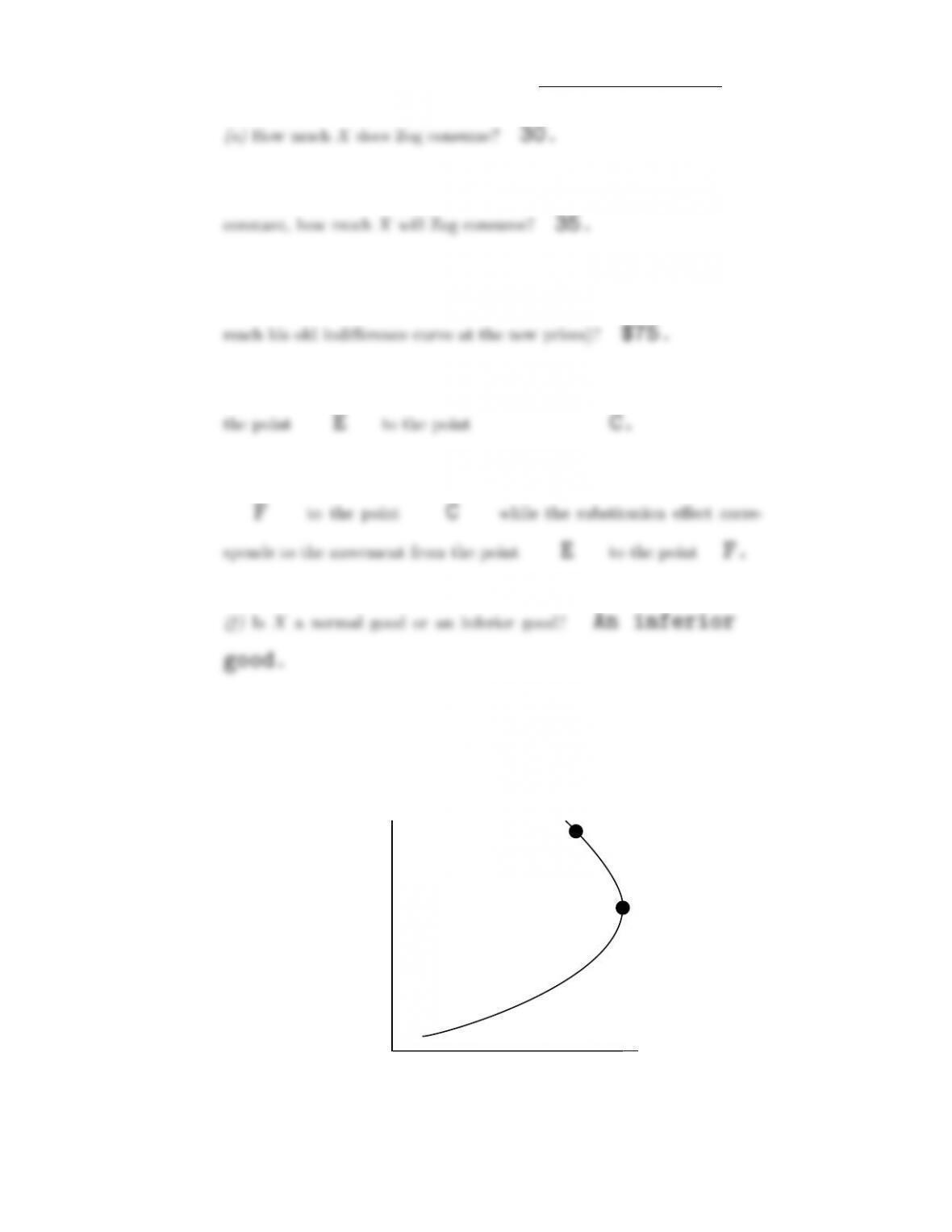
fect”. Consider the figure below, which shows the budget constraint and
the indifference curves of good King Zog. Zog is in equilibrium with an
income of $300, facing prices pX=$4andpY= $10.
C
E
F
Y
X
3
30
2
2.
5
30
35
4
3
90
7
5
12
0
NAME 101
(b) If the price of Xfalls to $2.50, while income and the price of Ystay
(c) How much income must be taken away from Zog to isolate the Hicksian
income and substitution effects (i.e., to make him just able to afford to
(d) The total effect of the price change is to change consumption from
(e) The income effect corresponds to the movement from the point
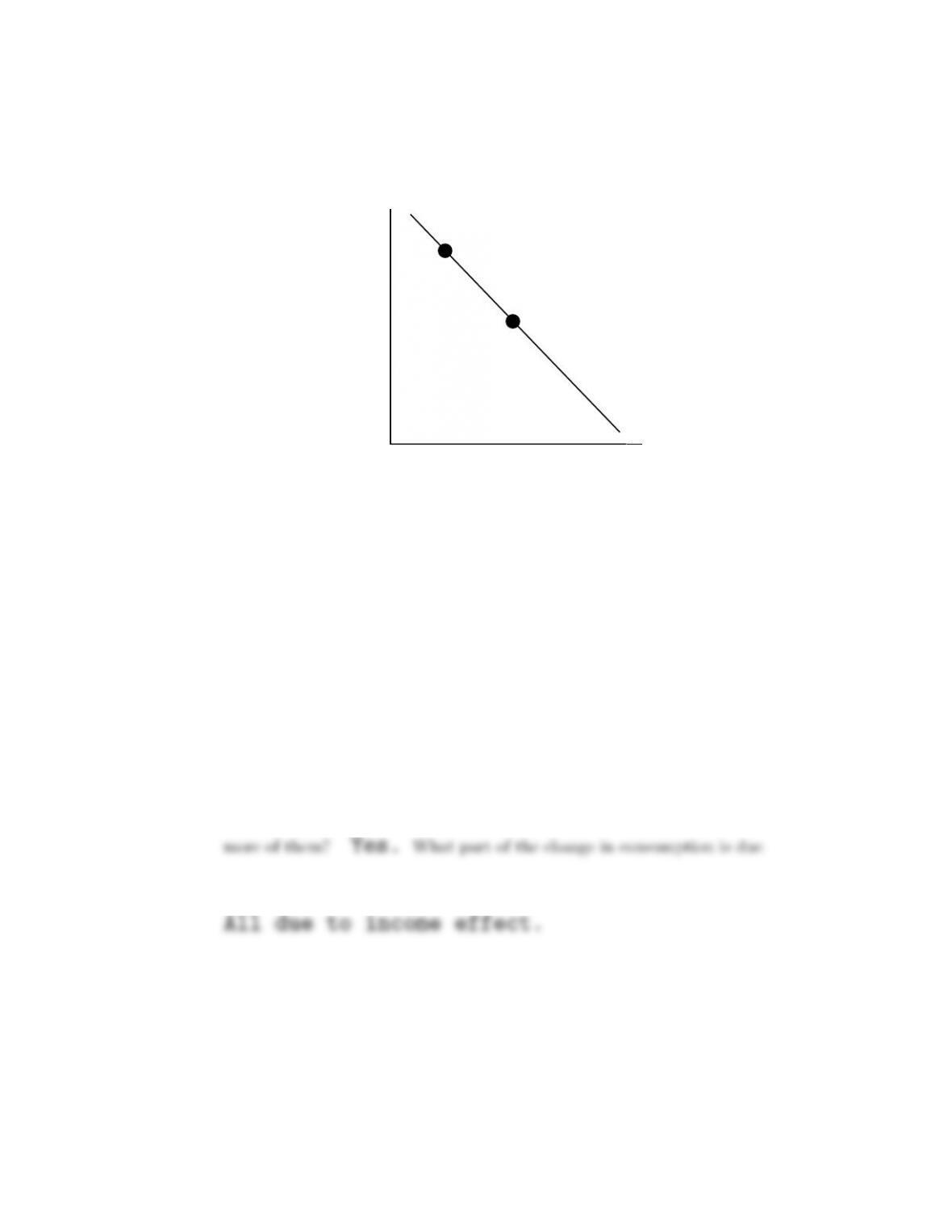
(g) On the axes below, sketch an Engel curve and a demand curve for
Good Xthat would be reasonable given the information in the graph
above. Be sure to label the axes on both your graphs.
Income
x
300
225
43
30
102 SLUTSKY EQUATION (Ch. 8)
Price
x
1
2
3
4
30
2.5
35
8.4 (0) Maude spends all of her income on delphiniums and hollyhocks.
She thinks that delphiniums and hollyhocks are perfect substitutes; one
delphinium is just as good as one hollyhock. Delphiniums cost $4 a unit
and hollyhocks cost $5 a unit.
(a) If the price of delphiniums decreases to $3 a unit, will Maude buy
to the income effect and what part is due to the substitution effect?
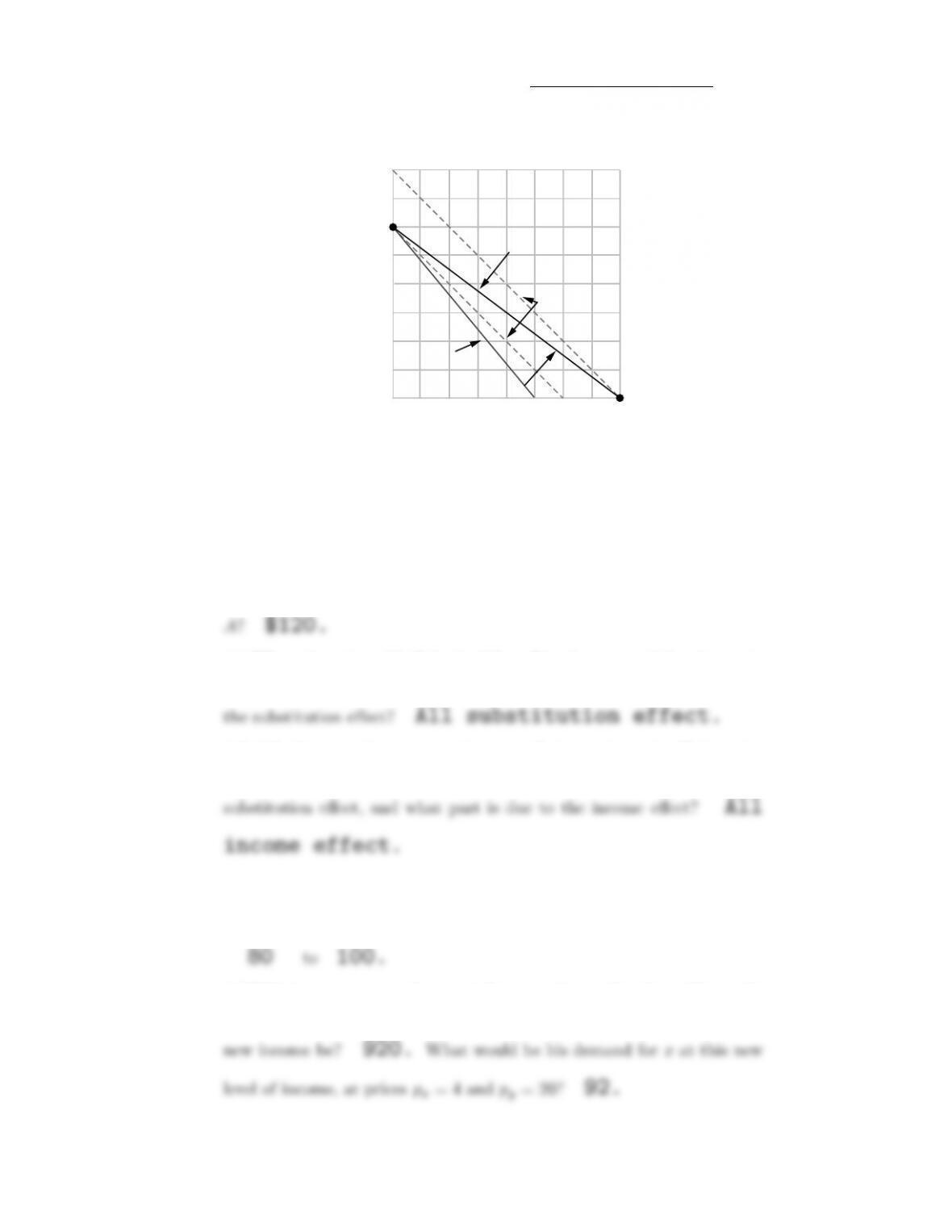
(b) If the prices of delphiniums and hollyhocks are respectively pd=$4
and ph= $5 and if Maude has $120 to spend, draw her budget line in
blue ink. Draw the highest indifference curve that she can attain in red
ink, and label the point that she chooses as A.
NAME 103
0102030
40
10
20
30
Hollyhocks
Delphiniums
40
a
b
Red
curves
Black line
Blue line
(c) Now let the price of hollyhocks fall to $3 a unit, while the price of
delphiniums does not change. Draw her new budget line in black ink.
Draw the highest indifference curve that she can now reach with red ink.
Label the point she chooses now as B.
(d) How much would Maude’s income have to be after the price of holly-
hocks fell, so that she could just exactly afford her old commodity bundle
(e) When the price of hollyhocks fell to $3, what part of the change in
Maude’s demand was due to the income effect and what part was due to
8.5 (1) Suppose that two goods are perfect complements. If the price
of one good changes, what part of the change in demand is due to the
8.6 (0) Douglas Cornfield’s demand function for good xis x(px,p
y,m)=
2m/5px. His income is $1,000, the price of xis $5, and the price of yis
$20. If the price of xfalls to $4, then his demand for xwill change from
(a) If his income were to change at the same time so that he could exactly
afford his old commodity bundle at px=4andpy= 20, what would his