
3) A low cash realization ratio may reveal liquidity problems in a profitable company.
4) Return on assets is a very important analytical tool because it measures how effectively
management is using a firm’s assets to generate profits.
5) A firm with a very low debt-equity ratio has a low risk of defaulting on its loans.
6) The Allied Computer Co. has sales of $300 million, a net profit margin of 9%, and 10 million
shares of common stock outstanding. It has no preferred stock outstanding. If Allied stock trades
at $50 per share, it has a price/earnings ratio of 20.9.
7) Return on equity (ROE) is computed by dividing net income by the market value of equity.
8) In seeking potential stock investments, most analysts look for companies that have PEG ratios
that are equal to or less than one.
9) Banks can use the times interest earned ratio as a measure of a borrower’s ability to repay their
loan.
10) If a firm has an equity multiplier of 3, this means that the firm has $3 in equity for every $1
in long-term debt.

11) Return on equity can be expressed mathematically as “(net profit margin)(total asset
turnover)(equity multiplier).”
12) A high P/E ratio may be an indication that a stock is overpriced.
13) Price-to–book-value indicates how aggressively a stock is being priced.
14) High dividend payout ratios are more of a concern to analysts than low payout ratios.
15) Which of the following are measures of liquidity?
I. net working capital
II. accounts receivable turnover
III. current ratio
IV. times interest earned
A) I and III only
B) I, II and III only
C) I, II and IV only
D) I, III and IV only

16) On December 31, the Gold Standard Company reported the following information on its
financial statements.
According to this information, the company’s current ratio is approximately
A) 1.39.
B) 1.68.
C) 1.73.
D) 1.90.
17) A company has sales of $640,000, net profit after taxes of $23,000, and a total asset turnover
of 2.5. What is the return on assets?
A) 3.6%
B) 4.5%
C) 8.1%
D) 9.0%
18) Substituting EBITDA for EBIT when computing the times interest earned ratio will make the
company appear
A) more leveraged.
B) less leveraged.
C) more profitable.
D) less efficient.

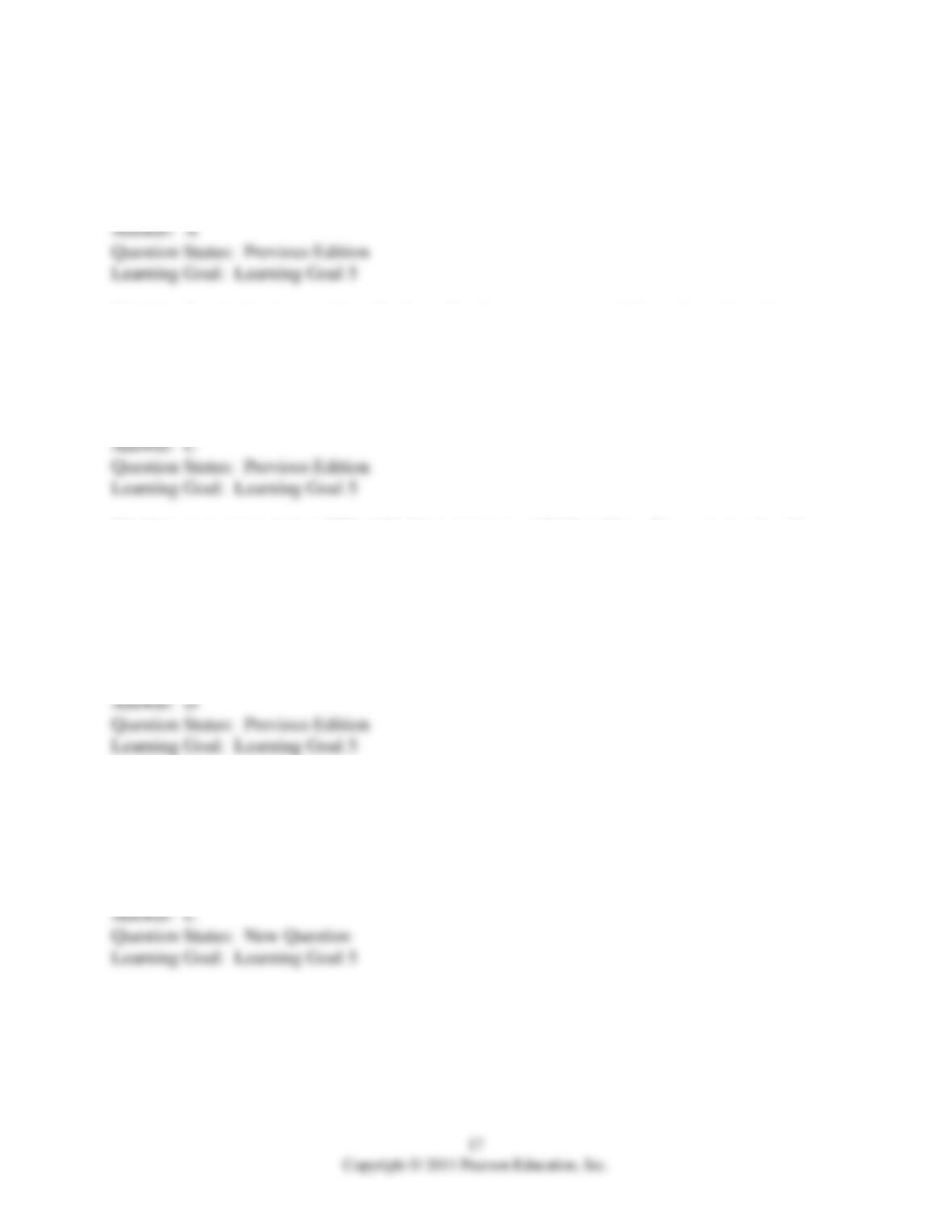
19) For their last fiscal year, the Short Company reported the following information.
What is the accounts receivables turnover rate?
A) 0.8
B) 2.8
C) 4.5
D) 7.3
20) The inventory turnover rate for a firm is 14.5 as compared to the relevant industry rate of
13.2. In this case, the firm is
A) selling its inventory slower than the industry.
B) underperforming the industry.
C) averaging less days of sales in inventory than the industry.
D) generating less sales per dollar of inventory.
21) A total asset turnover of 3 means that every
A) $1 in sales is supported by $3 of assets.
B) $3 in assets produces $1 in net earnings.
C) $1 in total assets is replaced on average every 3 years.
D) $1 in assets produces $3 in sales.
22) A company has annual sales of $160 million, a net profit margin of 4%, and total assets of
$90 million. It carries $10 million in accounts receivable, $25 million in inventory, has $55
million in total debt, and 5 million shares of common stock outstanding. Based on this
information, the company’s return on equity (ROE) is
A) 4.4%.
B) 7.1%.
C) 11.5%.
D) 18.3%.
23) The measure that indicates how efficiently assets are being used to support sales is called the
A) total asset turnover.
B) current ratio.
C) book value.
D) net profit margin.
24) A lending institution would prefer that a firm have a ________ debt-equity ratio and a
________ times interest earned ratio.
A) higher; higher
B) higher; lower
C) lower; higher
D) lower; lower
25) Marco’s just reported an EPS of $1.68 on revenues of $440 million. The company has 12
million shares outstanding. Total assets are $280 million, current liabilities equal $48 million,
and long-term debt is $112 million. Net fixed assets are worth $230 million. Given this
information, which one of the following statements is correct?
A) Marco’s debt-equity ratio is 0.75.
B) Marco’s current ratio is 1.75.
C) Marco’s total asset turnover is 3.67.
D) Marco’s net working capital is $2 million.
26) Worcester Corporation has a P/E ratio of 15. Natick Corporation is in the same industry as
Worcester, but has a P/E ratio of 20. Possible interpretations of this discrepancy include
A) Worcester corporation is overpriced.
B) Natick corporation has higher earnings per share.
C) Investors expect Natick to grow faster than Worcester.
D) Natick’s stock price is higher than Worcester’s.

27) Nadine Enterprises has total assets of $240,000, a debt-equity ratio of 0.60, and a return on
assets of 9%. What is the return on equity?
A) 5.4%
B) 5.6%
C) 14.4%
D) 15.0%
28) Quick Cement has a return on assets of 8%. If it has $1.5 million in total assets and a total
asset turnover of 2, it follows that the firm must have a net profit margin of
A) 4%.
B) 6%.
C) 8%.
D) 12%.
29) Investors are most interested in which one of the following ratios?
A) return on assets
B) current ratio
C) net profit margin
D) return on equity
30) Which one of the following is a leverage measure?
A) times interest earned
B) net working capital
C) return on equity
D) net profit margin
31) If a company’s ROA is high, then an investor can assume that the company
A) is in danger of defaulting on its loans.
B) pays a high dividend.
C) is profitable.
D) has more equity than debt in its capital structure.
32) If a firm has an ROA of 10% and an ROE of 10%, then the
A) operating results of the firm are improving.
B) firm has no financial leverage.
C) firm must have enough cash on hand to pay some extra dividends.
D) firm is losing money.
33) Kim has gathered the following information on a company.
What is the amount of the earnings per share?
A) $0.14
B) $0.25
C) $0.28
D) $0.30
34) A company has 2 million shares of common stock outstanding. Annual sales are $26 million.
The net profit margin is 8% and the dividend payout ratio is 40%. Currently the stock trades at
$17.68 per share. Given this information, the company has a P/E ratio of
A) 16 and a dividend yield of 2.35%.
B) 16 and a dividend yield of 3.20%.
C) 17 and a dividend yield of 2.35%.
D) 17 and a dividend yield of 3.20%.
35) JJ Industries has a P/E ratio of 18 and an EPS of $0.93. This means that JJ’s stock is currently
selling for
A) $16.74 per share.
B) $17.07 per share.
C) $18.00 per share.
D) $19.35 per share.
36) For most companies, the dividend payout ratio falls within the range of
A) 10 to 20%.
B) 20 to 40%.
C) 40 to 60%.
D) 60 to 80%.
37) Which of the following may be signs of future problems for a company?
I. Inventories growing faster than sales.
II. Rapidly increasing debt to equity ratio.
III. Cash flow from operations is higher than net income.
IV. Current liabilities increasing faster than current assets.
A) I and III only
B) II and IV only
C) I, II and IV only
D) I, II and III only
38) The PEG ratio
A) preferred by investors is equal to 2.0 or higher.
B) compares the price/earnings ratio to the rate of growth of the company’s earnings.
C) is a measure of a firm’s liquidity.
D) measures the ability of a firm’s assets to generate growth for the firm.
39) The cash realization ratio (cash flow from operating activities divided by net income) is a
useful measure of
A) quality of earnings.
B) liquidity.
C) leverage.
D) distortion of earnings by inflation.
40) ROE = (net profit margin)(total asset turnover)(equity multiplier). What is the advantage of
using this expanded version of the ROE formula versus using the simplified version which is net
income divided by total equity?
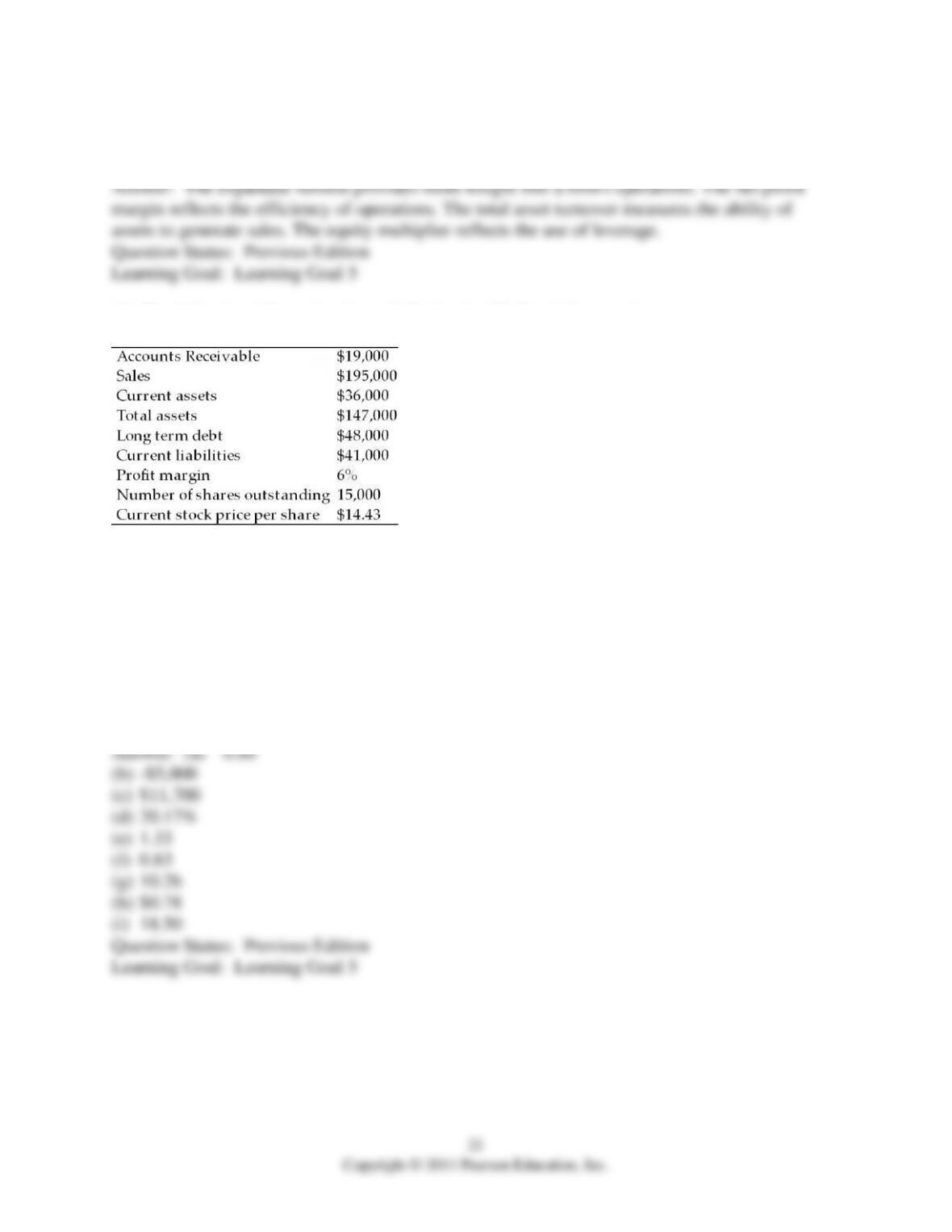
41) The following information is available for the Oil Creek Corporation.
(a) What is the current ratio?
(b) What is the net working capital?
(c) What is the net income?
(d) What is the return on equity?
(e) What is the total asset turnover?
(f) What is the debt-equity ratio?
(g) What is the accounts receivable turnover?
(h) What is the earnings per share (EPS)?
(i) What is the price to earnings (P/E) ratio?
22
Copyright © 2011 Pearson Education, Inc.
7.6 Learning Goal 6
1) A companies ratios are more meaningful when compared to other companies in the same
industry.
2) The debt to equity ratio should be approximately the same across all industrial sectors.
3) Historical comparisons will reveal whether a company’s performance is improving or
deteriorating.
4) Generally, the market price of a stock is
A) below its book value.
B) above its book value.
C) equal to its par value.
D) equal to its book value.
5) To determine whether a pharmaceutical company’s profitability ratios indicate strength or
weakness, we should
I. compare them to others in the same industry.
II. compare them to companies in unrelated industries such as energy or banking.
III. compare them to previous years.
IV. compare them to absolute standards established by the CFA Institute.
A) I and II only
B) I and III only
C) III and IV only
D) IV only

6) Which of the following is a readily available source of industry comparisons:
A) The Wall Street Journal
B) Company Annual Reports
C) Standard & Poors
D) EDGAR
7) A comparison of a firm’s current financial ratios to those of prior years allows one to
A) accurately predict the future performance of a firm.
B) see how a firm’s performance compares to that of a competitor.
C) see trends that are developing.
D) determine if the firm is performing better than the overall industry.
8) Amgen’s debt to equity ratio is .54 while Wal-Mart’s is .68. By comparing these ratios we can
conclude
A) that Wal-Mart is in danger of bankruptcy.
B) that Amgen uses too little debt financing.
C) that Wal-Mart uses too little equity financing.
D) very little because the firm’s are in different industries.
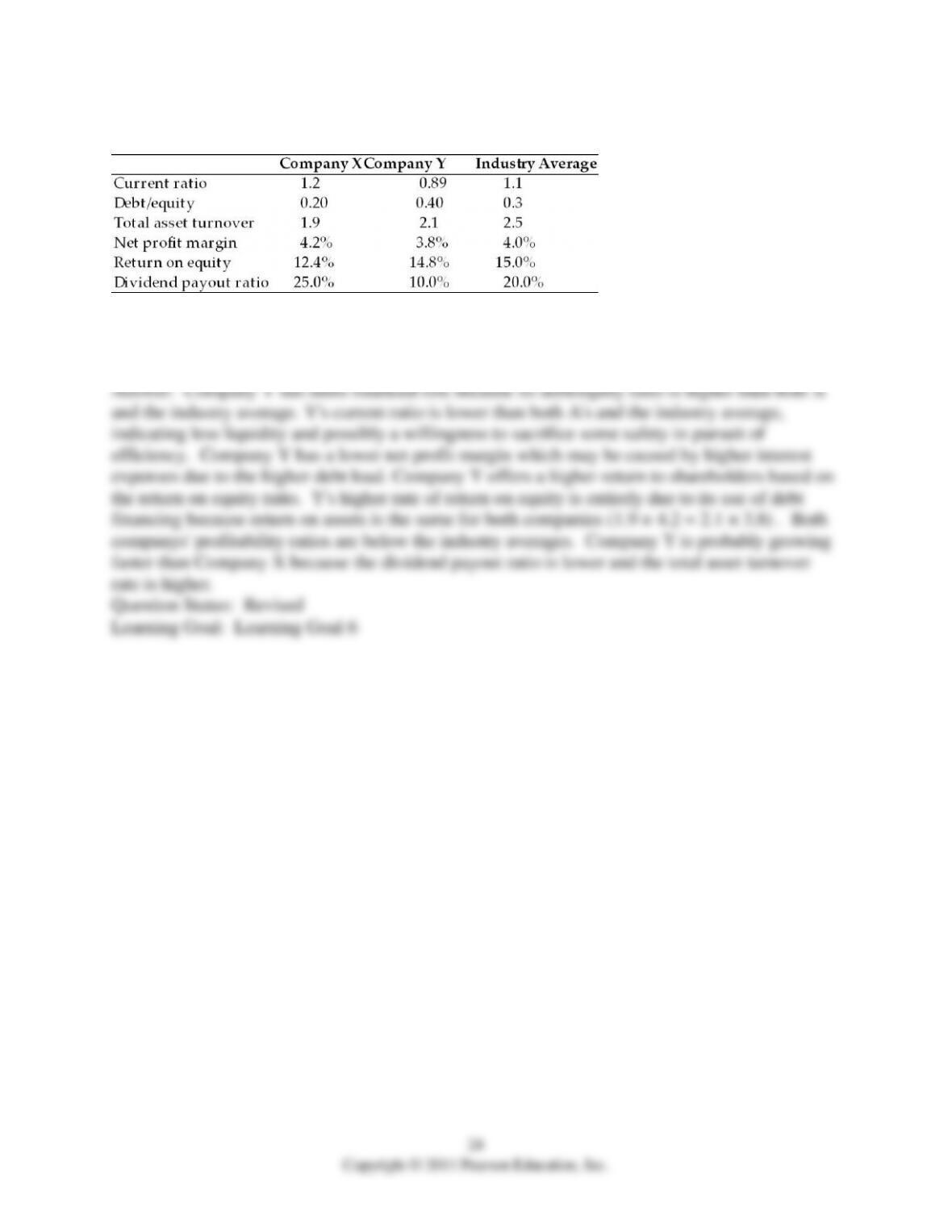
9) Company X and Company Y are in the same industry and have the following ratios.
Discuss the relative natures of the two companies in terms of risk and return. Identify the more
growth-oriented firm and justify your selection. Support your discussion and conclusions by
referring to the ratios.