Fundamentals of Investing, 11e (Gitman/Joehnk/Smart)
Chapter 7 Analyzing Common Stocks
1) An investor should buy a stock only if the prevailing market price exceeds the intrinsic value
of the stock.
2) An investment should offer an expected return commensurate with the risk involved.
3) Advocates of the efficient market hypothesis would argue that it is virtually impossible for
any investor to consistently outperform the market.
4) Fundamental analysis can only be profitable if some securities are at least temporarily
mispriced.
5) According to the efficient markets hypothesis, securities can be substantially mispriced in the
marketplace.
6) One of the basic premises of security analysis, and in particular fundamental analysis, is that
A) a stock’s price is based on its past cash flows rather than on anticipated future cash flows.
B) market sectors do not move in concert with business cycles.
C) all securities have an intrinsic value that their market value will approach over time.
D) a security’s risk has relatively little effect on the security’s return.

7) The intrinsic value of a security is based on the
I. amount of risk.
II. current market value of the security.
III. discount rate applicable to the security.
IV. estimated future cash flows from the security.
A) I and III only
B) III and IV only
C) I, II and III only
D) I, III and IV only
8) The security analysis process should help investors to
I. purchase investments that are priced at or above their intrinsic value.
II. sell investments that are priced above their intrinsic value.
III. purchase investments that are priced below their intrinsic value.
IV. identify investments appropriate for their goals.
A) I and IV only
B) II and III only
C) I, II and III only
D) II, III and IV only
9) Top-down security analysis
A) starts with the fundamental analysis of a firm.
B) includes economic, industry, and fundamental analysis.
C) concentrates on the competency of the senior management of a firm.
D) centers on the past performance of a firm.
10) Fundamental analysis involves the in-depth study of the
A) role of nondiversifiable risk in an investor’s portfolio.
B) financial condition and operating results of a given firm.
C) pattern of security prices as revealed in chart formations.
D) role of diversifiable risk in an investor’s portfolio.
11) Some investment analysts believe that the market processes new information so well and so
quickly that securities trade very close to their intrinsic values at all times. These analysts are
said to be advocates of
A) fundamental analysis.
B) sector analysis.
C) the efficient market hypothesis.
D) the prevailing price hypothesis.
1) Firms tend to be more profitable and have higher stock values when the economy is strong.
2) The purpose of economic analysis is to gain an insight into the underlying health or vitality of
the economy and to formulate expectations about future security prices.
3) The business cycle reflects economic changes only in the industrial sectors of the economy.
4) Developing a general economic outlook assists in the identification of industries and firms that
might be good investment opportunities.
5) Changes in stock prices tend to lag changes in level of economic activity by several months.
6) Economic analysis is relatively useless for investment purposes since the stock market is used
to forecast the economy.
7) Which measure of the business cycle represents the market value of all goods and services
produced in a country over a twelve-month period?
A) industrial production index
B) money supply
C) gross domestic product
D) productivity average
8) Which one of the following statements is true?
A) Monetary policy includes adjusting interest rates and determining the level of government
taxation.
B) Inflation has little, if any, impact on the economy or the financial markets.
C) Both consumer spending and business investment are key components of the economy.
D) Restrictive fiscal policy tends to increase economic activity.
9) The Federal Reserve through monetary policy can help expand the economy by
A) lowering income taxes on individuals.
B) reducing tariffs such that foreign exports can increase.
C) supporting a moderate growth of the money supply.
D) increasing government spending on the national infrastructure.
10) Increases in either interest rates or taxes tend to
A) contract the level of economic activity.
B) increase the level of business investment.
C) indicate governmental expansion of the economy.
D) signal the trough of a recessionary market.
11) The government has an expansionary economic policy when it
A) increases taxes.
B) increases government spending.
C) promotes rising interest rates.
D) limits exports of goods and services.

12) Rising corporate profits and are likely to have the greatest effect on which of the following
industrial sectors?
A) business equipment.
B) defense
C) food and agriculture
D) consumer durables
13) Which of the following business es will be negatively impacted by a strong dollar?
A) retailing
B) imports
C) exports
D) automotive
14) Which one of the following is a correct description of an economic measure?
A) The consumer price index is a monthly indicator of changes in the price of goods at various
stages of production.
B) The monthly estimate of total sales by the Commerce Department is known as the consumer
price index.
C) The unemployment rate shows the number of payroll jobs that exist in the economy.
D) The amount of funds in circulation, in checking, savings and money market accounts and in
CDs is referred to as the money supply.
15) Which of the following tend to increase security market prices?
I. An increase in industrial production
II. An increase in corporate profits
III. An increase in the federal deficit when the economy is strong
IV. An increase in interest rates
A) I and II only
B) II and III only
C) I, II and III only
D) I, II, III and IV
16) Which one of the following statements is correct?
A) Stock prices are independent of the economic cycle.
B) Stock prices change simultaneously with the economy.
C) Stock prices are often used to predict changes in the economy.
D) Changes in stock prices generally lag changes in the economy.
1) To predict the demand for an industrial sector, it is essential to understand the economic
forces that affect the industry.
2) Economic factors such as a weak dollar will have a negative impact on all industrial sectors.
3) Industries in the rapid expansion stage will be especially sensitive to a slowing economy.
4) The economy will expand more slowly if consumers decided to save more and reduce their
debt levels.
5) When the economic outlook for an industrial sector is strong, the outlook for many of the
stocks of firms within that sector will also be strong.

6) Investors who conduct industry analyses typically favor companies with strong market
positions over companies with less secure market positions because firms with strong market
positions tend to
I. be price leaders.
II. benefit more from economies of scale.
III. have better R&D programs.
IV. have lower production costs.
A) II and IV only.
B) I, II and IV only.
C) I, II and III only
D) I, II, III and IV
7) The consumer electronics would be most significantly affected by
A) developments in technology.
B) interest rates and inflation.
C) labor relations.
D) government regulations.
8) Which of the following factors are considered when analyzing an industry?
I. the nature and conditions of governmental regulations
II. the involvement and relations, if any, with labor unions
III. the development of new technologies relevant to the industry
IV. the extent of competition within the industry
A) I, II and IV only
B) II, III and IV only
C) I, II and III only
D) I, II, III and IV
9) Which stage of an industry’s growth cycle is most influenced by economic events?
A) initial development
B) stability or decline
C) mature growth
D) rapid expansion
10) The stage in an industry’s growth cycle in which product acceptance is spreading, investors
can foresee the industry’s future, and overall economic variables have little to do with the
industry’s overall performance, is known as the
A) initial development stage.
B) rapid expansion stage.
C) mature growth stage.
D) stability or decline stage.
11) Which stage of an industry’s growth cycle offers the greatest opportunity for an investor who
is seeking capital gains?
A) initial development
B) mature growth
C) stability or decline
D) rapid expansion
12) List and explain the various stages of the growth cycle of an industry. Also discuss the merit
of investing in the industry during each of the various stages.
13) Briefly describe and discuss both industry analysis and fundamental analysis.
1) Fundamental analysis is based on the presumption that the value of a stock is influenced by
the financial performance of the issuing company.
2) Fundamental analysis encompasses return, but not risk, in the valuation process.
3) The income statement and balance sheet are linked through the statement of cash flows.
4) The income statement indicates how successfully a company has utilized its assets.
5) A company may appear to be profitable on its income statement, but fail to generate strong
cash flows.

6) If a company rewards executives with stock options, core earnings will be lower than net
income.
7) EBITDA stands for earnings before inflation, taxes, depreciation, and adjustments.
8) For a company to remain in business for the long term, cash flow from operations must
generally be a positive number.
9) Which of the following are considered in the company analysis phase of a fundamental
analysis of a firm?
I. the composition and growth in sales
II. the capital structure of the firm
III. the outlook of the national economy
IV. the composition and liquidity of the company’s assets
A) I and II only
B) I, II and IV only
C) II and IV only
D) I, II, III and IV
10) Which of the following accounting practices are potentially misleading or even fraudulent?
I. capitalization of operating expenses
II. accrual rather than cash basis reporting
III. off-balance sheet liabilities
IV. recognizing revenues prematurely
A) I and II only
B) I, II and IV only
C) III and IV only
D) I, III, and IV only
11) Which one of the following statements concerning accounting reports is correct?
A) The income statement reflects the position of a firm as of a single point in time.
B) The total equity of a firm is equal to the total assets plus the total liabilities.
C) The statement of cash flows identifies both the sources and the uses of cash.
D) The income statement reflects the amount of cash available for investment and financing
activities.
12) Cash flow from operations
A) represents the amount of cash generated by the company.
B) is the least important section of the Statement of Cash Flows.
C) is the amount of cash acquired from the borrowing activities of the firm.
D) represents the cash flows from the purchase and sale of long-term assets.
13) Which of the following measures excludes non-cash charges against income.
A) core earnings
B) EBITDA
C) net income before taxes
D) Income from operating activities
14) Financial ratios
I. allow comparisons across firms without concern over firm size.
II. can compare a firm’s operating and financial status to industry norms.
III. reflect the future outlook of a firm based on analysts projections.
IV. look at the liquidity, activity, leverage, profitability and market measures of a firm.
A) II and IV only
B) I and II only
C) I, II and IV only
D) I, II, III and IV
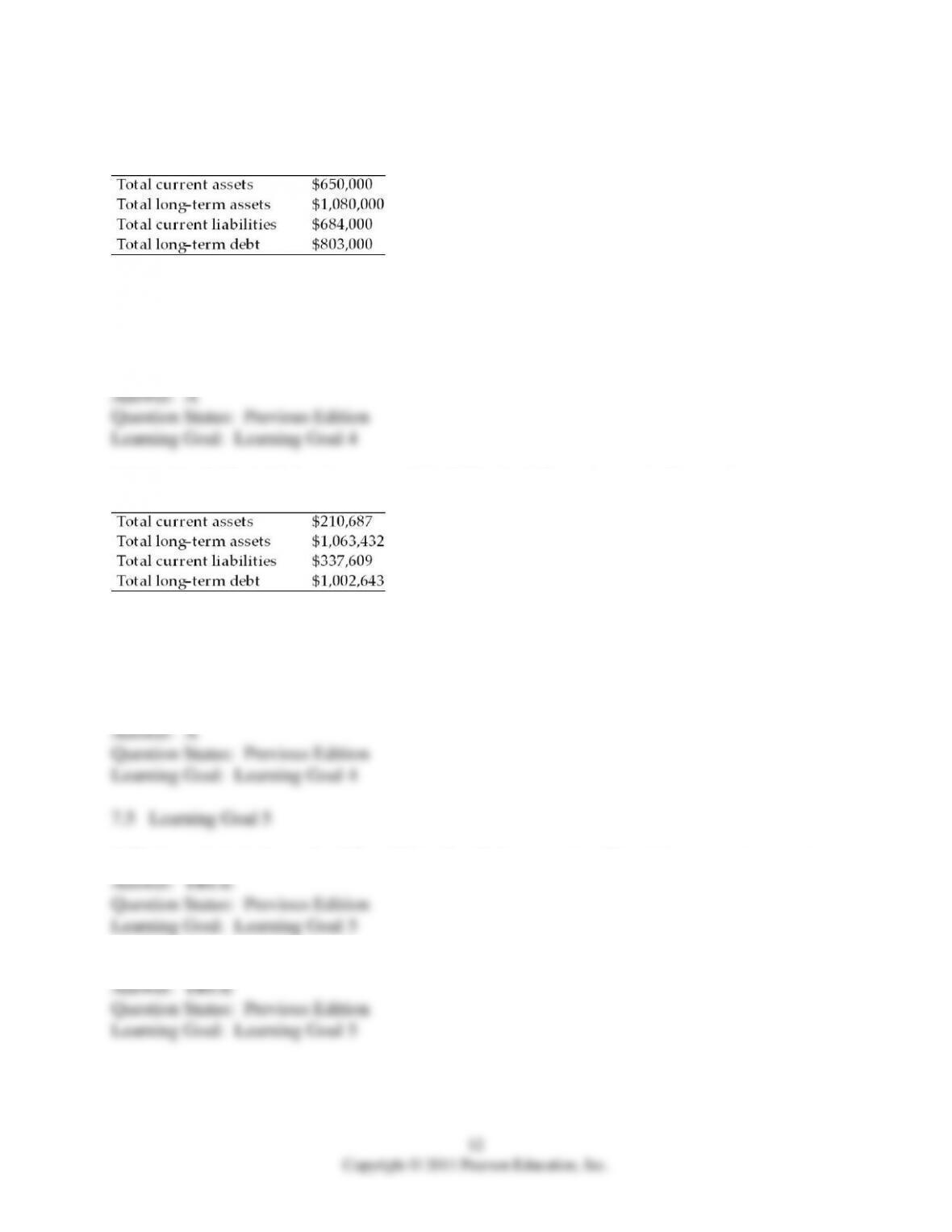
15) On September 30, the Simpson Company reported the following information on its financial
statements.
What is the amount of the stockholder’s equity in the Simpson Company?
A) $243,000
B) $277,000
C) $927,000
D) $3,217,000
16) On March 31, Adolpha, Inc. reported the following information on its financial statements.
What is the available net working capital for Adolpha, Inc.?
A) -$126,922
B) -$66,133
C) $60,789
D) $936,510
1) Ratio analysis is the study of the relationships between various financial statement accounts.
2) Financial ratios can reveal a lot about a company’s liquidity, activity, and profitability.