Fundamentals of Investing, 11e (Gitman/Joehnk/Smart)
Chapter 6 Common Stocks
1) Every shareholder is a part owner of the firm and, as such, has a direct claim on a portion of
the firm’s assets.
2) There is a stronger tendency for the stock market to increase in value rather than decrease in
value over time.
3) Since 1960, returns on the Dow Jones Industrial Average have never been negative for 3
consecutive years.
4) Between 1956 and 2005 the stock market, as measured by the Dow-Jones industrial average,
had more than twice as many up years as down years.
5) Because common shareholders are entitled to the profits that remain after all of a corporation’s
other obligations have been met, common shareholders are known as
A) residual owners.
B) temporary owners.
C) debt owners.
D) owners of last resort.
6) If stocks earn an average rate of return of 12 %, their value doubles every
A) 4 years.
B) 6 years.
C) 8 years.
D) 12 years.
7) Which one of the following statements about common stock is true?
A) Common stock can provide attractive capital appreciation opportunities.
B) Dividends generally provide the greatest rate of return on common stocks.
C) Common stocks generally have a negative rate of return over a ten-year period.
D) The DJIA is the best indicator of the overall performance of common stocks.
8) Which of the following are benefits related to stock ownership?
I. ease of trading
II. attractive inflation-adjusted rates of return
III. guarantee of long-term positive returns
IV. affordability
A) I and II only
B) II and IV only
C) I and III only
D) I, II and IV only
1) A market correction is defined as a stock market decline of 10% or more.
2) While many stocks increase in value over the long run, most of the return on stocks comes
from dividends.
3) A bear market is described as a stock market decline of 25% or more.
4) Over the long term, the capital gain on most stocks will exceed the dividend income.
5) A bear market similar to that of 2000-03 generally occurs once every decade.
6) Over the 50-year period of 1953-2002, the stock market provided an average annual rate of
return of approximately 11%.
7) As evidenced in the late 1990s and early 2000s, the S&P 500 Index is more volatile than the
Nasdaq Composite Index.
8) An individual who invested $100,000 in average stocks early in the year 2000 would have
approximately how much money at the end of 2008?
A) $137,500
B) $96,400
C) $74,000
D) $37,500
9) Which of the following periods provided particularly high returns to stock investors?
A) February 1972-October 1974
B) August 1998-March 2000
C) September 2000-September 2002
D) October 2007-March 2009
10) $10,000 invested in the Nasdaq Composite at the beginning of 1995 would have increased in
value to over $50,000 by the end of 1999.
11) $10,000 invested in the Nasdaq Composite at the beginning of 2000 would have increased in
value to about $20,000 by the end of 2005.
4
Copyright © 2011 Pearson Education, Inc.
12) The technology bubble of the 1990s lasted about 18 months.
13) Stocks generally have produced positive inflation-adjusted rates of return over the long-term.
14) An individual stock generally provides a
A) dividend payment that ensures total protection from purchasing power risk.
B) refuge from event risk.
C) lower current income than that available from other types of investments.
D) predictable annual rate of return.
15) Over the long run, stocks have provided investors with annual returns of around
A) 6% to 8%.
B) 8% to 10%.
C) 10% to 12%.
D) 12% to 14%.
16) The extraordinary run up in stock prices during the late 1990’s primarily affected
A) energy stocks.
B) retail stocks.
C) pharmaceutical stocks.
D) technology stocks.
17) Stock values declined sharply between
A) 1994 and 1997.
B) 1997 and 2000.
C) 2003 and 2007.
D) 2007 and 2008.
18) Describe the bear market of 2008 through 2009 and put it in historical context.
1) Shares of publicly traded stock can be issued either through a public offering or a rights
offering.
2) Companies typically issue new shares through an initial public offering (IPO).
3) Shareholders have the option of selling their rights granted via a rights offering.
4) Stock splits may be used when a firm, believing the price of its stock is too high, wants to
enhance the stock’s trading appeal.
5) The total value of an investor’s holdings in a company will not change as a direct result of a
stock split.
6) Treasury stock is a means of increasing the number of shares outstanding.
7) Firms tend to repurchase shares of their outstanding stock when they view the shares as
undervalued.
8) Different classes of stock generally have either different voting rights or different dividends.
9) Transaction costs can significantly reduce the rate of return on stock investments.
10) Since each share of common stock represents ownership in a company, shares of common
stock are often referred to as
A) illiquid investments.
B) equity securities.
C) fixed-income securities.
D) unit-cost securities.
11) Which one of the following statements about common stock is correct?
A) Each share of stock has a specified maturity date.
B) Common stock gives stockholders first title to a share of the company’s earnings, prior to
other corporate obligations.
C) Common stock typically provides higher levels of current income than do similar grade
corporate bonds.
D) Each share of common stock entitles the holder to an equal ownership position and an equal
vote in the corporation.
12) Stocks that are readily available to the general public and that are bought and sold on the
open market are known as
A) sustained stocks.
B) publicly traded issues.
C) treasury stocks.
D) split issues.
7
Copyright © 2011 Pearson Education, Inc.
13) When a company, working with an underwriter, offers the investing public a certain number
of shares of its stock at a certain price, the company is making what is known as a
A) public offering.
B) rights offering.
C) stock spin-off.
D) treasury offering.
14) In a rights offering, the
A) existing stockholders are given the first opportunity to purchase new shares in proportion to
their current ownership position.
B) underwriter offers the investing public a certain number of shares at a certain price.
C) total equity remains constant while the number of shares of common stock outstanding
increases.
D) amount of debt in the capital structure increases by the amount of the rights offering.
15) Rob owns 300 shares of Blackwood common stock valued at $9 a share. Blackwood has
declared a 3-for-1 stock split effective tomorrow. After the split, Rob will own
A) 100 shares valued at about $27 a share.
B) 100 shares valued at about $3 a share.
C) 900 shares valued at about $27 a share.
D) 900 shares valued at about $3 a share.
16) Engines, Inc. declares a 2-for-5 stock split. The stock currently sells for $3 a share. A
shareholder who owned 100 shares of stock prior to the split will now own
A) 40 shares valued at about $7.50 a share.
B) 40 shares valued at about $1.20 a share.
C) 250 shares valued at about $7.50 a share.
D) 250 shares valued at about $1.20 a share.
17) When a corporation declares a stock split, it usually does so because
A) the firm’s retained earnings are excessive.
B) there are too many shares of stock outstanding.
C) investors sometimes require nontaxable returns.
D) the stock price is too high.
18) Stock which has been issued and subsequently reacquired by the issuing corporation is called
A) letter stock.
B) treasury stock.
C) classified stock.
D) book stock.
19) Tiffany owned 1000 shares of GIA stock which was selling for $1.50 per share when the
company declared a 1 for 10 reverse split. After the split, Tiffany owned
A) 10,000 shares worth approximately $1.50 per share.
B) 10,000 shares worth approximately $0.15 per share.
C) 100 shares worth approximately $15 per share.
D) 100 shares worth approximately $1.50 per share.
20) Treasury stock can be used to do which of the following?
I. pay for an acquisition
II. pay the company employees
III. pay stock dividends
IV. cover employee stock option plan contributions
A) I and III only
B) II and IV only
C) III and IV only
D) I, III and IV only
21) Treasury stock can be used to do which of the following?
I. pay for an acquisition
II. pay the company employees
III. pay stock dividends
IV. cover employee stock option plan contributions
A) I and III only
B) II and IV only
C) III and IV only
D) I, III and IV only
22) Wall Street Journal Stock quotations include
I. the highest and lowest price over the last 52 weeks
II. dividend and dividend yield
III. PE (price/earnings) ratio
IV. the stock’s beta
A) I and III only
B) II and IV only
C) I, II and III only
D) I, III and IV only
23) A round lot consists of
A) 1 share.
B) 10 shares.
C) 100 shares.
D) 1,000 shares.
24) Assume the Plum Corporation has two different issues of common stock. One issue carries
voting rights, and the other issue does not. In this situation, Plum is said to have issued
A) buy-back stock.
B) treasury stock.
C) OTC stock.
D) classified stock.
25) Why do some companies split their stock?
1) A stock’s market value would normally be higher than it’s book value.
2) Investors should never pay more than par value for a stock.
3) The investment value for a publicly traded stock can readily be found in the financial section
of the newspaper or on the internet.
4) If a firm has a 2 million shares outstanding and its stock trades at $25, the company has a
market capitalization of $50,000,000.
5) Another term for the stated value or face value of a stock is its
A) book value.
B) liquidation value.
C) par value.
D) proxy value.
6) The par or stated value of common stock is important for
A) accounting purposes only.
B) helping the investor determine the stock’s intrinsic value.
C) helping the board of directors determine the dividend payout.
D) helping the market determine the trading price of the stock.
7) The value that represents the amount of stockholders’ equity in a firm is called the
A) par value.
B) book value.
C) liquidation value.
D) market value.
8) Westlake Industries has total assets of $42.5 million, total debt of $29.3 million, and $2.4
million of 6% preferred stock outstanding. If the company has 250,000 shares of common stock
outstanding, its book value per share would be
A) $32.33.
B) $33.60.
C) $43.20.
D) $52.80.
9) As a general rule, which one of the following statements concerning the various values of
common stock is correct?
A) Market values are usually below book values.
B) Par values are usually above book values.
C) Market values are usually below par values.
D) Book values are usually below market values.
10) Which of the following will tend to increase transaction costs?
A) Buying or selling fewer than 100 shares at a time.
B) Buying or selling shares through an on-line broker.
C) Buying or selling more than 1000 shares in a single trade.
D) Buying or selling at times when volume is high and the exchanges are busy.
11) The Jennings Company has 4 million shares of stock outstanding. The stock has a par value
of $0.10 per share and is currently trading at $18 per share. According to this information, the
market capitalization of Jennings is
A) $400,000.
B) $7.2 million.
C) $40 million.
D) $72 million.
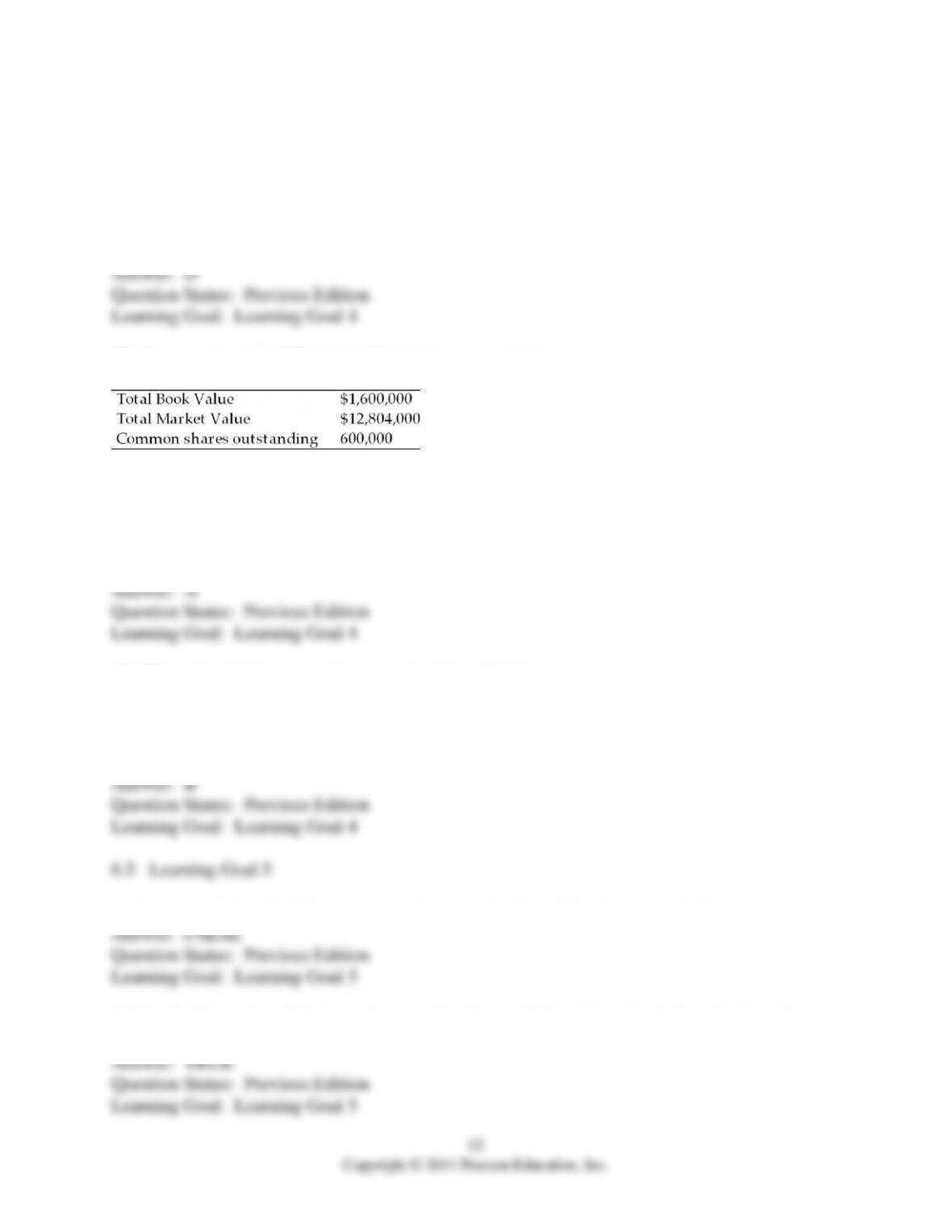
12) You are given the following information on a company.
Which one of the following statements is correct based on the information provided?
A) The market price is $21.34 per share.
B) The investment value is $2.67 per share.
C) The par value is $2.67 per share.
D) The book value is $21.34 per share.
13) The value that investors place on a stock is called its
A) book value.
B) investment value.
C) liquidation value.
D) par value.
1) A company’s board of directors must declare a dividend if the firm is profitable.
2) Shareholders who sell their stock on or after the ex-dividend date, but before the date of
record, will still receive the declared dividend.