Fundamentals of Investing, 11e (Gitman/Joehnk/Smart)
Chapter 5 Modern Portfolio Concepts
1) Portfolio objectives should be established before beginning to invest.
2) A portfolio that offers the lowest risk for a given level of return is known as an efficient
portfolio.
3) Portfolio objectives should be established independently of tax considerations.
4) If the actual rate of return on an investment portfolio is constant from year to year, the
standard deviation of that portfolio is zero.
5) An efficient portfolio maximizes the rate of return without consideration of risk.
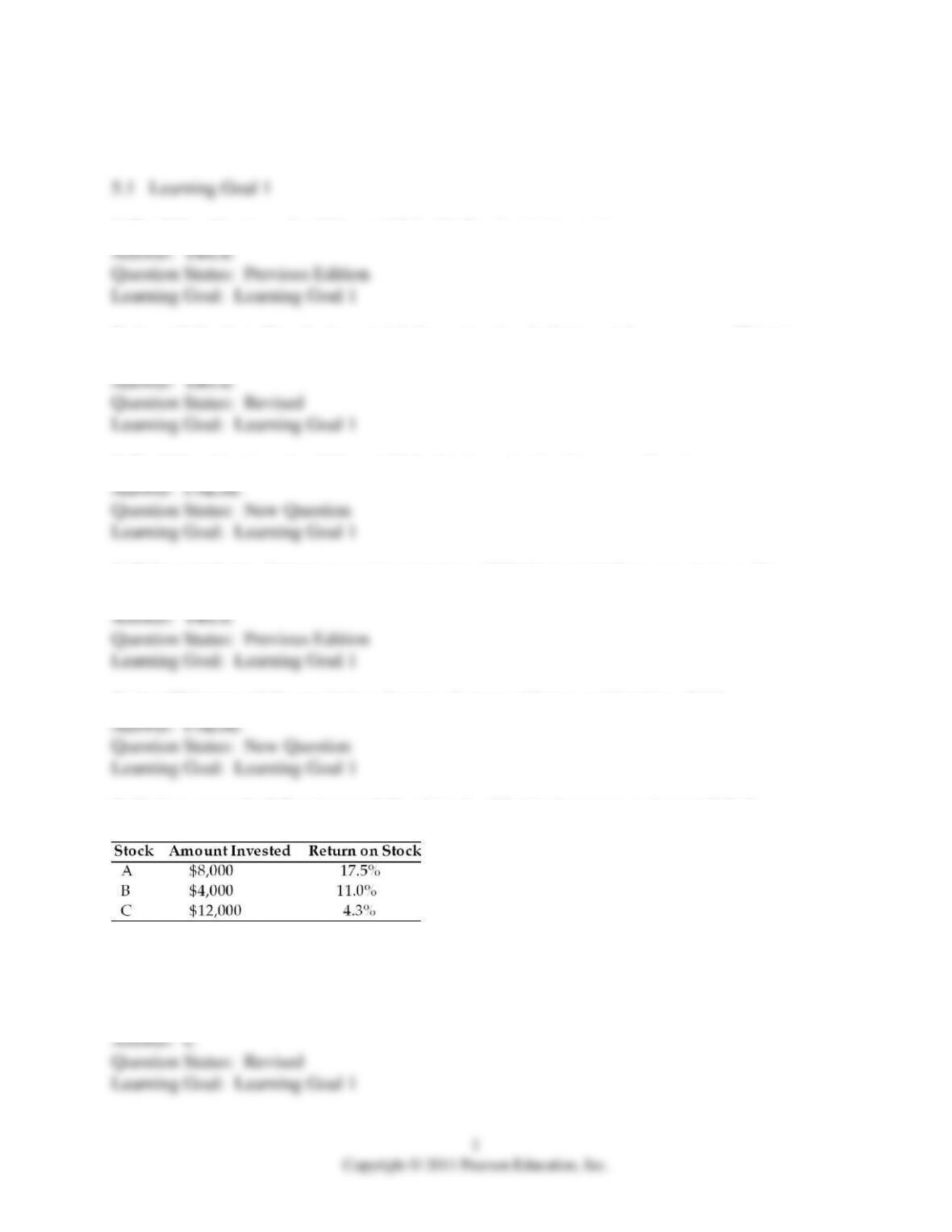
6) Melissa owns the following portfolio of stocks. What is the return on her portfolio?
A) 8.0%
B) 9.0%
C) 9.8%
D) 10.9%

7) Marco owns the following portfolio of stocks. What is the expected return on his portfolio?
A) 4.7%
B) 6.6%
C) 8.4%
D) 8.7%
8) A portfolio consisting of four stocks is expected to produce returns of 9%, 11%, 3% and 17%,
respectively, over the next four years. What is the standard deviation of these expected returns?
A) 5.00%
B) 5.77%
C) 25.00%
D) 33.33%
1) Negatively correlated assets reduce risk more than positively correlated assets.
2) Correlation is a measure of the relationship between two series of numbers.
3) Risk can be totally eliminated by combining two assets that are perfectly positively correlated.
4) Investing globally offers better diversification than investing only domestically.

5) Studies have shown that investing in different industries as well as different countries reduces
portfolio risk.
6) Currency exchange rate risk can be hedged using forwards, futures and options.
7) Maximum international diversification can be achieved by investing solely in U.S.
multinational corporations.
8) The opportunities to earn excess returns in foreign investments continue to grow.
9) Investing in emerging markets is an effective means of diversifying a U.S. portfolio.
10) The transaction costs of investing directly in foreign-currency-denominated assets are
relatively low.
11) If there is no relationship between the rates of return of two assets over time, these assets are
A) positively correlated.
B) negatively correlated.
C) perfectly negatively correlated.
D) uncorrelated.

12) Combining uncorrelated assets should
A) increase the overall risk level of a portfolio.
B) decrease the overall risk level of a portfolio.
C) not change the overall risk level of a portfolio.
D) cause the other assets in the portfolio to become positively related.
13) To obtain the maximum reduction in risk, an investor should combine assets that
A) are negatively correlated.
B) are uncorrelated.
C) have a correlation coefficient of positive one.
D) have a correlation coefficient of negative one.
14) The risk of a portfolio consisting of two uncorrelated assets will be
A) equal to zero.
B) greater than the risk of the least risky asset but less than the risk level of the more risky asset.
C) greater than zero but less than the risk of the more risky asset.
D) equal to the average of the risk level of the two assets.
15) Over the long term, a portfolio consisting of an S&P 500 index and an EAFE index will
generally produce ________ returns and have ________ risk than a portfolio comprised solely of
the S&P 500 index.
A) higher; more
B) higher; less
C) lower; more
D) lower; less
16) Which one of the following will provide the greatest international diversification?
A) directly purchasing a foreign stock
B) purchasing stock of a U.S. multinational firm
C) purchasing an ADS
D) purchasing shares of an international mutual fund
17) American depositary shares (ADS) are
A) shares of foreign companies traded on the U.S. markets.
B) shares of American companies traded on foreign markets.
C) foreign currency deposits in American banks.
D) American currency deposits in foreign banks
18) Explain the relationship between correlation, diversification, and risk reduction.
1) Diversifiable risk is also called systematic risk.
2) Standard deviation is a measure that indicates how the price of an individual security responds
to market forces.
3) Market return is the average return on a large sample of stocks such as those in the Standard &
Poor’s 500 Stock Composite Index.
4) It is relatively easy to obtain the beta for actively traded stocks.
5) Betas must be positive numbers.

6) A beta of 0.5 means that a stock is half as risky the overall market.
7) The market surrogate is always assigned a beta of 1.0.
8) A stock with a beta of 1.3 is less risky than a stock with a beta of 0.42.
9) For stocks with positive betas, higher risk stocks will have higher beta values.
10) Adding stocks with higher standard deviations to a portfolio will necessarily increase the
portfolio’s risk.
11) Beta measures diversifiable risk while standard deviation measures systematic risk.
12) Historical betas are always reliable predictors of future return fluctuations.

13) Which of the following represent unsystematic risks?
I. the president of a company suddenly resigns
II. the economy goes into a recessionary period
III. a company’s product is recalled for defects
IV. the Federal Reserve unexpectedly changes interest rates
A) I, II and IV only
B) II and IV only
C) I and III only
D) I, II and III only
14) Which of the following represent systematic risks?
I. the president of a company suddenly resigns
II. the economy goes into a recessionary period
III. a company’s product is recalled for defects
IV. the Federal Reserve unexpectedly changes interest rates
A) I, II and IV only
B) II and IV only
C) I and III only
D) I, II and III only
15) Which one of the following types of risk cannot be effectively eliminated through portfolio
diversification?
A) inflation risk
B) labor problems
C) materials shortages
D) product recalls
16) Which one of the following conditions can be effectively eliminated through portfolio
diversification?
A) a general price increase nationwide
B) an interest rate reduction by the Federal Reserve
C) increased government regulation of auto emissions
D) change in the political party that controls Congress

17) Systematic risks
A) can be eliminated by investing in a variety of economic sectors.
B) are forces that affect all investment categories.
C) result from random firm-specific events.
D) are unique to certain investment vehicles.
18) A measure of systematic risk
A) standard deviation
B) historical average rate of return
C) beta
D) variance
19) Beta can be defined as the slope of the line that explains the relationship between
A) the return on a security and the return on the market.
B) the returns on a security and various points in time.
C) the return on stocks and the returns on bonds.
D) the risk free rate of return versus the market rate of return.
20) In designing a portfolio, the only relevant risk is
A) total risk.
B) unsystematic risk.
C) event risk.
D) nondiversifiable risk.
21) A stock’s beta value is a measure of
A) interest rate risk.
B) total risk.
C) systematic risk.
D) diversifiable risk.

22) The beta of the market is
A) -1.0.
B) 0.0.
C) 1.0.
D) undefined.
23) When the stock market has bottomed out and is beginning to recover, the best portfolio to
own is the one with a beta of
A) 0.0.
B) +0.5.
C) +1.5.
D) +2.0.
24) The best stock to own when the stock market is at a peak and is expected to decline in value
is one with a beta of
A) +1.5.
B) +1.0.
C) -1.0.
D) -0.5.
25) Security A has a beta of .99, security B has a beta of 1.2, and security C has a beta of -1.0.
This information indicates that
A) security A has the highest degree of market risk.
B) security B has 20% more systematic risk than the market.
C) security C has the highest degree of market risk.
D) security C would be the best investment if a strong bull market is expected.

26) Beta is the slope of the best fit line for the points with coordinates representing the ________
and the ________ for each one of several years.
A) rate of return; level of risk for an individual security
B) rate of inflation; rate of return for an individual security
C) risk level of a stock; market rate of return
D) market rate of return; security’s rate of return
27) The stock of ABC, Inc. has a beta of 1.10. The market rate of return is expected to increase
in value by 5%. ABC stock should
A) increase in value by 0.5%.
B) increase in value by 5.5%.
C) decrease in value by 0.5%.
D) decrease in value by 5.5%.
28) Analysts commonly use the ________ to measure market return.
A) the Dow Jones Industrial Average
B) the rate of return on 10 year Treasury bonds
C) some large, mainstream company such as General Electric
D) the Standard & Poors 500 Index
29) The market rate of return increased by 8% while the rate of return on XYZ stock increased
by 4%. The beta of XYZ stock is
A) -2.0.
B) -0.40.
C) 0.50.
D) 2.0.

30) Which of the following statements concerning beta are correct?
I. Adding stocks with high betas to a portfolio increases the portfolio’s risk.
II. The higher the beta, the higher the expected return.
III. A beta can be positive, negative, or equal to zero.
IV. A beta of .35 indicates a lower rate of risk than a beta of -0.50.
A) II and III only
B) I and IV only
C) II, III and IV only
D) I, II, III and IV
31) Explain what beta measures and how investors can use beta.
1) The basic theory linking risk and return is the Capital Asset Pricing Model.
2) The CAPM estimates the required rate of return on a stock held as part of a well diversified
portfolio.
3) The Dow Jones Industrial Average of thirty stocks is a suitable proxy for market returns in the
CAPM.

4) Arbitrage pricing theory states that the only relevant measure of risk is a stock’s sensitivity to
overall market returns.
5) According to the CAPM, the required rate of a return on a stock can be estimated using only
beta and the risk-free rate.
6) The following data has been gathered concerning a particular investment and conditions in the
market.
According to the Capital Asset Pricing Model, the required return for this investment is
A) 8.8%.
B) 12.9%.
C) 13.3%.
D) 14.9%.
7) OKAY stock has a beta of 0.73. The market as a whole is expected to decline by 20% thereby
causing OKAY stock to
A) decline by 14.6%.
B) decline by 20.7%.
C) increase by 14.6%.
D) increase by 20.7%.
8) The Capital Asset Pricing Model (CAPM) is a mathematical model that depicts the
A) positive relationship between risk and return.
B) standard deviation between a risk premium and an investment’s expected return.
C) exact price that an investor should be willing to pay for any given investment.
D) difference between a risk-free return and the expected rate of inflation.

9) When the Capital Asset Pricing Model is depicted graphically, the result is the
A) standard deviation line.
B) coefficient of variation line.
C) security market line.
D) alpha-beta line.
10) Which of the following factors comprise the CAPM?
I. dividend yield
II. risk-free rate of return
III. the expected rate of return on the market
IV. risk premium for the firm
A) I and III only
B) II and IV only
C) III and IV only
D) II, III and IV only
11) The Franko Company has a beta of 1.09. By what percent will the rate of return on the stock
of Franko Company increase if the market rate of return rises by 3%?
A) 1.91%
B) 2.75%
C) 3.27%
D) 4.09%
12) What is the expected return on a stock with a beta of 1.09, a market risk premium of 8%, and
a risk-free rate of 4%?
A) 4.36%
B) 8.36%
C) 8.72%
D) 12.72%

13) The Capital Asset Pricing Model (CAPM) includes which of the following in its base
assumptions?
I. Investors should earn a minimum return equal to the risk-free rate.
II. Investors in the market should earn a return greater than the return on the overall market.
III. Investors should be rewarded for the amount of risk they assume.
IV. Investors should earn a return located above the Security Market Line.
A) I and III only
B) II and IV only
C) I, II and III only
D) I, III, and IV only
14) Small company stocks are yielding 15.7% while the U.S. Treasury bill has a 4.3% yield and
a bank savings account is yielding 3.8%. What is the risk premium on small company stocks?
A) 7.6%
B) 11.4%
C) 11.9%
D) 15.7%
15) The risk-free rate of return is 2% while the market rate of return is 12%. Parson Company
has a historical beta of .85. Today, the beta for Delta Company was adjusted to reflect internal
changes in the structure of the company. The new beta is 1.38. What is the amount of the change
in the expected rate of return for Delta Company based on this revision to beta?
A) 8.5%
B) 10.5
C) 12.2%
D) 14.0%

16) Which of the following statements about the Security Market Line are correct?
I. The intercept point is the market rate of return.
II. The slope of the line is beta.
III. An investor should accept any return located above the SML line.
IV. A beta of 0.0 indicates the risk-free rate of return.
A) I and II only
B) III and IV only
C) II, III and IV only
D) I, II, and IV only
1) Both the efficient frontier and beta are important aspects of MPT.
2) Portfolios located on the efficient frontier are preferable to all other portfolios in the feasible
set.
3) Portfolios located on the efficient frontier may not be part of the feasible set.
4) A coefficient of determination of 0.6 means that 40% of the variation in a security’s return is
related to factors other than the security’s relationship to the market.
5) Traditional portfolio management
A) concentrates on only the most recent “hot” sectors of the market.
B) typically centers on interindustry diversification.
C) includes only diversified bonds in a laddered portfolio.
D) is based on statistical measures to develop the portfolio plan.

6) Traditional portfolio managers prefer well-known companies because
I. stocks of well-known firms tend to be less risky than stocks of lesser-known firms.
II. individuals are more apt to purchase a mutual fund if it contains stocks of well-known firms.
III. window dressing encourages the purchase of well-known stocks.
IV. institutional investors tend to exhibit “herd-like” behavior.
A) I only
B) I and II only
C) II and III only
D) I, II , III, and IV
7) Which of the following measures or concepts are used by modern portfolio theory?
I. beta
II. inter industry diversification
III. efficient frontier
IV. correlation
A) II and III only
B) I and IV only
C) I, III and IV only
D) I, II, III and IV
8) Portfolios falling to the left of the efficient frontier
A) have too much risk for the expected return.
B) would be desirable if only they were possible.
C) do not use all of the assets in the portfolio.
D) fall within the set of feasible portfolios.
9) The efficient frontier
A) is represented by the rightmost boundary of the feasible set of portfolios.
B) represents the best attainable tradeoff between risk and return.
C) includes all feasible sets of portfolios based on risk and return characteristics.
D) provides the highest level of risk for the lowest level of return.

10) Investors are rewarded for assuming
A) total risk.
B) diversifiable risk.
C) nondiversifiable risk.
D) any type of risk.
11) The optimal portfolio for an individual investor is represented by the point that lies on the
A) lowest possible utility curve and connects to the efficient frontier.
B) utility curve which is just tangent to the right side of the feasible set of risk-return options.
C) utility curve which is just tangent to the efficient frontier.
D) utility curve which represents the highest possible rate of return within the feasible set of risk–
return options.
12) Beta measures
A) total risk.
B) diversifiable risk.
C) relevant risk.
D) the total return.
13) Explain the efficient frontier as it relates to the utility function of an individual investor.
1) An investment portfolio should be built around the needs of the individual investor.
2) Beta is more useful in explaining an individual security’s return fluctuations than a large
portfolio’s return fluctuations.
3) A portfolio with a beta of 1.5 will be 50% more volatile than the market portfolio.
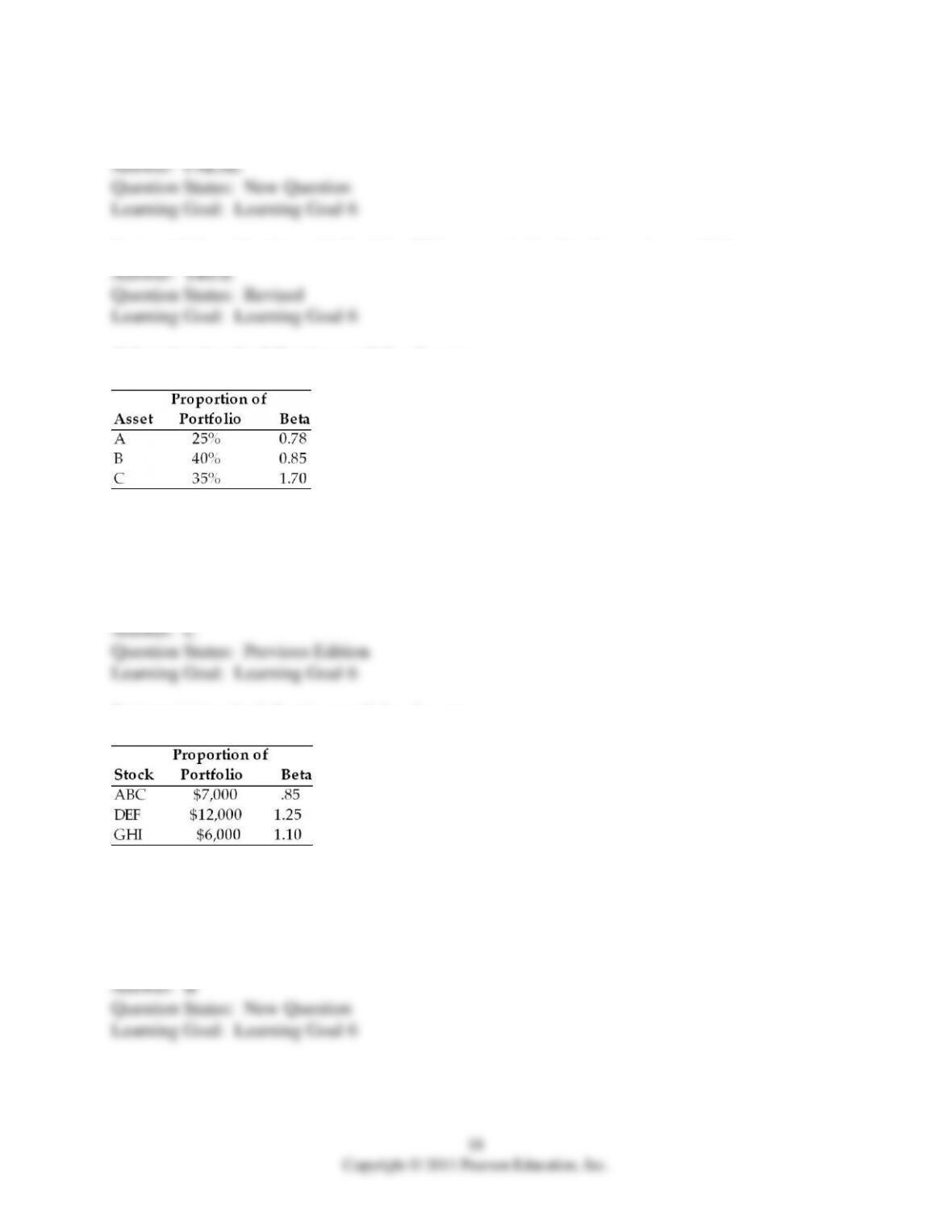
4) Jonathan has the following portfolio of assets.
What is the beta of Jonathan’s portfolio?
A) 1.08
B) 1.11
C) 1.13
D) 1.15
5) Amanda has the following portfolio of assets.
What is the beta of Jonathan’s portfolio?
A) 1.06
B) 1.10
C) 1.13
D) 3.02

6) A portfolio with a beta of 1.06
A) is 106% more risky than the overall market.
B) has less risk than the lowest risk security held within that portfolio.
C) is 6% more risky than a risk-free asset.
D) is slightly more risky than the overall market.
7) The coefficient of determination, R2, demonstrates that beta
A) has a low predictive power when applied to a portfolio of securities.
B) is more effective when evaluating a portfolio rather than an individual security.
C) is relatively unreliable when predicting the return fluctuation of a portfolio.
D) generally explains 75% of the return fluctuation of an individual security.
8) Which of the following guidelines are appropriate for inclusion in a portfolio management
policy?
I. diversify among different types of securities and across industry and geographic lines
II. determine the risk level and financial situation of the individual investor
III. utilize beta to help align the portfolio to the risk level of the investor
IV. minimize the standard deviation of each security in the portfolio.
A) I, II and IV only
B) II, III and IV only
C) I, II and III only
D) I, II, III and IV
9) The investment choice of an individual is affected by
I. their tolerance for risk.
II. their prior investment experience.
III. their marginal tax bracket.
IV. the stability of their income.
A) II and III only
B) II, III and IV only
C) I, III and IV only
D) I, II, III and IV

10) Dr. Zweibel’s portfolio consists of four stocks: AZMN, 35%, beta 2..4; MKR, 20%, beta 1.6;
ABDE, 25%, beta 1.8; and SBUK, 20%, beta 2.1. Compute Dr. Z’s portfolio beta. Does he seem
to be a conservative or aggressive investor?