Fundamentals of Investing, 11e (Gitman/Joehnk/Smart)
Chapter 15 Commodities and Financial Futures
1) All futures contracts trade continuously between 7:30 a.m. and 2:00 p.m., Monday through
Friday.
2) The use of futures contracts for commodities is a key method of controlling risk.
3) Unlike stocks and bonds, futures contracts trade only at specific times during normal working
hours.
4) The owner of a futures contract has the right, but not the obligation, to buy or sell at the
contracted price.
5) Commodity prices react to a unique set of economic, political, and international pressures, as
well as to the weather.
6) Because a futures contract deals with very large trading units, even a modest price change in
the price of the underlying commodity can have a large impact on the market value of the
contract.
7) With a futures contract, an investor cannot lose more than the price of the contract itself.
8) The seller of a futures contract
A) has the option of canceling the contract the following day if the price is not acceptable to
him/her.
B) is legally bound to make delivery of the specified item on the specified day.
C) receives the entire contract amount at the time the contract is made.
D) must make delivery before receiving any monies on the contract.
9) A futures contract
I. obligates the buyer of the contract to buy a specified amount of a commodity.
II. grants the buyer the right to either buy or sell a specified amount of a commodity.
III. uses specified settle prices that vary with the type of commodity.
IV. establishes the delivery price based on the selling price of the futures contract.
A) I and III only
B) I and IV only
C) II and III only
D) II and IV only
10) The majority of trading in futures contracts takes place on
I. the Chicago Mercantile Exchange
II. the Chicago Board of Trade
III. the American Exchange
IV. the New York Mercantile Exchange
A) I and III only
B) II and IV only
C) I, II, and IV only
D) I, II, III, and IV
11) The Chicago Mercantile Exchange recently merged with
A) the Chicago Board of Trade
B) the American Exchange
C) the New York Mercantile Exchange
D) NASDAQ
12) The amount paid at the time a futures contract is sold
A) represents the maximum loss for the buyer of the contract.
B) represents the maximum profit for the buyer of the contract.
C) is simply a refundable security deposit.
D) is the total value of the goods being traded in the future.
13) With futures contracts, the price at which the commodity must be delivered is
A) set when the futures contract is sold.
B) set when the contract expires.
C) is equivalent to the strike price for an options contract.
D) changes frequently during the life of the contract.
14) Which of the following characteristics apply to futures contracts?
I. Futures contracts are an important tool to control risk.
II. Futures contracts are highly risky and involve speculation.
III. Futures contracts specify both the quantity and the quality of the item.
IV. The buyer must hold the contract until maturity.
A) I and II only
B) II and IV only
C) I, II and III only
D) I, II, III and IV
15) Which of the following are specifically stated in futures contracts?
I. the quantity of the commodity to be delivered.
II. the quality of the commodity to be delivered.
III. the exact price at which the commodity must be delivered
V. the time and place at which the commodity must be delivered
A) I and II only
B) II and IV only
C) I, II and III only
D) I, II, and IV only
4
Copyright © 2011 Pearson Education, Inc.
15.2 Learning Goal 2
1) All trading in the futures market is done on a margin basis.
2) The maximum loss on a futures contract is the price paid for the contract.
3) Speculators provide liquidity to the futures market.
4) The normal initial margin requirement for commodities or financial futures ranges from about
2% to 10% of the value of the contract.
5) An investor’s margin in a futures contract is checked each day under a procedure known as
mark-to-the-market.
6) All futures contracts are traded on a margin basis.
7) Failure to meet a margin call will cause an investor’s futures contract to be sold.
8) Nearly all futures contracts traded in the United States are traded on the over-the-counter
(OTC) market.
9) There is no limit to the amount of loss than can occur with a futures contract.
10) The seller of a futures contract in euros hopes that the dollar will strengthen against the euro.
11) Futures contracts have two sources of return namely the capital gains that can be earned
when prices move in a favorable fashion, and dividend income from the underlying asset.
12) Larry is a corn farmer. To attempt to maximize the value of his crop, Larry is most likely to
benefit from
A) selling his crop at the market price when it is harvested.
B) buying a futures contract on corn for delivery at harvest time.
C) selling a futures contract on corn for delivery at harvest time.
D) buying a futures contract on corn and selling a futures contract on wheat.
13) Fred purchased a futures contract on live hogs through Broker A. After purchasing the
contract, Fred moved his investments to Broker B. During the transition, the contract on the hogs
was forgotten. When the delivery date for the futures contract arrived,
A) the pigs were not delivered because Fred did not ask for them.
B) the futures contract was not exercised.
C) Fred took delivery of live hogs.
D) Broker A had to pay for the hogs so that they would not be delivered to Fred.
14) A farmer who grows soy beans can hedge against the risk that bad weather will damage her
crop by
A) buying soy bean futures for delivery near the time of harvest.
B) selling soy bean futures for delivery near the time of harvest.
C) buying contracts in alternative crops for delivery near the time of harvest.
D) buying contracts in unrelated commodities for delivery near the time of harvest.
15) Which of the following is(are) correct statements about the buyer of a futures contract?
I. The contract buyer is short on the position.
II. The contract buyer wants the price of the item to increase.
III. The buyer can liquidate the position with an offsetting transaction.
IV. The majority of the buyers actually take delivery of the item.
A) II only
B) I and II only
C) I and IV only
D) II and III only
16) In the futures markets, gains and losses in a contract’s value are calculated every day and
added to or subtracted from the trader’s account. This procedure is called
A) checking the maintenance margin.
B) checking the maintenance deposit.
C) settling.
D) mark–to–the-market.
17) Eric has just purchased a heating oil contract at $2.05 per gallon. The contract size is 21,000
gallons. Initial margin is $6,075; maintenance margin is $4,500. If the price of heating oil is
$2.15 when the contract expires, Eric’s profit or loss is ________
A) $(2,100) loss.
B) $2,100 profit.
C) $(3,975) loss.
D) $(2,400) loss
18) The margin deposit associated with the purchase of a futures contract
A) is a partial payment on the contract with the amount of the payment equal to 10% or more of
the contract value.
B) represents the purchasers equity in the contract with the balance of the contract financed with
borrowed funds at the margin rate of interest.
C) is related to the value of the item underlying the contract.
D) is used to cover any loss in market value of the contract resulting from adverse price
fluctuations.
19) The minimum amount of margin that must be kept in an account for futures contracts is
known as the
A) round-trip cost.
B) forward basis.
C) maintenance deposit.
D) initial deposit.
20) If the purchaser of a futures contract fails to meet a margin call,
A) his/her contract will be sold at the current market price.
B) his/her contract will automatically be executed along with immediate delivery.
C) their local broker can decide to waive the call.
D) they will be given a 30-day grace period before payment is required.
21) The purchaser of a futures contract
A) is required to obtain a margin loan equal in amount to the cost of the contract minus the cash
down payment.
B) is generally required to make a cash deposit of 10 to 20% of the contract price at the time the
contract is entered.
C) does not have to worry about margin calls since margin loans are not required.
D) is affected by the daily procedure known as mark-to-the-market.
22) The futures market contains two basic types of traders: hedgers and speculators. Define the
role played by each of these types of traders.
23) All futures contracts are traded on a margin basis. What does “margin” mean, and how does
the use of margin affect the inherent risk-return nature of the futures market?
24) Fred has just sold short 3 contracts of May wheat on the CBT. These are 5,000 bushel
contracts. The initial deposit is $1,500 per contract with a maintenance margin of $1,200.
(a) What is Fred’s total initial margin?
(b) How much of an increase in the price of wheat is necessary to cause a margin call?
1) Investors can trade futures on electricity and natural gas.
2) Each commodity quote identifies the product, the exchange on which the contract is traded,
the size of the contract, the price of the contract, and the delivery month.
3) The open interest at the end of the trading day indicates the number of contracts in existence at
that time.
4) The open interest at the end of the trading day indicates the volume of contracts traded during
the day.
5) For a commodities contract, the maximum daily price range is usually equal to twice the daily
price limit.
6) Every commodity contract specifies all the following EXCEPT
A) the settle price.
B) the product.
C) the delivery month.
D) the unit size of the contract.
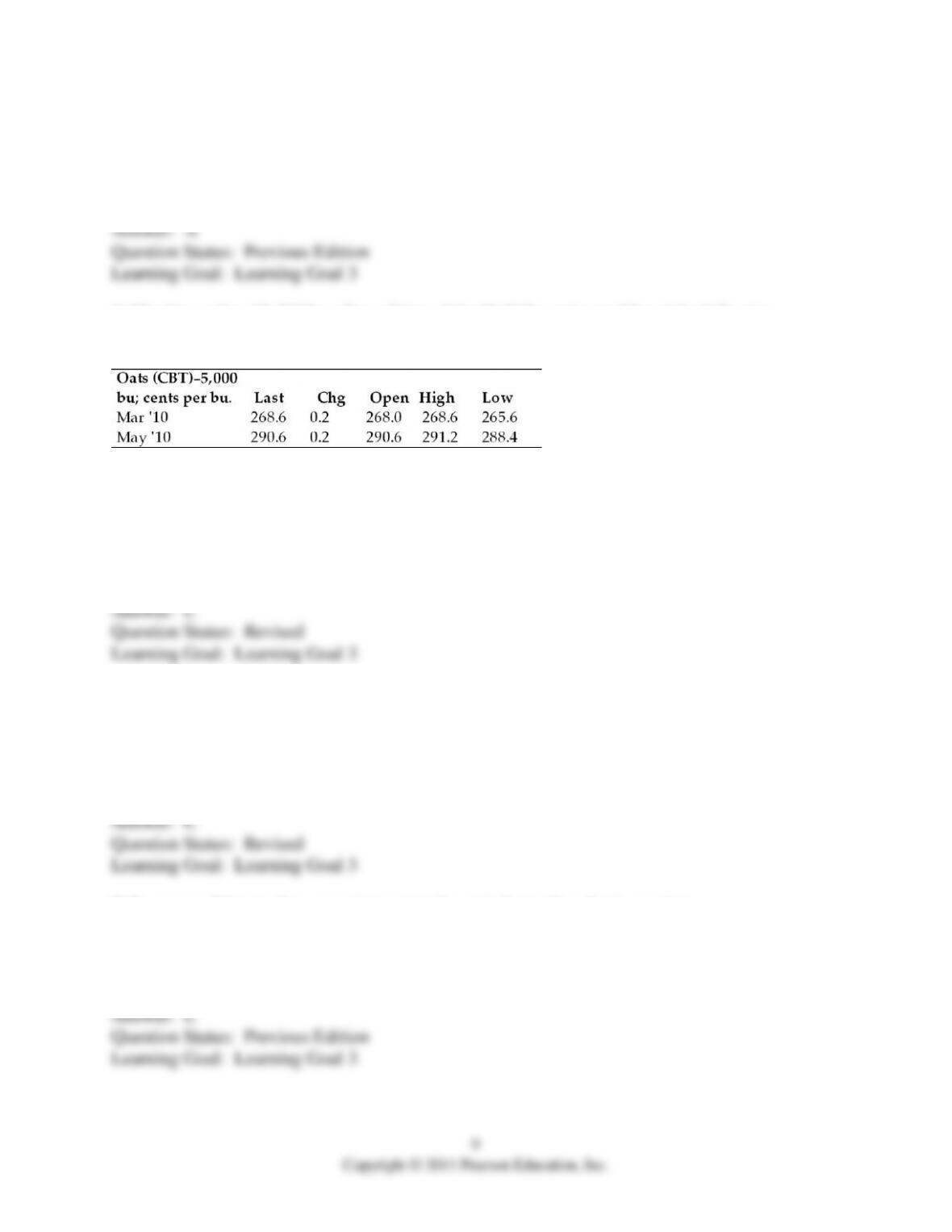
7) The November 12, 2009 on-line edition of the Wall Street Journal listed the following
information on oat futures.
Based on this information, which one of the following statements is correct?
A) Oats trade on the New York Mercantile Exchange.
B) The highest price at which the May oats contract traded was $291.20 per contract.
C) The cost of a March 2010 contract was $13,430 at the market close.
D) The price of the March 2010 oats contract at the close was $100 higher than the previous
day’s closing price.
8) A wheat futures contract is quoted in cents per bushel with a contract unit of 5,000 bushels. If
the contract is quoted at a settle price of 529, then the value of one wheat futures contract is
A) $529
B) $2,645
C) $26,450
D) $9,451.80
9) In commodities trading, open interest at the end of a trading day is equal to
A) the net change in price from the prior day’s close.
B) the number of speculative positions sold in the last 60-day period.
C) the number of contracts presently outstanding.
D) the advances minus the declines.
10
Copyright © 2011 Pearson Education, Inc.
15.4 Learning Goal 4
1) The rate of return on a futures contract is based on the size of the initial margin deposit.
2) The high rates of returns, either positive or negative, on futures contracts are primarily due to
the high initial margin requirement.
3) A successful hedge results in a guaranteed sales price to the producers of commodities.
4) Producers and industrial users of commodities who also buy and sell futures contracts are
known as speculators.
5) For individual investors to adequately hedge their personal portfolios, they should always use
the S&P 500 Stock Index futures contract.
6) The maximum amount that the price of a futures contract can change during the day is
referred to as
A) the swing limit.
B) the maximum daily range.
C) the daily margin limit.
D) the leverage restriction.
7) A corn futures contract closed yesterday at a price of $3.90 a bushel. The maximum daily
price range is $0.70 and the daily price limit is $0.35. Therefore, the
A) highest closing price for today is $4.25 a bushel.
B) most the price can fluctuate today is $0.35 a bushel.
C) minimum change in the price today is $0.35 a bushel.
D) lowest closing price for today is $3.55 a bushel.
8) Which of the following statements concerning futures are correct?
I. Investors in financial futures can earn both dividend income from the underlying security as
well as the potential capital gain from the futures contract.
II. The return on a futures contract is computed by dividing the net difference between the sale
and the purchase price of the contract by the amount of the margin deposit.
III. It is very easy to lose your entire investment in a futures contract in a very short period of
time due to the volatility of the futures market and also the use of leverage.
IV. Conservative investors tend to purchase one futures contract as a means of increasing the
return on their portfolio while maintaining minimal risk.
A) I and II only
B) II and III only
C) I, II and IV only
D) I, II and III only
9) One reason that commodities appeal to investors is because they
A) act as hedges against inflation during periods of rapidly rising consumer prices.
B) offer high returns for low risks.
C) do not require much specialized knowledge on the part of the investor.
D) are a suitable investment vehicle for one’s retirement savings.
10) The return on a futures contract is calculated as
A) (purchase price – selling price)/purchase price.
B) (selling price – purchase price)/purchase price.
C) (purchase price – selling price)/margin deposit.
D) (selling price – purchase price)/margin deposit.
11) The return on a futures contract
A) is highly related to the low margin requirement.
B) is always equal to or greater than zero.
C) tends to be fairly stable from one trading day to the next.
D) is solely related to the current price of the underlying item.
12) What is the return on invested capital to an investor who purchased a futures contract at a
price of 297 and sells the contract for 308? The contract is on 5,000 units, requires a 3% margin
deposit and is priced in cents per unit.
A) 116.5%
B) 119.0%
C) 123.5%
D) 127.4%
13) George purchased a futures contract at 349. The contract is on 2500 units, requires a 10%
margin deposit and is priced in cents per unit. George sold the contract at 278. What is George’s
return on invested capital?
A) -255.4%
B) -203.4%
C) -155.4%
D) -103.4%
14) Midge feels that the price of gold is going to fall because inflation is on the decline. To profit
from her prediction, assuming she is correct, Midge should
A) buy gold bullion today and then sell an equivalent amount of gold futures.
B) buy a gold futures contract today.
C) sell short a futures contract today.
D) sell short one futures contract and offset it by buying an equivalent long futures contract.
15) You short sell contract A at 428 and buy contract B at 333. After one month, you close
contract A at 435 and contract B at 339. What is you net profit in points?
A) -13
B) -1
C) 1
D) 13
16) Which one of the following statements is correct if a speculator short sells a commodity or
financial futures contract?
A) The speculator expects to profit from a decline in the price of the contract.
B) The speculator stands to make an unlimited amount of profit since there is no limit to how
high the price of the underlying commodity or financial instrument can rise.
C) The speculator is hoping to gain some of the benefit derived from the volatile price while
limiting his/her exposure to loss.
D) The speculator may be hedging if the underlying commodity is not in the speculator’s
possession.
17) Some investors combine two or more different futures contracts into one investment position
that offers the potential for generating a modest amount of profit while restricting exposure to
loss. This practice is called
A) speculating.
B) spreading.
C) gambling.
D) market making.
18) The basic reason why investors use spreading strategies when speculating in commodities is
to
A) increase leverage
B) increase profits
C) reduce risk
D) decrease transaction costs
19) If an investor is going to participate in the commodities market by buying a contract, he/she
should do which of the following?
I. realize that making a profit is relatively easy
II. be mentally prepared for an enormous loss
III. be financially able to meet repeated margin calls
IV. spend all of their available cash on margin deposits
A) I, II and III only
B) II and III only
C) II and IV only
D) II, III and IV only
20) Joseph bought a contract for future delivery of 5000 bushels of corn at $2.80 per bushel and
sold a later contract at $2.90 a bushel. A month later, corn prices were rising and Joseph sold his
long contract for $3.10 per bushel and covered his short by purchasing the same contract for
$3.25 per bushel. Ignoring trading costs, Joseph
A) broke even
B) made $500
C) lost $750
D) made $750
21) Which of the following are advantages of using options for futures speculation?
I. increased leverage
II. potential losses are limited to the cost of the option
III. options are available on a broad range of commodity, index, and currency futures
IV. investors avoid the possibility of having to take delivery of the commodity.
A) I and II only
B) II and III only
C) I, II and IV only
D) I, II, III and IV
22) Assume the initial margin on a Swiss franc futures contract is $2,000. If an individual
purchases a contract at $0.78 per franc and the contract involves 125,000 Swiss francs, what
return on invested capital will the investor receive if the price per franc moves to $0.80?
A) 3%
B) 50%
C) 100%
D) 125%
23) Hedging in the commodities market is a strategy primarily used by
A) individual investors with high risk tolerance levels for commodities.
B) institutional investors on behalf of their conservative investors.
C) by producers and processors of commodities.
D) investors looking for short-term capital gains.
24) Briefly discuss futures options. What are they, and what advantage do they offer an investor?
25) Calculate the return on invested capital on a platinum futures contract for 50 troy ounces
when the purchase price is $810.40 per ounce and the sale price is $823.54 per ounce. The initial
deposit is $2,500. (Show all work.)
1) One of the advantages of speculating with stock-index futures is that they eliminate the need
to predict the future course of the stock market.
2) The owner of a currency future has a claim on a specified amount of a specified foreign
currency.
3) Businesses that engage in international trade can hedge their exchange rate risk with futures
contracts.
4) The seller of a stock-index future is obligated to deliver a specified number of shares of the
underlying security.
5) Given that futures contracts on the Japanese yen are traded in units of 12.5 million yen and are
quoted in cents per yen, it follows that a Japanese yen contract quoted at 01.171 would be worth
$14,637,500.
6) Interest rate futures are traded on all the following EXCEPT
A) savings bonds.
B) Treasury notes.
C) Treasury bills.
D) municipal bonds.
7) Which one of the following statements concerning financial futures is correct?
A) Except for short-term securities, interest rate futures are quoted based on a percentage of the
par value of the underlying debt security.
B) Stock-index futures are priced at an amount equal to the value of the index.
C) Foreign currency futures are based on 100,000 units of the foreign currency.
D) An investor who is long on a financial future losses money when the value of the future rises.
8) The value of an interest-rate futures contract will go up when
A) interest rates go up.
B) interest rates go down.
C) gold prices rise.
D) gold prices fall.
9) The value of a euro futures contract will go up when
A) European interest rates go down.
B) interest rates go down.
C) the dollar strengthens against the euro
D) the dollar weakens against the euro
10) Which one of the following statements concerning financial futures is correct?
A) Speculators in the currency markets are generally firms involved with international trading of
goods and services.
B) Portfolio managers wishing to provide downside protection to their portfolios are the primary
speculators in the financial futures markets.
C) Investors who simply play in the futures market with the hope of realizing capital gains are
referred to as the hedgers.
D) International trade often is accompanied by currency hedging via financial futures.
1) Speculating originally provided the economic rational to create financial futures.
2) Speculators are especially interested in financial futures because price volatility can lead to
potentially highly profitable outcomes.
3) Stock Index futures can substitute for indexed mutual funds in conservative portfolios.
18
Copyright © 2011 Pearson Education, Inc.
4) Businesses engaged in foreign trade often invest in currency futures.
5) Which of the following trading strategies are correct?
I. If you expect the British pound to appreciate in value, you should short the pound.
II. If you expect interest rates to rise, you should go long on interest rate futures.
III. If you expect the stock market to rise, you should go long on stock-index futures.
IV. If you expect the stocks in your portfolio to temporarily decline in value, you should short
stock-index futures.
A) I and II only
B) II and IV only
C) III and IV only
D) I and III only
6) Assume an investor thinks the stock market is about to undergo a sharp retreat. Under these
conditions, the investor’s best course of action would be to
A) buy stock-index futures contracts.
B) short sell stock-index futures contracts.
C) use single stock futures to sit out the market.
D) use a long hedge against the investor’s existing positions.
7) Mr. Lecourt sells short 200,000 euros for $280,000. The exchange rate moves from $1.40 per
euro to $1.47. If Mr. Lecourt covers his short at this point, he
A) loses $14,000
B) gains $14,000
C) loses $5,600
D) gains $5,600
8) To hedge a bond portfolio, an investor should use
A) a foreign-currency future.
B) a stock-index future.
C) a certificate of deposit.
D) an interest rate future.
9) To hedge a bond portfolio against rising interest rates, an investor should
A) sell interest rate futures.
B) buy a stock-index future.
C) buy Treasury Notes
D) buy interest rate futures.
10) Assume a portfolio manager created a short interest rate hedge for his/her portfolio. Given
this hedge, the manager is
A) essentially eliminating both the downside risk and the upside potential.
B) eliminating the downside risk without hampering the upside potential.
C) partially diminishing the downside risk without impairing the upside potential.
D) eliminating the downside risk and increasing the upside potential.
11) Suppose you own a portfolio of British securities valued at $430,000. The exchange rate is
currently at $1 = £0.57. A currency contract on British pounds is set at 62,500 pounds. How
many contracts must you purchase to protect your portfolio from exchange rate risk?
A) 1
B) 2
C) 3
D) 4
12) One of the biggest differences between a futures option and a futures contract is that
A) the option limits the loss exposure to the price of the option.
B) the futures contract limits the loss exposure to the price of the contract.
C) an option can be traded on the secondary market, whereas a futures contract cannot.
D) a futures contract can be traded on the secondary market, whereas an option cannot.
20
Copyright © 2011 Pearson Education, Inc.
13) The value of a futures option is defined as
A) the difference between the option’s strike price and its original purchase price.
B) the difference between the option’s strike price and the market price of the underlying futures
contract.
C) the strike price of the option multiplied by the mark-to-the-market value.
D) the mark-to–the-market value divided by the strike price.