12) Which type of mutual fund consists of both stocks and bonds with a combined objective of
current income and long-term capital gains?
A) equity-income
B) balanced
C) value
D) bond
13) One characteristic of bond funds is the
A) requirement of a minimum initial investment of $5,000 or more.
B) high anticipated short-term growth potential.
C) fluctuation in value in response to changing interest rates.
D) extremely aggressive trading approach.
14) One advantage gained by investing in a bond fund rather than in individual bonds is the
A) ability to earn fully compounded rates of return.
B) government guarantee protecting the bond principal.
C) ability to earn a capital gain.
D) guarantee that the bonds will be held to maturity to avoid market fluctuations.
15) Which of the following are advantages of bond funds over individual bonds?
I. greater liquidity.
II. maturities matched to the investor’s time horizon
III. automatic reinvestment of interest payments.
IV. diversification
A) I and III only
B) I, III, and IV only
C) I, II, and IV only
D) II, III and IV only
16) Investors who seek triple (federal, state, and local) tax-free income should invest in
________ bond funds.
A) convertible
B) indexed
C) mortgage-backed
D) single-state municipal
17) Compared to yields on general purpose money funds, the yields on tax-exempt money funds
are
A) about the same.
B) 5 to 10 percent higher.
C) 5 to 10 percent lower.
D) 20 to 30 percent lower.
18) Government securities money funds are structured to eliminate
A) interest rate risk.
B) inflation risk.
C) default risk.
D) market risk.
19) A fund that is designed to match the performance of a measure such as the S & P 500 or the
Russell 2000 is called a(n)
A) index fund.
B) targeted fund.
C) sector fund.
D) block fund.
20) One characteristic of most index funds is that such funds typically
A) produce a large dollar amount of realized capital gains every year.
B) have a very low-cost structure with respect to management fees and transaction fees.
C) charge high front-end loads.
D) are designed to “beat the market.”
15
Copyright © 2011 Pearson Education, Inc.
21) Ashley believes that the price of gas and oil is about to rise and energy company profits will
follow. She should invest in
A) an asset allocation fund.
B) an emerging market fund.
C) a sector fund.
D) an aggressive growth fund.
22) Socially responsible funds are distinguished from other mutual funds because they
A) invest only in over-the-counter stocks.
B) do not charge any sales commission or management fees.
C) invest only in companies that meet specified moral, ethical, or environmental standards.
D) will sell their shares only to investors who sign a statement saying they do not smoke tobacco
or use alcohol.
23) Funds that invest in a portfolio of companies from the same or closely related industries are
known as
A) aggressive growth funds.
B) sector funds.
C) emerging market funds.
D) asset allocation funds.
24) One type of mutual fund spreads investors’ money across equity markets, bond markets, and
money markets. Moreover, as market conditions change, the amount of money invested in each
market sector will change. This type of mutual fund is known as a(n)
A) socially responsible fund.
B) fiscally responsible fund.
C) growth-and-income fund.
D) asset allocation fund.
25) Which one of the following statements is correct concerning international funds?
A) A devaluation of the dollar causes returns on foreign investments to improve from a U.S.
perspective.
B) International funds are considered low-risk investments.
C) Balance-of-trade positions do NOT affect the rate of return from a U.S. perspective.
D) Technically, global funds can only invest in foreign securities.
26) Every mutual fund has a stated investment objective. Disclosure of the investment objective
is required by the SEC, and is used to classify a mutual fund into one of several categories.
Briefly explain the investment objective of each of the following categories.
(a) growth funds
(b) aggressive growth funds
(c) equity-income funds
(d) balanced funds
1) Automatic investment plans makes it easier for investors to save money.
2) To participate in an automatic investment plan, investors must allow the investment company
to have access to a bank account or their paycheck.
3) Dividends and capital gains earned by mutual fund investors are taxed when the shares are
redeemed.

4) The conversion privilege offered by many mutual funds enables investors, within three days,
to convert their shares back to cash in an amount equal to the original cost of the investment.
5) Systematic withdrawal plans from mutual funds usually require a minimum investment of at
least $100,000.
6) The ability to automatically buy additional fund shares using the dividend income generated
by the fund is called a(n)
A) automatic investment plan.
B) automatic reinvestment plan.
C) systematic withdrawal plan.
D) conversion plan.
7) Typical services offered by mutual funds include:
I. automatic investing from a payroll withholding plan
II. automatic reinvestment of dividends and capital gains
III systematic withdrawal plans
IV automatic transfers from one fund type to another when market conditions change
A) I and III only
B) II and IV only
C) I, II, and III only
D) I, II, III, and IV
8) Automatic reinvestment plans
A) are a good way to avoid taxes on dividends and capital gains.
B) may involve exceptionally high transaction fees.
C) do not allow for the purchase of fractional shares.
D) are an excellent way to accumulate wealth through disciplined investing.
9) Investors interested in predictable cash flow from their investments should consider funds that
offer
A) conversion privileges.
B) systematic withdrawal plans
C) automatic reinvestment plans
D) automatic investment plans
10) Mutual funds often report returns as the growth of $10,000 over a period of time. These
returns assume that
A) all dividends and capital gains are reinvested.
B) all dividends and capital gains are withdrawn.
C) all dividends and capital gains are reinvested after deductions for income taxes.
D) the investor contributes money to the fund on a regular basis through an automatic investment
plan.
11) The conversion privilege provided by mutual fund families allows investors to
A) move from one fund to another without incurring any capital gains tax liability.
B) be more aggressive since they can re-allocate their funds when market conditions change.
C) re-allocate their funds at any time as long as they pay an additional sales load on the
transferred funds.
D) move from one fund family to another once every six months.
1) Mutual funds are used extensively as retirement investments.
2) Investors should select mutual funds that match their personal investment goals and provide
the services they desire.
3) Investors should never use mutual funds to invest in areas where they would not buy
individual stocks.
4) Funds that consistently earn above average rates of return also tend to charge higher sales
commissions.
5) Much of the success of a mutual fund depends on the investment skills of the fund manager.
6) An investor who wants to use mutual funds as a storehouse of value should invest in
A) high-yield corporate bond funds and growth funds.
B) growth funds and equity-income funds.
C) equity-income funds and long-term bond funds.
D) money funds and short-term bond funds.
7) Investors use mutual funds for which of the following reasons?
I. to accumulate wealth
II. to minimize risk
III. as a speculative vehicle
IV. as a storehouse of value
A) I and II only
B) II, III and IV only
C) I, II and IV only
D) I, II, III and IV

8) Tax laws allow investors to hold mutual funds in which of the following types of retirement
plans?
I. ordinary IRA’s
II. Roth IRA’s
III. 401-K plans
IV. Keogh plans
A) I and II only
B) II, III and IV only
C) I, II and IV only
D) I, II, III and IV
9) Which of the following accurately describe reasons for investing in mutual funds?
I. to effectively control the timing of capital gains for tax purposes
II. to achieve portfolio diversification at a reasonable cost
III. to invest in unfamiliar sectors or geographic regions
IV. to outperform the market
A) I and IV only
B) II and III only
C) I, II and III only
D) I, II, III and IV
10) Reasons to invest in mutual fund include
I. a wide range of services such automatic reinvestment and systematic withdrawal plans
II. minimizing the time and effort spent choosing securities
III. rates of return that consistently beat the market averages
IV. participation in a variety of tax sheltered and tax deferred retirement programs
A) I and II only
B) II, III and IV only
C) I, II and IV only
D) I, II, III and IV
11) A mutual fund is generally more tax efficient when it has a ________ turnover rate and a
________ dividend yield.
A) low; low
B) low; high
C) high; low
D) high; high
1) As a general rule, the time to buy a closed-end mutual fund is when the fund’s premium is
approximately 5 percent higher than its past average.
2) A closed end fund is selling at a premium when the NAV exceeds the market price.
3) A closed-end fund with an NAV of $9.60 and a market price of $10.25 is selling at a premium
of 6.8%.
4) Closed-end funds are required to provide a prospectus to all new shareholders as long as the
fund is trading at a premium.
5) IPOs for closed-end funds are priced at NAV.
6) Both realized and unrealized capital gains from mutual fund investments are currently taxable
for individual income tax purposes.

7) Both the performance of the overall stock market as well as the skills of the mutual fund
manager affect the performance of a mutual fund.
8) Holding period returns are normally used only for investment periods of one year or less.
9) Last year, Sue purchased a closed-end mutual fund that was trading at $42 and had an NAV of
$38. Sue sold the fund today when the NAV is $44 and the market price is $43. The fund paid $1
in dividends over the past year. What is the Sue’s holding period return?
A) 4.8%
B) 7.1%
C) 11.6%
D) 18.4%
10) Investors are generally well advised to avoid mutual funds with
A) highly rated fund managers.
B) low fees and high tax efficiency.
C) consistently poor historical performance.
D) good performance in both up and down markets.
11) Returns on exchange traded funds may come from
I. capital gains
II. dividends
III. increases in the fund’s premium
IV. decreases in the fund’s discount
A) I and II only
B) III and IV only
C) I, II, and III only
D) I, II, III, and IV

12) Which of the following are sources of income for an open-end mutual fund?
I. dividend and interest income
II. change in the discount or premium
III. capital gains
IV. change in NAV
A) I and III only
B) I, II and III only
C) I, III and IV only
D) II, III and IV only
13) Income distributed by a mutual fund from which one of the following sources receives a
preferential tax rate of 15%?
A) dividends on common stock
B) interest on bonds
C) dividends from most preferred stocks
D) dividends from REITs
14) Income from ________ is exempt from federal income taxes?
A) money market funds
B) municipal bond funds
C) government bond funds
D) REITs
15) Last year at this time, a mutual fund had an NAV of $13.20 per share. Over the past year the
fund paid dividends of $0.70 per share and had a capital gains distribution of $1.20 per share.
What is the holding period return assuming that the current NAV is $14.42?
A) 13.2%
B) 14.4%
C) 21.6%
D) 23.6%
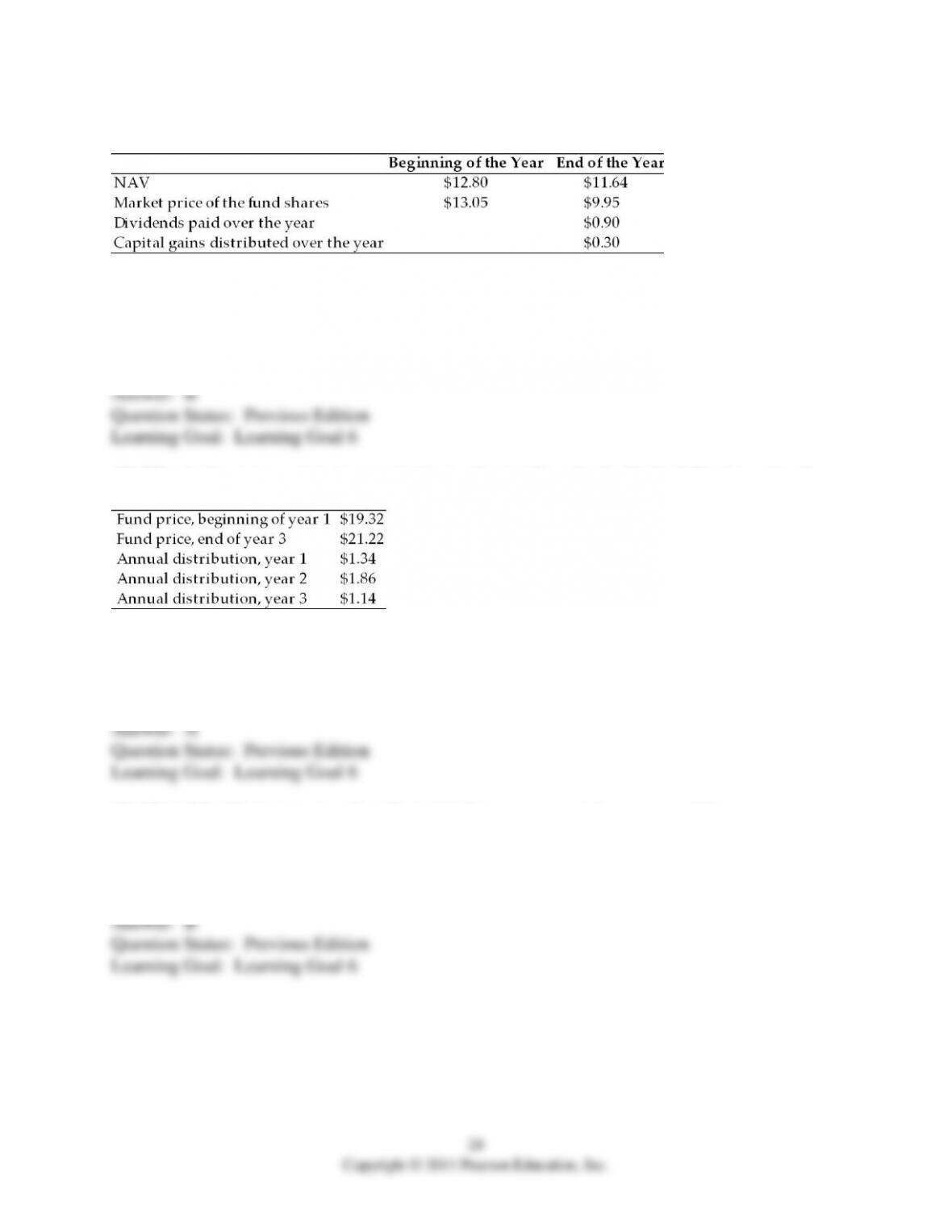
16) Information for ABC Fund is
The market-based holding period return for ABC Mutual Fund is
A) -19.1%.
B) -14.6%.
C) 0.3%.
D) 9.4%.
17) What is the average annual compound rate of return for a fund with the following values?
A) 10.5%
B) 10.8%
C) 25.6%
D) 32.3%
18) Mutual fund investors are primarily exposed to ________ and ________ risks.
A) market; financial
B) market; inflation
C) business; financial
D) business; inflation