
9) The greater of the yield–to–call or the yield-to-maturity is used as the appropriate indicator of
value.
10) Yield to call is a useful measure for bonds selling at a premium, but not for bonds selling at a
discount .
11) Which one of the following statements is correct concerning bond investors?
A) Aggressive investors want to lock in high interest rates.
B) Aggressive investors purchase bonds when they believe interest rates will rise.
C) Conservative investors seek capital gains.
D) Conservative investors buy bonds when interest rates are high.
12) If you are an income-oriented investor and you feel that interest rates are relatively high and
will decline in the future, you should purchase
A) zero-coupon, long-term bonds.
B) long-term, non-callable bonds.
C) short-term, zero-coupon bonds.
D) long-term, freely callable bonds.
13) Which of the following statements concerning the current yield is correct?
A) It is of great interest to aggressive bond investors seeking capital gains.
B) It is of great interest to conservative bond investors seeking current income.
C) It shows the rate of return an investor will receive by holding a bond to maturity.
D) It can be determined by dividing interest income by the par value of a bond.
14) A bond is most likely to be called
A) when investors must reinvest at lower rates.
B) when the bond sells at a large discount.
C) when market yields are close to coupon rates.
D) when investors can reinvest at higher rates.
15) Which of the following statements are correct concerning yield–to–maturity (YTM)?
I. YTM considers both interest income and price appreciation.
II. YTM assumes the bond is called at the earliest possible date.
III. YTM is a compounded rate of return.
IV. YTM assumes all interest payments are reinvested at the YTM rate.
A) I and IV only
B) I, III and IV only
C) II, III and IV only
D) I, II and III only
16) Which one of the following statements is true about a $1,000, 6% annual coupon bond that is
selling for $1,012?
A) The current yield is less than 6%.
B) The current yield is 6%.
C) The yield-to–maturity is greater than 6%.
D) The yield-to-maturity is 6%.
17) The conventional way to calculate the bond-equivalent yield (BEY) for a bond is to
A) divide the coupon rate by 2.
B) multiply the semi-annual yield by 2.
C) subtract the approximate yield from the promised yield.
D) calculate the effective annual yield.
18) Yield to call on a bond with a coupon rate of 8% paid semi-annually, 10 years to maturity, a
par value of $1,000 and a selling price of $1,071, callable after 5 years at $1,010 is
A) 3.5%.
B) 6.49%.
C) 7.0%.
D) 8.16%
19) The current yield on a bond is most similar to
A) the discount rate on a Treasury Bill.
B) the effective annual rate on a certificate of deposit.
C) the dividend yield on a stock.
D) the internal rate of return if the bond is held to maturity.
20) The actual return on a bond is dependent upon which of the following?
I. the coupon rate
II. the reinvested interest rate
III. any changes in par value
IV. any changes in market price
A) I, II and III only
B) II, III and IV only
C) I, III and IV only
D) I, II and IV only
21) The reinvestment rate assumption is more important
I. the longer the time to maturity.
II. the shorter the time to maturity.
III. the higher the coupon rate.
IV. the lower the coupon rate.
A) I and III
B) I and IV
C) II and III
D) II and IV
22) Yield-to-call is
A) commonly used for bonds with deferred-call provisions.
B) calculated using the time to call and the par value of the bond.
C) based solely on the call premium and ignores interest payments.
D) always less than the yield-to-maturity.
23) The value of a bond can be calculated several different ways, depending on the investor’s
objectives. Conservative, income-oriented bondholders will typically use
A) promised yield, whereas aggressive bond traders are likely to use expected return.
B) expected return, whereas aggressive bond traders are likely to use promised yield.
C) realized yield, whereas aggressive bond traders are likely to use holding period return.
D) holding period return, whereas aggressive bond traders are likely to use realized yield.
24) The yield-to-maturity (YTM) approach fails to consider which of the following risks?
I. reinvestment risk
II. price or market risk
A) I only
B) II only
C) Both I and II
D) Neither I nor II
25) Explain the differences between yield–to–maturity and yield-to-call.
1) Bond duration refers to the remaining life of a bond.
2) An increase in interest rates has a negative effect on bond prices and a positive effect on the
reinvestment of coupons.
3) The duration of a bond portfolio is the weighted average of the durations of the individual
bonds included in the portfolio.
4) With exception of zero coupon bonds, a bond’s duration is always shorter than its time to
maturity.
5) When yield swings are relatively small, a bond’s duration is a viable predictor of its price
volatility.
6) A bond portfolio manager believes that interest rates are about to increase. Given this belief,
the manager should buy long duration bonds and sell short duration bonds.
7) When the weighted-average duration of an investor’s bond portfolio is exactly equal to the
investor’s desired investment horizon, then the bond portfolio is said to be immunized.
8) As applied to bonds, duration refers to
A) the average maturity of a diversified portfolio of corporate bonds.
B) the point in the life of a bond when its price exactly offsets its reinvestment risk.
C) the average price and annual reinvestment rate of return for a bond.
D) the point in the life of a bond when its yield–to–maturity equals its expected yield.
9) Based on the concept of bond duration, which one of the following statements is correct?
A) Lower coupons result in shorter durations.
B) Longer maturities mean shorter durations.
C) Higher yields (YTMs) lead to longer durations.
D) Longer durations mean greater volatility.
10) Which one of the following bonds would have a duration that exactly matches its time to
maturity?
A) discount bond
B) premium bond
C) zero-coupon bond
D) U.S. Treasury bond
11) Which of the following statements concerning duration are correct?
I. Duration is a weighted-average life of a bond.
II. The Macaulay duration considers the timing of a bond’s cash flows.
III. The Macaulay duration uses the YTM of a bond to discount the cash flows.
IV. For coupon bonds, duration will be less than the actual time to maturity.
A) I, II and III only
B) II, III and IV only
C) I, III and IV only
D) I, II, III and IV
12) Which of the following risks can be essentially eliminated by immunizing a bond portfolio?
I. Default risk.
II. Price risk.
III. Reinvestment risk.
IV. Liquidity risk.
A) I, II and III only
B) II, and III only
C) II, III and IV only
D) I, II, III and IV
13) The duration of a bond will increase as the time to maturity ________ and/or as the YTM on
the bond ________
A) increases; increases.
B) increases; decreases.
C) decreases; increases.
D) decreases; decreases.
14) A $1,000, 7% annual coupon bond matures in three years. The bond is currently priced at
$974.23 and has a YTM of 8.0%. What is the Macaulay duration?
A) 1.95 years
B) 2.60 years
C) 2.81 years
D) 3.00 years
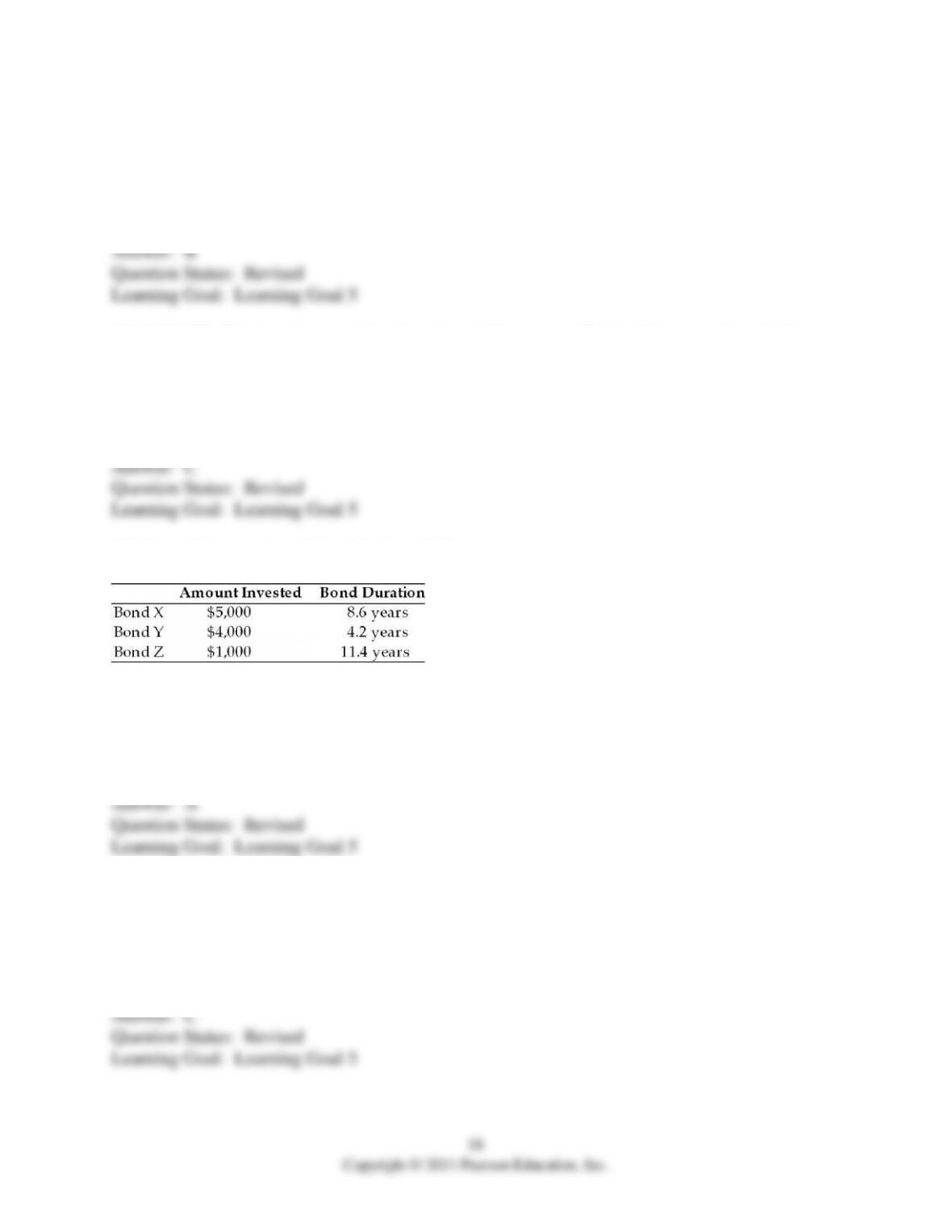
15) A portfolio consists of three bonds as follows.
What is the duration of the bond portfolio?
A) 7.12 years
B) 8.07 years
C) 8.69 years
D) 11.4 years
16) A bond matures in 30 years, has a 20 year duration and a yield to maturity of 9.32%. The
change in the level of the market interest rate is 0.47%. The modified duration is
A) 9.4 years.
B) 14.1 years.
C) 18.29 years.
D) 27.44 years.
17) The mathematical link between a bond’s price and interest rate changes is the
A) Macaulay duration.
B) modified duration.
C) yield to market.
D) yield-to-call.
18) A bond has a YTM of 6.5%, a modified duration of 16.9 years, a duration of 18 years and a
30 year maturity. By what percentage will the bond’s price change if market interest rates
increase by 0.75%?
A) -0.750 percent
B) +0.750 percent
C) +12.675 percent
D) -12.675 percent
19) If the bond market undergoes a large change in yield (for example, more than 100 basis
points), then a bond’s duration will
A) understate both the price appreciation when rates fall and the price decline when rates
increase.
B) overstate both the price appreciation when rates fall and the price decline when rates increase.
C) overstate the price appreciation when rates fall and understate the price decline when rates
increase.
D) understate the price appreciation when rates fall and overstate the price decline when rates
increase.
20) The practical application of bond portfolio immunization to investors is that immunization
A) allows aggressive traders to eliminate the price effects caused by interest rate changes.
B) allows investors to derive a specified rate of return from bond investments for a given
investment horizon.
C) eliminates the possibility of losing money due to a company defaulting on its bond payments.
D) allows investors to passively manage their bond portfolio once it is initially immunized.
21) Explain the basic concept of bond duration and why this measure is meaningful to investors.
22) Explain the concept of bond immunization and the benefits derived from using this
technique.
1) In building a bond ladder, an investor invests an equal amount in a series of bonds with
staggered maturities.
2) When conducting a tax swap, an investor must use identical issues in order for the swap to be
allowed by the IRS.
3) Buying bonds in anticipation of an expected decline in interest rates is a risky strategy.
4) Once a bond portfolio is initially immunized, an investor should maintain the portfolio as it is
until the end of the investment horizon.
5) The main purpose of a bond ladder is to
A) lessen the effects of changes in interest rates.
B) achieve the highest level of capital gains possible.
C) maintain a highly liquid portfolio.
D) offset the effects of bond duration.
6) Active bond trading strategies include
I. buy and hold.
II. trading on forecasted interest rate behavior.
III. bond ladders.
IV. bond swaps.
A) I and III
B) II and IV
C) I, II, and III
D) II, III, and IV
7) Reasons for using a bond ladder strategy include
I. typically higher rates on long-term bonds.
II. uncertainty concerning future interest rates.
III. lower tax rates on bonds held to maturity.
IV. reducing the amount of time spent managing the bond portfolio.
A) I and III
B) II and IV
C) I, II, and III
D) I, II, and IV
8) Some common types of bond swaps are
I. tax swaps.
II. yield pickup swaps.
III. substitution swaps.
IV. credit default swaps.
A) I and III
B) II and IV
C) I, II, and III
D) I, II, and IV
22
Copyright © 2011 Pearson Education, Inc.
9) Suppose you sell the 10-year, A-rated 7 percent bonds you own, which are yielding 8 percent,
and replace them with an equal amount of 10-year, A-rated 8 percent bonds that are priced to
yield 9 percent. In this situation, you are executing
A) an immunization deal.
B) a yield pickup swap.
C) a laddered bid.
D) a spread bid.
10) In a tax swap, a bond investor typically
A) sells an issue which has a capital loss and replaces it with a comparable security.
B) sells an issue that has a capital gain and replaces it with a comparable security.
C) swaps a lower-yielding security for a higher-yielding security.
D) swaps a higher-yielding security for a lower-yielding security.
11) Explain the technique and the purpose of building bond ladders.