
65) The first step in transforming an extended E-R model into a relational database design is to
________.
A) create a table for each relationship
B) evaluate the entities against the normalization criteria
C) create a table for each entity
D) remove any recursive relationships
66) Each attribute of an entity becomes a(n) ________ of a table.
A) column
B) primary key
C) foreign key
D) alternate key
67) The identifier of the entity becomes the ________ of the corresponding table.
A) primary key
B) foreign key
C) supertype
D) subtype
68) Which of the following is not true for an ideal primary key?
A) a composite of several long attributes
B) numeric
C) fixed
D) short
69) A surrogate key should be considered when ________.
A) A relationship is N:M
B) A composite key is required
C) The key contains a lengthy text field
D) The key contains a number
70) Which of the following is not true about surrogate keys?
A) They are identifiers that are supplied by the system, not the users.
B) They have no meaning to the users.
C) They are non-unique within a table.
D) They can be problematic when combining databases.
71) Which of the following is not true about a NULL attribute?
A) On insertion, entering the data for that field is optional.
B) It is an important property of an attribute.
C) It must have a default value specified.
D) A primary key can’t be NULL.
72) In a relational database design, all relationships are expressed by ________.
A) creating a primary key
B) creating a foreign key
C) creating a supertype
D) creating a subtype
73) When representing a 1:1 relationship in a relational database design, ________.
A) the key of each table must be placed as foreign keys into the other
B) the key of either table may be placed as a foreign key into the other
C) the key of both tables must be the same
D) the intersection table gets the key from both relations
74) To represent a one-to-many relationship in a relational database design, ________.
A) the key of the child is placed as a foreign key into the parent
B) the key of the parent is placed as a foreign key into the child
C) an intersection table must be created
D) the key of the table on the “many” side is placed in the table on the “one” side
75) When representing a one-to-many relationship in a relational database design, ________.
A) the parent is always on the one side of the “one-to-many” relationship
B) the child is always on the one side of the “one-to-many” relationship
C) either parent or child can be on the one side of the “one-to-many” relationship, and the choice
is arbitrary
D) either parent or child can be on the one side of the “one-to-many” relationship, and special
criteria indicate which table should be on the one side
76) Many-to-many relationships are represented by ________.
A) two tables with an M:N relationship
B) two tables with a 1:N relationship
C) an intersection table which has M:N relationships with the two tables
D) an intersection table which has 1:N relationships with the two tables
77) In many-to-many relationships in a relational database design, ________.
A) the key of the child is placed as a foreign key into the parent
B) the key of the parent is placed as a foreign key into the child
C) the keys of both tables are placed in a third table
D) the keys of both entity tables are placed in each other
78) In many-to-many relationships between strong entities in a relational database design, which
of the following is not true?
A) The intersection table is ID-dependent on one of the parents
B) The intersection table is ID-dependent on both of the parents
C) The relationships from the intersection table to the parent tables are identifying relationships
D) The maximum cardinality to the intersection table is always N
79) In relational database design, ID-dependent entities are not used to ________.
A) represent N:M relationships
B) handle associative relationships
C) represent relationships where the child identifier does not include the key of the parent
D) handle archetype/instance relationships
80) When transforming an E-R data model into a relational database design, the key of the parent
entity should be placed as part of the primary key into the child entity ________.
A) when the child entity is ID-dependent
B) when the child entity is non-ID-dependent
C) when the child entity has a 1:1 relationship with the parent entity
D) when the child entity has a 1:N relationship with the parent entity
81) Four uses for ID-dependent entities include all of the following except _______.
A) representing N:M relationships
B) representing intersection relationships
C) storing multivalued attributes
D) representing archetype/instance relationships
82) Which of the following is not true about N:M recursive relationships?
A) Both foreign keys in the intersection table refer to the same table.
B) Since it is a recursive relationship, an intersection table is not needed.
C) The foreign keys in the intersection table can’t refer to the same attribute in the parent table.
D) Both B and C are correct.
83) Which of the following is not true about representing subtypes in a relational database
design?
A) One table is created for the supertype and one for each subtype.
B) All attributes of the supertype are added to the subtype relations.
C) The key of the supertype is made the key of the subtypes.
D) An instance of the supertype may be related to one instance each of several subtypes.
84) In a supertype-subtype structure, discriminator attributes ________.
A) are easily represented in a relational design
B) cannot be represented in a relational design
C) require application logic to determine which subtypes correspond to a specific supertype
instance
D) Both B and C are correct
85) Which of the following is not true of recursive relationships?
A) When the recursive relationship is M:N, an intersection table is created.
B) The rows of a single table can play two different roles.
C) Recursive relationships can be 1:1, 1:N, or M:N relationships.
D) When the relationship is 1:N, a new table must be defined to represent the relationship.
86) Which of the following is not true of a MUST constraint?
A) It may be needed in ternary relationships to enforce special business rules.
B) It can be expressed directly in a relational model.
C) It must be enforced by program code.
D) It requires that one entity be combined with another entity.
87) The binary constraint MUST NOT indicates that ________.
A) a specific binary relationship must not be included in a ternary relationship
B) a table includes values that must not occur in a binary relationship
C) a table includes values that must not occur in a ternary relationship
D) a binary relationship includes value combinations that must not occur in a ternary relationship
88) The binary constraint MUST COVER indicates that ________.
A) a specific binary relationship must be included in a ternary relationship
B) a binary relationship includes a set of value combinations that must all occur in a ternary
relationship
C) a table includes values that must occur in a binary relationship
D) a table includes values that must occur in a ternary relationship
89) For the M-O (parent mandatory, child optional) case, what action(s) should be taken to
ensure minimum cardinality is maintained?
A) Define referential integrity constraint from child to parent
B) Make foreign key NOT NULL
C) Will require trigger or other application code
D) Both A and B are correct
90) A referential integrity constraint policy that insures that foreign key values in a table are
correctly maintained when there is a change to the primary key value in the parent table is called
________.
A) incremental updates
B) incremental deletes
C) cascading updates
D) cascading deletes
91) A referential integrity constraint policy that insures that all rows containing a foreign key
value in a table are eliminated from the table when the row containing the corresponding primary
key value in a parent table is eliminated from the database is called ________.
A) incremental updates
B) incremental deletes
C) cascading updates
D) cascading deletes
19
92) A referential integrity constraint policy that guarantees that a row in a parent table always
has a required entry in a child table ________.
A) is known as a minimum cardinality enforcement action
B) needs to be documented by the database development team
C) is enforced in most DBMS products
D) Both A and B are correct
93) When transforming an ID-dependent E-R data model relationship into a relational database
design, the referential integrity constraints should allow ________.
A) parent updates to cascade
B) child updates to cascade
C) child deletes to cascade
D) Both A and B are correct
94) Briefly describe the process of converting an extended E-R model into a relational database
design.
95) Explain the pragmatic reason for using surrogate keys.
96) How are one-to-one recursive relationships addressed using the relational model?
97) Explain the representation of a one-to-many strong entity relationship in a relational database
design.
98) Explain the representation of a many-to-many strong entity relationship in a relational
database design.
99) What is an association relationship and how does it differ from a many-to-many (N:M)
relationship?
100) What are MUST NOT and MUST COVER constraints?
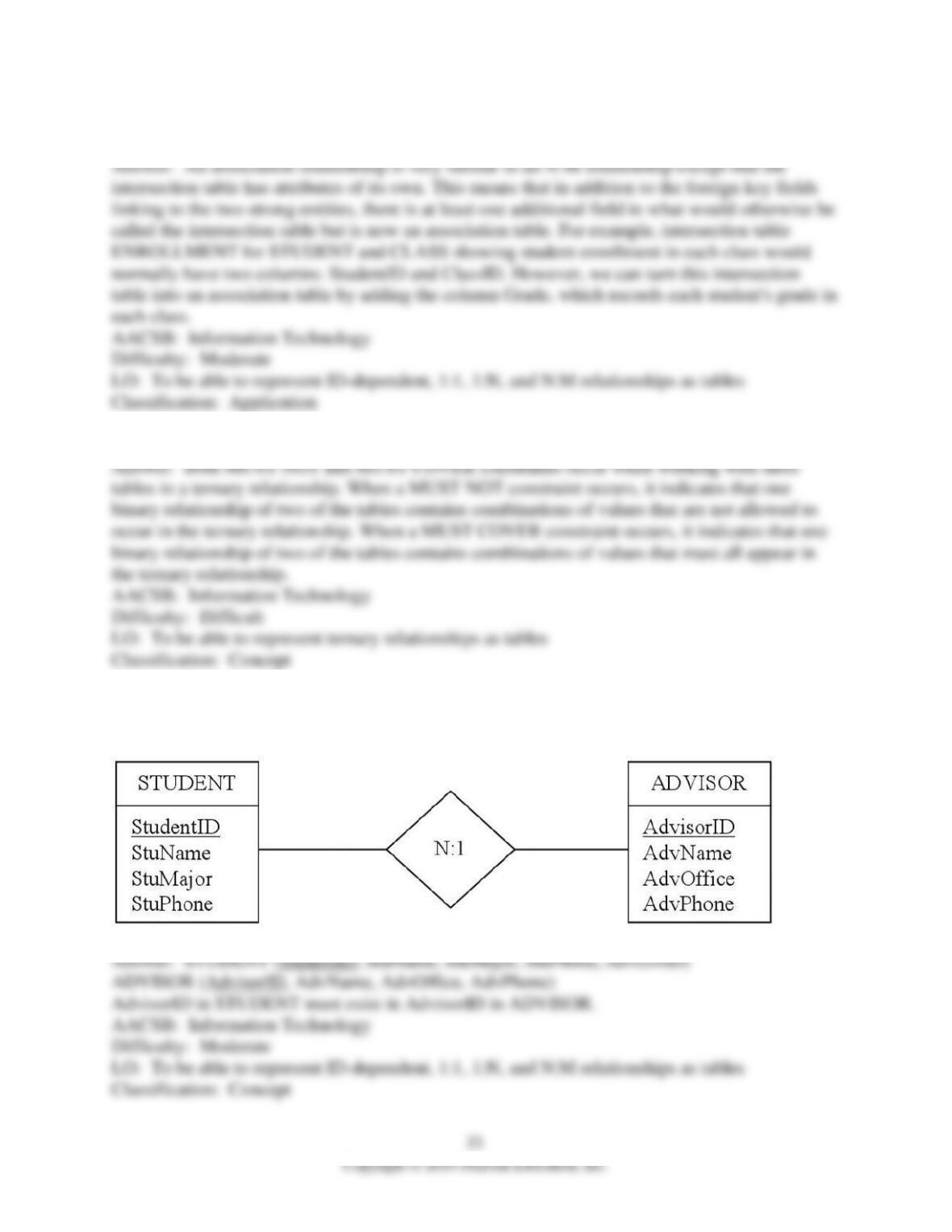
101) Write the database table design to represent the data model below, including tables, the
proper placement of the foreign key, and referential integrity constraint.
102) What are the four sets of minimum cardinalities that can be present in a 1:N binary
relationship?
103) Using the VRG database as an example, briefly describe what a final database design
consists of.