
64) Attributes may be ________.
A) complete
B) rows
C) multivalued
D) instances
65) An identifier may be ________.
A) composite
B) optional
C) a relationship
D) minimal
66) A composite attribute is an attribute that ________.
A) is multivalued
B) describes a characteristic of the relationship
C) consists of a group of attributes
D) is calculated at run-time
67) For a relationship to be considered a binary relationship it must satisfy which of the
following conditions?
A) It must involve exactly two entity classes.
B) It must have a maximum cardinality of 1:1.
C) It must have a maximum cardinality of 1:N.
D) Both A and B are correct
68) Which of the following is not a common variant of the E-R model?
A) IE Crow’s Foot
B) IDEF1X
C) UML
D) Object-oriented
69) Maximum cardinality refers to ________.
A) the most instances of one entity class that can be involved in a relationship instance with
another entity class
B) the minimum number of entity classes involved in a relationship
C) whether or not an instance of one entity class is required to be related to an instance of
another entity class
D) whether or not an entity is a weak entity
70) You are given an E-R diagram with two entities, ORDER and CUSTOMER, as shown
above, and are asked to draw the relationship between them. If a given customer can place only
one order and a given order can be placed by at most one customer, which of the following
should be indicated in the relationship symbol between the two entities?
A) N:M
B) 1:1
C) 1:N
D) N:1
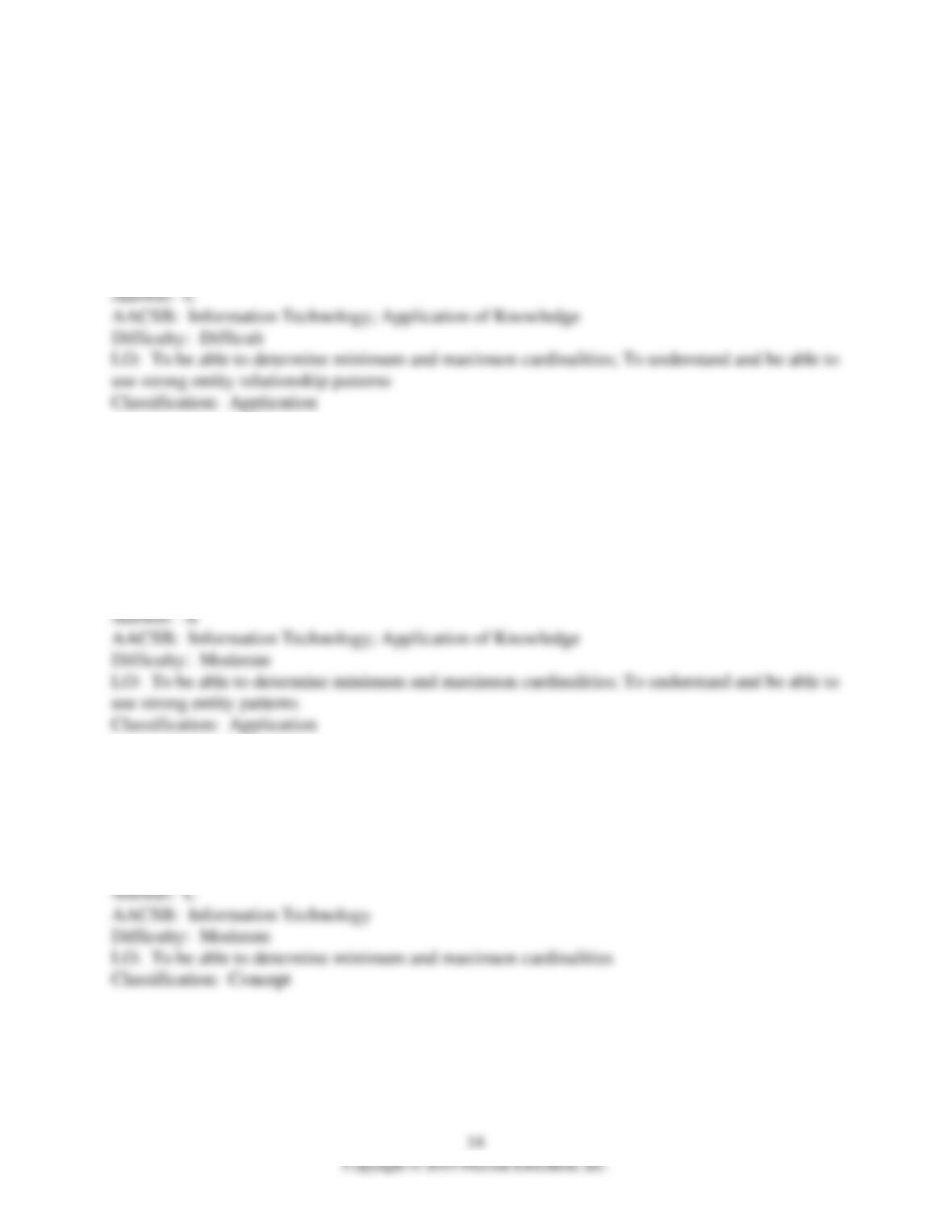
71) You are given an E-R diagram with two entities, ORDER and CUSTOMER, as shown
above, and are asked to draw the relationship between them. If a given customer can place many
orders and a given order can be placed by at most one customer, which of the following should
be indicated in the relationship symbol between the two entities?
A) N:M
B) 1:1
C) 1:N
D) N:1
72) You are given an E-R diagram with two entities, ORDER and CUSTOMER, as shown
above, and are asked to draw the relationship between them. If a given customer can place many
orders and a given order can be placed by one or more customers, which of the following should
be indicated in the relationship symbol between the two entities?
A) N:M
B) 1:1
C) 1:N
D) N:1
73) Minimum cardinality refers to ________.
A) the most instances of one entity class that can be involved in a relationship with one instance
of another entity class
B) the number of entity classes involved in a relationship
C) the number of entity instances that must participate in a relationship
D) whether or not an entity is a weak entity
74) In a minimum cardinality, minimums are generally stated as ________.
A) 0 or 1
B) 1 or N
C) M or N
D) one or many
75) A hash mark across the relationship line near an entity indicates ________.
A) a maximum cardinality of “zero”
B) a maximum cardinality of “one”
C) a minimum cardinality of “optional”
D) a minimum cardinality of “required”
76) A circle across the relationship line near an entity indicates ________.
A) a maximum cardinality of “zero”
B) a maximum cardinality of “one”
C) a minimum cardinality of “optional”
D) a minimum cardinality of “required”
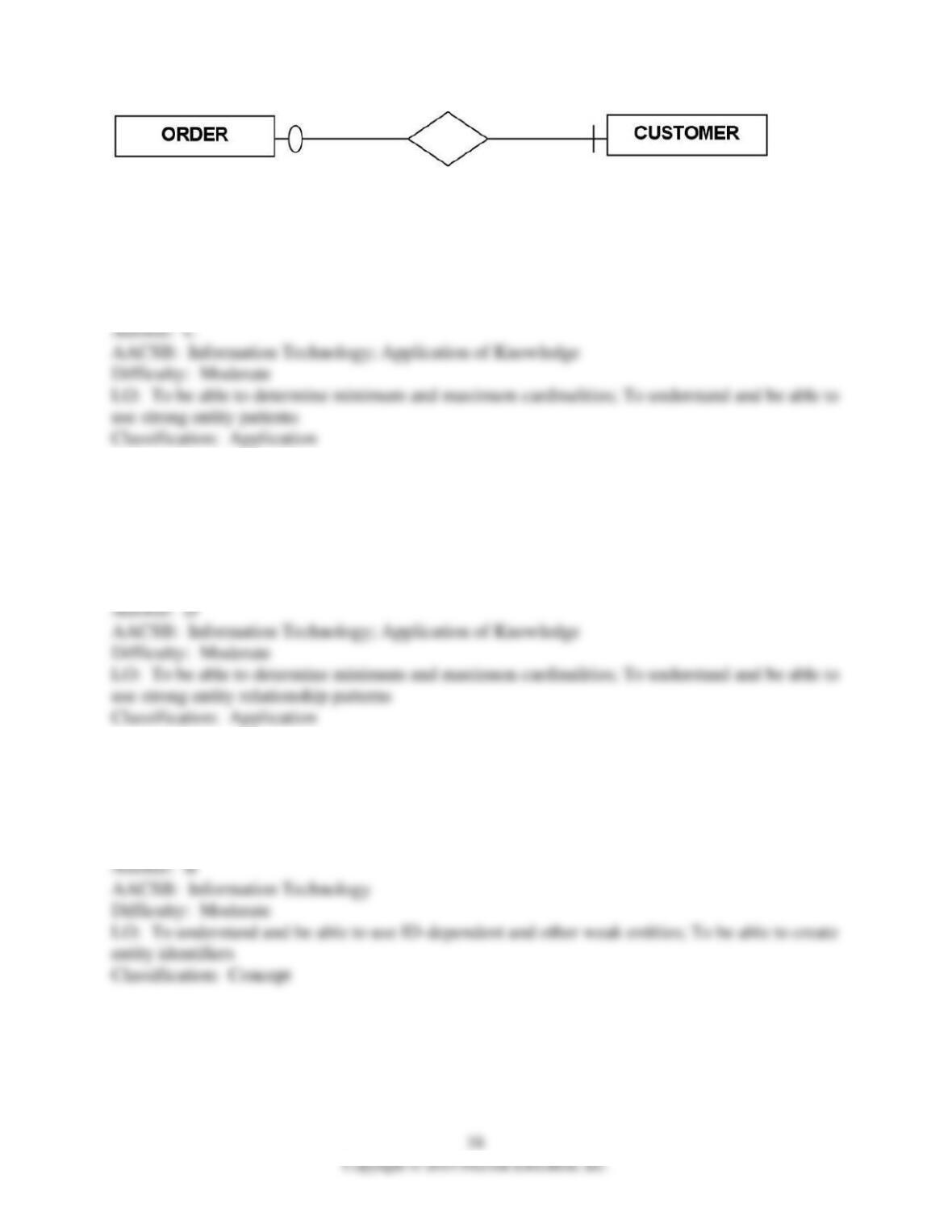
77) You are given an E-R diagram with two entities, ORDER and CUSTOMER, as shown
above. What does the symbol next to the ORDER entity indicate?
A) A maximum cardinality of “zero”
B) A maximum cardinality of “one”
C) A minimum cardinality of “optional”
D) A minimum cardinality of “required”
78) You are given an E-R diagram with two entities, ORDER and CUSTOMER, as shown
above. What does the symbol next to the CUSTOMER entity indicate?
A) A maximum cardinality of “zero”
B) A maximum cardinality of “one”
C) A minimum cardinality of “optional”
D) A minimum cardinality of “required”
79) An entity whose identifier includes the identifier of another entity is a(n) ________.
A) strong entity
B) weak entity
C) optional entity
D) required entity
80) An entity whose existence depends on the presence of another entity but whose identifier
does not include the identifier of the other entity is a(n) ________.
A) strong entity
B) weak entity
C) ID-dependent entity
D) subtype entity
81) Which of the following is considered to be a weak entity?
A) A subtype entity
B) The archetype in an archetype/instance pattern
C) The association entity in an association pattern
D) The parent entity in a parent-child relationship
82) Subtypes can be ________________.
A) a form of a supertype
B) disjoint and overlapping
C) a discriminator
D) related to multiple supertypes
83) Which of the following is not true about subtype entities?
A) Subtypes may be exclusive.
B) The supertype and subtypes will have the same identifier.
C) Subtypes are used to avoid a situation in which some attributes are required to be null.
D) All subtypes of a supertype must have the same attributes.
84) An attribute that determines which subtype should be used is a(n) ________.
A) supertype
B) subtype
C) discriminator
D) identifier
85) Discriminators can be ________.
A) attributes
B) entities
C) relationships
D) subtypes
86) Supertype/subtype entities are said to have a(n) ________ relationship.
A) HAS-A
B) IS-A
C) recursive
D) redundant
87) To represent an association pattern in an E-R model, ________.
A) create a new ID-dependent entity with a 1:1 relationship to one other entity
B) create a new weak, but not ID-dependent entity with a 1:1 relationship to one other entity
C) create a new strong entity with a 1:1 relationship to one other entity
D) create a new ID-dependent entity with a N:1 relationships to two parent entities
88) To represent a multivalued attribute in an E-R model, ________.
A) create a new ID-dependent entity with a 1:N relationship
B) create a new weak, but not ID-dependent entity with a 1:N relationship
C) create a new strong entity with a 1:1 relationship
D) create a new ID-dependent entity with a 1:1 relationship
89) To represent an archetype/instance pattern in an E-R model, ________.
A) create a new ID-dependent entity with a 1:N relationship
B) create a new weak, but not ID-dependent entity with a 1:N relationship
C) create a new strong entity with a 1:1 relationship
D) create a new ID-dependent entity with a 1:1 relationship
90) A line-item pattern must involve what kind of entity?
A) Strong entity
B) Supertype entity
C) Weak entity with one identifying relationship
D) Weak entity with two identifying relationships
91) A for-use-by pattern must involve what kind of entity?
A) Strong entity
B) Supertype entity
C) Weak entity with one identifying relationship
D) Weak entity with two identifying relationships
92) When an entity has a relationship to itself, we have a(n) ________.
A) supertype/subtype relationship
B) archetype/instance relationship
C) recursive relationship
D) Both A and C are correct
93) Recursive relationships can have all of the following maximum cardinalities except
________.
A) 1:1
B) 1:N
C) N:M
D) M:M
94) Suppose you have created a data model for an airline based on a variety of forms, reports,
user interviews, data sources, etc. Your client comes forward with a new desired report that
includes passenger weights and a relationship between passengers and employees, neither of
which is in your E-R diagram. You should ________.
A) create a new, separate E-R diagram with just the new information
B) add the relationship and the weight attribute to the existing data model
C) add the relationship but not the weight attribute
D) add the weight attribute but not the relationship
95) Describe and discuss the main elements of the Entity-Relationship (E-R) model. Include an
example.
96) Distinguish between an entity class and an entity instance.
97) What is meant by the degree of a relationship?
98) What is meant by the cardinality of a relationship?
99) How is maximum cardinality expressed in IE Crow’s Foot E-R diagrams?
100) How is minimum cardinality expressed in IE Crow’s Foot E-R diagrams?
101) Distinguish between entity identifiers and keys.
102) What is an ID-Dependent entity? Include an example.
103) Explain the ambiguity in the broad definition of a weak entity.
104) What are supertype and subtype entities? Include an example.